
Chinese Journal of Plant Ecology >
Research progress on the effects of grazing on grassland ecosystem
Received date: 2019-11-18
Accepted date: 2020-04-19
Online published: 2020-04-30
Supported by
National Natural Science Foundation of China(41725003)
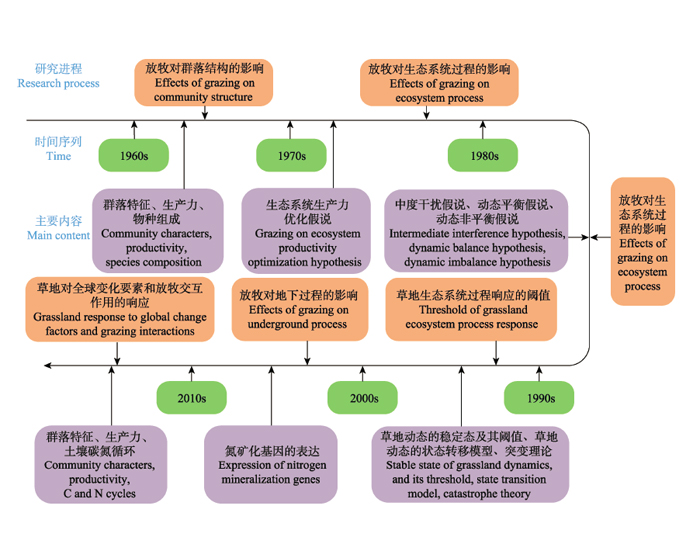
As an important component of terrestrial ecosystems, natural grasslands cover 30% of the global land. Thus, grasslands play a significant role in global carbon cycle, climate change, water retention, soil and water conservation, livestock production and so on. Grazing, as one common use of grasslands, brings fundamental impacts on plant individuals, populations, communities, biodiversity, soil quality and microbes, and then affects structural and functional processes of grassland ecosystems through different kinds of grazing livestock, grazing intensity, period, and system. We explored the effects of grazing on grassland ecosystem by using the methods of bibliometric analysis and literature review. To summarize the effects of grazing on grassland structure and functional processes, our study 1) reviewed the research stages on the impacts of grazing on grassland ecosystems since the 1950s; 2) extracted the hot topics, important research areas and keywords of previous research; 3) revealed the cutting-edge and limitations of domestic research on the effects of grazing on plants growth, community characteristics, carbon, nitrogen and nutrient cycling, productivity and soil quality; 4) proposed the future research directions and priority areas from the aspects of precise grazing management, validation of related hypothesis, and global change research. This study can provide scientific basis for grassland grazing ecology research, adaptive management and sustainable development in China.
ZHANG Yang-Jian, ZHU Jun-Tao, SHEN Ruo-Nan, WANG Li . Research progress on the effects of grazing on grassland ecosystem[J]. Chinese Journal of Plant Ecology, 2020 , 44(5) : 553 -564 . DOI: 10.17521/cjpe.2019.0314
| [1] | Aarons SR, O’Connor CR, Hosseini HM, Gourley CJP (2009). Dung pads increase pasture production, soil nutrients and microbial biomass carbon in grazed dairy systems. Nutrient Cycling in Agroecosystems, 84, 81-92. |
| [2] | Arsenault R, Owen-Smith N (2002). Facilitation versus competition in grazing herbivore assemblages. Oikos, 97, 313-318. |
| [3] | Bai WM, Fang Y, Zhou M, Xie T, Li LH, Zhang WH (2015). Heavily intensified grazing reduces root production in an Inner Mongolia temperate steppe. Agriculture, Ecosystems & Environment, 200, 143-150. |
| [4] | Bullock JM, Hill BC, Dale MP, Silvertown J (1994). An experimental study of the effects of sheep grazing on vegetation change in a species-poor grassland and the role of seedling recruitment into gaps. Journal of Applied Ecology, 31, 493-507. |
| [5] | Cease AJ, Elser JJ, Ford CF, Hao S, Kang L, Harrison JF (2012). Heavy livestock grazing promotes locust outbreaks by lowering plant nitrogen content. Science, 335, 467-469. |
| [6] | Charles GK, Porensky LM, Riginos C, Veblen KE, Young TP (2017). Herbivore effects on productivity vary by guild: cattle increase mean productivity while wildlife reduce variability. Ecological Applications, 27, 143-155. |
| [7] | Chen ZZ, Wang SP (2000). Typical Grassland Ecosystem in China. Science Press, Beijing. |
| [7] | [ 陈佐忠, 汪诗平 (2000). 中国典型草原生态系统. 科学出版社, 北京.] |
| [8] | Connell JH (1978). Diversity in tropical rain forests and coral reefs—High diversity of trees and corals is maintained only in a non-equilibrium state. Science, 199, 1302-1310. |
| [9] | Dong QM, Zhao XQ, Ma YS, Shi JJ, Wang YL, Li SX, Yang SH, Wang LY, Sheng L (2012). Influence of grazing on biomass, growth ratio and compensatory effect of different plant groups in Kobresia parva meadow. Acta Ecologica Sinica, 32, 16-26. |
| [9] | [ 董全民, 赵新全, 马玉寿, 施建军, 王彦龙, 李世雄, 杨时海, 王柳英, 盛丽 (2012). 放牧对小嵩草草甸生物量及不同植物类群生长率和补偿效应的影响. 生态学报, 32, 16-26.] |
| [10] | Du ZY, Cai YJ, Wang XD, Zhang B, Du Z (2019). Research progress on grazing livestock dung decomposition and its influence on the dynamics of grassland soil nutrients. Acta Ecologica Sinica, 39, 4627-4637. |
| [10] | [ 杜子银, 蔡延江, 王小丹, 张斌, 杜忠 (2019). 放牧牲畜粪便降解及其对草地土壤养分动态的影响研究进展. 生态学报, 39, 4627-4637.] |
| [11] | Duan MJ, Gao QZ, Wan YF, Li YE, Guo YQ, Danjiu Luobu, Luosang Jiacuo (2010). Effect of grazing on community characteristics and species diversity of Stipa purpurea alpine grassland in Northern Tibet. Acta Ecologica Sinica, 30, 3892-3900. |
| [11] | [ 段敏杰, 高清竹, 万运帆, 李玉娥, 郭亚奇, 旦久罗布, 洛桑加措 (2010). 放牧对藏北紫花针茅高寒草原植物群落特征的影响. 生态学报, 30, 3892-3900.] |
| [12] | Ellison L (1960). Influence of grazing on plant succession of Rangelands. The Botanical Review, 26, 1-78. |
| [13] | Evans R (2005). Curtailing grazing-induced erosion in a small catchment and its environs, the Peak District, Central England. Applied Geography, 25, 81-95. |
| [14] | Foster BL, Gross KL (1998). Species richness in a successional grassland: effects of nitrogen enrichment and plant litter. Ecology, 79, 2593-2602. |
| [15] | Greenwood KL, Hutchinson KJ (1998). Root characteristics of temperate pasture in New South Wales after grazing at three stocking rates for 30 years. Grass and Forage Science, 53, 120-128. |
| [16] | Hatch DJ, Lovell RD, Antil RS, Jarvis SC, Owen PM (2000). Nitrogen mineralization and microbial activity in permanent pastures amended with nitrogen fertilizer or dung. Biology and Fertility of Soils, 30, 288-293. |
| [17] | Hodgson J (1990). Grazing Management: Science into Practice. Longman Scientific &Technical, New York . 1-2. |
| [18] | Holechek JL (1981). Livestock grazing impacts on public lands: a viewpoint. Journal of Range Management, 34, 251-254. |
| [19] | Jatimliansky JR, Gimenez DO, Bujan A (1997). Herbage yield, tiller number and root system activity after defoliation of prairie grass (Bromus catharticus Vahl). Grass and Forage Science, 52, 52-62. |
| [20] | Jiang XL, Zhang WG, Yang ZY, Wang G (2003). The influence of disturbance on community structure and plant diversity of alpine meadow. Acta Botanica Boreali-Occidentalia Sinica, 23, 1479-1485. |
| [20] | [ 江小蕾, 张卫国, 杨振宇, 王刚 (2003). 不同干扰类型对高寒草甸群落结构和植物多样性的影响. 西北植物学报, 23, 1479-1485.] |
| [21] | Klein JA, Harte J, Zhao XQ (2004). Experimental warming causes large and rapid species loss, dampened by simulated grazing, on the Tibetan Plateau. Ecology Letters, 7, 1170-1179. |
| [22] | Klein JA, Harte J, Zhao XQ (2005). Dynamic and complex microclimate responses to warming and grazing manipulations. Global Change Biology, 11, 1440-1451. |
| [23] | Laca EA, Sokolow S, Galli JR, Cangiano CA (2010). Allometry and spatial scales of foraging in mammalian herbivores. Ecology Letters, 13, 311-320. |
| [24] | Le Roux X, Bardy M, Loiseau P, Louault F (2003). Stimulation of soil nitrification and denitrification by grazing in grasslands: Do changes in plant species composition matter? Oecologia, 137, 417-425. |
| [25] | Li W, Wu GL, Zhang GF, Du GZ (2011). The maintenance of offspring diversity in response to land use: sexual and asexual recruitment in an alpine meadow on the Tibetan Plateau. Nordic Journal of Botany, 29, 81-86. |
| [26] | Li YH (1993). Grazing dynamics of the species diversity in a new Rolepidium Chinese steppe and Stipa grandis steppe. Chinese Bulletin of Botany, 35, 877-884. |
| [26] | [ 李永宏 (1993). 放牧影响下羊草草原和大针茅草原植物多样性的变化. 植物学通报, 35, 877-884.] |
| [27] | Li YH, Wang SP (1999). The effects of grazing on grassland plants. Acta Pratacultural Science, 3, 11-19. |
| [27] | [ 李永宏, 汪诗平 (1999). 放牧对草原植物的影响. 中国草地学报, 3, 11-19.] |
| [28] | Li YM, Lin QY, Wang SP, Li XZ, Liu WT, Luo CY, Zhang ZH, Zhu XX, Jiang LL, Li XN (2016). Soil bacterial community responses to warming and grazing in a Tibetan alpine meadow. FEMS Microbiology Ecology, 92, 1-10. |
| [29] | Liu C, Song XX, Wang L, Wang DL, Zhou XM, Liu J, Zhao X, Li J, Lin HJ (2016). Effects of grazing on soil nitrogen spatial heterogeneity depend on herbivore assemblage and pre-grazing plant diversity. Journal of Applied Ecology, 53, 242-250. |
| [30] | Liu J, Feng C, Wang DL, Wang L, Wilsey BJ, Zhong ZW (2015). Impacts of grazing by different large herbivores in grassland depend on plant species diversity. Journal of Applied Ecology, 52, 1053-1062. |
| [31] | Liu W, Zhou L, Wang X (1999). Responses of plant and rodents to different grazing intensity. Acta Ecologica Sinica, 19, 376-382. |
| [31] | [ 刘伟, 周立, 王溪 (1999). 不同放牧强度对植物及啮齿动物作用的研究. 生态学报, 376-382.] |
| [32] | Lovell RD, Jarvis SC (1996). Effect of cattle dung on soil microbial biomass C and N in a permanent pasture soil. Soil Biology & Biochemistry, 28, 291-299. |
| [33] | Lu XY, Kelsey KC, Yan Y, Sun J, Wang XD, Cheng GW, Neff JC (2017). Effects of grazing on ecosystem structure and function of alpine grasslands in Qinghai-Tibetan Plateau: a synthesis. Ecosphere, 8, e01656. DOI: . |
| [34] | Ma L, Guo C, Lü X, Yuan S, Wang R (2015). Soil moisture and land use are major determinants of soil microbial community composition and biomass at a regional scale in northeastern China. Biogeosciences, 12, 2585-2596. |
| [35] | Ma XZ, Ambus P, Wang SP, Wang YF, Wang CJ (2013). Priming of soil carbon decomposition in two Inner Mongolia grassland soils following sheep dung addition: a study using13C natural abundance approach . PLOS ONE, 8, e78578. DOI: 10.1371/journal.pone.0078578. |
| [36] | McNaughton SJ (1979). Grazing as an optimization process: grass ungulate relationships in the serengeti. The American Naturalist, 113, 691-703. |
| [37] | Mitchell R, Allen V, Waller J, Ohlenbusch P (2004). A mobile classroom approach to graduate education in forage and range sciences. Journal of Natural Resources and Life Sciences Education, 33, 117-120. |
| [38] | Moe SR, Wegge P (2008). Effects of deposition of deer dung on nutrient redistribution and on soil and plant nutrients on intensively grazed grasslands in lowland Nepal. Ecological Research, 23, 227-234. |
| [39] | Morris JT, Jensen A (1998). The carbon balance of grazed and non-grazed Spartina anglica saltmarshes at Skallingen, Denmark. Journal of Ecology, 86, 229-242. |
| [40] | Niu KC, He JS, Lechowicz MJ (2016). Grazing-induced shifts in community functional composition and soil nutrient availability in Tibetan alpine meadows. Journal of Applied Ecology, 53, 1554-1564. |
| [41] | Peng JT, Liang CZ, Niu YM, Jiang W, Wang W, Wang LX (2015). Moderate grazing promotes genetic diversity of Stipa species in the Inner Mongolian steppe. Landscape Ecology, 30, 1783-1794. |
| [42] | Pietola L, Horn R, Yli-Halla M (2005). Effects of trampling by cattle on the hydraulic and mechanical properties of soil. Soil and Tillage Research, 82, 99-108. |
| [43] | Pucheta E, Bonamici I, Cabido M, Díaz S (2004). Below- ground biomass and productivity of a grazed site and a neighbouring ungrazed exclosure in a grassland in central Argentina. Austral Ecology, 29, 201-208. |
| [44] | Qi Q, Zhao MX, Wang SP, Ma XY, Wang YX, Gao Y, Lin QY, Li XZ, Gu BH, Li GX, Zhou JZ, Yang YF (2017). The biogeographic pattern of microbial functional genes along an altitudinal gradient of the Tibetan pasture. Frontiers in Microbiology, 8, 976-988. |
| [45] | Schimel JP, Bennett J (2004). Nitrogen mineralization: challenges of a changing paradigm. Ecology, 85, 591-602. |
| [46] | Socher SA, Prati D, Boch S, Müller J, Baumbach H, Gockel S, Hemp A, Sch?ning I, Wells K, Buscot F, Kalko EKV, Linsenmair KE, Schulze ED, Weisser WW, Fischer M (2013). Interacting effects of fertilization, mowing and grazing on plant species diversity of 1500 grasslands in Germany differ between regions. Basic and Applied Ecology, 14, 126-136. |
| [47] | Sousa WP (1984). The role of disturbance in natural communities. Annual Review of Ecology and Systematics, 15, 353-391. |
| [48] | Sun DS, Wesche K, Chen DD, Zhang SH, Wu GL, Du GZ, Comerford NB (2011). Grazing depresses soil carbon storage through changing plant biomass and composition in a Tibetan alpine meadow. Plant, Soil and Environment, 57, 271-278. |
| [49] | Tilman D, Wedin D, Knops J (1996). Productivity and sustainability influenced by biodiversity in grassland ecosystems. Nature, 379, 718-720. |
| [50] | van der Plas F, Howison RA, Mpanza N, Cromsigt JPGM, Olff H (2016). Different-sized grazers have distinctive effects on plant functional composition of an African savannah. Journal of Ecology, 104, 864-875. |
| [51] | van Klink R, Nolte S, Mandema FS, Lagendijk DDG, WallisDeVries MF, Bakker JP, Esselink P, Smit C (2016). Effects of grazing management on biodiversity across trophic levels—The importance of livestock species and stocking density in salt marshes. Agriculture Ecosystems Environment, 235, 329-339. |
| [52] | Wachendorf C, Lampe C, Taube F, Dittert K (2008). Nitrous oxide emissions and dynamics of soil nitrogen under15N-labeled cow urine and dung patches on a sandy grassland soil. Journal of Plant Nutrition and Soil Science, 171, 171-180. |
| [53] | Wan HW, Bai YF, Hooper DU, Sch?nbach P, Gierus M, Schiborra A, Taube F (2015). Selective grazing and seasonal precipitation play key roles in shaping plant community structure of semi-arid grasslands. Landscape Ecology, 30, 1767-1782. |
| [54] | Wang DL, Du J, Zhang BT, Ba L, Hodgkinson KC (2017). Grazing intensity and phenotypic plasticity in the clonal grass Leymus chinensis. Rangeland Ecology Management, 70, 740-747. |
| [55] | Wang DL, Wang L, Liu JS, Zhu H, Zhong ZW (2018). Grassland ecology in China: perspectives and challenges. Frontiers of Agricultural Science and Engineering, 5, 24-43. |
| [56] | Wang L, Wang DL, Bai YG, Huang Y, Fan M, Liu JS, Li YX (2010a). Spatially complex neighboring relationships among grassland plant species as an effective mechanism of defense against herbivory. Oecologia, 164, 193-200. |
| [57] | Wang L, Wang DL, He ZB, Liu GF, Hodgkinson KC (2010b). Mechanisms linking plant species richness to foraging of a large herbivore. Journal of Applied Ecology, 47, 868-875. |
| [58] | Wang L, Wang DL, Liu JS, Huang Y, Hodgkinson KC (2011). Diet selection variation of a large herbivore in a feeding experiment with increasing species numbers and different plant functional group combinations. Acta Oecologica, 37, 263-268. |
| [59] | Wang MJ, Wan XR, Zhong WQ (2001). The interaction between the vegetarian and the plant. Chinese Journal of Ecology, 20, 39-43. |
| [59] | [ 王梦军, 宛新荣, 钟文勤 (2001). 食草动物与植物的相互关系. 生态学杂志, 20, 39-43.] |
| [60] | Wang RZ (1996). Effect of disturbances on species diversity in grassland ecosystems. Journal of Northeast Normal University (Natural Science Edition), 3, 112-116. |
| [60] | [ 王仁忠 (1996). 干扰对草地生态系统生物多样性的影响. 东北师大学报(自然科学版), 3, 112-116.] |
| [61] | Wang SP, Li YH, Wang YF, Chen ZZ (2001). Influence of different stocking rates on plant diversity of Artemisia frigida community in Inner Mongolia steppe. Acta Botanica Sinica, 43, 89-96. |
| [61] | [ 汪诗平, 李永宏, 王艳芬, 陈佐忠 (2001). 不同放牧率对内蒙古冷蒿草原植物多样性的影响. 植物学报, 43, 89-96.] |
| [62] | Wang SP, Li YH, Wang YF, Han YH (1998). The succession of Artemisia frigida rangeland and multivariation analysis under different stocking rates in Inner Mongolia. Acta Agrestia Sinica, 6, 299-305. |
| [62] | [ 汪诗平, 李永宏, 王艳芬, 韩苑鸿 (1998). 不同放牧率下冷蒿小禾草草原放牧演替规律与数量分析. 草地学报, 6, 299-305.] |
| [63] | Wang XD, Yan Y, Cao YZ (2012). Impact of historic grazing on steppe soils on the northern Tibetan Plateau. Plant and Soil, 354, 173-183. |
| [64] | Wei ZJ, Han GD, Yang J, Lü X (2000). The response of Stipa breviflora community to stocking rate. Grassland of China, (6), 2-6. |
| [64] | [ 卫智军, 韩国栋, 杨静, 吕雄 (2000). 短花针茅荒漠草原植物群落特征对不同载畜率水平的响应. 中国草地, (6), 2-6.] |
| [65] | Wei ZJ, Wu RT, Dabu X, Su JA, Yang SM (2005). The influence of different grazing systems on soil physical and chemical properties in desert steppe. Grassland of China, 27, 6-10. |
| [65] | [ 卫智军, 乌日图, 达布希拉图, 苏吉安, 杨尚明 (2005). 荒漠草原不同放牧制度对土壤理化性质的影响. 中国草地, 27, 6-10.] |
| [66] | Williams PH, Haynes RJ (1995). Effect of sheep, deer and cattle dung on herbage production and soil nutrient content. Grass and Forage Science, 50, 263-271. |
| [67] | Wilson PJ, Thompson K, Hodgson JG (1999). Specific leaf area and leaf dry matter content as alternative predictors of plant strategies. New Phytologist, 143, 155-162. |
| [68] | Wu X, Chen WM, Luo YC, Wu FM, Yu Z (2006). Research on the influence of different grazing system on vegetation characteristics in Ningxia typical grassland. Pruataculture & Animal Husbandry, (12), 5-7, 14. |
| [68] | [ 武新, 陈卫民, 罗有仓, 武芳梅, 于钊 (2006). 宁夏干草原不同放牧方式对植被特征影响的研究. 草业与畜牧,(12), 5-7, 14.] |
| [69] | Yan RR, Xin XP, Yan YC, Wang X, Zhang BH, Yang GX, Liu SM, Deng Y, Li LH (2015). Impacts of differing grazing rates on canopy structure and species composition in Hulunber Meadow Steppe. Rangeland Ecology & Management, 68, 54-64. |
| [70] | Yang DL, Han GD, Hu YG, Wuyung erle (2006). Effects of grazing intensity on plant diversity and aboveground biomass of Stipa baicalensis grassland. Chinese Journal of Ecology, 25, 1470-1475. |
| [70] | [ 杨殿林, 韩国栋, 胡跃高, 乌云格日勒 (2006). 放牧对贝加尔针茅草原群落植物多样性和生产力的影响. 生态学杂志, 25, 1470-1475.] |
| [71] | Yang LM, Zhou GS, Li JD (2002). Relationship between productivity and plant species diversity of grassland communities in Songnen Plain of Northeast China. Acta Phytoecologica Sinica, 26, 589-593. |
| [71] | [ 杨利民, 周广胜, 李建东 (2002). 松嫩平原草地群落物种多样性与生产力关系的研究. 植物生态学报, 26, 589-593.] |
| [72] | Yang YF, Wu LW, Lin QY, Yuan MT, Xu DP, Yu H, Hu YG, Duan JC, Li XZ, He ZL, Xue K, van Nostrand J, Wang SP, Zhou JZ (2013). Responses of the functional structure of soil microbial community to livestock grazing in the Tibetan alpine grassland. Global Change Biology, 19, 637-648. |
| [73] | Yu Q, Chen QS, Elser JJ, He NP, Wu HH, Zhang GM, Wu JG, Bai YF, Han XG (2010). Linking stoichiometric homoeostasis with ecosystem structure, functioning and stability. Ecology Letters, 13, 1390-1399. |
| [74] | Zhang CX, Nan ZB (2010). Research progress on effects of grazing on physical and chemical characteristics of grassland soil. Acta Prataculturae Sinica, 19, 204-211. |
| [74] | [ 张成霞, 南志标 (2010). 放牧对草地土壤理化特性影响的研究进展. 草业学报, 19, 204-211.] |
| [75] | Zhao HL, Zhao XY, Zhou RL, Zhang TH, Drake S (2005). Desertification processes due to heavy grazing in sandy rangeland, Inner Mongolia. Journal of Arid Environment, 62, 309-319. |
| [76] | Zheng SX, Ren HY, Lan ZC, Li WH, Wang KB, Bai YF (2010). Effects of grazing on leaf traits and ecosystem functioning in Inner Mongolia grasslands: scaling from species to community. Biogeosciences, 7, 1117-1132. |
| [77] | Zhong ZW, Li XF, Pearson D, Wang DL, Sanders D, Zhu Y, Wang L (2017). Ecosystem engineering strengthens bottom- up and weakens top-down effects via trait-mediated indirect interactions. Proceedings of the Royal Society: Biological Sciences, 284, 20170894. DOI: 10.1098/rspb.2017.0894. |
| [78] | Zhou GY, Zhou XH, He YH, Shao JJ, Hu ZH, Liu RQ, Zhou HM, Hosseinibai S (2017). Grazing intensity significantly affects belowground carbon and nitrogen cycling in grassland ecosystems: a meta-analysis. Global Change Biology, 23, 1167-1179. |
| [79] | Zhu SH, Xu CL, Fang QE, Liu FY (2006). Effect of white yak grazing intensity on species diversity of plant communities in alpine grassland. Journal of Gansu Agricultural University,(4), 71-75. |
| [79] | [ 朱绍宏, 徐长林, 方强恩, 刘发央 (2006). 白牦牛放牧强度对高寒草原植物群落物种多样性的影响. 甘肃农业大学学报, (4), 71-75.] |
/
| 〈 |
|
〉 |
Copyright © 2026 Chinese Journal of Plant Ecology
Tel: 010-62836134, 62836138, E-mail: apes@ibcas.ac.cn, cjpe@ibcas.ac.cn

