
Chinese Journal of Plant Ecology >
Vegetation phenology in the Northern Hemisphere based on the solar-induced chlorophyll fluorescence
Received date: 2020-11-18
Accepted date: 2021-01-11
Online published: 2021-04-01
Supported by
National Key R&D Program of China(2017YFB0504000);National Natural Science Foundation of China(41871084);National Natural Science Foundation of China(31400393)
Aims Vegetation phenology is an important indicator to reflect the stages of vegetation growth, which is of great significance to the feedback to climate. Solar-induced chlorophyll fluorescence (SIF) is a by-product of photosynthesis, which provides the possibility to directly detect vegetation phenology at the global scale. In order to reveal the accuracy of phenology estimated by SIF of different forest types, we estimated phenology of three forest types in the Northern Hemisphere.
Methods Based on 35 eddy flux tower sites in the Northern Hemisphere during the period of 2007-2014, we estimated phenology of three typical forest types using SIF value and gross primary production (GPP) by double logistic growth model and dynamic threshold. Correlation analysis was used to evaluate the different potential of SIF in estimating phenology of different forest types.
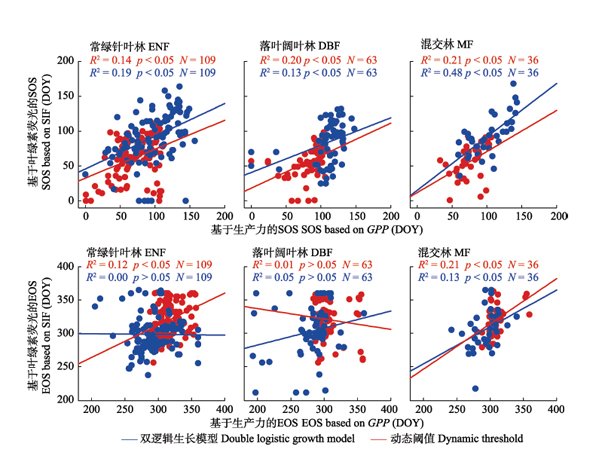
Important findings Results showed that: 1) SIF was more suitable to estimate the timing of the start of growing season (SOS) than the timing of the end of growing season (EOS). 2) SOS based on SIF had the highest correlation with SOS based on GPP in mixed forests (MF). However, the SOS of deciduous broadleaf forest (DBF) and evergreen needleleaf forest (ENF) could not be accurately tracked by SIF value. 3) The preseason shortwave radiation (SR) was the primarily environmental factor of SOS.
ZHOU Wen, CHI Yong-Gang, ZHOU Lei . Vegetation phenology in the Northern Hemisphere based on the solar-induced chlorophyll fluorescence[J]. Chinese Journal of Plant Ecology, 2021 , 45(4) : 345 -354 . DOI: 10.17521/cjpe.2020.0376
| [1] | Bertani G, Wagner FH, Anderson LO, Aragão LJRS (2017). Chlorophyll fluorescence data reveals climate-related photosynthesis seasonality in Amazonian forests. Remote Sensing, 9, 1275. DOI: 10.3390/rs9121275. |
| [2] | Chang Q, Xiao X, Jiao W, Wu X, Doughty R, Wang J, Du L, Zou Z, Qin Y (2019). Assessing consistency of spring phenology of snow-covered forests as estimated by vegetation indices, gross primary production, and solar-induced chlorophyll fluorescence. Agricultural and Forest Meteorology, 275, 305-316. |
| [3] | Cui T, Sun R, Qiao C (2017). Analyzing the relationship between solar-induced chlorophyll fluorescence and gross primary production using remotely sensed data and model simulation. International Journal of Earth & Environmental Sciences, 2, 129. DOI: 10.15344/2456-351X/2017/129. |
| [4] | Dai WJ, Jin HY, Zhang YH, Zhou ZQ, Liu T ( 2020). Advances in plant phenology. Acta Ecologica Sinica, 40, 6705-6719. |
| [4] | [ 代武君, 金慧颖, 张玉红, 周志强, 刘彤 ( 2020). 植物物候学研究进展. 生态学报, 40, 6705-6719.] |
| [5] | Fang JY ( 2000). Forest biomass carbon pool of middle and high latitudes in the North Hemisphere is probably much smaller than present estimates. Acta phytoecologica Sinica, 24, 635-638. |
| [5] | [ 方精云 ( 2000). 北半球中高纬度的森林碳库可能远小于目前的估算. 植物生态学报, 24, 635-638.] |
| [6] | Frankenberg C, Fisher JB, Worden J, Badgley G, Saatchi SS, Lee JE, Toon GC, Butz A, Jung M, Kuze A (2011). New global observations of the terrestrial carbon cycle from GOSAT: patterns of plant fluorescence with gross primary productivity. Geophysical Research Letters, 38, L17706. DOI: 10.1029/2011GL048738. |
| [7] | Guan K, Berry JA, Zhang Y, Joiner J, Guanter L, Badgley G, Lobell DB (2016). Improving the monitoring of crop productivity using spaceborne solar-induced fluorescence. Global Change Biology, 22, 716-726. |
| [8] | Guan QH, Ding MJ, Zhang HM ( 2019). Spatiotemporal variation of spring phenology in alpine grassland and response to climate changes on the Qinghai-Tibet, China. Mountain Research, 37, 639-648. |
| [8] | [ 管琪卉, 丁明军, 张华敏 ( 2019). 青藏地区高寒草地春季物候时空变化及其对气候变化的响应. 山地学报, 37, 639-648.] |
| [9] | Guanter L, Zhang Y, Jung M, Joiner J, Voigt M, Berry JA, Frankenberg C, Huete AR, Zarco-Tejada P, Lee JE, Moran MS, Ponce-Campos G, Beer C, Camps-Valls G, Buchmann N, et al. (2014). Global and time-resolved monitoring of crop photosynthesis with chlorophyll fluorescence. Proceedings of the National Academy of Sciences of the United States of America, 111, E1327-E1333. |
| [10] | He L, Chen JM, Liu J, Mo G, Joiner J (2017). Angular normalization of GOME-2 Sun-induced chlorophyll fluorescence observation as a better proxy of vegetation productivity. Geophysical Research Letters, 44, 5691-5699. |
| [11] | Huang JG, Ma Q, Rossi S, Biondi F, Deslauriers A, Fonti P, Liang E, Mäkinen H, Oberhuber W, Rathgeber CBK, Tognetti R, Treml V, Yang B, Zhang JL, Antonucci S, et al. (2020). Photoperiod and temperature as dominant environmental drivers triggering secondary growth resumption in Northern Hemisphere conifers. Proceedings of the National Academy of Sciences of the United States of America, 117, 20645-20652. |
| [12] | Inoue S, Dang QL, Man R, Tedla B (2020). Photoperiod, [CO2] and soil moisture interactively affect phenology in trembling aspen: implications to climate change-induced migration. Environmental and Experimental Botany, 180, 104269. DOI: 10.1016/j.envexpbot.2020.104269. |
| [13] | Jeong SJ, Ho CH, Gim HJ, Brown ME (2011). Phenology shifts at start vs. end of growing season in temperate vegetation over the Northern Hemisphere for the period 1982-2008. Global Change Biology, 17, 2385-2399. |
| [14] | Jeong SJ, Schimel D, Frankenberg C, Drewry DT, Fisher JB, Verma M, Berry JA, Lee JE, Joiner J (2017). Application of satellite solar-induced chlorophyll fluorescence to understanding large-scale variations in vegetation phenology and function over northern high latitude forests. Remote Sensing of Environment, 190, 178-187. |
| [15] | Jin H, Jönsson AM, Olsson C, Lindström J, Jönsson P, Eklundh L (2019). New satellite-based estimates show significant trends in spring phenology and complex sensitivities to temperature and precipitation at northern European latitudes. International Journal of Biometeorology, 63, 763-775. |
| [16] | Joiner J, Guanter L, Lindstrot R, Voigt M, Vasilkov AP, Middleton EM, Huemmrich KF, Yoshida Y, Frankenberg C (2013). Global monitoring of terrestrial chlorophyll fluorescence from moderate-spectral-resolution near-infrared satellite measurements: methodology, simulations, and application to GOME-2. Atmospheric Measurement Techniques, 6, 2803-2823. |
| [17] | Köhler P, Guanter L, Joiner J (2015). A linear method for the retrieval of sun-induced chlorophyll fluorescence from GOME-2 and SCIAMACHY data. Atmospheric Measurement Techniques, 8, 2589-2608. |
| [18] | Lee JE, Berry JA, van der Tol C, Yang X, Guanter L, Damm A, Baker I, Frankenberg C (2015). Simulations of chlorophyll fluorescence incorporated into the Community Land Model version 4. Global Change Biology, 21, 3469-3477. |
| [19] | Li X, Xiao J, He B, Altaf Arain M, Beringer J, Desai AR, Emmel C, Hollinger DY, Krasnova A, Mammarella I, Noe SM, Ortiz PS, Rey-Sanchez AC, Rocha AV, Varlagin A (2018). Solar-induced chlorophyll fluorescence is strongly correlated with terrestrial photosynthesis for a wide variety of biomes: first global analysis based on OCO-2 and flux tower observations. Global Change Biology, 24, 3990-4008. |
| [20] | Liu LL, Zhang XY (2020). Effects of temperature variability and extremes on spring phenology across the contiguous United States from 1982 to 2016. Scientific Reports, 10, 17952. DOI: 10.1038/s41598-020-74804-4. |
| [21] | Liu Q, Fu YH, Zhu Z, Liu Y, Liu Z, Huang M, Janssens IA, Piao S (2016a). Delayed autumn phenology in the Northern Hemisphere is related to change in both climate and spring phenology. Global Change Biology, 22, 3702-3711. |
| [22] | Liu RG, Shang R, Liu Y, Lu XL (2017). Global evaluation of gap-filling approaches for seasonal NDVI with considering vegetation growth trajectory, protection of key point, noise resistance and curve stability. Remote Sensing of Environment, 189, 164-179. |
| [23] | Liu XT, Zhou L, Shi H, Wang SQ, Chi YG ( 2018). Phenological characteristics of temperate coniferous and broad-leaved mixed forests based on multiple remote sensing vegetation indices, chlorophyll fluorescence and CO2 flux data . Acta Ecologica Sinica, 38, 3482-3494. |
| [23] | [ 刘啸添, 周蕾, 石浩, 王绍强, 迟永刚 ( 2018). 基于多种遥感植被指数、叶绿素荧光与CO2通量数据的温带针阔混交林物候特征对比分析. 生态学报, 38, 3482-3494.] |
| [24] | Liu Y, Wu C, Peng D, Xu S, Gonsamo A, Jassal RS, Altaf Arain M, Lu L, Fang B, Chen JM (2016b). Improved modeling of land surface phenology using MODIS land surface reflectance and temperature at evergreen needleleaf forests of central North America. Remote Sensing of Environment, 176, 152-162. |
| [25] | Lu XC, Cheng X, Li XL, Chen JQ, Sun MM, Ji M, He H, Wang SY, Li S, Tang JW (2018a). Seasonal patterns of canopy photosynthesis captured by remotely sensed sun-induced fluorescence and vegetation indexes in mid-to-high latitude forests: a cross-platform comparison. Science of the Total Environment, 644, 439-451. |
| [26] | Lu XL, Liu ZQ, Zhou YY, Liu YL, An SQ, Tang JW (2018b). Comparison of phenology estimated from reflectance-?based indices and solar-induced chlorophyll fluorescence (SIF) observations in a temperate forest using GPP-based phenology as the standard. Remote Sensing, 10, 932. DOI: 10.3390/rs10060932. |
| [27] | Peaucelle M, Janssens IA, Stocker BD, Ferrando AD, Fu YH, Molowny-Horas R, Ciais P, Peñuelas J (2019). Spatial variance of spring phenology in temperate deciduous forests is constrained by background climatic conditions. Nature Communications, 10, 5388. DOI: 10.1038/s41467-019-13365-1. |
| [28] | Piao S, Liu Q, Chen A, Janssens IA, Fu Y, Dai J, Liu L, Lian X, Shen M, Zhu X (2019). Plant phenology and global climate change: current progresses and challenges. Global Change Biology, 25, 1922-1940. |
| [29] | Piao SL, Friedlingstein P, Ciais P, Viovy N, Demarty J (2007). Growing season extension and its impact on terrestrial carbon cycle in the Northern Hemisphere over the past 2 decades. Global Biogeochemical Cycles, 21, GB3018. DOI: 10.1029/2006GB002888. |
| [30] | Shen MG, Jiang N, Peng DL, Rao YH, Huang Y, Fu YH, Yang W, Zhu XL, Cao RY, Chen XH, Chen J, Miao CY, Wu CY, Wang T, Liang EY, Tang YH (2020). Can changes in autumn phenology facilitate earlier green-up date of northern vegetation? Agricultural and Forest Meteorology, 291, 108077. DOI: 10.1016/j.agrformet.2020.108077. |
| [31] | Shen MG, Tang YH, Chen J, Yang X, Wang C, Cui XY, Yang YP, Han LJ, Li L, Du JH, Zhang GX, Cong N (2014). Earlier-season vegetation has greater temperature sensitivity of spring phenology in Northern Hemisphere. PLOS ONE, 9, e88178. DOI: 10.1371/journal.pone.0088178. |
| [32] | Shen XJ, Liu BH, Xue ZS, Jiang M, Lu XG, Zhang Q (2019). Spatiotemporal variation in vegetation spring phenology and its response to climate change in freshwater marshes of Northeast China. Science of the Total Environment, 666, 1169-1177. |
| [33] | Singh RK, Svystun T, AlDahmash B, Jönsson AM, Bhalerao RP (2017). Photoperiod- and temperature- mediated control of phenology in trees—A molecular perspective. New Phytologist, 213, 511-524. |
| [34] | Sun Y, Frankenberg C, Wood JD, Schimel DS, Jung M, Guanter L, Drewry DT, Verma M, Porcar-Castell A, Griffis TJ, Gu L, Magney TS, Köhler P, Evans B, Yuen K (2017). OCO-2 advances photosynthesis observation from space via solar-induced chlorophyll fluorescence. Science,358, eaam5747. DOI: 10.1126/science.aam5747. |
| [35] | Tan B, Morisette JT, Wolfe RE, Gao F, Ederer GA, Nightingale J, Pedelty JA (2011). An enhanced TIMESAT algorithm for estimating vegetation phenology metrics from MODIS data. IEEE Journal of Selected Topics in Applied Earth Observations and Remote Sensing, 4, 361-371. |
| [36] | Wang F, Chen BZ, Lin XF, Zhang HF (2020). Solar-induced chlorophyll fluorescence as an indicator for determining the end date of the vegetation growing season. Ecological Indicators, 109, 105755. DOI: 10.1016/j.ecolind.2019. 105755. |
| [37] | Wang X, Xiao J, Li X, Cheng G, Ma M, Zhu G, Altaf Arain M, Andrew Black T, Jassal RS (2019a). No trends in spring and autumn phenology during the global warming Hiatus. Nature Communications, 10, 2389. DOI: 10.1038/s41467-019-10235-8. |
| [38] | Wang XY, Wang T, Liu D, Zhang TT, Xu JF, Cui GS, Lv GT, Huang HB (2019b). Multisatellite analyses of spatiotemporal variability in photosynthetic activity over the Tibetan Plateau. Journal of Geophysical Research, 124, 3778-3797. |
| [39] | Wilson TB, Meyers TP (2007). Determining vegetation indices from solar and photosynthetically active radiation fluxes. Agricultural and Forest Meteorology, 144, 160-179. |
| [40] | Wu C, Peng D, Soudani K, Siebicke L, Gough CM, Altaf Arain M, Bohrer G, Lafleur PM, Peichl M, Gonsamo A, Xu S, Fang B, Ge Q (2017). Land surface phenology derived from normalized difference vegetation index (NDVI) at global FLUXNET sites. Agricultural and Forest Meteorology, 233, 171-182. |
| [41] | Xie YY, Wang XJ, Silander JA (2015). Deciduous forest responses to temperature, precipitation, and drought imply complex climate change impacts. Proceedings of the National Academy of Sciences of the United States of America, 112, 13585-13590. |
| [42] | Xu X, Riley WJ, Koven CD, Jia G (2019a). Heterogeneous spring phenology shifts affected by climate: supportive evidence from two remotely sensed vegetation indices. Environmental Research Communications, 1, 091004. DOI: 10.1088/2515-7620/ab3d79. |
| [43] | Xu XJ, Du HQ, Fan WL, Hu JG, Mao FJ, Dong HJ (2019b). Long-term trend in vegetation gross primary production, phenology and their relationships inferred from the FLUXNET data. Journal of Environmental Management, 246, 605-616. |
| [44] | Yang H, Yang X, Zhang Y, Heskel MA, Lu X, Munger JW, Sun S, Tang J (2017). Chlorophyll fluorescence tracks seasonal variations of photosynthesis from leaf to canopy in a temperate forest. Global Change Biology, 23, 2874-2886. |
| [45] | Yang X, Guo R, Knops JMH, Mei L, Kang F, Zhang T, Guo J (2020a). Shifts in plant phenology induced by environmental changes are small relative to annual phenological variation. Agricultural and Forest Meteorology, 294, 108144. DOI: 10.1016/j.agrformet.2020.108144. |
| [46] | Yang X, Tang J, Mustard JF, Lee JE, Rossini M, Joiner J, Munger JW, Kornfeld A, Richardson AD (2015). Solar-induced chlorophyll fluorescence that correlates with canopy photosynthesis on diurnal and seasonal scales in a temperate deciduous forest. Geophysical Research Letters, 42, 2977-2987. |
| [47] | Yang Y, Wu ZF, Guo L, He HS, Ling YH, Wang L, Zong SW, Na RS, Du HB, Li MH (2020b). Effects of winter chilling vs. spring forcing on the spring phenology of trees in a cold region and a warmer reference region. Science of the Total Environment, 725, 138323. DOI: 10.1016/j.scitotenv.2020.138323. |
| [48] | Yuan HH, Wu CY, Gu CY, Wang XY (2020). Evidence for satellite observed changes in the relative influence of climate indicators on autumn phenology over the Northern Hemisphere. Global and Planetary Change, 187, 103131. DOI: 10.1016/j.gloplacha.2020.103131. |
| [49] | Zhang Y, Guanter L, Berry J, van der Tol C, Yang X, Tang J, Zhang F (2016). Model-based analysis of the relationship between sun-induced chlorophyll fluorescence and gross primary production for remote sensing applications. Remote Sensing of Environment, 187, 145-155. |
| [50] | Zhang ZY, Wang SH, Qiu B, Song L, Zhang YG ( 2019). Retrieval of Sun-induced chlorophyll fluorescence and advancements in carbon cycle application. Journal of Remote Sensing, 23, 37-52. |
| [50] | [ 章钊颖, 王松寒, 邱博, 宋练, 张永光 ( 2019). 日光诱导叶绿素荧光遥感反演及碳循环应用进展. 遥感学报, 23, 37-52.] |
| [51] | Zhang ZY, Zhang YG, Porcar-Castell A, Joiner J, Guanter L, Yang X, Migliavacca M, Ju WM, Sun ZG, Chen SP, Martini D, Zhang Q, Li ZH, Cleverly J, Wang HZ, Goulas Y (2020). Reduction of structural impacts and distinction of photosynthetic pathways in a global estimation of GPP from space-borne solar-induced chlorophyll fluorescence. Remote Sensing of Environment, 240, 111722. DOI: 10.1016/j.rse.2020.111722. |
| [52] | Zhong S, Shi H, Xue C, Wang L, Xi Y, Li J, Quail PH, Deng XW, Guo H (2012). A molecular framework of light-controlled phytohormone action in Arabidopsis. Current Biology, 22, 1530-1535. |
| [53] | Zhou L, Chi YG, Liu XT, Dai XQ, Yang FT ( 2020). Land surface phenology tracked by remotely sensed Sun-induced chlorophyll fluorescence in subtropical evergreen coniferous forests. Acta Ecologica Sinica, 40, 4114-4125. |
| [53] | [ 周蕾, 迟永刚, 刘啸添, 戴晓琴, 杨风亭 ( 2020). 日光诱导叶绿素荧光对亚热带常绿针叶林物候的追踪. 生态学报, 40, 4114-4125.] |
/
| 〈 |
|
〉 |
Copyright © 2026 Chinese Journal of Plant Ecology
Tel: 010-62836134, 62836138, E-mail: apes@ibcas.ac.cn, cjpe@ibcas.ac.cn

