
Chinese Journal of Plant Ecology >
Effects of arbuscular mycorrhizal fungi and nitrogen addition on nitrogen uptake of rice genotypes with different root morphologies
Received date: 2021-04-22
Accepted date: 2021-05-20
Online published: 2021-06-26
Supported by
National Natural Science Foundation of China(91951107);National Natural Science Foundation of China(32025024);Fundamental Research Funds for the Central Universities(K20200026)
Aims Plants absorb mineral nutrients such as nitrogen (N) mainly through their roots. The nutrient uptake of plants with different root morphologies differs. Many studies have shown that arbuscular mycorrhizal fungi (AMF) can help their symbiotic associates absorb mineral N. However, there is little research on whether the effect of AMF on nutrient uptake of plant roots is affected by root morphology.
Methods In this study, we selected three rice mutants and one wild type (root hairless (rhl1), lateral rootless (iaa11), adventitious rootless (arl1) and wild type (Kas)) to investigate the role of root morphology in plant nutrient uptake. Subsequently, we used the 15N isotope labeling method to explore the effects of arbuscular mycorrhizal fungi and N addition (low N: 20 mg·kg-1 NH4+-N; high N: 100 mg·kg-1 NH4+-N) on N uptake of rice mutants with different root morphologies.
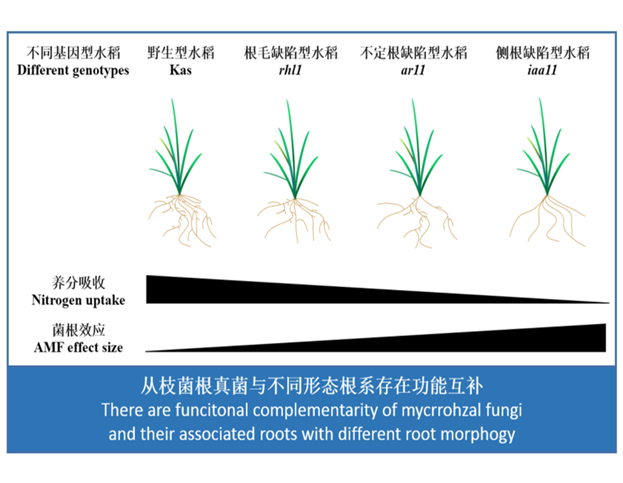
Important findings The results show that the leaf 15N concentrations of rhl1,Kas, iaa11 and arl1 were increased by 60%, 72%, 128% and 118%, respectively, under the high N compared to the low N treatment. This result indicates that the addition of N significantly promoted rice N uptake with the most evident effect occurring in iaa11 and arl1. The average effect sizes of AMF on rhl1, Kas, iaa11 and arl1 were 17%, 31%, 42% and 51% under the low N level, indicating that root morphology can alter the effect of AMF on plant N uptake. Compared to the low N treatment, high N significantly downregulated the AMF effect on N uptake by rice plants with different root morphologies, indicating that N addition may mediate the complementary effect of AMF and root morphology on plant nutrient uptake. In conclusion, our data provide direct experimental evidence of funcitonal complementarity of mycrrohzal fungi and their associated roots with different root morphogy.
MA Ju-Feng, XIN Min, XU Chen-Chao, ZHU Wan-Ying, MAO Chuan-Zao, CHEN Xin, CHENG Lei . Effects of arbuscular mycorrhizal fungi and nitrogen addition on nitrogen uptake of rice genotypes with different root morphologies[J]. Chinese Journal of Plant Ecology, 2021 , 45(7) : 728 -737 . DOI: 10.17521/cjpe.2021.0155
| [1] | Addo-Danso SD, Defrenne CE, McCormack ML, Ostonen I, Addo-Danso A, Foli EG, Borden KA, Isaac ME, Prescott CE (2020). Fine-root morphological trait variation in tropical forest ecosystems: an evidence synthesis. Plant Ecology, 221, 1-13. |
| [2] | Awaydul A, Zhu WY, Yuan YG, Xiao J, Hu H, Chen X, Koide RT, Cheng L (2019). Common mycorrhizal networks influence the distribution of mineral nutrients between an invasive plant, Solidago canadensis, and a native plant, Kummerowa striata. Mycorrhiza, 29, 29-38. |
| [3] | Bai JJ, Piao ZZ, Zeng W, Li GX, Yang RF (2019). Effects of different lateral root densities on growth, development and main agronomic characters of rice. Molecular Plant Breeding, 17, 1624-1630. |
| [3] | [ 白建江, 朴钟泽, 曾威, 李刚燮, 杨瑞芳 (2019). 不同侧根密度对水稻生长发育及主要农艺性状的影响. 分子植物育种, 17, 1624-1630.] |
| [4] | Bakhshandeh S, Corneo PE, Mariotte P, Kertesz MA, Dijkstra FA (2017). Effect of crop rotation on mycorrhizal colonization and wheat yield under different fertilizer treatments. Agriculture, Ecosystems & Environment, 247, 130-136. |
| [5] | Bates TR, Lynch JP (2001). Root hairs confer a competitive advantage under low phosphorus availability. Plant and Soil, 236, 243-250. |
| [6] | Bonneau L, Huguet S, Wipf D, Pauly N, Truong HN (2013). Combined phosphate and nitrogen limitation generates a nutrient stress transcriptome favorable for arbuscular mycorrhizal symbiosis in Medicago truncatula. New Phytologist, 199, 188-202. |
| [7] | Brundrett MC (2002). Coevolution of roots and mycorrhizas of land plants. New Phytologist, 154, 275-304. |
| [8] | Chen C, Gong HQ, Zhang JZ, Xu YJ, Gao HJ (2016). Evaluation of nitrogen nutrition characteristics of different rice cultivars at seedling stage. Chinese Journal of Eco- Agriculture, 24, 1347-1355. |
| [8] | [ 陈晨, 龚海青, 张敬智, 徐寓军, 郜红建 (2016). 不同基因型水稻苗期氮营养特性差异及综合评价. 中国生态农业学报, 24, 1347-1355.] |
| [9] | Chen WL, Koide RT, Adams TS, DeForest JL, Cheng L, Eissenstat DM (2016). Root morphology and mycorrhizal symbioses together shape nutrient foraging strategies of temperate trees. Proceedings of the National Academy of Sciences of the United States of America, 113, 8741-8746. |
| [10] | Cheng L, Booker FL, Tu C, Burkey KO, Zhou LS, Shew HD, Rufty TW, Hu SJ (2012). Arbuscular mycorrhizal fungi increase organic carbon decomposition under elevated CO2. Science, 337, 1084-1087. |
| [11] | Cheng L, Chen WL, Adams TS, Wei X, Li L, McCormack ML, DeForest JL, Koide RT, Eissenstat DM (2016). Mycorrhizal fungi and roots are complementary in foraging within nutrient patches. Ecology, 97, 2815-2823. |
| [12] | Corkidi L, Rowland DL, Johnson NC, Allen EB (2002). Nitrogen fertilization alters the functioning of arbuscular mycorrhizas at two semiarid grasslands. Plant and Soil, 240, 299-310. |
| [13] | Coutinho BG, Mevers E, Schaefer AL, Pelletier DA, Harwood CS, Clardy J, Greenberg EP (2018). A plant-responsive bacterial-signaling system senses an ethanolamine derivative. Proceedings of the National Academy of Sciences of the United States of America, 115, 9785-9790. |
| [14] | Ding WN (2009). Cloning and Functional Analysis of OsRHL1 Controlling Root Hair Development in Rice (Orzya sativa). PhD dissertation, Zhejiang University, Hangzhou. 10-15. |
| [14] | [ 丁沃娜 (2009). 水稻根毛发育调控基因OsRHL1的克隆及功能研究. 博士学位论文, 浙江大学, 杭州. 10-15.] |
| [15] | Eissenstat DM, Kucharski JM, Zadworny M, Adams TS, Koide RT (2015). Linking root traits to nutrient foraging in arbuscular mycorrhizal trees in a temperate forest. New Phytologist, 208, 114-124. |
| [16] | Geneva MP, Stancheva IV, Boychinova MM, Mincheva NH, Yonova PA (2010). Effects of foliar fertilization and arbuscular mycorrhizal colonization on Salvia officinalis L. growth, antioxidant capacity, and essential oil composition. Journal of the Science of Food and Agriculture, 90, 696-702. |
| [17] | Giehl RFH, Gruber BD, von Wirén N (2014). It’s time to make changes: modulation of root system architecture by nutrient signals. Journal of Experimental Botany, 65, 769-778. |
| [18] | Govindarajulu M, Pfeffer PE, Jin HR, Abubaker J, Douds DD, Allen JW, Bücking H, Lammers PJ, Shachar-Hill Y (2005). Nitrogen transfer in the arbuscular mycorrhizal symbiosis. Nature, 435, 819-823. |
| [19] | Hawkins HJ, Johansen A, George E (2000). Uptake and transport of organic and inorganic nitrogen by arbuscular mycorrhizal fungi. Plant and Soil, 226, 275-285. |
| [20] | Hetrick BAD (1991). Mycorrhizas and root architecture. Experientia, 47, 355-362. |
| [21] | Hodge A, Storer K (2015). Arbuscular mycorrhiza and nitrogen: implications for individual plants through to ecosystems. Plant and Soil, 386, 1-19. |
| [22] | Jansa J, Mozafar A, Frossard E (2003). Long-distance transport of P and Zn through the hyphae of an arbuscular mycorrhizal fungus in symbiosis with maize. Agronomie, 23, 481-488. |
| [23] | Jin H, Pfeffer PE, Douds DD, Piotrowski E, Lammers PJ, Shachar-Hill Y (2005). The uptake, metabolism, transport and transfer of nitrogen in an arbuscular mycorrhizal symbiosis. New Phytologist, 168, 687-696. |
| [24] | Johnson NC (2010). Resource stoichiometry elucidates the structure and function of arbuscular mycorrhizas across scales. New Phytologist, 185, 631-647. |
| [25] | Koide RT (2000). Functional complementarity in the arbuscular mycorrhizal symbiosis. New Phytologist, 147, 233-235. |
| [26] | Li HB, Liu BT, McCormack ML, Ma ZQ, Guo DL (2017). Diverse belowground resource strategies underlie plant species coexistence and spatial distribution in three grasslands along a precipitation gradient. New Phytologist, 216, 1140-1150. |
| [27] | Liu BT, Li HB, Zhu B, Koide RT, Eissenstat DM, Guo DL (2015). Complementarity in nutrient foraging strategies of absorptive fine roots and arbuscular mycorrhizal fungi across 14 coexisting subtropical tree species. New Phytologist, 208, 125-136. |
| [28] | Liu HJ (2005). Cloning and Functional Analysis of ARL1 Gene Required for Adventitious Root Formation in Rice. PhD dissertation, Zhejiang University, Hangzhou. 12-16. |
| [28] | [ 刘洪家 (2005). 水稻不定根发生基因ARL1的克隆与功能分析. 博士学位论文, 浙江大学, 杭州. 12-16.] |
| [29] | Liu MM, Li YS, Sun J, He CX (2018). Comparison of propagation of two arbuscular mycorrhizal fungi and their effects on maize growth. Bulletin of Agricultural Science and Technology, 556(4), 65-69. |
| [29] | [ 刘铭铭, 李衍素, 孙锦, 贺超兴 (2018). 两种丛枝菌根真菌扩繁比较及其对玉米促生的研究. 农业科技通讯, 556(4), 65-69.] |
| [30] | Lu YW, Liu X, Chen F, Zhou SR (2020). Shifts in plant community composition weaken the negative effect of nitrogen addition on community-level arbuscular mycorrhizal fungi colonization. Proceedings of the Royal Society B: Biological Sciences, 287, 20200483. DOI: 10.1098/rspb.2020.0483. |
| [31] | Luck McCormack M, Adams TS, Smithwick EAH, Eissenstat DM (2012). Predicting fine root lifespan from plant functional traits in temperate trees. New Phytologist, 195, 823-831. |
| [32] | Ma XC, Geng QH, Zhang HG, Bian CY, Chen HYH, Jiang DL, Xu X (2021). Global negative effects of nutrient enrichment on arbuscular mycorrhizal fungi, plant diversity and ecosystem multifunctionality. New Phytologist, 229, 2957-2969. |
| [33] | Ma ZQ, Guo DL, Xu XL, Lu MZ, Bardgett RD, Eissenstat DM, McCormack ML, Hedin LO (2018). Evolutionary history resolves global organization of root functional traits. Nature, 555, 94-97. |
| [34] | Mergemann H, Sauter M (2000). Ethylene induces epidermal cell death at the site of adventitious root emergence in rice. Plant Physiology, 124, 609-614. |
| [35] | Ohtomo R, Kobae Y, Morimoto S, Oka N (2018). Infection unit density as an index of infection potential of arbuscular mycorrhizal fungi. Microbes and Environments, 33, 34-39. |
| [36] | Parniske M (2008). Arbuscular mycorrhiza: the mother of plant root endosymbioses. Nature Reviews Microbiology, 6, 763-775. |
| [37] | Paszkowski U, Boller T (2002). The growth defect of lrt1, a maize mutant lacking lateral roots, can be complemented by symbiotic fungi or high phosphate nutrition. Planta, 214, 584-590. |
| [38] | Reinhardt DR, Miller RM (1990). Size classes of root diameter and mycorrhizal fungal colonization in two temperate grassland communities. New Phytologist, 116, 129-136. |
| [39] | Schalamuk S, Cabello MN, Chidichimo H, Golik S (2011). Effects of inoculation with Glomus mosseae in conventionally tilled and nontilled soils with different levels of nitrogen fertilization on wheat growth, arbuscular mycorrhizal colonization, and nitrogen nutrition. Communications in Soil Science and Plant Analysis, 42, 586-598. |
| [40] | Smith SE, Smith FA (2011). Roles of arbuscular mycorrhizas in plant nutrition and growth: new paradigms from cellular to ecosystem scales. Annual Review of Plant Biology, 62, 227-250. |
| [41] | Song ZY, Lü K, Luo F, Lian XM (2012). Effect of nitrogen application on nitrogen uptaking and utilization in ten different rice varieties. Journal of Huazhong Agricultural University, 31, 165-170. |
| [41] | [ 宋智勇, 吕凯, 罗凤, 练兴明 (2012). 施氮量对不同基因型水稻品种氮素吸收利用的影响. 华中农业大学学报, 31, 165-170.] |
| [42] | Tateno R, Nakayama M, Yano M, Fukuzawa K, Inagaki Y, Koba K, Ugawa S (2020). Nitrogen source utilization in co-existing canopy tree and dwarf bamboo in a northern hardwood forest in Japan. Trees, 34, 1047-1057. |
| [43] | Valenzuela-Estrada LR, Vera-Caraballo V, Ruth LE, Eissenstat DM (2008). Root anatomy, morphology, and longevity among root orders in Vaccinium corymbosum (Ericaceae). American Journal of Botany, 95, 1506-1514. |
| [44] | Wang QC, Cheng YH (2004). Response of fine roots to soil nutrient spatial heterogeneity. Chinese Journal of Applied Ecology, 15, 1063-1068. |
| [44] | [ 王庆成, 程云环 (2004). 土壤养分空间异质性与植物根系的觅食反应. 应用生态学报, 15, 1063-1068.] |
| [45] | Wang XX, Wang XJ, Sun Y, Cheng Y, Liu ST, Chen XP, Feng G, Kuyper TW (2018a). Arbuscular mycorrhizal fungi negatively affect nitrogen acquisition and grain yield of maize in a N deficient soil. Frontiers in Microbiology, 9, 418. DOI: 10.3389/fmicb.2018.00418. |
| [46] | Wang YH, Wang MQ, Li Y, Wu AP, Huang JY (2018b). Effects of arbuscular mycorrhizal fungi on growth and nitrogen uptake of Chrysanthemum morifolium under salt stress. PLOS ONE, 13, e0196408. DOI: 10.1371/journal.pone. 0196408. |
| [47] | Weemstra M, Mommer L, Visser EJW, van Ruijven J, Kuyper TW, Mohren GMJ, Sterck FJ (2016). Towards a multidimensional root trait framework: a tree root review. New Phytologist, 211, 1159-1169. |
| [48] | Wen ZH, Li HB, Shen Q, Tang XM, Xiong CY, Li HG, Pang JY, Ryan MH, Lambers H, Shen JB (2019). Tradeoffs among root morphology, exudation and mycorrhizal symbioses for phosphorus-acquisition strategies of 16 crop species. New Phytologist, 223, 882-895. |
| [49] | Yahara H, Tanikawa N, Okamoto M, Makita N (2019). Characterizing fine-root traits by species phylogeny and microbial symbiosis in 11 co-existing woody species. Oecologia, 191, 983-993. |
| [50] | Zhu ZX (2011). OsIAA11-Mediated Auxin Signaling Controls Lateral Root Initiation in Rice. PhD dissertation, Zhejiang University, Hangzhou. 11-22. |
| [50] | [ 朱振兴 (2011). OsIAAll介导的生长素信号调控水稻侧根的起始. 博士学位论文, 浙江大学, 杭州. 11-22.] |
/
| 〈 |
|
〉 |
Copyright © 2026 Chinese Journal of Plant Ecology
Tel: 010-62836134, 62836138, E-mail: apes@ibcas.ac.cn, cjpe@ibcas.ac.cn

