
Chinese Journal of Plant Ecology >
Responses of leaf hydraulic traits to water conditions in eight tree species and the driving factors
Received date: 2021-04-14
Accepted date: 2021-08-09
Online published: 2021-09-18
Supported by
Central Public-interest Scientific Institution Basal Research Fund(CAFYBB2017ZX002);Applied Basic Research Project of Shanxi Province(201801D121246);Planting Project for Key Research in Shanxi Province(201903D221051)
Aims The hydraulic efficiency and safety of tree leaves can respond to changes in water conditions, hence affecting the growth and distribution of trees. This study was conducted to determine the patterns of responses in leaf hydraulic conductivity (Kleaf) and leaf hydraulic vulnerability (P50) in trees to varying water conditions and the influencing factors.
Methods In this study, eight tree species were selected at the study sites of Guandi Mountain and Heicha Mountain in northwestern Shanxi, and their hydraulic traits, leaf vessel and morphological traits were measured. Changes of Kleaf and P50 in those eight tree species were compared between the two locations. The trade-off relationship between leaf hydraulic efficiency and safety was analyzed.
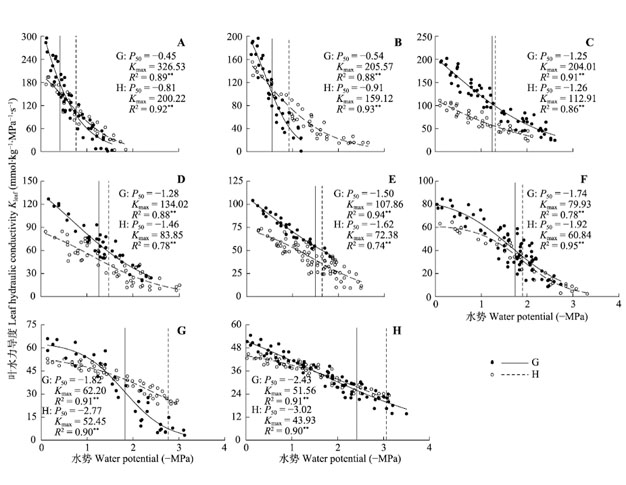
Important findings Within the same tree species, the maximum hydraulic conductivity (Kmax) and P50 were higher at the moist Guandi Mountain sites than at the dry Heicha Mountain sites; within the same study areas, Kmax and P50 were higher in tree species occurring under high water availability than those in drought-prone environment. There were significant correlations among Kmax, P50 and water potential at turgor loss points (TLP). Leaf P50 in trees in the two study areas was significantly and positively correlated with the number of vessels per unit area, the predicted value of vessel collapse ((t/b)3), leaf thickness, and leaf mass per unit area, and negatively with vessel diameter and leaf area. Kleaf and P50 in different tree species were better related with leaf vessel traits than with leaf morphological traits. The changes in P50(δP50) from Guandi Mountain to Heicha Mountain within the same tree species were significantly and positively correlated with changes in leaf mass per unit area and leaf dry mass content, and δP50 was more closely related with the leaf morphological traits than with the leaf vessel traits within the same tree species. The above results indicate that, with deterioration of water conditions, leaf hydraulic efficiency decreases while the hydraulic safety increases. There is a certain trade-off between leaf hydraulic efficiency and safety across different tree species. The differences in leaf hydraulic traits among tree species are more affected by leaf vessel traits than leaf morphological traits. The responses of leaf hydraulic safety to changes in water conditions are mainly driven by leaf morphological traits. An improvement in leaf hydraulic safety occurs at the expenses of structural carbon investment.
REN Jin-Pei, LI Jun-Peng, WANG Wei-Feng, DAI Yong-Xin, WANG Lin . Responses of leaf hydraulic traits to water conditions in eight tree species and the driving factors[J]. Chinese Journal of Plant Ecology, 2021 , 45(9) : 942 -951 . DOI: 10.17521/cjpe.2021.0140
| [1] | Brodribb TJ, Holbrook NM (2003). Stomatal closure during leaf dehydration, correlation with other leaf physiological traits. Plant Physiology, 132, 2166-2173. |
| [2] | Brodribb TJ, Holbrook NM (2005). Water stress deforms tracheids peripheral to the leaf vein of a tropical conifer. Plant Physiology, 137, 1139-1146. |
| [3] | Bucci SJ, Silletta LMC, Garré A, Cavallaro A, Efron ST, Arias NS, Goldstein G, Scholz FG (2019). Functional relationships between hydraulic traits and the timing of diurnal depression of photosynthesis. Plant, Cell & Environment, 42, 1603-1614. |
| [4] | Gao HP (2019). Afforestation situation and countermeasures of main broad-leaved species in Heicha forest bureau. Shanxi Forestry Science and Technology, 48(4), 48-50. |
| [4] | [ 郜慧萍 (2019). 黑茶林局主要阔叶树造林现状及对策建议. 山西林业科技, 48(4), 48-50.] |
| [5] | Gleason SM, Westoby M, Jansen S, Choat B, Hacke UG, Pratt RB, Bhaskar R, Brodribb TJ, Bucci SJ, Cao KF, Cochard H, Delzon S, Domec JC, Fan ZX, Feild TS, et al. (2016). Weak tradeoff between xylem safety and xylem-specific hydraulic efficiency across the world's woody plant species. New Phytologist, 209, 123-136. |
| [6] | Guo JP, Yang HX, Xue JJ, Wang YM, Wei X (1999). Forest landscape heterogeneity and its dynamics of Guandishan Mountain. Chinese Journal of Applied Ecology, 10, 40-44. |
| [6] | 郭晋平, 阳含熙, 薛俊杰, 王毅敏, 魏信 (1999). 关帝山森林景观异质性及其动态的研究. 应用生态学报, 10, 40-44.] |
| [7] | He B, Li ZG, Hao XJ, He YC (2014). A new technique of fast paraffin sectioning in plant tissues. Chinese Bulletin of Botany, 49, 203-208. |
| [7] | [ 贺冰, 李志岗, 郝晓娟, 贺运春 (2014). 植物材料快速石蜡制片方法. 植物学报, 49, 203-208.] |
| [8] | Hoffmann WA, Marchin RM, Abit P, Lau OL (2011). Hydraulic failure and tree dieback are associated with high wood density in a temperate forest under extreme drought. Global Change Biology, 17, 2731-2742. |
| [9] | Jin Y, Wang CK (2016). Leaf hydraulic traits and their trade-offs for nine Chinese temperate tree species with different wood properties. Chinese Journal of Plant Ecology, 40, 702-710. |
| [9] | [ 金鹰, 王传宽 (2016). 九种不同材性的温带树种叶水力性状及其权衡关系. 植物生态学报, 40, 702-710.] |
| [10] | Johnson DM, McCulloh KA, Woodruff DR, Meinzer FC (2012). Evidence for xylem embolism as a primary factor in dehydration-induced declines in leaf hydraulic conductance. Plant, Cell & Environment, 35, 760-769. |
| [11] | Johnson DM, Meinzer FC, Woodruff DR, McCulloh KA (2009). Leaf xylem embolism, detected acoustically and by cryo-SEM, corresponds to decreases in leaf hydraulic conductance in four evergreen species. Plant, Cell & Environment, 32, 828-836. |
| [12] | Liu M, Zhang XY, Li XL, Liu Q, Meng WZ, Xu MH (2020). Short-term responses of under-canopy grasslands to the experimental warming on the Loess Plateau, China. Acta Ecologica Sinica, 40, 6009-6024. |
| [12] | [ 刘敏, 张潇月, 李晓丽, 刘琦, 孟万忠, 徐满厚 (2020). 黄土高原林下草地对模拟增温的短期响应. 生态学报, 40, 6009-6024.] |
| [13] | Maréchaux I, Bartlett MK, Sack L, Baraloto C, Engel J, Joetzjer E, Chave J (2015). Drought tolerance as predicted by leaf water potential at turgor loss point varies strongly across species within an Amazonian forest. Functional Ecology, 29, 1268-1277. |
| [14] | McCulloh KA, Johnson DM, Meinzer FC, Woodruff DR (2014). The dynamic pipeline: hydraulic capacitance and xylem hydraulic safety in four tall conifer species. Plant, Cell & Environment, 37, 1171-1183. |
| [15] | McDowell NG, Brodribb TJ, Nardini A (2019). Hydraulics in the 21st century. New Phytologist, 224, 537-542. |
| [16] | Nardini A, Luglio J (2014). Leaf hydraulic capacity and drought vulnerability: possible trade-offs and correlations with climate across three major biomes. Functional Ecology, 28, 810-818. |
| [17] | Nardini A, Pedà G, Rocca NL (2012). Trade-offs between leaf hydraulic capacity and drought vulnerability: morpho- anatomical bases, carbon costs and ecological consequences. New Phytologist, 196, 788-798. |
| [18] | Nardini A, Salleo S (2005). Water stress-induced modifications of leaf hydraulic architecture in sunflower: co-ordination with gas exchange. Journal of Experimental Botany, 56, 3093-3101. |
| [19] | Sack L, Ball MC, Brodersen C, Davis SD, Marais DLD, Donovan LA, Givnish TJ, Hacke UG, Huxman T, Jansen S, Jacobsen AL, Johnson DM, Koch GW, Maurel C, McCulloh KA, et al. (2016). Plant hydraulics as a central hub integrating plant and ecosystem function: meeting report for “Emerging Frontiers in Plant Hydraulics”. Plant, Cell & Environment, 39, 2085-2094. |
| [20] | Sack L, Holbrook NM (2006). Leaf hydraulics. Annual Review of Plant Biology, 57, 361-381. |
| [21] | Sanchez-Martinez P, Martínez-Vilalta J, Dexter KG, Segovia RA, Mencuccini M (2020). Adaptation and coordinated evolution of plant hydraulic traits. Ecology Letters, 23, 1599-1610. |
| [22] | Scoffoni C, Albuquerque C, Brodersen CR, Townes SV, John GP, Cochard H, Buckley TN, McElrone AJ, Sack L (2017). Leaf vein xylem conduit diameter influences susceptibility to embolism and hydraulic decline. New Phytologist, 213, 1076-1092. |
| [23] | Scoffoni C, McKown AD, Rawls M, Sack L (2012). Dynamics of leaf hydraulic conductance with water status: quantification and analysis of species differences under steady state. Journal of Experimental Botany, 63, 643-658. |
| [24] | Simonin KA, Limm EB, Dawson TE (2012). Hydraulic conductance of leaves correlates with leaf lifespan: implications for lifetime carbon gain. New Phytologist, 193, 939-947. |
| [25] | Sperry JS, Hacke UG, Pittermann J (2006). Size and function in conifer tracheids and angiosperm vessels. American Journal of Botany, 93, 1490-1500. |
| [26] | Tyree MT, Ewers FW (1991). The hydraulic architecture of trees and other woody plants. New Phytologist, 119, 345-360. |
| [27] | Tyree MT, Hammel HT (1972). The measurement of the turgor pressure and the water relations of plants by the pressure- bomb technique. Journal of Experimental Botany, 23, 267-282. |
| [28] | Vilagrosa A, Morales F, Abadía A, Bellot J, Cochard H, Gil-Pelegrin E (2010). Are symplast tolerance to intense drought conditions and xylem vulnerability to cavitation coordinated? An integrated analysis of photosynthetic, hydraulic and leaf level processes in two Mediterranean drought-resistant species. Environmental & Experimental Botany, 69, 233-242. |
| [29] | Villagra M, Campanello PI, Bucci SJ, Goldstein G (2013). Functional relationships between leaf hydraulics and leaf economic traits in response to nutrient addition in subtropical tree species. Tree Physiology, 33, 1308-1318. |
| [30] | Yan CL, Ni MY, Cao KF, Zhu SD (2020). Leaf hydraulic safety margin and safety-efficiency trade-off across angiosperm woody species. Biology Letters, 16, 20200456. DOI: 10.1098/rsbl.2020.0456. |
| [31] | Yao GQ, Nie ZF, Turner NC, Li FM, Gao TP, Fang XW, Scoffoni C (2021). Combined high leaf hydraulic safety and efficiency provides drought tolerance in Caragana species adapted to low mean annual precipitation. New Phytologist, 229, 230-244. |
| [32] | Zwieniecki MA, Brodribb TJ, Holbrook NM (2007). Hydraulic design of leaves: insights from rehydration kinetics. Plant, Cell & Environment, 30, 910-921. |
/
| 〈 |
|
〉 |
Copyright © 2026 Chinese Journal of Plant Ecology
Tel: 010-62836134, 62836138, E-mail: apes@ibcas.ac.cn, cjpe@ibcas.ac.cn

