
Chinese Journal of Plant Ecology >
Application of boosted regression trees for the gap-filling to flux dataset in an alpine scrubland of Qingzang Plateau
Received date: 2021-07-13
Accepted date: 2021-12-03
Online published: 2022-01-04
Supported by
National Key R&D Program of China(2017YFA0604801);National Key R&D Program of China(2017YFA0604802);Chinese Academy of Sciences-People’s Government of Qinghai Province Joint Grant on Sanjiangyuan National Park Research(LHZX-2020-07);Special Foundation for National Science and Technology Basic Research Program of China(2019FY101300);National Natural Science Foundation of China(41730752);National Natural Science Foundation of China(41877547)
Aims The continuous observation datasets of water, heat, and carbon fluxes measured by the eddy covariance technique are important basis for accurate assessment of regional carbon sequestration and water-holding capacity. However, the rate of gaps in flux datasets is high and common due to various reasons, and different gap-filling methods increase the uncertainties of the related studies. The aim of this study is to introduce and test the applicability of boosted regression trees model (BRT), one of the up-to-date machine learning algorithms, for the gap- filling to flux datasets.
Methods Based on the published valid dataset of water, heat and CO2 flux, and main environmental factors, including air temperature, atmospheric water vapor pressure, wind speed, solar shortwave radiation, topsoil temperature, and topsoil water content of an alpine Potentilla fruticosa scrubland on the northeastern Qingzang Plateau from 2003 to 2005, the BRT were trained to fill flux data gaps and the results were compared to those corresponding data serials provided by Chinese Flux Observation and Research Network (ChinaFLUX).
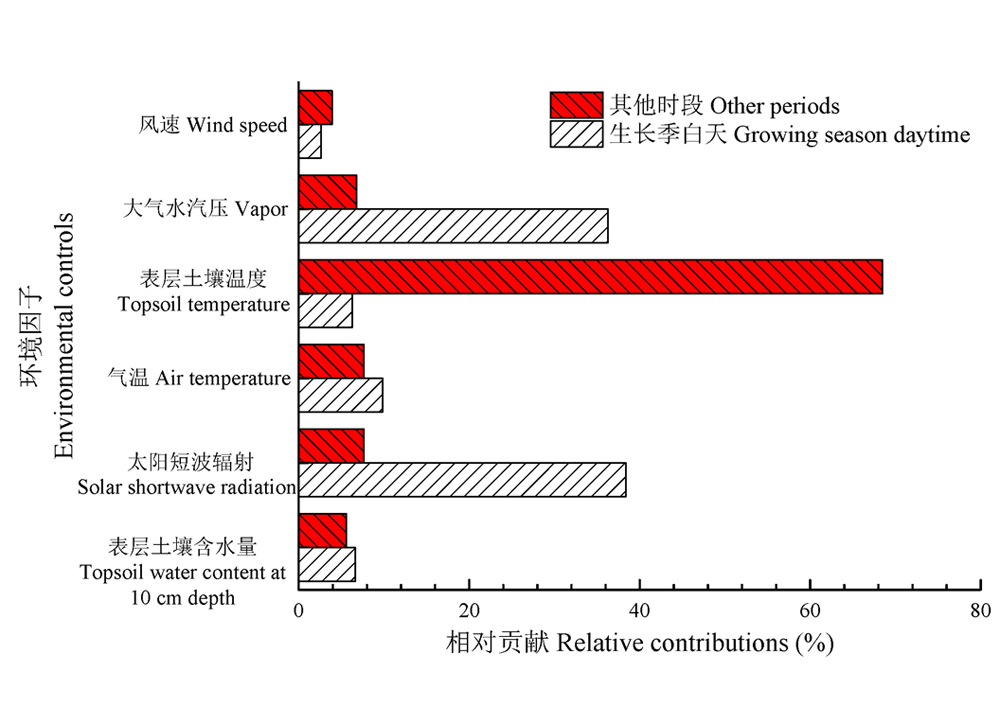
Important findings The results showed that the BRT performed well for a large amount of samples (N > 10 000) and the regression slopes of observation data against predicted value were between 1.01 and 1.05 with R2 > 0.80. The BRT revealed that the daytime 30-min CO2 flux (net ecosystem CO2 exchange, NEE) in the growing season (i.e., May to October) was mainly controlled by solar shortwave radiation and atmospheric vapor pressure, whose relative contributions to NEE variability were up to 74.7%. The topsoil temperature was the determinant for NEE at night during the growing season and the whole day during the non-growing season, and its relative contribution was 68.5%. The 30-min sensible heat flux (H) and latent heat flux (LE) were both linearly related to solar radiation, and their relative contributions were above 58.6%. 30-min flux data gap amount filled by the BRT was significantly less than those by ChinaFLUX. Except for daily net ecosystem CO2 exchange (p = 0.14), daily gross ecosystem CO2 exchange (GEE), ecosystem respiration (RES), H, and LE of the BRT were significantly less than those of ChinaFLUX by 17.5%, 21.0%, 2.7%, and 2.2%, respectively. However, there was a reasonable consistency between the daily fluxes of 2003-2005 interpolated by the BRT and by ChinaFLUX due to the small magnitude difference (the regression slopes of the two data series were between 0.95 and 1.17). Except for monthly GEE and RES, monthly NEE, H, and LE of the BRT had no significant difference between the BRT and ChinaFLUX (p > 0.09). Compared with the ChinaFLUX gap-filling method, BRT can simulate the nonlinear relationships between fluxes and environmental factors without complicated mathematical expressions and quantify the relative contribution of environmental factors to the flux data gaps, which is a feasible technique for the integrated analysis of flux data.
LI Hong-Qin, ZHANG Ya-Ru, ZHANG Fa-Wei, MA Wen-Jing, LUO Fang-Lin, WANG Chun-Yu, YANG Yong-Sheng, ZHANG Lei-Ming, LI Ying-Nian . Application of boosted regression trees for the gap-filling to flux dataset in an alpine scrubland of Qingzang Plateau[J]. Chinese Journal of Plant Ecology, 2022 , 46(12) : 1437 -1447 . DOI: 10.17521/cjpe.2021.0259
| [1] | Baldocchi DD (2003). Assessing the eddy covariance technique for evaluating carbon dioxide exchange rates of ecosystems: past, present and future. Global Change Biology, 9, 479-492. |
| [2] | Baldocchi DD (2020). How eddy covariance flux measurements have contributed to our understanding of Global Change Biology. Global Change Biology, 26, 242-260. |
| [3] | Chen SP, You CH, Hu ZM, Chen Z, Zhang LM, Wang QF (2020). Eddy covariance technique and its applications in flux observations of terrestrial ecosystems. Chinese Journal of Plant Ecology, 44, 291-304. |
| [3] | [ 陈世苹, 游翠海, 胡中民, 陈智, 张雷明, 王秋凤 (2020). 涡度相关技术及其在陆地生态系统通量研究中的应用. 植物生态学报, 44, 291-304.] |
| [4] | De’Ath G (2002). Multivariate regression trees: a new technique for constrained classification analysis. Ecology, 83, 1105-1117. |
| [5] | De’Ath G (2007). Boosted trees for ecological modeling and prediction. Ecology, 88, 243-251. |
| [6] | Desai AR, Richardson AD, Moffat AM, Kattge J, Hollinger DY, Barr A, Falge E, Noormets A, Papale D, Reichstein M, Stauch VJ (2008). Cross-site evaluation of eddy covariance GPP and RE decomposition techniques. Agricultural and Forest Meteorology, 148, 821-838. |
| [7] | Elith J, Leathwick JR, Hastie T (2008). A working guide to boosted regression trees. Journal of Animal Ecology, 77, 802-813. |
| [8] | Falge E, Baldocchi D, Olson R, Anthoni P, Aubinet M, Bernhofer C, Burba G, Ceulemans R, Clement R, Dolman H, Granier A, Gross P, Grünwald T, Hollinger D, Jensen NO, et al. (2001). Gap filling strategies for defensible annual sums of net ecosystem exchange. Agricultural and Forest Meteorology, 107, 43-69. |
| [9] | He HL, Yu GR, Zhang LM, Sun XM, Su W (2006). Simulating CO2 flux of three different ecosystems in ChinaFLUX based on artificial neural networks. Science in China Series D: Earth Sciences, 49, 252-261. |
| [10] | Kang M, Ichii K, Kim J, Indrawati YM, Park J, Moon M, Lim JH, Chun JH (2019). New gap-filling strategies for long-period flux data gaps using a data-driven approach. Atmosphere, 10, 568. DOI: 10.3390/atmos10100568. |
| [11] | Kim Y, Johnson MS, Knox SH, Black TA, Dalmagro HJ, Kang M, Kim J, Baldocchi D (2020). Gap-filling approaches for eddy covariance methane fluxes: a comparison of three machine learning algorithms and a traditional method with principal component analysis. Global Change Biology, 26, 1499-1518. |
| [12] | Li C, He HL, Liu M, Su W, Fu YL, Zhang LM, Wen XF, Yu GR (2008). The design and application of CO2 flux data processing system at ChinaFLUX. Geo-information Science, 10, 557-565. |
| [12] | [ 李春, 何洪林, 刘敏, 苏文, 伏玉玲, 张雷明, 温学发, 于贵瑞 (2008). ChinaFLUX CO2通量数据处理系统与应用. 地球信息科学学报, 10, 557-565.] |
| [13] | Li HQ, Zhang FW, Li YN, Cao GM, Zhao L, Zhao XQ (2014). Seasonal and interannual variations of ecosystem photosynthetic features in an alpine dwarf shrubland on the Qinghai-Tibetan Plateau, China. Photosynthetica, 52, 321-331. |
| [14] | Li HQ, Zhang FW, Li YN, Wang JB, Zhang LM, Zhao L, Cao GM, Zhao XQ, Du MY (2016). Seasonal and inter-annual variations in CO2 fluxes over 10 years in an alpine shrubland on the Qinghai-Tibetan Plateau, China. Agricultural and Forest Meteorology, 228-229, 95-103. |
| [15] | Li HQ, Zhang FW, Li YN, Zhao XQ, Cao GM (2015). Thirty-year variations of above-ground net primary production and precipitation-use efficiency of an alpine meadow in the north-eastern Qinghai-Tibetan Plateau. Grass and Forage Science, 71, 208-218. |
| [16] | Li HQ, Zhang FW, Zhu JB, Guo XW, Li YK, Lin L, Zhang LM, Yang YS, Li YN, Cao GM, Zhou HK, Du MY (2021). Precipitation rather than evapotranspiration determines the warm-season water supply in an alpine shrub and an alpine meadow. Agricultural and Forest Meteorology, 300, 108318. DOI: 10.1016/j.agrformet.2021.108318. |
| [17] | Li HQ, Zhu JB, Zhang FW, He HD, Yang YS, Li YN, Cao GM, Zhou HK (2019). Growth stage-dependant variability in water vapor and CO2 exchanges over a humid alpine shrubland on the northeastern Qinghai-Tibetan Plateau. Agricultural and Forest Meteorology, 268, 55-62. |
| [18] | Moffat AM, Papale D, Reichstein M, Hollinger DY, Richardson AD, Barr AG, Beckstein C, Braswell BH, Churkina G, Desai AR, Falge E, Gove JH, Heimann M, Hui D, Jarvis AJ, Kattge J, Noormets A, Stauch VJ (2007). Comprehensive comparison of gap-filling techniques for eddy covariance net carbon fluxes. Agricultural and Forest Meteorology, 147, 209-232. |
| [19] | Niu SL, Wang S, Wang JS, Xia JY, Yu GR (2020). Integrative ecology in the era of big data—From observation to prediction. Science China Earth Sciences, 63, 1429-1442. |
| [20] | Richardson AD, Hollinger DY (2007). A method to estimate the additional uncertainty in gap-filled NEE resulting from long gaps in the CO2 flux record. Agricultural and Forest Meteorology, 147, 199-208. |
| [21] | Reichstein M, Falge E, Baldocchi D, Papale D, Aubinet M, Berbigier P, Bernhofer C, Buchmann N, Gilmanov T, Granier A, Grünwald T, Havránková K, Ilvesniemi H, Janous D, Knohl A, et al. (2005). On the separation of net ecosystem exchange into assimilation and ecosystem respiration: review and improved algorithm. Global Change Biology, 11, 1424-1439. |
| [22] | Soloway AD, Amiro BD, Dunn AL, Wofsy SC (2017). Carbon neutral or a sink? Uncertainty caused by gap-filling long-term flux measurements for an old-growth boreal black spruce forest. Agricultural and Forest Meteorology, 233, 110-121. |
| [23] | Soykan CU, Eguchi T, Kohin S, Dewar H (2014). Prediction of fishing effort distributions using boosted regression trees. Ecological Applications, 24, 71-83. |
| [24] | Wei D, Qi YH, Ma YM, Wang XF, Ma WQ, Gao TG, Huang L, Zhao H, Zhang JX, Wang XD (2021). Plant uptake of CO2outpaces losses from permafrost and plant respiration on the Tibetan Plateau. Proceedings of the National Academy of Sciences of the United States of America, 118, e2015283118. DOI: 10.1073/pnas.2015283118. |
| [25] | Yu G, Chen Z, Zhang L, Peng C, Chen J, Piao S, Zhang Y, Niu S, Wang Q, Luo Y, Philippe C, Dennis BD (2017). Recognizing the scientific mission of flux tower observation networks—Lay the solid scientific data foundation for solving ecological issues related to global change. Journal of Resources and Ecology, 8, 115-120. |
| [26] | Yu GR, Sun XM (2006). Principles of Flux Measurements in Terrestrial Ecosystems. High Education Press, Beijing. |
| [26] | [ 于贵瑞, 孙晓敏 (2006). 陆地生态系统通量观测的原理与方法. 高等教育出版社, 北京.] |
| [27] | Zhang FW, Li HQ, Wang WY, Li YK, Lin L, Guo XW, Du YG, Li Q, Yang YS, Cao GM, Li YN (2018). Net radiation rather than surface moisture limits evapotranspiration over a humid alpine meadow on the northeastern Qinghai-Tibetan Plateau. Ecohydrology, 11, e1925. DOI: 10.1002/eco.1925. |
| [28] | Zhang FW, Han Y, Li HQ, Li YN, Cao GM, Zhou HK (2020a). Turbulent heat exchange and partitioning and its environmental controls between the atmosphere and an alpine Potentilla fruticosa shrublands over the Qinghai-Tibetan Plateau. Chinese Journal of Agrometeorology, 41, 76-85. |
| [28] | [ 张法伟, 韩赟, 李红琴, 李英年, 曹广民, 周华坤 (2020a). 青藏高原高寒金露梅灌丛湍流热通量交换与分配特征及其环境影响机制. 中国农业气象, 41, 76-85.] |
| [29] | Zhang FW, Li HQ, Zhao L, Zhang LM, Chen Z, Zhu JB, Xu SX, Yang YS, Zhao XQ, Yu GR, Li YN (2020b). An observation dataset of carbon, water and heat fluxes over an alpine shrubland in Haibei (2003-2010). Science Data Bank, 6. DOI: 10.11922/csdata.2020.0034.zh. |
| [29] | [ 张法伟, 李红琴, 赵亮, 张雷明, 陈智, 祝景彬, 徐世晓, 杨永胜, 赵新全, 于贵瑞, 李英年 (2020b). 2003-2010年海北高寒灌丛碳水热通量观测数据集. 中国科学数据, 6. DOI: 10.11922/csdata.2020.0034.zh.] |
| [30] | Zhang LM, Luo YW, Liu M, Chen Z, Su W, He HL, Zhu ZL, Sun XM, Wang YF, Zhou GY, Zhao XQ, Han SJ, Ouyang Z, Zhang XZ, Zhang YP, et al. (2019). Carbon and water fluxes observed by the Chinese Flux Observation and Research Network (2003- 2005). Science Data Bank, 4. DOI: 10.11922/csdata.2018.0028.zh. |
| [30] | [ 张雷明, 罗艺伟, 刘敏, 陈智, 苏文, 何洪林, 朱治林, 孙晓敏, 王艳芬, 周国逸, 赵新全, 韩世杰, 欧阳竹, 张宪洲, 张一平, 等 (2019). 2003-2005年中国通量观测研究联盟(ChinaFLUX)碳水通量观测数据集. 中国科学数据, 4. DOI: 10.11922/csdata.2018.0028.zh.] |
| [31] | Zhao L, Li YN, Xu SX, Zhou HK, Gu S, Yu GR, Zhao XQ (2006). Diurnal, seasonal and annual variation in net ecosystem CO2 exchange of an alpine shrubland on Qinghai- Tibetan Plateau. Global Change Biology, 12, 1940-1953. |
/
| 〈 |
|
〉 |
Copyright © 2026 Chinese Journal of Plant Ecology
Tel: 010-62836134, 62836138, E-mail: apes@ibcas.ac.cn, cjpe@ibcas.ac.cn

