
Chinese Journal of Plant Ecology >
Advances in the study of shrubland facilitation on herbs in arid and semi-arid regions
Received date: 2021-10-26
Accepted date: 2022-03-22
Online published: 2022-03-30
Supported by
The Key Technology Research and Development Project in Xizang Autonomous Region(XZ202101ZY0005G);The Second Tibetan Plateau Scientific Expedition and Research Program (STEP)(2019QZKK0301)
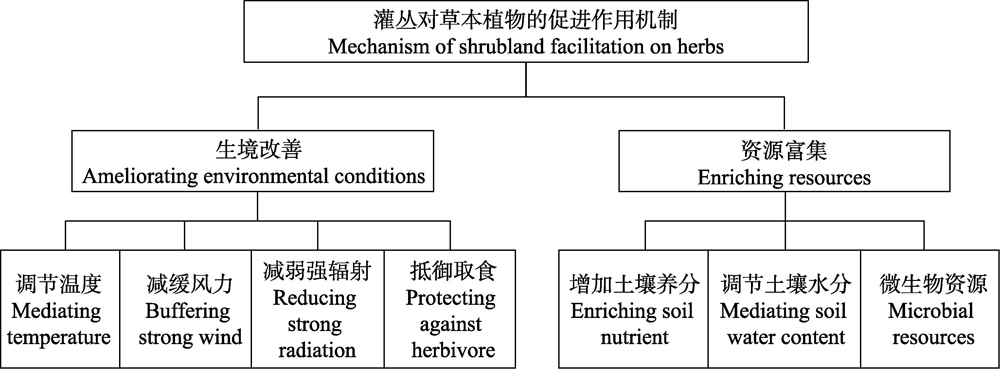
Competition and facilitation among plants are an important part of the mechanisms regulating the responses of species, communities, and ecosystems to environmental changes. Basically, facilitation plays a more important role than competition in stress environments. The present review summarized the research progress of shrubland facilitation in arid and semi-arid regions in the past 30 years, on the aspects of trends of facilitation along a water availability gradient, mechanisms of shrubland facilitation, and the application of shrubland facilitation in vegetation restoration. As the most important empirical model that predicts the trend of plant-plant interactions along abiotic stress gradient, stress gradient hypothesis (SGH) posits that facilitation increases with increasing abiotic stress. However, SGH has been largely debated in water limiting system. Shrubland facilitation does not always increase linearly with the decreasing water availability, which is not only closely related to the complex impact of shrub on soil water, but also associates with the species identities, plant life history stages, study methods, scales and indicators. Arid shrubs could affect the survival, growth, and reproduction of its understory plants via ameliorating soil moisture and nutrient, mediating soil microbial community compositions, buffering extreme temperature and radiation, and resisting predators. Removal studies have shown that the effects of shrub on belowground play a stronger role than aboveground on shrubland facilitation. Shrubland facilitations are commonly considered a potential effective approach of vegetation restoration in degraded ecosystems. Whereas, the success of vegetation restoration is comprehensively affected by the abiotic stress, species identities, plant life history stages and land use. Under the dual influence of climate change and human activities, the areas of drylands and shrublands are assumed to be expanding. Thus, the studies on mechanisms of shrubland facilitation and trends of shrub-herbs interactions along drought gradient, as well as the effects of shrub on herbs, are critical for predicting the responses of species and grassland to climate change in arid and semi-arid regions. Based on the current research progresses and environmental changes in arid and semi-arid regions, the present review proposes the following issues in the future studies: 1) exploring the biological indicators to the abiotic stress and plant-plant interactions; 2) clarifying the relative contribution of shrub belowground versus aboveground on facilitation, in order to disclose the mechanisms of shrubland facilitation; 3) exploring the feedback effect of beneficiaries on facilitators; 4) assessing the comprehensive role of nurse plants on vegetation restoration; 5) popularizing the study methods of manipulative water experiments and long-term positioning observations on shrubland facilitation; and 6) addressing the study of plant facilitation on related research issues, such as the relationship between facilitation and species invasion, shrub encroachment, biodiversity and ecosystem function, and the response of facilitation to climate change.
CUI Guang-Shuai, LUO Tian-Xiang, LIANG Er-Yuan, ZHANG Lin . Advances in the study of shrubland facilitation on herbs in arid and semi-arid regions[J]. Chinese Journal of Plant Ecology, 2022 , 46(11) : 1321 -1333 . DOI: 10.17521/cjpe.2021.0382
| [1] | Ale R, Zhang L, Li X, Raskoti BB, Pugnaire FI, Luo TX (2018a). Leaf δ13C as an indicator of water availability along elevation gradients in the dry Himalayas. Ecological Indicators, 94, 266-273. |
| [2] | Ale R, Zhang L, Li X, Raskoti BB, Pugnaire FI, Luo TX (2018b). Water shortage drives interactions between cushion and beneficiary species along elevation gradients in dry Himalayas. Journal of Geophysical Research: Biogeosciences, 123, 226-238. |
| [3] | Anthelme F, Cavieres LA, Dangles O (2014). Facilitation among plants in alpine environments in the face of climate change. Frontiers in Plant Science, 5, 387. DOI: 10.3389/ fpls.2014.00387. |
| [4] | Armas C, Pugnaire FI (2005). Plant interactions govern population dynamics in a semi-arid plant community. Journal of Ecology, 93, 978-989. |
| [5] | Armas C, Rodríguez-Echeverría S, Pugnaire FI (2011). A field test of the stress-gradient hypothesis along an aridity gradient. Journal of Vegetation Science, 22, 818-827. |
| [6] | Báez S, Collins SL, Pockman WT, Johnson JE, Small EE (2013). Effects of experimental rainfall manipulations on Chihuahuan Desert grassland and shrubland plant communities. Oecologia, 172, 1117-1127. |
| [7] | Ballantyne M, Pickering CM (2015). Shrub facilitation is an important driver of alpine plant community diversity and functional composition. Biodiversity and Conservation, 24, 1859-1875. |
| [8] | Barchuk AH, Valiente-Banuet A, Díaz MP (2005). Effect of shrubs and seasonal variability of rainfall on the establishment of Aspidosperma quebracho-blanco in two edaphically contrasting environments. Austral Ecology, 30, 695-705. |
| [9] | Berdugo M, Maestre FT, Kéfi S, Gross N, Le Bagousse-Pinguet Y, Soliveres S (2019). Aridity preferences alter the relative importance of abiotic and biotic drivers on plant species abundance in global drylands. Journal of Ecology, 107, 190-202. |
| [10] | Bertness MD (1991). Interspecific interactions among high marsh perennials in a New England salt marsh. Ecology, 72, 125-137. |
| [11] | Bertness MD, Callaway R (1994). Positive interactions in communities. Trends in Ecology & Evolution, 9, 191-193. |
| [12] | Bertness MD, Hacker SD (1994). Physical stress and positive associations among marsh plants. The American Naturalist, 144, 363-372. |
| [13] | Bertness MD, Shumway SW (1993). Competition and facilitation in marsh plants. The American Naturalist, 142, 718-724. |
| [14] | Br?then KA, Lortie C (2016). A portfolio effect of shrub canopy height on species richness in both stressful and competitive environments. Functional Ecology, 30, 60-69. |
| [15] | Brooker RW (2006). Plant-plant interactions and environmental change. New Phytologist, 171, 271-284. |
| [16] | Brooker RW, Maestre FT, Callaway RM, Lortie CL, Cavieres LA, Kunstler G, Liancourt P, Tielb?rger K, Travis JMJ, Anthelme F, Armas C, Coll L, Corcket E, Delzon S, Forey E, et al. (2008). Facilitation in plant communities: the past, the present, and the future. Journal of Ecology, 96, 18-34. |
| [17] | Bruno JF, Stachowicz JJ, Bertness MD (2003). Inclusion of facilitation into ecological theory. Trends in Ecology & Evolution, 18, 119-125. |
| [18] | Butterfield BJ, Bradford JB, Armas C, Prieto I, Pugnaire FI (2016). Does the stress-gradient hypothesis hold water? Disentangling spatial and temporal variation in plant effects on soil moisture in dryland systems. Functional Ecology, 30, 10-19. |
| [19] | Butterfield BJ, Cavieres LA, Callaway RM, Cook BJ, Kikvidze Z, Lortie CJ, Michalet R, Pugnaire FI, Sch?b C, Xiao S, Zaitchek B, Anthelme F, Bj?rk RG, Dickinson K, Gavilan R, et al. (2013). Alpine cushion plants inhibit the loss of phylogenetic diversity in severe environments. Ecology Letters, 16, 478-486. |
| [20] | Cai YR, Yan YC, Xu DW, Xu XL, Wang C, Wang X, Chen JQ, Xin XP, Eldridge DJ (2020). The fertile island effect collapses under extreme overgrazing: evidence from a shrub-encroached grassland. Plant and Soil, 448, 201-212. |
| [21] | Callaway RM (1995). Positive interactions among plants. Botanical Review, 61, 306-349. |
| [22] | Callaway RM (2007). Positive Interactions and Interdependence in Plant Communities. Springer Science & Business Media, Berlin. |
| [23] | Callaway RM, Brooker RW, Choler P, Kikvidze Z, Lortie CJ, Michalet R, Paolini L, Pugnaire FI, Newingham B, Aschehoug ET, Armas C, Kikodze D, Cook BJ (2002). Positive interactions among alpine plants increase with stress. Nature, 417, 844-848. |
| [24] | Cavieres LA, Badano EI, Sierra-Almeida A, Gómez-González S, Molina-Montenegro MA (2006). Positive interactions between alpine plant species and the nurse cushion plant Laretia acaulis do not increase with elevation in the Andes of central Chile. New Phytologist, 169, 59-69. |
| [25] | Cavieres LA, Brooker RW, Butterfield BJ, Cook BJ, Kikvidze Z, Lortie CJ, Michalet R, Pugnaire FI, Sch?b C, Xiao S, Anthelme F, Bj?rk RG, Dickinson KJM, Cranston BH, Gavilán R, et al. (2014). Facilitative plant interactions and climate simultaneously drive alpine plant diversity. Ecology Letters, 17, 193-202. |
| [26] | Cavieres LA, Hernández-Fuentes C, Sierra-Almeida A, Kikvidze Z (2016). Facilitation among plants as an insurance policy for diversity in alpine communities. Functional Ecology, 30, 52-59. |
| [27] | Chaieb G, Wang XT, Abdelly C, Michalet R (2021). Shift from short-term competition to facilitation with drought stress is due to a decrease in long-term facilitation. Oikos, 130, 29-40. |
| [28] | Choler P, Michalet R, Callaway RM (2001). Facilitation and competition on gradients in alpine plant communities. Ecology, 82, 3295-3308. |
| [29] | Chu CJ (2010). Effects of Positive Interactions Among Plants on Population Dynamics and Community Structures. PhD dissertation, Lanzhou Unversity, Lanzhou. 5-8. |
| [29] | [ 储诚进 (2010) 植物间正相互作用对种群动态与群落结构的影响研究. 博士学位论文, 兰州大学, 兰州. 5-8.] |
| [30] | Chu CJ, Maestre FT, Xiao S, Weiner J, Wang YS, Duan ZH, Wang G (2008). Balance between facilitation and resource competition determines biomass-density relationships in plant populations. Ecology Letters, 11, 1189-1197. |
| [31] | Constantinou E, Sarris D, Vogiatzakis IN (2021). The possible role of Ziziphus lotus as an ecosystem engineer in semiarid landscapes. Journal of Arid Environments, 195, 104614. DOI: 10.1016/j.jaridenv.2021.104614. |
| [32] | Dai AG (2011). Drought under global warming: a review. Wiley Interdisciplinary Reviews Climate Change, 2, 45-65. |
| [33] | Dai AG, Trenberth KE, Qian TT (2004). A global dataset of Palmer Drought Severity Index for 1870-2002: relationship with soil moisture and effects of surface warming. Journal of Hydrometeorology, 5, 1117-1130. |
| [34] | Darrouzet-Nardi A, D’Antonio CM, Dawson TE (2006). Depth of water acquisition by invading shrubs and resident herbs in a Sierra Nevada meadow. Plant and Soil, 285, 31-43. |
| [35] | de Dios Miranda J, Padilla FM, Lázaro R, Pugnaire FI (2009). Do changes in rainfall patterns affect semiarid annual plant communities? Journal of Vegetation Science, 20, 269-276. |
| [36] | Dovrat G, Masci T, Bakhshian H, Mayzlish Gati E, Golan S, Sheffer E (2018). Drought-adapted plants dramatically downregulate dinitrogen fixation: evidences from Mediterranean legume shrubs. Journal of Ecology, 106, 1534-1544. |
| [37] | Dovrat G, Sheffer E (2019). Symbiotic dinitrogen fixation is seasonal and strongly regulated in water-limited environments. New Phytologist, 221, 1866-1877. |
| [38] | Duponnois R, Ouahmane L, Kane A, Thioulouse J, Hafidi M, Boumezzough A, Prin Y, Baudoin E, Galiana A, Dreyfus B (2011). Nurse shrubs increased the early growth of Cupressus seedlings by enhancing belowground mutualism and soil microbial activity. Soil Biology & Biochemistry, 43, 2160-2168. |
| [39] | Eldridge DJ, Bowker MA, Maestre FT, Roger E, Reynolds JF, Whitford WG (2011). Impacts of shrub encroachment on ecosystem structure and functioning: towards a global synthesis. Ecology Letters, 14, 709-722. |
| [40] | Gómez-Aparicio L (2009). The role of plant interactions in the restoration of degraded ecosystems: a meta-analysis across life-forms and ecosystems. Journal of Ecology, 97, 1202-1214. |
| [41] | Gómez-Aparicio L, Zamora R, Gómez JM, Hódar JA, Castro J, Baraza E (2004). Applying plant facilitation to forest restoration: a meta-analysis of the use of shrubs as nurse plants. Ecological Applications, 14, 1128-1138. |
| [42] | Hamerlynck EP, Scott RL, Susan Moran M, Schwander AM, Connor E, Huxman TE (2011). Inter- and under-canopy soil water, leaf-level and whole-plant gas exchange dynamics of a semi-arid perennial C4 grass. Oecologia, 165, 17-29. |
| [43] | Han DY, Wang JF Ahan J, Zhao Y, Yang YF (2021). Soil and shrub differentially determine understorey herbaceous plant richness and abundance in a semi-arid riparian meadow. Community Ecology, 22, 113-125. |
| [44] | He L, Cheng LL, Hu LL, Tang JJ, Chen X (2016). Deviation from niche optima affects the nature of plant-plant interactions along a soil acidity gradient. Biology Letters, 12, 20150925. DOI: 10.1098/rsbl.2015.0925. |
| [45] | He Q, Bertness MD, Altieri AH (2013). Global shifts towards positive species interactions with increasing environmental stress. Ecology Letters, 16, 695-706. |
| [46] | Holmgren M, Gómez-Aparicio L, Quero JL, Valladares F (2012). Non-linear effects of drought under shade: reconciling physiological and ecological models in plant communities. Oecologia, 169, 293-305. |
| [47] | Holmgren M, Scheffer M (2010). Strong facilitation in mild environments: the stress gradient hypothesis revisited. Journal of Ecology, 98, 1269-1275. |
| [48] | Holzapfel C, Tielb?rger K, Parag HA, Kigel J, Sternberg M (2006). Annual plant-shrub interactions along an aridity gradient. Basic and Applied Ecology, 7, 268-279. |
| [49] | Hooper DU, Chapin III FS, Ewel JJ, Hector A, Inchausti P, Lavorel S, Lawton JH, Lodge DM, Loreau M, Naeem S, Schmid B, Set?l? H, Symstad AJ, Vandermeer J, Wardle DA (2005). Effects of biodiversity on ecosystem functioning: a consensus of current knowledge. Ecological Monographs, 75, 3-35. |
| [50] | Hoover DL, Bestelmeyer B, Grimm NB, Huxman TE, Reed SC, Sala O, Seastedt TR, Wilmer H, Ferrenberg S (2020). Traversing the wasteland: a framework for assessing ecological threats to drylands. BioScience, 70, 35-47. |
| [51] | Hortal S, Bastida F, Armas C, Lozano YM, Moreno JL, García C, Pugnaire FI (2013). Soil microbial community under a nurse-plant species changes in composition, biomass and activity as the nurse grows. Soil Biology & Biochemistry, 64, 139-146. |
| [52] | Huang J, Guan X, Ji F (2012). Enhanced cold-season warming in semi-arid regions. Atmospheric Chemistry and Physics, 12, 5391-5398. |
| [53] | Ibá?ez I, Rodríguez A (2020). Understanding neighborhood effects to increase restoration success of woody plant communities. Ecological Applications, 30, e02098. DOI: 10.1002/eap.2098. |
| [54] | IPCC (2013). Climate Change 2013: the Physical Science Basis. Cambridge University Press, Cambridge, New York. |
| [55] | Iyengar SB, Bagchi S, Barua D, Mishra C, Sankaran M (2017). A dominant dwarf shrub increases diversity of herbaceous plant communities in a Trans-Himalayan rangeland. Plant Ecology, 218, 843-854. |
| [56] | Kikvidze Z, Pugnaire FI, Brooker RW, Choler P, Lortie CJ, Michalet R, Callaway RM (2005). Linking patterns and processes in alpine plant communities: a global study. Ecology, 86, 1395-1400. |
| [57] | Knapp AK, Briggs JM, Collins SL, Archer SR, Bret-harte MS, Ewers BE, Peters DP, Young DR, Shaver GR, Pendall E, Cleary MB (2008). Shrub encroachment in North American grasslands: shifts in growth form dominance rapidly alters control of ecosystem carbon inputs. Global Change Biology, 14, 615-623. |
| [58] | Liancourt P, Callaway RM, Michalet R (2005). Stress tolerance and competitive-response ability determine the outcome of biotic interactions. Ecology, 86, 1611-1618. |
| [59] | Liancourt P, Dolezal J (2021). Community-scale effects and strain: facilitation beyond conspicuous patterns. Journal of Ecology, 109, 19-25. |
| [60] | Liancourt P, Le Bagousse-Pinguet Y, Rixen C, Dolezal J (2017). SGH: stress or strain gradient hypothesis? Insights from an elevation gradient on the roof of the world. Annals of Botany, 120, 29-38. |
| [61] | Liu L, Bai YX, She WW, Qiao YG, Qin SG, Zhang YQ (2021). A nurse shrub species helps associated herbaceous plants by preventing shade-induced evaporation in a desert ecosystem. Land Degradation & Development, 32, 1796-1808. |
| [62] | Liu ZZ, Fu Y, Ma X, Xie CJ, Qiu DD, Sui HC, Cui BS (2020). Advances and prospects of incorporating facilitation in ecological restoration. Environmental Ecology, 2(Z1), 41-47. |
| [62] | [ 刘泽正, 傅宇, 马旭, 解成杰, 邱冬冬, 隋皓辰, 崔保山 (2020). 促进作用理论在生态修复中的应用进展与发展趋势. 环境生态学, 2(Z1), 41-47.] |
| [63] | Lortie CJ, Callaway RM (2006). Re-analysis of meta-analysis: support for the stress-gradient hypothesis. Journal of Ecology, 94, 7-16. |
| [64] | Lortie CJ, Filazzola A, Sotomayor DA (2016). Functional assessment of animal interactions with shrub-facilitation complexes: a formal synthesis and conceptual framework. Functional Ecology, 30, 41-51. |
| [65] | Losapio G, Pugnaire FI, O’Brien MJ, Sch?b C (2018). Plant life history stage and nurse age change the development of ecological networks in an arid ecosystem. Oikos, 127, 1390-1397. |
| [66] | Loydi A, Eckstein RL, Otte A, Donath TW (2013). Effects of litter on seedling establishment in natural and semi-natural grasslands: a meta-analysis. Journal of Ecology, 101, 454-464. |
| [67] | Lozano YM, Hortal S, Armas C, Pugnaire FI (2020). Complementarity in nurse plant systems: soil drives community composition while microclimate enhances productivity and diversity. Plant and Soil, 450, 385-396. |
| [68] | Madrigal-González J, Kelt DA, Meserve PL, Squeo FA, Gutiérrez JR (2016). Shrub-ephemeral plants interactions in semiarid north-central Chile: Is the nurse plant syndrome manifested at the community level? Journal of Arid Environments, 126, 47-53. |
| [69] | Maestre FT, Bautista S, Cortina J (2003). Positive, negative, and net effects in grass-shrub interactions in Mediterranean semiarid grasslands. Ecology, 84, 3186-3197. |
| [70] | Maestre FT, Bautista S, Cortina J, Bellot J (2001). Potential for using facilitation by grasses to establish shrubs on a semiarid degraded steppe. Ecological Applications, 11, 1641-1655. |
| [71] | Maestre FT, Bowker MA, Puche MD, Belén Hinojosa M, Martínez I, García-Palacios P, Castillo AP, Soliveres S, Luzuriaga AL, Sanchez AM, Carreira JA, Gallardo A, Escudero A (2009a). Shrub encroachment can reverse desertification in semi-arid Mediterranean grasslands. Ecology Letters, 12, 930-941. |
| [72] | Maestre FT, Callaway RM, Valladares F, Lortie CJ (2009b). Refining the stress-gradient hypothesis for competition and facilitation in plant communities. Journal of Ecology, 97, 199-205. |
| [73] | Maestre FT, Cortina J (2004). Do positive interactions increase with abiotic stress? A test from a semi-arid steppe. Proceedings of the Royal Society B: Biological Sciences, 271, S331-S333. |
| [74] | Maestre FT, Valladares F, Reynolds JF (2005). Is the change of plant-plant interactions with abiotic stress predictable? A meta-analysis of field results in arid environments. Journal of Ecology, 93, 748-757. |
| [75] | Maestre FT, Valladares F, Reynolds JF (2006). The stress- gradient hypothesis does not fit all relationships between plant-plant interactions and abiotic stress: further insights from arid environments. Journal of Ecology, 94, 17-22. |
| [76] | Malkinson D, Tielb?rger K (2010). What does the stress- gradient hypothesis predict? Resolving the discrepancies. Oikos, 119, 1546-1552. |
| [77] | Metz J, Tielb?rger K (2016). Spatial and temporal aridity gradients provide poor proxies for plant-plant interactions under climate change: a large-scale experiment. Functional Ecology, 30, 20-29. |
| [78] | Michalet R, Brooker RW, Cavieres LA, Kikvidze Z, Lortie CJ, Pugnaire FI, Valiente-Banuet A, Callaway RM (2006). Do biotic interactions shape both sides of the humped-back model of species richness in plant communities? Ecology Letters, 9, 767-773. |
| [79] | Michalet R, Brooker RW, Lortie CJ, Maalouf JP, Pugnaire FI (2015). Disentangling direct and indirect effects of a legume shrub on its understorey community. Oikos, 124, 1251-1262. |
| [80] | Michalet R, Pugnaire FI (2016). Facilitation in communities: underlying mechanisms, community and ecosystem implications. Functional Ecology, 30, 3-9. |
| [81] | Michalet R, Sch?b C, Xiao S, Zhao L, Chen T, An LZ, Callaway RM (2016). Beneficiary feedback effects on alpine cushion benefactors become more negative with increasing cover of graminoids and in dry conditions. Functional Ecology, 30, 79-87. |
| [82] | Miriti MN (2006). Ontogenetic shift from facilitation to competition in a desert shrub. Journal of Ecology, 94, 973-979. |
| [83] | Moro MJ, Pugnaire FI, Haase P, Puigdefábregas J (1997a). Mechanisms of interaction between a leguminous shrub and its understorey in a semi-arid environment. Ecography, 20, 175-184. |
| [84] | Moro MJ, Pugnaire FI, Haase P, Puigdefábregas J (1997b). Effect of the canopy of Retama sphaerocarpa on its understorey in a semiarid environment. Functional Ecology, 11, 425-431. |
| [85] | Noumi Z, Chaieb M, Le Bagousse-Pinguet Y, Michalet R (2016). The relative contribution of short-term versus long-term effects in shrub-understory species interactions under arid conditions. Oecologia, 180, 529-542. |
| [86] | O’Brien MJ, Pugnaire FI, Armas C, Rodríguez-Echeverría S, Sch?b C (2017). The shift from plant-plant facilitation to competition under severe water deficit is spatially explicit. Ecology and Evolution, 7, 2441-2448. |
| [87] | Ouyang SN, Tian YQ, Liu QY, Zhang L, Sun Y, Xu XL, Liu YH (2016). Symbiotic nitrogen fixation and interspecific transfer by Caragana microphylla in a temperate grassland with 15N dilution technique. Applied Soil Ecology, 108, 221-227. |
| [88] | Padilla FM, de Dios Miranda, Jorquera MJ, Pugnaire FI (2009a). Variability in amount and frequency of water supply affects roots but not growth of arid shrubs. Plant Ecology, 204, 261-270. |
| [89] | Padilla FM, Ortega R, Sánchez J, Pugnaire FI (2009b). Rethinking species selection for restoration of arid shrublands. Basic and Applied Ecology, 10, 640-647. |
| [90] | Padilla FM, Pugnaire FI (2006). The role of nurse plants in the restoration of degraded environments. Frontiers in Ecology and the Environment, 4, 196-202. |
| [91] | Padilla FM, Pugnaire FI (2007). Rooting depth and soil moisture control Mediterranean woody seedling survival during drought. Functional Ecology, 21, 489-495. |
| [92] | Padilla FM, Pugnaire FI (2009). Species identity and water availability determine establishment success under the canopy of Retama sphaerocarpa shrubs in a dry environment. Restoration Ecology, 17, 900-907. |
| [93] | Parajuli R, O’Brien MJ, Timilsina B, Pugnaire FI, Sch?eb C, Ghimire SK (2021). Facilitation by a dwarf shrub enhances plant diversity of human-valued species at high elevations in the Himalayas of Nepal. Basic and Applied Ecology, 54, 23-36. |
| [94] | Paterno GB, Siqueira Filho JA, Ganade G (2016). Species- specific facilitation, ontogenetic shifts and consequences for plant community succession. Journal of Vegetation Science, 27, 606-615. |
| [95] | Pistón N, Sch?b C, Armas C, Prieto I, Pugnaire FI (2016). Contribution of co-occurring shrub species to community richness and phylogenetic diversity along an environmental gradient. Perspectives in Plant Ecology, Evolution and Systematics, 19, 30-39. |
| [96] | Prieto I, Padilla FM, Armas C, Pugnaire FI (2011). The role of hydraulic lift on seedling establishment under a nurse plant species in a semi-arid environment. Perspectives in Plant Ecology Evolution and Systematics, 13, 181-187. |
| [97] | Pugnaire FI, Haase P, Puigdefábregas J, Cueto M, Clark SC, Incoll LD (1996). Facilitation and succession under the canopy of a leguminous shrub, Retama sphaerocarpa, in a semi-arid environment in south-east Spain. Oikos, 76, 455-464. |
| [98] | Pugnaire FI, Losapio G, Sch?b C (2021). Species interactions involving cushion plants in high-elevation environments under a changing climate. Ecosistemas, 30, 2186. DOI: 10.7818/ECOS.2186. |
| [99] | Pugnaire FI, Luque MT (2001). Changes in plant interactions along a gradient of environmental stress. Oikos, 93, 42-49. |
| [100] | Pugnaire FI, Morillo JA, Pe?uelas J, Reich PB, Bardgett RD, Gaxiola A, Wardle DA, van der Putten WH(2019). Climate change effects on plant-soil feedbacks and consequences for biodiversity and functioning of terrestrial ecosystems. Science Advances, 5, eaaz1834. DOI: 10.1126/sciadv. aaz1834. |
| [101] | Pugnaire FI, Zhang L, Li RC, Luo TX (2015). No evidence of facilitation collapse in the Tibetan Plateau. Journal of Vegetation Science, 26, 233-242. |
| [102] | Rebollo S, Milchunas DG, Noy-Meir I, Chapman PL (2002). The role of a spiny plant refuge in structuring grazed shortgrass steppe plant communities. Oikos, 98, 53-64. |
| [103] | Richards JH, Caldwell MM (1987). Hydraulic lift: substantial nocturnal water transport between soil layers by Artemisia tridentata roots. Oecologia, 73, 486-489. |
| [104] | Rodríguez-Echeverría S, Lozano YM, Bardgett RD (2016). Influence of soil microbiota in nurse plant systems. Functional Ecology, 30, 30-40. |
| [105] | Saixiyala,Yang D, Zhang SD, Liu GF, Yang XJ, Huang ZY, Ye XH (2017). Facilitation by a spiny shrub on a rhizomatous clonal herbaceous in thicketization-grassland in Northern China: increased soil resources or shelter from herbivores. Frontiers in Plant Science, 8, 809. DOI: 10.3389/fpls.2017.00809. |
| [106] | Sch?b C, Armas C, Guler M, Prieto I, Pugnaire FI (2013). Variability in functional traits mediates plant interactions along stress gradients. Journal of Ecology, 101, 753-762. |
| [107] | Shackelford N, Paterno GB, Winkler DE, Erickson TE, Leger EA, Svejcar LN, Breed MF, Faist AM, Harrison PA, Curran MF, Guo Q, Kirmer A, Law DJ, Mganga KZ, Munson SM, et al. (2021). Drivers of seedling establishment success in dryland restoration efforts. Nature Ecology & Evolution, 5, 1283-1290. |
| [108] | Soliveres S, Maestre FT (2014). Plant-plant interactions, environmental gradients and plant diversity: a global synthesis of community-level studies. Perspectives in Plant Ecology, Evolution and Systematics, 16, 154-163. |
| [109] | Soliveres S, Maestre FT, Bowker MA, Torices R, Quero JL, García-Gómez M, Cabrera O, Cea AP, Coaguila D, Eldridge DJ, Espinosa CI, Hemmings F, Monerris JJ, Tighe M, Delgado-Baquerizo M, et al. (2014). Functional traits determine plant co-occurrence more than environment or evolutionary relatedness in global drylands. Perspectives in Plant Ecology, Evolution and Systematics, 16, 164-173. |
| [110] | Soliveres S, Smit C, Maestre FT (2015). Moving forward on facilitation research: response to changing environments and effects on the diversity, functioning and evolution of plant communities. Biological Reviews, 90, 297-313. |
| [111] | Suding KN (2011) Toward an era of restoration in ecology: successes, failures, and opportunities ahead. Annual Review of Ecology, Evolution, and Systematics, 42, 465-487. |
| [112] | Tielb?rger K, Kadmon R (2000). Temporal environmental variation tips the balance between facilitation and interference in desert plants. Ecology, 81, 1544-1553. |
| [113] | Tirado R, Br?then KA, Pugnaire FI (2015). Mutual positive effects between shrubs in an arid ecosystem. Scientific Reports, 5, 14710. DOI: 10.1038/srep14710. |
| [114] | Valiente-Banuet A, Ezcurra E (1991). Shade as a cause of the association between the cactus Neobuxbaumia tetetzo and the nurse plant Mimosa luisana in the Tehuacan Valley, Mexico. Journal of Ecology, 79, 961-971. |
| [115] | van Auken OW (2009). Causes and consequences of woody plant encroachment into western North American grasslands. Journal of Environmental Management, 90, 2931-2942. |
| [116] | Wang XT, Michalet R, Chen SY, Zhao L, An LZ, Du GZ, Zhang XC, Jiang XP, Xiao S (2017). Contrasting understorey species responses to the canopy and root effects of a dominant shrub drive community composition. Journal of Vegetation Science, 28, 1118-1127. |
| [117] | Wang XT, Michalet R, Liu ZY, Guo AF, Zhou XH, Du GZ, Ge WJ, Chen SY, Xiao S (2019). Stature of dependent forbs is more related to the direct and indirect above- and below-ground effects of a subalpine shrub than are foliage traits. Journal of Vegetation Science, 30, 403-412. |
| [118] | Wang XT, Michalet R, Meng LH, Zhou XH, Chen SY, Du GZ, Xiao S (2021). Direct and indirect facilitation affect community productivity through changes in functional diversity in an alpine system. Annals of Botany, 127, 241-249. |
| [119] | Wang XT, Nielsen UN, Yang XL, Zhang LM, Zhou XH, Du GZ, Li GX, Chen SY, Xiao S (2018). Grazing induces direct and indirect shrub effects on soil nematode communities. Soil Biology & Biochemistry, 121, 193-201. |
| [120] | Wang YS, Chu CJ, Maestre FT, Wang G (2008). On the relevance of facilitation in alpine meadow communities: an experimental assessment with multiple species differing in their ecological optimum. Acta Oecologica, 33, 108-113. |
| [121] | Wei HX, Luo TX, Wu B (2016). Optimal balance of water use efficiency and leaf construction cost with a link to the drought threshold of the desert steppe ecotone in northern China. Annals of Botany, 118, 541-553. |
| [122] | Wezel A, Rajot JL, Herbrig C (2000). Influence of shrubs on soil characteristics and their function in Sahelian agro- ecosystems in semi-arid Niger. Journal of Arid Environments, 44, 383-398. |
| [123] | Xie LN, Guo HY, Gabler CA, Li QF, Ma CC (2015). Changes in spatial patterns of Caragana stenophylla along a climatic drought gradient on the Inner Mongolian Plateau. PLOS ONE, 10, e0121234. DOI: 10.1371/journal.pone.0121234. |
| [124] | Xie LN, Guo HY, Liu Z, Gabler CA, Chen WZ, Gu S, Ma CC (2017). Shrubs facilitate recruitment of Caragana stenophylla Pojark: microhabitat amelioration and protection against herbivory. Annals of Forest Science, 74, 1-12. |
| [125] | Xie LN, Soliveres S, Allan E, Zhang GG, Man L, Mei XF, Li Y, Wang YT, Ma CC (2021). Woody species have stronger facilitative effects on soil biota than on plants along an aridity gradient. Journal of Vegetation Science, 32, e13034. DOI: 10.1111/jvs.13034. |
| [126] | Xu J, Michalet R, Zhang JL, Wang G, Chu CJ, Xiao S (2010). Assessing facilitative responses to a nurse shrub at the community level: the example of Potentilla fruticosa in a sub-alpine grassland of northwest China. Plant Biology, 12, 780-787. |
| [127] | Yang L, Wei W, Chen LD, Chen WL, Wang JL (2014). Response of temporal variation of soil moisture to vegetation restoration in semi-arid Loess Plateau, China. CATENA, 115, 123-133. |
| [128] | Young TP, Petersen DA, Clary JJ (2005). The ecology of restoration: historical links, emerging issues and unexplored realms. Ecology Letters, 8, 662-673. |
| [129] | Yu RP, Lambers H, Callaway RM, Wright AJ, Li L (2021). Belowground facilitation and trait matching: two or three to tango? Trends in Plant Science, 26, 1227-1235. |
| [130] | Zhang GF, Zhao WZ, Zhou H, Yang QY, Wang XF (2018a). Extreme drought stress shifts net facilitation to neutral interactions between shrubs and sub-canopy plants in an arid desert. Oikos, 127, 381-391. |
| [131] | Zhang HY, Lü XT, Knapp AK, Hartmann H, Bai E, Wang XB, Wang ZW, Wang XG, Yu Q, Han XG (2018b). Facilitation by leguminous shrubs increases along a precipitation gradient. Functional Ecology, 32, 203-213. |
| [132] | Zhang HY, Yu Q, Lü XT, Trumbore SE, Yang JJ, Han XG (2016). Impacts of leguminous shrub encroachment on neighboring grasses include transfer of fixed nitrogen. Oecologia, 180, 1213-1222. |
| [133] | Zhang PJ, Yang J, Zhao LQ, Bao S, Song BY (2011). Effect of Caragana tibetica nebkhas on sand entrapment and fertile islands in steppe-desert ecotones on the Inner Mongolia Plateau, China. Plant and Soil, 347, 79-90. |
| [134] | Zhang WP, Pan S, Jia X, Chu CJ, Xiao S, Lin Y, Bai YY, Wang GX (2013). Effects of positive plant interactions on population dynamics and community structures: a review based on individual-based simulation models. Chinese Journal of Plant Ecology, 37, 571-582. |
| [134] | [ 张炜平, 潘莎, 贾昕, 储诚进, 肖洒, 林玥, 白燕远, 王根轩 (2013). 植物间正相互作用对种群动态和群落结构的影响: 基于个体模型的研究进展. 植物生态学报, 37, 571-582.] |
| [135] | Zhang WP, Wang GX (2010). Positive interactions in plant communities. Acta Ecologica Sinica, 30, 5371-5380. |
| [135] | [ 张炜平, 王根轩 (2010). 植物邻体间的正相互作用. 生态学报, 30, 5371-5380.] |
| [136] | Ziffer-Berger J, Weisberg PJ, Cablk ME, Osem Y (2014). Spatial patterns provide support for the stress-gradient hypothesis over a range-wide aridity gradient. Journal of Arid Environments, 102, 27-33. |
/
| 〈 |
|
〉 |
Copyright © 2026 Chinese Journal of Plant Ecology
Tel: 010-62836134, 62836138, E-mail: apes@ibcas.ac.cn, cjpe@ibcas.ac.cn

