
Chinese Journal of Plant Ecology >
Research progress on home-field advantage of leaf litter decomposition
Received date: 2022-04-14
Accepted date: 2022-09-08
Online published: 2022-09-08
Supported by
National Natural Science Foundation of China(32171599);National Natural Science Foundation of China(31870465)
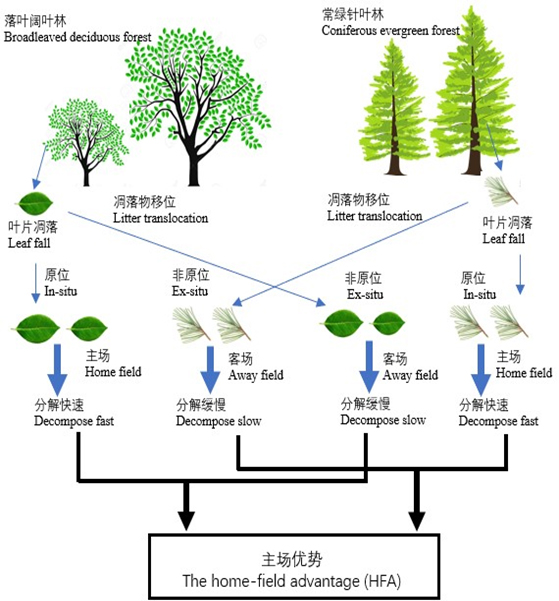
Litter often decomposes more rapidly in its native habitat (“home”) than in non-native habitats (“away”), a phenomenon called the “home-field advantage”. To explore the driving mechanism of home-field advantage of litter decomposition is important to predict the process of plant nutrient return and ecosystem carbon budget. This study reviewed the research progress on the home-field advantage of litter decomposition in recent years by discussing the quantification of home-field advantage, the controlling factors, and related driving mechanisms. There are four common metrics to describe home-field advantage in litter decomposition, and the use of linear model analysis to calculate home-field advantage is more appropriate. Litter quality (chemical composition, etc.) and soil microbial community structure are the main factors influencing the home-field advantage of litter decomposition, and soil fauna, climatic conditions, decomposition time, plant life form and growth form can also influence the intensity of the home-field advantage. Greater differences in litter quality usually generate stronger home-field advantage. Microbial taxa in the soil drive the home-field advantage of litter decomposition, but the role of soil microbes is often mediated by animal and climatic disturbances. In addition, the existence of phyllosphere microbes makes the home-field advantage of litter decomposition stronger. The litter chemical convergence hypothesis, decomposer control hypothesis and substrate quality-matrix quality interaction hypothesis are major hypotheses explaining the home-field advantage in litter decomposition, but they are not impeccable. We believe that the association between litter and soil microbial community is the driving force behind home-field advantage. The current researches on the factors and relative contribution of home-field advantage are not deep enough and usually focusing on a single ecosystem. Future investigations should explore deeper on the factors and their relative contributions of home-field advantage, and focus on more ecosystem types to improve the understandings of the mechanism of home-field advantage.
ZHAO Xiao-Xiang, ZHU Bin-Bin, TIAN Qiu-Xiang, LIN Qiao-Ling, CHEN Long, LIU Feng . Research progress on home-field advantage of leaf litter decomposition[J]. Chinese Journal of Plant Ecology, 2023 , 47(5) : 597 -607 . DOI: 10.17521/cjpe.2022.0143
| [1] | Aponte C, García LV, Mara?ón T (2012). Tree species effect on litter decomposition and nutrient release in mediterranean oak forests changes over time. Ecosystems, 15, 1204-1218. |
| [2] | Austin AT, Vivanco L, González-Arzac A, Pérez LI (2014). There?s no place like home? An exploration of the mechanisms behind plant litter-decomposer affinity in terrestrial ecosystems. New Phytologist, 204, 307-314. |
| [3] | Ayres E, Steltzer H, Berg S, Wall DH (2009a). Soil biota accelerate decomposition in high-elevation forests by specializing in the breakdown of litter produced by the plant species above them. Journal of Ecology, 97, 901-912. |
| [4] | Ayres E, Steltzer H, Simmons BL, Simpson RT, Steinweg JM, Wallenstein MD, Mellor N, Parton WJ, Moore JC, Wall DH (2009b). Home-field advantage accelerates leaf litter decomposition in forests. Soil Biology & Biochemistry, 41, 606-610. |
| [5] | Bachega LR, Bouillet JP, de Cássia Piccolo M, Saint-André L, Bouvet JM, Nouvellon Y, de Moraes Gon?alves JL, Robin A, Laclau JP (2016). Decomposition of Eucalyptus grandis and Acacia mangium leaves and fine roots in tropical conditions did not meet the Home Field Advantage hypothesis. Forest Ecology and Management, 359, 33-43. |
| [6] | Baptist F, Yoccoz NG, Choler P (2010). Direct and indirect control by snow cover over decomposition in alpine tundra along a snowmelt gradient. Plant and Soil, 328, 397-410. |
| [7] | Bardgett RD, Whittaker JB, Frankland JC (1993). The diet and food preferences of Onychiurus procampatus (Collembola) from upland grassland soils. Biology and Fertility of Soils, 16, 296-298. |
| [8] | Berg B, McClaugherty C (2005). Plant Litter: Decomposition, Humus Formation, Carbon Sequestration. Springer, Berlin. |
| [9] | Bradford MA, Tordoff GM, Eggers T, Jones TH, Newington JE (2002). Microbiota, fauna, and mesh size interactions in litter decomposition. Oikos, 99, 317-323. |
| [10] | Chomel M, Guittonny-Larchevêque M, DesRochers A, Baldy V (2015). Home field advantage of litter decomposition in pure and mixed plantations under boreal climate. Ecosystems, 18, 1014-1028. |
| [11] | Crowther TW, Boddy L, Hefin Jones T, (2012). Functional and ecological consequences of saprotrophic fungus-grazer interactions. The ISME Journal, 6, 1992-2001. |
| [12] | de Toledo Castanho C, de Oliveira AA (2008). Relative effect of litter quality, forest type and their interaction on leaf decomposition in south-east Brazilian forests. Journal of Tropical Ecology, 24, 149-156. |
| [13] | Fanin N, Fromin N, Bertrand I (2016). Functional breadth and home-field advantage generate functional differences among soil microbial decomposers. Ecology, 97, 1023-1037. |
| [14] | Fanin N, Lin D, Freschet GT, Keiser AD, Augusto L, Wardle DA, Veen GFC (2021). Home-field advantage of litter decomposition: from the phyllosphere to the soil. New Phytologist, 231, 1353-1358. |
| [15] | Freschet GT, Aerts R, Cornelissen JHC (2012). Multiple mechanisms for trait effects on litter decomposition: moving beyond home-field advantage with a new hypothesis. Journal of Ecology, 100, 619-630. |
| [16] | Fukami T (2015). Historical contingency in community assembly: integrating niches, species pools, and priority effects. Annual Review of Ecology, Evolution, and Systematics, 46, 1-23. |
| [17] | Gessner MO, Chauvet E, Dobson M (1999). A perspective on leaf litter breakdown in streams. Oikos, 85, 377-384. |
| [18] | Gholz HL, Wedin DA, Smitherman SM, Harmon ME, Parton WJ (2000). Long-term dynamics of pine and hardwood litter in contrasting environments: toward a global model of decomposition. Global Change Biology, 6, 751-765. |
| [19] | Gie?elmann UC, Martins KG, Br?ndle M, Sch?dler M, Marques R, Brandl R (2011). Lack of home-field advantage in the decomposition of leaf litter in the Atlantic Rainforest of Brazil. Applied Soil Ecology, 49, 5-10. |
| [20] | H?ttenschwiler S, Coq S, Barantal S, Handa IT (2011). Leaf traits and decomposition in tropical rainforests: revisiting some commonly held views and towards a new hypothesis. New Phytologist, 189, 950-965. |
| [21] | Hobbie SE, Reich PB, Oleksyn J, Ogdahl M, Zytkowiak R, Hale C, Karolewski P (2006). Tree species effects on decomposition and forest floor dynamics in a common garden. Ecology, 87, 2288-2297. |
| [22] | Ibrahima A, Joffre R, Gillon D (1995). Changes in litter during the initial leaching phase: an experiment on the leaf litter of Mediterranean species. Soil Biology & Biochemistry, 27, 931-939. |
| [23] | Jewell MD, Shipley B, Paquette A, Messier C, Reich PB (2015). A traits-based test of the home-field advantage in mixed-species tree litter decomposition. Annals of Botany, 116, 781-788. |
| [24] | Kagata H, Ohgushi T (2013). Home-field advantage in decomposition of leaf litter and insect frass. Population Ecology, 55, 69-76. |
| [25] | Keiser AD, Bradford MA (2017). Climate masks decomposer influence in a cross-site litter decomposition study. Soil Biology & Biochemistry, 107, 180-187. |
| [26] | Keiser AD, Keiser DA, Strickland MS, Bradford MA (2014). Disentangling the mechanisms underlying functional differences among decomposer communities. Journal of Ecology, 102, 603-609. |
| [27] | Laforest-Lapointe I, Paquette A, Messier C, Kembel SW (2017). Leaf bacterial diversity mediates plant diversity and ecosystem function relationships. Nature, 546, 145-147. |
| [28] | Li TY, Kang FF, Han HR, Gao J, Song XS, Yu S, Zhao JL, Yu XW (2015). Responses of soil microbial carbon metabolism to the leaf litter composition in Liaohe River Nature Reserve of northern Hebei Province, China. Chinese Journal of Applied Ecology, 26, 715-722. |
| [28] | [立天宇, 康峰峰, 韩海荣, 高晶, 宋小帅, 于舒, 赵金龙, 于晓文 (2015). 冀北辽河源自然保护区土壤微生物碳代谢对阔叶林叶凋落物组成的响应. 应用生态学报, 26, 715-722.] |
| [29] | Li YB, Li Q, Yang JJ, Lü XT, Liang WJ, Han XG, Martijn Bezemer T (2017). Home-field advantages of litter decomposition increase with increasing N deposition rates: a litter and soil perspective. Functional Ecology, 31, 1792-1801. |
| [30] | Li Y, Veen GFC, Gera Hol WH, Vandenbrande S, Emilia Hannula S, ten Hooven FC, Li Q, Liang W, Martjn Bezemer T, (2020). “Home” and “away” litter decomposition depends on the size fractions of the soil biotic community. Soil Biology & Biochemistry, 144, 107783. DOI: 10.1016/j.soilbio.2020.107783. |
| [31] | Lin D, Dou P, Yang G, Qian S, Wang H, Zhao L, Yang Y, Mi X, Ma K, Fanin N (2020). Home-field advantage of litter decomposition differs between leaves and fine roots. New Phytologist, 227, 995-1000. |
| [32] | Lin D, Pang M, Fanin N, Wang H, Qian S, Zhao L, Yang Y, Mi X, Ma K (2019). Fungi participate in driving home-field advantage of litter decomposition in a subtropical forest. Plant and Soil, 434, 467-480. |
| [33] | Lindow SE, Brandl MT (2003). Microbiology of the phyllosphere. Applied and Environmental Microbiology, 69, 1875-1883. |
| [34] | Liu H, Brettell LE, Singh B (2020). Linking the phyllosphere microbiome to plant health. Trends in Plant Science, 25, 841-844. |
| [35] | Milcu A, Manning P (2011). All size classes of soil fauna and litter quality control the acceleration of litter decay in its home environment. Oikos, 120, 1366-1370. |
| [36] | Negrete-Yankelevich S, Fragoso C, Newton AC, Russell G, Heal OW (2008). Species-specific characteristics of trees can determine the litter macroinvertebrate community and decomposition process below their canopies. Plant and Soil, 307, 83-97. |
| [37] | Newell K (1984). Interaction between two decomposer basidiomycetes and a collembolan under Sitka spruce: grazing and its potential effects on fungal distribution and litter decomposition. Soil Biology & Biochemistry, 16, 235-239. |
| [38] | Osono T (2002). Phyllosphere fungi on leaf litter of Fagus crenata: occurrence, colonization, and succession. Canadian Journal of Botany, 80, 460-469. |
| [39] | Osono T (2006). Role of phyllosphere fungi of forest trees in the development of decomposer fungal communities and decomposition processes of leaf litter. Canadian Journal of Microbiology, 52, 701-716. |
| [40] | Osono T, Takeda H (1999). Decomposing ability of interior and surface fungal colonizers of beech leaves with reference to lignin decomposition. European Journal of Soil Biology, 35, 51-56. |
| [41] | Palozzi JE, Lindo Z (2017). Pure and mixed litters of Sphagnum and Carex exhibit a home-field advantage in Boreal peatlands. Soil Biology & Biochemistry, 115, 161-168. |
| [42] | Parton W, Silver WL, Burke IC, Grassens L, Harmon ME, Currie WS, King JY, Adair EC, Brandt LA, Hart SC, Fasth B (2007). Global-scale similarities in nitrogen release patterns during long-term decomposition. Science, 315, 361-364. |
| [43] | Perez G, Aubert M, Deca?ns T, Trap J, Chauvat M (2013). Home-field advantage: a matter of interaction between litter biochemistry and decomposer biota. Soil Biology & Biochemistry, 67, 245-254. |
| [44] | Poorter H, Niklas KJ, Reich PB, Oleksyn J, Poot P, Mommer L (2012). Biomass allocation to leaves, stems and roots: meta-analyses of interspecific variation and environmental control. New Phytologist, 193, 30-50. |
| [45] | Prescott CE, Zabek LM, Staley CL, Kabzems R (2000). Decomposition of broadleaf and needle litter in forests of British Columbia: influences of litter type, forest type, and litter mixtures. Canadian Journal of Forest Research, 30, 1742-1750. |
| [46] | Rothstein DE, Vitousek PM, Simmons BL (2004). An exotic tree alters decomposition and nutrient cycling in a Hawaiian montane forest. Ecosystems, 7, 805-814. |
| [47] | Schmitt L, Perfecto I (2021). Coffee leaf litter decomposition: short term home-field advantage in shaded coffee agro- ecosystems. Applied Soil Ecology, 161, 103854. DOI: 10.1016/j.apsoil.2020.103854. |
| [48] | St. John MG, Orwin. KH, Dickie. IA (2011). No “home” versus “away” effects of decomposition found in a grassland- forest reciprocal litter transplant study. Soil Biology & Biochemistry, 43, 1482-1489. |
| [49] | Sterkenburg E, Clemmensen KE, Ekblad A, Finlay RD, Lindahl BD (2018). Contrasting effects of ectomycorrhizal fungi on early and late stage decomposition in a boreal forest. The ISME Journal, 12, 2187-2197. |
| [50] | Strickland MS, Keiser AD, Bradford MA (2015). Climate history shapes contemporary leaf litter decomposition. Biogeochemistry, 122, 165-174. |
| [51] | Strickland MS, Osburn E, Lauber C, Fierer N, Bradford MA (2009). Litter quality is in the eye of the beholder: initial decomposition rates as a function of inoculum characteristics. Functional Ecology, 23, 627-636. |
| [52] | Vacher C, Hampe A, Porté AJ, Sauer U, Compant S, Morris CE (2016). The phyllosphere: microbial jungle at the plant- climate interface. Annual Review of Ecology, Evolution, and Systematics, 47, 1-24. |
| [53] | Vauramo S, Set?l? H (2011). Decomposition of labile and recalcitrant litter types under different plant communities in urban soils. Urban Ecosystems, 14, 59-70. |
| [54] | Veen GFC, Freschet GT, Ordonez A, Wardle DA (2015a). Litter quality and environmental controls of home-field advantage effects on litter decomposition. Oikos, 124, 187-195. |
| [55] | Veen GFC, Keiser AD, van der Putten WH, Wardle DA (2018). Variation in home-field advantage and ability in leaf litter decomposition across successional gradients. Functional Ecology, 32, 1563-1574. |
| [56] | Veen GFC, Snoek BL, Bakx-Schotman T, Wardle DA, Putten WH (2019). Relationships between fungal community composition in decomposing leaf litter and home-field advantage effects. Functional Ecology, 33, 1524-1535. |
| [57] | Veen GFC, Sundqvist MK, Wardle DA (2015b). Environmental factors and traits that drive plant litter decomposition do not determine home-field advantage effects. Functional Ecology, 29, 981-991. |
| [58] | Vivanco L, Austin AT (2008). Tree species identity alters forest litter decomposition through long-term plant and soil interactions in Patagonia, Argentina. Journal of Ecology, 96, 727-736. |
| [59] | Vo?í?ková J, Baldrian P (2013). Fungal community on decomposing leaf litter undergoes rapid successional changes. The ISME Journal, 7, 477-486. |
| [60] | Wallenstein MD, Haddix ML, Ayres E, Steltzer H, Magrini-Bair KA, Paul EA (2013). Litter chemistry changes more rapidly when decomposed at home but converges during decomposition-transformation. Soil Biology & Biochemistry, 57, 311-319. |
| [61] | Wang QK, Zhong MC, He TX (2013). Home-field advantage of litter decomposition and nitrogen release in forest ecosystems. Biology and Fertility of Soils, 49, 427-434. |
| [62] | Wardle DA, Bardgett RD, Klironomos JN, Set?l? H, van der Putten WH, Wall DH (2004). Ecological linkages between aboveground and belowground biota. Science, 304, 1629-1633. |
| [63] | Wolfe ER, Ballhorn DJ (2020). Do foliar endophytes matter in litter decomposition? Microorganisms, 8, 446. DOI: 10.3390/microorganisms8030446. |
| [64] | Yang HL, Li YL, Ning ZY, Zhang ZQ (2019). Home-field effects of leaf litter decomposition of dominate sand-fixing shrubs in the Horqin Sandy Land. Journal of Desert Research, 39(5), 62-70. |
| [64] | [杨红玲, 李玉霖, 宁志英, 张子谦 (2019). 科尔沁沙地优势固沙灌木叶片凋落物分解的主场效应. 中国沙漠, 39(5), 62-70.] |
| [65] | Yeung ACY, Kreutzweiser DP, Richardson JS (2019). Stronger effects of litter origin on the processing of conifer than broadleaf leaves: a test of home-field advantage of stream litter breakdown. Freshwater Biology, 64, 1755-1768. |
| [66] | Yu ZP, Huang ZQ, Wang MH, Liu RQ, Zheng LJ, Wan XH, Hu ZH, Davis MR, Lin TC (2015). Nitrogen addition enhances home-field advantage during litter decomposition in subtropical forest plantations. Soil Biology & Biochemistry, 90, 188-196. |
| [67] | Yuan X, Niu D, Wang Y, Boydston A, Guo D, Li X, Wen H, Qin Y, Fu H (2019). Litter decomposition in fenced and grazed grasslands: a test of the home-field advantage hypothesis. Geoderma, 354, 113876. DOI: 10.1016/j.geoderma.2019.07.034. |
| [68] | Zha TG, Zhang ZQ, Sun G, Wang GM, Yun XQ, Wang YK, Liu Y (2012). Home-field advantage of litter decomposition and its soil biological driving mechanism: a review. Acta Ecologica Sinica, 32, 7991-8000. |
| [68] | [查同刚, 张志强, 孙阁, 王高敏, 贠小琴, 王伊琨, 刘艳 (2012). 凋落物分解主场效应及其土壤生物驱动. 生态学报, 32, 7991-8000.] |
| [69] | Zhang DQ, Hui DF, Luo YQ, Zhou GY (2008). Rates of litter decomposition in terrestrial ecosystems: global patterns and controlling factors. Journal of Plant Ecology, 1, 85-93. |
/
| 〈 |
|
〉 |
Copyright © 2026 Chinese Journal of Plant Ecology
Tel: 010-62836134, 62836138, E-mail: apes@ibcas.ac.cn, cjpe@ibcas.ac.cn

