
Chinese Journal of Plant Ecology >
Selenium biofortification in plants and application potential of microorganisms in selenium biofortification
Received date: 2022-04-25
Accepted date: 2022-09-28
Online published: 2022-09-28
Supported by
Sichuan Science and Technology Program(2022YFS0499);National Natural Science Foundation of China(32071500)
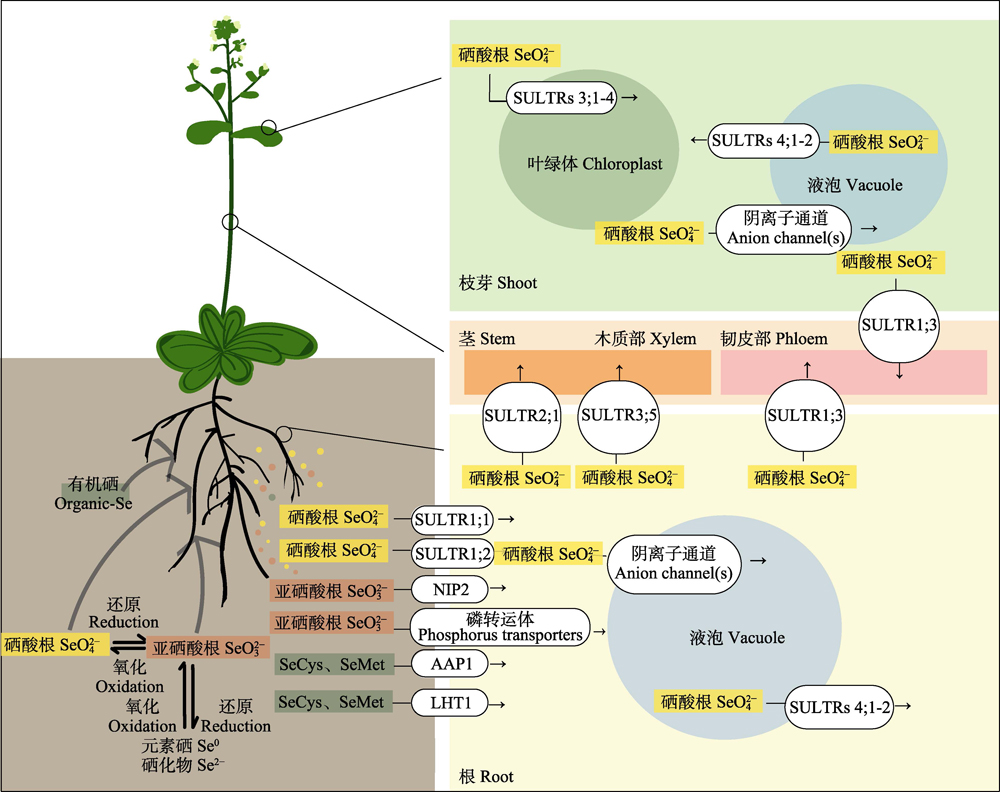
Selenium is an essential micronutrient element for humans. The range between “beneficial” and “harmful” levels of selenium is very narrow, so biofortification through plants is a safe and effective way to supplement selenium. This article reviewed the processes of selenium uptake, transport, and metabolism in plants. Plants mainly absorb selenate, selenite, and organic selenium from soil. The root system has different absorption mechanisms for different forms of selenium, and the absorption process is participated by different transporters. The absorbed selenium is mainly transported in plants in the form of selenate ion, transported to the aboveground through the xylem and the phloem, and metabolized under the action of various enzymes. Finally, part of the selenium absorbed by the roots is stored in the plant as organic selenium, and the other part is released into the atmosphere in the form of selenide. This article also focuses on the effects of different types of rhizosphere microorganisms on plant selenium biofortification. Arbuscular mycorrhizal fungi, ectomycorrhizal fungi, and rhizosphere promoting bacteria can promote the absorption of selenium in plants to a certain extent, but their internal mechanisms are still unclear. Based on the current research status, the future research focuses are put forward: 1) the process of selenium absorption by plants and its gene regulation; 2) the underlying mechanism and application potential of microorganisms on selenium biofortification in plants.
Key words: selenium; rhizosphere microorganism; absorption; transportation; biofortification
LI Liu, LIU Qing-Hua, YIN Chun-Ying . Selenium biofortification in plants and application potential of microorganisms in selenium biofortification[J]. Chinese Journal of Plant Ecology, 2023 , 47(6) : 756 -769 . DOI: 10.17521/cjpe.2022.0163
| [1] | Acu?a JJ, Jorquera MA, Barra PJ, Crowley DE, de la Luz Mora M (2012). Selenobacteria selected from the rhizosphere as a potential tool for Se biofortification of wheat crops. Biology and Fertility of Soils, 49, 175-185. |
| [2] | Anderson IC, Cairney JWG (2007). Ectomycorrhizal fungi: exploring the mycelial frontier. FEMS Microbiology Reviews, 31, 388-406. |
| [3] | Artursson V, Finlay RD, Jansson JK (2006). Interactions between arbuscular mycorrhizal fungi and bacteria and their potential for stimulating plant growth. Environmental Microbiology, 8, 1-10. |
| [4] | Asher CJ, Butler GW, Peterson PJ (1977). Selenium transport in root systems of tomato. Journal of Experimental Botany, 28, 279-291. |
| [5] | Berg G (2009). Plant-microbe interactions promoting plant growth and health: perspectives for controlled use of microorganisms in agriculture. Applied Microbiology and Biotechnology, 84, 11-18. |
| [6] | Blazina T, Sun YB, Voegelin A, Lenz M, Berg M, Winkel LHE (2014). Terrestrial selenium distribution in China is potentially linked to monsoonal climate. Nature Communications, 5, 4717. DOI: 10.1038/ncomms5717. |
| [7] | Bodnar M, Konieczka P, Namiesnik J (2012). The properties, functions, and use of selenium compounds in living organisms. Journal of Environmental Science and Health, Part C: Environmental Carcinogenesis & Ecotoxicology Reviews, 30, 225-252. |
| [8] | Boorer KJ, Frommer WB, Bush DR, Kreman M, Loo DD, Wright EM (1996). Kinetics and specificity of a H+/amino acid transporter from Arabidopsis thaliana. The Journal of Biological Chemistry, 271, 2213-2220. |
| [9] | Cao D, Liu YL, Ma LL, Jin XF, Guo GY, Tan RR, Liu Z, Zheng L, Ye F, Liu W (2018). Transcriptome analysis of differentially expressed genes involved in selenium accumulation in tea plant (Camellia sinensis). PLoS ONE, 13, e0197506. DOI: 10.1371/journal.pone.0197506. |
| [10] | Cao MJ, Wang Z, Wirtz M, Hell R, Oliver DJ, Xiang CB (2013). SULTR3;1 is a chloroplast-localized sulfate transporter in Arabidopsis thaliana. The Plant Journal, 73, 607-616. |
| [11] | Chen LC, Yang FM, Zhang YL, Hu QH, Pan GX (2002). Selenium analysis of some polished rice in China and effect of biological selenium-enriched fertilizers on level and chemical constitution of selenium in rice grains. Chinese Journal of Rice Science, 16, 341-345. |
| [11] | [陈历程, 杨方美, 张艳玲, 胡秋辉, 潘根兴 (2002). 我国部分大米含硒量分析及生物硒肥对籽粒硒水平的影响. 中国水稻科学, 16, 341-345.] |
| [12] | Chen X, Zhang ZY, Gu MH, Li H, Shohag MJI, Shen FK, Wang XL, Wei YY (2020). Combined use of arbuscular mycorrhizal fungus and selenium fertilizer shapes microbial community structure and enhances organic selenium accumulation in rice grain. Science of the Total Environment, 748, 141166. DOI: 10.1016/j.scitotenv.2020.141166. |
| [13] | Chen Z, Zhao PX, Miao ZQ, Qi GF, Wang Z, Yuan Y, Ahmad N, Cao MJ, Hell R, Wirtz M, Xiang CB (2019). SULTR3s function in chloroplast sulfate uptake and affect ABA biosynthesis and the stress response. Plant Physiology, 180, 593-604. |
| [14] | Chilimba ADC, Young SD, Black CR, Meacham MC, Lammel J, Broadley MR (2012). Agronomic biofortification of maize with selenium (Se) in Malawi. Field Crops Research, 125, 118-128. |
| [15] | Conversa G, Lazzizera C, Chiaravalle AE, Miedico O, Bonasia A, La Rotonda P, Elia A (2019). Selenium fern application and arbuscular mycorrhizal fungi soil inoculation enhance Se content and antioxidant properties of green asparagus (Asparagus officinalis L.) spears. Scientia Horticulturae, 252, 176-191. |
| [16] | Dinh QT, Wang MK, Tran TAT, Zhou F, Wang D, Zhai H, Peng Q, Xue MY, Du ZK, Ba?uelos GS, Lin ZQ, Liang DL (2018). Bioavailability of selenium in soil-plant system and a regulatory approach. Critical Reviews in Environmental Science and Technology, 49, 443-517. |
| [17] | Durán P, Acu?a JJ, Armada E, López-Castillo OM, Cornejo P, Mora ML, Azcón R (2016). Inoculation with selenobacteria and arbuscular mycorrhizal fungi to enhance selenium content in lettuce plants and improve tolerance against drought stress. Journal of Soil Science and Plant Nutrition, 161, 201-225. |
| [18] | Durán P, Acu?a JJ, Gianfreda L, Azcón R, Funes-Collado V, Mora ML (2015). Endophytic selenobacteria as new inocula for selenium biofortification. Applied Soil Ecology, 96, 319-326. |
| [19] | El Kassis E, Cathala N, Rouached H, Fourcroy P, Berthomieu P, Terry N, Davidian JC (2007). Characterization of a selenate-resistant Arabidopsis mutant. Root growth as a potential target for selenate toxicity. Plant Physiology, 143, 1231-1241. |
| [20] | El-Ramady HR, Abdalla N, Alshaal T, Domokos-Szabolcsy é, Elhawat N, Prokisch J, Sztrik A, Fári M, El-Marsafawy S, Shams MS (2014). Selenium in soils under climate change, implication for human health. Environmental Chemistry Letters, 13, 1-19. |
| [21] | El-Ramady HR, Abdalla N, Alshaal T, Elhenawy AS, Shams MS, Faizy SE-DA, Belal ESB, Shehata SA, Ragab MI, Amer MM, Fári M, Sztrik A, Prokisch J, Selmar D, Schnug E, et al. (2015). Giant reed for selenium phytoremediation under changing climate. Environmental Chemistry Letters, 13, 359-380. |
| [22] | El-Ramady HR, Abdalla N, Elbasiouny H, Elbehiry F, Elsakhawy T, Omara AED, Amer M, Bayoumi Y, Shalaby TA, Eid Y, Zia-ur-Rehman M (2021). Nano-biofortification of different crops to immune against COVID-19: a review. Ecotoxicology and Environmental Safety, 222, 112500. DOI: 10.1016/j.ecoenv.2021.112500. |
| [23] | Etteieb S, Magdouli S, Zolfaghari M, Brar S (2020). Monitoring and analysis of selenium as an emerging contaminant in mining industry: a critical review. Science of the Total Environment, 698, 134339. DOI: 10.1016/j.scitotenv.2019.134339. |
| [24] | Feinberg A, Stenke A, Peter T, Hinckley ELS, Driscoll CT, Winkel LHE (2021). Reductions in the deposition of sulfur and selenium to agricultural soils pose risk of future nutrient deficiencies. Communications Earth & Environment, 2, 101. DOI: 10.1038/s43247-021-00172-0. |
| [25] | Feng RW, Wei CY, Tu SX (2013). The roles of selenium in protecting plants against abiotic stresses. Environmental and Experimental Botany, 87, 58-68. |
| [26] | Fernández-Martínez A, Charlet L (2009). Selenium environmental cycling and bioavailability: a structural chemist point of view. Reviews in Environmental Science and Bio/Technology, 8, 81-110. |
| [27] | Fitter AH, Helgason T, Hodge A (2011). Nutritional exchanges in the arbuscular mycorrhizal symbiosis: implications for sustainable agriculture. Fungal Biology Reviews, 25, 68-72. |
| [28] | Goicoechea N, Garmendia I, Fabbrin EG, Bettoni MM, Palop JA, Sanmartín C (2015). Selenium fertilization and mycorrhizal technology may interfere in enhancing bioactive compounds in edible tissues of lettuces. Scientia Horticulturae, 195, 163-172. |
| [29] | Gupta M, Gupta S (2017). An overview of selenium uptake, metabolism, and toxicity in plants. Frontiers in Plant Science, 7, 2074. DOI: 10.3389/fpls.2016.02074. |
| [30] | Hemkemeyer M, Schwalb SA, Heinze S, Joergensen RG, Wichern F (2021). Functions of elements in soil microorganisms. Microbiological Research, 252, 126832. DOI: 10.1016/j.micres.2021.126832. |
| [31] | Hirner A, Ladwig F, Stransky H, Okumoto S, Keinath M, Harms A, Frommer WB, Koch W (2006). Arabidopsis LHT1 is a high-affinity transporter for cellular amino acid uptake in both root epidermis and leaf mesophyll. The Plant Cell, 18, 1931-1946. |
| [32] | Hossain A, Skalicky M, Brestic M, Maitra S, Sarkar S, Ahmad Z, Vemuri H, Garai S, Mondal M, Bhatt R, Kumar P, Banerjee P, Saha S, Islam T, Laing AM (2021). Selenium biofortification: roles, mechanisms, responses and prospects. Molecules, 26, 881. DOI: 10.3390/molecules26040881. |
| [33] | Hu WL, Zhao C, Hu HB, Yin ST (2021). Food sources of selenium and its relationship with chronic diseases. Nutrients, 13, 1739. DOI: 10.3390/nu13051739. |
| [34] | Huang CL, Wang HL, Shi XY, Wang YH, Li P, Yin HQ, Shao YX (2021). Two new selenite reducing bacterial isolates from paddy soil and the potential Se biofortification of paddy rice. Ecotoxicology, 30, 1465-1475. |
| [35] | Huang YT, Lei NY, Fan B, Deng KL, Blecker C, Maesen P, Wang FZ (2021). Effect of selenium on nutrient quality of agricultural products. Quality and Safety of Agro-products, (2), 80-87. |
| [35] | [黄亚涛, 雷宁宇, 范蓓, 邓凯琳, Blecker C, Maesen P, 王凤忠 (2021). 硒对农产品营养品质的影响. 农产品质量与安全, (2), 80-87.] |
| [36] | Jiang Y, Zeng ZH, Yang QS, Zhao J, Yang YD, Hu YG (2016). Selenium (Se) uptake and transformation mechanisms and physiological function in plant: a review. Chinese Journal of Applied Ecology, 27, 4067-4076. |
| [36] | [姜英, 曾昭海, 杨麒生, 赵杰, 杨亚东, 胡跃高 (2016). 植物硒吸收转化机制及生理作用研究进展. 应用生态学报, 27, 4067-4076.] |
| [37] | Johnson TM (2004). A review of mass-dependent fractionation of selenium isotopes and implications for other heavy stable isotopes. Chemical Geology, 204, 201-214. |
| [38] | Jones GD, Droz B, Greve P, Gottschalk P, Poffet D, McGrath SP, Seneviratne SI, Smith P, Winkel LHE (2017). Selenium deficiency risk predicted to increase under future climate change. Proceedings of the National Academy of Sciences of the United States of America, 114, 2848-2853. |
| [39] | Kataoka T, Hayashi N, Yamaya T, Takahashi H (2004a). Root-to-shoot transport of sulfate in Arabidopsis. Evidence for the role of SULTR3;5 as a component of low-affinity sulfate transport system in the root vasculature. Plant Physiology, 136, 4198-4204. |
| [40] | Kataoka T, Watanabe-Takahashi A, Hayashi N, Ohnishi M, Mimura T, Buchner P, Hawkesford MJ, Yamaya T, Takahashi H (2004b). Vacuolar sulfate transporters are essential determinants controlling internal distribution of sulfate in Arabidopsis. The Plant Cell, 16, 2693-2704. |
| [41] | Kausch M, Ng P, Ha J, Pallud C (2012). Soil-aggregate-scale heterogeneity in microbial selenium reduction. Vadose Zone Journal, 11, vzj2011.0101. DOI: 10.2136/vzj2011.0101. |
| [42] | Khan AG, Kuek C, Chaudhry TM, Khoo CS, Hayes WJ (2000). Role of plants, mycorrhizae and phytochelators in heavy metal contaminated land remediation. Chemosphere, 41, 197-207. |
| [43] | Khanna K, Kumar P, Ohri P, Bhardwaj R (2023). Harnessing the role of selenium in soil-plant-microbe ecosystem: ecophysiological mechanisms and future prospects. Plant Growth Regulation, 100, 197-217. |
| [44] | Kikkert J, Berkelaar E (2013). Plant uptake and translocation of inorganic and organic forms of selenium. Archives of Environmental Contamination and Toxicology, 65, 458-465. |
| [45] | K?nig S, Luguet A, Lorand JP, Wombacher F, Lissner M (2012). Selenium and tellurium systematics of the Earth’s mantle from high precision analyses of ultra-depleted orogenic peridotites. Geochimica et Cosmochimica Acta, 86, 354-366. |
| [46] | Kumawat KC, Razdan N, Saharan K (2022). Rhizospheric microbiome: bio-based emerging strategies for sustainable agriculture development and future perspectives. Microbiological Research, 254, 126901. DOI: 10.1016/j.micres.2021.126901. |
| [47] | Lampis S, Zonaro E, Bertolini C, Bernardi P, Butler CS, Vallini G (2014). Delayed formation of zero-valent selenium nanoparticles by Bacillus mycoides SeITE01 as a consequence of selenite reduction under aerobic conditions. Microbial Cell Factories, 13, 35. DOI: 10.1186/1475-2859-13-35. |
| [48] | Li HF, McGrath SP, Zhao FJ (2008). Selenium uptake, translocation and speciation in wheat supplied with selenate or selenite. New Phytologist, 178, 92-102. |
| [49] | Li J, Liu RF, Wu BY, Zhang CY, Wang JF, Lyu LH, Tong XG, Wu FY (2022). Influence of arbuscular mycorrhizal fungi on selenium uptake by winter wheat depends on the level of selenate spiked in soil. Chemosphere, 291, 132813. DOI: 10.1016/j.chemosphere.2021.132813. |
| [50] | Li Z, Liang DL, Peng Q, Cui ZW, Huang J, Lin ZQ (2017). Interaction between selenium and soil organic matter and its impact on soil selenium bioavailability: a review. Geoderma, 295, 69-79. |
| [51] | Lindblom SD, Fakra SC, Landon J, Schulz P, Tracy B, Pilon- Smits EAH (2013). Inoculation of Astragalus racemosus and Astragalus convallarius with selenium-hyperaccumulator rhizosphere fungi affects growth and selenium accumulation. Planta, 237, 717-729. |
| [52] | Lindblom SD, Fakra SC, Landon J, Schulz P, Tracy B, Pilon-Smits EAH (2014). Inoculation of selenium hyperaccumulator Stanleya pinnata and related non-accumulator Stanleya elata with hyperaccumulator rhizosphere fungi—Investigation of effects on Se accumulation and speciation. Physiologia Plantarum, 150, 107-118. |
| [53] | Liu DY, Yuan YQ, Qiu RL, Wang SZ, Huang XF, Huang HY (2021). Effect of plant growth promoting rhizobacteria Enterobacter sp. EG16 on the growth and Selenium uptake of Brassica chinensis L. Journal of Agro-Environment Science, 40, 1420-1431. |
| [53] | [刘东昀, 袁永强, 仇荣亮, 王诗忠, 黄雄飞, 黄海燕 (2021). 根际促生菌Enterobacter sp. EG16对小白菜生长及硒吸收的影响. 农业环境科学学报, 40, 1420-1431.] |
| [54] | Liu JG, Diamond J (2005). China’s environment in a globalizing world. Nature, 435, 1179-1186. |
| [55] | Liu LL, Liu RD, Huang RH (2014). Effect of arbuscular mycorrhizal fungi (AMF) on accumlation capability for Se and photosynthesis characteristics of Actinidia chinensis ‘hongyang’ leaves. Science and Technology of Food Industry, 35, 234-237. |
| [55] | [刘丽丽, 刘仁道, 黄仁华 (2014). 丛枝菌根真菌(AMF)对红阳猕猴桃叶片富硒能力及光合特性的影响. 食品工业科技, 35, 234-237.] |
| [56] | Longchamp M, Castrec-Rouelle M, Biron P, Bariac T (2015). Variations in the accumulation, localization and rate of metabolization of selenium in mature Zea mays plants supplied with selenite or selenate. Food Chemistry, 182, 128-135. |
| [57] | Luo LP, Zhang JP, Zhang KY, Wen QY, Ming K, Xiong H, Ning FJ (2021). Peanut selenium distribution, concentration, speciation, and effects on proteins after exogenous selenium biofortification. Food Chemistry, 354, 129515. DOI: 10.1016/j.foodchem.2021.129515. |
| [58] | Luo WQ, Li J, Ma XN, Niu H, Hou SW, Wu FY (2019). Effect of arbuscular mycorrhizal fungi on uptake of selenate, selenite, and selenomethionine by roots of winter wheat. Plant and Soil, 438, 71-83. |
| [59] | Lusa M, Help H, Honkanen AP, Knuutinen J, Parkkonen J, Kalasová D, Bomberg M (2019). The reduction of selenium(IV) by boreal Pseudomonas sp. strain T5-6-I—Effects on selenium(IV) uptake in Brassica oleracea. Environmental Research, 177, 108642. DOI: 10.1016/j.enveres.2019.108642. |
| [60] | McLaughlin MJ, Parker DR, Clarke JM (1999). Metals and micronutrients—Food safety issues. Field Crops Research, 60, 143-163. |
| [61] | Mehdi Y, Hornick JL, Istasse L, Dufrasne I (2013). Selenium in the environment, metabolism and involvement in body functions. Molecules, 18, 3292-3311. |
| [62] | Meng Y, Xu FH, Meng QY, Gu WR (2008). Current application status and prospect of microbiological fertilizer in China. Chinese Agricultural Science Bulletin, 24, 276-283. |
| [62] | [孟瑶, 徐凤花, 孟庆有, 顾万荣 (2008). 中国微生物肥料研究及应用进展. 中国农学通报, 24, 276-283.] |
| [63] | Moghaddam A, Heller RA, Sun Q, Seelig J, Cherkezov A, Seibert L, Hackler J, Seemann P, Diegmann J, Pilz M, Bachmann M, Minich WB, Schomburg L (2020). Selenium deficiency is associated with mortality risk from COVID-19. Nutrients, 12, 2098. DOI: 10.3390/nu12072098. |
| [64] | Natasha, Shahid M, Niazi NK, Khalid S, Murtaza B, Bibi I, Rashid MI (2018). A critical review of selenium biogeochemical behavior in soil-plant system with an inference to human health. Environmental Pollution, 234, 915-934. |
| [65] | Neal RH, Sposito G, Holtzclaw KM, Traina SJ (1987). Selenite adsorption on alluvial soils: I. Soil composition and pH effects. Soil Science Society of America Journal, 51, 1161-1165. |
| [66] | Numan M, Bashir S, Khan Y, Mumtaz R, Shinwari ZK, Khan AL, Khan A, Al-Harrasi A (2018). Plant growth promoting bacteria as an alternative strategy for salt tolerance in plants: a review. Microbiological Research, 209, 21-32. |
| [67] | Olanrewaju OS, Glick BR, Babalola OO (2017). Mechanisms of action of plant growth promoting bacteria. World Journal of Microbiology and Biotechnology, 33, 197. DOI: 10.1007/s11274-017-2364-9. |
| [68] | Pankievicz VCS, Amaral FPD, Ané JM, Stacey G (2021). Diazotrophic bacteria and their mechanisms to interact and benefit cereals. Molecular Plant-Microbe Interactions, 34, 491-498. |
| [69] | Parniske M (2008). Arbuscular mycorrhiza: the mother of plant root endosymbioses. Nature Reviews Microbiology, 6, 763-775. |
| [70] | Peng LL, Wang XL, Chen X, Dai WH, Gan SJ (2015). Environmental distribution of selenium and its effect on human health. Anhui Journal of Preventive Medicine, 21, 33-36. |
| [70] | [朋玲龙, 王先良, 陈霞, 戴维红, 甘沈娟 (2015). 我国硒的环境分布及其健康影响. 安徽预防医学杂志, 21, 33-36.] |
| [71] | Peng Q, Wu MM, Zhang ZK, Su R, He HH, Zhang XC (2020). The interaction of arbuscular mycorrhizal fungi and phosphorus inputs on selenium uptake by alfalfa (Medicago sativa L.) and selenium fraction transformation in soil. Frontiers in Plant Science, 11, 966. |
| [72] | Ramakrishna W, Yadav R, Li KF (2019). Plant growth promoting bacteria in agriculture: two sides of a coin. Applied Soil Ecology, 138, 10-18. |
| [73] | Reis HPG, de Queiroz Barcelos JP, Silva VM, Santos EF, Tavanti RFR, Putti FF, Young SD, Broadley MR, White PJ, dos Reis AR (2020). Agronomic biofortification with selenium impacts storage proteins in grains of upland rice. Journal of the Science of Food and Agriculture, 100, 1990-1997. |
| [74] | Sharma VK, McDonald TJ, Sohn M, Anquandah GAK, Pettine M, Zboril R (2015). Biogeochemistry of selenium. Environmental Chemistry Letters, 13, 49-58. |
| [75] | Shibagaki N, Rose A, McDermott JP, Fujiwara T, Hayashi H, Yoneyama T, Davies JP (2002). Selenate-resistant mutants of Arabidopsis thaliana identify SULTR1;2, a sulfate transporter required for efficient transport of sulfate into roots. The Plant Journal, 29, 475-486. |
| [76] | Smith SE, Read DJ (2008). Mycorrhizal Symbiosis. 3rd ed. Academic Press, Cambridge, USA. |
| [77] | Sors TG, Ellis DR, Na GN, Lahner B, Lee SM, Leustek T, Pickering IJ, Salt DE (2005a). Analysis of sulfur and selenium assimilation in Astragalus plants with varying capacities to accumulate selenium. The Plant Journal, 42, 785-797. |
| [78] | Sors TG, Ellis DR, Salt DE (2005b). Selenium uptake, translocation, assimilation and metabolic fate in plants. Photosynthesis Research, 86, 373-389. |
| [79] | Sun YJ, Yu PY, Chen JZ, Li SM, Jiang LJ (2020). Effects of slippery jack (Suillus luteus) on the heavy metal accumulation and soil properties of Masson’s pine (Pinus massoniana Lamb) in a mining area of China. Applied Ecology and Environmental Research, 18, 3741-3755. |
| [80] | Takahashi H, Watanabe-Takahashi A, Smith FW, Blake-Kalff M, Hawkesford MJ, Saito K (2000). The roles of three functional sulphate transporters involved in uptake and translocation of sulphate in Arabidopsis thaliana. The Plant Journal, 23, 171-182. |
| [81] | Tan YQ, Yao R, Wang R, Wang D, Wang GJ, Zheng SX (2016). Reduction of selenite to Se(0) nanoparticles by filamentous bacterium Streptomyces sp. ES2-5 isolated from a selenium mining soil. Microbial Cell Factories, 15, 157. DOI: 10.1186/s12934-016-0554-z. |
| [82] | Terry N, Zayed AM, de Souza MP, Tarun AS (2000). Selenium in higher plants. Annual Review of Plant Physiology and Plant Molecular Biology, 51, 401-432. |
| [83] | Timmusk S, Behers L, Muthoni J, Muraya A, Aronsson AC (2017). Perspectives and challenges of microbial application for crop improvement. Frontiers in Plant Science, 8, 49. DOI: 10.3389/fpls.2017.00049. |
| [84] | Trippe III RC, Pilon-Smits EAH (2021). Selenium transport and metabolism in plants: phytoremediation and biofortification implications. Journal of Hazardous Materials, 404, 124178. DOI: 10.1016/j.jhazmat.2020.124178. |
| [85] | Turner TR, Ramakrishnan K, Walshaw J, Heavens D, Alston M, Swarbreck D, Osbourn A, Grant A, Poole PS (2013). Comparative metatranscriptomics reveals Kingdom level changes in the rhizosphere microbiome of plants. The ISME Journal, 7, 2248-2258. |
| [86] | Vinceti M, Mandrioli J, Borella P, Michalke B, Tsatsakis A, Finkelstein Y (2014). Selenium neurotoxicity in humans: bridging laboratory and epidemiologic studies. Toxicology Letters, 230, 295-303. |
| [87] | Wadgaonkar SL, Nancharaiah YV, Esposito G, Lens PNL (2018). Environmental impact and bioremediation of seleniferous soils and sediments. Critical Reviews in Biotechnology, 38, 941-956. |
| [88] | Wang JF, Zhou C, Xiao X, Xie Y, Zhu L, Ma ZY (2017). Enhanced iron and selenium uptake in plants by volatile emissions of Bacillus amyloliquefaciens (BF06). Applied Sciences, 7, 85. DOI: 10.3390/app7010085. |
| [89] | Wang MK, Dinh QT, Qi MX, Wang M, Yang WX, Zhou F, Liang DL (2020). Radicular and foliar uptake, and xylem- and phloem-mediated transport of selenium in maize (Zea mays L.): a comparison of five Se exogenous species. Plant and Soil, 446, 111-123. |
| [90] | Wen HJ, Carignan J (2007). Reviews on atmospheric selenium: emissions, speciation and fate. Atmospheric Environment, 41, 7151-7165. |
| [91] | White PJ, Broadley MR (2009). Biofortification of crops with seven mineral elements often lacking in human diets—Iron, zinc, copper, calcium, magnesium, selenium and iodine. New Phytologist, 182, 49-84. |
| [92] | WHO (2009). Global health risks: mortality and burden of disease attributable to selected major risks. [2022-06-10]. https://www.who.int/publications/i/item/9789241563871. |
| [93] | Winkel LHE, Vriens B, Jones GD, Schneider LS, Pilon-Smits E, Ba?uelos GS (2015). Selenium cycling across soil- plant-atmosphere interfaces: a critical review. Nutrients, 7, 4199-4239. |
| [94] | Wu ZL, Ba?uelos GS, Lin ZQ, Liu Y, Yuan LX, Yin XB, Li M (2015). Biofortification and phytoremediation of selenium in China. Frontiers in Plant Science, 6, 136. DOI: 10.3389/fpls.2015.00136. |
| [95] | Xue TL, Hartikainen H, Piironen V (2001). Antioxidative and growth-promoting effect of selenium on senescing. Plant and Soil, 237, 55-61. |
| [96] | Xun WB, Shao JH, Shen QR, Zhang RF (2021). Rhizosphere microbiome: functional compensatory assembly for plant fitness. Computational and Structural Biotechnology Journal, 19, 5487-5493. |
| [97] | Yang F, Pan YP, Ali A, Zhang SY, Li XX, Qi XF, Liu HJ, Meng HW, Cheng ZH (2021). Agronomic biofortification of garlic through selenium and arbuscular mycorrhizal fungi application. Horticulturae, 7, 230. DOI: 10.3390/horticulturae7080230. |
| [98] | Yang LX, Xie YD, He ZQ, Yan WY (2020). Effects of selenium and arbuscular mycorrhizal fungi on the growth and quality of Talinum paniculatum (Jacq.) Gaertn under cadmium stress. Journal of Agro-Environment Science, 39, 982-988. |
| [98] | [仰路希, 谢永东, 贺忠群, 严文一 (2020). 硒与丛枝菌根真菌对镉胁迫下人参菜生长及品质的影响. 农业环境科学学报, 39, 982-988.] |
| [99] | Yasin M, El-Mehdawi AF, Anwar A, Pilon-Smits EAH, Faisal M (2015a). Microbial-enhanced selenium and iron biofortification of wheat (Triticum aestivum L.) — Applications in phytoremediation and biofortification. International Journal of Phytoremediation, 17, 341-347. |
| [100] | Yasin M, El-Mehdawi AF, Pilon-Smits EAH, Faisal M (2015b). Selenium-fortified wheat: potential of microbes for biofortification of selenium and other essential nutrients. International Journal of Phytoremediation, 17, 777-786. |
| [101] | Ye YM, Qu JW, Pu Y, Rao S, Xu F, Wu C (2020). Selenium biofortification of crop food by beneficial microorganisms. Journal of Fungi, 6, 59. DOI: 10.3390/jof6020059. |
| [102] | Yoshimoto N, Inoue E, Saito K, Yamaya T, Takahashi H (2003). Phloem-localizing sulfate transporter, SULTR1;3, mediates re-distribution of sulfur from source to sink organs in Arabidopsis. Plant Physiology, 131, 1511-1517. |
| [103] | Yu Y, Luo L, Yang K, Zhang SZ (2011). Influence of mycorrhizal inoculation on the accumulation and speciation of selenium in maize growing in selenite and selenate spiked soils. Pedobiologia, 54, 267-272. |
| [104] | Yuan LX, Zhu YY, Lin ZQ, Banuelos G, Li W, Yin XB (2013). A novel selenocystine-accumulating plant in selenium- mine drainage area in Enshi, China. PLoS ONE, 8, e65615. DOI: 10.1371/journal.pone.0065615. |
| [105] | Zayed AM, Terry N (1992). Selenium volatilization in broccoli as influenced by sulfate supply. Journal of Plant Physiology, 140, 646-652. |
| [106] | Zhang LH, Hu B, Li W, Che RH, Deng K, Li H, Yu FY, Ling HQ, Li YJ, Chu CC (2014). OsPT2, a phosphate transporter, is involved in the active uptake of selenite in rice. New Phytologist, 201, 1183-1191. |
| [107] | Zhang LH, Yu FY, Deng K, Xie YS (2014). Study on physiological characteristics of selenite uptake by soybean exised roots. Soybean Science, 33, 519-523. |
| [107] | [张联合, 郁飞燕, 邓坤, 谢玉松 (2014). 大豆根系吸收亚硒酸盐的生理特性研究. 大豆科学, 33, 519-523.] |
| [108] | Zhao FJ, McGrath SP (2009). Biofortification and phytoremediation. Current Opinion in Plant Biology, 12, 373-380. |
| [109] | Zhao XQ, Mitani N, Yamaji N, Shen RF, Ma JF (2010). Involvement of silicon influx transporter OsNIP2;1 in selenite uptake in rice. Plant Physiology, 153, 1871-1877. |
| [110] | Zheng SX, Su J, Wang L, Yao R, Wang D, Deng YJ, Wang R, Wang GJ, Rensing C (2014). Selenite reduction by the obligate aerobic bacterium Comamonas testosteroni S44 isolated from a metal-contaminated soil. BMC Microbiology, 14, 204. DOI: 10.1186/s12866-014-0204-8. |
| [111] | Zhu DH, Niu YX, Fan KK, Zhang FJ, Wang Y, Wang GJ, Zheng SX (2021). Selenium-oxidizing Agrobacterium sp. T3F4 steadily colonizes in soil promoting selenium uptake by pak choi (Brassica campestris). Science of the Total Environment, 791, 148294. DOI: 10.1016/j.scitotenv.2021.148294. |
| [112] | Zhu YY, Wu WL, Zhao GS, Guo YB (2018). Progress of selenium biological transformation in animals, plants, and microorganisms. Journal of Agricultural Resources and Environment, 35, 189-198. |
| [112] | [朱燕云, 吴文良, 赵桂慎, 郭岩彬 (2018). 硒在动植物及微生物体中的转化规律研究进展. 农业资源与环境学报, 35, 189-198.] |
/
| 〈 |
|
〉 |
Copyright © 2026 Chinese Journal of Plant Ecology
Tel: 010-62836134, 62836138, E-mail: apes@ibcas.ac.cn, cjpe@ibcas.ac.cn

