
Chinese Journal of Plant Ecology >
Insight into recent studies on the diversity of arbuscular mycorrhizal fungi in shaping plant community assembly and maintaining rare species
Received date: 2022-09-14
Accepted date: 2022-10-25
Online published: 2022-10-25
Supported by
National Natural Science Foundation of China(31670531);National Natural Science Foundation of China(32071645)
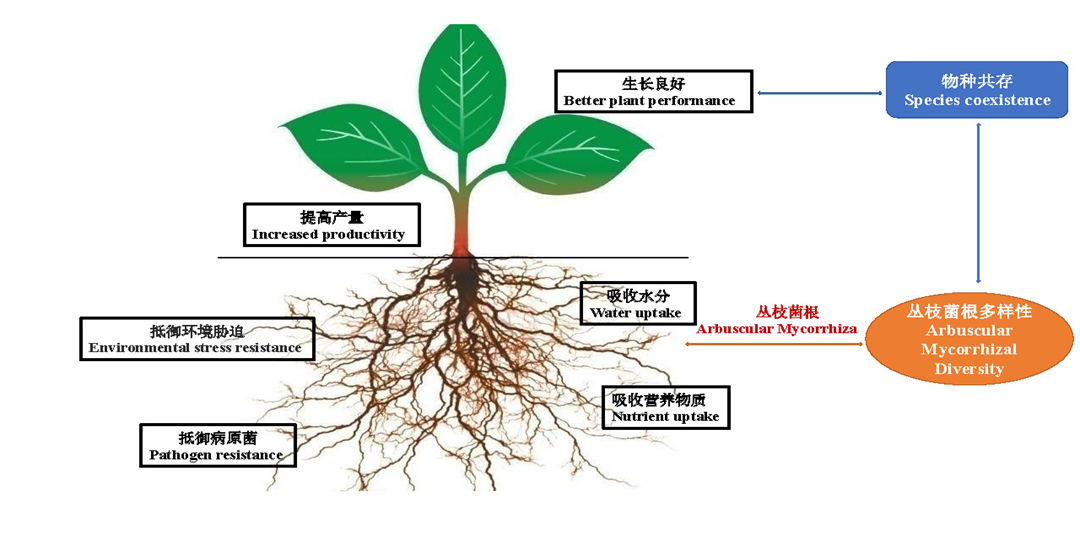
Arbuscular mycorrhiza (AM) is one of the oldest symbionts between plants and soil microorganisms, and about 80% terrestrial plant species can associate with AM fungi on earth. Because of the stable climate and poor soil phosphorus content in tropical and subtropical forests, this mutualistic symbiosis is much more common there. Previous studies have extensively investigated the diversity of AM fungi in tropical and subtropical forests, and have shown that AM fungi can promote plant recruitment and growth. However, this positive effect of AM fungi on plants (i.e., the positive plant-soil feedback) can weaken the contribution of the negative plant-soil feedback (caused by soil-borne pathogens) to maintaining tree species diversity, which appears to contradict with the surprisingly high tree diversity and high proportion of rare tree species in tropical and subtropical forests. Recently, a mounting number of empirical studies have found that the diversity of AM fungi varies significantly in different habitats and AM colonization depends on the identity of host species, thereby affecting the fitness of plants and further shaping the plant community structure. Through synthesizing the current research about the diversity of AM fungi in promoting plant coexistence and maintaining community diversity, we expect to put forward a promising study direction for testing the “rare species advantage” hypothesis, therefore improving the conservation of rare plant species.
YANG Jia-Rong, DAI Dong, CHEN Jun-Fang, WU Xian, LIU Xiao-Lin, LIU Yu . Insight into recent studies on the diversity of arbuscular mycorrhizal fungi in shaping plant community assembly and maintaining rare species[J]. Chinese Journal of Plant Ecology, 2023 , 47(6) : 745 -755 . DOI: 10.17521/cjpe.2022.0373
| [1] | Ahanger MA, Hashem A, Abd-Allah EF, Ahmad P (2014). Arbuscular mycorrhiza in crop improvement under environmental stress//Ahmad P, Rasool S. Emerging Technologies and Management of Crop Stress Tolerance. Academic Press, San Diego, USA. 69-95. |
| [2] | Alexander I, Selosse MA (2009). Mycorrhizas in tropical forests: a neglected research imperative. New Phytologist, 182, 14-16. |
| [3] | Anacker BL, Klironomos JN, Maherali H, Reinhart KO, Strauss SY (2014). Phylogenetic conservatism in plant-soil feedback and its implications for plant abundance. Ecology Letters, 17, 1613-1621. |
| [4] | Bachelot B, Kobe RK, Vriesendorp C (2015). Negative density- dependent mortality varies over time in a wet tropical forest, advantaging rare species, common species, or no species. Oecologia, 179, 853-861. |
| [5] | Bachelot B, Uriarte M, McGuire KL, Thompson J, Zimmerman J (2017). Arbuscular mycorrhizal fungal diversity and natural enemies promote coexistence of tropical tree species. Ecology, 98, 712-720. |
| [6] | Bennett JA, Cahill Jr JF (2016). Fungal effects on plant-plant interactions contribute to grassland plant abundances: evidence from the field. Journal of Ecology, 104, 755-764. |
| [7] | Bennett JA, Maherali H, Reinhart KO, Lekberg Y, Hart MM, Klironomos J (2017). Plant-soil feedbacks and mycorrhizal type influence temperate forest population dynamics. Science, 355, 181-184. |
| [8] | Bever JD (1994). Feedback between plants and their soil communities in an old field community. Ecology, 75, 1965-1977. |
| [9] | Bever JD (1999). Dynamics within mutualism and the maintenance of diversity: inference from a model of interguild frequency dependence. Ecology Letters, 2, 52-61. |
| [10] | Bever JD (2002a). Host-specificity of AM fungal population growth rates can generate feedback on plant growth. Plant and Soil, 244, 281-290. |
| [11] | Bever JD (2002b). Negative feedback within a mutualism: host-specific growth of mycorrhizal fungi reduces plant benefit. Proceedings of the Royal Society B: Biological Sciences, 269, 2595-2601. |
| [12] | Bever JD (2003). Soil community feedback and the coexistence of competitors: conceptual frameworks and empirical tests. New Phytologist, 157, 465-473. |
| [13] | Bever JD, Dickie IA, Facelli E, Facelli JM, Klironomos J, Moora M, Rillig MC, Stock WD, Tibbett M, Zobel M (2010). Rooting theories of plant community ecology in microbial interactions. Trends in Ecology & Evolution, 25, 468-478. |
| [14] | Bever JD, Mangan SA, Alexander HM (2015). Maintenance of plant species diversity by pathogens. Annual Review of Ecology, Evolution, and Systematics, 46, 305-325. |
| [15] | Bever JD, Platt TG, Morton ER (2012). Microbial population and community dynamics on plant roots and their feedbacks on plant communities. Annual Review of Microbiology, 66, 265-283. |
| [16] | Bever JD, Westover KM, Antonovics J (1997). Incorporating the soil community into plant population dynamics: the utility of the feedback approach. Journal of Ecology, 85, 561-573. |
| [17] | Cameron DD, Neal AL, van Wees SCM, Ton J (2013). Mycorrhiza-induced resistance: more than the sum of its parts? Trends in Plant Science, 18, 539-545. |
| [18] | Carteron A, Vellend M, Laliberté E (2022). Mycorrhizal dominance reduces local tree species diversity across US forests. Nature Ecology & Evolution, 6, 370-374. |
| [19] | Chase JM, Leibold MA (2004). Ecological Niches: Linking Classical and Contemporary Approaches. University of Chicago Press, Chicago. |
| [20] | Chen L, Zheng Y, Gao C, Mi XC, Ma KP, Wubet T, Guo LD (2017). Phylogenetic relatedness explains highly interconnected and nested symbiotic networks of woody plants and arbuscular mycorrhizal fungi in a Chinese subtropical forest. Molecular Ecology, 26, 2563-2575. |
| [21] | Chen YJ, Jia P, Cadotte MW, Wang PD, Liu X, Qi YL, Jiang XM, Wang ZH, Shu WS (2019). Rare and phylogenetically distinct plant species exhibit less diverse root-associated pathogen communities. Journal of Ecology, 107, 1226-1237. |
| [22] | Chesson P (2000). Mechanisms of maintenance of species diversity. Annual Review of Ecology and Systematics, 31, 343-366. |
| [23] | Chisholm RA, Muller-Landau HC (2011). A theoretical model linking interspecific variation in density dependence to species abundances. Theoretical Ecology, 4, 241-253. |
| [24] | Comita LS, Muller-Landau HC, Aguilar S, Hubbell SP (2010). Asymmetric density dependence shapes species abundances in a tropical tree community. Science, 329, 330-332. |
| [25] | Connell JH (1971). On the role of the natural enemies in preventing competitive exclusion in some marine animals and in rain forest trees//Boer PJD, Gradwell GR. Dynamics of Populations. Center for Agriculture Publishing and Documentation, Wageningen, The Netherlands. 298-312. |
| [26] | Connell JH, Tracey JG, Webb LJ (1984). Compensatory recruitment, growth, and mortality as factors maintaining rain forest tree diversity. Ecological Monographs, 54, 141-164. |
| [27] | Crawford KM, Bauer JT, Comita LS, Eppinga MB, Johnson DJ, Mangan SA, Queenborough SA, Strand AE, Suding KN, Umbanhowar J, Bever JD (2019). When and where plant-soil feedback may promote plant coexistence: a meta-analysis. Ecology Letters, 22, 1274-1284. |
| [28] | Dai D, Xing H, Yang JR, Liu YJ, Cai HM, Liu Y (2021). Advances in mechanisms of rare species maintenance and plant-soil feedback in plant communities. Biodiversity Science, 29, 1687-1699. |
| [28] | [戴冬, 邢华, 杨佳绒, 刘雅静, 蔡焕满, 刘宇 (2021). 植物群落稀有种维持机制与土壤反馈的研究进展. 生物多样性, 29, 1687-1699.] |
| [29] | Davison J, Moora M, ?pik M, Adholeya A, Ainsaar L, Ba A, Burla S, Diedhiou AG, Hiiesalu I, Jairus T, Johnson NC, Kane A, Koorem K, Kochar M, Ndiaye C, et al. (2015). Global assessment of arbuscular mycorrhizal fungus diversity reveals very low endemism. Science, 349, 970-973. |
| [30] | Dybzinski R, Tilman D (2007). Resource use patterns predict long-term outcomes of plant competition for nutrients and light. The American Naturalist, 170, 305-318. |
| [31] | Edathil TT, Manian S, Udaiyan K (1996). Interaction of multiple VAM fungal species on root colonization, plant growth and nutrient status of tomato seedlings (Lycopersicon esculentum Mill.). Agriculture, Ecosystems & Environment, 59, 63-68. |
| [32] | Enquist BJ, Feng X, Boyle B, Maitner B, Newman EA, J?rgensen PM, Roehrdanz PR, Thiers BM, Burger JR, Corlett RT, Couvreur TLP, Dauby G, Donoghue JC, Foden W, Lovett JC, et al. (2019). The commonness of rarity: global and future distribution of rarity across land plants. Science Advances, 5, eaaz0414. DOI: 10.1126/sciadv.aaz0414. |
| [33] | Fitter AH (1990). The role of ecological significance of vesicular-arbuscular mycorrhizas in temperate ecosystems. Agriculture, Ecosystems & Environment, 29, 137-151. |
| [34] | Fitter AH, Helgason T, Hodge A (2011). Nutritional exchanges in the arbuscular mycorrhizal symbiosis: implications for sustainable agriculture. Fungal Biology Reviews, 25, 68-72. |
| [35] | Gange AC, Brown VK, Sinclair GS (1993). Vesicular-arbuscular mycorrhizal fungi: a determinant of plant community structure in early succession. Functional Ecology, 7, 616-622. |
| [36] | Grainger TN, Levine JM, Gilbert B (2019). The invasion criterion: a common currency for ecological research. Trends in Ecology & Evolution, 34, 925-935. |
| [37] | Grime JP, MacKey JML, Hillier SH, Read DJ (1987). Floristic diversity in a model system using experimental microcosms. Nature, 328, 420-422. |
| [38] | Grinnell J (1917). The niche-relationships of the California thrasher. The Auk, 34, 427-433. |
| [39] | Guerra CA, Bardgett RD, Caon L, Crowther TW, Delgado- Baquerizo M, Montanarella L, Navarro LM, Orgiazzi A, Singh BK, Tedersoo L, Vargas-Rojas R, Briones MJI, Buscot F, Cameron EK, Cesarz S, et al. (2021). Tracking, targeting, and conserving soil biodiversity. Science, 371, 239-241. |
| [40] | Herre EA, Kyllo D, Mangan S, Husband R, Mejia LC, Eom AH (2005). An overview of arbuscular mycorrhizal fungal composition, distribution and host effects from a tropical moist forest//Burslem D, Pinard M, Hartley S. Biotic Interactions in the Tropics: Their Role in the Maintenance of Species Diversity. Cambridge University Press, Cambridge, UK. 204-225. |
| [41] | Hodge A, Fitter AH (2013). Microbial mediation of plant competition and community structure. Functional Ecology, 27, 865-875. |
| [42] | Hood LA, Swaine MD, Mason PA (2004). The influence of spatial patterns of damping-off disease and arbuscular mycorrhizal colonization on tree seedling establishment in Ghanaian tropical forest soil. Journal of Ecology, 92, 816-823. |
| [43] | Hooper DU, Bignell DE, Brown VK, Brussard L, Dangerfield JM, Wall DH, Wardle DA, Coleman DC, Giller KE, Lavelle P, van der Putten WH, de Ruiter PC, Rusek J, Silver WL, Tiedje JM, Wolters V (2000). Interactions between aboveground and belowground biodiversity in terrestrial ecosystems: patterns, mechanisms, and feedbacks. BioScience, 50, 1049-1061. |
| [44] | Hooper DU, Vitousek PM (1997). The effects of plant composition and diversity on ecosystem processes. Science, 277, 1302-1305. |
| [45] | Huisman J, Olff H (1998). Competition and facilitation in multispecies plant-herbivore systems of productive environments. Ecology Letters, 1, 25-29. |
| [46] | Jansa J, Smith FA, Smith SE (2008). Are there benefits of simultaneous root colonization by different arbuscular mycorrhizal fungi? New Phytologist, 177, 779-789. |
| [47] | Janzen DH (1970). Herbivores and the number of tree species in tropical forests. The American Naturalist, 104, 501-528. |
| [48] | Jia SH, Wang XG, Yuan ZQ, Lin F, Ye J, Lin GG, Hao ZQ, Bagchi R (2020). Tree species traits affect which natural enemies drive the Janzen-Connell effect in a temperate forest. Nature Communications, 11, 286. DOI: 10.1038/s41467-019-14140-y. |
| [49] | Jiang F, Zhu K, Cadotte MW, Jin GZ (2020). Tree mycorrhizal type mediates the strength of negative density dependence in temperate forests. Journal of Ecology, 108, 2601-2610. |
| [50] | Jiang SJ, Shi GX, Mao L, Pan JB, An LZ, Liu YJ, Feng HY (2015). Comparison of different PCR primers on detecting arbuscular mycorrhizal communities inside plant roots. Acta Microbiologica Sinica, 55, 916-925. |
| [51] | Johnson DJ, Clay K, Phillips RP (2018). Mycorrhizal associations and the spatial structure of an old-growth forest community. Oecologia, 186, 195-204. |
| [52] | Johnson NC, Graham JH, Smith FA (1997). Functioning of mycorrhizas associations along the mutualism-parasitism continuum. New Phytologist, 135, 575-585. |
| [53] | Kadowaki K, Yamamoto S, Sato H, Tanabe AS, Hidaka A, Toju H (2018). Mycorrhizal fungi mediate the direction and strength of plant-soil feedbacks differently between arbuscular mycorrhizal and ectomycorrhizal communities. Communications Biology, 1, 196. DOI: 10.1038/s42003-018-0201-9. |
| [54] | Kempel A, Rindisbacher A, Fischer M, Allan E (2018). Plant soil feedback strength in relation to large-scale plant rarity and phylogenetic relatedness. Ecology, 99, 597-606. |
| [55] | Kiers ET, Lovelock CE, Krueger EL, Herre EA (2000). Differential effects of tropical arbuscular mycorrhizal fungal inocula on root colonization and tree seedling growth: implications for tropical forest diversity. Ecology Letters, 3, 106-113. |
| [56] | Kivlin SN, Hawkes CV, Treseder KK (2011). Global diversity and distribution of arbuscular mycorrhizal fungi. Soil Biology & Biochemistry, 43, 2294-2303. |
| [57] | Klironomos JN (2002). Feedback with soil biota contributes to plant rarity and invasiveness in communities. Nature, 417, 67-70. |
| [58] | Klironomos JN (2003). Variation in plant response to native and exotic arbuscular mycorrhizal fungi. Ecology, 84, 2292-2301. |
| [59] | Koide RT (2000). Functional complementarity in the arbuscular mycorrhizal symbiosis. New Phytologist, 147, 233-235. |
| [60] | Law R (1988). Some ecological properties of intimate mutualisms involving plants. Symposium of the British Ecological Society, 28, 315-341. |
| [61] | Liang MX, Liu XB, Etienne RS, Huang FM, Wang YF, Yu SX (2015). Arbuscular mycorrhizal fungi counteract the Janzen-Connell effect of soil pathogens. Ecology, 96, 562-574. |
| [62] | Liang MX, Shi LQ, Burslem DFRP, Johnson D, Fang M, Zhang XY, Yu SX (2021). Soil fungal networks moderate density-dependent survival and growth of seedlings. New Phytologist, 230, 2061-2071. |
| [63] | Liang ZB, Lee DJ, Dweikat IM, Wedin DA, Yuen GY, Drijber RA (2017). Molecular diversity of arbuscular mycorrhizae in roots of Juniperus virginiana invasive to grasslands. Soil Science Society of America Journal, 81, 526-536. |
| [64] | Liu M, Zheng R, Bai SL, Wang JG, Li L, Duan GZ (2016). Advances of species diversity of arbuscular mycorrhizal fungi. Microbiology China, 43, 1836-1843. |
| [64] | [刘敏, 峥嵘, 白淑兰, 王琚钢, 李龙, 段国珍 (2016). 丛枝菌根真菌物种多样性研究进展. 微生物学通报, 43, 1836-1843.] |
| [65] | Liu XB, Liang MX, Etienne RS, Gilbert GS, Yu SX (2016). Phylogenetic congruence between subtropical trees and their associated fungi. Ecology and Evolution, 6, 8412-8422. |
| [66] | Liu Y, Fang SQ, Chesson P, He FL (2015). The effect of soil-borne pathogens depends on the abundance of host tree species. Nature Communications, 6, 10017. DOI: 10.1038/ncomms10017. |
| [67] | Liu Y, He FL (2019). Incorporating the disease triangle framework for testing the effect of soil-borne pathogens on tree species diversity. Functional Ecology, 33, 1211-1222. |
| [68] | Liu Y, Yu SX, Xie ZP, Staehelin C (2012). Analysis of a negative plant-soil feedback in a subtropical monsoon forest. Journal of Ecology, 100, 1019-1028. |
| [69] | Mack KML, Bever JD (2014). Coexistence and relative abundance in plant communities are determined by feedbacks when the scale of feedback and dispersal is local. Journal of Ecology, 102, 1195-1201. |
| [70] | Mangan SA, Herre EA, Bever JD (2010a). Specificity between Neotropical tree seedlings and their fungal mutualists leads to plant-soil feedback. Ecology, 91, 2594-2603. |
| [71] | Mangan SA, Schnitzer SA, Herre EA, Mack KML, Valencia MC, Sanchez EI, Bever JD (2010b). Negative plant-soil feedback predicts tree-species relative abundance in a tropical forest. Nature, 466, 752-755. |
| [72] | Mi XC, Feng G, Hu YB, Zhang J, Chen L, Corlett RT, Hughes AC, Pimm S, Schmid B, Shi SH, Svenning JC, Ma KP (2021). The global significance of biodiversity science in China: an overview. National Science Review, 8, nwab032. DOI: 10.1093/nsr/nwab032. |
| [73] | Montesinos-Navarro A, Segarra-Moragues JG, Valiente-Banuet A, Verdú M (2012). Plant facilitation occurs between species differing in their associated arbuscular mycorrhizal fungi. New Phytologist, 196, 835-844. |
| [74] | Moora M, Zobel M (2010). Arbuscular mycorrhizae and plant-plant interactions impact of invisible world on visible patterns//Pugnaire F. Positive Plant Interactions and Community Dynamics. CRC Press, Boca Raton, USA. 79-98. |
| [75] | Newman EI, Reddell P (1987). The distribution of mycorrhizas among families of vascular plants. New Phytologist, 106, 745-751. |
| [76] | Newsham KK, Fitter AH, Watkinson AR (1995). Arbuscular mycorrhiza protect an annual grass from root pathogenic fungi in the field. Journal of Ecology, 83, 991-1000. |
| [77] | ?pik M, Zobel M, Cantero JJ, Davison J, Facelli JM, Hiiesalu I, Jairus T, Kalwij JM, Koorem K, Leal ME, Liira J, Metsis M, Neshataeva V, Paal J, Phosri C, et al. (2013). Global sampling of plant roots expands the described molecular diversity of arbuscular mycorrhizal fungi. Mycorrhiza, 23, 411-430. |
| [78] | Parker IM, Saunders M, Bontrager M, Weitz AP, Hendricks R, Magarey R, Suiter K, Gilbert GS (2015). Phylogenetic structure and host abundance drive disease pressure in communities. Nature, 520, 542-544. |
| [79] | Peay KG (2016). The mutualistic niche: mycorrhizal symbiosis and community dynamics. Annual Review of Ecology, Evolution, and Systematics, 47, 143-164. |
| [80] | Pi L, Liu YX, Shu CW, Zhou EX (2018). Research progress on the interaction between plant pathogen effectors and their host plants. Molecular Plant Breeding, 16, 2035-2040. |
| [80] | [皮磊, 刘艳潇, 舒灿伟, 周而勋 (2018). 植物病原物效应子与寄主植物互作的研究进展. 分子植物育种, 16, 2035-2040.] |
| [81] | Powell JR, Rillig MC (2018). Biodiversity of arbuscular mycorrhizal fungi and ecosystem function. New Phytologist, 220, 1059-1075. |
| [82] | Read DJ (1991). Mycorrhizas in ecosystems. Experientia, 47, 376-391. |
| [83] | Rowe HI, Brown CS, Claassen VP (2007). Comparisons of mycorrhizal responsiveness with field soil and commercial inoculum for six native montane species and Bromus tectorum. Restoration Ecology, 15, 44-52. |
| [84] | Rúa MA, Antoninka A, Antunes PM, Chaudhary VB, Gehring C, Lamit LJ, Piculell BJ, Bever JD, Zabinski C, Meadow JF, Lajeunesse MJ, Milligan BG, Karst J, Hoeksema JD (2016). Home-field advantage? Evidence of local adaptation among plants, soil, and arbuscular mycorrhizal fungi through meta-analysis. BMC Evolutionary Biology, 16, 122. DOI: 10.1186/s12862-016-0698-9. |
| [85] | Saia S, Tamayo E, Schillaci C, de Vita P (2020). Arbuscular mycorrhizal fungi and nutrient cycling in cropping systems//Datta R, Meena RS, Pathan SI, Ceccherini MT. Carbon and Nitrogen Cycling in Soil. Springer, Singapore. 87-115. |
| [86] | Schroeder JW, Martin JT, Angulo DF, Barbosa JM, Perea R, Arias-Del Razo I, Sebastián-González E, Dirzo R (2018). Community composition and diversity of Neotropical root-associated fungi in common and rare trees. Biotropica, 50, 694-703. |
| [87] | Schroeder JW, Dobson A, Mangan SA, Petticord DF, Herre EA (2020). Mutualist and pathogen traits interact to affect plant community structure in a spatially explicit model. Nature Communications, 11, 2204. DOI: 10.1038/s41467-020-16047-5. |
| [88] | Schroeder JW, Martin JT, Angulo DF, Arias-Del Razo I, Barbosa JM, Perea R, Sebastián-González E, Dirzo R (2019). Host plant phylogeny and abundance predict root- associated fungal community composition and diversity of mutualists and pathogens. Journal of Ecology, 107, 1557-1566. |
| [89] | Sheng M, Rosche C, Al-Gharaibeh M, Bullington LS, Callaway RM, Clark T, Cleveland CC, Duan WY, Flory SL, Khasa DP, Klironomos JN, McLeod M, Okada M, Pal RW, Shah MA, Lekberg Y (2022). Acquisition and evolution of enhanced mutualism—An underappreciated mechanism for invasive success? The ISME Journal, 16, 2467-2478. |
| [90] | Shi ZY, Yin KJ, Wang FY, Mickan BS, Wang XG, Zhou WL, Li YJ (2019). Alterations of arbuscular mycorrhizal fungal diversity in soil with elevation in tropical forests of China. Diversity, 11, 181. DOI: 10.3390/d11100181. |
| [91] | Singh P, Baruah G (2021). Higher order interactions and species coexistence. Theoretical Ecology, 14, 71-83. |
| [92] | Smith FA, Jakobsen I, Smith SE (2000). Spatial differences in acquisition of soil phosphate between two arbuscular mycorrhizal fungi in symbiosis with Medicago truncatula. New Phytologist, 147, 357-366. |
| [93] | Smith SE, Read D (2008). The symbionts forming arbuscular mycorrhizas//Smith SE, Read D. Mycorrhizal Symbiosis. 3rd ed. Academic Press, London. 13-41. |
| [94] | Song XY, Lim JY, Yang J, Luskin MS (2021). When do Janzen-Connell effects matter? A phylogenetic meta- analysis of conspecific negative distance and density dependence experiments. Ecology Letters, 24, 608-620. |
| [95] | Tedersoo L, Bahram M, P?lme S, K?ljalg U, Yorou NS, Wijesundera R, Ruiz LV, Vasco-Palacios AM, Thu PQ, Suija A, Smith ME, Sharp C, Saluveer E, Saitta A, Rosas M, et al. (2014). Global diversity and geography of soil fungi. Science, 346, 1256688. DOI: 10.1126/science.1256688. |
| [96] | Tedersoo L, Bahram M, Zobel M (2020). How mycorrhizal associations drive plant population and community biology. Science, 367, eaba1223. DOI: 10.1126/science.aba1223. |
| [97] | Teste FP, Kardol P, Turner BL, Wardle DA, Zemunik G, Renton M, Laliberté E (2017). Plant-soil feedback and the maintenance of diversity in Mediterranean-climate shrublands. Science, 355, 173-176. |
| [98] | Toussaint A, Bueno G, Davison J, Moora M, Tedersoo L, Zobel M, ?pik M, P?rtel M (2020). Asymmetric patterns of global diversity among plants and mycorrhizal fungi. Journal of Vegetation Science, 31, 355-366. |
| [99] | Trivedi P, Leach JE, Tringe SG, Sa TM, Singh BK (2020). Plant-microbiome interactions: from community assembly to plant health. Nature Reviews: Microbiology, 18, 607-621. |
| [100] | Turner TR, James EK, Poole PS (2013). The plant microbiome. Genome Biology, 14, 209. DOI: 10.1186/gb-2013-14-6-209. |
| [101] | van der Heijden MGA, Bardgett RD, van Straalen NM (2008). The unseen majority: soil microbes as drivers of plant diversity and productivity in terrestrial ecosystems. Ecology Letters, 11, 296-310. |
| [102] | van der Heijden MGA, Boller T, Wiemken A, Sanders IR (1998a). Different arbuscular mycorrhizal fungal species are potential determinants of plant community structure. Ecology, 79, 2082-2091. |
| [103] | van der Heijden MGA, Klironomos JN, Ursic M, Moutoglis P, Streitwolf-Engel R, Boller T, Wiemken A, Sanders IR (1998b). Mycorrhizal fungal diversity determines plant biodiversity, ecosystem variability and productivity. Nature, 396, 69-72. |
| [104] | van der Putten WH, Van Dijk C, Peters BAM (1993). Plant- specific soil-borne diseases contribute to succession in foredune vegetation. Nature, 362, 53-56. |
| [105] | Vandenkoornhuyse P, Quaiser A, Duhamel M, Le Van A, Dufresne A (2015). The importance of the microbiome of the plant holobiont. New Phytologist, 206, 1196-1206. |
| [106] | Vieira LC, da Silva DKA, da Silva IR, Gon?alves CM, de Assis DMA, Oehl F, da Silva GA (2019). Ecological aspects of arbuscular mycorrhizal fungal communities in different habitat types of a Brazilian mountainous area. Ecological Research, 34, 182-192. |
| [107] | Waldrop MP, Zak DR, Blackwood CB, Curtis CD, Tilman D (2006). Resource availability controls fungal diversity across a plant diversity gradient. Ecology Letters, 9, 1127-1135. |
| [108] | Wardle DA, Bardgett RD, Klironomos JN, Set?l? H, van der Putten WH, Wall DH (2004). Ecological linkages between aboveground and belowground biota. Science, 304, 1629-1633. |
| [109] | Xiong T, Liang JL, Li JT, Shu WS, Wang YT (2021). Genomic and transcriptomic studies of several species of arbuscular mycorrhizal fungi. Acta Microbiologica Sinica, 61, 3413-3430. |
| [109] | [熊天, 梁洁良, 李金天, 束文圣, 王宇涛 (2021). 丛枝菌根真菌数个种的基因组和转录组研究概况. 微生物学报, 61, 3413-3430.] |
| [110] | Yang HY, Zhao LL, He XL (2005). Function of arbuscular mycorrhiza in the restoration and reconstruction of degraded ecosystems. Arid Land Geography, 28, 836-842. |
| [110] | [杨宏宇, 赵丽莉, 贺学礼 (2005). 丛枝菌根在退化生态系统恢复和重建中的作用. 干旱区地理, 28, 836-842.] |
| [111] | Yang WY, Sun LY, Song FB, Yang XQ, Zhang MJ, Li SX, Zhu XC (2019). Research advances in species diversity of arbuscular mycorrhizal fungi in terrestrial agro-ecosystem. Chinese Journal of Applied Ecology, 30, 3971-3979. |
| [111] | [杨文莹, 孙露莹, 宋凤斌, 杨小琴, 张梦杰, 李书鑫, 朱先灿 (2019). 陆地农业生态系统丛枝菌根真菌物种多样性研究进展. 应用生态学报, 30, 3971-3979.] |
| [112] | Yenni G, Adler PB, Ernest SKM (2012). Strong self-limitation promotes the persistence of rare species. Ecology, 93, 456-461. |
| [113] | Zhong SY, Zhang J, Chu GW, Xia YJ, Tang XL (2017). Soil aggregate composition and its relationship with arbuscular mycorrhizal fungi in different restoration stages on severely eroded lands. Ecology and Environmental Sciences, 26, 219-226. |
| [113] | [钟思远, 张静, 褚国伟, 夏艳菊, 唐旭利 (2017). 沿海侵蚀台地不同恢复阶段土壤团聚体组成及其与丛枝菌根真菌的关系. 生态环境学报, 26, 219-226.] |
/
| 〈 |
|
〉 |
Copyright © 2026 Chinese Journal of Plant Ecology
Tel: 010-62836134, 62836138, E-mail: apes@ibcas.ac.cn, cjpe@ibcas.ac.cn

