
Chinese Journal of Plant Ecology >
Nonlinear responses of productivity and diversity of alpine meadow communities to degradation
Online published: 2018-03-08
Supported by
Supported by the National Key Research and Development Project of China(2016YFC0501802);Supported by the National Key Research and Development Project of China(2017YFA0604802);the National Natural Science Foundation of China(41571195);the National Natural Science Foundation of China(41501103)
Aims The alpine meadow degradation could have profound effects on the grassland productivity. The aim of our study is to clarify the dynamic response of community productivity and species diversity in the process of alpine meadow degradation.
Methods In the Institute of Geographic Sciences and Natural Resources Research, Chinese Academy of Sciences, Northern Tibetan Grassland Ecosystem Research Station (Nagqu station), we conducted stages experiments with multiple degradation levels: control, mild degraded meadow, moderate degraded meadow, severe degraded meadow and serious sandy meadow.
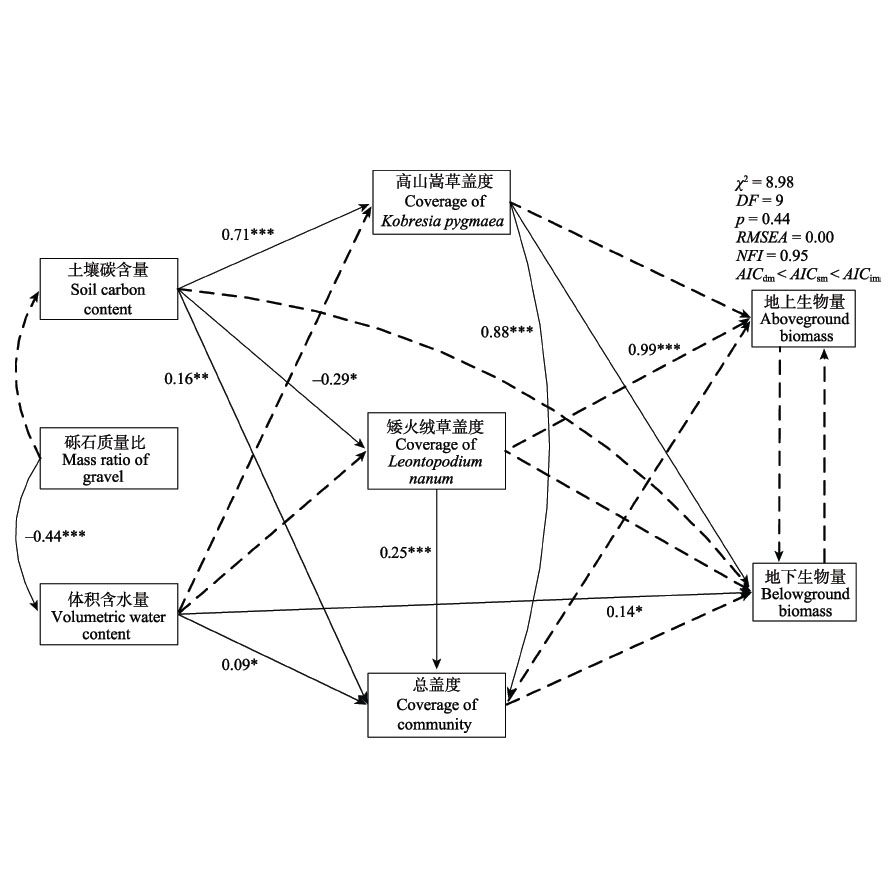
Important findings The response of aboveground biomass to alpine meadow degradation showed a linear or nonlinear increased response patterns, but the belowground biomass and total biomass decreased nonlinearly. As observed in measurement of aboveground biomass, Margalef index, Simpson index, Shannon-Wiener index and Pielou evenness index also exhibit a nonlinear increased response to degradation. The results of structural equation models showed that belowground biomass has a positive relationship with soil carbon content (p < 0.05) and volume water content (p < 0.1). However, soil nutrient and soil physical properties had no significant impact on aboveground biomass (p < 0.1). Compared with soil physical properties, soil nutrition is an important factor influencing the diversity index. In our study, the nonlinear responses of productivity and diversity of alpine meadow were described by using the multiple levels of degradation in space. The results suggested that aboveground productivity cannot interpret the degree of degradation of alpine meadow, and by contrast, alpine meadow degradation should be measured by the change of plant functional groups, such as edible grasses and poisonouups, such as edible grasses and poisonous forbs.
CHEN Ning, ZHANG Yang-Jian, ZHU Jun-Tao, LI Jun-Xiang, LIU Yao-Jie, ZU Jia-Xing, CONG Nan, HUANG Ke, WANG Li . Nonlinear responses of productivity and diversity of alpine meadow communities to degradation[J]. Chinese Journal of Plant Ecology, 2018 , 42(1) : 50 -65 . DOI: 10.17521/cjpe.2017.0252
| [1] | Bai YF, Li LH, Wang QB, Zhang LX, Zhang Y, Chen ZZ ( 2000). Changes in plant species diversity and productivity along gradients of precipitation and elevation in the Xilin River Basin, Inner Mongolia. Acta Phytoecologica Sinica, 24, 667-673. |
| [1] | [ 白永飞, 李凌浩, 王其兵, 张丽霞, 张焱, 陈佐忠 ( 2000). 锡林河流域草原群落植物多样性和初级生产力沿水热梯度变化的样带研究. 植物生态学报, 24, 667-673.] |
| [2] | Cai XB, Zhang YQ, Shao W ( 2007). Degradation and mechanism of grassland of North Tibet alpine prairie. Soil, 39, 855-858. |
| [2] | [ 蔡晓布, 张永青, 邵伟 ( 2007). 藏北高寒草原草地退化及其驱动力分析. 土壤, 39, 855-858.] |
| [3] | Chen LL, Shi JJ, Wang YL, Ma YS, Dong QM, Hou XK ( 2016). Study on different degraded degrees grassland community structure characteristics of the alpine area. Acta Agrectir Sinica, 24, 210-213. |
| [3] | [ 陈乐乐, 施建军, 王彦龙, 马玉寿, 董全民, 侯宪宽 ( 2016). 高寒地区不同退化程度草地群落结构特征研究. 草地学报, 24, 210-213.] |
| [4] | Dong XB, Zhang XS ( 2005). View on the grassland in China. Green Economy, ( 10), 70-73. |
| [4] | [ 董孝斌, 张新时 ( 2005). 我国草地的发展观. 生态经济, ( 10), 70-73.] |
| [5] | Gao YZ, Han XG, Wang SP ( 2004). The effects of grazing on grassland soils. Acta Ecologica Sinica, 24, 790-797. |
| [5] | [ 高英志, 韩兴国, 汪诗平 ( 2004). 放牧对草原土壤的影响. 生态学报, 24, 790-797.] |
| [6] | Gu YR, Zhang GF, Meng L ( 2005). Drought resistance of four forage species at seedling under water stress. Journal of Sichuan Grassland, ( 4), 4-7. |
| [6] | [ 谷燕蓉, 张国芳, 孟林 ( 2005). 四种牧草幼苗对水分胁迫的相应及其抗旱性. 四川草原, ( 4), 4-7.] |
| [7] | He JS, Fang JY, Ma KP, Huang JH ( 2003). Biodiversity and ecosystem productivity: Why is there a discrepancy in the relationship between experimental and natural ecosystems? Acta Phytoecologica Sinica, 27, 835-843. |
| [7] | [ 贺金生, 方精云, 马克平, 黄建辉 ( 2003). 生物多样性与生态系统生产力: 为什么野外观测和受控实验结果不一致? 植物生态学报, 27, 835-843.] |
| [8] | Hou JT, Cheng ZJ ( 1999). Application and analytical strategies of structure equation modelling. Exploration of Psychology, 19, 54-59. |
| [8] | [ 侯杰泰, 成子娟 ( 1999). 结构方程模型的应用及分析策略. 心理学探新, 19, 54-59.] |
| [9] | Kong FZ, Yu RC, Xu ZJ, Zhou MJ ( 2012). Application of excel in calculation of biodiversity indices. Marine Sciences, 36(4), 57-62. |
| [9] | [ 孔凡洲, 于仁成, 徐子钧, 周名江 ( 2012). 应用Excel软件计算生物多样性指数. 海洋科学, 36(4), 57-62.] |
| [10] | Li L, Liu W ( 2011). Relationship between plant functional groups, species richness and community’s productivity in degraded grassland. Acta Agrectir Sinica, 19, 917-921. |
| [10] | [ 李里, 刘伟 ( 2011). 退化草地植物功能群和物种丰富度与群落生产力关系的研究. 草地学报, 19, 917-921.] |
| [11] | Li MS ( 2000). Countermeasures for environmental protection in the Qinghai-Tibet Plateau. Resources Science, 22(4), 78-82. |
| [11] | [ 李明森 ( 2000). 青藏高原环境保护对策. 资源科学, 22(4), 78-82.] |
| [12] | Lin HL, Hou FJ, Ren JZ ( 2008). Evaluation of indicators of grazing trampling intensity. Acta Prataculturae Sinica, 17(1), 85-92. |
| [12] | [ 林慧龙, 侯扶江, 任继周 ( 2008). 放牧家畜的践踏强度指标探讨. 草业学报, 17(1), 85-92.] |
| [13] | Liu W, Wang QJ, Wang X, Zhou L, Li YF, Li FJ ( 1999). Ecological process of forming “black soil-type” degraded grassland. Acta Agrestia Sinica, 7, 301-305. |
| [13] | [ 刘伟, 王启基, 王溪, 周立, 李有福, 李发吉 ( 1999). 高寒草甸“黑土型”退化草地的成因及生态过程. 草地学报, 7, 301-305.] |
| [14] | Liu XN, Sun JL, Zhang DG, Pu XP, Xu GP ( 2008). A study on the community structure and plant diversity of alpine meadow under different degrees of degradation in the Eastern Qilian Mountains. Acta Prataculturae Sinica, 17(4), 1-11. |
| [14] | [ 柳小妮, 孙九林, 张德罡, 蒲小鹏, 徐广平 ( 2008). 东祁连山不同退化阶段高寒草甸群落结构与植物多样性特征研究, 草业学报, 17(4), 1-11.] |
| [15] | Liu XQ, Wu QH, Li HQ, Mao SJ, Li YN ( 2013). A comparison of the vegetation/soil carbon density and net ecosystem CO2 exchange of alpine meadow with different enclosure durations. Journal of Glaciology and Geocryology, 35, 848-856. |
| [15] | [ 刘晓琴, 吴启华, 李红琴, 毛绍娟, 李英年 ( 2013). 不同封育年限高寒草甸植被/土壤碳密度及净生态系统CO2交换量的比较. 冰川冻土, 35, 848-856.] |
| [16] | Long Y, Meng FD, Wang CS, Bai L, Zhong Y, Wang SP ( 2015). Above- and below-ground biomass distribution of main alpine meadow plants and impact of degradation on root/shoot ratio and root area. Guihaia, 35, 532-538. |
| [16] | [ 龙毅, 孟凡栋, 王常顺, 白玲, 钟扬, 汪诗平 ( 2015). 高寒草甸主要植物地上地下生物量分布及退化对根冠比和根系表面积的影响. 广西植物, 35, 532-538.] |
| [17] | Luo YY, Meng QT, Zhang JH, Zhao XY, Qin Y ( 2014). Species diversity and biomass in relation to soil properties of alpine meadows in the eastern Tibetan Plateau in different degradation stages. Journal of Glaciology and Geocryology, 36, 1298-1305. |
| [17] | [ 罗亚勇, 孟庆涛, 张静辉, 赵学勇, 秦彧 ( 2014). 青藏高原东缘高寒草甸退化过程中植物群落物种多样性、生产力与土壤特性的关系. 冰川冻土, 36, 1298-1305.] |
| [18] | Luo YY, Zhang Y, Zhang JH, Ka ZJ, Shang LY, Wang SY ( 2012). Soil stiochiometry characteristics among alpine meadows of different degradation stages in Maqu County. Chinese Journal of Ecology, 31, 254-260. |
| [18] | [ 罗亚勇, 张宇, 张静辉, 卡召加, 尚伦宇, 王少影 ( 2012). 不同退化阶段高寒草甸土壤化学计量特征. 生态学杂志, 31, 254-260.] |
| [19] | Mao F, Zhang YH, Hou YY, Tang SH, Lu ZG, Zhang JH ( 2008). Dynamic assessment of grassland degradation in Naqu of northern Tibet. Chinese Journal of Applied Ecology, 19, 278-284. |
| [19] | [ 毛飞, 张艳红, 侯英雨, 唐世浩, 卢志光, 张佳华 ( 2008). 藏北那曲地区草地退化动态评价. 应用生态学报, 19, 278-284.] |
| [20] | Niu KC, Luo YJ, Choler P, Du GZ ( 2008). The role of biomass allocation strategy in diversity loss due to fertilization. Basic and Applied Ecology, 9, 485-493. |
| [21] | Qi B, Zhang DG, Ding LL, Zhang L, Wang X, Yang YH ( 2005). Properties of plant community diversity of degraded alpine arid grasslands. Journal of Gansu Agricultural University, 40, 626-631. |
| [21] | [ 祁彪, 张德罡, 丁玲玲, 张力, 汪玺, 杨予海 ( 2005). 退化高寒干旱草地植物群落多样性特征. 甘肃农业大学学报, 40, 626-631.] |
| [22] | Ren QJ, Cui XL, Zhao BB ( 2008). Effects of grazing impact on community structure and productivity in an alpine meadow. Acta Prataculturae Sinica, 17(6), 134-140. |
| [22] | [ 仁青吉, 崔现亮, 赵彬彬 ( 2008). 放牧对高寒草甸植物群落结构及生产力的影响. 草业学报, 17(6), 134-140.] |
| [23] | Sala OE, Oesterheld M, León RJC, Soriano A ( 1986). Grazing effects upon plant community structure in subhumid grasslands of Argentina. Vegetatio, 67, 27-32. |
| [24] | Sheng L, Wang YL ( 2010). Characteristics variation of soil nutrition in different degraded degree alpine meadow in Dawu region of Guoluo prefecture. Chinese Qinghai Journal of Animal and Veterinary Sciences, 40(4), 4-6. |
| [24] | [ 盛丽, 王彦龙 ( 2010). 果洛大武地区不同退化梯度下高寒草甸土壤养分特征变化. 青海畜牧兽医杂志, 40(4), 4-6.] |
| [25] | Studies on the Development of Agriculture and Animal Husbandry Industry with Characteristics of Tibet Autonomous Region Group ( 2003). Studies on the development of agriculture and animal husbandry industry with characteristics of Tibet Autonomous Region. Journal of China Agricultural Resources and Regional Planning, 24(6), 8-12. |
| [25] | [ 西藏自治区农牧业特色产业发展研究课题组 ( 2003). 西藏自治区农牧业特色产业发展研究. 中国农业资源与区划, 24(6), 8-12.] |
| [26] | Wang CT, Long RJ, Wang QL, Cao GM, Shi JJ, Du YG ( 2008). Response of plant diversity and productivity to soil response changing under grazing disturbance on an alpine meadow. Acta Ecologica Sinica, 28, 4144-4152. |
| [26] | [ 王长庭, 龙瑞军, 王启兰, 曹广民, 施建军, 杜岩功 ( 2008). 放牧扰动下高寒草甸植物多样性、生产力对土壤养分条件变化的响应. 生态学报, 28, 4144-4152.] |
| [27] | Wang DL, Lü XL, Luo WD ( 1996). Analysis to effects of different grazing density on characteristics of rangeland vegetation. Acta Prataculturae Sinica, 5(3), 28-33. |
| [27] | [ 王德利, 吕新龙, 罗卫东 ( 1996). 不同放牧密度对草原植被特征的影响分析. 草业学报, 5(3), 28-33.] |
| [28] | Wang GX, Shen YP, Cheng GD ( 2000). Eco-environmental changes and causal analysis in the source regions of the Yellow River. Journal of Glaciology and Geocryology, 22, 200-205. |
| [28] | [ 王根绪, 沈永平, 程国栋 ( 2000). 黄河源区生态环境变化与成因分析. 冰川冻土, 22, 200-205.] |
| [29] | Wang QL, Wang CT, Du YG, Cao GM ( 2008). Grazing impact on soil microbial biomass carbon and relationships with soil environment in alpine Kobresia meadow. Acta Prataculturae Sinica, 17(2), 39-46. |
| [29] | [ 王启兰, 王长庭, 杜岩功, 曹广民 ( 2008). 放牧对高寒嵩草草甸土壤微生物量碳的影响及其与土壤环境的关系. 草业学报, 17(2), 39-46.] |
| [30] | Wang W, Liu ZL, Hao DY, Liang CZ ( 1996). Research on the restoring succession of the degenerated grassland in Inner Mongolia II. Analysis of the restoring process. Acta Phytoecologica Sinica, 20, 460-471. |
| [30] | [ 王炜, 刘钟龄, 郝敦元, 梁存柱 ( 1996). 内蒙古草原退化群落恢复演替的研究: II.恢复演替时间进程的分析. 植物生态学报, 20, 460-471.] |
| [31] | Wang YX, Cao JM ( 2007). How to solve the overgrazing problem in Inner Mongolia. Green Economy, ( 7), 58-64. |
| [31] | [ 王云霞, 曹建民 ( 2007). 内蒙古草原过度放牧的解决途径. 生态经济, ( 7), 58-64.] |
| [32] | Wu ML ( 2010). Structural Equation Modeling: Operation and Response of AMOS. The University of Chongqing Press, Chongqing. |
| [32] | (in Chinese) [ 吴明隆 ( 2010).结构方程模型: AMOS的操作与应用. 重庆大学出版.] |
| [33] | Yang FY, Zhang YW, Miao YJ, Wei XH ( 2003). Main limiting factors for deteriorated grasslands vegetation restoration of Northern Tibet Plateau. Bulletin of Soil and Water Conservation, 23(4), 17-20. |
| [33] | [ 杨富裕, 张蕴微, 苗彦军, 魏学红 ( 2003). 藏北高寒退化草地植被恢复过程的障碍因子初探. 水土保持通报, 23(4), 17-20.] |
| [34] | Zhang GS, Li L ( 1999). Effects of climatic changes of South Qinghai Plateau on the alpine meadow. Acta Prataculturae Sinica, 8(3), 1-10. |
| [34] | [ 张国胜, 李林 ( 1999). 青南高原气候变化及其对高寒草甸牧草生长影响的研究. 草业学报, 8(3), 1-10.] |
| [35] | Zhang J, Zhao H, Zhang T, Zhao X, Drake S ( 2005). Community succession along a chronosequence of vegetation restoration on sand dunes in Horqin Sandy Land. Journal of Arid Environments, 62, 555-566. |
| [36] | Zhang JP, Chen XH, Zou XY, Ji HL, Du J, Cao ZJ, Fu XF ( 2001). The eco-environmental problems and its countermeasures in Tibet. Journal of Mountain Science, 19, 81-86. |
| [36] | [ 张建平, 陈学华, 邹学勇, 靳鹤龄, 杜杰, 曹宗杰, 付雪峰 ( 2001). 西藏自治区生态环境问题及对策. 山地学报, 19, 81-86.] |
| [37] | Zhao CZ, Long RJ, Ma YH, Ji SZ ( 2005). The impact of the institution of grassland property right on overgrazing—A case from Hongshiwo countryside, Sunan County, Gansu. Acta Prataculturae Sinica, 14(1), 1-5. |
| [37] | [ 赵成章, 龙瑞军, 马永欢, 吉生柱 ( 2005). 草地产权制度对草地超载过牧的影响——以肃南县红石窝乡的调查为例. 草业学报, 14(1), 1-5.] |
| [38] | Zheng W, Dong QM, Li SX, Li HT, Liu Y, Yang SH ( 2012). Impact of grazing intensities on community biodiversity and productivity of alpine grassland in Qinghai Lake Region. Acta Agrestia Sinica, 20, 1033-1038. |
| [38] | [ 郑伟, 董全民, 李世雄, 李红涛, 刘玉, 杨时海 ( 2012). 放牧强度对环青海湖高寒草原群落物种多样性和生产力的影响. 草地学报, 20, 1033-1038.] |
| [39] | Zhong XH ( 2005). Pay close attention to an issue at home and abroad academic circles all along: Research of the Qinghai-Tibet Plateau. Journal of Mountain Science, 23, 257-259. |
| [39] | [ 钟祥浩 ( 2005). 国内外学术界一直关注的问题: 青藏高原研究. 山地学报, 23, 257-259.] |
| [40] | Zhou HK, Zhao XQ, Zhou Li, Liu W, Li YN, Tang YH ( 2005). A study on correlations between vegetation degradation and soil degradation in the alpine meadow of the Qinghai-Tibetan Plateau. Acta Prataculturae Sinica, 14(3), 31-40. |
| [40] | [ 周华坤, 赵新全, 周立, 刘伟, 李英年, 唐艳鸿 ( 2005). 青藏高原高寒草甸的植被退化与土壤退化特征研究. 草业学报, 14(3), 31-40.] |
| [41] | Zhu JT ( 2016). Effects of experimental warming on plant phenology in Xizang alpine meadow. Chinese Journal of Plant Ecology, 40, 1028-1036. |
| [41] | [ 朱军涛 ( 2016). 实验增温对藏北高寒草甸植物物候的影响. 植物生态学报, 40, 1028-1036.] |
| [42] | Zong N, Shi PL, Niu B, Jiang J, Song MH, Zhang XZ, He YT ( 2010). Effects of nitrogen and phosphorous fertilization on community structure and productivity of degraded alpine meadows in northern Tibet, China. Chinese Journal of Applied Ecology, 25, 3458-3468. |
| [42] | [ 宗宁, 石培礼, 牛犇, 蒋婧, 宋明华, 张宪洲, 何永涛 ( 2010). 氮磷配施对藏北退化高寒草甸群落结构和生产力的影响. 应用生态学报, 25, 3458-3468.] |
| [43] | Zou XY, Dong GR, Li S, Dong YX, Yang P, Ji HL, Zhang CL, Cheng H ( 2003). Desertification and its prevention and control strategy in Tibet. Journal of Natural Disasters, 17-24. |
| [43] | [ 邹学勇, 董光荣, 李森, 董玉祥, 杨萍, 靳鹤龄, 张春来, 程宏 ( 2003). 西藏荒漠化及其防治战略. 自然灾害学报, 12, 17-24.] |
| [44] | Zuo XA, Zhao XY, Zhao HL, Li YQ, Guo ZR, Zhao YP ( 2007). Changes of species diversity and productivity in relation to soil properties in sandy grassland in Horqin Sand Land. Environmental Science, 28, 945-951. |
| [44] | [ 左小安, 赵学勇, 赵哈林, 李玉强, 郭轶瑞, 赵玉萍 ( 2007). 科尔沁沙质草地群落物种多样性、生产力与土壤特性的关系. 环境科学, 28, 945-951.] |
/
| 〈 |
|
〉 |
