
Chinese Journal of Plant Ecology >
Hierarchical responses of plant stoichiometry to phosphorus addition in an alpine meadow community
Online published: 2018-03-08
Supported by
Supported by the National Natural Science Foundation of China(31270472)
Aims Terrestrial carbon (C), nitrogen (N), phosphorus (P) stoichiometry will reflect the effects of adjustment to local growth conditions as well as species’ replacements. However, it remains unclear about the hierarchical responses of plant C:N:P to P addition at levels of species and functional groups in the N-limited alpine meadow.
Methods A field experiment of P enrichment was conducted in an alpine meadow on the Qinghai-Xizang Plateau during 2009-2013. The stoichiometric patterns of four functional groups (grass, sedge, legume and forb) and five representative species, Elymus nutans (grass), Kobresia humilis (sedge), Oxytropis ochrocephala (legume), Taraxacum lugubre (rosette forb), Geranium pylzowianum (upright forb) were investigated in 2013, and the effects of P addition on species dominance and plant biomass were also analyzed.
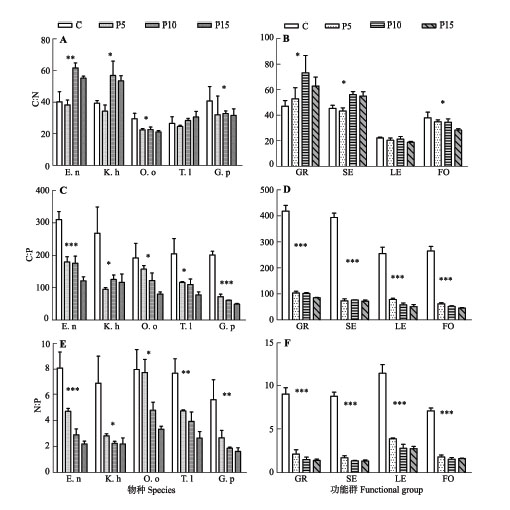
Important finding Both plant nutrition content and C:N:P varied significantly after five years’ P addition, and the responses were consistent at species- and functional group (exemplar species excluded)-levels in the alpine meadow. P addition had neutral effect on C concentrations of grasses, sedges and forbs at both species- and functional group (exemplar species excluded)-levels. P fertilization increased plant P concentrations and thus decreased C:P and N:P of the four functional groups (exemplar species excluded) and the corresponding species. N concentrations significantly decreased and C:N increased in grasses and sedges after P addition, and the species-level responses were consistent with the functional group (exemplar species excluded) level. P addition significantly increased N contents and decreased C:N in Oxytropis ochrocephala, but had neutral effect on N contents and C:N at the functional group (exemplar species excluded) level of the legumes. While N contents and C:N in forbs responded to P addition differently at species and functional group (exemplar species excluded) levels. In the N-limited alpine meadow, species dominance of grasses increased gradually after P addition due to the increased N and P use efficiencies, while the biomass proportion of forbs decreased because of the lowered nutrition use efficiency.
Key words: P addition; C:N:P; species dominance; alpine meadow community
SUN Xiao-Mei, CHEN Jing-Jing, LI Jin-Xia, LI Liang, HAN Guo-Jun, CHEN Nian-Lai . Hierarchical responses of plant stoichiometry to phosphorus addition in an alpine meadow community[J]. Chinese Journal of Plant Ecology, 2018 , 42(1) : 78 -85 . DOI: 10.17521/cjpe.2017.0253
| [1] | Chen LY, Zhao J, Zhang RY, Wang SM, Wang G ( 2010). Effects of nitrogen and phosphorus fertilization on legumes in Potentilla fruticosa shrub in alpine meadow. Ecological Science, 29, 512-517. |
| [1] | [ 陈凌云, 赵君, 张仁懿, 王绍美, 王刚 ( 2010). 氮磷复合肥添加对高寒草甸金露梅灌丛中豆科植物的影响. 生态科学, 29, 512-517.] |
| [2] | Chen X, Liu WY, Song L, Li S, Wu Y, Shi XM ( 2016). Physiological Responses of two epiphytic bryophytes to nitrogen, phosphorus and sulfur addition in a subtropical montane cloud forest. PLOS ONE, 11, e0161492. DOI: 10.1371/journal.pone.0161492. |
| [3] | Danger M, Daufresne T, Lucas F, Pissard S, Lacroix G ( 2008). Does Liebig’s law of the minimum scale up from species to communities? Oikos, 117, 1741-1751. |
| [4] | de Long JR, Sundqvist MK, Gundale MJ, Giesler R, Wardle DA ( 2016). Effects of elevation and nitrogen and phosphorus fertilization on plant defence compounds in subarctic tundra heath vegetation. Functional Ecology, 30, 314-325. |
| [5] | Dybzinski R, Fargione JE, Zak DR, Fornara D, Tilman D ( 2008). Soil fertility increases with plant species diversity in a long-term biodiversity experiment. Oecologia, 158, 85-93. |
| [6] | Evans JR ( 1989). Photosynthesis and nitrogen relationships in leaves of C3 plants. Oecologia, 78, 9-19. |
| [7] | Feller IC, Lovelock CE, Mckee KL ( 2007). Nutrient addition differentially affects ecological processes of Avicennia germinans in nitrogen versus phosphorus limited mangrove ecosystems. Ecosystems, 10, 347-359. |
| [8] | Güsewell S ( 2004). N:P ratios in terrestrial plants: Variation and functional significance. New Phytologist, 164, 243-266. |
| [9] | Han X, Sistla SA, Zhang Y, Lu XT, Han XG ( 2014). Hierarchical responses of plant stoichiometry to nitrogen deposition and mowing in a temperate steppe. Plant and Soil, 382, 175-187. |
| [10] | Heerwaarden LMV, Toet S, Aerts R ( 2003). Nitrogen and phosphorus resorption efficiency and proficiency in six sub-arctic bog species after 4 years of nitrogen fertilization. Journal of Ecology, 91, 1060-1070. |
| [11] | Hong JT, Wang XD, Wu JB ( 2015). Effects of soil fertility on the N:P stoichiometry of herbaceous plants on a nutrient-?limited alpine steppe on the northern Tibetan Plateau. Plant and Soil, 391, 179-194. |
| [12] | Iversen CM, Bridgham SD, Kellogg LE ( 2010). Scaling plant nitrogen use and uptake efficiencies in response to nutrient addition in peatlands. Ecology, 91, 693-707. |
| [13] | Koerner SE, Avolio ML, La Pierre KJ, Wilcox KR, Smith MD, Collins SL ( 2016). Nutrient additions cause divergence of tallgrass prairie plant communities resulting in loss of ecosystem stability. Journal of Ecology, 104, 1478-1487. |
| [14] | Li L, Gao XP, Gui DW, Liu B, Zhang B, Li XY ( 2017). Stoichiometry in aboveground and fine roots of Seriphidium korovinii in desert grassland in response to artificial nitrogen addition. Journal of Plant Research, 130, 1-9. |
| [15] | Li LJ, Zeng DH, Yu ZY, Fan ZP, Mao R, Peri PL ( 2011). Foliar N/P ratio and nutrient limitation to vegetation growth on Keerqin sandy grassland of Northeast China. Grass & Forage Science, 66, 237-242. |
| [16] | Luo YJ, Qin G, Du GZ ( 2006). Importance of assemblage-level thinning: A field experiment in an alpine meadow on the Tibet Plateau. Journal of Vegetation Science, 17, 417-424. |
| [17] | Mao R, Chen HM, Zhang XH, Shi FX, Song CC ( 2016). Effects of P addition on plant C:N:P stoichiometry in an N-limited temperate wetland of Northeast China. Science of the Total Environment, 559, 1-6. |
| [18] | Mayor JR, Wright SJ, Turner BL ( 2014). Species-specific responses of foliar nutrients to long-term nitrogen and phosphorus additions in a lowland tropical forest. Journal of Ecology, 102, 36-44. |
| [19] | Méndez M, Karlsson PS ( 2005). Nutrient stoichiometry in Pinguicula vulgaris: Nutrient availability, plant size, and reproductive status. Ecology, 86, 982-991. |
| [20] | Miao SJ, Qiao YF, Han XZ ( 2006). Requirement of phosphorous for soybean cultivars nodulation and nitrogen fixation. Soil and Crop, 22, 276-278. |
| [20] | [ 苗淑杰, 乔云发, 韩晓增 ( 2006). 大豆结瘤固氮对磷素的需求. 土壤与作物, 22, 276-278.] |
| [21] | Ostertag R ( 2010). Foliar nitrogen and phosphorus accumulation responses after fertilization: An example from nutrient-??limited Hawaiian forests. Plant and Soil, 334, 85-98. |
| [22] | Pe?uelas J, Poulter B, Sardans J, Ciais P, van der Velde M, Bopp L, Boucher O, Godderis Y, Hinsinger P, Llusia J, Nardin E, Vicca S, Obersteiner M, Janssens IA ( 2013). Human-induced nitrogen-phosphorus imbalances alter natural and managed ecosystems across the globe. Nature Communications, 4, 2934-2943. |
| [23] | Reich PB, Oleksyn J ( 2004). Global patterns of plant leaf N and P in relation to temperature and latitude. Proceedings of the National Academy of Sciences of the United States of America, 101, 11001-11006. |
| [24] | Sterner RW, Elser JJ ( 2002). Ecological Stoichiometry: The Biology of Elements from Molecules to the Biosphere. Princeton University Press, Princeton, USA. |
| [25] | Suding KN, Collins SL, Gough L, Clark C, Cleland EE, Gross KL ( 2005). Functional- and abundance-based mechanisms explain diversity loss due to N fertilization. Proceedings of the National Academy of Sciences of the United States of America, 102, 4387-4392. |
| [26] | Sun XM, Yu KL, Shugart HH, Wang G ( 2016). Species richness loss after nutrient addition as affected by N:C ratios and phytohormone GA3 contents in an alpine meadow community. Journal of Plant Ecology, 9, 201-211. |
| [27] | Townsend AR, Asner GP ( 2013). Multiple dimensions of resource limitation in tropical forests. Proceedings of the National Academy of Sciences of the United States of America, 110, 4864-4865. |
| [28] | Ventura M, Liboriussen L, Lauridsen TL, S?ndergaard M, Jeppesen E ( 2008). Effects of increased temperature and nutrient enrichment on the stoichiometry of primary producers and consumers in temperate shallow lakes. Freshwater Biology, 53, 1434-1452. |
| [29] | Vitousek P ( 1982). Nutrient cycling and nutrient use efficiency. The American Naturalist, 119, 553-572. |
| [30] | Wang N, Xu SS, Jia X, Gao J, Zhang WP, Qiu YP ( 2013). Variations in foliar stable carbon isotopes among functional groups and along environmental gradients in China—A meta-analysis. Plant Biology, 15, 144-151. |
| [31] | Yan ZB, Kim NY, Han WX, Guo YL, Han TS, Du EZ ( 2015). Effects of nitrogen and phosphorus supply on growth rate, leaf stoichiometry, and nutrient resorption of Arabidopsis thaliana. Plant and Soil, 388, 147-155. |
| [32] | Yuan ZY, Chen HY ( 2015). Negative effects of fertilization on plant nutrient resorption. Ecology, 96, 373-380. |
| [33] | Zhang RY, Gou X, Bai Y, Zhao J, Chen LY, Song XY ( 2011). Biomass fraction of graminoids and forbs in N-limited alpine grassland: N:P stoichiometry. Polish Journal of Ecology, 59, 105-114. |
/
| 〈 |
|
〉 |
Copyright © 2026 Chinese Journal of Plant Ecology
Tel: 010-62836134, 62836138, E-mail: apes@ibcas.ac.cn, cjpe@ibcas.ac.cn

