
Chinese Journal of Plant Ecology >
Effects of short-term experimental warming on soil microbes in a typical alpine steppe
Online published: 2018-03-08
Supported by
Supported by National Natural Science Foundation of China(31670482)
Aims Soil microbe plays key role in mediating terrestrial carbon cycles. It has been suggested that climate warming may affect the microbial community, which may accelerate carbon release and induce a positive feedback to soil climate warming. However, there is still controversy on how microbial community responds to experimental warming, especially in cold and drought environment.
Methods We conducted an open top chambers (OTCs) experiment to explore the effects of warming on soil microbial community in an alpine steppe on Qinghai-Xizang Plateau. During the maximum of the growing seasons (August) of 2015 and 2016, we monitored the biomass and structure of soil microbial community in warming and control plots using phospholipid fatty acids (PLFA) as biomarkers.
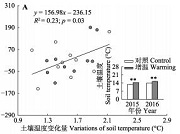
Important findings Short-term warming treatment significantly increased the soil temperature by 1.6 and 1.6 oC and decreased soil moisture by 3.4% and 2.4% (volume fraction) respectively, but did not alter either soil properties or normalized difference vegetation index (NDVI) during the growing season (from May to October) in 2015 and 2016. During the maximum of growing seasons (August) of 2015 and 2016, the magnitude of microbial biomass carbon (MBC) were 749.0 and 844.3 mg·kg-1, microbial biomass nitrogen (MBN) were 43.1 and 102.1 mg·kg-1, and the microbial biomass C:N ranged between 17.9 and 8.4. Moreover, all three showed no significant differences between warming and control treatments. The abundance of bacteria was the most in microbial community, while arbuscular mycorrhizal fungi was the least, and warming treatment did not alter the abundance of different microbial group and the microbial community structure. Nonetheless, our result revealed that warming-induced changes in MBC had significant positive correlation with changes in soil temperature and soil moisture. These patterns indicate that, microbial community in this alpine steppe may not respond substantially to future climate warming due to the limitation of soil drought. Therefore, estimation of microbial community response to climate change calls for consideration on the combined effect of warming and drought.
WANG Jun, WANG Guan-Qin, LI Fei, PENG Yun-Feng, YANG Gui-Biao, YU Jian-Chun, ZHOU Guo-Ying, YANG Yuan-He . Effects of short-term experimental warming on soil microbes in a typical alpine steppe[J]. Chinese Journal of Plant Ecology, 2018 , 42(1) : 116 -125 . DOI: 10.17521/cjpe.2017.0297
| [1] | Birgander J, Rousk J, Olsson PA ( 2017). Warmer winters increase the rhizosphere carbon flow to mycorrhizal fungi more than to other microorganisms in a temperate grassland. Global Change Biology, 23, 5372-5382. |
| [2] | Bossio DA, Scow KM, Gunapala N, Graham KJ ( 1998). Determinants of soil microbial communities: Effects of agricultural management, season, and soil type on phospholipid fatty acid profiles. Microbial Ecology, 36, 1-12. |
| [3] | Brockett BFT, Prescott CE, Grayston SJ ( 2012). Soil moisture is the major factor influencing microbial community structure and enzyme activities across seven biogelimatic zones in western Canada. Soil Biology & Biochemistry, 44, 9-20. |
| [4] | Brookes PC, Landman A, Pruden G, Jenkinson DS ( 1985). Chloroform fumigation and the release of soil nitrogen: A rapid direct extraction method to measure microbial biomass nitrogen in soil. Soil Biology & Biochemistry, 17, 837-842. |
| [5] | Chen H, Zhu Q, Peng CH, Wu N, Wang YF, Fang XQ, Gao YH, Zhu D, Yang G, Tian JQ, Kang XM, Piao SL, Ouyang H, Xiang WH, Luo ZB, Jiang H, Song XZ, Zhang Y, Yu GR, Zhao XQ, Gong P, Yao TD, Wu JH ( 2013). The impacts of climate change and human activities on biogeochemical cycles on the Qinghai-Tibetan Plateau. Global Change Biology, 19, 2940-2955. |
| [6] | Chen YL, Ding JZ, Peng YF, Li F, Yang GB, Liu L, Qin SQ, Fang K, Yang YH ( 2016). Patterns and drivers of soil microbial communities in Tibetan alpine and global terrestrial ecosystems. Journal of Biogeography, 43, 2027-2039. |
| [7] | Cheng L, Zhang NF, Yuan MT, Xiao J, Qin YJ, Deng Y, Tu QC, Xue K, Van Nostrand JD, Wu LY, He ZL, Zhou XH, Leigh MB, Konstantinidis KT, Schuur EA, Luo YQ, Tiedje JM, Zhou JZ ( 2017). Warming enhances old organic carbon decomposition through altering functional microbial communities. The ISME Journal, 11, 1825-1835. |
| [8] | Delgado-Baquerizo M, Maestre FT, Reich PB, Jeffries TC, Gaitan JJ, Encinar D, Berdugo M, Campbell CD, Singh BK ( 2016). Microbial diversity drives multifunctionality in terrestrial ecosystems. Nature Communications, 7, 10541. DOI: 10.1038/ncomms10541. |
| [9] | Ding JZ, Li F, Yang GB, Chen LY, Zhang B, Liu L, Fang K, Qin SQ, Chen YL, Peng YF, Ji C, He H, Smith P, Yang YH ( 2016). The permafrost carbon inventory on the Tibetan Plateau: A new evaluation using deep sediment cores. Global Change Biology, 22, 2688-2701. |
| [10] | Duan MJ, Gao QZ, Wan YF, Li Y, Guo YQ, Danjiu LB, Luosang JS ( 2010). Effect of grazing on community characteristics and species diversity of Stipa purpurea alpine grassland in Northern Tibet. Acta Ecologica Sinica, 30, 3892-3900. |
| [10] | [ 段敏杰, 高清竹, 万运帆, 李玉娥, 郭亚奇, 旦久罗布, 洛桑加措 ( 2010). 放牧对藏北紫花针茅高寒草原植物群落特征的影响. 生态学报, 30, 3892-3900.] |
| [11] | Friedlingstein P ( 2015). Carbon cycle feedbacks and future climate change. Philosophical Transactions of the Royal Society A: Mathematical, Physical and Engineering Sciences, 373, DOI: 10.1098/rsta.2014.0421. |
| [12] | Frosteg?rd A, B??th E ( 1996). The use of phospholipid fatty acid analysis to estimate bacterial and fungal biomass in soil. Biology & Fertility of Soils, 22, 59-65. |
| [13] | Frosteg?rd A, B??th E, Tunlio A ( 1993). Shifts in the structure of soil microbial communities in limed forests as revealed by phospholipid fatty acid analysis. Soil Biology & Biochemistry, 25, 723-730. |
| [14] | Frosteg?rd A, Tunlid A, B??th E ( 2011). Use and misuse of PLFA measurements in soils. Soil Biology & Biochemistry, 43, 1621-1625. |
| [15] | Griffiths BS, Philippot L ( 2013). Insights into the resistance and resilience of the soil microbial community. FEMS Microbiology Reviews, 37, 112-129. |
| [16] | He JZ, Li J, Zheng YM ( 2013). Thoughts on the microbial diversity-stability relationship in soil ecosystems. Biodiversity Science, 21, 411-420. |
| [16] | [ 贺纪正, 李晶, 郑袁明 ( 2013). 土壤生态系统微生物多样性-稳定性关系的思考. 生物多样性, 21, 411-420.] |
| [17] | Hicks PCE, Castanha C, Porras R, Torn MS ( 2017). The whole-soil carbon flux in response to warming. Science, 355, 1420-1423. |
| [18] | Hopkins FM, Filley TR, Gleixner G, Lange M, Top SM, Trumbore SE ( 2014). Increased belowground carbon inputs and warming promote loss of soil organic carbon through complementary microbial responses. Soil Biology & Biochemistry, 76, 57-69. |
| [19] | IPCC (Intergovernmental Panel on Climate Change) ( 2013). Climate Change 2013: the Scientific Basis. Contribution of Working Group I to the Fifth Assessment Report of the Intergovernmental Panel on Climate Change. Cambridge University Press, Cambridge, UK. |
| [20] | Kroppenstedt RM ( 1985). Fatty acid and menaquinone analysis of actinomycetes and related organisms. In: Goodfellow M, Minnikin D eds. Chemical Methods in Bacterial Systematics. Academic Press, London, UK. |
| [21] | Lehmann J, Kleber M ( 2015). The contentious nature of soil organic matter. Nature, 528, 60. |
| [22] | Li SQ, Ren SJ, Li SX ( 2004). Seasonal change of soil microbial biomass and the relationship between soil microbial biomass and soil moisture and temperature. Plant Nutrition and Fertilizer Science, 10, 18-23. |
| [22] | [ 李世清, 任书杰, 李生秀 ( 2004). 土壤微生物体氮的季节性变化及其与土壤水分和温度的关系. 植物营养与肥料学报, 10, 18-23.] |
| [23] | Liu XD, Chen BD ( 2000). Climatic warming in the Tibetan Plateau during recent decades. International Journal of Climatology, 20, 1729-1742. |
| [24] | Luo YQ, Sherry R, Zhou XH, Wan SQ ( 2009). Terrestrial carbon-cycle feedback to climate warming: Experimental evidence on plant regulation and impacts of biofuel feedstock harvest. GCB Bioenergy, 1, 62-74. |
| [25] | Margesin R, Jud M, Tscherko D, Schinner F ( 2009). Microbial communities and activities in alpine and subalpine soils. FEMS Microbiology Ecology, 67, 208-218. |
| [26] | Miller DJ ( 2005). The Tibetan Steppe. In: Suttie JM, Reynolds SG, Batello C eds. Grasslands of the World. UN Food and Agriculture Organization, Rome. |
| [27] | Moore-Kucera J, Dick RP ( 2008). PLFA profiling of microbial community structure and seasonal shifts in soils of a douglas-fir chronosequence. Microbial Ecology, 55, 500-511. |
| [28] | Nazaries L, Tottey W, Robinson L, Khachane A, Abu Al-Soud W, Sorensen S, Singh BK ( 2015). Shifts in the microbial community structure explain the response of soil respiration to land-use change but not to climate warming. Soil Biology & Biochemistry, 89, 123-134. |
| [29] | Olsson PA ( 1999). Signature fatty acids provide tools for determination of the distribution and interactions of mycorrhizal fungi in soil. FEMS Microbiology Ecology, 29, 303-310. |
| [30] | Pailler A, Vennetier M, Torre F, Ripert C, Guiral D ( 2014). Forest soil microbial functional patterns and response to a drought and warming event: Key role of climate-plant-soil interactions at a regional scale. Soil Biology & Biochemistry, 70, 1-4. |
| [31] | Peng YF, Li F, Zhou GY, Fang K, Zhang DY, Li CB, Yang GB, Wang GQ, Wang J, Yang YH ( 2017). Linkages of plant stoichiometry to ecosystem production and carbon fluxes with increasing nitrogen inputs in an alpine steppe. Global Change Biology, 23, 5249-5259. |
| [32] | Rinnan R, Michelsen A, Baath E, Jonasson S ( 2007). Fifteen years of climate change manipulations alter soil microbial communities in a subarctic heath ecosystem. Global Change Biology, 13, 28-39. |
| [33] | Romero-Olivares AL, Allison SD, Treseder KK ( 2017). Soil microbes and their response to experimental warming over time: A meta-analysis of field studies. Soil Biology & Biochemistry, 107, 32-40. |
| [34] | Schmidt MW, Torn MS, Abiven S, Dittmar T, Guggenberger G, Janssens IA, Kleber M, Kogel-Knabner I, Lehmann J, Manning DA, Nannipieri P, Rasse DP, Weiner S, Trumbore SE ( 2011). Persistence of soil organic matter as an ecosystem property. Nature, 478, 49-56. |
| [35] | Sheik CS, Beasley WH, Elshahed MS, Zhou XH, Luo YQ, Krumholz LR ( 2011). Effect of warming and drought on grassland microbial communities. The ISME Journal, 5, 1692-1700. |
| [36] | Shen JP, He JZ ( 2011). Responses of microbes-mediated carbon and nitrogen cycles to global climate change. Acta Ecologica Sinica, 31, 2957-2967. |
| [36] | [ 沈菊培, 贺纪正 ( 2011). 微生物介导的碳氮循环过程对全球气候变化的响应. 生态学报, 31, 2957-2967.] |
| [37] | Smith P, Fang C ( 2010). Carbon cycle: A warm response by soils. Nature, 464, 499-500. |
| [38] | Tischer A, Potthast K, Hamer U ( 2014). Land-use and soil depth affect resource and microbial stoichiometry in a tropical mountain rainforest region of southern Ecuador. Oecologia, 175, 375-393. |
| [39] | Vance ED, Brookes PC, Jenkinson DS ( 1987). An extraction method for measuring soil microbial biomass C. Soil Biology & Biochemistry, 19, 703-707. |
| [40] | Wang WL, Kong WD, Zeng H ( 2015). A meta-analysis of responses of soil microbes to warming. Journal of Agro-Environment Science, 34, 2169-2175. |
| [40] | [ 王文立, 孔维栋, 曾辉 ( 2015). 土壤微生物对增温响应的Meta分析. 农业环境科学学报, 34, 2169-2175.] |
| [41] | Weedon JT, Kowalchuk GA, Aerts R, Hal VJ, Logtestijn VR, Ta? N, R?ling WFM, Bodegom VPM ( 2012). Summer warming accelerates sub-arctic peatland nitrogen cycling without changing enzyme pools or microbial community structure. Global Change Biology, 18, 138-150. |
| [42] | Wolf S, Keenan TF, Fisher JB, Baldocchi DD, Desai AR, Richardson AD, Scott RL, Law BE, Litvak ME, Brunsell NA ( 2016). Warm spring reduced carbon cycle impact of the 2012 US summer drought. Proceedings of the National Academy of Sciences of the United States of America, 113, 5880-5885. |
| [43] | Wu JS, Lin QM, Huang QY, Xiao HA ( 2006). Soil Microbial Biomass—Methods and Application. China Meteorological Press, Beijing. |
| [43] | [ 吴金水, 林启美, 黄巧云, 肖和艾 ( 2006). 土壤微生物生物量测定方法及其应用. 气象出版社, 北京.] |
| [44] | Xue K, Yuan MT, Shi ZJ, Qin YJ, Deng Y, Cheng L, Wu LY, He ZL, Van Nostrand JD, Bracho R, Natali S, Schuur EAG, Luo CW, Konstantinidis KT, Wang Q, Cole JR, Tiedje JM, Luo YQ, Zhou JZ ( 2016 a). Tundra soil carbon is vulnerable to rapid microbial decomposition under climate warming. Nature Climate Change, 6, 595-600. |
| [45] | Xue K, Yuan MT, Xie JP, Li DJ, Qin YJ, Hale L, Wu LY, Deng Y, He ZL, Van Nostrand JD ( 2016 b). Annual removal of aboveground plant biomass alters soil microbial responses to warming. mBio, 7. e00976-16, DOI: 10.1128/ mBio.00976-16. |
| [46] | Yang L, Chen YM, He RL, Deng CC, Liu JW, Liu Y ( 2016). Responses of soil microbial community structure and function to simulated warming in alpine forest. Chinese Journal of Applied Ecology, 27, 2855-2863. |
| [46] | [ 杨林, 陈亚梅, 和润莲, 邓长春, 刘军伟, 刘洋 ( 2016). 高山森林土壤微生物群落结构和功能对模拟增温的响应. 应用生态学报, 27, 2855-2863.] |
| [47] | Yang YQ, Li XL, Kong XX, Ma L, Hu XY, Yang YP ( 2015). Transcriptome analysis reveals diversified adaptation of Stipa purpurea along a drought gradient on the Tibetan Plateau. Functional & Integrative Genomics, 15, 295-307. |
| [48] | Zeglin LH, Bottomley PJ, Jumpponen A, Rice CW, Arango M, Lindsley A, Mcgowan A, Mfombep P, Myrold DD ( 2013). Altered precipitation regime affects the function and composition of soil microbial communities on multiple time scales. Ecology, 94, 2334. |
| [49] | Zhang NL, Wan SQ, Guo JX, Han GD, Gutknecht J, Schmid B, Yu L, Liu WX, Bi J, Wang Z, Ma KP ( 2015 a). Precipitation modifies the effects of warming and nitrogen addition on soil microbial communities in northern Chinese grasslands. Soil Biology & Biochemistry, 89, 12-23. |
| [50] | Zhang XZ, Shen ZX, Fu G ( 2015 b). A meta-analysis of the effects of experimental warming on soil carbon and nitrogen dynamics on the Tibetan Plateau. Applied Soil Ecology, 87, 32-38. |
| [51] | Zhou JZ, Xue K, Xie JP, Deng Y, Wu LY, Cheng XL, Fei SF, Deng SP, He ZL, van Nostrand JD, Luo YQ ( 2011). Microbial mediation of carbon-cycle feedbacks to climate warming. Nature Climate Change, 2, 106-110. |
/
| 〈 |
|
〉 |
Copyright © 2026 Chinese Journal of Plant Ecology
Tel: 010-62836134, 62836138, E-mail: apes@ibcas.ac.cn, cjpe@ibcas.ac.cn

