Research Articles

Vertical variations in leaf functional traits of three typical ferns in mixed broadleaved- Korean pine forest

  • ZHAO Meng-Juan ,
  • JIN Guang-Ze ,
  • LIU Zhi-Li , *
Expand
  • Center for Ecological Research, Key Laboratory of Sustainable Forest Ecosystem Management-Ministry of Education, Northeast Asia Biodiversity Research Center, Northeast Forestry University, Harbin 150040, China
*LIU Zhi-Li()

Received date: 2022-10-21

  Accepted date: 2023-03-27

  Online published: 2023-03-28

Supported by

National Natural Science Foundation of China(31971636)

Fundamental Research Funds for the Central Universities(2572022DS13)

Abstract

Aims Understanding the differences in leaf functional traits and their correlations in ferns at different vertical heights can provide a scientific basis for revealing the resource utilization strategies of large fern fronds.

Methods Individuals of three fern species in a mixed broadleaved-Korean pine (Pinus koraiensis) forest, i.e., Dryopteris crassirhizoma, Athyrium brevifrons and Matteuccia struthiopteris were divided into upper, middle, and lower layers according to the vertical height of leaves. We measured specific leaf area, leaf dry matter content, net photosynthetic rate, instantaneous water use efficiency, leaf nitrogen content and leaf phosphorus content, as well as the light environment and soil factors of each individual plant to reveal the vertical variation patterns and correlations of leaf functional traits.

Important findings (1) Leaf dry matter content of the three fern species increased with the vertical height of the fronds, but specific leaf area showed no variation. The net photosynthetic rate of A. brevifrons and M. struthiopteris showed an increasing trend with the increases of vertical height of fronds, the instantaneous water use efficiency of M. struthiopteris increased and then decreased with the vertical height of the fronds, and leaf nitrogen content gradually decreased; leaf phosphorus content of D. crassirhizoma showed an increase and then decreased trend. (2) There were positive correlations between leaf nitrogen content and specific leaf area, and also between instantaneous water use efficiency and net photosynthetic rate. There were negative correlations between leaf nitrogen content and leaf dry matter content, and between leaf dry matter content and specific leaf area. The correlations among those leaf functional traits did not differ significantly among different vertical heights. (3) Soil available phosphorus content and soil pH were the main factors affecting the variation of leaf functional traits at different vertical heights, with soil available phosphorus content having the highest explanatory degree to the variation of leaf functional traits. Our results indicated that there were vertical differences in leaf functional traits of large ferns in the mixed broadleaved-Korean pine forest, but the rate of change among individual characters was basically constant, the effects of light environment and soil factors on the variation of leaf functional traits differed among vertical heights. This study provided reference for further research on the mechanism of leaf functional traits variation in different vertical heights of ferns in understory.

Cite this article

ZHAO Meng-Juan , JIN Guang-Ze , LIU Zhi-Li . Vertical variations in leaf functional traits of three typical ferns in mixed broadleaved- Korean pine forest[J]. Chinese Journal of Plant Ecology, 2023 , 47(8) : 1131 -1143 . DOI: 10.17521/cjpe.2022.0423

植物功能性状反映植物对环境变化的响应, 与植物定植、存活、生长和死亡密切相关(孟婷婷等, 2007; Violle et al., 2007; Kattge et al., 2011; 刘晓娟和马克平, 2015)。叶功能性状反映植物对资源的获取和利用能力, 且易于观察和测定(Royer et al., 2010; Scoffoni et al., 2011), 基于功能性状解析植物的适生策略已成为植物生理生态学领域的关键问题(Prior et al., 2003; Poorter et al., 2006)。因此, 研究植物叶功能性状有助于了解植物自身生长状况及其与环境之间的关系。
森林植物叶片的分布、大小和方向决定了冠层内光利用方式(Yu & Sun, 2013; Cheng et al., 2022), 同时, 冠层差异意味着不同垂直高度叶片光拦截和资源利用能力的变化(Osada & Hiura, 2017), 冠层开放度扩大, 林内的光照总辐射增多, 叶片截获光资源并充分利用叶绿素可吸收波段的光进行光合作用(李晖等, 2021), 表现为植物叶功能性状的垂直变异。比叶面积反映植物对光、温、水等资源的利用效率, 与叶氮含量密切相关(Reich et al., 1997; Roche et al., 2004; Wright et al., 2004); 干物质含量为叶片干质量与饱和鲜质量的比值, 一定程度反映了叶片对养分的获取和储存能力(Wilson et al., 1999); 净光合速率反映植物叶片光强利用率、耐阴性及光合作用效率, 是各尺度下植物生理生态学研究的重要指标(Pierangelini et al., 2014; Han et al., 2022); 水分利用效率表征植物在消耗等量水分时固定CO2的能力, 是衡量植物适应环境胁迫的关键指标(赵自国等, 2019); 氮是叶绿素的重要组成部分, 与植物光合作用密切相关(Reich et al., 1997); 叶氮、磷含量均能反映植物叶片获取营养的能力(Wang et al., 2014)。目前, 众多研究表明温带森林树木叶片从树冠下部到树冠上部, 比叶面积减少而干物质含量呈递增趋势(Asner et al., 2017; Coble & Cavaleri, 2017; Jiang et al., 2017; 田俊霞等, 2018; 荀彦涵等, 2020)。生长在乔木不同冠层的苔藓叶功能性状存在显著差异(Waite & Sack, 2010)。基于草本层、灌木层和林冠层植物功能性状的研究结果表明在森林的不同垂直层次下, 植物表现出明显的性状分异(Vivek & Parthasarathy, 2018; Yang et al., 2018; 李艳朋, 2021)。另外, 乔木层以下的植物叶功能性状随垂直高度变化也表现出一定的适应性, 例如Digrado等(2020)研究发现豇豆(Vigna unguiculata)光合作用和水分利用效率存在冠层差异。然而, 冠层高度引起叶功能性状变异的研究多集中于乔灌木, 对于个体较小的草本层植物, 叶片垂直高度对功能性状的影响是否具有相同结论仍有待探究。
以往研究表明土壤呼吸、养分循环受森林小气候影响(Smith & Johnson, 2004; Ewers & Banks-Leite, 2013)。森林冠层覆盖度的大小决定了土壤湿度的变化, 从而影响蕨类植物的物种组成(Ewers & Banks-Leite, 2013; Cicuzza & Mammides, 2022)。全球尺度下的研究表明, 土壤pH对植物光合性状存在显著影响(Maire et al., 2015; Wang et al., 2017; Cornwell et al., 2018)。然而, 局域尺度下土壤pH是否具有相同结论仍有待考证。土生蕨类植物的根系能够直接从土壤中汲取水分及养分, 土壤资源有限时, 叶片具有更保守的策略(Delpiano et al., 2020)。土壤养分、土壤水分和降水量的结合影响陆地蕨类的功能性状组成(Viana & Dalling, 2022)。综上所述, 土壤作为环境因子, 对蕨类植物叶功能性状变异具有显著影响, 但土壤因子对不同垂直高度叶功能性状变异的影响缺少相关研究。
蕨类从大约4亿年前进化而来(Lehtonen et al., 2017; Morris et al., 2018), 现存的蕨类植物构成了地球上最大的孢子繁殖的维管植物群, 具有重要的研究价值。对蕨类植物性状和生态策略变化的了解, 有助于理解植物进化。近年来, 关于蕨类叶功能性状的研究日益增多。众多研究表明, 从种子植物中发现的叶经济谱同样适用于蕨类植物(Yang et al., 2018; Lin et al., 2020; Li et al., 2022)。相比种子植物, 蕨类植物比叶质量和单位面积氮含量较低, 但单位质量氮含量较高, 这一结果与草本植物模式(Reich et al., 1997; Díaz et al., 2016; Jin et al., 2021)一致。基于不同生境蕨类植物的叶功能性状研究表明蕨类叶性状与生境的相关性十分显著(宋娟等, 2013; 卢艺苗, 2021)。林下草本植物垂直高度变化引起的资源分配也存在差异(Brock et al., 2018), 然而, 关于蕨类垂直高度变化对叶功能性状的影响仍未见报道。
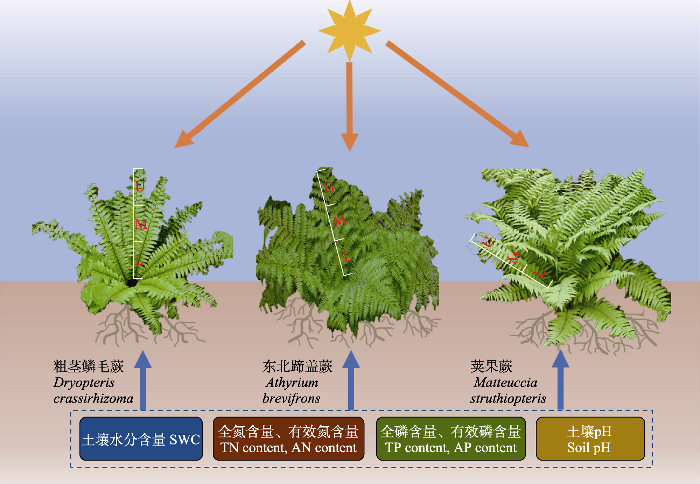
本研究在我国东北东部山区的地带性植被阔叶红松(Pinus koraiensis)林内开展, 以常见的3种大型蕨类(图1)为研究对象, 分别为粗茎鳞毛蕨(Dryopteris crassirhizoma)、东北蹄盖蕨(Athyrium brevifrons)和荚果蕨(Matteuccia struthiopteris)。3种蕨类均属多年生草本, 地上部分每年抽出新叶, 叶片生长周期短。测定不同垂直高度叶片的形态、生理和化学性状, 包括比叶面积、叶干物质含量、净光合速率、瞬时水分利用效率、叶氮和叶磷含量共6种, 并记录个体所处光环境和土壤因子, 旨在研究以下内容: (1)揭示阔叶红松林3种典型蕨类叶功能性状的垂直变异规律, 并分析种间差异; (2)分析叶功能性状之间的相关关系, 并探究叶片垂直高度对性状间相关关系的影响; (3)分析光环境和土壤环境因子对不同垂直高度叶功能性状变异的影响。
图1 阔叶红松林3种典型蕨类。L,下层; M, 中层; U, 上层。

Fig. 1 Three typical ferns in mixed broadleaved-Korean pine forest. L, lower layer; M, middle layer; U, upper layer. AN, available nitrogen; AP, available phosphorus; SWC, soil water content; TN, total nitrogen; TP, total phosphorus.

1 材料和方法

1.1 研究区域概况

凉水国家级自然保护区(128.79°-128.96° E, 47.11°-47.27° N)隶属于黑龙江省伊春市, 属温带大陆性季风气候, 夏季高温多雨, 冬季寒冷干燥, 年平均气温-0.3 ℃, 年降水量676 mm, 年蒸发量855 mm, 地带性植被为阔叶红松林, 森林覆被率为96%, 草本层有葶苈(Draba nemorosa)、东北点地梅(Androsace filiformis)、东北穗花(Pseudolysimachion rotundum subsp. subintegrum)、狼尾草(Pennisetum alopecuroides)等一、二年生草本植物和蚊子草(Filipendula palmata)、宽叶荨麻(Urtica laetevirens)、东北羊角芹(Aegopodium alpestre)、粗茎鳞毛蕨等多年生草本植物, 地带性土壤为暗棕壤, 土壤pH介于4.55-6.32, 呈弱酸性。

1.2 样品采集

2021年8月, 在保护区阔叶红松林内坡向相同、坡度相似、平均冠层开放度为24.3%左右的林内生境下, 对满足叶片垂直高度在75-85 cm范围内的粗茎鳞毛蕨、东北蹄盖蕨和荚果蕨随机采样, 每种蕨类带土挖取10株长势良好, 发育成熟的个体, 每株个体距离保证在5 m以上, 以减少空间自相关性的影响。以最贴近地面的羽叶至植株最高处的垂直高度作为个体叶片垂直高度, 按垂直高度将叶片均等平分为上、中、下3个层次, 并在各层中间位置各取1片健康且完全展开的叶片用于光合及形态性状测量, 其余叶片采集后用自封袋保存带回实验室。

1.3 性状测量

1.3.1 叶功能性状测定

在天气晴朗的上午9:00-11:00, 用LI-6800便携式光合仪(LI-COR, Lincoln, USA)测定叶光合参数。设置叶室参数为: 光强1 500 μmol·m-2·s-1, CO2浓度400 μmol·mol-1, 叶室温度25 ℃, 相对湿度65%。每株植物每层各取1片完整样叶, 在设定光强下诱导 5 min后, 测定其净光合速率(µmol·m-2·s-1)和蒸腾速率(mol·m-2·s-1), 计算得到瞬时水分利用效率(µmol·mol-1), 计算公式为: 瞬时水分利用效率=净光合速率/蒸腾速率。
光合性状测定后将叶片保存带回实验室用于形态性状测量。利用Canon LiDE 400扫描仪测量叶面积; 利用电子天平(精度0.000 1 g)称量样叶鲜质量后放入65 ℃烘箱烘干至恒质量, 之后用电子天平测定叶干质量。叶面积与叶干质量的比值即为比叶面积(cm2·g-1), 叶干质量与叶鲜质量的比值即为干物质含量(g·g-1)。
其余叶片在65 ℃烘箱内烘干至恒质量后研磨至粉状, 过100目筛, 消煮后, 采用AQ400自动间断化学分析仪(SEAL Analytical, Mequon, USA)测定叶片全氮含量(mg·g-1)和全磷含量(mg·g-1)。

1.3.2 光环境及土壤因子测定

采用半球摄影法(digital hemispherical photography, DHP)测定光环境因子, 使用Gap光分析仪软件(GLA)对鱼眼照片进行分析, 以冠层开放度(CO)作为光环境指标。每株个体周围选取3个点采集鲜土样品并混合。鲜土去除石块、细根后装入铝盒并做好标记, 105 ℃下烘干72 h后测定土壤水分含量(SWC); 剩余鲜土风干后磨粉过100目筛, 消煮后, 采用AQ400自动间断化学分析仪测定土壤全氮(TN)含量和全磷(TP)含量。采用碱解扩散法测定有效氮(AN)含量, 钼锑抗比色法测定有效磷(AP)含量。采用电位法测定土壤pH。本研究3种蕨类样本所处生境的环境因子概况见表1。
表1 3种蕨类所处生境的环境因子概况(平均值±标准误)

Table 1 Profile of environmental factors in the habitats of the three ferns (mean ± SE)

环境因子 Environmental factor 粗茎鳞毛蕨
Dryopteris crassirhizoma
东北蹄盖蕨
Athyrium brevifrons
荚果蕨
Matteuccia struthiopteris
冠层开放度 Canopy openness (%) 24.29 ± 1.04a 24.90 ± 0.66a 23.68 ± 2.45a
土壤水分含量 Soil water content 0.90 ± 0.09a 0.87 ± 0.17a 0.99 ± 0.12a
土壤全氮含量 Soil total nitrogen content (mg·g-1) 9.32 ± 0.74a 6.57 ± 0.91b 9.06 ± 0.64ab
土壤全磷含量 Soil total phosphorus content (mg·g-1) 0.82 ± 0.08a 0.89 ± 0.16a 0.88 ± 0.10a
土壤pH Soil pH 5.67 ± 0.11ab 5.31 ± 0.10b 5.76 ± 0.11a
土壤有效氮含量 Soil available nitrogen content (mg·g-1) 0.59 ± 0.05a 0.50 ± 0.06a 0.59 ± 0.03a
土壤有效磷含量 Soil available phosphorus content (mg·g-1) 0.02 ± 0.00a 0.01 ± 0.00a 0.02 ± 0.00a

同行不同小写字母表示不同蕨类间差异显著(p < 0.05)。

Different lowercase letters in the same row indicate significant difference between ferns (p < 0.05).

1.4 数据分析

首先对数据进行对数转换以保证数据正态化。在叶片垂直高度和种间水平, 分别对叶性状做单因素方差分析并进行Tukey检验, 显著性水平设置为α = 0.05; 采用Pearson相关性分析比较不同高度性状间的相关性; 对有显著相关关系的性状采用标准化主轴估计(SMA)法检验不同垂直高度蕨类叶功能性状间的相关关系是否存在显著差异; 若不同高度叶功能性状相关关系存在共同斜率, 则表明功能性状间关系在高度上不存在显著差异; 如不存在显著差异, 再对其截距进行差异性检验。性状间的关系用方程y = bxa来描述, 线性转换为lgy = lgb + algx, x、y分别表示两个功能性状, lgb表示截距, a表示斜率。当|a| = 1时, x、y为等速变化; 当|a|与1有显著差异时, x、y为异速变化。采用冗余分析法(RDA)分析环境因子对功能性状的影响。以上统计分析用到SPSS 15.0、R语言的smatr函数和Canoco 5软件。

2 结果

2.1 叶功能性状的垂直变异

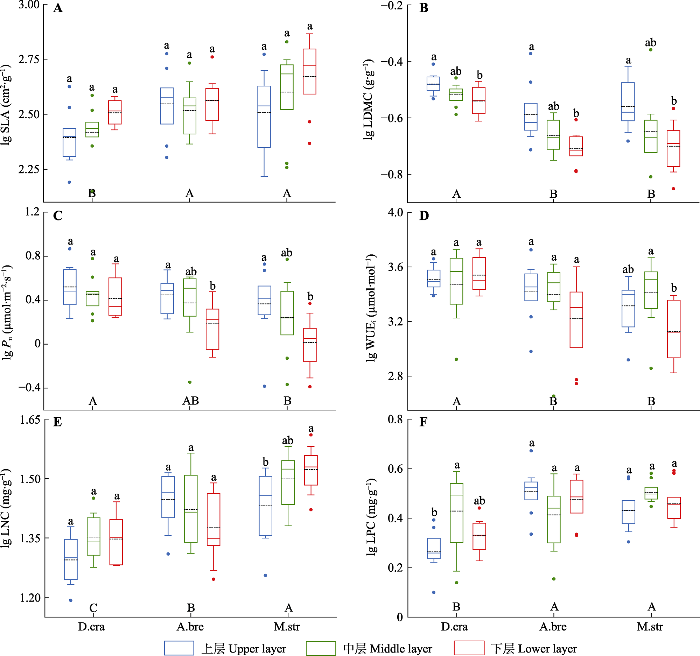
3 种蕨类的比叶面积在不同垂直高度无明显差异(图2A), 叶干物质含量随叶片垂直高度增加均呈递增趋势(图2B)。东北蹄盖蕨和荚果蕨的净光合速率随高度增加而增大, 粗茎鳞毛蕨净光合速率随高度变化无明显差异(图2C)。瞬时水分利用效率和叶氮含量仅在荚果蕨的不同垂直高度表现出明显差异, 即随高度增加, 瞬时水分利用效率先增后减, 叶氮含量则呈递减趋势(图2D、2E)。叶磷含量在粗茎鳞毛蕨中层显著高于上、下层, 东北蹄盖蕨和荚果蕨则无明显规律(图2F)。
图2 阔叶红松林3种典型蕨类叶功能性状的垂直变异。A.bre, 东北蹄盖蕨; D.cra, 粗茎鳞毛蕨; M.str, 荚果蕨。LDMC, 叶干物质含量; LNC, 叶氮含量; LPC, 叶磷含量; Pn, 净光合速率; SLA, 比叶面积; WUEi, 瞬时水分利用效率。不同大写字母表示种间差异显著(p < 0.05), 不同小写字母表示种内差异显著(p < 0.05)。黑色虚线为平均值。

Fig. 2 Differences in leaf functional traits of three typical ferns in mixed broadleaved-Korean pine forest. A.bre, Athyrium brevifrons; D.cra, Dryopteris crassirhizoma; M.str, Matteuccia struthiopteris. LDMC, leaf dry matter content; LNC, leaf nitrogen content; LPC, leaf phosphorus content; Pn, leaf net photosynthetic rate; SLA, specific leaf area; WUEi, instantaneous water use efficiency. Different uppercase letters indicate significant differences between species (p < 0.05), and different lowercase letters indicate significant intraspecific differences (p < 0.05). The black dashed line represents the average value.

粗茎鳞毛蕨的比叶面积和叶磷含量显著低于其他两种蕨类(图2A、2F), 叶干物质含量和瞬时水分利用效率则显著高于东北蹄盖蕨和荚果蕨(图2B、2D); 净光合速率和叶氮含量在三者之间差异显著, 净光合速率表现为粗茎鳞毛蕨>东北蹄盖蕨>荚果蕨(图2C), 叶氮含量则表现为荚果蕨>东北蹄盖蕨>粗茎鳞毛蕨(图2E)。

2.2 不同垂直高度叶功能性状的相关性

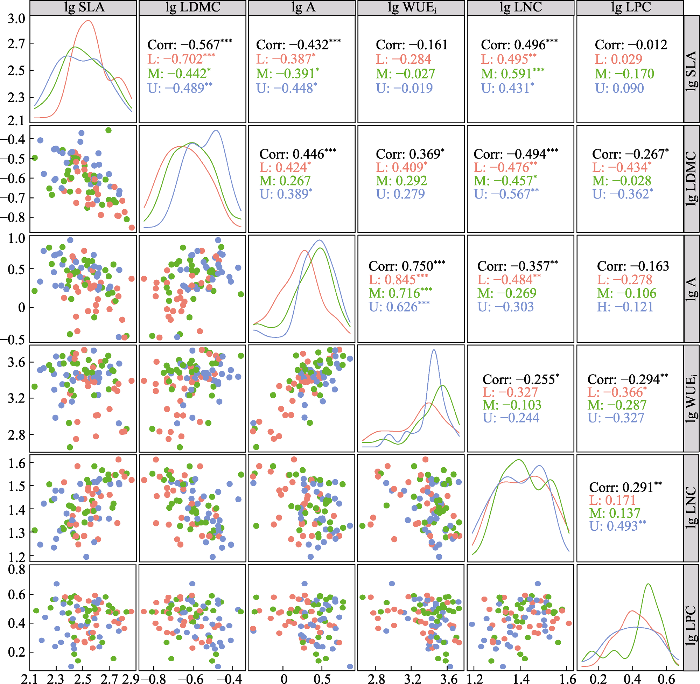
80%的性状间表现出显著或极显著的相关关系(图3), 不同垂直高度的叶功能性状间的相关程度不同。整体而言, 比叶面积与叶干物质含量在不同垂直高度均呈显著负相关关系; 净光合速率与叶干物质含量、瞬时水分利用效率存在极显著正相关关系, 与比叶面积呈极显著负相关关系, 但不同高度的相关性差异较大; 叶氮含量与比叶面积、叶干物质含量在不同高度均存在显著或极显著的相关关系, 与净光合速率仅在下层表现为极显著负相关; 叶磷含量与叶氮含量在上层正相关关系极显著, 与瞬时水分利用效率在下层呈显著负相关关系; 净光合速率与瞬时水分利用效率、叶磷含量与叶干物质含量在上、下层分别呈显著相关关系(图3)。
图3 阔叶红松林3种典型蕨类不同垂直高度叶功能性状的相关性。Corr, 相关系数; L, 下层; M, 中层; U, 上层。A, 净光合速率; LDMC, 叶干物质含量; LNC, 叶氮含量; LPC, 叶磷含量; SLA, 比叶面积; WUEi, 瞬时水分利用效率。*, p < 0.05; **, p < 0.01; ***, p < 0.001。

Fig. 3 Correlation of leaf functional traits at different vertical heights in three typical ferns in mixed broadleaved-Korean pine forest. Corr, correlation coefficient; L, lower layer; M, middle layer; U, upper layer. A, leaf net photosynthetic rate; LDMC, leaf dry matter content; LNC, leaf nitrogen content; LPC, leaf phosphorus content; SLA, specific leaf area; WUEi, instantaneous water use efficiency. *, p < 0.05; **, p < 0.01; ***, p < 0.001.

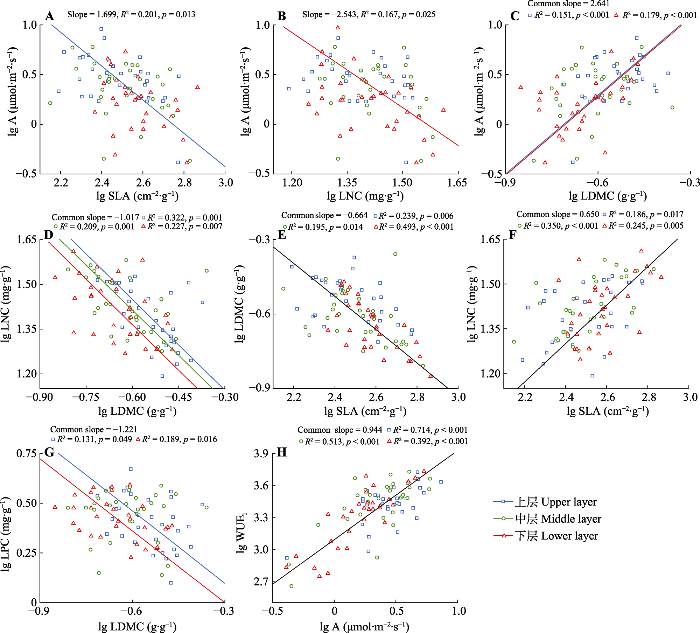
不同蕨类的性状相关关系并无较大差异(附录I)。不同垂直高度下, 叶功能性状的相关关系在斜率上均未表现出显著差异(图4)。叶氮含量与叶干物质含量、叶干物质含量与比叶面积在各垂直高度均呈负相关关系。叶干物质含量一定时, 叶氮含量表现为上层>中层>下层(图4D); 叶干物质含量与比叶面积在不同垂直高度截距无显著差异(图4E); 叶氮含量与比叶面积、瞬时水分利用效率与净光合速率则呈显著正相关关系, 且在不同垂直高度存在相同斜率和截距(图4F、4H)。另外, 一些性状仅在某些高度达到显著的相关关系。例如, 净光合速率与比叶面积仅在上层呈负相关关系(图4A); 净光合速率与叶氮含量仅在下层呈负相关关系(图4B); 净光合速率与叶干物质含量在上、下层呈正相关关系(图4C); 叶磷含量与叶干物质含量在上、下层呈显著负相关关系(图4G)。此外,和叶氮含量与叶干物质含量的匀速生长不同, 其他性状之间均表现为异速生长(附录II)。
图4 阔叶红松林3种典型蕨类的叶功能性状相关关系在不同高度间的差异。A, 净光合速率; LDMC, 叶干物质含量; LNC, 叶氮含量; LPC, 叶磷含量; SLA, 比叶面积; WUEi, 瞬时水分利用效率。Common slope, 共同斜率; Slope, 斜率。图中彩色实线表示性状间相关关系显著, 黑色实线表示3条实线重合。

Fig. 4 Differences in leaf trait correlations among different heights for three typical ferns in mixed broadleaved-Korean pine forest. A, leaf net photosynthetic rate; LDMC, leaf dry matter content; LNC, leaf nitrogen content; LPC, leaf phosphorus content; SLA, specific leaf area; WUEi, instantaneous water use efficiency. The colored solid lines in the figure indicate that the correlations between traits were significant, the black solid line indicates that the three solid lines overlap.

2.3 叶功能性状与环境因子之间的冗余分析

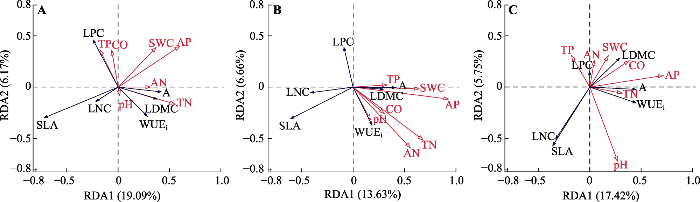
光环境和土壤因子对上、中、下层叶功能性状变异的解释率依次为27.9%、23.6%和25.6% (附录III)。对于上层(图5A), 土壤全氮含量、土壤有效氮含量和土壤有效磷含量与比叶面积、叶氮含量呈显著负相关关系, 与净光合速率、叶干物质含量、瞬时水分利用效率呈正相关关系(图5A)。对于中层, 土壤全磷含量、有效磷含量和土壤水分含量与叶氮含量、比叶面积的夹角大于90°, 为负相关关系, 与净光合速率、叶干物质含量呈正相关关系; 土壤pH与瞬时水分利用效率存在正相关关系, 与叶磷含量为负相关关系(图5B)。对于下层, 土壤全氮含量、土壤有效磷含量和冠层开放度与净光合速率、瞬时水分利用效率呈正相关关系, 土壤pH与比叶面积、叶氮含量呈显著正相关关系(图5C)。
图5 阔叶红松林3种典型蕨类不同垂直高度下叶功能性状与环境因子的冗余分析(RDA)排序。A, 上层。B, 中层。C, 下层。A, 净光合速率; AN, 土壤有效氮含量; AP, 土壤有效磷含量; CO, 冠层开放度; LDMC, 叶干物质含量; LNC, 叶氮含量; LPC, 叶磷含量; pH, 土壤pH; SLA, 比叶面积; SWC, 土壤水分含量; TN, 土壤全氮含量; TP, 土壤全磷含量; WUEi, 瞬时水分利用效率。

Fig. 5 Redundancy analysis (RDA) ranking of leaf functional traits and environmental factors in three typical ferns in mixed broadleaved-Korean pine forest. A, Lower layer; B, Middle layer; C, Upper layer. A, leaf net photosynthetic rate; AN, soil available nitrogen content; AP, soil available phosphorus content; CO, canopy openness; LDMC, leaf dry matter content; LNC, leaf nitrogen content; LPC, leaf phosphorus content; pH, soil pH; SLA, specific leaf area; SWC, soil water content; TN, soil total nitrogen content; TP, soil total phosphorus content; WUEi, instantaneous water use efficiency.

3 讨论

3.1 叶功能性状的垂直变化规律

本研究表明, 相比东北蹄盖蕨和荚果蕨, 粗茎鳞毛蕨具有小比叶面积, 高叶干物质含量, 叶氮含量、叶磷含量显著偏低的特点, 但其净光合速率和瞬时水分利用效率则高于其他2种蕨类; 荚果蕨的叶氮含量较高但净光合速率偏低, 这与以往净光合速率与叶氮含量有相同变化趋势的结果(Tosens et al., 2016)不一致。植物叶功能性状随垂直高度的增加表现出明显变化趋势(Leal & Thomas, 2003)。以往研究表明, 光照和水分对植物叶功能性状垂直梯度变异存在重要影响(田俊霞等, 2018; 罗恬等, 2022)。蕨类比叶面积随高度变化无显著差异, 叶干物质含量随高度从高到低递减; 东北蹄盖蕨和荚果蕨净光合速率随高度从高到低呈递减趋势。对处于优势层的高大乔木来说, 上层叶片由于高度优势, 在竞争中率先获取大部分光照; 为避免光强过大、失水过多, 上层叶片会采取减少受光面积、增加角质层厚度、关闭气孔等措施; 蕨类由于长期生活在林下弱光环境中, 上层获得光照优势, 光合作用积累的产物较多, 但不需要减少受光面以避免强光照射, 表现为净光合速率较强, 叶干物质含量高, 比叶面积无显著差异; 下层叶片长期处于光照更弱的环境, 限制叶片生长, 因而表现为净光合速率和叶干物质含量较中上层更低(宋娟等, 2013; Coble et al., 2017)。粗茎鳞毛蕨和东北蹄盖蕨不同高度叶片的瞬时水分利用效率无显著差异, 荚果蕨叶片瞬时水分利用效率随高度升高呈先增后减的趋势, 一定程度反映不同高度叶片蒸腾速率的变化及对干旱环境的适应能力, 即上层叶片的蒸腾速率显著高于中下层; 中层较上下层而言, 具有更强的耐旱能力。不同垂直高度下, 荚果蕨的叶氮含量和粗茎鳞毛蕨的叶磷含量有较大差异, 反映不同垂直高度不同种类的植物叶片对营养资源的利用能力有较大差别, 氮和磷可能分别为荚果蕨和粗茎鳞毛蕨叶片生长的限制元素。

3.2 垂直高度对叶片性状相关关系的影响

本研究结果表明, 蕨类净光合速率随叶干物质含量的增大而增大, 这与罗达等(2021)对榛(Corylus heterophylla)种质资源叶功能性状的研究结果一致;叶干物质含量与比叶面积呈负相关关系, 这与许多研究结果(de la Riva et al., 2016; 刘贵峰等, 2017)一致。垂直高度下净光合速率与叶干物质含量、叶干物质含量与比叶面积相关关系的斜率与截距无显著差异, 说明林下的弱光环境对蕨类各层叶功能性状间的生物量分配及资源利用的影响不显著。蕨类作为林下草本植物, 被林内高大乔木和灌木的遮蔽, 接受到的光照从上到下依次减少, 不同垂直高度的叶片充分利用弱光进行光合作用, 光合速率随接受光照的强弱变化, 即上层叶片净光合速率高于下层, 从而造成生长位置靠下的叶片具有更低的叶干物质含量。比叶面积减小, 即叶干物质含量增大, 主要与叶肉细胞层厚度增大, 叶片变厚, 叶片密度显著增强, 细胞内含物显著上升有关(刘明秀和梁国鲁, 2016)。
氮是构成叶绿素的重要物质, 在调节光合作用、资源运输和繁殖等方面发挥重要作用(Allison, 2002; Lovelock et al., 2004)。以往研究表明, 单位面积光合速率、单位质量光合速率与单位质量氮含量均呈高度正相关关系(朱军涛等, 2010; Funk et al., 2020; Martin & Isaac, 2021), 然而, 本研究结果与之相反。有学者认为光合能力的差异由比叶质量和氮含量的变化引起, 比叶质量通过影响氮含量进而影响光合速率, 即光合能力主要受比叶质量影响(Le Roux et al., 2001; Walcroft et al., 2002)。通常高比叶质量反映叶片低氮含量, 这与本研究中叶氮含量与比叶面积呈正相关关系的结果一致; 叶氮含量的增加反而引起净光合速率的下降, 这与以往研究结果(朱军涛等, 2010; Khan et al., 2022)相反。Westoby等(2013)提出净光合速率与比叶质量在物种间没有太大的相关性; 在高比叶质量的叶片中, 大量氮可用于非光合成分合成, 从而导致较低的光合速率(Bucher et al., 2021), 本研究结果与之一致。可见, 区域环境下比叶质量是否为蕨类光合能力的主要衡量参数仍值得探究。本研究中虽然将林下蕨类叶片按垂直高度分为3层, 但整体而言, 其生长环境长期荫蔽, 接受的光照主要来源为林隙透光和地面散射, 上层叶片较下层而言受光条件好, 可以更好地利用光照进行光合作用, 净光合速率更高, 因而净光合速率与比叶面积表现为负相关关系。养分含量越高, 植物光合能力和呼吸消耗越强, 高效的代谢有利于植物适应环境(Cornelissen et al., 2003; Wright et al., 2004)。本研究中, 叶氮、磷含量与叶干物质含量均表现为负相关关系, 且各高度相关关系斜率相同, 叶氮含量与叶干物质含量截距表现为上层>中层>下层; 叶磷含量与叶干物质含量截距为上层>下层, 与以往研究结果(荀彦涵等, 2020)一致。受光照条件影响, 叶片内有机物积累随高度升高逐渐增多, 叶干物质含量自下而上依次升高, 叶片内氮、磷含量呈上升趋势。瞬时水分利用效率与净光合速率在不同垂直高度的正相关关系并无差别, 不同垂直高度的光照变化不足以引起叶片耐旱机制的分异。

3.3 光环境和土壤因子对叶功能性状的影响

本研究表明, 随叶片垂直高度的增加, 冠层开放度对叶功能性状的解释率逐渐上升。叶功能性状受光照条件的影响(Wang et al., 2021; Westerband et al., 2021)。与乔、灌木相比, 由于树冠的遮阴, 蕨类的光照条件较差, 光强度也较弱。在阴蔽环境下, 高度较高的叶片受光照强度更大, 促进蕨类叶片光合、蒸腾、呼吸等生理活动, 使叶功能性状向适应环境的方向变化。本研究区土壤呈弱酸性, 该条件下植物对氮的利用率降低(Jenny, 1941), 因而叶片氮含量与土壤总氮含量、土壤有效氮含量在不同垂直高度均表现为负相关关系, 这与以往研究结论(Santiago et al., 2005; Ordoñez et al., 2009)一致。另外, 土壤局部氮含量的变化并不能有效地反映植物可利用氮含量的变化(Burton et al., 2017)。本研究仅下层叶片的叶氮含量受土壤pH影响较大, 地表枯落物分解对土壤pH的调节影响近地面叶片氮的吸收利用。本研究中叶片和土壤磷含量变化具有一致性, 土壤有效磷含量对不同垂直高度叶功能性状变异的解释率最高, 与净光合速率均表现为正相关关系。叶片中磷积累越快, 生长越快(Guo et al., 2020), 3种蕨类属多年生草本, 地上部分每年抽出新叶, 叶片生长周期短, 需要从土壤中吸收大量可用的磷投入叶片以维持自身生长发育。此外, 本研究中蕨类生长环境并无较大差异(表1), 植物叶功能性状的变异受多重环境条件的影响, 温度、湿度、风力等其他环境因素对蕨类叶功能性状的影响仍有待探究。

4 结论

不同种的蕨类叶功能性状存在一定差异, 且一定程度上, 在不同垂直高度下呈现相同的变化趋势。除比叶面积外, 蕨类叶片的其他功能性状随垂直高度的增加变化明显; 叶功能性状间的相关关系在不同冠层位置存在共同斜率, 垂直高度并未引起性状间相关关系的明显变化, 即在个体内叶片变化速率是恒定的, 但不同高度叶片的资源获取及利用能力有所差异。各环境因子对不同垂直高度叶功能性状的影响方向和程度存在差异, 其中影响各层叶功能性状变异的主要环境因子为土壤有效磷含量和土壤pH。除光环境和土壤因子外, 其他环境因素对蕨类叶功能性状的影响还需进一步探究。以叶功能性状为切入点探究不同垂直高度下蕨类叶功能性状的变异及适应机制, 反映出蕨类叶片为适应环境变化所形成的资源利用策略, 对深入了解植物的适应进化具有重要意义。

附录

附录I 阔叶红松林3种典型蕨类不同高度叶功能性状相关关系在种间的差异
Supplement I Differences in leaf trait correlations among different heights for three typical ferns in mixed broadleaved- Korean pine forest
附录II 阔叶红松林3种典型蕨类不同垂直高度下叶功能性状的标准主轴分析结果
Supplement II Standardized major axis analysis results of leaf functional traits at different vertical heights in mixed broadleaved-Korean pine forest
附录III 阔叶红松林3种典型蕨类不同垂直高度环境因子对叶功能性状的解释率
Supplement III Interpretation of leaf functional traits by environmental factors at different vertical heights in mixed broadleaved-Korean pine forest

感谢黑龙江凉水国家级自然保护区管理局在样品采集过程中给予的大力支持。

[1]
Allison VJ (2002). Nutrients, arbuscular mycorrhizas and competition interact to influence seed production and germination success in Achillea millefolium. Functional Ecology, 16, 742-749.

DOI

[2]
Asner GP, Martin RE, Anderson CB, Kryston K, Vaughn N, Knapp DE, Bentley LP, Shenkin A, Salinas N, Sinca F, Tupayachi R, Quispe Huaypar K, Montoya Pillco M, Delis Ccori Álvarez F, Díaz S, et al. (2017). Scale dependence of canopy trait distributions along a tropical forest elevation gradient. New Phytologist, 214, 973-988.

DOI PMID

[3]
Brock JMR, Perry GLW, Burkhardt T, Burns BR (2018). Forest seedling community response to understorey filtering by tree ferns. Journal of Vegetation Science, 29, 887-897.

DOI

[4]
Bucher SF, Auerswald K, Grün-Wenzel C, Higgins SI, Römermann C (2021). Abiotic site conditions affect photosynthesis rates by changing leaf functional traits. Basic and Applied Ecology, 57, 54-64.

DOI

[5]
Burton JI, Perakis SS, McKenzie SC, Lawrence CE, Puettmann KJ (2017). Intraspecific variability and reaction norms of forest understorey plant species traits. Functional Ecology, 31, 1881-1893.

DOI

[6]
Cheng X, Ping T, Li Z, Wang T, Han H, Epstein HE (2022). Effects of environmental factors on plant functional traits across different plant life forms in a temperate forest ecosystem. New Forests, 53, 125-142.

DOI

[7]
Cicuzza D, Mammides C (2022). Soil, topography and forest structure shape the abundance, richness and composition of fern species in the fragmented tropical landscape of Xishuangbanna, Yunnan, China. Forests, 13, 1453. DOI: 10.3390/f13091453.

[8]
Coble AP, Cavaleri MA (2017). Vertical leaf mass per area gradient of mature sugar maple reflects both height-driven increases in vascular tissue and light-driven increases in palisade layer thickness. Tree Physiology, 37, 1337-1351.

DOI PMID

[9]
Coble AP, Fogel ML, Parker GG (2017). Canopy gradients in leaf functional traits for species that differ in growth strategies and shade tolerance. Tree Physiology, 37, 1415-1425.

DOI PMID

[10]
Cornelissen JHC, Lavorel S, Garnier E, Díaz S, Buchmann N, Gurvich DE, Reich PB ter Steege H, Morgan HD, van der Heijden MGA, Pausas JG, Poorter H (2003). A handbook of protocols for standardised and easy measurement of plant functional traits worldwide. Australian Journal of Botany, 51, 335-380.

DOI

[11]
Cornwell WK, Wright IJ, Turner J, Maire V, Barbour MM, Cernusak LA, Dawson T, Ellsworth D, Farquhar GD, Griffiths H, Keitel C, Knohl A, Reich PB, Williams DG, Bhaskar R, et al. (2018). Climate and soils together regulate photosynthetic carbon isotope discrimination within C3 plants worldwide. Global Ecology and Biogeography, 27, 1056-1067.

DOI

[12]
de la Riva EG, Tosto A, Pérez-Ramos IM, Navarro-Fernández CM, Olmo M, Anten NPR, Marañón T, Villar R (2016). A plant economics spectrum in Mediterranean forests along environmental gradients: Is there coordination among leaf, stem and root traits? Journal of Vegetation Science, 27, 187-199.

DOI

[13]
Delpiano CA, Prieto I, Loayza AP, Carvajal DE, Squeo FA (2020). Different responses of leaf and root traits to changes in soil nutrient availability do not converge into a community-level plant economics spectrum. Plant and Soil, 450, 463-478.

DOI

[14]
Díaz S, Kattge J, Cornelissen JHC, Wright IJ, Lavorel S, Dray S, Reu B, Kleyer M, Wirth C, Colin Prentice I, Garnier E, Bönisch G, Westoby M, Poorter H,Reich PB, et al. (2016). The global spectrum of plant form and function. Nature, 529, 167-171.

DOI

[15]
Digrado A, Mitchell NG, Montes CM, Dirvanskyte P, Ainsworth EA (2020). Assessing diversity in canopy architecture, photosynthesis, and water-use efficiency in a cowpea magic population. Food and Energy Security, 9, e236. DOI: 10.1002/fes3.236.

PMID

[16]
Ewers RM, Banks-Leite C (2013). Fragmentation impairs the microclimate buffering effect of tropical forests. PLoS ONE, 8, e58093. DOI: 10.1371/journal.pone.0058093.

[17]
Funk JL, Larson JE, Vose G (2021). Leaf traits and performance vary with plant age and water availability in Artemisia californica. Annals of Botany, 127, 495-503.

DOI

[18]
Guo Y, Yan Z, Gheyret G, Zhou G, Xie Z, Tang Z (2020). The community-level scaling relationship between leaf nitrogen and phosphorus changes with plant growth, climate and nutrient limitation. Journal of Ecology, 108, 1276-1286.

DOI

[19]
Han LD, Wo XT, Liu YK (2022). Analysis of photosynthetic characteristics of Pinus koraiensis with different slope orientations. Forestry Science & Technology, 47(5), 41-43.

[韩丽冬, 沃晓棠, 刘延坤 (2022). 不同坡向红松光合特性分析. 林业科技, 47(5), 41-43.]

[20]
Jenny H (1941). Factors of Soil Formation. McGrawHill Book Company, New York.

[21]
Jiang F, Xun YH, Cai HY, Jin GZ (2017). Coordination and determinants of leaf community economics spectrum for canopy trees and shrubs in a temperate forest in northeastern China. Forests, 8, 202. DOI: 10.3390/f8060202.

[22]
Jin DM, Zhou XL, Schneider H, Wei HJ, Wei HY, Yan YH (2021). Functional traits: adaption of ferns in forest. Journal of Systematics and Evolution, 59, 1040-1050.

DOI

[23]
Kattge J, Díaz S, Lavorel S, Prentice IC, Leadley P, Bönisch G, Garnier E, Westoby M, Reich PB, Wright IJ, Cornelissen JHC, Violle C, Harrison SP, van Bodegom PM, Reichstein M, et al. (2011). TRY—A global database of plant traits. Global Change Biology, 17, 2905-2935.

[24]
Khan A, Yan L, Mahadi Hasan M, Wang W, Xu K, Zou G, Liu XD, Fang XW (2022). Leaf traits and leaf nitrogen shift photosynthesis adaptive strategies among functional groups and diverse biomes. Ecological Indicators, 141, 109098. DOI: 10.1016/j.ecolind.2022.109098.

[25]
Le Roux X, Walcroft AS, Daudet FA, Sinoquet H, Chaves MM, Rodrigues A, Osorio L (2001). Photosynthetic light acclimation in peach leaves: importance of changes in mass:area ratio, nitrogen concentration, and leaf nitrogen partitioning. Tree Physiology, 21, 377-386.

DOI PMID

[26]
Leal DB, Thomas SC (2003). Vertical gradients and tree-to-tree variation in shoot morphology and foliar nitrogen in an old-growth Pinus strobus stand. Canadian Journal of Forest Research, 33, 1304-1314.

DOI

[27]
Lehtonen S, Silvestro D, Karger DN, Scotese C, Tuomisto H, Kessler M, Peña C, Wahlberg N, Antonelli A (2017). Environmentally driven extinction and opportunistic origination explain fern diversification patterns. Scientific Reports, 7, 4831. DOI: 10.1038/s41598-017-05263-7.

PMID

[28]
Li H, Yang H, Xie R (2021). Canopy characteristics in gaps and its relationship with seedlings and saplings in a spruce-fir forest in the Changbai Mountain area of northeastern China. Journal of Beijing Forestry University, 43(7), 54-62.

[李晖, 杨华, 谢榕 (2021). 长白山云冷杉林林隙冠层特征及与幼苗幼树的关系. 北京林业大学学报, 43(7), 54-62.]

[29]
Li J, Chen X, Wu P, Niklas KJ, Lu Y, Zhong Q, Hu D, Cheng L, Cheng D (2022). The fern economics spectrum is unaffected by the environment. Plant, Cell & Environment, 45, 3205-3218.

[30]
Li YP, Ni YL, Xu H, Lian JY, Ye WH (2021). Relationship between variation of plant functional traits and individual growth at different vertical layers in a subtropical evergreen broad-leaved forest of Dinghushan. Biodiversity Science, 29, 1186-1197.

DOI

[李艳朋, 倪云龙, 许涵, 练琚愉, 叶万辉 (2021). 鼎湖山南亚热带常绿阔叶林植物功能性状变异与不同垂直层次个体生长的关联. 生物多样性, 29, 1186-1197.]

DOI

[31]
Lin D, Yang S, Dou P, Wang H, Wang F, Qian S, Yang G, Zhao L, Yang Y, Fanin N (2020). A plant economics spectrum of litter decomposition among coexisting fern species in a sub-tropical forest. Annals of Botany, 125, 145-155.

DOI PMID

[32]
Liu GF, Liu YP, Baiyila DF, Cheng WY, Gao XL, Jiang LL (2017). Leaf traits of dominant plants of main forest communities in Daqinggou Nature Reserve. Acta Ecologica Sinica, 37, 4646-4655.

[刘贵峰, 刘玉平, 达福白乙拉, 程伟燕, 高学磊, 姜丽丽 (2017). 大青沟自然保护区主要森林群落优势种的叶性状. 生态学报, 37, 4646-4655.]

[33]
Liu MX, Liang GL (2016). Research progress on leaf mass per area. Chinese Journal of Plant Ecology, 40, 847-860.

DOI

[刘明秀, 梁国鲁 (2016). 植物比叶质量研究进展. 植物生态学报, 40, 847-860.]

DOI

[34]
Liu XJ, Ma KP (2015). Plant functional traits—Concepts, applications and future directions. Scientia Sinica (Vitae), 45, 325-339.

[刘晓娟, 马克平 (2015). 植物功能性状研究进展. 中国科学: 生命科学, 45, 325-339.]

[35]
Lovelock CE, Feller IC, McKee KL, Engelbrecht BMJ, Ball MC (2004). The effect of nutrient enrichment on growth, photosynthesis and hydraulic conductance of dwarf mangroves in Panamá. Functional Ecology, 18, 25-33.

DOI

[36]
Lu YM (2021). Study on Functional Traits of Ferns from Different Habitats in Wuyi Mountain. Master degree dissertation, Fujian Normal University, Fuzhou. 1-101.

[卢艺苗 (2021). 武夷山不同生境蕨类植物功能性状研究. 硕士学位论文, 福建师范大学, 福州. 1-101.]

[37]
Luo D, Shi YJ, Song FH, Li JC (2021). Variation and correlation of leaf functional traits and photosynthetic characteristics of 38 hazelnut germplasm resources. Chinese Journal of Ecology, 40, 11-22.

[罗达, 史彦江, 宋锋惠, 李嘉诚 (2021). 38个榛种质资源叶功能性状与光合特征变异及其相关性. 生态学杂志, 40, 11-22.]

[38]
Luo T, Yu FY, Lian JY, Wang JJ, Shen J, Wu ZF, Ye WH (2022). Impact of canopy vertical height on leaf functional traits in a lower subtropical evergreen broad-leaved forest of Dinghushan. Biodiversity Science, 30, 21414. DOI: 10.17520/biods.2021414.

[罗恬, 俞方圆, 练琚愉, 王俊杰, 申健, 吴志峰, 叶万辉 (2022). 冠层垂直高度对植物叶片功能性状的影响: 以鼎湖山南亚热带常绿阔叶林为例. 生物多样性, 30, 21414. DOI: 10.17520/biods.2021414.]

[39]
Maire V, Wright IJ, Prentice IC, Batjes NH, Bhaskar R, van Bodegom PM, Cornwell WK, Ellsworth D, Niinemets Ü, Ordonez A, Reich PB, Santiago LS (2015). Global effects of soil and climate on leaf photosynthetic traits and rates. Global Ecology and Biogeography, 24, 706-717.

DOI

[40]
Martin AR, Isaac ME (2021). The leaf economics spectrum’s morning coffee: plant size-dependent changes in leaf traits and reproductive onset in a perennial tree crop. Annals of Botany, 127, 483-493.

DOI PMID

[41]
Meng TT, Ni J, Wang GH (2007). Plant functional traits, environments and ecosystem functioning. Journal of Plant Ecology (Chinese Version), 31, 150-165.

[孟婷婷, 倪健, 王国宏 (2007). 植物功能性状与环境和生态系统功能. 植物生态学报, 31, 150-165.]

DOI

[42]
Morris JL, Puttick MN, Clark JW, Edwards D, Kenrick P, Pressel S, Wellman CH, Yang Z, Schneider H, Donoghue PCJ (2018). The timescale of early land plant evolution. Proceedings of The National Academy of Sciences of the United States of America, 115, E2274-E2283.

[43]
Ordoñez JC, van Bodegom PM, Witte JPM, Wright IJ, Reich PB, Aerts R (2009). A global study of relationships between leaf traits, climate and soil measures of nutrient fertility. Global Ecology and Biogeography, 18, 137-149.

DOI

[44]
Osada N, Hiura T (2017). How is light interception efficiency related to shoot structure in tall canopy species? Oecologia, 185, 29-41.

DOI PMID

[45]
Pierangelini M, Stojkovic S, Orr PT, Beardall J (2014). Photosynthetic characteristics of two Cylindrospermopsis raciborskii strains differing in their toxicity. Journal of Phycology, 50, 292-302.

DOI PMID

[46]
Poorter H, Pepin S, Rijkers T, de Jong Y, Evans JR, Körner C (2006). Construction costs, chemical composition and payback time of high- and low-irradiance leaves. Journal of Experimental Botany, 57, 355-371.

PMID

[47]
Prior LD, Eamus D, Bowman DMJS (2003). Leaf attributes in the seasonally dry tropics a comparison of four habitats in northern Australia. Functional Ecology, 17, 504-515.

DOI

[48]
Reich PB, Walters MB, Ellsworth DS (1997). From tropics to tundra: global convergence in plant functioning. Proceedings of the National Academy of Sciences of the United States of America, 94, 13730-13734.

PMID

[49]
Roche P, Díaz-Burlinson N, Gachet S (2004). Congruency analysis of species ranking based on leaf traits: Which traits are the more reliable? Plant Ecology, 174, 37-48.

DOI

[50]
Royer DL, Miller IM, Peppe DJ, Hickey LJ (2010). Leaf economic traits from fossils support a weedy habit for early angiosperms. American Journal of Botany, 97, 438-445.

DOI PMID

[51]
Santiago LS, Schuur EAG, Silvera K (2005). Nutrient cycling and plant-soil feedbacks along a precipitation gradient in lowland Panama. Journal of Tropical Ecology, 21, 461-470.

DOI

[52]
Scoffoni C, Rawls M, McKown A, Cochard H, Sack L (2011). Decline of leaf hydraulic conductance with dehydration: relationship to leaf size and venation architecture. Plant Physiology, 156, 832-843.

DOI PMID

[53]
Smith DL, Johnson L (2004). Vegetation-mediated changes in microclimate reduce soil respiration as woodlands expand into grasslands. Ecology, 85, 3348-3361.

DOI

[54]
Song J, Li RH, Zhu SD, Ye Q (2013). Leaf functional traits of ferns from different habitats in monsoon evergreen broad-leaved forest in Dinghushan Mountain. Journal of Tropical and Subtropical Botany, 21, 489-495.

[宋娟, 李荣华, 朱师丹, 叶清 (2013). 鼎湖山季风常绿阔叶林不同生境蕨类植物的叶片功能性状研究. 热带亚热带植物学报, 21, 489-495.]

[55]
Tian JX, Wei LP, He NP, Xu L, Chen Z, Hou JH (2018). Vertical variation of leaf functional traits in temperate forest canopies in China. Acta Ecologica Sinica, 38, 8383-8391.

[田俊霞, 魏丽萍, 何念鹏, 徐丽, 陈智, 侯继华 (2018). 温带针阔混交林叶片性状随树冠垂直高度的变化规律. 生态学报, 38, 8383-8391.]

[56]
Tosens T, Nishida K, Gago J, Coopman RE, Cabrera HM, Carriquí M, Laanisto L, Morales L, Nadal M, Rojas R, Talts E, Tomas M, Hanba Y, Niinemets Ü, Flexas J (2016). The photosynthetic capacity in 35 ferns and fern allies: mesophyll CO2 diffusion as a key trait. New Phytologist, 209, 1576-1590.

DOI PMID

[57]
Viana JL, Dalling JW (2022). Soil fertility and water availability effects on trait dispersion and phylogenetic relatedness of tropical terrestrial ferns. Oecologia, 198, 733-748.

DOI PMID

[58]
Violle C, Navas ML, Vile D, Kazakou E, Fortunel C, Hummel I, Garnier E (2007). Let the concept of trait be functional! Oikos, 116, 882-892.

DOI

[59]
Vivek P, Parthasarathy N (2018). Contrasting leaf-trait strategies in dominant liana and tree species of Indian tropical dry evergreen forest. Flora, 249, 143-149.

DOI

[60]
Waite M, Sack L (2010). How does moss photosynthesis relate to leaf and canopy structure? Trait relationships for 10 Hawaiian species of contrasting light habitats. New Phytologist, 185, 156-172.

DOI PMID

[61]
Walcroft A, Le Roux X, Diaz-Espejo A, Dones N, Sinoquet H (2002). Effects of crown development on leaf irradiance, leaf morphology and photosynthetic capacity in a peach tree. Tree Physiology, 22, 929-938.

PMID

[62]
Wang H, Prentice IC, Keenan TF, Davis TW, Wright IJ, Cornwell WK, Evans BJ, Peng C (2017). Towards a universal model for carbon dioxide uptake by plants. Nature Plants, 3, 734-741.

DOI PMID

[63]
Wang L, Han X, Yin Q, Wang G, Xu J, Chai Y, Yue M (2021). Differences in leaf phenological traits between trees and shrubs are closely related to functional traits in a temperate forest. Acta Oecologica, 112, 103070. DOI: 10.1016/j.actao.2021.103760.

[64]
Wang M, Murphy MT, Moore TR (2014). Nutrient resorption of two evergreen shrubs in response to long-term fertilization in a bog. Oecologia, 174, 365-377.

DOI

[65]
Westerband AC, Funk JL, Barton KE (2021). Intraspecific trait variation in plants: a renewed focus on its role in ecological processes. Annals of Botany, 127, 397-410.

DOI PMID

[66]
Westoby M, Reich PB, Wright IJ (2013). Understanding ecological variation across species area-based vs mass- based expression of leaf traits. New Phytologist, 199, 322-323.

DOI PMID

[67]
Wilson PJ, Thompson K, Hodgson JG (1999). Specific leaf area and leaf dry matter content as alternative predictors of plant strategies. New Phytologist, 143, 155-162.

DOI

[68]
Wright IJ, Reich PB, Westoby M, Ackerly DD, Baruch Z, Bongers F, Cavender-Bares J, Chapin T, Cornelissen JHC, Diemer M, Flexas J, Garnier E, Groom PK, Gulias J, Hikosaka K, et al. (2004). The worldwide leaf economics spectrum. Nature, 428, 821-827.

DOI

[69]
Xun YH, Di XY, Jin GZ (2020). Vertical variation and economic strategy of leaf trait of major tree species in a typical mixed broadleaved-Korean pine forest. Chinese Journal of Plant Ecology, 44, 730-741.

DOI

[荀彦涵, 邸雪颖, 金光泽 (2020). 典型阔叶红松林主要树种叶性状的垂直变异及经济策略. 植物生态学报, 44, 730-741.]

[70]
Yang Y, Wang H, Harrison SP, Prentice IC, Wright IJ, Peng C, Lin G (2018). Quantifying leaf-trait covariation and its controls across climates and biomes. New Phytologist, 221, 155-168.

DOI

[71]
Yu M, Sun OJ (2013). Effects of forest patch type and site on herb-layer vegetation in a temperate forest ecosystem. Forest Ecology and Management, 300, 14-20.

DOI

[72]
Zhao ZG, Zhao FJ, Xia JB, Wang YH (2019). Effects of groundwater salinities on photosynthesis and water consumption characteristics of Tamarix chinensis in the Yellow River Delta. Journal of Natural Resources, 34, 2588-2600.

DOI

[赵自国, 赵凤娟, 夏江宝, 王月海 (2019). 地下水矿化度对黄河三角洲柽柳光合及耗水特征的影响. 自然资源学报, 34, 2588-2600.]

DOI

[73]
Zhu JT, Li XY, Zhang XM, Zeng FJ, Yang SG (2010). Leaf functional traits of Ceratoides latens in northern slope of Kunlun Mountain and its regional difference with the altitude. Journal of Desert Research, 30, 1325-1330.

[朱军涛, 李向义, 张希明, 曾凡江, 杨尚功 (2010). 昆仑山北坡驼绒藜叶片功能性状及其海拔差异性. 中国沙漠, 30, 1325-1330.]

Outlines

/

〈 〉