
Chinese Journal of Plant Ecology >
Effects of nitrogen addition on the morphological and chemical traits of fine roots with different orders of Castanopsis hystrix
Received date: 2023-03-10
Accepted date: 2023-08-03
Online published: 2023-08-31
Supported by
Natural Science Foundation of Guangxi Zhuangzu Autonomous Region(2023GXNSFBA026143)
Aims As an important organ for plant nutrient acquisition and energy transport, fine roots are the most active and sensitive part of the root system. Their functional traits change along the environmental gradient, which can reflect plant resource acquisition strategies and adaptability to environmental changes. The purpose of this study was to analyze the effects of different nitrogen (N) addition levels on the morphological and chemical traits of the fine roots of Castanopsis hystrix, explore the plasticity of the fine roots of the species to short-term N addition, and provide theoretical support for clarifying and predicting the changes of root physiological function under global climate change.
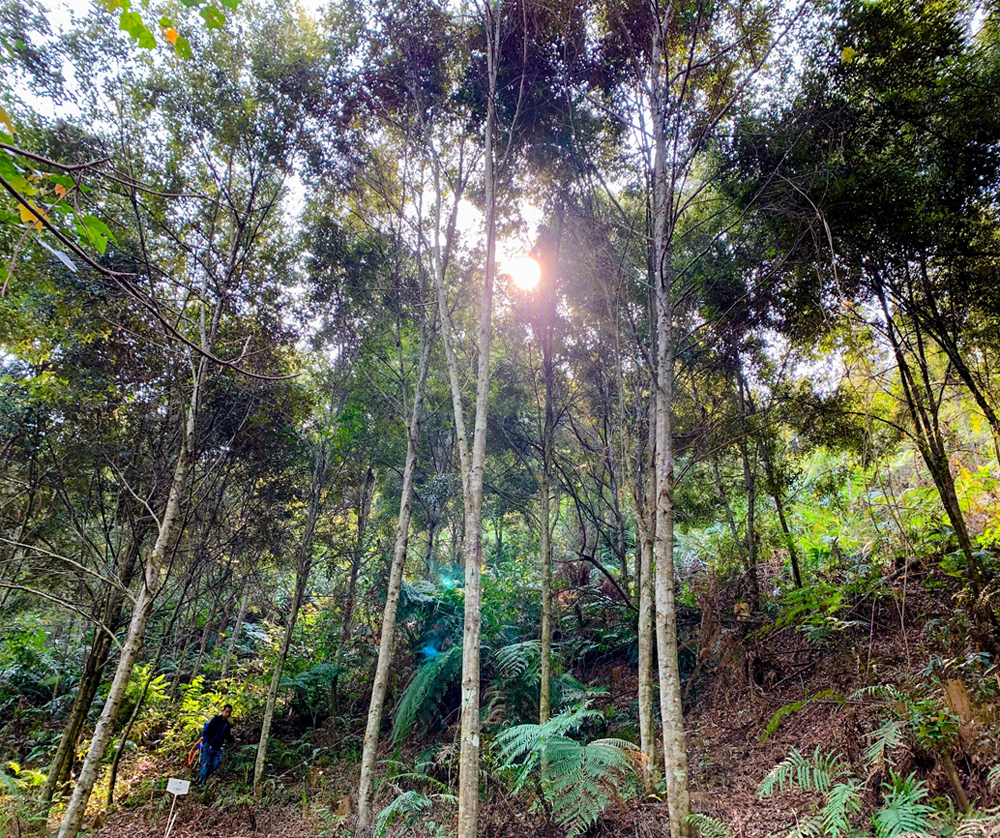
Methods In January 2020, four treatments with different N addition levels were set up in the C. hystrix plantation, which were the control (CK, 0 kg·hm-2·a-1), low N treatment (LN, 50 kg·hm-2·a-1), medium N treatment (MN, 100 kg·hm-2·a-1) and high N treatment (HN, 150 kg·hm-2·a-1), with three replicates per treatment. Fine roots of C. hystrix were dug out by the excavation method, and traits of the 1st to 5th order fine roots in different N addition treatments were determined, including specific root length, specific root area, root tissue density, average root diameter and stoichiometry.
Important findings The results showed that, compared with the CK treatment, MN and HN treatments significantly reduced soil pH, HN treatment significantly increased soil NO3--N and total phosphorus contents. Nitrogen addition significantly increased the content of carbon (C) in the 1st order fine root. HN treatment significantly increased the C content of the 2nd order fine root. MN and HN treatments significantly increased the N content of the 1st and 2nd order fine root, and significantly decreased the C:N of the 2nd order fine root. There were no significant differences in specific root length, specific root surface area, root tissue density and average root diameter of fine roots under different N addition levels. Taken together, these results showed that short-term N addition mainly affected the element content and stoichiometric ratio of fine roots, but had no significant effect on the morphological traits of fine roots in the C. hystrix plantation. This finding will help to understand the response of forest nutrient cycling and C sequestration to global environmental changes in the southern subtropical region.
Key words: root order; nitrogen addition; fine root; morphological trait; plastic
SHU Wei-Wei , YANG Kun , MA Jun-Xu , MIN Hui-Lin , CHEN Lin , LIU Shi-Ling , HUANG Ri-Yi , MING An-Gang , MING Cai-Dao , TIAN Zu-Wei . Effects of nitrogen addition on the morphological and chemical traits of fine roots with different orders of Castanopsis hystrix[J]. Chinese Journal of Plant Ecology, 2024 , 48(1) : 103 -112 . DOI: 10.17521/cjpe.2023.0069
| [1] | Ackerman D, Millet DB, Chen X (2019). Global estimates of inorganic nitrogen deposition across four decades. Global Biogeochemical Cycles, 33, 100-107. |
| [2] | Akatsuki M, Makita N (2020). Influence of fine root traits on in situ exudation rates in four conifers from different mycorrhizal associations. Tree Physiology, 40, 1071-1079. |
| [3] | Bader M, Hiltbrunner E, K?rner C (2009). Fine root responses of mature deciduous forest trees to free air carbon dioxide enrichment (FACE). Functional Ecology, 23, 913-921. |
| [4] | Egerton-Warburton LM, Allen EB (2000). Shifts in arbuscular mycorrhizal communities along an anthropogenic nitrogen deposition gradient. Ecological Applications, 10, 484-496. |
| [5] | Fan AL, Zhang LH, Chen TT, Chen YH, Jiang Q, Jia LQ, Wang X, Chen GS (2020). Response of fine root stoichiometric traits to nitrogen addition in ectomycorrhizal and arbuscular mycorrhizal tree species in an evergreen broad-leaved forest. Acta Ecologica Sinica, 40, 4966-4974. |
| [范爱连, 张礼宏, 陈廷廷, 陈宇辉, 姜琦, 贾林巧, 王雪, 陈光水 (2020). 常绿阔叶林外生、内生菌根树种细根化学计量学性状对N添加的响应. 生态学报, 40, 4966-4974.] | |
| [6] | Fan HB, Liao YC, Liu WF, Yuan YH, Li YY, Huang RZ (2011). Effects of simulated nitrogen deposition on nutrient balance of Chinese fir (Cunninghamia lanceolata) seedlings. Acta Ecologica Sinica, 31, 3277-3284. |
| [樊后保, 廖迎春, 刘文飞, 袁颖红, 李燕燕, 黄荣珍 (2011). 模拟氮沉降对杉木幼苗养分平衡的影响. 生态学报, 31, 3277-3284.] | |
| [7] | Galloway J, Cowling E, Wang N (2002). Reactive nitrogen and the world: 200 years of change. Ambio, 31, 64-71. |
| [8] | Gao ZB, Wang HY, Lü XT, Wang ZW (2017). Effects of nitrogen and phosphorus addition on C:N:P stoichiometry in roots and leaves of four dominant plant species in a meadow steppe of Hulunbuir. Chinese Journal of Ecology, 36, 80-88. |
| [高宗宝, 王洪义, 吕晓涛, 王正文 (2017). 氮磷添加对呼伦贝尔草甸草原4种优势植物根系和叶片C:N:P化学计量特征的影响. 生态学杂志, 36, 80-88.] | |
| [9] | Guo DL, Mitchell RJ, Hendricks JJ (2004). Fine root branch orders respond differentially to carbon source-sink manipulations in a longleaf pine forest. Oecologia, 140, 450-457. |
| [10] | Guo RQ, Xiong DC, Song TT, Cai YY, Chen TT, Chen WY, Zheng X, Chen GS (2018). Effects of simulated nitrogen deposition on stoichiometry of fine roots of Chinese fir (Cunninghamia lanceolata) seedlings. Acta Ecologica Sinica, 38, 6101-6110. |
| [郭润泉, 熊德成, 宋涛涛, 蔡瑛莹, 陈廷廷, 陈望远, 郑欣, 陈光水 (2018). 模拟氮沉降对杉木幼苗细根化学计量学特征的影响. 生态学报, 38, 6101-6110.] | |
| [11] | Hong PZ, Liu SR, Yu HL, Hao J (2016). Effects of simulated nitrogen deposition on soil microbial biomass and community structure in a young plantation of Castanopsis hystrix. Journal of Shandong University (Natural Science), 51(5), 18-28. |
| [洪丕征, 刘世荣, 于浩龙, 郝建 (2016). 模拟氮沉降对红椎人工幼龄林土壤微生物生物量和微生物群落结构的影响. 山东大学学报(理学版), 51(5), 18-28.] | |
| [12] | Huang ZQ, Liu B, Davis M, Sardans J, Pe?uelas J, Billings S (2016). Long-term nitrogen deposition linked to reduced water use efficiency in forests with low phosphorus availability. New Phytologist, 210, 431-442. |
| [13] | Hyv?nen R, Persson T, Andersson S, Olsson B, ?gren GI, Linder S (2008). Impact of long-term nitrogen addition on carbon stocks in trees and soils in northern Europe. Biogeochemistry, 89, 121-137. |
| [14] | Jia SX, Wang ZQ, Li XP, Sun Y, Zhang XP, Liang AZ (2010). N fertilization affects on soil respiration, microbial biomass and roo trespiration in Larix gmelinii and Fraxinus mandshurica plantations in China. Plant and Soil, 333, 325-336. |
| [15] | Koerselman W, Meuleman AFM (1996). The vegetation N:P ratio: a new tool to detect the nature of nutrient limitation. Journal of Applied Ecology, 33, 1441. DOI: 10.2307/2404783. |
| [16] | Kou L, Guo DL, Yang H, Gao WL, Li SG (2015). Growth, morphological traits and mycorrhizal colonization of fine roots respond differently to nitrogen addition in a slash pine plantation in subtropical China. Plant and Soil, 391, 207-218. |
| [17] | Kou L, Jiang L, Fu XL, Dai XQ, Wang HM, Li SG (2018). Nitrogen deposition increases root production and turnover but slows root decomposition in Pinus elliottii plantations. New Phytologist, 218, 1450-1461. |
| [18] | Kraus TEC, Zasoski RJ, Dahlgren RA (2004). Fertility and pH effects on polyphenol and condensed tannin concentrations in foliage and roots. Plant and Soil, 262, 95-109. |
| [19] | Li HS, Wang JS, Fa L, Zhao XH (2013). Effects of simulated nitrogen deposition on seedling growth of Pinus tabulaeformis. Chinese Journal of Applied and Environmental Biology, 19, 774-780. |
| [李化山, 汪金松, 法蕾, 赵秀海 (2013). 模拟氮沉降对油松幼苗生长的影响. 应用与环境生物学报, 19, 774-780.] | |
| [20] | Li WB, Jin CJ, Guan DX, Wang QK, Wang AZ, Yuan FH, Wu JB (2015). The effects of simulated nitrogen deposition on plant root traits: a meta-analysis. Soil Biology & Biochemistry, 82, 112-118. |
| [21] | Liu J, Xiang WH, Xu X, Chen R, Tian DL, Peng CH, Fang X (2010). Analysis of architecture and functions of fine roots of five subtropical tree species in Huitong, Hunan Province, China. Chinese Journal of Plant Ecology, 34, 938-945. |
| [刘佳, 项文化, 徐晓, 陈瑞, 田大伦, 彭长辉, 方晰 (2010). 湖南会同5个亚热带树种的细根构型及功能特征分析. 植物生态学报, 34, 938-945.] | |
| [22] | Liu RQ, Huang ZQ, Luke McCormack M, Zhou XH, Wan XH, Yu ZP, Wang MH, Zheng LJ (2017). Plasticity of fine-root functional traits in the litter layer in response to nitrogen addition in a subtropical forest plantation. Plant and Soil, 415, 317-330. |
| [23] | Liu RX, Wu HJ, Huang GZ, Zhao CY, Li WB (2019). Effects of nitrogen addition on tree root traits. Chinese Journal of Applied Ecology, 30, 1735-1742. |
| [刘瑞雪, 吴泓瑾, 黄国柱, 赵传燕, 李伟斌 (2019). 氮添加对树木根系特性的影响. 应用生态学报, 30, 1735-1742.] | |
| [24] | Lu XK, Vitousek PM, Mao QG, Gilliam FS, Luo YQ, Zhou GY, Zou XM, Bai E, Scanlon TM, Hou EQ, Mo JM (2018). Plant acclimation to long term high nitrogen deposition in an N-rich tropical forest. Proceedings of the National Academy of Sciences of the United States of America, 115, 5187-5192. |
| [25] | Mao R, Song CC, Zhang XH, Wang XW, Zhang ZH (2013). Response of leaf, sheath and stem nutrient resorption to 7 years of N addition in freshwater wetland of northeast china. Plant and Soil, 364, 385-394. |
| [26] | Marklein AR, Houlton BZ (2012). Nitrogen inputs accelerate phosphorus cycling rates across a wide variety of terrestrial ecosystems. New Phytologist, 193, 696-704. |
| [27] | Maskell LC, Smart SM, Bullock JM, Thompson K, Stevens CJ (2010). Nitrogen deposition causes widespread loss of species richness in British habitats. Global Change Biology, 16, 671-679. |
| [28] | Miao Y, Chen YL, Li XW, Fan C, Liu YK, Yang ZJ, Zhang J, Cai XL (2013). Effects of fertilization on Alnus formosana fine root morphological characteristics, biomass and issue content of C, N under A. formosana-Hemarthria compressa compound mode. Chinese Journal of Plant Ecology, 37, 674-683. |
| [苗宇, 陈栎霖, 李贤伟, 范川, 刘运科, 杨正菊, 张军, 蔡新莉 (2013). 施肥对台湾桤木-扁穗牛鞭草复合模式下桤木细根形态特征、生物量及组织碳氮含量的影响. 植物生态学报, 37, 674-683.] | |
| [29] | Mou P, Jones RH, Tan ZQ, Bao Z, Chen HM (2013). Morphological and physiological plasticity of plant roots when nutrients are both spatially and temporally heterogeneous. Plant and Soil, 364, 373-384. |
| [30] | Ostonen I, Helmisaari HS, Borken W, Tedersoo L, Kukum?gi M, Bahram M, Lindroos AJ, N?jd P, Uri V, Meril? P, Asi E, L?hmus K (2011). Fine root foraging strategies in Norway spruce forests across a European climate gradient. Global Change Biology, 17, 3620-3632. |
| [31] | Pregitzer KS, Deforest JL, Burton AJ, Allen MF, Ruess RW, Hendrick RL (2002). Fine root architecture of nine north american trees. Ecological Monographs, 72, 293-309. |
| [32] | Quinn Thomas R, Canham CD, Weathers KC, Goodale CL (2010). Increased tree carbon storage in response to nitrogen deposition in the US. Nature Geoscience, 3, 13-17. |
| [33] | Reay DS, Dentener F, Smith P, Grace J, Feely RA (2008). Global nitrogen deposition and carbon sinks. Nature geoscience, 1, 430-437. |
| [34] | Shi SZ, Xiong DC, Feng JX, Xu CS, Zhong BY, Deng F, Chen YY, Chen GS, Yang YS (2017). Ecophysiological effects of simulated nitrogen deposition on fine roots of Chinese fir (Cunninghamia lanceolata) seedlings. Acta Ecologica Sinica, 37, 74-83. |
| [史顺增, 熊德成, 冯建新, 许辰森, 钟波元, 邓飞, 陈云玉, 陈光水, 杨玉盛 (2017). 模拟氮沉降对杉木幼苗细根的生理生态影响. 生态学报, 37, 74-83.] | |
| [35] | Shi W, Wang ZQ, Liu JL, Gu JC, Guo DL (2008). Fine root morphology of twenty hardwood species in Maoershan natural secondary forest in northeastern China. Journal of Plant Ecology, 32, 1217-1226. |
| [师伟, 王政权, 刘金梁, 谷加存, 郭大立 (2008). 帽儿山天然次生林20个阔叶树种细根形态. 植物生态学报, 32, 1217-1226.] | |
| [36] | Wang QT, Zhang ZL, Guo WJ, Zhu XM, Xiao J, Liu Q, Yin HJ (2021). Absorptive and transport roots differ in terms of their impacts on rhizosphere soil carbon storage and stability in alpine forests. Soil Biology & Biochemistry, 161, 108379. DOI: 10.1016/j.soilbio.2021.108379. |
| [37] | Wang GL, Fahey TJ, Xue S, Liu F (2012). Root morphology and architecture respond to N addition in Pinus tabuliformis, west China. Oecologia, 171, 583-590. |
| [38] | Wang RJ, Jiang Y, Wang Y, Liu TW, Tang JR, Liu XS, Huang RL (2021). The change of soil carbon stabilization and carbon management index in different mixed plantations of Castanopsis hystrix in subtropical area of South China. Forest Research, 34(2), 24-31. |
| [王仁杰, 蒋燚, 王勇, 刘庭薇, 唐靓茹, 刘雄盛, 黄荣林 (2021). 南亚热带不同红锥混交林土壤碳库稳定性与碳库管理指数变化. 林业科学研究, 34(2), 24-31.] | |
| [39] | Wang WN, Wang Y, Wang SZ, Wang ZQ, Gu JC (2016). Effects of elevated N availability on anatomy, morphology and mycorrhizal colonization of fine roots: a review. Chinese Journal of Applied Ecology, 27, 1294-1302. |
| [王文娜, 王燕, 王韶仲, 王政权, 谷加存 (2016). 氮有效性增加对细根解剖、形态特征和菌根侵染的影响. 应用生态学报, 27, 1294-1302.] | |
| [40] | Weand MP, Arthur MA, Lovett GM, Sikora F, Weathers KC (2010). The phosphorus status of northern hardwoods differs by species but is unaffected by nitrogen fertilization. Biogeochemistry, 97, 159-181. |
| [41] | Wurzburger N, Wright SJ (2015). Fine-root responses to fertilization reveal multiple nutrient limitation in a lowland tropical forest. Ecology, 96, 2137-2146. |
| [42] | Xiong DC, Huang JX, Yang ZJ, Lu ZL, Chen GS, Yang YS (2012). Fine root architecture and morphology among different branch orders of six subtropical tree species. Acta Ecologica Sinica, 32, 1888-1897. |
| [熊德成, 黄锦学, 杨智杰, 卢正立, 陈光水, 杨玉盛 (2012). 亚热带6种树种细根序级结构和形态特征. 生态学报, 32, 1888-1897.] | |
| [43] | Yan GY, Zhou MX, Wang M, Han SJ, Liu GC, Zhang X, Sun WJ, Huang BB, Wang HL, Xing YJ, Wang QG (2019). Nitrogen deposition and decreased precipitation altered nutrient foraging strategies of three temperate trees by affecting root and mycorrhizal traits. Catena, 181, 104094. DOI: 10.1016/j.catena.2019.104094. |
| [44] | Yan XL, Lin ZY, Hu WJ, Ma XQ, Qu LP (2022). Root morphological characteristics of Cunninghamia lanceolata and its foraging strategies. World Forestry Research, 35(1), 26-31. |
| [闫小莉, 林智熠, 胡文佳, 马祥庆, 曲鲁平 (2022). 杉木根系形态特征及其觅养策略研究进展. 世界林业研究, 35(1), 26-31.] | |
| [45] | Yang XJ, Huang ZY, Venable DL, Wang L, Zhang KL, Baskin JM, Baskin CC, Cornelissen JHC (2016). Linking performance trait stability with species distribution: the case of Artemisia and its close relatives in Northern China. Journal of Vegetation Science, 27, 123-132. |
| [46] | Yang Y, Li T, Pokharel P, Liu LX, Qiao JB, Wang YQ, An SS, Chang SX (2022). Global effects on soil respiration and its temperature sensitivity depend on nitrogen addition rate. Soil Biology & Biochemistry, 174, 108814. DOI: 10.1016/j.soilbio.2022.108814. |
| [47] | Zhang LH (2019). Plastic Responses of Fine Root Traits to N and P in Ectomycorrhizal and Arbuscular Mycorrhizal Tree Species in an Evergreen Broadleaved Fores. Master degree dissertation, Fujian Normal University, Fuzhou. |
| [张礼宏 (2019). 常绿阔叶林外生菌根与内生菌根树种细根性状对N和P的可塑性响应. 硕士学位论文, 福建师范大学, 福州.] | |
| [48] | Zhao XX, Tian QX, Huang L, Lin QL, Wu JJ, Liu F (2022). Fine-root functional trait response to nitrogen deposition across forest ecosystems: a meta-analysis. Science of the Total Environment, 844, 157111. DOI: 10.1016/j.scitotenv.2022.157111. |
| [49] | Zhou C, Liu T, Wang QG, Han SJ (2022). Effects of long-term nitrogen addition on fine root morphological, anatomical structure and stoichiometry of broadleaved Korean pine forest. Journal of Beijing Forestry University, 44(11), 31-40. |
| [周诚, 刘彤, 王庆贵, 韩士杰 (2022). 长期氮添加对阔叶红松林细根形态、解剖结构和化学组分的影响. 北京林业大学学报, 44(11), 31-40.] |
/
| 〈 |
|
〉 |
Copyright © 2026 Chinese Journal of Plant Ecology
Tel: 010-62836134, 62836138, E-mail: apes@ibcas.ac.cn, cjpe@ibcas.ac.cn

