
Chinese Journal of Plant Ecology >
History of forest disturbance recorded by old trees in Xishan Mountain, Beijing
Received date: 2023-06-16
Accepted date: 2023-09-20
Online published: 2023-09-21
Aims Old trees not only record the climate and environment change information, but also witness the history of social changes. Understanding the history of growth change and disturbance of old trees is useful to accurately assess the health of old trees in the context of global warming and to develop conservation plans.
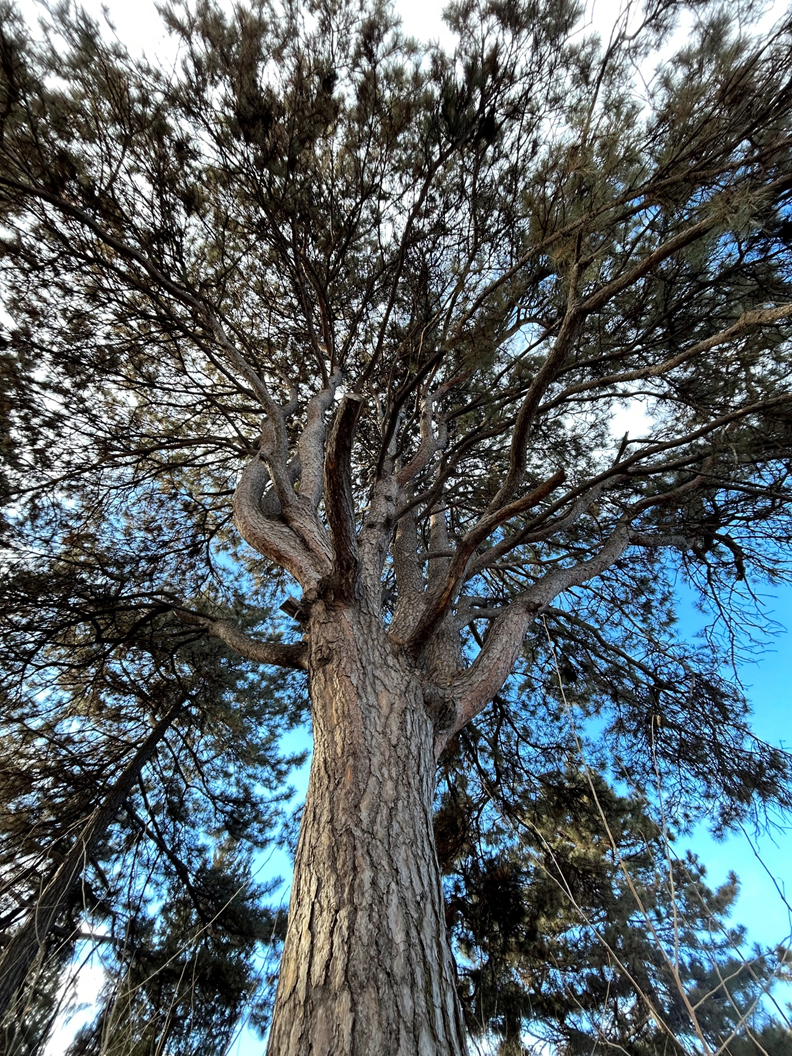
Methods We used tree-ring methods to analyze the disturbance history of the old trees (Pinus tabuliformis) in the Xishan Mountain of Beijing.
Important findings There were six major growth suppression (1831-1837, 1855-1868, 1882-1891, 1920-1930, 1960-1970 and 1980-1986) and five release events (1820-1830, 1869-1881, 1909-1918, 1947-1959 and 2004-2010). The response analysis of tree growth to climate factors and the historical data showed that drought events and subsequent climatic improvement were the main reasons for growth suppression and release events. Further studies showed that the average growth rate of diameter at breast height of old trees was 2.70 mm·a-1 before 1840, and then the growth rate of diameter at breast height gradually decreased. After 1980, there was an obvious growth suppression, and the annual average growth rate decreased to 0.38 mm·a-1. A stronger negative correlation between tree growth and temperature emerged after 1965, and a significant positive correlation emerged for Palmer Drought Severity Index (PDSI). These results suggest that the warming and drying trend in Beijing in recent years may further negatively affect old trees in the urban area. These results are helpful for further understanding the regularity of forest disturbance in the Beijing area during historical period, and are of great significance for accurately assessing the healthy status of elderly trees in the context of climate change.
Key words: tree-ring; disturbance history; climate change; old tree
ZHANG Qi , CHENG Xue-Han , WANG Shu-Zhi . History of forest disturbance recorded by old trees in Xishan Mountain, Beijing[J]. Chinese Journal of Plant Ecology, 2024 , 48(3) : 341 -348 . DOI: 10.17521/cjpe.2023.0173
| [1] | Biondi F, Qeadan F (2008). A theory-driven approach to tree-ring standardization: defining the biological trend from expected basal area increment. Tree-Ring Research, 64, 81-96. |
| [2] | Biondi F, Waikul K (2004). DENDROCLIM2002: a C++ program for statistical calibration of climate signals in tree-ring chronologies. Computers & Geosciences, 30, 303-311. |
| [3] | Chang YX, Chen ZJ, Zhang XL, Bai XP, Zhao XP, Li JX, Lu X (2017). Responses of radial growth to temperature in Larix gmelinii of the Da Hinggan Ling under climate warming. Chinese Journal of Plant Ecology, 41, 279-289. |
| [常永兴, 陈振举, 张先亮, 白学平, 赵学鹏, 李俊霞, 陆旭 (2017). 气候变暖下大兴安岭落叶松径向生长对温度的响应. 植物生态学报, 41, 279-289.] | |
| [4] | Chen M, Zhang X, Li M, Zhang J, Cao Y (2021). Climate-growth pattern of Pinus tabulaeformis plantations and their resilience to drought events in the Loess Plateau. Forest Ecology and Management, 499, 119642. DOI: 10.1016/j.foreco.2021.119642. |
| [5] | Cherubini P, Schweingruber FH, Forster T (1997). Morphology and ecological significance of intra-annual radial cracks in living conifers. Trees, 11, 216-222. |
| [6] | Chiarucci A, Piovesan G (2020). Need for a global map of forest naturalness for a sustainable future. Conservation Biology, 34, 368-372. |
| [7] | Dudley N, Higgins-Zogib L, Mansourian S (2009). The links between protected areas, faiths, and sacred natural sites. Conservation Biology, 23, 568-577. |
| [8] | Evans MEK, Falk DA, Arizpe A, Swetnam TL, Babst F, Holsinger KE (2017). Fusing tree-ring and forest inventory data to infer influences on tree growth. Ecosphere, 8, e01889. DOI: 10.1002/ecs2.1889. |
| [9] | Faison EK (2014). Large old tree declines at broad scales: a more complicated story. Conservation Letters, 7, 70-71. |
| [10] | Gao H, Ouyang Z, Chen S, 2013). Role of culturally protected forests in biodiversity conservation in Southeast China. Biodiversity and Conservation, 22, 531-544. |
| [11] | Hauru K, Niemi A, Lehvavirta S (2012). Spatial distribution of saplings in heavily worn urban forests: implications for regeneration and management. Urban Forestry & Urban Greening, 11, 279-289. |
| [12] | Hu JQ, Xia YG, Mei Y, Wang XQ (2004). Research of the acient and famouse trees in China. Journal of Fujian Forestry Science and Technology, 31, 151-154. |
| [胡坚强, 夏有根, 梅艳, 王学勤 (2004). 古树名木研究概述. 福建林业科技, 31, 151-154.] | |
| [13] | Li Y, Zhang QB (2017). History of tree growth declines recorded in old trees at two sacred sites in northern China. Frontiers in Plant Science, 8, 1779. DOI: 10.3389/fpls.2017.01779. |
| [14] | Li ZS, Chen WL, Wei JS, Maierdang K, Zhang YX, Zhang S, Wang XC (2021). Tree-ring growth responses of Liaodong Oak (Quercus wutaishanica) to climate in the Beijing Dongling Mountain of China. Acta Ecologica Sinica, 41, 27-37. |
| [李宗善, 陈维梁, 韦景树, 买尔当·克依木, 张育新, 张霜, 王晓春 (2021). 北京东灵山辽东栎林树木生长对气候要素的响应特征. 生态学报, 41, 27-37.] | |
| [15] | Lindenmayer DB (2017). Conserving large old trees as small natural features. Biological Conservation, 211, 51-59. |
| [16] | Lindenmayer DB, Laurance WF, Franklin JF (2012). Global decline in large old trees. Science, 338, 1305-1306. |
| [17] | Lindenmayer DB, Laurance WF, Franklin JF, Likens GE, Banks SC, Blanchard W, Gibbons P, Ikin K, Blair D, McBurney L, Manning AD, Stein JAR (2014). New policies for old trees: averting a global crisis in a keystone ecological structure. Conservation Letters, 7, 61-69. |
| [18] | Liu J, Yang B, Lindenmayer DB (2019). The oldest trees in China and where to find them. Frontiers in Ecology and the Environment, 17, 319-322. |
| [19] | Liu Y, Zhang XJ, Song HM, Cai QF, Li Q, Zhao BY, Liu H, Mei RC (2017). Tree-ring-width-based PDSI reconstruction for central Inner Mongolia, China over the past 333 years. Climate Dynamics, 48, 867-879. |
| [20] | Nowacki GJ, Abrams MD (1997). Radial-growth averaging criteria for reconstructing disturbance histories from presettlement-origin oaks. Ecological Monographs, 67, 225-249. |
| [21] | Piovesan G, Biondi F (2021). On tree longevity. New Phytologist, 231, 1318-1337. |
| [22] | Reyer CPO, Rammig A, Brouwers N, Langerwisch F (2015). Forest resilience, tipping points and global change processes. Journal of Ecology, 103, 1-4. |
| [23] | Sikorski P, Szumacher I, Sikorska D, Kozak M, Wierzba M (2013). Effects of visitor pressure on understory vegetation in Warsaw forested parks (Poland). Environmental Monitoring and Assessment, 185, 5823-5836. |
| [24] | Sui XH, Zhang JJ, Wen WR (2011). Study on sap flow in forest of Quercus liaotungensis and Populus davidiana by using the TDP method. Acta Ecologica Sinica, 31, 4791-4798. |
| [隋旭红, 张建军, 文万荣 (2011). 晋西黄土区辽东栎、山杨树干液流比较研究. 生态学报, 31, 4791-4798.] | |
| [25] | Wang BY, Xiu XT, Lan SR (2016). Monetary valuation of the cultural value of ancient and famous trees. Issues of Forestry Economics, 36, 565-570. |
| [王碧云, 修新田, 兰思仁 (2016). 古树名木文化价值货币化评估研究. 林业经济问题, 36, 565-570.] | |
| [26] | Wang SW, Zhu JH, Cai JN (2004). Interdecadal variability of temperature and precipitation in China since 1880. Advances in Atmospheric Sciences, 21, 307-313. |
| [27] | Wang T, Yu D, Li JF, Ma KP (2003). Advances in research on the relationship between climatic and tree-ring width. Chinese Journal of Plant Ecology, 27, 23-33. |
| [王婷, 于丹, 李江风, 马克平 (2003). 树木年轮宽度与气候变化关系研究进展. 植物生态学报, 27, 23-33.] | |
| [28] | Wang XC, Zhao YF (2011). Growth release determination and interpretation of Korean pine and Koyama spruce in Shengshan National Nature Reserve, Heilongjiang Province, China. Acta Ecologica Sinica, 31, 1230-1239. |
| [王晓春, 赵玉芳 (2011). 黑河胜山国家自然保护区红松和红皮云杉生长释放判定及解释. 生态学报, 31, 1230-1239.] | |
| [29] | Xiao JY, Zhang WY, Mou YM, Lyu LX (2021). Differences of drought tolerance of the main tree species in Dongling Mountain, Beijing, China as indicated by tree rings. Chinese Journal of Applied Ecology, 32, 3487-3496. |
| [肖健宇, 张文艳, 牟玉梅, 吕利新 (2021). 树木年轮揭示的东灵山主要树种间干旱耐受性差异. 应用生态学报, 32, 3487-3496.] | |
| [30] | Xie M, Cai QF, Liu Y, Zhang HY, Li T, Ye YD (2023). Growth characteristics of Pinus tabuliformis Carr. and its relationship with climate change in the south of Lüliang Mountains in the past century. Journal of Earth Environment, 14, 62-73. |
| [谢梅, 蔡秋芳, 刘禹, 张涵玉, 李腾, 叶远达 (2023). 过去百年吕梁山南端油松生长特征及其与气候变化的关系. 地球环境学报, 14, 62-73.] | |
| [31] | Xue XF, Gao YK (2014). Appreciating the beauty and history of the ancient trees—Discussion on the sustainable utilization of the landscape of ancient trees of Fragrant Hills Park in Beijing. Chinese Landscape Architecture, 30(6), 79-84. |
| [薛晓飞, 高云昆 (2014). 赏古树芳华享历史浓荫——论北京香山公园古树景观可持续利用. 中国园林, 30(6), 79-84.] | |
| [32] | Yang SY, Meng D, Li XJ, Wu XL (2018). Multi-scale responses of vegetation changes relative to the SPEI meteorological drought index in North China in 2001-2014. Acta Ecologica Sinica, 38, 1028-1039. |
| [杨思遥, 孟丹, 李小娟, 吴新玲 (2018). 华北地区2001-2014年植被变化对SPEI气象干旱指数多尺度的响应. 生态学报, 38, 1028-1039.] | |
| [33] | Zhang Q, Yan M, Liang HX (2017). History of growth suppression and release events in forests in Changzhi Prefecture, Shanxi Province, China. Acta Ecologica Sinica, 37, 3115-3123. |
| [张启, 闫明, 梁寒雪 (2017). 山西省长治市过去150年森林的生长抑制和释放历史. 生态学报, 37, 3115-3123.] | |
| [34] | Zhang XQ, Lei YC, Pang Y, Liu XZ, Wang JZ (2014). Tree mortality in response to climate change induced drought across Beijing, China. Climatic Change, 124, 179-190. |
| [35] | Zhu LJ, Jin GZ, Wang XC (2015). Reconstruction of disturbance history of a typical broad-leaved Pinus koraiensis forest and mechanisms of disturbance occurrence. Chinese Journal of Plant Ecology, 39, 125-139. |
| [朱良军, 金光泽, 王晓春 (2015). 典型阔叶红松林干扰历史重建及干扰形成机制. 植物生态学报, 39, 125-139.] |
/
| 〈 |
|
〉 |
Copyright © 2026 Chinese Journal of Plant Ecology
Tel: 010-62836134, 62836138, E-mail: apes@ibcas.ac.cn, cjpe@ibcas.ac.cn

