
Chinese Journal of Plant Ecology >
Mechanisms of the invasion of Cenchrus spinifex and drought effects on productivity of Leymus chinensis community
Received date: 2023-12-14
Accepted date: 2024-01-23
Online published: 2024-01-24
Supported by
Chinese Academy of Sciences Pioneering Young Talent Program(Y9B7041001)
Aims The Leymus chinensis community is one of the most precious natural wealth in China’s grassland resources. However, its productivity is constrained by a variety of global change factors. Although, the invasion of Cenchrus spinifex (hereafter as “invasion”) and drought are two of most important global change factors that significantly affected the productivity of L. chinensis community in the northeast Songnen grassland area, the relevant mechanisms have still not received sufficient attention.
Methods Through the microcosmic control experiments and a complete interaction design with two factors, we explored the mechanism of invasion and drought on the productivity of the L. chinensis community. Factor one was the invasion treatment (invasion vs control), factor two was the water treatment (drought vs normal water), and a total of 10 replications were set up under each treatment, with a total of 40 pots in the experiment.
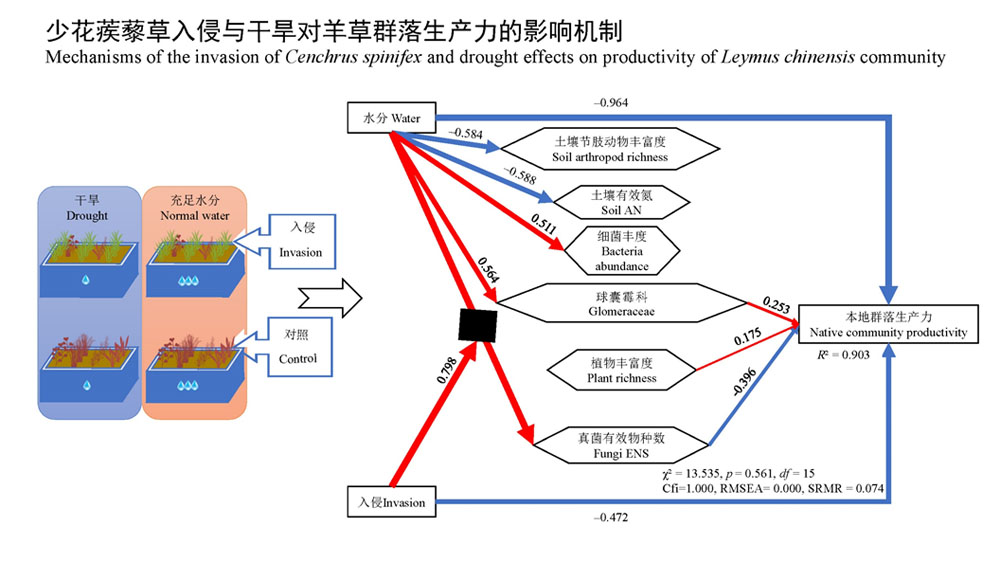
Important findings The results showed that invasion and drought significantly reduced the aboveground biomass of the L. chinensis community and the dominant species L. chinensis. Soil available nitrogen content and soil arthropod richness significantly decreased under drought treatment, while soil bacterial abundance and arbuscular mycorrhiza fungi (AMF) of the family Glomeraceae increased significantly. The effect of invasion on the effective number of species of soil fungi is moderated by drought, showed that invasion did not affect the effective number of species of soil fungi under normal water conditions, but significantly increased the effective number of species of soil fungi under drought conditions. The results of the structural equation modeling indicated that invasion and drought directly suppressed the L. chinensis community productivity. Drought has indirectly mitigate negative effect on native community productivity by increasing the abundance of dominant soil fungi. In addition, the interaction of invasion and drought suppressed native community productivity by increasing soil fungal community diversity. This study provides a theoretical basis for better protection of grassland productivity and conservation of high-quality forage in the future.
BAI Hao-Ran , HOU Meng , LIU Yan-Jie . Mechanisms of the invasion of Cenchrus spinifex and drought effects on productivity of Leymus chinensis community[J]. Chinese Journal of Plant Ecology, 2024 , 48(5) : 577 -589 . DOI: 10.17521/cjpe.2023.0374
| [1] | Aupic-Samain A, Baldy V, Delcourt N, Krogh PH, Gauquelin T, Fernandez C, Santonja M (2021). Water availability rather than temperature control soil fauna community structure and prey-predator interactions. Functional Ecology, 35, 1550-1559. |
| [2] | Bardgett RD, Chan KF (1999). Experimental evidence that soil fauna enhance nutrient mineralization and plant nutrient uptake in montane grassland ecosystems. Soil Biology & Biochemistry, 31, 1007-1014. |
| [3] | Bartholomeus H, Schaepman-Strub G, Blok D, Sofronov R, Udaltsov S (2012). Spectral estimation of soil properties in Siberian tundra soils and relations with plant species composition. Applied and Environmental Soil Science, 2012, 241535. DOI: 10.1155/2012/241535. |
| [4] | Baruch Z, Goldstein G (1999). Leaf construction cost, nutrient concentration, and net CO2 assimilation of native and invasive species in Hawaii. Oecologia, 121, 183-192. |
| [5] | Biederman LA, Boutton TW (2009). Biodiversity and trophic structure of soil nematode communities are altered following woody plant invasion of grassland. Soil Biology & Biochemistry, 41, 1943-1950. |
| [6] | Bonkowski M, Clarholm M (2012). Stimulation of plant growth through interactions of bacteria and Protozoa: testing the auxiliary microbial loop hypothesis. Acta Protozoologica, 51, 237-247. |
| [7] | Bowles TM, Jackson LE, Cavagnaro TR (2018). Mycorrhizal fungi enhance plant nutrient acquisition and modulate nitrogen loss with variable water regimes. Global Change Biology, 24, e171-e182. |
| [8] | Brook BW, Sodhi NS, Bradshaw CJA (2008). Synergies among extinction drivers under global change. Trends in Ecology & Evolution, 23, 453-460. |
| [9] | Callaway RM, Thelen GC, Rodriguez A, Holben WE (2004). Soil biota and exotic plant invasion. Nature, 427, 731-733. |
| [10] | Cao Y, Hawkins CP (2019). Weighting effective number of species measures by abundance weakens detection of diversity responses. Journal of Applied Ecology, 56, 1200-1209. |
| [11] | Ciais P, Reichstein M, Viovy N, Granier A, Ogée J, Allard V, Aubinet M, Buchmann N, Bernhofer C, Carrara A, Chevallier F, de Noblet N, Friend AD, Friedlingstein P, Grünwald T, et al. (2005). Europe-wide reduction in primary productivity caused by the heat and drought in 2003. Nature, 437, 529-533. |
| [12] | Diez JM, D’Antonio CM, Dukes JS, Grosholz ED, Olden JD, Sorte CJ, Blumenthal DM, Bradley BA, Early R, Ibá?ez I, Jones SJ, Lawler JJ, Miller LP (2012). Will extreme climatic events facilitate biological invasions. Frontiers in Ecology and the Environment, 10, 249-257. |
| [13] | Dijkstra FA, Augustine DJ, Brewer P, von Fischer JC (2012). Nitrogen cycling and water pulses in semiarid grasslands: Are microbial and plant processes temporally asynchronous. Oecologia, 170, 799-808. |
| [14] | Dong GJ (2003). Leymus chinensis, one of the seven males of forage grass. Plants, (3), 20. |
| [董贵俊 (2003). 牧草七雄之一——羊草. 植物杂志, (3), 20.] | |
| [15] | Engelbrecht BMJ, Tyree MT, Kursar TA (2007). Visual assessment of wilting as a measure of leaf water potential and seedling drought survival. Journal of Tropical Ecology, 23, 497-500. |
| [16] | Essl F, Lenzner B, Bacher S, Bailey S, Capinha C, Daehler C, Dullinger S, Genovesi P, Hui C, Hulme PE, Jeschke JM, Katsanevakis S, Kühn I, Leung B, Liebhold A, et al. (2020). Drivers of future alien species impacts: an expert- based assessment. Global Change Biology, 26, 4880-4893. |
| [17] | Fan LH, Zhou XM, Wu SL, Xiang J, Zhong XY, Tang XZ, Wang YJ (2019). Research advances on the effects of drought stress in plant rhizosphere environments. Chinese Journal of Applied and Environmental Biology, 25, 1244-1251. |
| [樊利华, 周星梅, 吴淑兰, 向君, 钟晓燕, 唐雪滋, 王彦杰 (2019). 干旱胁迫对植物根际环境影响的研究进展. 应用与环境生物学报, 25, 1244-1251.] | |
| [18] | Gang CC, Wang ZQ, Yang Y, Chen YZ, Zhang YZ, Li JL, Cheng JM (2016). The NPP spatiotemporal variation of global grassland ecosystems in response to climate change over the past 100 years. Acta Prataculturae Sinica, 25(11), 1-14. |
| [刚成诚, 王钊齐, 杨悦, 陈奕兆, 张艳珍, 李建龙, 程积民 (2016). 近百年全球草地生态系统净初级生产力时空动态对气候变化的响应. 草业学报, 25(11), 1-14.] | |
| [19] | Gao JH, Wang R, Song Z, Yun LL, Fu WD, Wang ZH, Ma T, Wang Y, Zhang GL (2022). Effects of Cenchrus spinifex invasion on phosphorus bacteria community diversity in rhizosphere soil. Journal of Biosafety, 31, 327-335. |
| [高金会, 王然, 宋振, 郓玲玲, 付卫东, 王忠辉, 马涛, 王伊, 张国良 (2022). 少花蒺藜草入侵对根际土壤磷细菌群落多样性的影响. 生物安全学报, 31, 327-335.] | |
| [20] | Gao Q, Zhu W, Schwartz M, Ganjurjav H, Wan YF, Qin XB, Ma X, Williamson M, Li Y (2016). Climatic change controls productivity variation in global grasslands. Scientific Reports, 6, 26958. DOI: 10.1038/srep26958. |
| [21] | Geng QH, Song LP, Lin CF, Zhang YY, Wang AH (2021). Study on the method of seed dormancy breaking in non- heading Chinese cabbage. Hubei Agricultural Sciences, 60(21), 76-80. |
| [耿启华, 宋莉萍, 林处发, 张余洋, 汪爱华 (2021). 小白菜种子休眠破除方法研究. 湖北农业科学, 60(21), 76-80.] | |
| [22] | Guo YF (2023). Relationship Between Plant Community Diversity and Productivity in Desert Steppe Under Controlled Precipitation. Master degree dissertation, Northwest Normal University, Lanzhou. |
| [郭亚飞 (2023). 控制降水下荒漠草原植物群落多样性与生产力的关系研究. 硕士学位论文, 西北师范大学, 兰州.] | |
| [23] | Haichar FZ, Marol C, Berge O, Rangel-Castro JI, Prosser JI, Balesdent J, Heulin T, Achouak W (2008). Plant host habitat and root exudates shape soil bacterial community structure. The ISME Journal, 2, 1221-1230. |
| [24] | Hartmann M, Brunner I, Hagedorn F, Bardgett RD, Stierli B, Herzog C, Chen XM, Zingg A, Graf-Pannatier E, Rigling A, Frey B (2017). A decade of irrigation transforms the soil microbiome of a semi-arid pine forest. Molecular Ecology, 26, 1190-1206. |
| [25] | Hou M, Wang JY (2023). Functional traits of both specific alien species and receptive community but not community diversity determined the invasion success under biotic and abiotic conditions. Functional Ecology, 37, 2598-2610. |
| [26] | Illeris L, Michelsen A, Jonasson S (2003). Soil plus root respiration and microbial biomass following water, nitrogen, and phosphorus application at a high arctic semi desert. Biogeochemistry, 65, 15-29. |
| [27] | Jost L (2006). Entropy and diversity. Oikos, 113, 363-375. |
| [28] | Keane RM, Crawley MJ (2002). Exotic plant invasions and the enemy release hypothesis. Trends in Ecology & Evolution, 17, 164-170. |
| [29] | Lecain DR, Morgan JA, Schuman GE, Reeder JD, Hart RH (2002). Carbon exchange and species composition of grazed pastures and exclosures in the shortgrass steppe of Colorado. Agriculture, Ecosystems & Environment, 93, 421-435. |
| [30] | Lei TJ, Feng J, Lv J, Wang JB, Song HQ, Song WL, Gao XF (2020). Net primary productivity loss under different drought levels in different grassland ecosystems. Journal of Environmental Management, 274, 111144. DOI: 10.1016/j.jenvman.2020.111144. |
| [31] | Lei TJ, Wu JJ, Wang JB, Shao CL, Wang WW, Chen DP, Li XY (2022). The net influence of drought on grassland productivity over the past 50 years. Sustainability, 14, 12374. DOI: 10.3390/su141912374. |
| [32] | Lemoine NP, Smith MD (2019). Drought and small-bodied herbivores modify nutrient cycling in the semi-arid shortgrass steppe. Plant Ecology, 220, 227-239. |
| [33] | Li J, Xie L (2019). Harm and control of exotic invasive organism Tribulus parviflora. Agriculture of Jilin, (22), 63. |
| [李静, 谢联 (2019). 外来入侵生物少花蒺藜草的危害与防控. 吉林农业, (22), 63.] | |
| [34] | Li JQ, Meng B, Chai H, Yang XC, Song WZ, Li SX, Lu A, Zhang T, Sun W (2019). Arbuscular mycorrhizal fungi alleviate drought stress in C3 (Leymus chinensis) and C4 (Hemarthria altissima) grasses via altering antioxidant enzyme activities and photosynthesis. Frontiers in Plant Science, 10, 499. DOI: 10.3389/fpls.2019.00499. |
| [35] | Liu J, Dai SS, Huang W, Ding JQ (2020). Aboveground herbivory increases soil nematode abundance of an invasive plant. Journal of Plant Ecology, 13, 405-412. |
| [36] | Liu YJ, van Kleunen M (2017). Responses of common and rare aliens and natives to nutrient availability and fluctuations. Journal of Ecology, 105, 1111-1122. |
| [37] | Liu ZL, Xu HG, Ding H (2006). Impacts of invasive alien plant Eupatorium adenophorum on soil animal communities in Kunming. Journal of Ecology and Rural Environment, 22(2), 31-35. |
| [刘志磊, 徐海根, 丁晖 (2006). 外来入侵植物紫茎泽兰对昆明地区土壤动物群落的影响. 生态与农村环境学报, 22(2), 31-35.] | |
| [38] | Maciá-Vicente JG, Francioli D, Weigelt A, Albracht C, Barry KE, Buscot F, Ebeling A, Eisenhauer N, Hennecke J, Heintz-Buschart A, van Ruijven J, Mommer L (2023). The structure of root-associated fungal communities is related to the long-term effects of plant diversity on productivity. Molecular Ecology, 32, 3763-3777. |
| [39] | Maestre FT, Delgado-Baquerizo M, Jeffries TC, Eldridge DJ, Ochoa V, Gozalo B, Quero JL, García-Gómez M, Gallardo A, Ulrich W, Bowker MA, Arredondo T, Barraza-Zepeda C, Bran D, Florentino A, et al. (2015). Increasing aridity reduces soil microbial diversity and abundance in global drylands. Proceedings of the National Academy of Sciences of the United States of America, 112, 15684-15689. |
| [40] | McCulley RL, Burke IC, Lauenroth WK (2009). Conservation of nitrogen increases with precipitation across a major grassland gradient in the Central Great Plains of North America. Oecologia, 159, 571-581. |
| [41] | Neher DA, Weicht TR, Moorhead DL, Sinsabaugh RL (2004). Elevated CO2 alters functional attributes of nematode communities in forest soils. Functional Ecology, 18, 584-591. |
| [42] | Py?ek P, Jaro?ík V, Hulme PE, Pergl J, Hejda M, Schaffner U, Vilà M (2012). A global assessment of invasive plant impacts on resident species, communities and ecosystems: the interaction of impact measures, invading species’ traits and environment. Global Change Biology, 18, 1725-1737. |
| [43] | Qi SS, Dai ZC, Zhai DL, Chen SC, Si CC, Huang P, Wang RP, Zhong QX, Du DL (2014). Curvilinear effects of invasive plants on plant diversity: plant community invaded by Sphagneticola trilobata. PLoS ONE, 9, e113964. DOI: 10.1371/journal.pone.0113964. |
| [44] | Qiu SY, Liu SS, Wei SJ, Cui XH, Nie M, Huang JX, He Q, Ju RT, Li B (2020). Changes in multiple environmental factors additively enhance the dominance of an exotic plant with a novel trade-off pattern. Journal of Ecology, 108, 1989-1999. |
| [45] | Rout ME, Callaway RM (2009). An invasive plant paradox. Science, 324, 734-735. |
| [46] | Sanaullah M, Blagodatskaya E, Chabbi A, Rumpel C, Kuzyakov Y (2011). Drought effects on microbial biomass and enzyme activities in the rhizosphere of grasses depend on plant community composition. Applied Soil Ecology, 48, 38-44. |
| [47] | Seabloom EW, Harpole WS, Reichman OJ, Tilman D (2003). Invasion, competitive dominance, and resource use by exotic and native California grassland species. Proceedings of the National Academy of Sciences of the United States of America, 100, 13384-13389. |
| [48] | Si HC, Wen SJ, Nan LL, Huo JY, Huang F, Pu H, Xu HY (2023). Influence of simulated drought stress on seedling growth and bacterial communities in the rhizosphere of sainfoin. Grassland and Turf, 43(3), 92-99. |
| [司海灿, 温素军, 南丽丽, 火久艳, 黄富, 蒲涵, 徐昊玥 (2023). 干旱胁迫对红豆草幼苗生长及根际土壤细菌群落的影响. 草原与草坪, 43(3), 92-99.] | |
| [49] | Sorte CJB, Ibá?ez I, Blumenthal DM, Molinari NA, Miller LP, Grosholz ED, Diez JM, D’Antonio CM, Olden JD, Jones SJ, Dukes JS (2013). Poised to prosper? A cross-system comparison of climate change effects on native and non- native species performance. Ecology Letters, 16, 261-270. |
| [50] | Sun ZL, Shu Q, Gao K, Zhou LY, Tian X, Guo FC, Wang HB (2020). Invasion status, adaptive mechanism and control strategy of field sandbur: a review. Acta Agrestia Sinica, 28, 1196-1202. |
| [孙忠林, 淑琴, 高凯, 周立业, 田迅, 郭福纯, 王海滨 (2020). 少花蒺藜草入侵现状、适应机制和防控策略. 草地学报, 28, 1196-1202.] | |
| [51] | Suseela V, Tharayil N (2018). Decoupling the direct and indirect effects of climate on plant litter decomposition: accounting for stress-induced modifications in plant chemistry. Global Change Biology, 24, 1428-1451. |
| [52] | Tang JL, Ren ZG, Zhang XY, Zhang YY, Wang ZW, Wang Z, Suo MC, Ren HY (2023). Relationships between species diversity and productivity of different functional groups in a typical steppe in Inner Mongolia. Acta Agrestia Sinica, 31, 1939-1949. |
| [汤靖磊, 任治国, 张学渊, 张依尧, 王忠武, 王珍, 索明春, 任海燕 (2023). 典型草原不同功能群物种多样性与生产力关系研究. 草地学报, 31, 1939-1949.] | |
| [53] | Thompson JP, MacKenzie J, Sheedy GH (2012). Root-lesion nematode (Pratylenchus thornei) reduces nutrient response, biomass and yield of wheat in sorghum-fallow-wheat cropping systems in a subtropical environment. Field Crops Research, 137, 126-140. |
| [54] | van Kleunen M, Dawson W, Schlaepfer D, Jeschke JM, Fischer M (2010). Are invaders different? A conceptual framework of comparative approaches for assessing determinants of invasiveness. Ecology Letters, 13, 947-958. |
| [55] | von Storch H (2004). A global problem. Nature, 429, 244-245. |
| [56] | Wang KF (2017). The Invasion Mechanism and Control Measures of Cenchrus spinifex. PhD dissertation, Shenyang Agricultural University, Shenyang. |
| 王坤芳 (2017). 草甸草原少花蒺藜草入侵机制及防控措施研究. 博士学位论文, 沈阳农业大学, 沈阳.] | |
| [57] | Wu JW, Wang JG, Li WJ (2023). Influence of Alternanthera philoxeroides invasion on plant community diversity and its risk evaluation. Journal of Weed Science, 41(2), 21-28. |
| [吴佳伟, 王加国, 李苇洁 (2023). 空心莲子草入侵对植物群落多样性影响及风险评估. 杂草学报, 41(2), 21-28.] | |
| [58] | Wu ST (2011). Effects of Mikania micrantha on plant community and physical-chemical properties of soil. Hubei Agricultural Sciences, 50, 3711-3713. |
| [吴双桃 (2011). 薇甘菊对入侵地植物群落及土壤理化性质的影响. 湖北农业科学, 50, 3711-3713.] | |
| [59] | Xu J, Li QF, Wang SY (2012). Distribution pattern of seed band for alien invasive species of Cenchrus incertus. Journal of Arid Land Resources and Environment, 26(11), 184-187. |
| [徐军, 李青丰, 王树彦 (2012). 科尔沁沙地外来入侵植物光梗蒺藜草的种子库分布格局. 干旱区资源与环境, 26(11), 184-187.] | |
| [60] | Yang GW, Ryo M, Roy J, Hempel S, Rillig MC (2021). Plant and soil biodiversity have non-substitutable stabilizing effects on biomass production. Ecology Letters, 24, 1582-1593. |
| [61] | Yang XY (2018). Genetic Diversity and Molecular Phylogeography of the Invasive Plant Cenchrus calyculatu in Inner Mongolia. Master degree dissertation, Inner Mongolia Agricultural University, Hohhot. |
| [杨新英 (2018). 内蒙古入侵植物光梗蒺藜草遗传多样性与分子系统地理学研究. 硕士学位论文, 内蒙古农业大学, 呼和浩特.] | |
| [62] | Yu WB, Li SP (2020). Modern coexistence theory as a framework for invasion ecology. Biodiversity Science, 28, 1362-1375. |
| [于文波, 黎绍鹏 (2020). 基于现代物种共存理论的入侵生态学概念框架. 生物多样性, 28, 1362-1375.] | |
| [63] | Zhang M (2023). Effects of Invasion Degree of Xanthium stumarium on Native X. sibiricum, Soil Nitrogen Transformation and Nitrifying Bacteria. Master degree dissertation, Shenyang Agricultural University, Shenyang. |
| [张明 (2023). 瘤突苍耳入侵程度对本地苍耳、土壤氮转化和硝化菌的影响. 硕士学位论文, 沈阳农业大学, 沈阳.] | |
| [64] | Zhang RH, Zhou P, Wei YQ, Liu N, Zhang YJ (2023a). Defoliation enhances the positive effects of soil microbial diversity on plant productivity. Functional Ecology, 37, 3027-3039. |
| [65] | Zhang X, Oduor AMO, Liu YJ (2023b). Invasive plants have greater growth than co-occurring natives in live soil subjected to a drought-rewetting treatment. Functional Ecology, 37, 513-522. |
| [66] | Zhang X, Zhang T, Liu YJ (2023c). Effects of arbuscular mycorrhizal fungi on plant invasion success driven by nitrogen fluctuations. Journal of Applied Ecology, 60, 2425-2436. |
| [67] | Zhou QL, Wang ZW, Qi FL, Yang DZ, Men HY, Sun B, Qi N, Cui X, Wang YC (2021). Biological and ecological characteristics of Cenchrus pauciflorus and the integrated control strategies. Chinese Journal of Ecology, 40, 2593-2600. |
| [周全来, 王正文, 齐凤林, 杨达志, 门红艳, 孙彪, 齐楠, 崔雪, 王永翠 (2021). 少花蒺藜草生物生态学特征与综合防除策略. 生态学杂志, 40, 2593-2600.] |
/
| 〈 |
|
〉 |
Copyright © 2026 Chinese Journal of Plant Ecology
Tel: 010-62836134, 62836138, E-mail: apes@ibcas.ac.cn, cjpe@ibcas.ac.cn

