Changes in normalized difference vegetation index of deserts and dunes with precipitation in the middle Heihe River Basin
LI Fang1, 2, ZHAO Wen-Zhi2, *
1Research Institute of Grassland Science, Chinese Academy of Agricultural Sciences, Hohhot 010010, Chinaand 2Institute of Northwestern Eco-environment and Resource, Chinese Academy of Sciences, Linze Inland River Basin Research Station, Chinese Ecosystem Research Network, Lanzhou 730000, China
AimsPrecipitation is the major water source for desert ecosystems, with its temporal dynamics significantly driving the changes of ecosystem structure and function in desert regions. The objectives of this study are to evaluate the changes in normalized difference vegetation index (NDVI) with seasonal precipitation and different climate years in two cover types (desert and dune).MethodsBased on the daily rainfall dataset of 2000-2012 in the middle Heihe River Basin in Northwest China and the NDVI extracted from the moderate resolution imaging spectroradiometer (MODIS) images, we performed linear regression analysis to examine the correlation of NDVIINT (accumulated NDVI) with precipitation in two cover types (desert and dune). Two measures of the precipitation are Pc (cool-season precipitation from last September to late February) and Pw (warm-season precipitation in between March and August), while NDVI was characterized with NDVIINT-pys (previous-year during the different climate years (dry: 2001-2003, wet: 2004-2007)) and the different periods of a growing season (i.e. whole growing season from May through September, early growing season in between May and June, and late growing season in between July and September).Important findings We found that: (1) the determinants of growing season NDVIINT and their order were NDVIINT-pys > Pc > Pw for the deserts, while the order was Pw > NDVIINT-pys for the dunes. The determinants and their order of NDVIINT in early growing season were NDVIINT-pys > Pc for the desert, while they were NDVIINT-pys > Pc = Pw for the late growing season. However, for the dunes, NDVIINT of the early and late growing season appeared determined by NDVIINT-pys and Pw, respectively. (2) During the dry and wet periods, precipitation was not a significant factor influencing NDVIINT for the desert and dune. However, significant increases in NDVIINTwere observed at dune under wet condition. With the wet years continued, the length of the wet years become an important determinant of NDVIINT at both cove types, particularly at dune. In addition, it appeared that different changes in NDVI with precipitation existed between the two cover types, but with very similar effects of time-lag. These findings provide useful references for further understanding the mechanisms of NDVI changes with precipitation.
Keywords:accumulated normalized difference vegetation index (NDVIINT)
;
precipitation of cold season
;
precipitation of warm season
;
dry and wet climate period
;
lag time
;
ecohydrology
LIFang, ZHAOWen-Zhi. Changes in normalized difference vegetation index of deserts and dunes with precipitation in the middle Heihe River Basin. Chinese Journal of Plant Ecology, 2016, 40(12): 1245-1256 https://doi.org/10.17521/cjpe.2015.0389
1), average NDVI is the average value over the growing season (May to September) from 2000 to 2012. 2), 3) and 4), the data of soil physical properties were collected from the literature (Chen et al., 2009, Wang et al., 2010; Liu et al., 2015). 5), average soil water content during April to September from 2002 to 2012.1), 2000-2012年生长季(5-9月)归一化植被指数(NDVI)的均值。2)、3)、4), 数据分别来自文献陈小洪等(2009)、王蕙等(2010)、刘继亮等(2015)。5), 2002-2012年4-9月的土壤水分的均值。
Table 3 F-statistical analysis of frequency and precipitation of small (<5 mm) and large rainfall (>10 mm) events during 1968-2000 and 2001-2012 in different seasons (spring, summer, fall and winter)
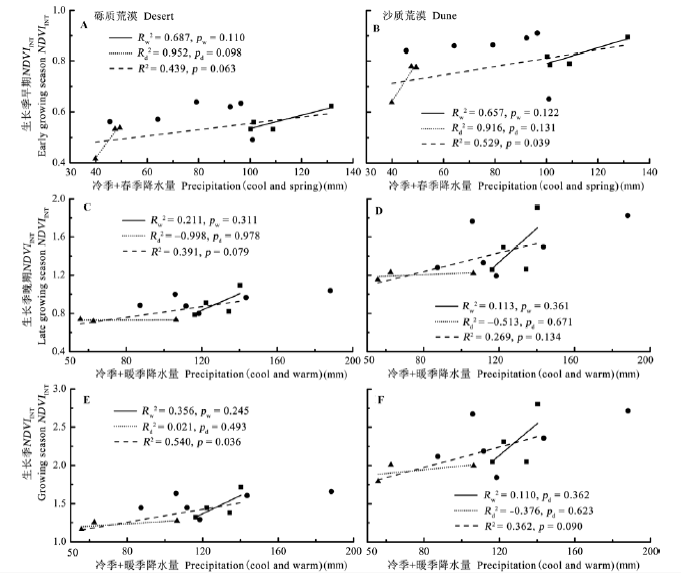
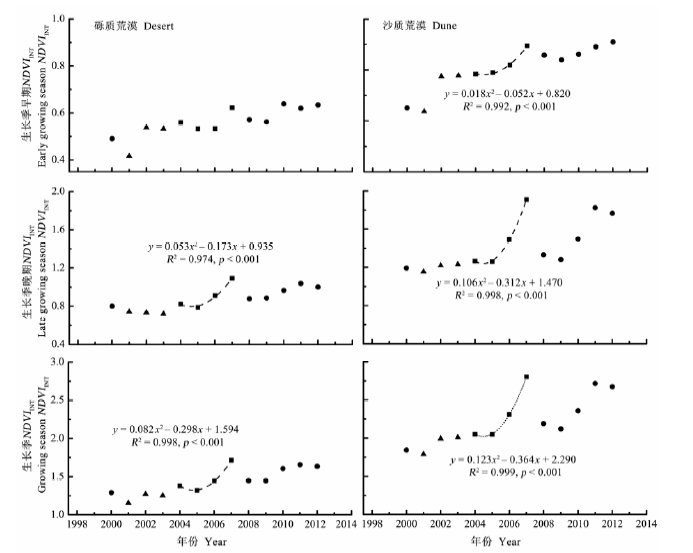
Fig. 3 Relationships between the growing season accumulated normalized difference vegetation index (NDVIINT) (early growing season, late growing season) and precipitation during the wet and dry years in dune and desert ecosystems. Triangles, rectangles and circles indicated NDVIINT in dry years (2001-2003), wet years (2004-2007), and normal years (2000, 2008-2012), respectively. R2, Rd2, Rw2 and p, pd, pw indicated the adjusted coefficient of determination and the probability values of significance test at dry and wet climate period (2001-2007), dry years, wet years.
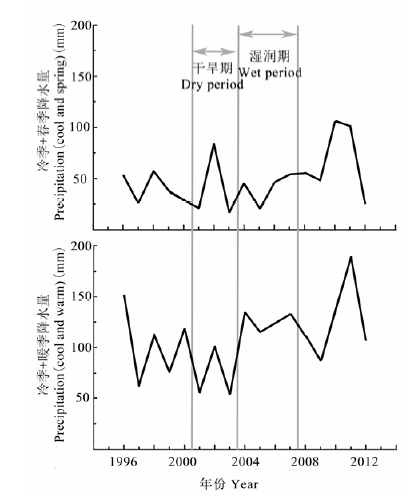
Fig. 5 Changes of accumulated normalized difference vegetation index (NDVIINT) during the wet and dry years at dune and desert. Triangles, rectangles and circles indicated NDVIINT in dry years (2001-2003), wet years (2004-2007) and no-trend years (2000, 2008-2012), respectively. The number of consecutive wet years is indicated in the quadratic function of the independent variable (x).
3 讨论
3.1 两种生境植被生长季NDVIINT对冷暖季降水的响应
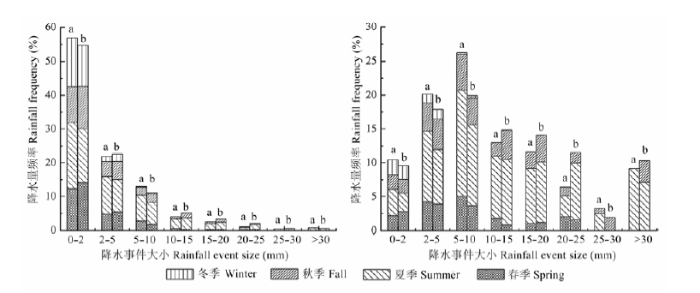
本研究表明沙漠和砾漠植被生长季早期NDVIINT与春季降水无关(表4), 可能是因为研究区春季降水以<5 mm的小降水为主(图2), 且荒漠由于较低的土壤有机质及黏粉粒含量使其土壤持水能力均较弱, 加上春季气温的快速上升, 使得地表土壤蒸发旺盛, 导致春季降水能为植物生长利用所提供的水分有限(Yang et al., 2011; Zeppel et al., 2014)。另外, 生长季早期气温与NDVI相关性大于降水, 说明生长季早期气温是决定NDVI的重要因子(赵铭石等, 2011)。然而, 砾漠生长季早期NDVIINT对冷季降水响应显著; 而沙漠生长季早期NDVIINT与冷季降水无关, 这是由于生长季早期约60%的水分补给来源于冷季降水补给的0-50 cm的浅层土壤水(周海等, 2013); 且砾漠由于黏粉粒含量较多使其浅层土壤持水能力强于沙漠(李玉山, 1983), 使得春季地表土壤水分的蒸发相对较小, 土壤含水量较高(常学向等, 2003), 即累积存储于浅层土壤的冷季降水对砾漠植被生长季早期NDVIINT影响明显, 此结果与其他学者指出的前一年冷季降水是植被春季生长关键水分来源的结论(Hamerlynck et al., 2012, 2013; Reichmann et al., 2013)一致。
Table 4 Linear regression models for the relationships between the accumulated normalized difference vegetation index (NDVIINT) of the entire- (May to September), early- (May to June), and late-growing-season (July to September) precipitation for different periods of the year at dunes and deserts
研究区 Sites
线性回归方程 Linear regression formula
R2
r2
生长季 Growing season
砾质荒漠 Desert
pt = 1.037 + 0.003xc + 0.003xw
R2 = 0.46*
rc2 = 0.29*; rw2 = 0.17*
沙质荒漠 Dune
pt = 1.480 + 0.005xc + 0.007xw
R2 = 0.33*
rc2 = 0.03; rw2 = 0.29*
早期 Early
砾质荒漠 Desert
pt = 0.492 + 0.001xc + 0.001xs
R2 = 0.26*
rc2 = 0.23*; rs2 = 0.04
沙质荒漠 Dune
pt = 0.734 + 0.001xc + 0.002xs
R2 = 0.08
rc2 = 0.02; rs2 = 0.06
晚期 Late
砾质荒漠 Desert
pt = 0.604 + 0.002xc + 0.002xw
R2 = 0.42*
rc2 = 0.22*; rw2 = 0.20*
沙质荒漠 Dune
pt = 0.822 + 0.003xc + 0.002xw
R2 = 0.35*
rc2 = 0.01; rw2 = 0.34*
Both standardized regression sum of squares (R2) and standardized partial regression sum of squares (r2) are shown. pt represents current year growing season NDVIINT. x, cumulative precipitation; c represents cool season; w represents warm season; s represents spring. * represents significant level (p < 0.05).R2和r2表示回归方程的标准化回归平方和与标准化偏回归平方和; pt表示生长季NDVIINT; x表示累积降水量; c表示冷季; w表示暖季; s表示春季; *表示在0.05水平上显著。
Table 5 Linear regression models for the relationships between the accumulated normalized difference vegetation index (NDVIINT) of the entire- (May to September), early- (May to June), and late-growing-season (July to September) precipitation and hydrological year precipitation (Ph) and the previous normalized difference vegetation index (NDVIINT-pys) at dune and desert
研究区 Sites
线性回归方程 Linear regression formula
R2
r2
生长季 Growing season
砾质荒漠 Desert
pt = 0.384 + 0.003xh + 0.527pt-1
R2 = 0.73*
rh2 = 0.40*; rt-12 = 0.34*
沙质荒漠 Dune
pt = 0.659 + 0.005xh + 0.466pt-1
R2 = 0.60*
rh2 = 0.35*; rt-12 = 0.24*
早期 Early
砾质荒漠 Desert
pt = 0.245 + 0.001xc + 0.192pt-1
R2 = 0.47*
rc2 = 0.20*; rt-12 = 0.27*
沙质荒漠 Dune
pt = 0.427 + 0.001xc + 0.170pt-1
R2 = 0.49*
rc2 = 0.01; rt-12 = 0.48*
晚期 Late
砾质荒漠 Desert
pt = 0.140 + 0.002xh + 0.378pt-1
R2 = 0.70*
rh2 = 0.34*; rt-12 = 0.36*
沙质荒漠 Dune
pt = 0.262 + 0.004xh + 0.325pt-1
R2 = 0.50*
rh2 = 0.33*; rt-12 = 0.17
Both standardized regression sum of squares (R2) and standardized partial regression sum of squares (r2) are shown; pt represents the normalized difference vegetation index (NDVI) integrated over the current growing season; pt-1 represents the NDVI integrated over the previous growing season; xh represents hydrological year precipitation; xc, cool season precipitation. * indicates significant level (p < 0.05).R2和r2表示回归方程的标准化回归平方和与标准化偏回归平方和; pt表示荒漠生长季NDVIINT; pt-1表示荒漠前一年生长季NDVIINT; xh表示水文年降水量; xc表示冷季降水; *表示为在0.05水平上显著。
Reaumuria soongorica, Leaf abscission and sucrose accumulation in the stem. Science in China Series C, Life Science ,36, 328-333.(in Chinese with English abstract) [刘玉冰, 张腾国, 李新荣, 张丽静, 白琰, 安黎哲, 王刚 (2006).
Precipita- tion timing and magnitude differentially affect above- ground annual net primary productivity in three perennial species in a Chihuahuan Desert grassland
NDVI and its relationship with meteorological factors in the upper-middle Heihe river basin region. Journal of Lanzhou University (Natural Sciences), 47, 33-38.(in Chinese with English abstract) [赵铭石, 勾晓华, 周非飞, 颉耀文, 苏军德 (2011).
NDVI in the desert-oasis ecotone of the Hexi Corridor. Science China-Earth Sciences, 44, 1561-1571.(in Chinese with English abstract) [赵文智, 常学礼 (2014).
Differences and similarities between water sources of
Tamarix ramosiss- ima, Nitraria sibirica and Reaumuria soongorica in the southeastern Junggar Basin. Chinese Journal of Plant Ecology, 37, 665-673.(in Chinese with English abstract) [周海, 郑新军, 唐立松, 李彦 (2013).
Calligonum mongolicum population and its expansion process in sandy habitat. Acta Ecologica Sinica, 28, 1399-1407.(in Chinese with English abstract) [庄艳丽, 赵文智, 谢国勋, 胡广录 (2008).
Ecosystem stability and compensatory effects in the Inner Mongolia grassland
2
2004
... 植被生产力是表征生态系统状态的核心指标, 是植被结构和功能的综合体现(Shi et al., 2014).荒漠植被生产力与降水的关系是干旱区生态水文研究中的关键问题(李晓兵等, 2000; Rustad, 2008).长期以来, 干旱半干旱区植被生产力与降水的关系研究集中于不同的时空尺度, 空间尺度的研究结果表明多年平均降水量可解释大于50%的植被地上净初级生产力(ANPP)的变化(Knapp & Smith, 2001; Bai et al., 2008), 而在时间尺度的研究则主要集中在年、季和月等较长时间尺度降水对生态系统的影响, 且研究结果表明年降水量仅可解释20%-40% ANPP的年际变化(Bai et al., 2004; Reichmann et al., 2013; Sala et al, 2014), 这是由于降水在时间序列上的高度变异性以及植被生产力对降水响应的滞后性影响植物个体的生态适应性(Zhao & Liu, 2010)、群落的种群增补(Noy-Meir, 1973; Swetnam & Betancourt, 1998)、生态系统气体交换和水碳平衡(董云社等, 2005; Ospina et al., 2012)使得时间尺度上ANPP与降水的关系较为复杂(Williams & Albertson, 2006).例如: Robinson等(2013)研究指出季节降水对植被生产力年际变化的解释率高于年降水, 说明植被生产力可能对某个或某几个时间段的降水作用响应明显而非年降水的综合作用; Peters等(2014)指出北美Chihuahuan荒漠豆科灌木在连续湿润年份可以更好地完成种群增补, ANPP随湿润年的持续呈指数增长趋势, 说明降水通过改变植被结构而影响后期植被对降水的响应能力(Yahdjian & Sala, 2006). ...
... 沙漠和砾漠植被生长季晚期NDVIINT对冷季和暖季降水的响应也明显不同.砾漠生长季晚期NDVIINT由冷暖季降水共同决定; 而沙漠NDVIINT则取决于暖季降水, 这与两种群落植物功能群组成及土壤质地等因素相关(Byrne et al., 2013).首先, 砾漠植物建群种为C3植物红砂, 吸收根主要分布范围为0-80 cm, 其86%的根系分布于土壤表层0-30 cm (王敏等, 2013), 生长季晚期主要利用较深层土壤水(周海等, 2013), 而存储于较深层的土壤水分有利于晚期植被生长(Robertson et al., 2009; Thomey et al., 2011; Reichmann et al., 2013).其次, 已有研究表明以红砂为建群种的临泽砾漠区NDVI对<30 mm的夏季降水事件响应较小(Li et al., 2013), 且砾漠的浅根系草本植物较沙漠分布较少(盖度为2.4%), 使其对夏季降水的响应小于沙漠植被.沙漠植物主要为C4灌木泡泡刺, 其90%的根系分布于土壤表层0-30 cm (王敏等, 2013), 且8月份浅根系一年生草本植物大量出现(盖度为17.5%), 使得沙漠植物根系总体上较砾漠较浅.另外, 土壤质地影响土壤的持水能力, 随土壤中细粒(黏粉粒)含量增加持水性能增强(李玉山, 1983).因此, 沙漠的浅层土壤持水能力弱于砾漠, 沙漠的浅层土壤水分较少, 当暖季>5 mm降水事件发生时, 降水入渗补给土壤水分, 可及时供生长季晚期沙漠植被的生长(Li et al., 2013).砾漠和沙漠的以上结论分别与Patagonia草地生产力(Milch- unas et al., 1994; Oesterheld et al., 2001)以及内蒙古草地生产力响应冷暖季降水的结论(Bai et al., 2004; Zeppel et al., 2014)一致. ...
Primary production and rain use efficiency across a precipitation gradient on the Mongolia plateau
1
2008
... 植被生产力是表征生态系统状态的核心指标, 是植被结构和功能的综合体现(Shi et al., 2014).荒漠植被生产力与降水的关系是干旱区生态水文研究中的关键问题(李晓兵等, 2000; Rustad, 2008).长期以来, 干旱半干旱区植被生产力与降水的关系研究集中于不同的时空尺度, 空间尺度的研究结果表明多年平均降水量可解释大于50%的植被地上净初级生产力(ANPP)的变化(Knapp & Smith, 2001; Bai et al., 2008), 而在时间尺度的研究则主要集中在年、季和月等较长时间尺度降水对生态系统的影响, 且研究结果表明年降水量仅可解释20%-40% ANPP的年际变化(Bai et al., 2004; Reichmann et al., 2013; Sala et al, 2014), 这是由于降水在时间序列上的高度变异性以及植被生产力对降水响应的滞后性影响植物个体的生态适应性(Zhao & Liu, 2010)、群落的种群增补(Noy-Meir, 1973; Swetnam & Betancourt, 1998)、生态系统气体交换和水碳平衡(董云社等, 2005; Ospina et al., 2012)使得时间尺度上ANPP与降水的关系较为复杂(Williams & Albertson, 2006).例如: Robinson等(2013)研究指出季节降水对植被生产力年际变化的解释率高于年降水, 说明植被生产力可能对某个或某几个时间段的降水作用响应明显而非年降水的综合作用; Peters等(2014)指出北美Chihuahuan荒漠豆科灌木在连续湿润年份可以更好地完成种群增补, ANPP随湿润年的持续呈指数增长趋势, 说明降水通过改变植被结构而影响后期植被对降水的响应能力(Yahdjian & Sala, 2006). ...
Contrasting effects of precipitation manipulations on production in two sites within the central grassland region, USA
1
2013
... 沙漠和砾漠植被生长季晚期NDVIINT对冷季和暖季降水的响应也明显不同.砾漠生长季晚期NDVIINT由冷暖季降水共同决定; 而沙漠NDVIINT则取决于暖季降水, 这与两种群落植物功能群组成及土壤质地等因素相关(Byrne et al., 2013).首先, 砾漠植物建群种为C3植物红砂, 吸收根主要分布范围为0-80 cm, 其86%的根系分布于土壤表层0-30 cm (王敏等, 2013), 生长季晚期主要利用较深层土壤水(周海等, 2013), 而存储于较深层的土壤水分有利于晚期植被生长(Robertson et al., 2009; Thomey et al., 2011; Reichmann et al., 2013).其次, 已有研究表明以红砂为建群种的临泽砾漠区NDVI对<30 mm的夏季降水事件响应较小(Li et al., 2013), 且砾漠的浅根系草本植物较沙漠分布较少(盖度为2.4%), 使其对夏季降水的响应小于沙漠植被.沙漠植物主要为C4灌木泡泡刺, 其90%的根系分布于土壤表层0-30 cm (王敏等, 2013), 且8月份浅根系一年生草本植物大量出现(盖度为17.5%), 使得沙漠植物根系总体上较砾漠较浅.另外, 土壤质地影响土壤的持水能力, 随土壤中细粒(黏粉粒)含量增加持水性能增强(李玉山, 1983).因此, 沙漠的浅层土壤持水能力弱于砾漠, 沙漠的浅层土壤水分较少, 当暖季>5 mm降水事件发生时, 降水入渗补给土壤水分, 可及时供生长季晚期沙漠植被的生长(Li et al., 2013).砾漠和沙漠的以上结论分别与Patagonia草地生产力(Milch- unas et al., 1994; Oesterheld et al., 2001)以及内蒙古草地生产力响应冷暖季降水的结论(Bai et al., 2004; Zeppel et al., 2014)一致. ...
黑河中游荒漠绿洲区免灌植被土壤水分状况. 水土保持学报,
1
2003
... 本研究表明沙漠和砾漠植被生长季早期NDVIINT与春季降水无关(表4), 可能是因为研究区春季降水以<5 mm的小降水为主(图2), 且荒漠由于较低的土壤有机质及黏粉粒含量使其土壤持水能力均较弱, 加上春季气温的快速上升, 使得地表土壤蒸发旺盛, 导致春季降水能为植物生长利用所提供的水分有限(Yang et al., 2011; Zeppel et al., 2014).另外, 生长季早期气温与NDVI相关性大于降水, 说明生长季早期气温是决定NDVI的重要因子(赵铭石等, 2011).然而, 砾漠生长季早期NDVIINT对冷季降水响应显著; 而沙漠生长季早期NDVIINT与冷季降水无关, 这是由于生长季早期约60%的水分补给来源于冷季降水补给的0-50 cm的浅层土壤水(周海等, 2013); 且砾漠由于黏粉粒含量较多使其浅层土壤持水能力强于沙漠(李玉山, 1983), 使得春季地表土壤水分的蒸发相对较小, 土壤含水量较高(常学向等, 2003), 即累积存储于浅层土壤的冷季降水对砾漠植被生长季早期NDVIINT影响明显, 此结果与其他学者指出的前一年冷季降水是植被春季生长关键水分来源的结论(Hamerlynck et al., 2012, 2013; Reichmann et al., 2013)一致. ...
荒漠-绿洲边缘区生态过渡带的土壤颗粒分形特征. 土壤,
1
2009
... 1), average NDVI is the average value over the growing season (May to September) from 2000 to 2012. 2), 3) and 4), the data of soil physical properties were collected from the literature (Chen et al., 2009, Wang et al., 2010; Liu et al., 2015). 5), average soil water content during April to September from 2002 to 2012. ...
不同降水强度4种草地群落土壤呼吸通量变化特征. 科学通报,
1
2005
... 植被生产力是表征生态系统状态的核心指标, 是植被结构和功能的综合体现(Shi et al., 2014).荒漠植被生产力与降水的关系是干旱区生态水文研究中的关键问题(李晓兵等, 2000; Rustad, 2008).长期以来, 干旱半干旱区植被生产力与降水的关系研究集中于不同的时空尺度, 空间尺度的研究结果表明多年平均降水量可解释大于50%的植被地上净初级生产力(ANPP)的变化(Knapp & Smith, 2001; Bai et al., 2008), 而在时间尺度的研究则主要集中在年、季和月等较长时间尺度降水对生态系统的影响, 且研究结果表明年降水量仅可解释20%-40% ANPP的年际变化(Bai et al., 2004; Reichmann et al., 2013; Sala et al, 2014), 这是由于降水在时间序列上的高度变异性以及植被生产力对降水响应的滞后性影响植物个体的生态适应性(Zhao & Liu, 2010)、群落的种群增补(Noy-Meir, 1973; Swetnam & Betancourt, 1998)、生态系统气体交换和水碳平衡(董云社等, 2005; Ospina et al., 2012)使得时间尺度上ANPP与降水的关系较为复杂(Williams & Albertson, 2006).例如: Robinson等(2013)研究指出季节降水对植被生产力年际变化的解释率高于年降水, 说明植被生产力可能对某个或某几个时间段的降水作用响应明显而非年降水的综合作用; Peters等(2014)指出北美Chihuahuan荒漠豆科灌木在连续湿润年份可以更好地完成种群增补, ANPP随湿润年的持续呈指数增长趋势, 说明降水通过改变植被结构而影响后期植被对降水的响应能力(Yahdjian & Sala, 2006). ...
Con- sequences of cool-season drought-induced plant mortality to chihuahuan desert grassland ecosystem and soil respiration dynamics
1
2013
... 本研究表明沙漠和砾漠植被生长季早期NDVIINT与春季降水无关(表4), 可能是因为研究区春季降水以<5 mm的小降水为主(图2), 且荒漠由于较低的土壤有机质及黏粉粒含量使其土壤持水能力均较弱, 加上春季气温的快速上升, 使得地表土壤蒸发旺盛, 导致春季降水能为植物生长利用所提供的水分有限(Yang et al., 2011; Zeppel et al., 2014).另外, 生长季早期气温与NDVI相关性大于降水, 说明生长季早期气温是决定NDVI的重要因子(赵铭石等, 2011).然而, 砾漠生长季早期NDVIINT对冷季降水响应显著; 而沙漠生长季早期NDVIINT与冷季降水无关, 这是由于生长季早期约60%的水分补给来源于冷季降水补给的0-50 cm的浅层土壤水(周海等, 2013); 且砾漠由于黏粉粒含量较多使其浅层土壤持水能力强于沙漠(李玉山, 1983), 使得春季地表土壤水分的蒸发相对较小, 土壤含水量较高(常学向等, 2003), 即累积存储于浅层土壤的冷季降水对砾漠植被生长季早期NDVIINT影响明显, 此结果与其他学者指出的前一年冷季降水是植被春季生长关键水分来源的结论(Hamerlynck et al., 2012, 2013; Reichmann et al., 2013)一致. ...
Cool-season whole-plant gas exchange of exotic and native semiarid bunchgrasses
1
2012
... 本研究表明沙漠和砾漠植被生长季早期NDVIINT与春季降水无关(表4), 可能是因为研究区春季降水以<5 mm的小降水为主(图2), 且荒漠由于较低的土壤有机质及黏粉粒含量使其土壤持水能力均较弱, 加上春季气温的快速上升, 使得地表土壤蒸发旺盛, 导致春季降水能为植物生长利用所提供的水分有限(Yang et al., 2011; Zeppel et al., 2014).另外, 生长季早期气温与NDVI相关性大于降水, 说明生长季早期气温是决定NDVI的重要因子(赵铭石等, 2011).然而, 砾漠生长季早期NDVIINT对冷季降水响应显著; 而沙漠生长季早期NDVIINT与冷季降水无关, 这是由于生长季早期约60%的水分补给来源于冷季降水补给的0-50 cm的浅层土壤水(周海等, 2013); 且砾漠由于黏粉粒含量较多使其浅层土壤持水能力强于沙漠(李玉山, 1983), 使得春季地表土壤水分的蒸发相对较小, 土壤含水量较高(常学向等, 2003), 即累积存储于浅层土壤的冷季降水对砾漠植被生长季早期NDVIINT影响明显, 此结果与其他学者指出的前一年冷季降水是植被春季生长关键水分来源的结论(Hamerlynck et al., 2012, 2013; Reichmann et al., 2013)一致. ...
Convergence and contingency in production-precipitation relationships in North American and South African C4 grasslands
... 沙漠和砾漠植被生长季晚期NDVIINT对冷季和暖季降水的响应也明显不同.砾漠生长季晚期NDVIINT由冷暖季降水共同决定; 而沙漠NDVIINT则取决于暖季降水, 这与两种群落植物功能群组成及土壤质地等因素相关(Byrne et al., 2013).首先, 砾漠植物建群种为C3植物红砂, 吸收根主要分布范围为0-80 cm, 其86%的根系分布于土壤表层0-30 cm (王敏等, 2013), 生长季晚期主要利用较深层土壤水(周海等, 2013), 而存储于较深层的土壤水分有利于晚期植被生长(Robertson et al., 2009; Thomey et al., 2011; Reichmann et al., 2013).其次, 已有研究表明以红砂为建群种的临泽砾漠区NDVI对<30 mm的夏季降水事件响应较小(Li et al., 2013), 且砾漠的浅根系草本植物较沙漠分布较少(盖度为2.4%), 使其对夏季降水的响应小于沙漠植被.沙漠植物主要为C4灌木泡泡刺, 其90%的根系分布于土壤表层0-30 cm (王敏等, 2013), 且8月份浅根系一年生草本植物大量出现(盖度为17.5%), 使得沙漠植物根系总体上较砾漠较浅.另外, 土壤质地影响土壤的持水能力, 随土壤中细粒(黏粉粒)含量增加持水性能增强(李玉山, 1983).因此, 沙漠的浅层土壤持水能力弱于砾漠, 沙漠的浅层土壤水分较少, 当暖季>5 mm降水事件发生时, 降水入渗补给土壤水分, 可及时供生长季晚期沙漠植被的生长(Li et al., 2013).砾漠和沙漠的以上结论分别与Patagonia草地生产力(Milch- unas et al., 1994; Oesterheld et al., 2001)以及内蒙古草地生产力响应冷暖季降水的结论(Bai et al., 2004; Zeppel et al., 2014)一致. ...
... ).因此, 沙漠的浅层土壤持水能力弱于砾漠, 沙漠的浅层土壤水分较少, 当暖季>5 mm降水事件发生时, 降水入渗补给土壤水分, 可及时供生长季晚期沙漠植被的生长(Li et al., 2013).砾漠和沙漠的以上结论分别与Patagonia草地生产力(Milch- unas et al., 1994; Oesterheld et al., 2001)以及内蒙古草地生产力响应冷暖季降水的结论(Bai et al., 2004; Zeppel et al., 2014)一致. ...
Productivity responses of desert vegetation to precipitation patterns across a rainfall gradient
1
2015
... 黑河流域位于我国西北干旱区, 是我国第二大内陆河流域, 以生态环境极为脆弱的荒漠景观为主.降水是荒漠植被生长的主要水分来源, 是其结构和功能变化的根本驱动力(Weltzin et al., 2003), 因此荒漠植被对降水的响应非常敏感(赵文智和常学礼, 2014).在全球气候变化背景下, 黑河中游近50年降水量呈缓慢增加的趋势, 平均每10年增加4.75 mm (王素萍等, 2011; 孟秀敬等, 2012), 且降水的年际年内变异增大, 表现为干湿年份的交替或干湿气候期的交替, 夏季降水减少, 秋冬降水增加, 以及大降水事件出现的频率增加(Weltzin et al., 2003; Li et al., 2015). ...
NDVI对降水季节性和年际变化的敏感性. 地理学报,
1
2000
... 植被生产力是表征生态系统状态的核心指标, 是植被结构和功能的综合体现(Shi et al., 2014).荒漠植被生产力与降水的关系是干旱区生态水文研究中的关键问题(李晓兵等, 2000; Rustad, 2008).长期以来, 干旱半干旱区植被生产力与降水的关系研究集中于不同的时空尺度, 空间尺度的研究结果表明多年平均降水量可解释大于50%的植被地上净初级生产力(ANPP)的变化(Knapp & Smith, 2001; Bai et al., 2008), 而在时间尺度的研究则主要集中在年、季和月等较长时间尺度降水对生态系统的影响, 且研究结果表明年降水量仅可解释20%-40% ANPP的年际变化(Bai et al., 2004; Reichmann et al., 2013; Sala et al, 2014), 这是由于降水在时间序列上的高度变异性以及植被生产力对降水响应的滞后性影响植物个体的生态适应性(Zhao & Liu, 2010)、群落的种群增补(Noy-Meir, 1973; Swetnam & Betancourt, 1998)、生态系统气体交换和水碳平衡(董云社等, 2005; Ospina et al., 2012)使得时间尺度上ANPP与降水的关系较为复杂(Williams & Albertson, 2006).例如: Robinson等(2013)研究指出季节降水对植被生产力年际变化的解释率高于年降水, 说明植被生产力可能对某个或某几个时间段的降水作用响应明显而非年降水的综合作用; Peters等(2014)指出北美Chihuahuan荒漠豆科灌木在连续湿润年份可以更好地完成种群增补, ANPP随湿润年的持续呈指数增长趋势, 说明降水通过改变植被结构而影响后期植被对降水的响应能力(Yahdjian & Sala, 2006). ...
黄土区土壤水分循环特征及其对陆地水分循环的影响. 生态学报,
2
1983
... 本研究表明沙漠和砾漠植被生长季早期NDVIINT与春季降水无关(表4), 可能是因为研究区春季降水以<5 mm的小降水为主(图2), 且荒漠由于较低的土壤有机质及黏粉粒含量使其土壤持水能力均较弱, 加上春季气温的快速上升, 使得地表土壤蒸发旺盛, 导致春季降水能为植物生长利用所提供的水分有限(Yang et al., 2011; Zeppel et al., 2014).另外, 生长季早期气温与NDVI相关性大于降水, 说明生长季早期气温是决定NDVI的重要因子(赵铭石等, 2011).然而, 砾漠生长季早期NDVIINT对冷季降水响应显著; 而沙漠生长季早期NDVIINT与冷季降水无关, 这是由于生长季早期约60%的水分补给来源于冷季降水补给的0-50 cm的浅层土壤水(周海等, 2013); 且砾漠由于黏粉粒含量较多使其浅层土壤持水能力强于沙漠(李玉山, 1983), 使得春季地表土壤水分的蒸发相对较小, 土壤含水量较高(常学向等, 2003), 即累积存储于浅层土壤的冷季降水对砾漠植被生长季早期NDVIINT影响明显, 此结果与其他学者指出的前一年冷季降水是植被春季生长关键水分来源的结论(Hamerlynck et al., 2012, 2013; Reichmann et al., 2013)一致. ...
... 沙漠和砾漠植被生长季晚期NDVIINT对冷季和暖季降水的响应也明显不同.砾漠生长季晚期NDVIINT由冷暖季降水共同决定; 而沙漠NDVIINT则取决于暖季降水, 这与两种群落植物功能群组成及土壤质地等因素相关(Byrne et al., 2013).首先, 砾漠植物建群种为C3植物红砂, 吸收根主要分布范围为0-80 cm, 其86%的根系分布于土壤表层0-30 cm (王敏等, 2013), 生长季晚期主要利用较深层土壤水(周海等, 2013), 而存储于较深层的土壤水分有利于晚期植被生长(Robertson et al., 2009; Thomey et al., 2011; Reichmann et al., 2013).其次, 已有研究表明以红砂为建群种的临泽砾漠区NDVI对<30 mm的夏季降水事件响应较小(Li et al., 2013), 且砾漠的浅根系草本植物较沙漠分布较少(盖度为2.4%), 使其对夏季降水的响应小于沙漠植被.沙漠植物主要为C4灌木泡泡刺, 其90%的根系分布于土壤表层0-30 cm (王敏等, 2013), 且8月份浅根系一年生草本植物大量出现(盖度为17.5%), 使得沙漠植物根系总体上较砾漠较浅.另外, 土壤质地影响土壤的持水能力, 随土壤中细粒(黏粉粒)含量增加持水性能增强(李玉山, 1983).因此, 沙漠的浅层土壤持水能力弱于砾漠, 沙漠的浅层土壤水分较少, 当暖季>5 mm降水事件发生时, 降水入渗补给土壤水分, 可及时供生长季晚期沙漠植被的生长(Li et al., 2013).砾漠和沙漠的以上结论分别与Patagonia草地生产力(Milch- unas et al., 1994; Oesterheld et al., 2001)以及内蒙古草地生产力响应冷暖季降水的结论(Bai et al., 2004; Zeppel et al., 2014)一致. ...
黑河中游荒漠地面节肢动物分布特征. 干旱区研究,
1
2015
... 1), average NDVI is the average value over the growing season (May to September) from 2000 to 2012. 2), 3) and 4), the data of soil physical properties were collected from the literature (Chen et al., 2009, Wang et al., 2010; Liu et al., 2015). 5), average soil water content during April to September from 2002 to 2012. ...
Precipitation legacies in desert grassland primary production occur through previous-year tiller density
6
2013
... 植被生产力是表征生态系统状态的核心指标, 是植被结构和功能的综合体现(Shi et al., 2014).荒漠植被生产力与降水的关系是干旱区生态水文研究中的关键问题(李晓兵等, 2000; Rustad, 2008).长期以来, 干旱半干旱区植被生产力与降水的关系研究集中于不同的时空尺度, 空间尺度的研究结果表明多年平均降水量可解释大于50%的植被地上净初级生产力(ANPP)的变化(Knapp & Smith, 2001; Bai et al., 2008), 而在时间尺度的研究则主要集中在年、季和月等较长时间尺度降水对生态系统的影响, 且研究结果表明年降水量仅可解释20%-40% ANPP的年际变化(Bai et al., 2004; Reichmann et al., 2013; Sala et al, 2014), 这是由于降水在时间序列上的高度变异性以及植被生产力对降水响应的滞后性影响植物个体的生态适应性(Zhao & Liu, 2010)、群落的种群增补(Noy-Meir, 1973; Swetnam & Betancourt, 1998)、生态系统气体交换和水碳平衡(董云社等, 2005; Ospina et al., 2012)使得时间尺度上ANPP与降水的关系较为复杂(Williams & Albertson, 2006).例如: Robinson等(2013)研究指出季节降水对植被生产力年际变化的解释率高于年降水, 说明植被生产力可能对某个或某几个时间段的降水作用响应明显而非年降水的综合作用; Peters等(2014)指出北美Chihuahuan荒漠豆科灌木在连续湿润年份可以更好地完成种群增补, ANPP随湿润年的持续呈指数增长趋势, 说明降水通过改变植被结构而影响后期植被对降水的响应能力(Yahdjian & Sala, 2006). ...
... 本研究表明沙漠和砾漠植被生长季早期NDVIINT与春季降水无关(表4), 可能是因为研究区春季降水以<5 mm的小降水为主(图2), 且荒漠由于较低的土壤有机质及黏粉粒含量使其土壤持水能力均较弱, 加上春季气温的快速上升, 使得地表土壤蒸发旺盛, 导致春季降水能为植物生长利用所提供的水分有限(Yang et al., 2011; Zeppel et al., 2014).另外, 生长季早期气温与NDVI相关性大于降水, 说明生长季早期气温是决定NDVI的重要因子(赵铭石等, 2011).然而, 砾漠生长季早期NDVIINT对冷季降水响应显著; 而沙漠生长季早期NDVIINT与冷季降水无关, 这是由于生长季早期约60%的水分补给来源于冷季降水补给的0-50 cm的浅层土壤水(周海等, 2013); 且砾漠由于黏粉粒含量较多使其浅层土壤持水能力强于沙漠(李玉山, 1983), 使得春季地表土壤水分的蒸发相对较小, 土壤含水量较高(常学向等, 2003), 即累积存储于浅层土壤的冷季降水对砾漠植被生长季早期NDVIINT影响明显, 此结果与其他学者指出的前一年冷季降水是植被春季生长关键水分来源的结论(Hamerlynck et al., 2012, 2013; Reichmann et al., 2013)一致. ...
... 沙漠和砾漠植被生长季晚期NDVIINT对冷季和暖季降水的响应也明显不同.砾漠生长季晚期NDVIINT由冷暖季降水共同决定; 而沙漠NDVIINT则取决于暖季降水, 这与两种群落植物功能群组成及土壤质地等因素相关(Byrne et al., 2013).首先, 砾漠植物建群种为C3植物红砂, 吸收根主要分布范围为0-80 cm, 其86%的根系分布于土壤表层0-30 cm (王敏等, 2013), 生长季晚期主要利用较深层土壤水(周海等, 2013), 而存储于较深层的土壤水分有利于晚期植被生长(Robertson et al., 2009; Thomey et al., 2011; Reichmann et al., 2013).其次, 已有研究表明以红砂为建群种的临泽砾漠区NDVI对<30 mm的夏季降水事件响应较小(Li et al., 2013), 且砾漠的浅根系草本植物较沙漠分布较少(盖度为2.4%), 使其对夏季降水的响应小于沙漠植被.沙漠植物主要为C4灌木泡泡刺, 其90%的根系分布于土壤表层0-30 cm (王敏等, 2013), 且8月份浅根系一年生草本植物大量出现(盖度为17.5%), 使得沙漠植物根系总体上较砾漠较浅.另外, 土壤质地影响土壤的持水能力, 随土壤中细粒(黏粉粒)含量增加持水性能增强(李玉山, 1983).因此, 沙漠的浅层土壤持水能力弱于砾漠, 沙漠的浅层土壤水分较少, 当暖季>5 mm降水事件发生时, 降水入渗补给土壤水分, 可及时供生长季晚期沙漠植被的生长(Li et al., 2013).砾漠和沙漠的以上结论分别与Patagonia草地生产力(Milch- unas et al., 1994; Oesterheld et al., 2001)以及内蒙古草地生产力响应冷暖季降水的结论(Bai et al., 2004; Zeppel et al., 2014)一致. ...
... 本研究表明: 除降水直接影响植被生产力外, 前一年NDVIINT是影响荒漠区生长季NDVIINT年际变化的另一个主要因素, 这与Chihuahua沙漠、Patagonia草地生产力对植被结构滞后响应的结论 (Milchunas et al., 1994; Oesterheld et al., 2001; Reichmann et al., 2013)一致.这种滞后性响应表现为: 前期降水通过改变植被结构(植被盖度、物种组成、分蘖密度等)而影响晚期植被对降水的响应能力, 进而影响植被生产力(Oesterheld et al., 2001; Reichmann et al., 2013).例如, 低降水年份较低的植被分蘖密度限制晚期植被响应降水的能力, 而高降水年份较高的植被分蘖密度促进晚期植被响应降水的能力(Reichmann et al., 2013); 当生态系统前一年可利用降水低于多年平均值时, 当年的植被生产力低于由当年降水量变化引起的生产力的预估值, 而当生态系统前一年可利用降水高于多年平均值时, 当年的植被生产力高于由当年降水量变化引起的生产力的预估值(Sala et al., 2014).因此, 前期降水通过影响植被结构, 从而促进或限制植被对当年降水的响应(Yahdjian & Sala, 2006). ...
... ; Reichmann et al., 2013).例如, 低降水年份较低的植被分蘖密度限制晚期植被响应降水的能力, 而高降水年份较高的植被分蘖密度促进晚期植被响应降水的能力(Reichmann et al., 2013); 当生态系统前一年可利用降水低于多年平均值时, 当年的植被生产力低于由当年降水量变化引起的生产力的预估值, 而当生态系统前一年可利用降水高于多年平均值时, 当年的植被生产力高于由当年降水量变化引起的生产力的预估值(Sala et al., 2014).因此, 前期降水通过影响植被结构, 从而促进或限制植被对当年降水的响应(Yahdjian & Sala, 2006). ...
... ).例如, 低降水年份较低的植被分蘖密度限制晚期植被响应降水的能力, 而高降水年份较高的植被分蘖密度促进晚期植被响应降水的能力(Reichmann et al., 2013); 当生态系统前一年可利用降水低于多年平均值时, 当年的植被生产力低于由当年降水量变化引起的生产力的预估值, 而当生态系统前一年可利用降水高于多年平均值时, 当年的植被生产力高于由当年降水量变化引起的生产力的预估值(Sala et al., 2014).因此, 前期降水通过影响植被结构, 从而促进或限制植被对当年降水的响应(Yahdjian & Sala, 2006). ...
Precipita- tion timing and magnitude differentially affect above- ground annual net primary productivity in three perennial species in a Chihuahuan Desert grassland
1
2009
... 沙漠和砾漠植被生长季晚期NDVIINT对冷季和暖季降水的响应也明显不同.砾漠生长季晚期NDVIINT由冷暖季降水共同决定; 而沙漠NDVIINT则取决于暖季降水, 这与两种群落植物功能群组成及土壤质地等因素相关(Byrne et al., 2013).首先, 砾漠植物建群种为C3植物红砂, 吸收根主要分布范围为0-80 cm, 其86%的根系分布于土壤表层0-30 cm (王敏等, 2013), 生长季晚期主要利用较深层土壤水(周海等, 2013), 而存储于较深层的土壤水分有利于晚期植被生长(Robertson et al., 2009; Thomey et al., 2011; Reichmann et al., 2013).其次, 已有研究表明以红砂为建群种的临泽砾漠区NDVI对<30 mm的夏季降水事件响应较小(Li et al., 2013), 且砾漠的浅根系草本植物较沙漠分布较少(盖度为2.4%), 使其对夏季降水的响应小于沙漠植被.沙漠植物主要为C4灌木泡泡刺, 其90%的根系分布于土壤表层0-30 cm (王敏等, 2013), 且8月份浅根系一年生草本植物大量出现(盖度为17.5%), 使得沙漠植物根系总体上较砾漠较浅.另外, 土壤质地影响土壤的持水能力, 随土壤中细粒(黏粉粒)含量增加持水性能增强(李玉山, 1983).因此, 沙漠的浅层土壤持水能力弱于砾漠, 沙漠的浅层土壤水分较少, 当暖季>5 mm降水事件发生时, 降水入渗补给土壤水分, 可及时供生长季晚期沙漠植被的生长(Li et al., 2013).砾漠和沙漠的以上结论分别与Patagonia草地生产力(Milch- unas et al., 1994; Oesterheld et al., 2001)以及内蒙古草地生产力响应冷暖季降水的结论(Bai et al., 2004; Zeppel et al., 2014)一致. ...
Seasonal, not annual precipitation drives community productivity across ecosystems
2013
The response of terrestrial ecosystems to global climate change: Towards an integrated approach
1
2008
... 植被生产力是表征生态系统状态的核心指标, 是植被结构和功能的综合体现(Shi et al., 2014).荒漠植被生产力与降水的关系是干旱区生态水文研究中的关键问题(李晓兵等, 2000; Rustad, 2008).长期以来, 干旱半干旱区植被生产力与降水的关系研究集中于不同的时空尺度, 空间尺度的研究结果表明多年平均降水量可解释大于50%的植被地上净初级生产力(ANPP)的变化(Knapp & Smith, 2001; Bai et al., 2008), 而在时间尺度的研究则主要集中在年、季和月等较长时间尺度降水对生态系统的影响, 且研究结果表明年降水量仅可解释20%-40% ANPP的年际变化(Bai et al., 2004; Reichmann et al., 2013; Sala et al, 2014), 这是由于降水在时间序列上的高度变异性以及植被生产力对降水响应的滞后性影响植物个体的生态适应性(Zhao & Liu, 2010)、群落的种群增补(Noy-Meir, 1973; Swetnam & Betancourt, 1998)、生态系统气体交换和水碳平衡(董云社等, 2005; Ospina et al., 2012)使得时间尺度上ANPP与降水的关系较为复杂(Williams & Albertson, 2006).例如: Robinson等(2013)研究指出季节降水对植被生产力年际变化的解释率高于年降水, 说明植被生产力可能对某个或某几个时间段的降水作用响应明显而非年降水的综合作用; Peters等(2014)指出北美Chihuahuan荒漠豆科灌木在连续湿润年份可以更好地完成种群增补, ANPP随湿润年的持续呈指数增长趋势, 说明降水通过改变植被结构而影响后期植被对降水的响应能力(Yahdjian & Sala, 2006). ...
Legacies of precipitation fluctuations on primary production, theory and data synthesis
3
2014
... 植被生产力是表征生态系统状态的核心指标, 是植被结构和功能的综合体现(Shi et al., 2014).荒漠植被生产力与降水的关系是干旱区生态水文研究中的关键问题(李晓兵等, 2000; Rustad, 2008).长期以来, 干旱半干旱区植被生产力与降水的关系研究集中于不同的时空尺度, 空间尺度的研究结果表明多年平均降水量可解释大于50%的植被地上净初级生产力(ANPP)的变化(Knapp & Smith, 2001; Bai et al., 2008), 而在时间尺度的研究则主要集中在年、季和月等较长时间尺度降水对生态系统的影响, 且研究结果表明年降水量仅可解释20%-40% ANPP的年际变化(Bai et al., 2004; Reichmann et al., 2013; Sala et al, 2014), 这是由于降水在时间序列上的高度变异性以及植被生产力对降水响应的滞后性影响植物个体的生态适应性(Zhao & Liu, 2010)、群落的种群增补(Noy-Meir, 1973; Swetnam & Betancourt, 1998)、生态系统气体交换和水碳平衡(董云社等, 2005; Ospina et al., 2012)使得时间尺度上ANPP与降水的关系较为复杂(Williams & Albertson, 2006).例如: Robinson等(2013)研究指出季节降水对植被生产力年际变化的解释率高于年降水, 说明植被生产力可能对某个或某几个时间段的降水作用响应明显而非年降水的综合作用; Peters等(2014)指出北美Chihuahuan荒漠豆科灌木在连续湿润年份可以更好地完成种群增补, ANPP随湿润年的持续呈指数增长趋势, 说明降水通过改变植被结构而影响后期植被对降水的响应能力(Yahdjian & Sala, 2006). ...
... 本研究表明: 除降水直接影响植被生产力外, 前一年NDVIINT是影响荒漠区生长季NDVIINT年际变化的另一个主要因素, 这与Chihuahua沙漠、Patagonia草地生产力对植被结构滞后响应的结论 (Milchunas et al., 1994; Oesterheld et al., 2001; Reichmann et al., 2013)一致.这种滞后性响应表现为: 前期降水通过改变植被结构(植被盖度、物种组成、分蘖密度等)而影响晚期植被对降水的响应能力, 进而影响植被生产力(Oesterheld et al., 2001; Reichmann et al., 2013).例如, 低降水年份较低的植被分蘖密度限制晚期植被响应降水的能力, 而高降水年份较高的植被分蘖密度促进晚期植被响应降水的能力(Reichmann et al., 2013); 当生态系统前一年可利用降水低于多年平均值时, 当年的植被生产力低于由当年降水量变化引起的生产力的预估值, 而当生态系统前一年可利用降水高于多年平均值时, 当年的植被生产力高于由当年降水量变化引起的生产力的预估值(Sala et al., 2014).因此, 前期降水通过影响植被结构, 从而促进或限制植被对当年降水的响应(Yahdjian & Sala, 2006). ...
Differential effects of extreme drought on production and respiration, synthesis and modeling analysis
1
2014
... 植被生产力是表征生态系统状态的核心指标, 是植被结构和功能的综合体现(Shi et al., 2014).荒漠植被生产力与降水的关系是干旱区生态水文研究中的关键问题(李晓兵等, 2000; Rustad, 2008).长期以来, 干旱半干旱区植被生产力与降水的关系研究集中于不同的时空尺度, 空间尺度的研究结果表明多年平均降水量可解释大于50%的植被地上净初级生产力(ANPP)的变化(Knapp & Smith, 2001; Bai et al., 2008), 而在时间尺度的研究则主要集中在年、季和月等较长时间尺度降水对生态系统的影响, 且研究结果表明年降水量仅可解释20%-40% ANPP的年际变化(Bai et al., 2004; Reichmann et al., 2013; Sala et al, 2014), 这是由于降水在时间序列上的高度变异性以及植被生产力对降水响应的滞后性影响植物个体的生态适应性(Zhao & Liu, 2010)、群落的种群增补(Noy-Meir, 1973; Swetnam & Betancourt, 1998)、生态系统气体交换和水碳平衡(董云社等, 2005; Ospina et al., 2012)使得时间尺度上ANPP与降水的关系较为复杂(Williams & Albertson, 2006).例如: Robinson等(2013)研究指出季节降水对植被生产力年际变化的解释率高于年降水, 说明植被生产力可能对某个或某几个时间段的降水作用响应明显而非年降水的综合作用; Peters等(2014)指出北美Chihuahuan荒漠豆科灌木在连续湿润年份可以更好地完成种群增补, ANPP随湿润年的持续呈指数增长趋势, 说明降水通过改变植被结构而影响后期植被对降水的响应能力(Yahdjian & Sala, 2006). ...
Mesoscale disturbance and ecological response to decadal climatic variability in the American Southwest
1
1998
... 植被生产力是表征生态系统状态的核心指标, 是植被结构和功能的综合体现(Shi et al., 2014).荒漠植被生产力与降水的关系是干旱区生态水文研究中的关键问题(李晓兵等, 2000; Rustad, 2008).长期以来, 干旱半干旱区植被生产力与降水的关系研究集中于不同的时空尺度, 空间尺度的研究结果表明多年平均降水量可解释大于50%的植被地上净初级生产力(ANPP)的变化(Knapp & Smith, 2001; Bai et al., 2008), 而在时间尺度的研究则主要集中在年、季和月等较长时间尺度降水对生态系统的影响, 且研究结果表明年降水量仅可解释20%-40% ANPP的年际变化(Bai et al., 2004; Reichmann et al., 2013; Sala et al, 2014), 这是由于降水在时间序列上的高度变异性以及植被生产力对降水响应的滞后性影响植物个体的生态适应性(Zhao & Liu, 2010)、群落的种群增补(Noy-Meir, 1973; Swetnam & Betancourt, 1998)、生态系统气体交换和水碳平衡(董云社等, 2005; Ospina et al., 2012)使得时间尺度上ANPP与降水的关系较为复杂(Williams & Albertson, 2006).例如: Robinson等(2013)研究指出季节降水对植被生产力年际变化的解释率高于年降水, 说明植被生产力可能对某个或某几个时间段的降水作用响应明显而非年降水的综合作用; Peters等(2014)指出北美Chihuahuan荒漠豆科灌木在连续湿润年份可以更好地完成种群增补, ANPP随湿润年的持续呈指数增长趋势, 说明降水通过改变植被结构而影响后期植被对降水的响应能力(Yahdjian & Sala, 2006). ...
Effect of precipitation variability on net primary production and soil respiration in a Chihuahuan Desert grassland
1
2011
... 沙漠和砾漠植被生长季晚期NDVIINT对冷季和暖季降水的响应也明显不同.砾漠生长季晚期NDVIINT由冷暖季降水共同决定; 而沙漠NDVIINT则取决于暖季降水, 这与两种群落植物功能群组成及土壤质地等因素相关(Byrne et al., 2013).首先, 砾漠植物建群种为C3植物红砂, 吸收根主要分布范围为0-80 cm, 其86%的根系分布于土壤表层0-30 cm (王敏等, 2013), 生长季晚期主要利用较深层土壤水(周海等, 2013), 而存储于较深层的土壤水分有利于晚期植被生长(Robertson et al., 2009; Thomey et al., 2011; Reichmann et al., 2013).其次, 已有研究表明以红砂为建群种的临泽砾漠区NDVI对<30 mm的夏季降水事件响应较小(Li et al., 2013), 且砾漠的浅根系草本植物较沙漠分布较少(盖度为2.4%), 使其对夏季降水的响应小于沙漠植被.沙漠植物主要为C4灌木泡泡刺, 其90%的根系分布于土壤表层0-30 cm (王敏等, 2013), 且8月份浅根系一年生草本植物大量出现(盖度为17.5%), 使得沙漠植物根系总体上较砾漠较浅.另外, 土壤质地影响土壤的持水能力, 随土壤中细粒(黏粉粒)含量增加持水性能增强(李玉山, 1983).因此, 沙漠的浅层土壤持水能力弱于砾漠, 沙漠的浅层土壤水分较少, 当暖季>5 mm降水事件发生时, 降水入渗补给土壤水分, 可及时供生长季晚期沙漠植被的生长(Li et al., 2013).砾漠和沙漠的以上结论分别与Patagonia草地生产力(Milch- unas et al., 1994; Oesterheld et al., 2001)以及内蒙古草地生产力响应冷暖季降水的结论(Bai et al., 2004; Zeppel et al., 2014)一致. ...
河西走廊荒漠区土壤物理性质沿降水梯度的变化. 水土保持通报,
1
2010
... 1), average NDVI is the average value over the growing season (May to September) from 2000 to 2012. 2), 3) and 4), the data of soil physical properties were collected from the literature (Chen et al., 2009, Wang et al., 2010; Liu et al., 2015). 5), average soil water content during April to September from 2002 to 2012. ...
黑河中游荒漠草地地上和地下生物量的分配格局. 植物生态学报,
2
2013
... 沙漠和砾漠植被生长季晚期NDVIINT对冷季和暖季降水的响应也明显不同.砾漠生长季晚期NDVIINT由冷暖季降水共同决定; 而沙漠NDVIINT则取决于暖季降水, 这与两种群落植物功能群组成及土壤质地等因素相关(Byrne et al., 2013).首先, 砾漠植物建群种为C3植物红砂, 吸收根主要分布范围为0-80 cm, 其86%的根系分布于土壤表层0-30 cm (王敏等, 2013), 生长季晚期主要利用较深层土壤水(周海等, 2013), 而存储于较深层的土壤水分有利于晚期植被生长(Robertson et al., 2009; Thomey et al., 2011; Reichmann et al., 2013).其次, 已有研究表明以红砂为建群种的临泽砾漠区NDVI对<30 mm的夏季降水事件响应较小(Li et al., 2013), 且砾漠的浅根系草本植物较沙漠分布较少(盖度为2.4%), 使其对夏季降水的响应小于沙漠植被.沙漠植物主要为C4灌木泡泡刺, 其90%的根系分布于土壤表层0-30 cm (王敏等, 2013), 且8月份浅根系一年生草本植物大量出现(盖度为17.5%), 使得沙漠植物根系总体上较砾漠较浅.另外, 土壤质地影响土壤的持水能力, 随土壤中细粒(黏粉粒)含量增加持水性能增强(李玉山, 1983).因此, 沙漠的浅层土壤持水能力弱于砾漠, 沙漠的浅层土壤水分较少, 当暖季>5 mm降水事件发生时, 降水入渗补给土壤水分, 可及时供生长季晚期沙漠植被的生长(Li et al., 2013).砾漠和沙漠的以上结论分别与Patagonia草地生产力(Milch- unas et al., 1994; Oesterheld et al., 2001)以及内蒙古草地生产力响应冷暖季降水的结论(Bai et al., 2004; Zeppel et al., 2014)一致. ...
... 灌木泡泡刺, 其90%的根系分布于土壤表层0-30 cm (王敏等, 2013), 且8月份浅根系一年生草本植物大量出现(盖度为17.5%), 使得沙漠植物根系总体上较砾漠较浅.另外, 土壤质地影响土壤的持水能力, 随土壤中细粒(黏粉粒)含量增加持水性能增强(李玉山, 1983).因此, 沙漠的浅层土壤持水能力弱于砾漠, 沙漠的浅层土壤水分较少, 当暖季>5 mm降水事件发生时, 降水入渗补给土壤水分, 可及时供生长季晚期沙漠植被的生长(Li et al., 2013).砾漠和沙漠的以上结论分别与Patagonia草地生产力(Milch- unas et al., 1994; Oesterheld et al., 2001)以及内蒙古草地生产力响应冷暖季降水的结论(Bai et al., 2004; Zeppel et al., 2014)一致. ...
近50年河西走廊地区降水均值突变特征分析. 高原气象,
1
2011
... 黑河流域位于我国西北干旱区, 是我国第二大内陆河流域, 以生态环境极为脆弱的荒漠景观为主.降水是荒漠植被生长的主要水分来源, 是其结构和功能变化的根本驱动力(Weltzin et al., 2003), 因此荒漠植被对降水的响应非常敏感(赵文智和常学礼, 2014).在全球气候变化背景下, 黑河中游近50年降水量呈缓慢增加的趋势, 平均每10年增加4.75 mm (王素萍等, 2011; 孟秀敬等, 2012), 且降水的年际年内变异增大, 表现为干湿年份的交替或干湿气候期的交替, 夏季降水减少, 秋冬降水增加, 以及大降水事件出现的频率增加(Weltzin et al., 2003; Li et al., 2015). ...
Assessing the response of terrestrial ecosystems to potential changes in precipitation
2
2003
... 黑河流域位于我国西北干旱区, 是我国第二大内陆河流域, 以生态环境极为脆弱的荒漠景观为主.降水是荒漠植被生长的主要水分来源, 是其结构和功能变化的根本驱动力(Weltzin et al., 2003), 因此荒漠植被对降水的响应非常敏感(赵文智和常学礼, 2014).在全球气候变化背景下, 黑河中游近50年降水量呈缓慢增加的趋势, 平均每10年增加4.75 mm (王素萍等, 2011; 孟秀敬等, 2012), 且降水的年际年内变异增大, 表现为干湿年份的交替或干湿气候期的交替, 夏季降水减少, 秋冬降水增加, 以及大降水事件出现的频率增加(Weltzin et al., 2003; Li et al., 2015). ...
... ), 且降水的年际年内变异增大, 表现为干湿年份的交替或干湿气候期的交替, 夏季降水减少, 秋冬降水增加, 以及大降水事件出现的频率增加(Weltzin et al., 2003; Li et al., 2015). ...
Dynamical effects of the statistical structure of annual rainfall on dryland vegetation
1
2006
... 植被生产力是表征生态系统状态的核心指标, 是植被结构和功能的综合体现(Shi et al., 2014).荒漠植被生产力与降水的关系是干旱区生态水文研究中的关键问题(李晓兵等, 2000; Rustad, 2008).长期以来, 干旱半干旱区植被生产力与降水的关系研究集中于不同的时空尺度, 空间尺度的研究结果表明多年平均降水量可解释大于50%的植被地上净初级生产力(ANPP)的变化(Knapp & Smith, 2001; Bai et al., 2008), 而在时间尺度的研究则主要集中在年、季和月等较长时间尺度降水对生态系统的影响, 且研究结果表明年降水量仅可解释20%-40% ANPP的年际变化(Bai et al., 2004; Reichmann et al., 2013; Sala et al, 2014), 这是由于降水在时间序列上的高度变异性以及植被生产力对降水响应的滞后性影响植物个体的生态适应性(Zhao & Liu, 2010)、群落的种群增补(Noy-Meir, 1973; Swetnam & Betancourt, 1998)、生态系统气体交换和水碳平衡(董云社等, 2005; Ospina et al., 2012)使得时间尺度上ANPP与降水的关系较为复杂(Williams & Albertson, 2006).例如: Robinson等(2013)研究指出季节降水对植被生产力年际变化的解释率高于年降水, 说明植被生产力可能对某个或某几个时间段的降水作用响应明显而非年降水的综合作用; Peters等(2014)指出北美Chihuahuan荒漠豆科灌木在连续湿润年份可以更好地完成种群增补, ANPP随湿润年的持续呈指数增长趋势, 说明降水通过改变植被结构而影响后期植被对降水的响应能力(Yahdjian & Sala, 2006). ...
Vegetation structure constrains primary production response to water availability in the Patagonian steppe
2
2006
... 植被生产力是表征生态系统状态的核心指标, 是植被结构和功能的综合体现(Shi et al., 2014).荒漠植被生产力与降水的关系是干旱区生态水文研究中的关键问题(李晓兵等, 2000; Rustad, 2008).长期以来, 干旱半干旱区植被生产力与降水的关系研究集中于不同的时空尺度, 空间尺度的研究结果表明多年平均降水量可解释大于50%的植被地上净初级生产力(ANPP)的变化(Knapp & Smith, 2001; Bai et al., 2008), 而在时间尺度的研究则主要集中在年、季和月等较长时间尺度降水对生态系统的影响, 且研究结果表明年降水量仅可解释20%-40% ANPP的年际变化(Bai et al., 2004; Reichmann et al., 2013; Sala et al, 2014), 这是由于降水在时间序列上的高度变异性以及植被生产力对降水响应的滞后性影响植物个体的生态适应性(Zhao & Liu, 2010)、群落的种群增补(Noy-Meir, 1973; Swetnam & Betancourt, 1998)、生态系统气体交换和水碳平衡(董云社等, 2005; Ospina et al., 2012)使得时间尺度上ANPP与降水的关系较为复杂(Williams & Albertson, 2006).例如: Robinson等(2013)研究指出季节降水对植被生产力年际变化的解释率高于年降水, 说明植被生产力可能对某个或某几个时间段的降水作用响应明显而非年降水的综合作用; Peters等(2014)指出北美Chihuahuan荒漠豆科灌木在连续湿润年份可以更好地完成种群增补, ANPP随湿润年的持续呈指数增长趋势, 说明降水通过改变植被结构而影响后期植被对降水的响应能力(Yahdjian & Sala, 2006). ...
... 本研究表明: 除降水直接影响植被生产力外, 前一年NDVIINT是影响荒漠区生长季NDVIINT年际变化的另一个主要因素, 这与Chihuahua沙漠、Patagonia草地生产力对植被结构滞后响应的结论 (Milchunas et al., 1994; Oesterheld et al., 2001; Reichmann et al., 2013)一致.这种滞后性响应表现为: 前期降水通过改变植被结构(植被盖度、物种组成、分蘖密度等)而影响晚期植被对降水的响应能力, 进而影响植被生产力(Oesterheld et al., 2001; Reichmann et al., 2013).例如, 低降水年份较低的植被分蘖密度限制晚期植被响应降水的能力, 而高降水年份较高的植被分蘖密度促进晚期植被响应降水的能力(Reichmann et al., 2013); 当生态系统前一年可利用降水低于多年平均值时, 当年的植被生产力低于由当年降水量变化引起的生产力的预估值, 而当生态系统前一年可利用降水高于多年平均值时, 当年的植被生产力高于由当年降水量变化引起的生产力的预估值(Sala et al., 2014).因此, 前期降水通过影响植被结构, 从而促进或限制植被对当年降水的响应(Yahdjian & Sala, 2006). ...
Community structure and composition in response to climate change in a temperate steppe
1
2011
... 本研究表明沙漠和砾漠植被生长季早期NDVIINT与春季降水无关(表4), 可能是因为研究区春季降水以<5 mm的小降水为主(图2), 且荒漠由于较低的土壤有机质及黏粉粒含量使其土壤持水能力均较弱, 加上春季气温的快速上升, 使得地表土壤蒸发旺盛, 导致春季降水能为植物生长利用所提供的水分有限(Yang et al., 2011; Zeppel et al., 2014).另外, 生长季早期气温与NDVI相关性大于降水, 说明生长季早期气温是决定NDVI的重要因子(赵铭石等, 2011).然而, 砾漠生长季早期NDVIINT对冷季降水响应显著; 而沙漠生长季早期NDVIINT与冷季降水无关, 这是由于生长季早期约60%的水分补给来源于冷季降水补给的0-50 cm的浅层土壤水(周海等, 2013); 且砾漠由于黏粉粒含量较多使其浅层土壤持水能力强于沙漠(李玉山, 1983), 使得春季地表土壤水分的蒸发相对较小, 土壤含水量较高(常学向等, 2003), 即累积存储于浅层土壤的冷季降水对砾漠植被生长季早期NDVIINT影响明显, 此结果与其他学者指出的前一年冷季降水是植被春季生长关键水分来源的结论(Hamerlynck et al., 2012, 2013; Reichmann et al., 2013)一致. ...