




杉木(Cunninghamia lanceolata)是中国南方山地的优良速生用材树种, 在木材生产和生态环境保护中占有重要地位。大面积杉木纯林的经营及其林地连栽, 导致地力衰退、病虫害增加(陈楚莹等, 2000); 土壤有机物的数量和质量降低(Wang et al., 2007); 杉木根系分泌的有机酸和酚酸类物质易导致土壤酸化(陈龙池等, 2002), 这些问题已严重影响了杉木人工林的持续经营。林下植被是人工林生态系统的重要组成成分, 在促进养分循环、恢复人工林地力和维护生态系统多样性等方面具有关键性作用(Carr & Krueger, 2011; Arivin Rivaie, 2014)。土壤养分影响植被的生长, 林下植被及凋落物的种类和数量又参与了土壤的养分循环(张勇强等, 2019)。上层林木和林下植被凋落物的混合作用改变了凋落物原有的空间结构和化学环境, 能增加土壤有机质和营养物质的释放(Zhao et al., 2013)。因此, 开展林下植被管理对杉木人工林的高效培育具有重要意义。
土壤是一个复杂的生态系统, 微生物是土壤生态系统中最活跃的部分, 其中细菌占70%-80% (王纳纳等, 2014), 在土壤有机质转化和养分循环中起着重要的作用(杨君珑等, 2015)。土壤微生物群落的组成结构、多样性影响土壤肥力和养分循环, 是反映土壤质量及评价土壤生态系统可持续性的重要指标(秦红灵等, 2011; 赵杏等, 2017)。影响土壤微生物的因素复杂多样, 不同植物群落类型可以通过影响土壤环境, 进而影响土壤微生物群落结构(夏北成等, 1998)。土壤微生物群落结构的变化与杉木连栽障碍密切相关, 研究林下植被与土壤微生物的相互作用有利于深入了解生态系统多样性和土壤功能, 对林业的发展与生产起着关键的作用。
酸杆菌门(Acidobacteria)是地球上分布最广、数量最丰富的细菌门类之一(Naether et al., 2012), 但因其难培养的特点(Lin et al., 2014), 目前对酸杆菌门细菌在自然环境中的分布和生态功能还知之甚少。基于16S rRNA基因序列, 将酸杆菌门细菌划分为26个亚群(Gp1-Gp26)(Barns et al., 2007)。土壤酸性环境及寡营养条件适合酸杆菌生存, 可作为土壤贫瘠的评价指标(Ward et al., 2009)。对不同生态环境土壤微生物群落结构进行研究, 发现酸杆菌是森林土壤细菌的主导菌群(Turlapati et al., 2013)。Lin等(2018)在研究亚热带森林土壤微生物时, 发现酸杆菌在该类土壤中的相对丰度最高, 占土壤中细菌的42%-48%, 高于其他森林土壤研究中酸杆菌的相对丰度(31%)(Lauber et al., 2009)。
目前杉木人工林林下植被的研究多集中于生物量及其对土壤养分的影响, 而杉木林下植被对细菌群落结构的影响等相关研究尚未见报道。本研究基于16S rDNA高通量测序, 研究3种密度杉木人工林的土壤理化性质和细菌群落结构, 分析酸杆菌优势亚群与土壤养分的相关性, 以期为杉木人工林土壤肥力维护与林地可持续经营发展提供科学依据。
1 材料和方法
1.1 研究区概况
表1 不同密度杉木林试验样地的基本概况(平均值±标准差)
Table 1
| 类型 Type | 林分密度 Stand density (plant·hm-2) | 平均胸径 Average DBH (cm) | 平均树高 Average tree height (m) | 郁闭度 Canopy density |
|---|---|---|---|---|
| KH | 1 783.33 ± 76.38 a | 14.3 ± 2.55 b | 12.8 ± 0.69 c | 0.96 ± 0.02 a |
| KM | 1 616.67 ± 52.65 b | 15.6 ± 1.40 b | 14.4 ± 1.36 b | 0.84 ± 0.02 b |
| KL | 1 436.25 ± 28.87 c | 17.4 ± 0.95 a | 16.3 ± 0.31 a | 0.78 ± 0.01 c |
同列不同小写字母表示在p< 0.05水平下差异显著。KH, 高密度; KL, 低密度; KM, 中密度。
Different lowercase letters in the same column indicate significant difference at p< 0.05 level.DBH, diameter at breast height; KH, high-density; KL, low-density; KM, medium-density.
1.2 林下植被调查
采用典型样地法, 分别在3种林分密度试验地内各设置3个20 m × 20 m 样地。采用对角线法, 在每个样方内选取5个2 m × 2 m的样方调查灌木层, 同时选取5个1 m × 1 m的小样方调查草本层, 记录每种植物的种名(康冰等, 2009)。分别测定灌木与草本植物地上部分鲜质量, 茎、叶部分均匀取样, 带回实验室测定干质量。草本植物及叶片部分在58 ℃干燥箱烘干至恒质量, 木本植物在105 ℃烘干至恒质量并测定干质量, 计算含水率及林下植被地上部分生物量。
1.3 土壤样品采集与分析
在试验样地内按五点取样法“S”形路线取样, 每样地土壤按四分法均匀混为1份, 选取0-20 cm 土壤深度采集土样, 装入自封袋, 放入冰盒带回实验室, 一部分保存于-80 ℃冰箱用于提取土壤DNA, 另一部分自然风干。将风干后的样品研磨过2和0.25 mm筛, 装袋密封保存, 用于土壤理化指标测定。
土壤理化性质测定: 1 mol·L-1 KCl做浸提剂, 液土体积比2.5:1, 用pH计测定土壤pH, 烘干法测定束缚水含量, 碱解扩散法测定碱解氮含量, HCl-NH4F法测定有效磷含量, 火焰光度法测定速效钾含量, 重铬酸钾容量法测定有机质含量(鲁如坤, 2000)。
1.4 土壤微生物DNA提取及扩增测序
取过1 mm筛后的土壤0.6 g, 采用Soil DNA Kit试剂盒(Omega Biotek, Norcross, Georgia, USA)提取土壤DNA, Nanodrop检验DNA浓度, 保存于-20 ℃冰箱。
16S rDNA测序使用高可变区的PCR扩增产物建库, 依照Illumina测序仪文库构建方法。16S rDNA 测序以V3和V4为目标区域进行引物设计, 引物序列为319F(5’-ACTCCTACGGGAGGCAGCAG-3’)和806R(5’-GGACTACHVGGGTWTCTAAT-3’)。PCR反应体系(25 μL)为: DNA模板50 ng、预混液(Pusion Hot start flex 2X Master Mix) 12.5 μL、上下游引物各2.5 μL、ddH2O补足至25 μL。PCR反应程序为: 98 ℃预变性30 s; 32个循环(98 ℃变性10 s, 54 ℃复性30 s, 72 ℃延伸45 s); 最后72 ℃延伸10 min。PCR扩增产物经2%琼脂糖凝胶电泳检测, 回收目标片段。土壤细菌测定中扩增完成的PCR产物, 经纯化后使用Qubit对文库定量, 合格文库浓度应在2 nmol·mol -1以上。将合格的上机测序文库(Index序列不可重复)梯度稀释后, 根据所需测序量按相应比例混合, 经NaOH变性为单链, 使用MiSeq测序仪进行2 × 300 bp的双端测序(杭州联川生物技术有限公司)。
对测序获得的双端数据, 根据Barcode信息对样品进行数据拆分, 使用Flash将拆分的数据对每个样品的Reads进行拼接, 得到的拼接序列为原始Tags数据, 经处理后得到的Tags序列与数据库(UCHIME Algorithm)进行比对, 检测嵌合体序列并最终去除其中的嵌合体序列, 经过质控过滤处理后得到高质量的数据(Haas et al., 2011)。将来自同一环境的所有样品序列进行合并, 将序列之间按相似性大于97% (相当于物种分类种水平之间的序列差异)归类为一个可操作分类单元(OTU)。为获得每个OTU对应的物种分类信息, 采用RDP classifier和GreenGene数据库对97%相似水平的OTU代表序列进行分类学分析, 并在每个分类水平下统计各样品的群落组成。为避免各样品微生物量的差异, 按最小样本序列数进行抽平处理, 得到标准化数据用于后续的统计分析(Bokulich et al., 2013)。
1.5 数据处理与分析
使用QIIME 1.7.0对所获得的优质序列进行OTU聚类和物种分类分析, 并对OTU进行丰度、多样性指数等分析, 用R软件进行统计分析和作图。Venn图用于统计不同密度杉木林地土壤中共有和独有的OTU数目, 不同的颜色代表不同密度的杉木林地。α多样性中的物种数和Chao1指数为群落物种丰富度指标, Shannon指数反映群落物种多样性。
试验数据用Excel 2010进行预处理, 采用SPSS 19.0作单因素方差分析和最小显著差异(LSD)法以检验比较对象的差异显著性。冗余分析(RDA)使用Canoco 4.5软件进行, 分析不同环境因子与优势细菌菌群间相关性。Pearson (双尾检验, α = 0.05)相关分析法分析指标间相关性。
2 结果和分析
2.1 不同密度杉木人工林林下植被及其生物量
表2 不同密度杉木人工林林下植被种类
Table 2
| 类型 Type | 林下植被种类 Understory vegetation type | ||||||||||||||||
|---|---|---|---|---|---|---|---|---|---|---|---|---|---|---|---|---|---|
| KH | 檵木、豆腐柴、短尾越桔、狗脊 Loropetalum chinense, Premna microphylla, Vaccinium carlesii, Woodwardia japonica | ||||||||||||||||
| KM | 檵木、五节芒、黄瑞木、菝葜、狗脊、海金沙、三脉紫菀 L. chinense, Miscanthus floridulus, Adinandra millettii, Smilax china, W. japonica, Lygodium japonicum, Aster trinervius subsp.ageratoides | ||||||||||||||||
| KL | 檵木、芒萁、狗脊、渐尖毛蕨、淡竹叶、多花黄精、烟管头草、假福王草、大叶白纸扇、大青、寒莓、华紫珠、楤木 Loropetalum chinense, Dicranopteris pedata, W. japonica, Cyclosorus acuminatus, Lophatherum gracile, Polygonatum cyrtonema, Carpesium cernuum, Paraprenanthes sororia, Mussaenda shikokiana, Clerodendrum cyrtophyllum, Rubus buergeri, Callicarpa cathayana, Aralia chinensis | ||||||||||||||||
KH, 高密度; KL, 低密度; KM, 中密度。
KH, high-density; KL, low-density; KM, medium-density.
表3 不同密度杉木人工林林下植被生物量(平均值±标准差)
Table 3
| 类型 Type | 优势植物种类 Dominate species | 地上部分生物量 Aboveground biomass (t·hm-2) | 总计 Total (t·hm-2) | |||
|---|---|---|---|---|---|---|
| 灌木层 Shrub layer | 草本层 Herb layer | |||||
| KH | 檵木 Loropetalum chinense | 0.09 ± 0.15 b | 0.01 ± 0.02 b | 0.10 ± 0.17 b | ||
| KM | 檵木、五节芒 L. chinense, Miscanthus floridulus | 0.26 ± 0.02 b | 0.15 ± 0.02 b | 0.40 ± 0.07 b | ||
| KL | 檵木、芒萁、狗脊、渐尖毛蕨 L. chinense, Dicranopteris pedata, Woodwardia japonica, Cyclosorus acuminatus | 0.87 ± 0.15 a | 1.23 ± 0.15 a | 2.10 ± 0.57 a | ||
同列不同小写字母表示在p < 0.05水平下差异显著。KH, 高密度; KL, 低密度; KM, 中密度。
Different lowercase letters in the same column indicate significant difference at p < 0.05 level. KH, high-density; KL, low-density; KM, medium-density.
2.2 不同密度杉木人工林林地土壤理化特性
由表4可见, 3种林分密度的林地土壤pH变动于3.44-3.62之间, 均呈较强酸性。KL样地的土壤pH和有效磷含量显著高于KH样地(p <0.05)。土壤束缚水含量、碱解氮、速效钾和有机质等含量随着林分密度的降低而增加, 但未达显著差异。
表4 不同密度杉木人工林土壤的理化性质(平均值±标准差)
Table 4
| 类型 Type | pH | 束缚水含量(CW) Water content (%) | 碱解氮含量 Alkali-hydrolyzable N content (mg·kg-1) | 有效磷含量 Available P content (mg·kg-1) | 速效钾含量 Available K content (mg·kg-1) | 有机质含量 Organic matter content (g·kg-1) |
|---|---|---|---|---|---|---|
| KH | 3.44 ± 0.06 b | 3.17 ± 0.44 a | 142.18 ± 9.30 a | 2.51 ± 0.18 b | 54.24 ± 9.24 a | 34.29 ± 4.11 a |
| KM | 3.52 ± 0.06 ab | 3.63 ± 0.45 a | 156.88 ± 6.54 a | 3.31 ± 0.45 a | 66.91 ± 11.63 a | 38.58 ± 5.17 a |
| KL | 3.62 ± 0.03 a | 3.34 ± 0.55 a | 156.63 ± 1.42 a | 3.40 ± 0.32 a | 74.72 ± 3.90 a | 44.58 ± 1.81 a |
同列不同小写字母表示在p < 0.05水平下差异显著。KH, 高密度; KL, 低密度; KM, 中密度。
Different lowercase letters in the same column indicate significant difference at p < 0.05 level. KH, high-density; KL, low-density; KM, medium-density.
对不同密度林分林下植被的地上部分生物量与土壤理化性质进行相关性分析, 结果见表5。土壤pH与林下植被的草本、灌木及总生物量均呈显著正相关关系(p < 0.05), 土壤有机质含量与灌木植被生物量及林下植被总生物量呈显著正相关关系, 速效钾含量与灌木植被生物量呈显著正相关关系。但3种密度林分的生物量与土壤束缚水、碱解氮、有效磷含量的相关性未达到显著水平。
表5 不同密度杉木林林下植被地上生物量与土壤理化性质相关性分析
Table 5
| 类型 Type | pH | 束缚水含量 Water content | 碱解氮含量 Alkali-hydrolyzable N content | 有效磷含量 Available P content | 速效钾含量 Available K content | 有机质含量 Organic matter content |
|---|---|---|---|---|---|---|
| 草本生物量 Herb biomass | 0.764* | 0.191 | 0.485 | 0.514 | 0.612 | 0.749 |
| 灌木生物量 Shrub biomass | 0.874* | 0.193 | 0.564 | 0.648 | 0.760* | 0.820* |
| 总生物量 Total biomass | 0.814* | 0.193 | 0.520 | 0.571 | 0.675 | 0.783* |
*代表相关性达到显著水平,p< 0.05。
* represents significant correlation atp< 0.05 level.
2.3 不同密度杉木人工林土壤细菌群落多样性及其门水平的相对丰度
由图1可知, 3组土壤样品中共检测到了8 042个OTU, 其中共有OTU数目较多, 达5 643个。KL样品中检测到的OTU最多, 为7 546个, 其中有418个OTU是KL土壤中独有的。KM杉木林中OTU数目为6 897, KH杉木林中OTU数目为6 615。
图1
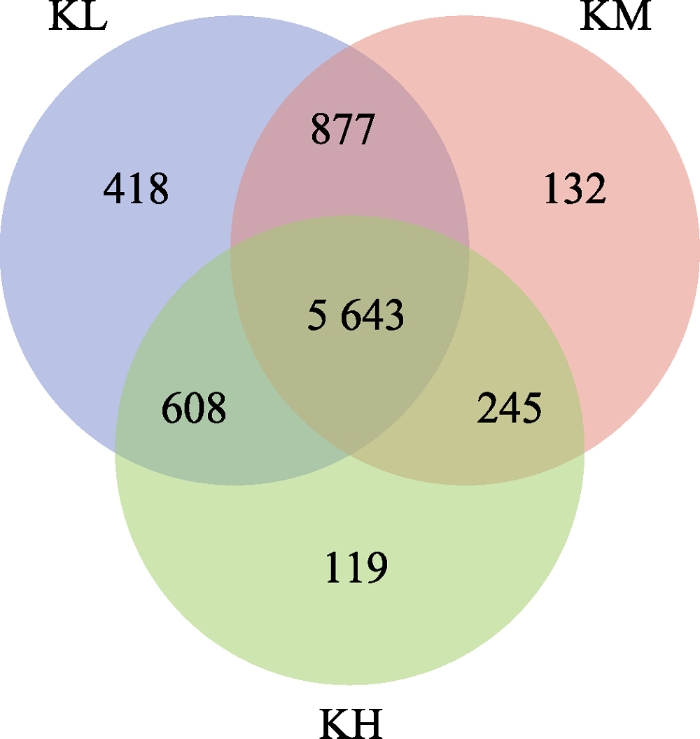
图1
不同处理可操作分类单元(OTU)数韦恩图。KH, 高密度; KL, 低密度; KM, 中密度。
Fig. 1
Venn diagram of different processing Operational Taxonomy Unit (OTU) numbers. KH, high-density; KL, low-density; KM, medium-density.
各样品的Coverage指数值均达0.96以上, 样品中绝大部分的细菌种属均被检测到, 测序结果能够较准确地反映样品的生物特性。由表6可知, KH、KM和KL 3种密度杉木人工林地土壤中检测出细菌群落的丰富度为KL > KM > KH, 但差异并不显著。3种密度林分林地土壤的Shannon指数表现为随林分密度降低而逐渐增高的趋势, 但未达到显著差异。
表6 不同密度杉木林土壤细菌群落多样性(平均值±标准差)
Table 6
| 类型 Type | 物种数 Observed species | Shannon指数 Shannon index | Chao1指数 Chao1 index | 覆盖率 Coverage (%) |
|---|---|---|---|---|
| KH | 4 939.80 ± 173.89 a | 10.21 ± 0.04 a | 6 223.62 ± 445.90 a | 0.973 2 ± 0.004 a |
| KM | 5 171.25 ± 320.72 a | 10.27 ± 0.25 a | 6 468.85 ± 109.98 a | 0.965 3 ± 0.005 a |
| KL | 5 277.67 ± 263.71 a | 10.30 ± 0.14 a | 6 619.39 ± 214.13 a | 0.975 3 ± 0.006 a |
同列不同小写字母表示在p< 0.05水平下差异显著。KH, 高密度; KL, 低密度; KM, 中密度。
Different lowercase letters in the same column indicate significant difference at p< 0.05 level. KH, high-density; KL, low-density; KM, medium-density.
3种密度杉木林土壤细菌群落结构存在差异, 但未达显著水平(附录I)。从门分类水平看, 3种密度林分土壤中检测出7个门(图2), 分属酸杆菌门、变形菌门(Proteobacteria)、放线菌门(Actinobacteria)、绿弯菌门(Chloroflexi)、浮霉菌门(Planctomycetes)、厚壁菌门(Firmicutes)、疣微菌门(Verrucomicrobia)。其中, 酸杆菌门(39.48%)、变形菌门(21.15%)、放线菌门(9.57%)、绿弯菌门(7.21%)、浮霉菌门(7.36%)在3种土壤样品中是优势菌群, 相对丰度占比超过80%。从图2可知, 酸杆菌门是所有样品中丰度最高的菌门, 占比均大于37%, 且以KH林分最高(41.96%)。
图2
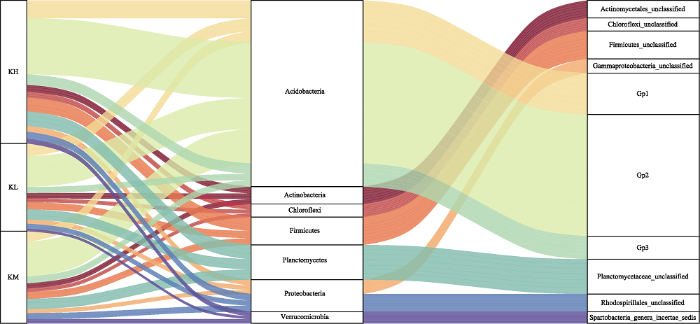
图2
不同密度杉木林土壤优势细菌门。Acidobacteria, 酸杆菌门; Actinobacteria, 放线菌门; Actinomycetales, 放线菌目; Chloroflexi, 绿弯菌门; Firmicutes, 厚壁菌门; Gammaproteobacteria, γ-变形菌; Planctomycetes, 浮霉菌门; Proteobacteria, 变形菌门; Rhodospirillales, 红螺菌目; Spartobacteria, 斯巴杆菌纲; Verrucomicrobia, 疣微菌门。Gp, 酸杆菌门亚群; unclassified, 未分类细菌。KH, 高密度; KL, 低密度; KM, 中密度。
Fig. 2
Soil dominant bacteria in different densities of Chinese fir forests. Gp, Acidobacteria subgroup. KH, high-density; KL, low-density; KM, medium-density.
附录I 不同密度杉木林土壤细菌群落结构差异分析
Supplement I
| 计算距离 Calculate distance | F | p |
|---|---|---|
| 未加权的 Unweighted_unifrac | 1.12 | 0.19 |
| 加权的 Weighted_unifrac | 1.09 | 0.41 |
表7 不同密度杉木林下土壤理化性质对细菌群落结构的影响
Table 7
| 理化指标 Physical and chemical indicator | Mds1 | Mds2 | R2 | p |
|---|---|---|---|---|
| pH | -0.580 22 | -0.814 46 | 0.159 7 | 0.747 |
| 束缚水含量 CW | -0.572 27 | -0.820 07 | 0.131 1 | 0.768 |
| 碱解氮含量 AN | 0.098 13 | -0.995 17 | 0.803 1 | 0.049* |
| 有效磷含量 AP | 0.128 86 | -0.991 66 | 0.565 5 | 0.140 |
| 速效钾含量 AK | -0.121 23 | -0.992 62 | 0.724 7 | 0.049* |
| 有机质含量 OM | -0.564 26 | -0.825 60 | 0.472 8 | 0.267 |
*代表相关性达到显著水平,p< 0.05。Mds, 多维缩放。
* represents significant correlation atp< 0.05 level. Mds, multi-dimensional scaling.AK, available K content; AN,alkali-hydrolyzable N content; AP, available P content; CW, water content; OM, organic matter content.
图3
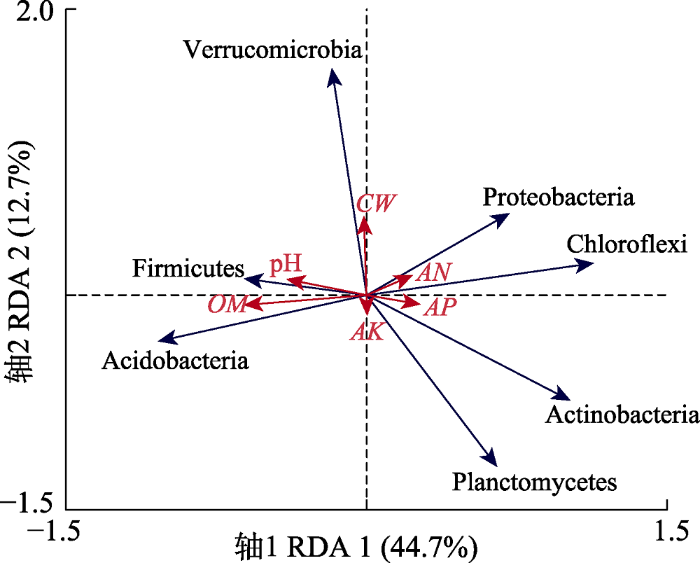
图3
不同密度杉木林土壤理化性质与细菌门冗余分析(RDA)。AK, 速效钾含量; AN, 碱解氮含量; AP, 有效磷含量; CW, 束缚水含量; OM, 有机质含量。Acidobacteria, 酸杆菌门; Actinobacteria, 放线菌门; Chloroflexi, 绿弯菌门; Firmicutes, 厚壁菌门; Planctomycetes, 浮霉菌门; Proteobacteria, 变形菌门; Verrucomicrobia, 疣微菌门。
Fig. 3
Redundancy analysis (RDA) of soil physical and chemical properties and bacteria of Chinese fir plantations with different densities. AK, available K content; AN, alkali- hydrolyzable N content; AP, available P content; CW, water content; OM, organic matter content.
2.4 不同密度杉木人工林土壤酸杆菌亚群特征及其与土壤理化性质的关系
在属水平上, 对土壤样品中丰度前20的细菌群落进行分析(图4), 其中酸杆菌门的Gp2 (22.33%)、Gp1 (7.60%)、Gp3 (4.37%)和Gp6 (1.28%)为3种密度林分中的优势类群。其中, Gp2在KH林分土壤中的相对丰度最高。
图4
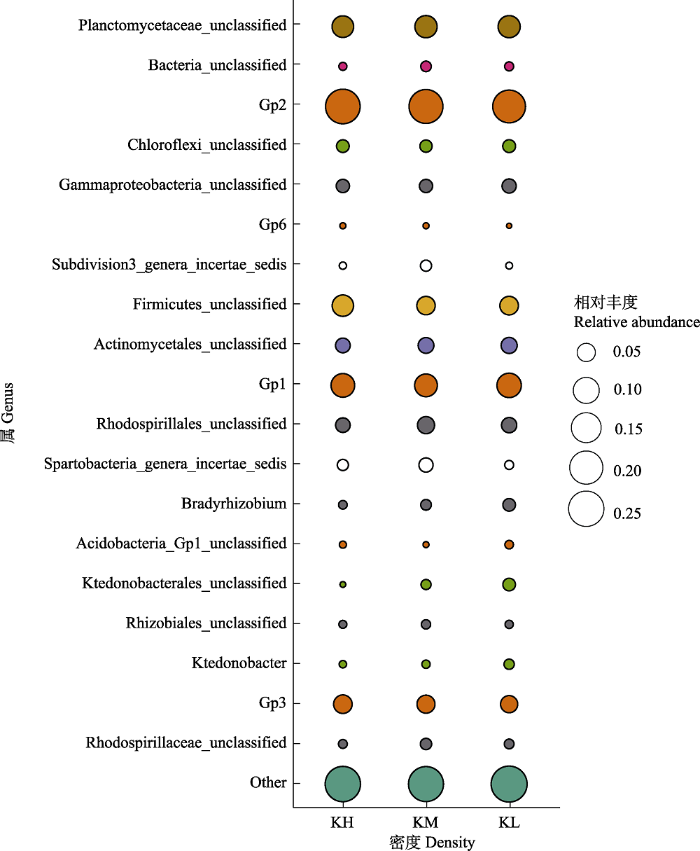
图4
不同密度杉木林土壤细菌属水平相对丰度。Acidobacteria, 酸杆菌门; Actinobacteria, 放线菌门; Bradyrhizobium, 慢生根瘤菌属; Chloroflexi, 绿弯菌门; Firmicutes, 厚壁菌门; Ktedonobacter, 纤线杆菌属; Planctomycetes, 浮霉菌门; Proteobacteria, 变形菌门; Rhodospirillales, 红螺菌目; Spartobacteria, 斯巴杆菌纲; Verrucomicrobia, 疣微菌门。Gp, 酸杆菌门亚群; other, 其他; unclassified, 未分类细菌。KH, 高密度; KL, 低密度; KM, 中密度。
Fig. 4
Relative abundance of bacteria genera in different densities of Chinese fir forests. Gp, Acidobacteria subgroup. KH, high-density; KL, low-density; KM, medium-density.
酸杆菌作为森林土壤细菌的主要菌群, 在生态系统循环过程中发挥着重要作用。不同酸杆菌亚群在3种密度林地土壤中的相对丰度聚类可划为2个大类(图5)。KH与KM林分的土壤酸杆菌组成及丰度相似性较高, 与KL差异较大。其中, Gp2、Gp3相对丰度在KH林地土壤中显著高于KL、KM; Gp6相对丰度在KH与KM林地土壤中明显高于KL, 而Gp1相对丰度在KL林地土壤中较高。
图5
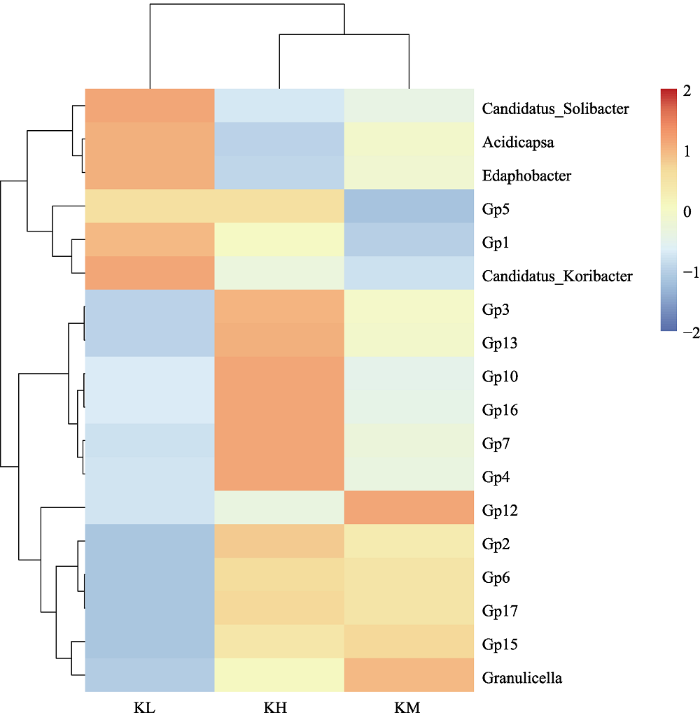
图5
不同密度杉木林土壤的酸杆菌门亚群(Gp)相对丰度聚类。KH, 高密度; KL, 低密度; KM, 中密度。
Fig. 5
Clustering of relative abundance of Acidobacteria subgroups (Gp) in different densities of Chinese fir plantations. KH, high-density; KL, low-density; KM, medium-density.
由3种林分密度杉木林土壤理化性质与优势酸杆菌亚群的相关分析(表8)可见, 酸杆菌不同亚群对土壤理化性质的响应有异, 仅Gp6与pH呈极显著负相关关系(p< 0.01)。
表8 不同密度杉木林酸杆菌优势亚群(Gp)与土壤理化性质的相关性
Table 8
| 分类 Item | pH | 束缚水含量 Water content | 碱解氮含量 Alkali-hydrolyzable N content | 有效磷含量 Available P content | 速效钾含量 Available K content | 有机质含量 Organic matter content |
|---|---|---|---|---|---|---|
| Gp1 | 0.257 | -0.043 | 0.118 | 0.455 | 0.228 | -0.075 |
| Gp2 | -0.336 | -0.077 | 0.266 | 0.316 | 0.142 | 0.416 |
| Gp3 | -0.006 | 0.164 | 0.573 | 0.693 | 0.293 | 0.353 |
| Gp6 | -0.890** | 0.178 | -0.222 | 0.479 | -0.642 | -0.475 |
*代表相关性达到显著水平(p < 0.05); **代表相关性达到极显著水平(p < 0.01)。
* represents significant correlation atp < 0.05 level; ** represents significant correlation at p < 0.01 level.
3 讨论和结论
人工林常以密集的单一种植为特征, 会引起生产力下降和生物多样性减少等问题(Felton et al., 2010)。长期高度集约化生产往往导致杉木生长发育受阻, 经济产量和土壤肥力下降, 直接威胁杉木人工林可持续经营。杉木凋落物数量少且分解周期长,导致林地土壤养分下降(何友军等, 2006)。人工针叶林的凋落物分解归还土壤养分速率较慢, 其林下植被对林地土壤肥力维护作用更为重要(李国雷等, 2009)。林下植被凋落物通常具有较低的碳氮比和木质素含量, 易于分解(朱喜等, 2014)。杉木凋落物的养分释放需要时间较长, 造成土壤中养分含量低。随着林分密度的降低, 林下植被较丰富的KL林分土壤养分较高, 说明林下植被的保留能够改善土壤理化性质。本研究表明, 林分密度与林下植被生物量密切相关, 且土壤有机质含量与林下植被生物量紧密相关, 而土壤速效养分与林下植被生物量的相关性较低, 林下灌木生物量和总生物量与土壤有机质含量呈显著正相关关系, 该结果与李亚娟等(2016)研究林下植被地上部分生物量与土壤有机质含量呈显著正相关关系结果一致。林下植被凋落物较杉木人工林凋落物分解速度快, 尤其是一年生草本植物能有效加快林地养分的归还速度。在杉木纯林地经营时, 可通过间伐、修枝等营林措施增加林内光照, 以及增施适量肥料补充营养元素等措施促进林下植被生长, 加速恢复杉木林地土壤肥力。
林下植被的种类与林地土壤理化性质及其肥力密切相关。曹梦等(2018)研究发现檵木等灌木植被多分布于郁闭度较高的林分, 五节芒(Miscanthus floridulus)多生长于土壤瘠薄的地方。芒萁(Dicranopteris pedata)作为酸性红壤特有的物种, 在南方山地植被恢复中发挥重要作用, 保留芒萁可增加地表生物量, 减少地表裸露, 其细根生物量和根系分泌物增加有利于土壤有机质的积累(刘迎春等, 2008)。在本研究中, 高、中密度(KH、KM)的林分, 林下仅有檵木等极少量的灌木地被, 而较低密度林分(KL)林地则以芒萁为优势物种, 且种类多, 尤其是草本植被恢复快, 土壤质量相对较好。据此可推测, 针对杉木纯林经营, 芒萁可作为林下植被恢复和土壤质量转好的指示性植物。
不同密度杉木林土壤细菌群落存在指示性物种(附录II, III), 但功能不确定。本研究中, 3种密度杉木林地土壤酸杆菌门、变形菌门、放线菌门、绿弯菌门和浮霉菌门为优势菌门, 与土壤呈酸性的鼎湖山森林土壤(柳春林等, 2012)和三江平原土壤(隋心等, 2015)中微生物群落结构具相似性。已有研究表明, 变形菌门和放线菌门主要参与有机质分解(Li et al., 2016), 绿弯菌门主要进行碳氮的固定(De-Bruyn et al., 2011)。变形菌门的相对丰度与土壤碳含量呈正相关关系(Fazi et al., 2005), 且在营养较为丰富的土壤中比例更高(McCaig et al., 1999), 本研究结果与此类似。土壤微生物多样性与其植物群落多样性呈正相关关系(杜玮超等, 2011), 林地植被通过改变土壤的营养物质含量、pH等环境因子会间接或直接影响土壤微生物的群落结构和丰度(Liu et al., 2010)。本研究中, 较低密度林分的土壤细菌多样性较高, 3种密度样地的细菌群落结构间存在较大差异。综合土壤理化因子和优势细菌门的RDA表明, pH、碱解氮、有效磷和速效钾含量显著影响细菌的群落结构, 这与相关研究(Logue & Lindström, 2010; 安韶山等, 2011)结果基本一致。表明土壤pH、速效养分含量等不仅是影响植物生长发育的主要环境因子, 也是影响土壤细菌组成和群落结构的重要因子。
附录II 不同密度杉木林的指示物种(门水平)
Supplement II
| 类型 Type | 指示物种 Indicator species | p |
|---|---|---|
| 高密度 KH | Latescibacteria | 0.048* |
| 低密度 KL | Candidatus_saccharibacteria | 0.008** |
*,p < 0.05; **, p < 0.01. KH, high-density; KL, low-density.
附录III 不同密度杉木林的指示物种(科水平)
Supplement III
| 类型 Type | 指示物种 Indicator species | p |
|---|---|---|
| 高密度 KH | Dehalococcoidaceae | 0.038* |
| Phycisphaeraceae | 0.036* | |
| Geobacteraceae | 0.027* | |
| 低密度 KL | Candidatus_Adlerbacteria_unclassified | 0.028* |
| Sphingobacteriaceae | 0.048* | |
| Saccharibacteria_genera_incertae_sedis | 0.037* | |
| Gemmatimonadaceae | 0.033* |
*,p < 0.05. KH, high-density; KL, low-density.
酸杆菌门细菌对环境具有较强的适应能力(王春香等, 2010), 本试验林地的土壤pH多为3.5左右, 酸杆菌能在微氧和缺氧环境下降解纤维素, 杉木林下难分解的针叶增加, 促进了土壤酸杆菌种群扩展。从3种密度林地比较看, 较高林分密度的林地酸杆菌占比最高, 与其林下植被稀少、土壤酸性高有关, 该结果与雷波等(2014)认为南方山地红壤富铝缺磷, 低密度林分的土壤酸杆菌相对丰度较低, 其林下植被保留有利于缓解土壤酸化及其所引起的铝毒害结果相似。植被种类(Massenssini et al., 2015)、土壤pH (Chu et al., 2010)等环境因子均能影响土壤酸杆菌的多样性和群落组成。Griffiths等(2011)认为, 影响土壤细菌类群结构的主要因素是pH; 酸杆菌门部分细菌对土壤pH的改变较为敏感(王光华等, 2016)。但Jones等(2009)分析87个土壤样品认为, 酸杆菌不同亚群对pH响应不一致。Navarrete等(2013)认为, 森林土壤中酸杆菌Gp1为主要菌群, 而农田土壤中Gp4、Gp6和Gp7占比较高。Zhang等(2014)分析神农架森林土壤发现酸杆菌中Gp1、Gp2、Gp3、Gp4和Gp6是优势亚群, 占酸杆菌测序总量的85%。本研究发现杉木纯林土壤中Gp2、Gp1、Gp3和Gp6为优势酸杆菌亚群, 且KH林分土壤中Gp2相对丰度最高。随着林下植被的增加(KL林分), Gp1占比增加, Gp2和Gp6占比降低; Gp6相对丰度与土壤pH呈极显著负相关关系, 其他酸杆菌亚群与pH无显著相关性。可以认为, 杉木林土壤酸化更有利于酸杆菌亚群Gp2、Gp6的生理活动与种群扩展。但酸杆菌门细菌的生理特性和功能, 尤其是与杉木林地力相关的功能菌群还需要深入研究。
参考文献
Soil microbial functional diversity between rhizosphere and non-rhizosphere soils of typical plants in the hilly area of southern Ningxia
宁南山区典型植物根际与非根际土壤微生物功能多样性
The effects of understory vegetation on P availability in Pinus radiata forest stands: a review
DOI:10.1007/s11676-014-0488-4 URL [本文引用: 1]
Acidobacteria phylum sequences in uranium-contaminated subsurface sediments greatly expand the known diversity within the phylum
DOI:10.1128/AEM.02012-06 URL [本文引用: 1]
Quality-filtering vastly improves diversity estimates from Illumina amplicon sequencing
DOI:10.1038/nmeth.2276 URL [本文引用: 1]
Relationships between the composition and diversity of understory vegetation and environmental factors in aerially seeded Pinus massoniana plantations
飞播马尾松林林下植被组成、多样性及其与环境因子的关系
Understory vegetation and ponderosa pine abundance in eastern Oregon
DOI:10.2111/REM-D-09-00005.1 URL [本文引用: 1]
Effect of vanillin and P-hydroxybenzoic acid on physiological characteristics of Chinese fir seedlings
香草醛和对羟基苯甲酸对杉木幼苗生理特性的影响
Soil bacterial diversity in the Arctic is not fundamentally different from that found in other biomes
DOI:10.1111/emi.2010.12.issue-11 URL [本文引用: 1]
Global biogeography and quantitative seasonal dynamics of Gemmatimonadetes in soil
DOI:10.1128/AEM.05005-11 URL [本文引用: 1]
Research progress of the relationship between soil microbial diversity and above- ground vegetation types
土壤微生物多样性与地上植被类型关系的研究进展
Bacterial communities associated with benthic organic matter in headwater stream microhabitats
DOI:10.1111/emi.2005.7.issue-10 URL [本文引用: 1]
Replacing coniferous monocultures with mixed-species production stands: an assessment of the potential benefits for forest biodiversity in northern Europe
DOI:10.1016/j.foreco.2010.06.011 URL [本文引用: 1]
The bacterial biogeography of British soils
DOI:10.1111/j.1462-2920.2011.02480.x
PMID:21507180
[本文引用: 1]

Despite recognition of the importance of soil bacteria to terrestrial ecosystem functioning there is little consensus on the factors regulating belowground biodiversity. Here we present a multi-scale spatial assessment of soil bacterial community profiles across Great Britain (> 1000 soil cores), and show the first landscape scale map of bacterial distributions across a nation. Bacterial diversity and community dissimilarities, assessed using terminal restriction fragment length polymorphism, were most strongly related to soil pH providing a large-scale confirmation of the role of pH in structuring bacterial taxa. However, while α diversity was positively related to pH, the converse was true for β diversity (between sample variance in α diversity). β diversity was found to be greatest in acidic soils, corresponding with greater environmental heterogeneity. Analyses of clone libraries revealed the pH effects were predominantly manifest at the level of broad bacterial taxonomic groups, with acidic soils being dominated by few taxa (notably the group 1 Acidobacteria and Alphaproteobacteria). We also noted significant correlations between bacterial communities and most other measured environmental variables (soil chemistry, aboveground features and climatic variables), together with significant spatial correlations at close distances. In particular, bacterial and plant communities were closely related signifying no strong evidence that soil bacteria are driven by different ecological processes to those governing higher organisms. We conclude that broad scale surveys are useful in identifying distinct soil biomes comprising reproducible communities of dominant taxa. Together these results provide a baseline ecological framework with which to pursue future research on both soil microbial function, and more explicit biome based assessments of the local ecological drivers of bacterial biodiversity.© 2011 Society for Applied Microbiology and Blackwell Publishing Ltd.
Chimeric 16S rRNA sequence formation and detection in Sanger and 454- pyrosequenced PCR amplicons
DOI:10.1101/gr.112730.110 URL [本文引用: 1]
Characteristics of soil microbial biomass carbon and nitrogen and their relationships with soil nutrients in Cunninghamia lanceolata plantations
杉木人工林土壤微生物生物量碳氮特征及其与土壤养分的关系
A comprehensive survey of soil acidobacterial diversity using pyrosequencing and clone library analyses
DOI:10.1038/ismej.2008.127 URL [本文引用: 1]
Effects of Pinus massoniana plantation stand density on understory vegetation and soil properties
马尾松人工林林分密度对林下植被及土壤性质的影响
Pyrosequencing-based assessment of soil pH as a predictor of soil bacterial community structure at the continental scale
DOI:10.1128/AEM.00335-09 URL [本文引用: 1]
Catabatic effect from artificial mixed plantation of Cunninghamia lanceolata on soil aluminum toxicity
杉木人工混交林对土壤铝毒害的缓解作用
Response of understory vegetation development of Pinus tabulaeformis plantation to growth rhythm of Pinus tabulaeformis
油松(Pinus tabulaeformis)人工林林下植被发育对油松生长节律的响应
Use of mulberry-soybean intercropping in salt-alkali soil impacts the diversity of the soil bacterial community
DOI:10.1111/mbt2.2016.9.issue-3 URL [本文引用: 1]
Effects of land use patterns on grassland biomass and soil properties in three-river headwater area
三江源区土地利用方式对草地植物生物量及土壤特性的影响
Comparison of soil bacterial communities in a natural hardwood forest and coniferous plantations in perhumid subtropical low mountains
DOI:10.1186/ s40529-014-0050-x [本文引用: 1]
Effects of reforestation on the structure and diversity of bacterial communities in subtropical low mountain forest soils
DOI:10.3389/?fmicb.2018.01968 [本文引用: 1]
Bacterial diversity of different successional stage forest soils in Dinghushan
鼎湖山不同演替阶段森林土壤细菌多样性
Characteristics of biomass allocation of Dicranopteris Dichotoma
芒萁生物量分布特征
Plant biomass, soil water content and soil N:P ratio regulating soil microbial functional diversity in a temperate steppe: a regional scale study
DOI:10.1016/j.soilbio.2009.11.027 URL [本文引用: 1]
Species sorting affects bacterioplankton community composition as determined by 16S rDNA and 16S rRNA fingerprints
DOI:10.1038/ismej.2009.156 URL [本文引用: 1]
Relative importance of soil physico-chemical characteristics and plant species identity to the determination of soil microbial community structure
DOI:10.1016/j.apsoil.2015.02.009 URL [本文引用: 1]
Molecular analysis of bacterial community structure and diversity in unimproved and improved upland grass pastures
DOI:10.1128/AEM.65.4.1721-1730.1999 URL [本文引用: 1]
Environmental factors affect Acidobacterial communities below the subgroup level in grassland and forest soils
In soil, Acidobacteria constitute on average 20% of all bacteria, are highly diverse, and are physiologically active in situ. However, their individual functions and interactions with higher taxa in soil are still unknown. Here, potential effects of land use, soil properties, plant diversity, and soil nanofauna on acidobacterial community composition were studied by cultivation-independent methods in grassland and forest soils from three different regions in Germany. The analysis of 16S rRNA gene clone libraries representing all studied soils revealed that grassland soils were dominated by subgroup Gp6 and forest soils by subgroup Gp1 Acidobacteria. The analysis of a large number of sites (n = 57) by 16S rRNA gene fingerprinting methods (terminal restriction fragment length polymorphism [T-RFLP] and denaturing gradient gel electrophoresis [DGGE]) showed that Acidobacteria diversities differed between grassland and forest soils but also among the three different regions. Edaphic properties, such as pH, organic carbon, total nitrogen, C/N ratio, phosphorus, nitrate, ammonium, soil moisture, soil temperature, and soil respiration, had an impact on community composition as assessed by fingerprinting. However, interrelations with environmental parameters among subgroup terminal restriction fragments (T-RFs) differed significantly, e.g., different Gp1 T-RFs correlated positively or negatively with nitrogen content. Novel significant correlations of Acidobacteria subpopulations (i.e., individual populations within subgroups) with soil nanofauna and vascular plant diversity were revealed only by analysis of clone sequences. Thus, for detecting novel interrelations of environmental parameters with Acidobacteria, individual populations within subgroups have to be considered.
Acidobacterial community responses to agricultural management of soybean in Amazon forest soils
DOI:10.1111/1574-6941.12018
PMID:23013447
[本文引用: 1]
This study focused on the impact of land-use changes and agricultural management of soybean in Amazon forest soils on the abundance and composition of the acidobacterial community. Quantitative real-time PCR (q-PCR) assays and pyrosequencing of 16S rRNA gene were applied to study the acidobacterial community in bulk soil samples from soybean croplands and adjacent native forests, and mesocosm soil samples from soybean rhizosphere. Based on qPCR measurements, Acidobacteria accounted for 23% in forest soils, 18% in cropland soils, and 14% in soybean rhizosphere of the total bacterial signals. From the 16S rRNA gene sequences of Bacteria domain, the phylum Acidobacteria represented 28% of the sequences from forest soils, 16% from cropland soils, and 17% from soybean rhizosphere. Acidobacteria subgroups 1-8, 10, 11, 13, 17, 18, 22, and 25 were detected with subgroup 1 as dominant among them. Subgroups 4, 6, and 7 were significantly higher in cropland soils than in forest soils, which subgroups responded to decrease in soil aluminum. Subgroups 6 and 7 responded to high content of soil Ca, Mg, Mn, and B. These results showed a differential response of the Acidobacteria subgroups to abiotic soil factors, and open the possibilities to explore acidobacterial subgroups as early-warning bioindicators of agricultural soil management effects in the Amazon area.© 2012 Federation of European Microbiological Societies. Published by Blackwell Publishing Ltd. All rights reserved.
Soil bacteria community structure in upland red soil in relation to land use pattern
红壤坡地利用方式对土壤细菌群落结构的影响
Study on bacterial diversity of Deyeuxia angustifolia wetland by application of high- throughput sequencing technology in Sanjiang plain
利用高通量测序对三江平原小叶章湿地土壤细菌多样性的研究
Chronic N-amended soils exhibit an altered bacterial community structure in Harvard Forest, MA, USA.
DOI:10.1111/1574-6941.12009
PMID:22974374
[本文引用: 1]
At the Harvard Forest, Petersham, MA, the impact of 20 years of annual ammonium nitrate application to the mixed hardwood stand on soil bacterial communities was studied using 16S rRNA genes pyrosequencing. Amplification of 16S rRNA genes was done using DNA extracted from 30 soil samples (three treatments × two horizons × five subplots) collected from untreated (control), low N-amended (50 kg ha(-1) year(-1)) and high N-amended (150 kg ha(-1) year(-1)) plots. A total of 1.3 million sequences were processed using qiime. Although Acidobacteria represented the most abundant phylum based on the number of sequences, Proteobacteria were the most diverse in terms of operational taxonomic units (OTUs). UniFrac analyses revealed that the bacterial communities differed significantly among soil horizons and treatments. Microsite variability among the five subplots was also evident. Nonmetric multidimensional scaling ordination of normalized OTU data followed by permutational manova further confirmed these observations. Richness indicators and indicator species analyses revealed higher bacterial diversity associated with N amendment. Differences in bacterial diversity and community composition associated with the N treatments were also observed at lower phylogenetic levels. Only 28-35% of the 6 936 total OTUs identified were common to three treatments, while the rest were specific to one treatment or common to two.© 2012 Federation of European Microbiological Societies. Published by Blackwell Publishing Ltd. All rights reserved.
Distribution and diversity of Acidobacteria in tropical rain forest soil of Xishuangbanna
西双版纳地区热带雨林土壤酸杆菌(Acidobacteria)群体结构和多样性分析
Research progress of Acidobacteria ecology in soils
土壤酸杆菌门细菌生态学研究进展
Effects of typical plant on soil microbial communities in an Inner Mongolia grassland
DOI:10.3724/SP.J.1258.2013.00037 URL PMID:46ff32ef-57f8-42f5-b69e-164c276a8f1d [本文引用: 1]
内蒙古草原典型植物对土壤微生物群落的影响
DOI:10.3724/SP.J.1258.2013.00037
PMID:46ff32ef-57f8-42f5-b69e-164c276a8f1d
[本文引用: 1]
为了分析内蒙古草原不同植物物种对土壤微生物群落的影响, 采用实时荧光定量PCR (real-time PCR)以及末端限制性片段长度多态性分析(terminal restriction fragment length polymorphism, T-RFLP)等分子生物学技术, 测定了退化-恢复样地上几种典型植物的根际土壤和非根际土壤中细菌和真菌的数量及群落结构。结果表明, 不同植物物种对根际和非根际细菌及根际真菌数量均有显著影响。根际土壤中的细菌和真菌数量普遍高于非根际土壤, 尤其以真菌更为明显。对T-RFLP数据进行多响应置换过程(multi-response permutation procedures, MRPP)分析和主成分分析(principal component analysis, PCA), 结果表明, 大多数物种的根际细菌及真菌的群落结构与非根际有明显差异, 并且所有物种的真菌群落可以按根际和非根际明显分为两大类群。此外, 细菌和真菌群落结构在一定程度上存在按物种聚类的现象, 以细菌较为明显。这些结果揭示了不同植物对土壤微生物群落的影响特征, 对理解内蒙古草原地区退化及恢复过程中植被演替引起的土壤性质和功能的变化有一定的帮助。
Litter production, leaf litter decomposition and nutrient return in Cunninghamia lanceolata plantations in south China: effect of planting conifers with broadleaved species
DOI:10.1007/s11104-007-9333-2 URL [本文引用: 1]
Three genomes from the phylum Acidobacteria provide insight into the lifestyles of these microorganisms in soils
DOI:10.1128/AEM.02294-08 URL [本文引用: 1]
Effect of vegetation on structure of soil microbial community
植被对土壤微生物群落结构的影响
Characteristics of soil microbial community in five forest types in mid-subtropical China
中亚热带5种类型森林土壤微生物群落特征
Community structure and elevational diversity patterns of soil Acidobacteria
DOI:10.1016/j.jes.2014.06.012 URL [本文引用: 1]
Effects of stand density on species diversity and soil nutrients of Chinese fir plantations
林分密度对杉木人工林下物种多样性和土壤养分的影响
Mixing effects of understory plant litter on decomposition and nutrient release of tree litter in two plantations in Northeast China
DOI:10.1371/journal.pone.0076334 URL [本文引用: 1]
The response of soil nutrients (carbon and nitrogen) and extracellular enzyme activities to drought in various cultivation ages from tea orchards
不同植茶年限土壤碳氮养分及胞外酶对干旱胁迫的响应


