



土壤腐殖质是动植物残体在微生物作用下分解并合成的一类结构复杂的聚合物, 其含量占总有机质的50%-75%, 是土壤的重要组成成分(卫芯宇等, 2018; 郑延云等, 2019), 对改善土壤团粒结构, 维持和提高土壤肥力、环境解毒均有重要作用(Serudo et al., 2007)。森林凋落物作为养分的载体, 是连接植物和土壤的“纽带”, 在土壤腐殖质的形成中发挥着重要的作用(Neumann et al., 2018)。凋落物中活性组分的输入可以激发土壤微生物和酶的活性, 导致土壤腐殖质的降解(Prescott et al., 2000), 但凋落物分解过程中产生的难降解物质又是土壤腐殖质形成的主要来源(Zanella et al., 2018b), 因此土壤腐殖质合成与降解一直处于动态平衡中。土壤腐殖质作为土壤有机质的主要成分, 主要由富里酸、胡敏酸、胡敏素构成(Piccolo, 2002; Lipczynska-Kochany, 2018), 其中胡敏素是稳定性土壤有机碳组分(张晋京和窦森, 2008)。研究表明, 土壤腐殖质的含量、组分及性质会随地理环境(水、热、气候等)和生物要素(植被类型、土壤微生物等)的不同而存在很大差异(徐小忠等, 2006; Pédrot et al., 2010; 王程栋等, 2019), 而森林凋落物作为森林土壤腐殖质的主要来源(Bradford et al., 2013), 其凋落物种类、凋落量、元素组成、分解速率等的不同对土壤腐殖质的影响也不同(Poage & Feng, 2004)。因此研究不同森林类型土壤腐殖质, 了解该地区森林土壤腐殖质组成及其影响因素, 对维持该地区森林土壤碳平衡、提高土壤肥力等方面具有重要意义。
位于长江上游和青藏高原东麓的川西亚高山森林是西南林区的主体, 作为长江上游重要的生态屏障, 在水源涵养、水土保持以及指示全球气候变化等方面具有不可替代的重要作用(Ni et al., 2015; 谭羽等, 2017)。川西亚高山森林因常年的低温及频繁的地质灾害等自然因素的影响, 土壤发育缓慢(杨万勤等, 2006), 森林凋落物的腐殖质化是其土壤有机质形成和森林碳固定的重要过程(谭羽等, 2017)。同时, 该地区不同森林凋落物分解动态对土壤养分归还差异显著(刘涛等, 2017), 从而影响土壤腐殖质的发育(Wei et al., 2020)。研究表明向土壤中添加有机物料会产生“激发”效应(Mazzilli et al., 2014), 促进高质量土壤中腐殖质分解, 低质量土壤中腐殖质合成(石坤等, 2016)。因此, 我们采用野外原位凋落物控制实验, 以川西亚高山3种不同森林类型(针叶林、阔叶林和针阔混交林)为对象, 对比研究了不同林型及不同采样时期下凋落物去除对土壤腐殖质变化的影响, 探讨不同凋落物动态变化与土壤腐殖质的动态关联, 以期为不同类型凋落物如何影响森林土壤肥力提供一定的基础数据。
1 材料和方法
1.1 研究区概况
表1 川西亚高山森林样地主要信息
Table 1
| 森林类型 Forest type | 海拔 Altitude (m) | 优势乔木 Dominant tree | 主要林下植物 Major understory species |
|---|---|---|---|
| 针叶林 Coniferous forest | 3 000 | 岷江冷杉 Abies fargesii var. faxoniana | 茜草 Rubia cordifolia 高山冷蕨 Cystopteris montana 高山杜鹃 Rhododendron lapponicum |
| 针阔混交林 Mixed coniferous and broad-leaved forest | 2 985 | 岷江冷杉 Abies fargesii var. faxoniana 红桦 Betula albosinensis | 高山杜鹃 Rhododendron lapponicum 箭竹 Fargesia spathacea 高山冷蕨 Cystopteris montana |
| 阔叶林 Broad-leaved forest | 3 010 | 红桦 Betula albosinensis | 箭竹 Fargesia spathacea 蟹甲草 Parasenecio forrestii 高山冷蕨 Cystopteris montana |
1.2 实验设计与处理
在前期野外调查的基础上, 于2018年9月在研究区域内选择海拔、年龄相似的针叶林(岷江冷杉 (Abies fargesii var. faxoniana)林)、阔叶林(红桦(Betula albosinensis)林)和针阔混交林(岷江冷杉-红桦混交林)3种典型森林为研究对象。在3种林型范围内各选取3个坡度、坡位等基本一致的样方, 每个样方规格为10 m × 10 m。在每个样方中安装60个内径20 cm、高15 cm的PVC环, 嵌入土壤深度为10 cm, 相邻PVC环间距0.50 m。在每个样方中各选取30个PVC环, 去除环内凋落物, 在其上方用可透水透气的圆形尼龙网(网孔为2 mm)遮盖, 阻止凋落物输入, 作为凋落物去除处理, 其余30个PVC环未做遮盖处理, 作为凋落物的自然输入处理(焦泽彬等, 2021)。
在研究样地内土壤5 cm深处埋设纽扣式温度传感器(iButton DS1921G, Maxim/Dallas semiconductor, Sunnyvale, USA)连续监测土壤温度, 每2 h记录一次数据(表2)。分别于凋落物处理1年(2019年9月中旬)、1.5年(2020年5月中旬)和2年(2020年9月中旬)进行土样采集。每次分别采集样方内3个凋落物自然输入和凋落物去除的完整PVC环内的土壤, 共计18个(3林型× 3样方× 2处理), 用4 ℃冰盒保存并立即运回实验室。剔除土壤中的碎石、植物根和凋落物后, 将土壤样品自然风干2周, 研磨, 过0.25 mm筛, 用于测定土壤腐殖质含量、光学特性及土壤有机碳、全氮、全磷含量。称取(0.5 ± 0.01) g风干土壤样品于105 ℃烘48 h, 测定风干土壤样品的含水量(表2)。所有数值均以风干样品的干质量计算。
表2 凋落物处理下不同采样时期川西亚高山3种森林类型土壤基本理化指标(平均值±标准误)
Table 2
| 时间 Time (a) | 指标 Index | 土壤含水量 Soil water content (%) | 温度 Temperature (°C) | pH | 有机碳含量 Organic carbon content (g·kg-1) | 全氮含量 Total nitrogen content (g·kg-1) | 全磷含量 Total phosphorus content (g·kg-1) |
|---|---|---|---|---|---|---|---|
| 1 | BFI | 54.94 ± 3.41a | 10.56 ± 0.05a | 5.82 ± 0.14a | 161.70 ± 25.4a | 0.25 ± 0.08a | 0.89 ± 0.07a |
| MFI | 41.75 ± 9.09a | 10.41 ± 0.30a | 5.08 ± 0.11b | 121.83 ± 21.55a | 0.17 ± 0.07a | 0.87 ± 0.05a | |
| CFI | 55.61 ± 2.35a | 10.15 ± 0.06a | 4.76 ± 0.07b | 171.80 ± 20.08a | 0.28 ± 0.03a | 0.83 ± 0.05a | |
| BFR | 45.86 ± 7.70a | 10.45 ± 0.04a | 5.48 ± 0.06a | 96.46 ± 43.51a | 0.21 ± 0.06a | 0.86 ± 0.10a | |
| MFR | 53.82 ± 7.35a | 10.14 ± 0.15a | 5.50 ± 0.09a | 192.46 ± 44.59a | 0.30 ± 0.13a | 0.76 ± 0.06a | |
| CFR | 54.96 ± 1.50a | 9.75 ± 0.06a | 5.10 ± 0.25a | 166.63 ± 12.94a | 0.27 ± 0.06a | 0.78 ± 0.04a | |
| 1.5 | BFI | 57.57 ± 2.10a | 5.00 ± 0.14a | 6.22 ± 0.14a | 186.73 ± 12.12b | 13.10 ± 1.59a | 0.76 ± 0.14a |
| MFI | 57.59 ± 7.96a | 4.75 ± 0.11a | 5.37 ± 0.25a | 240.58 ± 18.48a | 11.36 ± 3.33a | 0.79 ± 0.05a | |
| CFI | 50.79 ± 1.88a | 4.65 ± 0.07a | 5.68 ± 0.45a | 211.02 ± 6.00ab | 11.10 ± 2.62a | 0.63 ± 0.13a | |
| BFR | 50.32 ± 3.02a | 4.70 ± 0.06a | 5.97 ± 0.35a | 116.24 ± 20.35a | 10.36 ± 0.84a | 0.74 ± 0.10a | |
| MFR | 53.32 ± 5.71a | 4.65 ± 0.07a | 5.54 ± 0.27a | 177.99 ± 51.16a | 10.37 ± 3.13a | 0.83 ± 0.08a | |
| CFR | 52.90 ± 4.42a | 4.56 ± 0.25a | 5.69 ± 0.24a | 228.29 ± 16.32a | 14.07 ± 1.11a | 0.71 ± 0.08a | |
| 2 | BFI | 53.40 ± 8.82a | 10.24 ± 0.21a | 5.86 ± 0.21a | 121.61 ± 41.60a | 8.18 ± 2.54a | 0.47 ± 0.11a |
| MFI | 58.46 ± 5.45a | 9.13 ± 0.05a | 5.81 ± 0.05a | 156.81 ± 31.94a | 7.75 ± 1.55a | 0.41 ± 0.06a | |
| CFI | 46.65 ± 3.35a | 9.09 ± 0.05a | 5.79 ± 0.05a | 99.19 ± 5.10a | 2.60 ± 1.19a | 0.22 ± 0.04a | |
| BFR | 46.29 ± 3.96a | 9.86 ± 0.05a | 5.74 ± 0.05a | 84.60 ± 18.86a | 3.29 ± 1.09ab | 0.44 ± 0.05a | |
| MFR | 48.75 ± 6.25a | 8.90 ± 0.12a | 5.91 ± 0.12a | 102.31 ± 21.54a | 5.25 ± 0.71a | 0.36 ± 0.04ab | |
| CFR | 43.88 ± 0.75a | 9.10 ± 0.14a | 5.62 ± 0.14a | 106.16 ± 10.74a | 0.82 ± 0.13b | 0.26 ± 0.02b |
BFI, 阔叶林凋落物自然输入; BFR, 阔叶林凋落物去除; CFI, 针叶林凋落物自然输入; CFR, 针叶林凋落物去除; MFI, 针阔混交林凋落物自然输入; MFR, 针阔混交林凋落物去除。同列不同小写字母表示同一采样时期同一处理下不同林型间差异显著(p < 0.05)。
BFI, natural input of litter in broad-leaved forest; BFR, litter removal in broad-leaved forest; CFI, natural input of litter in coniferous forest; CFR, litter removal in coniferous forest; MFI, natural input of litter in mixed coniferous and broad-leaved forest; MFR, litter removal in mixed coniferous and broad-leaved forest. Different lowercase letters in the same column indicate significant differences between forest types under given measurement times and treatments (p < 0.05).
1.3 指标测定
可提取腐殖质(EHS)和胡敏酸(HA)的提取和分离参考《中华人民共和国林业行业标准 LY/T 1238—1999》, 采用TOC分析仪(Multi N/C 2100, Analytik Jena AG, Jena, Germany)测定。称取风干土壤样品0.500 g于150 mL锥形瓶中, 用100 mL 0.1 mol·L-1 NaOH和Na4P2O7·10 H2O混合液提取, 振荡、水浴、过滤后, 浸提液用于测定EHS含量。另取浸提液20 mL于试管中, 用H2SO4分离, 得到的胡敏酸沉淀用热NaOH溶液洗涤溶解, 滤液用于测定HA含量。测定结果用于计算富里酸(FA)、HA/FA及HA/EHS (PQ)(刘群等, 2017; Wei et al., 2020)。HA/FA可反映腐殖质构成, 其值越大, 腐殖质的腐殖化程度越高, 分子结构越复杂(高兆慧等, 2017)。由于FA是由差减法所得, 误差较大, 所以也常用PQ来描述腐殖质的结构特征和腐殖质品质(高兆慧等, 2017)。
公式如下:
EHS = (NPOC × 0.1 ×稀释倍数)/(m × k)
HA = (NPOC × 0.1 ×稀释倍数×分取倍数)/(m × k)
FA = EHS - HA
式中, NPOC为TOC分析仪测出的值, 0.1为浸提液体积, m为称取样品的质量, k为水分转化系数。
1.4 数据处理和统计分析
采用Origin 2018和SPSS 27.0软件对数据进行统计分析与作图。用最小显著差异(LSD)法和三因素方差分析进行差异显著性检验和方差分析。用Pearson相关性分析法分析土壤理化性质和腐殖质组分之间的相关关系。图表中数据均为平均值±标准误。
2 结果和分析
2.1 不同林型凋落物处理对土壤EHS含量的影响
图1
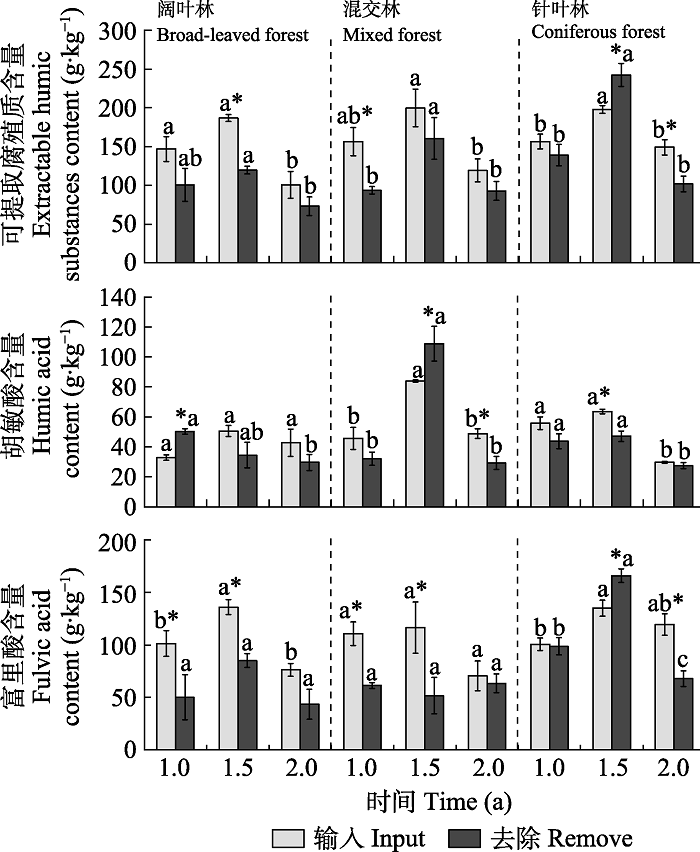
图1
川西亚高山3种林型凋落物自然输入与去除土壤的可提取腐殖质、胡敏酸和富里酸含量(平均值±标准误)。不同小写字母表示同一林型相同处理下不同采样时间土壤可提取腐殖质、胡敏酸和富里酸含量差异显著(p < 0.05)。*, 同一采样时间凋落物自然输入与凋落物去除之间差异显著(p < 0.05)。
Fig. 1
Soil extractable humic substances content, humic acid content and fulvic acid content as affected by litter input in broad-leaved forest, mixed coniferous and broad-leaved forest and coniferous forest in subalpine forests of western Sichuan (mean ± SE). Different lowercase letters indicate that the differences of extractable humic substances content, humic acid content and fulvic acid content between different measurement times within the same treatment are significant (p < 0.05). *, significant differences in soil humic substances content between litter treatments in the same measurement time (p < 0.05).
表3 凋落物、培养时间和林型对川西亚高山森林土壤可提取腐殖质、胡敏酸、富里酸含量、胡敏酸/富里酸及腐殖化度的三因素方差分析(F值)
Table 3
| 因子 Factor | 可提取腐殖质 EHS | 胡敏酸 HA | 富里酸 FA | 胡敏酸/富里酸 HA/FA | 胡敏酸/可提取腐殖质 PQ |
|---|---|---|---|---|---|
| 凋落物 Litter | 11.571** | 0.827 | 5.659* | 2.745 | 0.098 |
| 培养时间 Time | 73.835** | 28.137** | 38.713** | 10.653** | 4.263* |
| 林型 Type | 10.808** | 31.479** | 15.783** | 5.963** | 19.403** |
| 凋落物×时间 Litter × Time | 15.654** | 19.443** | 8.544** | 2.142 | 2.054 |
| 凋落物×林型 Litter × Type | 3.328 | 9.650** | 3.853* | 5.657* | 10.340** |
| 时间×林型 Time × Type | 8.584** | 8.011** | 12.489** | 5.838** | 7.266** |
| 凋落物×时间×林型 Litter × Time × Type | 1.111 | 5.777** | 4.080** | 4.936** | 8.496** |
*, p < 0.05; **, p < 0.01.
2.2 不同林型凋落物处理对HA含量的影响
经过2年培养, 凋落物去除显著影响了土壤HA含量(图1)。在阔叶林中, 凋落物去除显著增加了培养1年土壤HA含量; 在针阔混交林中, 凋落物去除显著增加和降低了培养1.5年和2年土壤HA含量; 而在针叶林中, 凋落物去除则显著降低了培养1.5年土壤HA含量(图1)。经过连续2年的培养, 凋落物处理对土壤HA含量的影响不显著, 但不同林型和培养时间对土壤HA含量具有显著影响, 且凋落物处理、林型和培养时间三者之间存在明显交互作用(图1; 表3)。阔叶林、针阔混交林和针叶林中土壤HA含量平均值变化范围分别为29.64-50.61、29.2-108.77、27.43-63.58 g·kg-1, 总体表现为: 针阔混交林>针叶林>阔叶林(图1)。在连续2年凋落物处理中, 3种林型土壤HA含量总体表现为先上升后下降的趋势, 均在培养2年达到最低值(图1)。
2.3 不同林型凋落物处理对FA含量的影响
与土壤EHS相似, 经过2年培养, 凋落物去除显著影响了土壤FA含量(图1)。在阔叶林和针阔混交林中, 凋落物去除分别显著降低了培养1年和1.5年土壤FA含量, 而在针叶林中则分别显著增加和降低了培养1.5年和2年土壤FA含量(图1)。不同林型、培养时间和凋落物处理均显著影响了土壤FA含量, 且三者之间存在明显的交互作用(图1; 表3)。其中, 不同林型间土壤FA含量主要表现为: 针叶林>阔叶林>针阔混交林(图1)。在连续2年凋落物处理中, 3种林型FA含量整体表现为先上升后下降的趋势(图1)。其中, 在凋落物自然输入中阔叶林和针阔混交林培养2年的土壤FA含量较培养1年均有所下降, 分别下降了49.3%和36.4%, 而针叶林则上升了15.7%。
2.4 不同林型土壤腐殖化程度分析
在2年的培养期间, 凋落物去除在一定程度上影响了土壤的HA/FA (图2)。其中, 在阔叶林中, 凋落物去除显著增加了培养1年的HA/FA; 在针阔混交林中, 凋落物去除显著增加了培养1.5年的HA/FA; 在针叶林中, 凋落物去除分别显著降低和增加了培养1.5年和2年的HA/FA (图2)。连续2年凋落物处理中, 不同林型间土壤HA/FA差异显著, 林型和培养时间存在显著交互作用(表3)。在凋落物去除处理中, 阔叶林和针阔混交林土壤分别在培养1年、1.5年和2年的HA/FA都大于1, 说明土壤整体腐殖物质聚合程度较高, 土壤腐殖化程度较高, 累积较快; 而针叶林整体HA/FA都小于1, 说明土壤整体腐殖物质聚合程度较低, 土壤腐殖质累积较慢。
图2
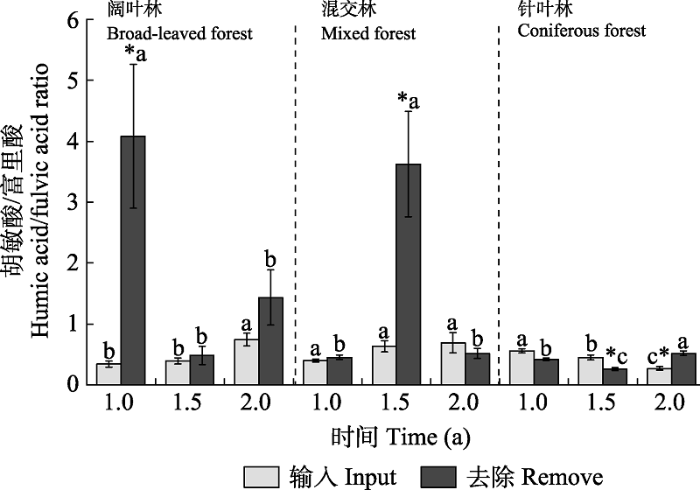
图2
川西亚高山3种林型凋落物自然输入与去除土壤的胡敏酸/富里酸(平均值±标准误)。不同小写字母表示同一林型相同处理下不同采样时间土壤胡敏酸/富里酸差异显著(p < 0.05)。*, 同一采样时间凋落物自然输入与凋落物去除之间差异显著(p < 0.05)。
Fig. 2
Humic acid/fulvic acid ratio as affected by litter input in broad-leaved forest, mixed coniferous and broad-leaved forest and coniferous forest in subalpine forests of western Sichuan (mean ± SE). Different lowercase letters indicate that the differences in humic acid/fulvic acid ratio between measurement times under given litter treatments are significant (p < 0.05). *, significant differences in humic acid/fulvic acid ratio between litter treatments in the same measurement time (p < 0.05).
研究表明, 土壤PQ与HA/FA在不同林型间表现出相同的变化趋势(图3)。在凋落物去除处理中, 阔叶林土壤PQ在1年和2年均大于0.5, 针阔混交林在1.5年大于0.5, 说明土壤中HA对腐殖质总量的贡献大于FA, 土壤腐殖化程度较高。针叶林整体PQ小于0.5, 说明土壤腐殖化程度较低。总的来说, 土壤腐殖化程度表现为: 针阔混交林>阔叶林>针叶林。
图3
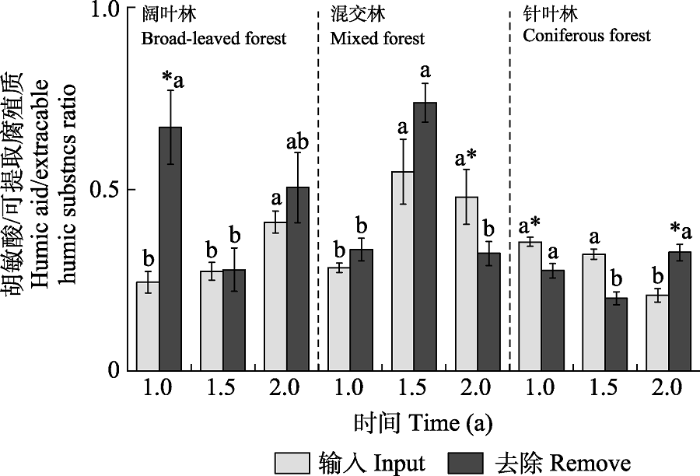
图3
川西亚高山3种林型凋落物自然输入与去除土壤的胡敏酸/可提取腐殖质(平均值±标准误)。不同小写字母表示同一林型相同处理下不同采样时间土壤胡敏酸/可提取腐殖质差异显著(p < 0.05)。 *, 同一采样时间凋落物自然输入与凋落物去除之间差异显著(p < 0.05)。
Fig. 3
Humic acid/extractable humic substances ratio as affected by litter input in broad-leaved forest, mixed coniferous and broad-leaved forest and coniferous forest in subalpine forests of western Sichuan (mean ± SE). Different lowercase letters indicate that the differences in humic acid/extractable humic substances ratio between measurement times are significant (p < 0.05). *, significant differences in humic acid/extractable humic substances ratio between litter treatments in the same measurement time (p < 0.05).
2.5 不同凋落物处理下土壤腐殖质与土壤理化性质之间的关系
对不同凋落物处理下土壤腐殖质与土壤理化性质进行了Pearson相关分析, 结果(表4)表明, 在连续2年凋落物自然输入中土壤EHS、HA含量与土壤有机碳、全氮含量均呈显著正相关关系, 与温度呈显著负相关关系, 其余指标间均无显著相关性。在连续2年凋落物去除中, 土壤EHS含量与含水量、有机碳、全氮含量均呈显著正相关关系, 与温度呈显著负相关关系。HA含量与有机碳、全氮含量均呈显著正相关关系, 与温度呈显著负相关关系。FA含量与含水量、有机碳、全氮含量均呈显著正相关关系。HA/FA与土壤含水量、有机碳含量呈显著负相关关系。说明土壤中各组分与土壤养分间存在密切关系。
表4 川西亚高山森林不同凋落物处理下土壤腐殖质与土壤理化性质之间的相关性
Table 4
| 指标 Index | 凋落物输入 Soil retained litter | 凋落物去除 Soil removed litter | ||||||||
|---|---|---|---|---|---|---|---|---|---|---|
| EHS | HA | FA | HA/FA | PQ | EHS | HA | FA | HA/FA | PQ | |
| SWC | 0.157 | 0.223 | 0.089 | 0.168 | -0.021 | 0.564** | 0.355 | 0.472* | -0.389* | -0.018 |
| pH | -0.122 | -0.213 | -0.068 | 0.023 | 0.025 | -0.194 | -0.139 | -0.154 | -0.004 | 0.179 |
| TM | -0.493** | -0.547** | -0.338 | 0.005 | 0.007 | -0.512** | -0.432* | -0.370 | 0.062 | 0.015 |
| SOC | 0.578** | 0.707** | 0.366 | 0.105 | 0.025 | 0.755** | 0.409* | 0.656** | -0.399* | -0.107 |
| TN | 0.414* | 0.513** | 0.257 | 0.181 | -0.012 | 0.658** | 0.418* | 0.546** | -0.185 | -0.127 |
| TP | 0.338 | 0.218 | 0.315 | -0.181 | -0.156 | 0.314 | 0.387* | 0.182 | 0.218 | -0.055 |
EHS, 可提取腐殖质含量; FA, 富里酸含量; HA, 胡敏酸含量; HA/FA, 胡敏酸/富里酸比值; PQ, 胡敏酸/可提取腐殖质比值; SOC, 土壤有机碳含量; SWC, 土壤含水量; TM, 土壤温度; TN, 全氮含量; TP, 全磷含量。*, p < 0.05; **, p < 0.01。
EHS, soil extractable humic substances content; FA, fulvic acid content; HA, humic acid content; HA/FA, humic acid/fulvic acid ratio; PQ, humic acid/extractable humic substances ratio; SOC, soil organic carbon content; SWC, soil water content; TM, soil temperature; TN, total nitrogen content; TP, total phosphorus content. *, p < 0.05; **, p < 0.01.
3 讨论和结论
腐殖质是土壤有机碳库中稳定的组分, 其含量和组成受气候、土壤和植被类型等多方面因素的影响(Zanella et al., 2018a)。研究表明, 适当的高温和适宜的水分有利于提高微生物活性, 进而加速土壤腐殖质分解, 使土壤腐殖质碳含量下降(宛祥, 2012)。与该研究结果相同, 本研究发现土壤EHS含量与温度呈显著负相关关系, 且土壤EHS含量在培养1.5年时显著高于培养2年。一方面的原因可能是在经历了整个冬季长时间的低温或冻融循环破坏了凋落物物理结构和凋落物中微生物残体细胞释放养分, 为存活微生物提供了有效基质(王程栋等, 2019; 陈子豪等, 2020), 使得凋落物或其他动植物残体以有机质的形式进入土壤, 而有机质在低温、潮湿的环境下易腐殖化, 在一定程度上促进腐殖质合成, 平衡腐殖质的分解(张健瑜等, 2019)。同时, 土壤动物和微生物对土壤环境变化的特殊响应决定着有机质的矿质化与腐殖化过程(蔡晓布等, 2014)。随着温度的降低, 土壤动物与微生物在一定程度上促进了凋落物腐殖化, 增加了碳固定, 土壤养分含量高, 参与土壤腐殖质形成的微生物活性较高, 有利于腐殖质的积累(谭羽等, 2017); 另一方面是在生长季新鲜凋落物的输入加剧了土壤腐殖质的矿化(Liljeroth et al., 1994), 从而加快了土壤腐殖质的分解。不同林型间EHS含量差异显著, 总体表现为针叶林>针阔混交林>阔叶林, 这与贾树海等(2017)的研究一致, 这可能是由于相对阔叶林、针阔混交林而言, 针叶林凋落物含较多的油脂、木质素等较难分解物质。邓仁菊等(2010)的研究也发现冬季白桦(Betula platyphylla)阔叶凋落物木质素和纤维素的降解率均显著高于岷江冷杉针叶凋落物, 使腐殖质不易积累。这些结果表明, 凋落物对土壤腐殖质的影响与凋落物类型密切相关。
HA、FA是土壤腐殖质的重要组成部分, 其中HA是土壤腐殖质中的活跃组分(党亚爱等, 2012; 王维等, 2017), 其含量的高低通常被认为是腐殖质组分是否良好的表现(王鑫, 2010)。Ni等(2016)研究发现, 在3种林型中HA在针阔混交林土壤中含量最高, FA则在针叶林土壤中含量最高。这可能是由于HA和FA的转化或腐殖质合成中FA的优先合成。森林植被和林下微气候的不同导致植被残体量、凋落物类型输入变化改变了微生物物种组成、土壤养分有效性等, 对腐殖质在土壤中的发育产生了不同的影响(Chang et al., 2016; 李茜等, 2017; Ni et al., 2018), 针叶凋落物含有萜类和酚类物质, 并且更可能在分解过程中造成酸性环境, 酸性环境更有利于FA的合成(窦森等, 2010)。本研究中不同凋落物处理和培养时间对HA和FA含量也存在不同的影响, 除部分采样时期凋落物去除中的HA和FA含量高于凋落物自然输入外, 其余总体表现为凋落物去除低于凋落物自然输入。可能是由于森林土壤中的腐殖质主要来源于凋落物, 尤其是凋落物中的难降解物质(如木质素、纤维素等)(Zanella et al., 2018b)。凋落物自然输入中的微生物可能会优先选择易降解物质进行分解(Kuzyakov, 2010), 增加土壤中难分解物质含量, 从而促进腐殖质的合成。其次, 相关分析表明HA和FA含量与温度呈负相关关系。已有研究表明低温会限制微生物活性, 导致顽固有机质的增加(Wang et al., 2019), 有利于FA的形成(刘育红和裴海昆, 2004)。亚高山森林全年温度较低, 冬季漫长, 其特殊的气候为FA的形成创造了有利的条件。因此本研究中FA是3种林型土壤腐殖质的主要成分, 3种林型整体表现为FA型土壤。
PQ以及HA/FA是表征土壤腐殖化程度的基本指标, 也是衡量土壤腐殖质稳定程度的重要参数(褚慧等, 2013)。一般认为, HA比例越高和PQ越大, 腐殖质的品质就越好, 土壤腐化程度则越高(张日升等, 2020)。本研究中土壤腐殖化程度总体上表现为针阔混交林>阔叶林>针叶林。在连续2年凋落物去除中, 阔叶林在培养1年和2年(分别为4.08、1.43)、针阔混交林培养1.5年时(3.63) HA/FA均大于1, PQ大于0.5, 说明在一定程度上阔叶凋落物去除有利于土壤腐殖化。一方面可能是由于阔叶林中土壤分泌物更多, 凋落物碳氮比低, 短时间内易转换分解(丛高等, 2019); 另一方面在无外来有机物的输入下, 土壤中残留的针叶凋落物或含木质素较多的枝条凋落物开始降解(Groffman et al., 2001), 使土壤腐殖化。其次, 较高的温度更有利于HA的形成, 从而导致生长季土壤中腐殖质含量升高, HA/FA较高(周红等, 2021)。针叶林整体表现为土壤腐殖质化程度较低, 可能是针叶林凋落物含有较多油脂、木质素、酚类等不易分解的物质(贾树海等, 2017), 并且更可能在分解过程中造成酸性环境, 酸性环境更有利于FA的合成(窦森等, 2010), 所以土壤中FA含量减少并不显著, 土壤腐殖质的合成与降解较为缓慢。
综上所述, 川西亚高山3种森林类型土壤总体表现为FA型。凋落物去除在一定程度上改变了川西亚高山森林土壤EHS含量, 且这种改变随林型和培养时间差异而变化, 主要受不同林型凋落物类型差异和不同培养时间环境因素的综合调控。这些结果为深入了解亚高山森林凋落物与土壤有机质累积的关系提供了一定的基础数据。
参考文献
Empirical evidence that soil carbon formation from plant inputs is positively related to microbial growth
DOI:10.1007/s10533-012-9822-0 URL [本文引用: 1]
Variation of organic carbon and humus carbon in alpine steppe soil and functions of microorganisms therein
高寒草原土壤有机碳与腐殖质碳变化及其微生物效应
Effect of 40 and 80 years of conifer regrowth on soil microbial activities and community structure in subtropical low mountain forests
DOI:10.3390/f7100244 URL [本文引用: 1]
Effects of three forest restoration pathways on soil biologically based phosphorus in the subalpine of western Sichuan
川西亚高山三种森林恢复途径对土壤生物有效磷的影响
Effects of the freeze-thaw cycle on soil enzyme activities in a sub-alpine forest in western Sichuan
冻融循环对川西亚高山森林土壤酶活性的影响
Dynamic changes in humus composition in vegetable soils different in cultivation mode
不同种植模式下菜地土壤腐殖质组分特性的动态变化
Research on characteristics of soil organic carbon in different forest types in Changbai Mountain
长白山不同林型土壤有机碳特征
Distribution characteristics of humus fraction in soil profile for the typical regions in the Loess Plateau
DOI:10.5846/stxb201102110162 URL [本文引用: 1]
黄土高原典型区域土壤腐殖酸组分剖面分布特征
Changes in litter quality of subalpine forests during one freeze-thaw season
季节性冻融期间亚高山森林凋落物的质量变化
Thermodynamic stability of humic acid and fulvic acid in soil and its driving factors
土壤胡敏酸与富里酸热力学稳定性及其驱动因素初步研究
Relationships between humus and cadmium speciation of reclaimed soil under various vegetation
不同植被下复垦土壤腐殖质与Cd形态的关系
Effects of mild winter freezing on soil nitrogen and carbon dynamics in a northern hardwood forest
DOI:10.1023/A:1013024603959 URL [本文引用: 1]
Dynamics of soil nutrients and their ecological stoichiometry characteristics under different longitudes in the east-west forest belt of the Loess Plateau
黄土高原森林带土壤养分和微生物量及其生态化学计量变化特征
Distribution characteristics of soil organic carbon and humus composition in different forest types
不同林型土壤有机碳及腐殖质组成的分布特征
Response of soil enzyme activities to short-term litter input in different types of forest in subalpine western Sichuan
川西亚高山不同森林类型土壤酶活性对短期凋落物输入量变化的响应
Priming effects: interactions between living and dead organic matter
DOI:10.1016/j.soilbio.2010.04.003 URL [本文引用: 1]
Soil carbon storage and its determinants in the forests of Shaanxi Province, China
DOI:10.17521/cjpe.2017.0102 URL [本文引用: 1]
陕西省森林土壤固碳特征及其影响因素
DOI:10.17521/cjpe.2017.0102
[本文引用: 1]

森林土壤碳库在全球碳循环中发挥着重要的作用。为明确陕西省森林土壤固碳特征及其影响因素, 基于2009年森林清查资料和2011年样地实测数据, 分析了陕西省森林土壤碳储量、碳密度及其分布特征和影响因素。结果表明: 陕西省森林土壤碳储量为579.68 Tg, 以软阔与硬阔类林土壤碳储量占比最大, 占全省森林土壤碳储量的36.35%。天然林的碳储量为467.17 Tg, 是人工林的4.15倍。各龄组中, 幼龄林和中龄林是陕西省森林土壤总碳储量的主要贡献者, 约占总碳储量的57.30%。陕西省森林土壤平均碳密度为90.68 t∙hm<sup>-2</sup>, 以桦木林最高, 为141.74 t∙hm<sup>-2</sup>。不同龄组森林的土壤碳密度以中龄林最高; 同一龄组中, 天然林的土壤碳密度高于人工林, 说明天然林的碳固存能力高于人工林。陕西省森林土壤碳储量和碳密度的地理空间分布格局不尽相同, 体现了森林覆盖面积对土壤碳储量的影响, 其中, 榆林市的森林土壤碳储量和碳密度均处于陕西省最低水平, 在此地可适当加强人工造林, 科学管理森林能显著提升区域的碳汇能力。陕西省森林土壤碳密度随经纬度和年平均气温的增加逐渐降低, 随海拔高度与年降水量的增加逐渐升高。该研究为我国省域尺度上森林土壤碳库的精确估算提供了一定的数据基础。
Carbon translocation to the rhizosphere of maize and wheat and influence on the turnover of native soil organic matter at different soil nitrogen levels
DOI:10.1007/BF00046394 URL [本文引用: 1]
Humic substances, their microbial interactions and effects on biological transformations of organic pollutants in water and soil: a review
DOI:S0045-6535(18)30521-6
PMID:29579677
[本文引用: 1]
Depicted as large polymers by the traditional model, humic substances (HS) tend to be considered resistant to biodegradation. However, HS should be regarded as supramolecular associations of rather small molecules. There is evidence that they can be degraded not only by aerobic but also by anaerobic bacteria. HS presence alters biological transformations of organic pollutants in water and soil. HS, including humin, have a great potential for an application in aerobic and anaerobic wastewater treatment as well as in bioremediation. Black carbon materials, including char (biochar) and activated carbon (AC), long recognized effective sorbents, have been recently discovered to act as effective redox mediators (RM), which may significantly accelerate degradation of organic pollutants in a way similar to HS. Humic-like coating on the biochar surface has been identified. Explanation of mechanisms and possibility of applications of black carbon materials have only started to be explored. Results of many original and review papers, presented and discussed in this article, show an enormous potential for an interesting, multidisciplinary research as well as for a development of new, green technologies for biological wastewater treatment and bioremediation. Future research areas have been suggested.Copyright © 2018 Elsevier Ltd. All rights reserved.
Humification characteristics of different root diameters of two dominant subalpine tree species in western Sichuan
川西亚高山森林两种优势树种不同径级根系腐殖化特征
Dynamics and differences in the decomposition of litters from three dominating plants in subalpine ecosystems in western Sichuan, China
川西亚高山生态系统三种典型植物凋落物分解动态特征
Study on composition and characteristics of soil humus under alpine-arctic meadow vegetation
高寒草甸植被土壤腐殖质组成及性质的研究
Priming of soil organic carbon decomposition induced by corn compared to soybean crops
DOI:10.1016/j.soilbio.2014.04.005 URL [本文引用: 1]
Quantifying carbon and nutrient input from litterfall in European forests using field observations and modeling
DOI:10.1029/2017GB005825 URL [本文引用: 1]
Rapid release of labile components limits the accumulation of humic substances in decomposing litter in an alpine forest
DOI:10.1002/ecs2.2434 URL [本文引用: 1]
Accelerated foliar litter humification in forest gaps: dual feedbacks of carbon sequestration during winter and the growing season in an alpine forest
Forest gaps slow the sequestration of soil organic matter: a humification experiment with six foliar litters in an alpine forest
DOI:10.1038/srep19744 URL [本文引用: 1]
Dynamic structure of humic substances: rare earth elements as a fingerprint
DOI:10.1016/j.jcis.2010.01.069 URL [本文引用: 1]
The supramolecular structure of humic substances: a novel understanding of humus chemistry and implications in soil science
A theoretical analysis of steady state δ13C profiles of soil organic matter
Humus in northern forests: friend or foe?
DOI:10.1016/S0378-1127(99)00295-9 URL [本文引用: 1]
Reduction capability of soil humic substances from the Rio Negro Basin, Brazil, towards Hg (II) studied by a multimethod approach and principal component analysis (PCA)
DOI:10.1016/j.geoderma.2006.11.020 URL [本文引用: 1]
Changes of dissolved organic carbon in paddy soils with different levels of carbon amended with exogenous organic matter based on fluorescence spectrum analysis
基于荧光分析的不同有机碳水平水稻土添加外源有机物培养对DOC的影响
Effects of soil fauna on winter litter humification along an altitudinal gradient in cold ecosystems in western Sichuan
川西高寒生态系统不同海拔土壤动物对冬季凋落叶腐殖化过程的影响
Soil Humus Characteristics of Typical Flue-cured Tobacco Production Regions and Its Effect on Tobacco Leaf Quality
典型烤烟产区土壤腐殖质特征及其对烟叶品质的影响
Humus composition of topsoil in quality flue-cured tobacco producing region in China
中国优质烤烟产区耕层土壤腐殖质组分特征
Response of humic acids and soil organic matter to vegetation replacement in subtropical high mountain forests
Effects of organic materials on the composition and structure of humic substance in the rhizosphere soil of different crops
有机物料对不同作物根系土壤腐殖质组成和结构的影响
Effects of different management mode of artificial Pinus tabulaeformis forest on the characteristics and binding forms of humus in Ziwuling Mountain
子午岭人工油松林不同管理方式对土壤腐殖质性质及结合形态的影响
Effects of litter addition on soil humification during freeze-thaw cycles in a subalpine forest
冻融环境下凋落叶添加对亚高山森林土壤腐殖化程度的影响
Effects of litterfall on the accumulation of extracted soil humic substances in subalpine forests
DOI:10.3389/fpls.2020.00254 URL [本文引用: 2]
Studies on humus fractions from different soil
不同类型土壤腐殖质组分的研究
Humusica 1, article 2: Essential bases—Functional considerations
DOI:10.1016/j.apsoil.2017.07.010 URL [本文引用: 1]
Humusica 1, article 7: Terrestrial humus systems and forms—Field practice and sampling problems
DOI:10.1016/j.apsoil.2017.05.028 URL [本文引用: 2]
Advances in soil humin research
土壤胡敏素研究进展
Distribution characteristics of humus in purple soil profile under different vegetation types
不同植被类型紫色土腐殖质的剖面分布特征
Variation characteristics of the composition of soil organic carbon and humus carbon in Pinus sylvestris var. mongolica plantations
樟子松人工林土壤有机碳及腐殖质碳组成的变化特征
Chemical composition and structure of humus relative to sources
不同来源腐殖质的化学组成与结构特征研究


