


大多数陆地生态系统特别是森林生态系统中, 水是生态系统生产力的主要驱动力(Werner & Dubbert, 2016)。当前气候变化剧烈、人口增长和水资源供应日益紧张, 存储在河流、湖泊与地下含水层的液态水和经过植被与土壤蒸散发的气态水分别被称作“蓝水”和“绿水” (Falkenmark & Rockström, 2006), 从水循环机制上理解与量化生态系统水文过程, 有利于良好预测“蓝水”与“绿水”通量, 提供可持续管理水资源的科学策略(Grant & Dietrich, 2017; Rothfuss & Javaux, 2017; Penna et al., 2018)。Philip (1966)提出土壤-植被-大气连续体(SPAC)为量化生态系统各界面水分源-汇过程提供指导。SPAC以一种跨学科视角审视生态系统的水通量过程, 成为水文学、土壤学和景观生态学等学科的重点研究对象(徐晓梧等, 2017)。由于稳定氢氧同位素(1H/2H; 16O/17O/18O)物理性质差异, 不同水体(雨水、土壤水、河水与地下水等)在相态转换或相互混合的过程中会产生不同程度的氢氧同位素分馏(林光辉, 2013)。稳定氢氧同位素技术逐渐成为揭示生态系统水文过程的有效示踪手段(Javaux et al., 2016; Dubbert & Werner, 2019; 汤显辉等, 2020)。
通过对生态系统关键水体的氢氧同位素比值(δ2H与δ18O)的测定与分析, 可探究生态系统水分运移、传递与混合过程中所反馈的生物信息(Dawson et al., 2002)。近年来, 稳定氢氧同位素技术广泛应用在叶片水同位素富集机制(Song et al., 2015; Cernusak et al., 2016), 植物对气候变化的生理响应(Roden et al., 2000; Kahmen et al., 2013), 蒸散发拆分(Xiao et al., 2018; Rothfuss et al., 2020)和植物水分来源及水分利用策略(Jia et al., 2017; Liu et al., 2020)等诸多领域。其中植物水分来源研究基于同位素质量守恒定理与两个基本假设: 1)水分从植物根系吸收到枝条木质部不会发生分馏(Zimmermann et al., 1968); 2)植物木质部水同位素是各土层水同位素的混合, 植物木质部水同位素具有时空不变性(de Deurwaerder et al., 2020)。各土壤水源对植物的贡献率可通过应用水分来源混合模型量化, 如Iso- source (Phillips & Gregg, 2003)、MixSIR (Moore & Semmens, 2008)、SIAR (Parnell et al., 2010)和MixSIAR (Stock et al., 2018)。
近年来, 随着采样方法、测定技术和分析手段的发展, 植物水源研究能获取多于以往的水同位素数据(Beyer et al., 2020; Marshall et al., 2020)。然而, 许多研究发现土壤水与木质部水δ2H和δ18O存在偏移(Casa et al., 2022): 在使用氢氧双同位素分别进行植物水分来源分析时, δ2H和δ18O计算出的水分来源贡献率存在显著偏差(Martín-Gómez et al., 2016; Zhao et al., 2016; Barbeta et al., 2020)。δ2H和δ18O偏移会影响水分来源贡献率及植物用水策略的准确判断(Li et al., 2021), 许多研究提出各自的解释, 但都集中在某个方面, 如生态系统水文时空过程影响(von Freyberg et al., 2020)、植物生理功能或土壤理化性质差异(Barbeta et al., 2022)或样品提取与测定技术偏差(Sprenger et al., 2015)等。对δ2H和δ18O偏移的认识并没有形成一个明确的框架, 更缺乏系统的理解与分析。因此, 本文综述了当前国内外植物水分来源δ2H和δ18O偏移的研究成果, 沿SPAC水分传输路径系统阐述了3个界面(植物-大气界面、土壤-大气界面和根系-土壤界面)与2个空间(植物体和土壤层)中引起δ2H和δ18O偏移的自然效应, 概述了样品提取与测定技术中引起δ2H和δ18O偏差的人为效应。通过对比分析已有研究方法与结论, 发掘当前植物水分来源研究的主要问题, 提出样品处理与测定技术的局限, 为精确量化δ2H和δ18O偏移指明后续的研究方向。
1 引起氢氧同位素偏移的自然效应
水分来源混合模型计算水源贡献需要输入木质部水与土壤水的δ2H和δ18O数据, SPAC水文循环过程存在造成植物木质部和土壤水源δ2H和δ18O偏移的自然效应(Beyer & Penna, 2021), 但以往研究对其缺少系统总结。本文沿SPAC水分传输路径构建一个梳理框架, 将水分传输过程分为3个界面(植物-大气界面、土壤-大气界面、土壤-根系界面)过程和2个空间(植物体和土壤层)过程, 分别探究各个界面与空间中自然效应对植物木质部水与土壤水δ2H和δ18O的影响。
1.1 植物-大气界面水分交换过程
气孔是植物-大气界面进行水碳交换的主要通道, 密切调控植物的光合和蒸腾功能(司建华等, 2008), 叶片作为气孔的主要载体与大气水汽发生着密切的水分交换。蒸腾作用伴随明显的叶水同位素富集分馏(Dongmann et al., 1974; Farquhar et al., 2007), 轻同位素液态水(H216O)的氢键较弱更易断裂, 更易汽化并通过气孔扩散至空气, 因此在叶片蒸发点会富集重同位素液态水(HD16O和H218O)。同位素稳态(ISS)假设植物叶片蒸腾水汽同位素比值等同植物木质部水同位素比值(Craig & Gordon, 1965)。ISS成立需满足三个前提: 1)水体-大气界面处于水汽饱和态; 2)垂直方向不发生水汽扩散和汇合; 3)水汽湍流过程中不发生同位素分馏。在Craig和Gordon (1965)预测蒸发水汽同位素比值的Craig-Gordon模型基础上, Dongmann等(1974)进一步推导出ISS条件叶片蒸发点水同位素模型。但肉质化程度高或气孔导度低的叶片难以达到ISS而长期处于同位素非稳态(NSS) (Cernusak et al., 2005, 2008)。叶片水由蒸发点重同位素水和木质部未富集水共同组成, Craig-Gordon模型预测的叶水同位素比值存在富集高估。双池模型(Leaney et al., 1985)和Péclet效应(Farquhar et al., 2007)通过描述叶片蒸发点重同位素水和木质部未富集水的混合比例来更准确地预测叶片水同位素富集。
另外, 当外界大气水汽压大于叶片细胞间隙内水汽压时, 叶片吸水(FWU)会发生在受雾水和露水影响强烈的潮湿生态系统(Eller et al., 2013) (表1), 高空气湿度条件下FWU可能造成木质部水与土壤水源的δ2H和δ18O偏差。Lehmann等(2018)通过高湿度温室模拟雾水事件证实了环境水汽同位素对植物叶片、叶脉和枝条水分的δ2H和δ18O均产生显著影响。在半干旱地区, 植物叶片通过气孔或角质层吸收凝结水可能是其适应干旱区水分亏缺的重要水分利用策略(桂子洋等, 2021)。凝结水由水蒸气分子凝结而成, 物理相态改变伴随的分馏会使得其δ2H和δ18O区别于土壤水, 这部分凝结水经气孔运输至维管束再至枝条的过程中, 潜在造成了植物木质部水与土壤水源的δ2H和δ18O偏差。
表1 植物木质部与土壤层之间氢氧同位素比值(δ)偏移量测定研究的主要文献及结果
Table 1
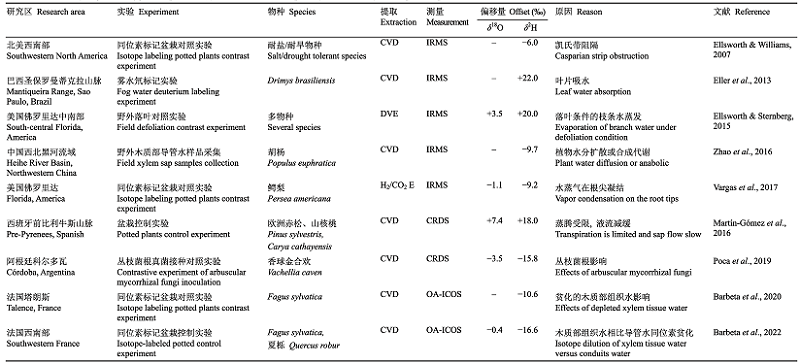 |
+、-在数字前分别代表同位素富集与贫化,数值代表了植物茎干木质部与土壤层同位素平均比值的偏移量; -,无数据; CRDS,腔衰荡光谱; CVD,低温真空蒸馏; DVE,直接水汽平衡; H/CO2 E, H/CO2平衡; IRMS, 同位素比率质谱; OA-ICOS,离轴集成腔输出光谱。
+、- in front of numerical values represents isotope enrichment and depletion, the numerical value in the offset represents the deviation of isotope average ratio between stem xylem and soil layer; : no data; CRDS, cavity ring-down spectroscopy; CVD, cryogenic vacuum dillation; DVE, direct vapor equilibration; H/CO2 E, H2/CO2 equilibration; IRMS, isotope ratio mass spectrometry; OA-ICOS, off axis integrated cavity output spectroscopy.
1.2 植物体内水分蒸发、运输和混合过程
1.2.1 枝条水蒸发
未栓化小枝与栓化枝条的水分蒸发会导致δ2H和δ18O富集分馏, 引起枝条木质部水分相比土壤水源δ2H和δ18O富集(Dawson & Ehleringer, 1993)。干燥环境与低空气湿度会在树皮细胞间隙与空气之间形成水汽亏缺, 造成树皮韧皮部水分蒸发流失, 韧皮组织与木质部的水分δ2H和δ18O平衡可能被打破, 树木枝条和茎干将表现出与空气湿度成反比的富集。这种木质部水δ2H和δ18O富集可能受树干液流速率的影响, 因为枝条木质部水同位素的蒸发富集是一个高度动态且受液流控制的过程(Martín-Gómez et al., 2016) (表1)。在蒸腾作用强烈时, 快速补充的茎干导管水会冲散树皮蒸发引起的木质部水δ2H和δ18O富集。但若处于蒸腾较弱的非生长季, 或采集的样本是落叶枝条时, 即便是栓化枝条, 无叶条件时木质部茎干水分运输停滞, 枝条水会产生明显的木质部水δ2H和δ18O富集(Ellsworh & Sternberg, 2015) (表1)。因此, 植物水分来源研究的样品采集工作需集中在枝繁叶茂的生长季进行, 虽然非生长季根系保留了吸水功能, 但树木水分运输减缓或停止, 水分大部分仅运输至主茎干混合存储。
1.2.2 水分运输时间滞后
降水、溪流水或地下水补给土壤, 根系吸水经过茎干运输至枝条都需要一定时间, 水分在土壤-植物系统内部的运输过程存在明显的时间滞后(von Freyberg et al., 2020)。植物水分来源研究中的木质部与土壤样品往往在同一时间采集, 水分运输滞留导致根系吸收的土壤水未及时补给枝条, 造成同一时刻采集的木质部与土壤样品不匹配, 导致同位素数据偏移。为避免将不匹配的数据代入水分来源混合模型计算引起δ2H和δ18O的偏差, 同位素样品采集的时间间隔要足够长。
水分平均滞留时间(MRT)描述了不同树种木质部导管管腔直径、密度和边材面积共同影响下水力传导能力的差异(Gaines et al., 2016; 孙龙等, 2020)。多数研究指出不同树种的MRT差异, Carya tomentosa、Quercus prinus和Quercus rubra的MRT在5-22天不等(Gaines et al., 2016)。由于非生长季落叶乔木的蒸腾作用弱于常绿树种, 落叶乔木的MRT约为常绿乔木的两倍(Graefe et al., 2019)。由于水力传导能力差别, 针阔叶树种的MRT差异同样明显, 针叶树种冷杉(Abies fabri)的MRT显著高于阔叶树种水青冈(Fagus longipetiolata) (Magh et al., 2020)。探究水力传导功能差异树木的水分运输时间滞后对于植物水分利用策略和水源贡献率的影响, 是理解水分滞留影响枝条水同位素比值偏移的关键。将树体水力学过程研究与植物水分来源研究结合, 能解析土壤水在树体内的滞留周期, 进而更准确地定量植物水源贡献率。使用D2O同位素示踪剂、热比率或热扩散液流监测, 同时加入树体茎干解剖测量能从植物解剖学角度探究影响植物水分滞留的关键因子。基于激光光谱技术的同位素原位观测方法的出现为获得长时间序列高时间分辨率的同位素动态变化提供了技术支撑(Beyer et al., 2020; Seeger & Weiler, 2021), 未来的研究应提倡应用多种技术实现对树体内水文过程更准确地定量。
1.2.3 茎干水同位素异质性
植物木质部茎干中不同水体(导管水与组织水)微米级同位素异质性可能是木质部茎干水与土壤水的δ2H和δ18O偏移的原因。根系从土壤吸收的水分需经过导管运输至枝条, 导管水可能更能代表根系吸收的土壤水源。实验提取的木质部茎干水不仅仅包括导管水, 还包括薄壁组织纤维素与氢键结合形成的结合水和木质部组织细胞间隙水(Barbeta et al., 2020, 2022)。Barbeta等(2022)应用新型离心技术(Peng et al., 2019)从Fagus sylvatica枝条的木质部中分离出导管水与组织水。导管水与土壤水δ2H和δ18O的差异不显著, 木质部组织水的δ2H和δ18O分别贫化了16.6‰和0.4‰ (表1)。Zhao等(2016)基于黑河流域胡杨(Populus euphratica)的正根压实验得出水分扩散或细胞的合成代谢过程会造成植物茎干水δ2H和δ18O显著变化(表1)。这种树体不同水体同位素异质性可能由细胞分裂时水分子通过水通道蛋白产生的同位素歧视引起, 也可能是植物纤维组织中纤维素-水表面的吸附同位素分馏造成。但尚不清楚树体内不同水体δ2H和δ18O的具体变化机制, 后续研究应该从更加微观的视角去审视植物体内部水分扩散与合成代谢过程, 解析植物细胞生理过程与氢氧同位素比值变化的关系。
通过构建基于物理过程的树体水力学模型, 部分研究者预测了树体水分扩散过程中δ2H和δ18O变化的时间规律。平移流水力过程为树体水力学模型的计算提供了初步依据, 但这种水力过程是理想且简化的, 实际树体水力过程还包括混合流和活塞流, 受土壤与植物水势梯度和土壤水分条件驱动, 计算也要更为复杂(Sprenger et al., 2018; Knighton et al., 2020)。将土壤水势驱动的根系吸水深度模型和树干液流流速驱动的平流-扩散模型耦合, 可模拟根系吸水深度动态变化和土壤垂直水分非均质性共同引起的木质部δ2H和δ18O变化(de Deurwaerder et al., 2020) (表2)。Seeger和Weiler (2021)通过改进高频原位监测系统装置, 观测到雨旱交替模式下木质部同位素比值的显著波动, 通过根系吸水深度模型和卷积方程结合, 预测出木质部δ2H和δ18O变化的时间序列。同位素原位观测技术能够提供高频的同位素实测数据, 弥补了破坏性采集中不能长期监测的缺陷, 将实测同位素数据与树体水力学模型的相互验证有助于理解δ2H和δ18O的时间规律与关键影响因子。
表2 植物木质 部和土壤层中氢氧同位素比值(δ)自然变化范围研究的主要文献及结果
Table 2
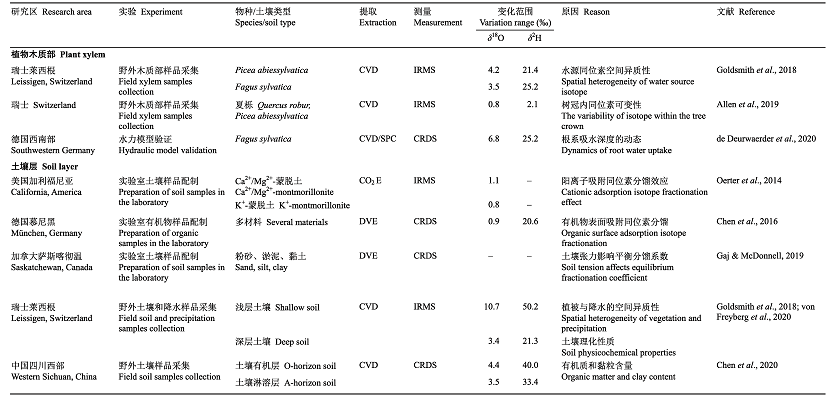 |
同位素自然变化范围采用平均同位素差值(Δ=δMx -δmim)表示。,无数据; CO2 E, CO2平衡; CRDS,腔衰荡光谱; CVD,低温真空蒸馏; DVE,直接水汽平衡; IRMS,同位素比率质谱; SPC,压力室法。
Ranges of natural isotopic variability are expressed as the mean isotopic dfference (Δ=δMx -δmim). -, no data; CO2 E, CO2 equilibration; CRDS, cavity ring-down spectroscopy; CVD, cryogenic vacuum distllation; DVE, direct
1.3 土壤-大气界面水分交换过程
土壤-大气界面水分交换包括降水输入和土壤水分蒸发输出。降水、穿透雨、植被遮蔽和土壤理化性质的空间异质性会导致植物-土壤系统内部水文运动过程差异(Goldsmith et al., 2018) (表2), 这种差异引发的水同位素分馏和交换过程会导致δ2H和δ18O的空间异质性(Beyer & Penna, 2021), 同位素景观图谱(isoscapes)被广泛应用于表征空间异质性降水(Bowen & Revenaugh, 2003)、地表水(Brooks et al., 2014)与地下水(West et al., 2014)的同位素分布格局。而这些地表与地下水源均为土壤层水的补给来源, 潜在影响了土壤水同位素的空间变异, 植物水分来源研究采集的样品大部分处于单株或林分尺度, 人工采集有限的土壤样品如果不具典型性(丢失关键土壤水源或采集未被利用的土壤水源), 都可能会导致土壤水与木质部水的δ2H和δ18O偏移。
1.3.1 降水、穿透雨的同位素异质性
降水δ2H和δ18O随温度、海拔以及降水量的变化而变化, 因此在时空上差异显著(Bowen & Wilkinson, 2002)。降水δ2H和δ18O受初始水汽源与分馏系数共同影响, 水汽大部分源于海洋蒸发, 蒸发至大气中的水汽沿大气环流运移、交换和混合过程会不断凝结形成降水, 较重的水分子更易凝结聚集成水滴降落, 大气水汽将持续地减少重同位素而呈现出贫化现象。如果区域季节性降水的水汽是分别来自不同大洋蒸发的稳定水汽源, 其降水δ2H和δ18O将呈现出明显的季节性规律, 可以利用正弦函数良好预测(Allen et al., 2018, 2019), 但对于降水水汽来源不明确且复杂的区域, 降水δ2H和δ18O的季节性规律并不明晰。
植被冠层对降水输入的再分配造成林内穿透雨或树干径流水同位素异质性(Allen et al., 2014, 2017), 潜在增加了林内土壤水δ2H和δ18O的异质性。途经植被冠层的降水会再分配为冠层截留水、林内穿透雨和树干径流3种形式的水源(Miralles et al., 2010)。植被冠层截留降水能力与储水时间受植被冠层密度与结构直接影响(Soulsby et al., 2017), 同时冠层内外温度、湿度与水汽压差间接控制着冠层截留水的蒸发程度(Sun et al., 2018; Zhang et al., 2019)。雨季降水频繁, 降水的间隔时间较短, 前一场降水的冠层截留水储存在冠层中还未完全蒸发便可能与下一场降水混合, 使得穿透雨与树干径流δ2H和δ18O的自然变化范围进一步加大。
1.3.2 土壤表层水分蒸发分馏
土壤水蒸发发生于土壤-大气的交界面, 与水-气界面类似, 土壤-大气界面的水分蒸发过程涉及热力学平衡分馏和动力学非平衡分馏(Majoube, 1971), 表层土壤水δ2H和δ18O显著富集。热力学平衡分馏发生在湿度高的近地表层, 平衡分馏系数(α)受温度的直接控制, 动力学非平衡分馏发生在高于地表且空气湿度低的大气湍流层, 由水分蒸发表面向大气的输送阻力和水同位素扩散系数共同驱动(Gaj & McDonnell, 2019)。两种土壤水分蒸发分馏过程受区域气候条件与植被冠层遮阴差异化影响, 不同区域表层土壤蒸发会呈现出复杂无规律的变化, 造成土壤δ2H和δ18O富集程度的空间差异, 形成土壤表层δ2H和δ18O的空间异质性(Goldsmith et al., 2018) (表2)。
1.4 土壤层水流动、混合与交换过程
天然土壤是不同质地矿物质、腐烂有机质和水共同组成的不均匀混合物(Lin et al., 2018)。土壤粒径、孔隙、黏粒和有机质含量等影响土壤基质势、水分运输路径和水分滞留时间, 造成土壤水流动、混合与交换过程的复杂变化(Sprenger et al., 2019)。土壤水分特征曲线描述了土壤基质势与含水量的关系, 可定义不同土壤水分类型(刘建立和徐绍辉, 2003)。植物有效水由植物凋萎点和田间持水量之间的水分构成, 包括少量膜状水和全部毛管水, 凋萎点以下为土壤吸附水和膜状水构成的植物无效水, 这部分水分不能被植物直接利用, 却参与土壤水分的混合与交换(吕斯丹等, 2019)。植物水分来源研究中如果缺乏对植物根系吸水生理策略的理解, 对土壤水的机械取样会导致错误采集土壤中未被植物利用的部分无效水源, 包括土壤吸附水和大部分膜状水构成的植物无效水, 植物无效水的δ2H和δ18O会干扰植物水源研究中对贡献率计算的准确性。
阳离子(Mg2+、Ca2+)水合作用可通过在离子周围形成水合区域, 通过结构和能量差异影响水合表层的同位素比值, 亲水物质表面与水分子相互吸附作用引起的同位素分馏过程同样在黏土-水界面(Oerter et al., 2014)、有机物-水界面(Chen et al., 2016)有过报道(表2), 土壤吸附水的δ2H和δ18O可能由此区别于植物有效水的δ2H和δ18O。另一方面, 土壤中不仅存在液态水, 孔隙间也充斥着土壤水汽, 水冷凝过程源于水分子之间的氢键的排序与重组。开放气体中水汽冷凝受环境条件如温度的控制, 但土壤孔隙间的汽液转变可能还受到土壤孔隙大小、孔隙化学成分和土壤水气压的直接影响(Lin et al., 2018)。土壤基质势也会影响土壤颗粒膜状水与土壤孔隙水汽之间的水汽交换过程(Gaj & McDonnell, 2019), 导致土壤颗粒膜状水的δ2H和δ18O可能区别于植物有效水的δ2H和δ18O。目前广泛使用的低温真空蒸馏技术会将土壤水全部提取出来, 忽略样品内部的水分混合, 样品中如果混杂了土壤吸附水和大部分膜状水等植物无效水, 可能会造成土壤水的δ2H和δ18O测量值偏离植物木质部水同位素比值。
1.5 土壤-根系界面根系吸水分馏过程
早期研究在盐生植物和旱生植物(Ellsworth & Williams, 2007)的根系吸水实验中均观察到植物木质部水与土壤水源之间的δ2H贫化, 认为造成这种δ2H贫化偏移的原因是根系吸水分馏(表1)。耐旱与耐盐植物根部内胚层放射状细胞壁上有一条发达的凯氏带, 凯氏带能阻碍水的质外体途径, 迫使水分子进行跨膜或共质体途径运输。南美洲阿根廷豆科植物Vachellia caven根系能通过与丛枝菌根共生来阻碍质外体途径, 迫使根系通过跨膜途径吸水。对比土壤水, Vachellia caven木质部水的δ18O和δ2H分别产生了-3.5‰和-15.8‰的贫化(Poca et al., 2019) (表1)。另一方面, 跨膜运输水分子的水通道蛋白可能存在同位素歧视。有研究通过分子动力学模拟证实, 由于D2O的自扩散系数较低且黏度较高, 在水通道蛋白1 (AQP1)的渗透通道中, D2O的渗透率低于H2O (Mamonov et al., 2007)。根系吸水分馏过程也可能是由于根尖根毛处的水蒸气冷凝的物理过程引起(Vargas et al., 2017), 由于根毛与土壤颗粒温度差造成土壤水汽在根毛上形成凝结水珠后被根毛吸收, 这种同位素分馏不是植物根系吸水的生理学策略造成, 而是由汽-液转变的物理过程导致的。但无论是水通道蛋白对轻/重同位素的歧视, 还是根毛区水汽的凝结过程, 这种从微观视角重新审视土壤水δ2H和δ18O分馏的相关研究还十分有限。
2 引起氢氧同位素偏移的人为效应
SPAC水文过程的时空异质性、植物生理与土壤物理结构差异等自然效应导致植物水源贡献研究中木质部水与土壤水δ2H和δ18O偏移已被讨论。同时, 木质部水和土壤水在提取与测定技术的差异、实验室分析中的仪器测量精确度等方面的人为效应也会引起δ2H和δ18O偏差。
2.1 土壤与木质部水样提取技术
2.1.1 土壤水样提取
土壤水样提取方法分为野外提取、实验室提取和平衡法提取3种(Sprenger et al., 2015) (表3)。纤维芯采样器(Holder et al., 1991)和吸力测渗计(Grossmann & Udluft, 1991)通过玻璃纤维芯和多孔陶瓷或金属管施加吸力在野外实地条件下采集孔隙自由水, 经过滤处理后用于同位素测定。但植物根系吸水策略会随土壤水分条件变化, 各土壤层水源贡献率随之改变, 该类方法只能在固定土壤层中施加吸力, 难以模拟植物根系吸水过程, 提取的水样不能代表根系吸水来源。实验室提取土壤水样的方法种类较多, 包括机械挤压与离心分离(Kelln et al., 2001; Millar et al., 2018)、共沸蒸馏(Allison & Hughes, 1983)和低温真空蒸馏(CVD) (Orlowski et al., 2016, 2018a)等。机械挤压与离心分离耗时费力, 对保水性能较好的黏土提取效率低下。共沸蒸馏基于有机溶剂与水混合可降低沸点的原理, 但残留在提取水样中的有机溶剂会造成激光光谱或质谱同位素比值测定结果的偏差。低温真空蒸馏能够达到>99%的提取效率, 但会提取出生物结合水、土壤吸附水和颗粒膜状水等植物无效水, 导致植物木质部水与土壤水的δ2H和δ18O偏移。平衡法提取主要包括: CO2和H2平衡(Sprenger et al., 2015)、扩散水混合平衡(Oerter et al., 2014)和直接水汽平衡(DVE) (Wassenaar et al., 2008; Hendry et al., 2015)等。基于密闭系统中同位素比值接近平衡的原理, 当实验样品与已知同位素比值的汽/液态水、H2或CO2平衡时, 可通过测量平衡后的汽/液态水、H2或CO2的同位素比值反推样品水同位素比值。避免了挤压、离心和抽提等物理手段带来的误差。但Hendry等(2015)指出样品水含量较低时, 用平衡法测量时会产生同位素比值正向偏差, 另外, 平衡过程中土壤中甲烷、甲醇等有机气体可能溢散, 干扰激光光谱的测定。
表3 部分样 品提取方法的原理和产生稳定氢氧同位素数据偏差的原因
Table 3
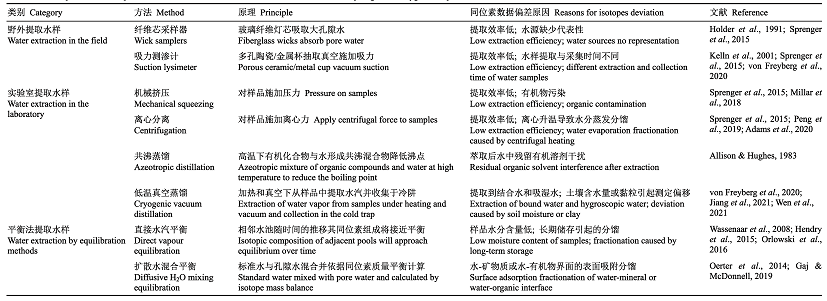 |
选择适合的提取方法对于降低提取技术人为效应造成的土壤水δ2H和δ18O测定偏差至关重要, 耗时费力且提取效率低的提取方法逐渐被淘汰。具有高提取效率与低提取成本的低温真空蒸馏法和直接水汽平衡法依旧是提取土壤水样时应用最为广泛且值得推广的方法, 但在具体应用时应注意: 通过改进提取步骤可能提取出植物利用的土壤孔隙活性水, 避免了非活性水如结合水与吸附水的同位素干扰, Jiang等(2021)提出一种低温蒸馏多步提取法, 该方法通过多次低温真空萃取和瑞利蒸馏模型计算相结合, 来区别土壤孔隙活性水与非活性水的δ2H和δ18O。另外, 离心技术与低温真空蒸馏法相结合, 能解析不同土壤基质势(Bowers et al., 2020)或土壤黏粒含量(Adams et al., 2020)的土壤水同位素的交换与混合过程。有研究证实低温真空蒸馏针对不同质地和含水量的土壤的水样提取过程中存在δ2H和δ18O偏差(Wen et al., 2021), 不同实验室提取条件如提取温度、时间和仪器精密度的差异, 即便是同位素比值相同的土样, 其测定结果也存在偏差(Orlowski et al., 2018b), 这提醒后续研究针对土壤样品的提取技术迫切需要一套较为认可的国际规范标准, 同时提供较为可靠的偏移校正方法。
2.1.2 植物水样提取
机械挤压、微波萃取与共沸蒸馏等提取方法同样可以提取植物茎干水, 这类方法破坏植物组织结构, 提取水样含有溶解性有机物, 提取效率也较低(Millar et al., 2018)。低温真空蒸馏可提取全部茎干水, 但默认木质部水同位素比值均匀不变, 忽略了木质部水同位素异质性(Zhao et al., 2016; Barbeta et al., 2020)。研究人员尝试通过其他提取技术分离植物木质部同位素比值差异的不同水体, 压力室法多用于测量植物叶水势, 部分研究利用该方法施加外部压力提取木质部导管中的汁液(Zuecco et al., 2022), 但该方法只能提取出微量导管水, 不能满足测定需求。离心技术通过对枝条施加离心力提取木质部导管的汁液(Peng et al., 2019), 但忽略了离心过程升温可能造成的水同位素分馏。低温真空蒸馏过程可能潜在造成木质部水的δ2H贫化。Chen等(2020)制定了一套测量植物蒸腾水汽同位素的密闭系统, 基于稳态假设间接测定木质部水的δ2H和δ18O, 发现与低温真空蒸馏抽提后得到的木质部δ2H和δ18O差异显著。低温真空蒸馏过程水分子与木质部组织的氘交换可能导致木质部水δ2H平均贫化8.1‰, 忽视这种贫化偏差会在双同位素图中引入蒸发富集偏移, 导致植物水源贡献研究的错误估计。原位测量技术能直接测定木质部水同位素比值的时间变化(Volkmann & Weiler, 2014)。Volkmann等(2016)在Acer campestre树干胸径处钻孔并插入含有疏水透气微孔膜的监测探针, 连接野外布设的激光光谱仪的吸入泵, 原位监测了植物木质部水同位素比值。但该方法没有考虑探针与植物木质部界面温度差异导致的水蒸气分馏, 同时也忽略了树木钻孔造成的导管栓塞对树体水分运输的影响。
研究者应针对不同研究主题选用相匹配的提取方法。δ2H和δ18O偏移可能是植物自身合成、生长与代谢过程对水分的利用与再分配过程导致的, 需要我们以更微观视角审视植物内部的水分交换、混合与运输过程中发生的同位素交换(Barbeta et al., 2022), 这类研究适宜采用分离植物水体的离心机或压力室手段, 施加不同梯度的外界力或许能提供解析木质部水δ2H和δ18O偏移原因的新见解, 但这类方法本身并不成熟, 应用过程是否会引入其他效应导致误差仍需要进一步讨论。通过借鉴密闭植物室测定叶片蒸腾水汽同位素比值的手段, 将叶片尺度放大至单株尺度后测定植物蒸腾水汽, 提供了间接测量木质部水δ2H和δ18O的新方法(Chen et al., 2020)。植物木质部水同位素原位测量技术的发展有助于深入研究植物体水同位素比值的变化动态, 提供植物水分来源的准确判断。
2.2 土壤与木质部水样测定方法
测定植物木质部和土壤水的δ2H和δ18O的传统方案是先使用低温真空蒸馏提取水分, 后采用同位素比率质谱仪(IRMS)进行同位素分析, IRMS造价昂贵, 操作过程复杂, 学习成本高, 推广上存在限制(Penna et al., 2010)。新开发的同位素比值红外光谱仪(IRIS)能够将水汽的激光吸收与样品同位素比值联系起来, 在高通量条件采用少量实验样品进行高频重复测定, 大大提高了样品的测定效率(Cui et al., 2017)。随着IRIS技术的发展, 目前已完成商业化并应用广泛的光谱仪器主要有离轴集成腔输出光谱仪(OA-ICOS) (Lis et al., 2008)和腔衰荡光谱仪(CRDS) (Gupta et al., 2009)两种。虽然激光光谱技术提高了样品测定效率, 降低了测定成本, 但同时也存在光谱仪器准确度较低与重复性偏差较大等新问题。
样品记忆效应指的是前一批水样的样品残留痕迹对本次样品测定的影响, 是影响同位素光谱测定仪器准确度中常出现的问题(Olsen et al., 2006)。Penna等(2012)在标准操作条件下评估了OA-ICOS和CRDS的样品记忆效应对测量精度的影响, 记忆效应影响下δ2H和δ18O的标准差为7.50‰和0.54‰, 若去除记忆效应影响, δ2H和δ18O的标准差将降低到1.00‰和0.17‰。丢弃前几个重复测定结果或构建记忆系数可有效消除样品记忆效应。Gröening (2011)和Cui等(2017)均采用校正算法计算记忆系数来校正多样本记忆效应, 有效提高了光谱测定数据的一致性和准确性。另外, 水样提取可能会同时提取如甲醇、乙醇等挥发性有机物, 该类有机物的光谱特征会与水同位素的光谱特征发生重叠, 导致测定的δ2H和δ18O偏差(Schmidt et al., 2012)。富含有机质的土壤或植物枝条的提取水样易受到有机物的光谱干扰, 在光谱测定前, 对提取水样进行固相萃取过滤(Chang et al., 2016)或有机物氧化(Martín-Gómez et al., 2015)能有效降低有机物干扰。在光谱仪器测定结束后, 应该进行有机物污染后校正处理来进一步剔除受到干扰的异常值。
3 问题与展望
3.1 获取与生态系统水文时空过程匹配的氢氧同位素数据
目前基于氢氧稳定同位素技术的植物水分来源研究中最主要的一个问题是采集的同位素数据十分有限, 难以真正表征SPAC生态水文过程时空异质性所引起的氢氧同位素自然变化机制, 更难以解析有限土壤与木质部样本δ2H和δ18O偏移与不确定性的关键原因(Beyer & Penna, 2021)。植物水分来源研究基于单株或林分尺度, 破坏性采样的数量与频率都受到严重限制(von Freyberg et al., 2020)。受气候环境、植被状况与土壤性质的影响, SPAC系统水分传输与交换十分频繁, 同位素数据难以与复杂的生态水文变化相匹配。因此, 如何获取与生态系统水文时空过程匹配的时空同位素数据, 探究SPAC系统水同位素的时间变化规律与空间格局是目前亟须解决的问题。
高时间分辨率测量土壤和植物木质部水同位素的原位监测技术将是解析SPAC水分传输过程中水同位素时间变化动态的有效手段, 具有良好的应用前景(Beyer et al., 2020)。将同位素原位监测探针插入土壤(Oerter & Bowen, 2017)或植物木质部(Volkmann et al., 2016)中, 与布设在野外的激光光谱仪连接, 可原位监测长时间序列土壤和植物木质部水同位素比值。同位素原位监测技术突破时间尺度同位素数据不足的限制, 可长期监测植物根系吸水深度和SPAC水同位素动态, 这对于理解与量化SPAC水分运输过程中的自然效应如何影响δ2H和δ18O的偏移至关重要。目前看来, 该技术将在量化植物-土壤系统水分滞留时间(Magh et al., 2020), 根系吸水策略的时间动态, 监测水力再分配, 修正根系吸水深度模型(Seeger & Weiler, 2021)等诸多课题中广泛应用。稳定同位素可用来研究大范围空间和时间尺度的生态过程(Dawson et al., 2002)。同位素景观图谱能运用地理信息系统表征不同物质同位素比值大尺度空间变化, 通过相关关系分析环境异质性对稳定同位素分布格局的影响(Hellmann et al., 2016; Jason & West, 2018)。但对植物水分来源贡献的研究多基于单株或林分等小尺度范围, 缺乏对大范围δ2H和δ18O空间异质性的表征。仅有少量研究讨论了δ2H和δ18O空间横向异质性对植物水源多元混合模型计算偏差的潜在影响(Goldsmith et al., 2018; Hahn et al., 2021)。未来应建立起区域δ2H和δ18O数据与生态水文因子的空间尺度数据库, 获得氢氧同位素分布格局演变与SPAC水文传输异质性变化的联系。
3.2 从更微观的视角审视植物-土壤系统中的水分转换过程
植物水分来源δ2H和δ18O偏移的研究缺乏从更微观的视角审视植物-土壤系统中的水分传输与转换过程。植物组织或细胞生理功能变化与孔隙尺度土壤理化性质差异导致的δ2H和δ18O异质性变化的具体过程机制仍不明了。事实上, 植物-土壤系统中可能存在诸多导致δ2H和δ18O偏移的自然效应, 但这些自然效应引发的水同位素交换或分馏是微观的, 发生在样品采集与测定过程中, 难以通过单株尺度的土壤和木质部样品的测定观测到。例如在植物生理功能上, 组织细胞分裂与生长的水分转换与消耗(Zhao et al., 2016; Barbeta et al., 2020), 根系水通道蛋白的水分子运输过程(Poca et al., 2019)与纤维组织有机物表面羟基与水分的吸附与交换作用(Chen et al., 2020); 土壤理化性质上, 阳离子或土壤黏粒对水分子的吸附作用(Oerter et al., 2014), 土壤孔隙中颗粒膜状水与水汽的分子交换(Gaj & McDonnell, 2019)与植物根毛上土壤孔隙水蒸气的凝结(Vargas et al., 2017)。这些引起δ2H和δ18O偏移的具体原因虽然被广泛讨论, 但多数是依据得到的同位素数据给予的假设性解释, 并未通过实际观测证实。后续的研究应通过更加详细的实验设计, 如染色、再水化、同位素标记或显微观察等来进一步检验这些分馏过程的存在。
3.3 水同位素样品提取方法与测定技术的优化与改进
从方法与技术层面上看, 植物水源研究中水同位素样品提取方法与测定技术也存在一些亟待解决的问题。水样提取方法上, 低温真空蒸馏与直接水汽平衡依旧是具有较强应用前景的方法, 但这些方法都忽略了植物或土壤样品内部的抽提或平衡过程中发生的潜在同位素分馏。后续研究中, 在具有革命性的新型提取技术出现前, 加强对提取步骤的改进, 与离心机与压力室等提取方法结合, 统一实验室提取标准都能一定程度上降低植物水源研究中δ2H和δ18O的提取误差。水样测定方法上, IRIS技术的发展使得氢氧同位素测量效率大大提高, 但后续研究依旧需要仔细考虑样品记忆效应、时间漂移与有机物污染带来的一系列新问题。后续的研究者应仔细考虑引起δ2H和δ18O测定偏差的技术误差来源, 采取适当的校正策略以获得准确度满足研究要求的δ2H和δ18O测量结果, 获得更精确的同位素数据。
参考文献
Bound and mobile soil water isotope ratios are affected by soil texture and mineralogy, whereas extraction method influences their measurement
DOI:10.1002/hyp.v34.4 URL [本文引用: 1]
The role of pre-event canopy storage in throughfall and stemflow by using isotopic tracers
DOI:10.1002/eco.v7.2 URL [本文引用: 1]
The role of stable isotopes in understanding rainfall interception processes: a review
DOI:10.1002/wat2.1187 [本文引用: 1]
Seasonal origins of soil water used by trees
DOI:10.5194/hess-23-1199-2019
[本文引用: 1]

Rain recharges soil water storages and either percolates downward into aquifers and streams or is returned to the atmosphere through evapotranspiration. Although it is commonly assumed that summer rainfall recharges plant-available water during the growing season, the seasonal origins of water used by plants have not been systematically explored. We characterize the seasonal origins of waters in soils and trees by comparing their midsummer isotopic signatures (delta H-2) to seasonal isotopic cycles in precipitation, using a new seasonal origin index. Across 182 Swiss forest sites, xylem water isotopic signatures show that summer rain was not the predominant water source for midsummer transpiration in any of the three sampled tree species. Beech and oak mostly used winter precipitation, whereas spruce used water of more diverse seasonal origins. Even in the same plots, beech consistently used more winter precipitation than spruce, demonstrating consistent niche partitioning in the rhizosphere. All three species' xylem water isotopes indicate that trees used more winter precipitation in drier regions, potentially mitigating their vulnerability to summer droughts. The widespread occurrence of winter isotopic signatures in midsummer xylem implies that growing-season rainfall may have minimally recharged the soil water storages that supply tree growth, even across diverse humid climates (690-2068 mm annual precipitation). These results challenge common assumptions concerning how water flows through soils and is accessed by trees. Beyond these ecological and hydrological implications, our findings also imply that stable isotopes of delta O-18 and delta H-2 in plant tissues, which are often used in climate reconstructions, may not reflect water from growing-season climates.
Predicting spatial patterns in precipitation isotope (δ2H and δ18O) seasonality using sinusoidal isoscapes
DOI:10.1029/2018GL077458 URL [本文引用: 1]
The use of natural tracers as indicators of soil-water movement in a temperate semi-arid region
Evidence for distinct isotopic compositions of sap and tissue water in tree stems consequences for plant water source identification
DOI:10.1111/nph.v233.3 URL [本文引用: 4]
An explanation for the isotopic offset between soil and stem water in a temperate tree species
DOI:10.1111/nph.16564
PMID:32239512
[本文引用: 4]
A growing number of field studies report isotopic offsets between stem water and its potential sources that prevent the unambiguous identification of plant water origin using water isotopes. We explored the causes of this isotopic offset by conducting a controlled experiment on the temperate tree species Fagus sylvatica. We measured δ H and δ O of soil and stem water from potted saplings growing on three soil substrates and subjected to two watering regimes. Regardless of substrate, soil and stem water δ H were similar only near permanent wilting point. Under moister conditions, stem water δ H was 11 ± 3‰ more negative than soil water δ H, coherent with field studies. Under drier conditions, stem water δ H became progressively more enriched than soil water δ H. Although stem water δ O broadly reflected that of soil water, soil-stem δ H and δ O differences were correlated (r = 0.76) and increased with transpiration rates indicated by proxies. Soil-stem isotopic offsets are more likely to be caused by water isotope heterogeneities within the soil pore and stem tissues, which would be masked under drier conditions as a result of evaporative enrichment, than by fractionation under root water uptake. Our results challenge our current understanding of isotopic signals in the soil-plant continuum.© 2020 The Authors. New Phytologist © 2020 New Phytologist Trust.
In situ measurements of soil and plant water isotopes: a review of approaches, practical considerations and a vision for the future
DOI:10.5194/hess-24-4413-2020
URL
[本文引用: 3]
. The number of ecohydrological studies involving water stable isotope measurements has been increasing steadily due to technological (e.g., field-deployable laser spectroscopy and cheaper instruments) and methodological (i.e., tracer approaches or improvements in root water uptake models)\nadvances in recent years. This enables researchers from a broad scientific background to incorporate water-isotope-based methods into their studies. Several isotope effects are currently not fully understood but might be essential when investigating root water uptake depths of vegetation and\nseparating isotope processes in the soil–vegetation–atmosphere continuum. Different viewpoints exist on (i) extraction methods for soil and plant\nwater and methodological artifacts potentially introduced by them, (ii) the pools of water (mobile vs. immobile) measured with those methods, and (iii) spatial variability and temporal dynamics of the water isotope composition of different compartments in terrestrial ecosystems. In situ methods have been proposed as an innovative and necessary way to address these issues and are required in order to disentangle isotope\neffects and take them into account when studying root water uptake depths of plants and for studying soil–plant–atmosphere interaction based on\nwater stable isotopes. Herein, we review the current status of in situ measurements of water stable isotopes in soils and plants, point out\ncurrent issues and highlight the potential for future research. Moreover, we put a strong focus and incorporate practical aspects into this review in\norder to provide a guideline for researchers with limited previous experience with in situ methods. We also include a section on opportunities for\nincorporating data obtained with described in situ methods into existing isotope-enabled ecohydrological models and provide examples illustrating\npotential benefits of doing so. Finally, we propose an integrated methodology for measuring both soil and plant water isotopes in situ when\ncarrying out studies at the soil–vegetation–atmosphere continuum. Several authors have shown that reliable data can be generated in the field using\nin situ methods for measuring the soil water isotope composition. For transpiration, reliable methods also exist but are not common in\necohydrological field studies due to the required effort. Little attention has been paid to in situ xylem water isotope measurements. Research\nneeds to focus on improving and further developing those methods. There is a need for a consistent and combined (soils and plants) methodology for ecohydrological studies. Such systems should be designed and\nadapted to the environment to be studied. We further conclude that many studies currently might not rely on in situ methods extensively because of\nthe technical difficulty and existing methodological uncertainties. Future research needs to aim on developing a simplified approach that provides a\nreasonable trade-off between practicability and precision and accuracy.\n
On the spatio-temporal under- representation of isotopic data in ecohydrological studies
DOI:10.3389/frwa.2021.643013 [本文引用: 3]
Interpolating the isotopic composition of modern meteoric precipitation
DOI:10.1029/2003WR002086 [本文引用: 1]
Spatial distribution of δ18O in meteoric precipitation
DOI:10.1130/0091-7613(2002)030<0315:SDOOIM>2.0.CO;2 URL [本文引用: 1]
A combination of soil water extraction methods quantifies the isotopic mixing of waters held at separate tensions in soil
DOI:10.5194/hess-24-4045-2020
URL
[本文引用: 1]
. Measurements of the isotopic composition of separate and\npotentially interacting pools of soil water provide a powerful means to\nprecisely resolve plant water sources and quantify water residence time and\nconnectivity among soil water regions during recharge events. Here we\npresent an approach for quantifying the time-dependent isotopic mixing of\nwater recovered at separate suction pressures or tensions in soil over an\nentire moisture release curve. We wetted oven-dried, homogenized sandy loam\nsoil first with isotopically “light” water (δ2H =-130 ‰; δ18O =-17.6 ‰) to represent antecedent moisture held at high matric tension. We then\nbrought the soil to near saturation with “heavy” water (δ2H =-44 ‰; δ18O =-7.8 ‰) that represented new input water. Soil water samples\nwere subsequently sequentially extracted at three tensions (“low-tension”\ncentrifugation ≈0.016 MPa; “mid-tension” centrifugation ≈1.14 MPa; and “high-tension” cryogenic vacuum distillation at an\nestimated tension greater than 100 MPa) after variable\nequilibration periods of 0 h, 8 h, 1 d, 3 d, and 7 d. We assessed the differences\nin the isotopic composition of extracted water over the 7 d equilibration\nperiod with a MANOVA and a model quantifying the time-dependent isotopic mixing\nof water towards equilibrium via self-diffusion. The simplified and\nhomogenous soil structure and nearly saturated moisture conditions used in\nour experiment likely facilitated rapid isotope mixing and equilibration\namong antecedent and new input water. Despite this, the isotope composition\nof waters extracted at mid compared with high tension remained significantly\ndifferent for up to 1 d, and waters extracted at low compared with\nhigh tension remained significantly different for longer than 3 d.\nComplete mixing (assuming no fractionation) for the pool of water extracted\nat high tension occurred after approximately 4.33 d. Our combination\napproach involving the extraction of water over different domains of the\nmoisture release curve will be useful for assessing how soil texture and\nother physical and chemical properties influence isotope exchange and mixing\ntimes for studies aiming to properly characterize and interpret the isotopic\ncomposition of extracted soil and plant waters, especially under variably\nunsaturated conditions.\n
Assessing environmental and physiological controls over water relations in Scots pine (Pinus sylvestris L.) stand through analyses of stable isotope composition of water and organic matter
Stable isotope estimates of evaporation: inflow and water residence time for lakes across the United States as a tool for national lake water quality assessments
DOI:10.4319/lo.2014.59.6.2150 URL [本文引用: 1]
Isotopic offsets between bulk plant water and its sources are larger in cool and wet environments
DOI:10.5194/hess-26-4125-2022 URL [本文引用: 1]
Stable isotopes in leaf water of terrestrial plants
Environmental and physiological controls over oxygen and carbon isotope composition of Tasmanian blue gum
Oxygen isotope composition of CAM and C3 Clusia species: non-steady-state dynamics control leaf water 18O enrichment in succulent leaves
Improved removal of volatile organic compounds for laser-based spectroscopy of water isotopes
DOI:10.1002/rcm.7497
PMID:26864530
[本文引用: 1]
Volatile organic compounds (VOCs) such as methanol and ethanol in water extracted from plants cause spectral interference in isotope ratio infrared spectroscopy (IRIS). This contamination degrades the accuracy of measurements, limiting the use of IRIS. In response, this study presents a new decontamination method of VOCs for enhanced IRIS measurements.The isotopic compositions of water from laboratory-made and field-collected plant samples pre- and post-treatment were analyzed using IRIS. Traditional treatment methods of activated charcoal and commercial pre-combustion systems (MCM) were compared with our new treatment method that implements solid-phase extraction (SPE). The absolute concentrations of contaminants pre- and post-treatment were determined using (1)H and (13)C nuclear magnetic resonance to assess the effectiveness of the different treatments.SPE removes an average of 86.7% and 78.8% ethanol and methanol, respectively, significantly reducing spectral interference. SPE reduces errors to within instrumental noise for both ethanol and methanol at concentrations found in nature (<3.0% and 0.08%, respectively). Activated charcoal minimally affected alcohol concentrations. MCM significantly worsened ethanol-contaminated water isotope measurements by producing primary alcohol oxidation products such as formic acid, another compound that interferes with IRIS absorption.SPE is an effective, low-cost method for eliminating errors in ethanol-contaminated samples. For samples where methanol is prevalent, combining SPE and MCM is more effective than the use of SPE alone. Hence, SPE treatment alone or in conjunction with MCM is recommended as an effective pre-analysis purification method for water extracted from plants.Copyright © 2016 John Wiley & Sons, Ltd.
2H and 18O depletion of water close to organic surfaces
DOI:10.5194/bg-13-3175-2016
URL
[本文引用: 1]
. Hydrophilic surfaces influence the structure of water close to them and may thus affect the isotope composition of water. Such an effect should be relevant and detectable for materials with large surface areas and low water contents. The relationship between the volumetric solid : water ratio and the isotopic fractionation between adsorbed water and unconfined water was investigated for the materials silage, hay, organic soil (litter), filter paper, cotton, casein and flour. Each of these materials was equilibrated via the gas phase with unconfined water of known isotopic composition to quantify the isotopic difference between adsorbed water and unconfined water. Across all materials, isotopic fractionation was significant (p<0.05) and negative (on average −0.91 ± 0.22 ‰ for 18∕16O and −20.6 ± 2.4 ‰ for 2∕1H at an average solid : water ratio of 0.9). The observed isotopic fractionation was not caused by solutes, volatiles or old water because the fractionation did not disappear for washed or oven-dried silage, the isotopic fractionation was also found in filter paper and cotton, and the fractionation was independent of the isotopic composition of the unconfined water. Isotopic fractionation became linearly more negative with increasing volumetric solid : water ratio and even exceeded −4 ‰ for 18∕16O and −44 ‰ for 2∕1H. This fractionation behaviour could be modelled by assuming two water layers: a thin layer that is in direct contact and influenced by the surface of the solid and a second layer of varying thickness depending on the total moisture content that is in equilibrium with the surrounding vapour. When we applied the model to soil water under grassland, the soil water extracted from 7 and 20 cm depth was significantly closer to local meteoric water than without correction for the surface effect. This study has major implications for the interpretation of the isotopic composition of water extracted from organic matter, especially when the volumetric solid : water ratio is larger than 0.5 or for processes occurring at the solid–water interface.\n
Stem water cryogenic extraction biases estimation in deuterium isotope composition of plant source water
DOI:10.1073/pnas.2014422117
PMID:33318208
[本文引用: 3]
The hydrogen isotope ratio of water cryogenically extracted from plant stem samples (δH) is routinely used to aid isotope applications that span hydrological, ecological, and paleoclimatological research. However, an increasing number of studies have shown that a key assumption of these applications-that δH is equal to the δH of plant source water (δH)-is not necessarily met in plants from various habitats. To examine this assumption, we purposedly designed an experimental system to allow independent measurements of δH, δH, and δH of water transported in xylem conduits (δH) under controlled conditions. Our measurements performed on nine woody plant species from diverse habitats revealed a consistent and significant depletion in δH compared with both δH and δH Meanwhile, no significant discrepancy was observed between δH and δH in any of the plants investigated. These results cast significant doubt on the long-standing view that deuterium fractionation occurs during root water uptake and, alternatively, suggest that measurement bias inherent in the cryogenic extraction method is the root cause of δH depletion. We used a rehydration experiment to show that the stem water cryogenic extraction error could originate from a dynamic exchange between organically bound deuterium and liquid water during water extraction. In light of our finding, we suggest caution when partitioning plant water sources and reconstructing past climates using hydrogen isotopes, and carefully propose that the paradigm-shifting phenomenon of ecohydrological separation ("two water worlds") is underpinned by an extraction artifact.
The influence of memory, sample size effects, and filter paper material on online laser-based plant and soil water isotope measurements
DOI:10.1002/rcm.7824
PMID:28072488
[本文引用: 2]
The recent development of isotope ratio infrared spectroscopy (IRIS) was quickly followed by the addition of online extraction and analysis systems, making it faster and easier to measure soil and plant water isotopes. However, memory and sample size effects limit the efficiency and accuracy of these new setups. In response, this study presents a scheme dedicated to estimating and eliminating these two effects.Memory effect was determined by injecting two standard waters alternately. Each standard was injected nine times in a row and analyzed using induction module cavity ring-down spectroscopy (IM-CRDS). Memory coefficients were calculated using a new "multistage jump" algorithm. Sample size effects were evaluated by injecting water volumes ranging from 1 μL to 6 μL. Finally, the influence of cellulose filter paper on the isotopic measurements, the memory, and the sample size effect was evaluated by comparing it with glass filter paper.Memory effects were detected for both δ O and δ H values, with the latter being stronger. Isotopic differences between replicates of the same plant or soil sample showed a clear decrease after memory correction. A small water volume effect was found only when the injected water volume was larger than 3 μL. However, while the correction method performed well for laboratory-made samples, it did not for field samples, due to the heterogeneity of the isotopic composition of the samples. Stronger memory and water volume effects were found for cellulose filter paper.The memory coefficients and the water volume-isotope relationship improved the consistency and accuracy of both laboratory and field data. Our results indicate that cellulose filter paper may not be a suitable medium to measure standard waters and evaluate memory and water volume effects. Finally, a detailed correction and calibration protocol is suggested, along with notes on best practices to obtain good-quality IM-CRDS data. Copyright © 2017 John Wiley & Sons, Ltd.Copyright © 2017 John Wiley & Sons, Ltd.
Isotopic enrichment of water in the “woody” tissues of plants: implications for plant water source, water uptake, and other studies which use the stable isotopic composition of cellulose
DOI:10.1016/0016-7037(93)90554-A URL [本文引用: 2]
Stable isotopes in plant ecology
DOI:10.1146/ecolsys.2002.33.issue-1 URL [本文引用: 2]
Causes and consequences of pronounced variation in the isotope composition of plant xylem water
DOI:10.5194/bg-17-4853-2020
URL
[本文引用: 2]
. Stable isotopologues of water are widely used to derive relative root water uptake (RWU) profiles and average RWU depth in lignified plants. Uniform isotope composition of plant xylem water (δxyl) along the stem length of woody plants is a central assumption of the isotope tracing approach which has never been properly evaluated. Here we evaluate whether strong variation in δxyl within woody plants exists using empirical field observations from French Guiana, northwestern China, and Germany. In addition, supported by a mechanistic plant hydraulic model, we test hypotheses on how variation in δxyl can develop through the effects of diurnal variation in RWU, sap flux density, diffusion, and various other soil and plant parameters on the δxyl of woody plants. The hydrogen and oxygen isotope composition of plant xylem water shows strong temporal (i.e., sub-daily) and spatial (i.e., along the stem) variation ranging up to 25.2 ‰ and 6.8 ‰ for δ2H and δ18O, respectively, greatly exceeding the measurement error range in all evaluated datasets. Model explorations predict that significant δxyl variation could arise from diurnal RWU fluctuations and vertical soil water heterogeneity. Moreover, significant differences in δxyl emerge between individuals that differ only in sap flux densities or are monitored at different times or heights. This work shows a complex pattern of δxyl transport in the soil–root–xylem system which can be related to the dynamics of RWU by plants. These dynamics complicate the assessment of RWU when using stable water isotopologues but also open new opportunities to study drought responses to environmental drivers. We propose including the monitoring of sap flow and soil matric potential for more robust estimates of average RWU depth and expansion of attainable insights in plant drought strategies and responses.
On the enrichment of H218O in the leaves of transpiring plants
Water fluxes mediated by vegetation: emerging isotopic insights at the soil and atmosphere interfaces
DOI:10.1111/nph.15547
PMID:30341780
[本文引用: 1]
Plants mediate water fluxes within the soil-vegetation-atmosphere continuum. This water transfer in soils, through plants, into the atmosphere can be effectively traced by stable isotopologues of water. However, rapid dynamic processes have only recently gained attention, such as adaptations in root water uptake depths (within hours to days) or the imprint of transpirational fluxes on atmospheric moisture, particularly promoted by the development of real-time in-situ water vapour stable isotope observation techniques. We focus on open questions and emerging insights at the soil-plant and plant-atmosphere interfaces, as we believe that these are the controlling factors for ecosystem water cycling. At both interfaces, complex pictures of interacting ecophysiological and hydrological processes emerge: root water uptake dynamics depend on both spatiotemporal variations in water availability and species-specific regulation of adaptive root conductivity within the rooting system by, for example, modulating soil-root conductivity in response to water and nutrient demands. Similarly, plant water transport and losses are a fine-tuned interplay between species-specific structural and functional strategies of water use and atmospheric processes. We propose that only by explicitly merging insights from distinct disciplines - for example, hydrology, plant physiology and atmospheric sciences - will we gain a holistic picture of the impact of vegetation on processes governing the soil-plant-atmosphere continuum.© 2018 The Authors. New Phytologist © 2018 New Phytologist Trust.
Foliar uptake of fog water and transport belowground alleviates drought effects in the cloud forest tree species
Seasonal water use by deciduous and evergreen woody species in a scrub community is based on water availability and root distribution
DOI:10.1002/eco.v8.4 URL [本文引用: 1]
Hydrogen isotope fractionation during water uptake by woody xerophytes
DOI:10.1007/s11104-006-9177-1 URL [本文引用: 1]
The new blue and green water paradigm: breaking new ground for water resources planning and management
DOI:10.1061/(ASCE)0733-9496(2006)132:3(129) URL [本文引用: 1]
Heavy water fractionation during transpiration
Rapid tree water transport and residence times in a Pennsylvania catchment
DOI:10.1002/eco.v9.8 URL [本文引用: 2]
Possible soil tension controls on the isotopic equilibrium fractionation factor for evaporation from soil
DOI:10.1002/hyp.v33.11 URL [本文引用: 3]
Spatial variation in throughfall, soil, and plant water isotopes in a temperate forest
DOI:10.1002/eco.2059 [本文引用: 3]
Water residence times in trees of a neotropical dry forest
DOI:10.1007/s00468-019-01849-y [本文引用: 1]
The frontier beneath our feet
DOI:10.1002/2017WR020835 URL [本文引用: 1]
Improved water δ2H and δ18O calibration and calculation of measurement uncertainty using a simple software tool
DOI:10.1002/rcm.5074 URL [本文引用: 1]
The extraction of soil water by the suction-cup method: a review
DOI:10.1111/ejs.1991.42.issue-1 URL [本文引用: 1]
Foliar condensate absorption and its pathways of two typical shrub species in the Mu Us Desert
DOI:10.17521/cjpe.2021.0066 URL [本文引用: 1]
毛乌素沙地两种典型灌木叶片凝结水吸收能力及吸水途径
Demonstration of high-precision continuous measurements of water vapor isotopologues in laboratory and remote field deployments using wavelength-scanned cavity ring-down spectroscopy (WS-CRDS) technology
DOI:10.1002/rcm.4100
PMID:19603459
[本文引用: 1]
This study demonstrates the application of Wavelength-Scanned Cavity Ring-Down Spectroscopy (WS-CRDS) technology which is used to measure the stable isotopic composition of water. This isotopic water analyzer incorporates an evaporator system that allows liquid water as well as water vapor to be measured with high precision. The analyzer can measure H2(18)O, H2(16)O and HD(16)O content of the water sample simultaneously. The results of a laboratory test and two field trials with this analyzer are described. The results of these trials show that the isotopic water analyzer gives precise, accurate measurements with little or no instrument drift for the two most common isotopologues of water. In the laboratory the analyzer has a precision of 0.5 per mil for deltaD and 0.1 per mil for delta(18)O which is similar to the precision obtained by laboratory-based isotope ratio mass spectrometers. In the field, when measuring vapor samples, the analyzer has a precision of 1.0 per mil for deltaD and 0.2 per mil for delta(18)O. These results demonstrate that the isotopic water analyzer is a powerful tool that is appropriate for use in a wide range of applications and environments.2009 John Wiley & Sons, Ltd.
Variability in tree water uptake determined with stable water isotopes in an African tropical montane forest
DOI:10.1002/eco.2278 [本文引用: 1]
Isoscapes resolve species-specific spatial patterns in plant- plant interactions in an invaded Mediterranean dune ecosystem
DOI:10.1093/treephys/tpw075 URL [本文引用: 1]
Determining the stable isotope composition of pore water from saturated and unsaturated zone core: improvements to the direct vapour equilibration laser spectrometry method
DOI:10.5194/hess-19-4427-2015
URL
[本文引用: 2]
. A method to measure the δ2H and δ18O composition of pore waters in saturated and unsaturated geologic core samples using direct vapour equilibration and laser spectrometry (DVE–LS) was first described in 2008, and has since been rapidly adopted. Here, we describe a number of important methodological improvements and limitations encountered in routine application of DVE–LS over several years. Generally, good comparative agreement, as well as accuracy, is obtained between core pore water isotopic data obtained using DVE–LS and that measured on water squeezed from the same core. In complex hydrogeologic settings, high-resolution DVE–LS depth profiles provide greater spatial resolution of isotopic profiles compared to long-screened or nested piezometers. When fluid is used during drilling and coring (e.g. water rotary or wet sonic drill methods), spiking the drill fluid with 2H can be conducted to identify core contamination. DVE–LS analyses yield accurate formational isotopic data for fine-textured core (e.g. clay, shale) samples, but are less effective for cores obtained from saturated permeable (e.g. sand, gravels) geologic media or on chip samples that are easily contaminated by wet rotary drilling fluid. Data obtained from DVE–LS analyses of core samples collected using wet (contamination by drill water) and dry sonic (water loss by heating) methods were also problematic. Accurate DVE–LS results can be obtained on core samples with gravimetric water contents > 5 % by increasing the sample size tested. Inexpensive Ziploc™ gas-sampling bags were determined to be as good as, if not better than, other, more expensive specialty bags. Sample storage in sample bags provides acceptable results for up to 10 days of storage; however, measurable water loss, as well as evaporitic isotopic enrichment, occurs for samples stored for up to 6 months. With appropriate care taken during sample collection and storage, the DVE–LS approach for obtaining high-resolution pore water isotopic data is a promising alternative to study the hydrogeology of saturated and unsaturated sediments. Eliminating analytical interferences from volatile organics remains a challenge.\n
Capillary-wick unsaturated zone soil pore water sampler
DOI:10.2136/sssaj1991.03615995005500050001x URL [本文引用: 1]
同位素景观图谱: 通过同位素制图认识地球物质移动、格局及其过程
Isotopic composition of plant water sources
Distinguish water utilization strategies of trees growing on earth-rocky mountainous area with transpiration and water isotopes
DOI:10.1002/ece3.3584
PMID:29299245
[本文引用: 1]
Water stress is regarded as a global challenge to forests. Unlike other water-limited areas, the water use strategies of rocky mountainous forests, which play an important ecohydrological role, have not received sufficient attention. To prove our hypothesis that species adopt different water use strategies to avoid competition of limited water resources, we used site abiotic monitoring, sap flow and stable isotope method to study the biophysiological responses and water use preferences of two commonly distributed forest species, (Pt) and (Qv). The results showed that Pt transpired higher than Qv. Pt was also prone to adopt isohydric water use strategy as it demonstrated sensitive stomatal control over water loss through transpiration. Qv developed cavitation which was reflected by the dropping in response to high vapor pressure deficit, concentrated peak sap flux density (), and enlarged hysteresis loop. Considering the average soil depth of 52.8 cm on the site, a common strategy shared by both species was the ability to tap water from deep soil layers (below 40 cm) when soil water was limited, and this contributed to the whole growing season transpiration. The contribution of surface layer water to plant water use increased and became the main water source for transpiration after rainfall. Qv was more efficient at using water from surface layer than Pt due to the developed surface root system when soil water content was not stressed. Our study proves that different water-using strategies of co-occurring species may be conducive to avoid competition of limited water resources to guarantee their survival. Knowledge of water stress-coping strategies of trees has implications for the understanding and prediction of vegetation composition in similar areas and can facilitate forest management criteria for plantations.
Determining the stable isotope composition of porewater using low temperature multi-step extraction for low water content soils
DOI:10.1016/j.jhydrol.2021.126079 [本文引用: 1]
Leaf water deuterium enrichment shapes leaf wax n-alkane δD values of angiosperm plants II: Observational evidence and global implications
DOI:10.1016/j.gca.2012.09.004 URL [本文引用: 1]
Stable isotopes (δ18O, δ2H) of pore waters in clay-rich aquitards: a comparison and evaluation of measurement techniques
Using isotopes to incorporate tree water storage and mixing dynamics into a distributed ecohydrologic modelling framework
DOI:10.1002/eco.2201 [本文引用: 1]
Hydrogen-isotope composition of leaf water in C3 and C4 plants:its relationship to the hydrogen-isotope composition of dry matter
The effect of 18O-labelled water vapour on the oxygen isotope ratio of water and assimilates in plants at high humidity
DOI:10.1111/nph.14788
PMID:28940549
[本文引用: 1]
Our understanding of how temporal variations of atmospheric water vapour and its isotopic composition (δ O ) influence water and assimilates in plants remains limited, restricting our ability to use δ O as a tracer of ecophysiological processes. We exposed oak (Quercus robur) saplings under wet and dry soil moisture conditions to O-depleted water vapour (c. - 200‰) at high relative humidity (c. 93%) for 5 h, simulating a fog event. We then traced the step change in δ O into water and assimilates (e.g. sucrose, hexoses, quercitol and starch) in the leaf lamina, main veins and twigs over 24 h. The immediate δ O effect was highest for δ O of leaf lamina water, but 40% lower on δ O of main vein water. To a smaller extent, we also observed changes in δ O of twig xylem water. Depending on the individual assimilation rate of each plant, the O-label was partitioned among different assimilates, with highest changes in δ O of starch/sucrose and lowest in δ O of quercitol. Additionally, O-label partitioning and allocation towards leaf starch and twig phloem sugars was influenced by the plant water status. Our results have important implications for water isotope heterogeneity in plants and for our understanding of how the δ O signal is incorporated into biomarkers.© 2017 The Authors. New Phytologist © 2017 New Phytologist Trust.
A δ2H offset correction method for quantifying root water uptake of riparian trees
DOI:10.1016/j.jhydrol.2020.125811 [本文引用: 1]
Adsorption isotope effects of water on mesoporous silica and alumina with implications for the land-vegetation-atmosphere system
DOI:10.1016/j.gca.2017.12.021 URL [本文引用: 2]
High-precision laser spectroscopy D/H and 18O/16O measurements of microliter natural water samples
Newly available gas analyzers based on off-axis integrated cavity output spectroscopy (OA-ICOS) lasers have been advocated as an alternative to conventional isotope-ratio mass spectrometers (IRMS) for the stable isotopic analysis of water samples. In the case of H2O, OA-ICOS is attractive because it has comparatively low capital and maintenance costs, the instrument is small and field laboratory portable, and provides simultaneous D/H and 16O/18O ratio measurements directly on H2O molecules with no conversion of H2O to H2, CO, or H2/CO2-water equilibration required. Here we present a detailed assessment of the performance of a liquid-water isotope analyzer, including instrument precision, estimates of sample memory and sample mass effects, and instrumental drift. We provide a recommended analysis procedure to achieve optimum results using OA-ICOS. Our results show that, by using a systematic sample analysis and data normalization procedure routine, measurement accuracies of +/-0.8 per thousand for deltaD and +/-0.1 per thousand delta18O are achievable on nanoliter water samples. This is equivalent or better than current IRMS-based methods and at a comparable sample throughput rate.
Figuring soil water characteristic curve based on particle size distribution data: application of fractal models
根据颗粒大小分布估计土壤水分特征曲线: 分形模型的应用
Variation of water uptake in degradation agroforestry shelterbelts on the North China Plain
DOI:10.1016/j.agee.2019.106697 [本文引用: 1]
Ecohydrologic separation of the mixing process between precipitation and soil water: a review
降水与土壤水混合过程的生态水文分离现象及其研究进展
DOI:10.13287/j.1001-9332.201906.010
[本文引用: 1]
以往通常假设降水与土壤水完全混合后形成径流,而基于δD-δ<sup>18</sup>O关系研究表明,降水与土壤水混合存在生态水文分离现象,即土壤水可分为由土壤无效水和可供植物吸收的有效水构成的束缚水及自由移动形成径流的自由水,且两个水库间存在着部分混合即连接性.本研究系统阐述了“生态水文分离”的概念及其内涵,描述了降水与土壤水的混合过程以及两个水库δD和δ<sup>18</sup>O的特征与关系,总结了土壤水、束缚水及自由水δD和δ<sup>18</sup>O直接观测及替代观测方法的优缺点,并阐明了径流小区及流域尺度上基于直接及替代观测方法的土壤束缚水与自由水完全分离及连接性的定性研究进展,同时阐明了基于模型和控制试验的土壤束缚水与自由水完全分离及连接性的定量研究进展,并指出应加强生态水文分离过程的定性及定量方法以及对传统生态水文模型的影响和改进研究.
Competition for water rather than facilitation in mixed beech-fir forests after drying-wetting cycle
DOI:10.1016/j.jhydrol.2020.124944 [本文引用: 2]
Fractionnement en oxygène 18 et en deutérium entre l’eau et sa vapeur
DOI:10.1051/jcp/1971681423 URL [本文引用: 1]
Water and deuterium oxide permeability through aquaporin 1: MD predictions and experimental verification
DOI:10.1085/jgp.200709810
URL
[本文引用: 1]
Determining the mechanisms of flux through protein channels requires a combination of structural data, permeability measurement, and molecular dynamics (MD) simulations. To further clarify the mechanism of flux through aquaporin 1 (AQP1), osmotic pf (cm3/s/pore) and diffusion pd (cm3/s/pore) permeability coefficients per pore of H2O and D2O in AQP1 were calculated using MD simulations. We then compared the simulation results with experimental measurements of the osmotic AQP1 permeabilities of H2O and D2O. In this manner we evaluated the ability of MD simulations to predict actual flux results. For the MD simulations, the force field parameters of the D2O model were reparameterized from the TIP3P water model to reproduce the experimentally observed difference in the bulk self diffusion constants of H2O vs. D2O. Two MD systems (one for each solvent) were constructed, each containing explicit palmitoyl-oleoyl-phosphatidyl-ethanolamine (POPE) phospholipid molecules, solvent, and AQP1. It was found that the calculated value of pf for D2O is ∼15% smaller than for H2O. Bovine AQP1 was reconstituted into palmitoyl-oleoyl-phosphatidylcholine (POPC) liposomes, and it was found that the measured macroscopic osmotic permeability coefficient Pf (cm/s) of D2O is ∼21% lower than for H2O. The combined computational and experimental results suggest that deuterium oxide permeability through AQP1 is similar to that of water. The slightly lower observed osmotic permeability of D2O compared to H2O in AQP1 is most likely due to the lower self diffusion constant of D2O.
Borehole equilibration: testing a new method to monitor the isotopic composition of tree xylem water in situ
DOI:10.3389/fpls.2020.00358 [本文引用: 1]
Isotope-ratio infrared spectroscopy: a reliable tool for the investigation of plant-water sources?
DOI:10.1111/nph.13376
PMID:25790288
[本文引用: 1]
Stable isotopes are extensively used as tracers for the study of plant-water sources. Isotope-ratio infrared spectroscopy (IRIS) offers a cheaper alternative to isotope-ratio mass spectroscopy (IRMS), but its use in studying plant and soil water is limited by the spectral interference caused by organic contaminants. Here, we examine two approaches to cope with contaminated samples in IRIS: on-line oxidation of organic compounds (MCM) and post-processing correction. We assessed these methods compared to IRMS across 136 samples of xylem and soil water, and a set of ethanol- and methanol-water mixtures. A post-processing correction significantly improved IRIS accuracy in both natural samples and alcohol dilutions, being effective with concentrations up to 8% of ethanol and 0.4% of methanol. MCM outperformed the post-processing correction in removing methanol interference, but did not effectively remove interference for high concentrations of ethanol. By using both approaches, IRIS can overcome with reasonable accuracy the analytical uncertainties associated with most organic contaminants found in soil and xylem water. We recommend the post-processing correction as the first choice for analysis of samples of unknown contamination. Nevertheless, MCM can be more effective for evaluating samples containing contaminants responsible for strong spectral interferences at low concentrations, such as methanol. © 2015 The Authors. New Phytologist © 2015 New Phytologist Trust.
Short-term dynamics of evaporative enrichment of xylem water in woody stems implications for ecohydrology
A comparison of extraction systems for plant water stable isotope analysis
DOI:10.1002/rcm.8136
PMID:29645300
[本文引用: 2]
The stable isotope ratios of water (δ H and δ O values) have been widely used to trace water in plants in a variety of physiological, ecohydrological, biogeochemical and hydrological studies. In such work, the analyte must first be extracted from samples, prior to isotopic analysis. While cryogenic vacuum distillation is currently the most widely used method reported in the literature, a variety of extraction-collection-analysis methods exist. A formal inter-method comparison on plant tissues has yet to be carried out.We performed an inter-method comparison of six plant water extraction techniques: direct vapour equilibration, microwave extraction, two unique versions of cryogenic vacuum distillation, centrifugation, and high-pressure mechanical squeezing. These methods were applied to four isotopically unique plant portions (head, stem, leaf, and root crown) of spring wheat (Triticum aestivum L.). Extracted plant water was analyzed via spectrometric (OA-ICOS) and mass-based (IRMS) analysis systems when possible. Spring wheat was grown under controlled conditions with irrigation inputs of a known isotopic composition.The tested methods of extraction yielded markedly different isotopic signatures. Centrifugation, microwave extraction, direct vapour equilibration, and high-pressure mechanical squeezing produced water more enriched in H and O content. Both cryogenic vacuum distillation systems and the high-pressure mechanical squeezing method produced water more depleted in H and O content, depending upon the plant portion extracted. The various methods also produced differing concentrations of co-extracted organic compounds, depending on the mode of extraction. Overall, the direct vapor equilibration method outperformed all other methods.Despite its popularity, cryogenic vacuum distillation was outperformed by the direct vapor equilibration method in terms of limited co-extraction of volatile organic compounds, rapid sample throughput, and near instantaneous returned stable isotope results. More research is now needed with other plant species, especially woody plants, to see how far the findings from this study could be extended.Copyright © 2018 John Wiley & Sons, Ltd.
Global canopy interception from satellite observations
DOI:10.1029/2009JD013530 [本文引用: 1]
Incorporating uncertainty and prior information into stable isotope mixing models
DOI:10.1111/j.1461-0248.2008.01163.x
PMID:18294213
[本文引用: 1]
Stable isotopes are a powerful tool for ecologists, often used to assess contributions of different sources to a mixture (e.g. prey to a consumer). Mixing models use stable isotope data to estimate the contribution of sources to a mixture. Uncertainty associated with mixing models is often substantial, but has not yet been fully incorporated in models. We developed a Bayesian-mixing model that estimates probability distributions of source contributions to a mixture while explicitly accounting for uncertainty associated with multiple sources, fractionation and isotope signatures. This model also allows for optional incorporation of informative prior information in analyses. We demonstrate our model using a predator-prey case study. Accounting for uncertainty in mixing model inputs can change the variability, magnitude and rank order of estimates of prey (source) contributions to the predator (mixture). Isotope mixing models need to fully account for uncertainty in order to accurately estimate source contributions.
Oxygen isotope fractionation effects in soil water via interaction with cations (Mg, Ca, K, Na) adsorbed to phyllosilicate clay minerals
DOI:10.1016/j.jhydrol.2014.04.029 URL [本文引用: 3]
In situ monitoring of H and O stable isotopes in soil water reveals ecohydrologic dynamics in managed soil systems
DOI:10.1002/eco.1841 [本文引用: 1]
Memory effect in deuterium analysis by continuous flow isotope ratio measurement
DOI:10.1016/j.ijms.2006.05.004 URL [本文引用: 1]
Inter-laboratory comparison of cryogenic water extraction systems for stable isotope analysis of soil water
DOI:10.5194/hess-22-3619-2018
URL
[本文引用: 1]
. For more than two decades, research groups in hydrology, ecology, soil science, and biogeochemistry have performed cryogenic water extractions (CWEs) for the analysis of δ2H and δ18O of soil water. Recent studies have shown that extraction conditions (time, temperature, and vacuum) along with physicochemical soil properties may affect extracted soil water isotope composition. Here we present results from the first worldwide round robin laboratory intercomparison. We test the null hypothesis that, with identical soils, standards, extraction protocols, and isotope analyses, cryogenic extractions across all laboratories are identical. Two standard soils with different physicochemical characteristics along with deionized (DI) reference water of known isotopic composition were shipped to 16 participating laboratories. Participants oven-dried and rewetted the soils to 8 and 20 % gravimetric water content (WC), using the deionized reference water. One batch of soil samples was extracted via predefined extraction conditions (time, temperature, and vacuum) identical to all laboratories; the second batch was extracted via conditions considered routine in the respective laboratory. All extracted water samples were analyzed for δ18O and δ2H by the lead laboratory (Global Institute for Water Security, GIWS, Saskatoon, Canada) using both a laser and an isotope ratio mass spectrometer (OA-ICOS and IRMS, respectively). We rejected the null hypothesis. Our results showed large differences in retrieved isotopic signatures among participating laboratories linked to soil type and soil water content with mean differences compared to the reference water ranging from +18.1 to −108.4 ‰ for δ2H and +11.8 to −14.9 ‰ for δ18O across all laboratories. In addition, differences were observed between OA-ICOS and IRMS isotope data. These were related to spectral interferences during OA-ICOS analysis that are especially problematic for the clayey loam soils used. While the types of cryogenic extraction lab construction varied from manifold systems to single chambers, no clear trends between system construction, applied extraction conditions, and extraction results were found. Rather, observed differences in the isotope data were influenced by interactions between multiple factors (soil type and properties, soil water content, system setup, extraction efficiency, extraction system leaks, and each lab's internal accuracy). Our results question the usefulness of cryogenic extraction as a standard for water extraction since results are not comparable across laboratories. This suggests that defining any sort of standard extraction procedure applicable across laboratories is challenging. Laboratories might have to establish calibration functions for their specific extraction system for each natural soil type, individually.\n
Intercomparison of soil pore water extraction methods for stable isotope analysis
DOI:10.1002/hyp.v30.19 URL [本文引用: 1]
A simple greenhouse experiment to explore the effect of cryogenic water extraction for tracing plant source water
DOI:10.1002/eco.1967 [本文引用: 1]
Source partitioning using stable isotopes: coping with too much variation
DOI:10.1371/journal.pone.0009672 [本文引用: 1]
Ideas and perspectives: tracing terrestrial ecosystem water fluxes using hydrogen and oxygen stable isotopes—Challenges and opportunities from an interdisciplinary perspective
DOI:10.5194/bg-15-6399-2018
URL
[本文引用: 1]
. In this commentary, we summarize and build upon discussions that\nemerged during the workshop “Isotope-based studies of water partitioning and\nplant–soil interactions in forested and agricultural environments” held in\nSan Casciano in Val di Pesa, Italy, in September 2017. Quantifying and\nunderstanding how water cycles through the Earth's critical zone is important\nto provide society and policymakers with the scientific background to manage\nwater resources sustainably, especially considering the ever-increasing\nworldwide concern about water scarcity. Stable isotopes of hydrogen and\noxygen in water have proven to be a powerful tool for tracking water fluxes in\nthe critical zone. However, both mechanistic complexities (e.g. mixing and\nfractionation processes, heterogeneity of natural systems) and methodological\nissues (e.g. lack of standard protocols to sample specific compartments,\nsuch as soil water and xylem water) limit the application of stable water\nisotopes in critical-zone\nscience. In this commentary, we examine some of the\nopportunities and critical challenges of isotope-based ecohydrological\napplications and outline new perspectives focused on interdisciplinary\nresearch opportunities for this important tool in water and environmental\nscience.\n
On the reproducibility and repeatability of laser absorption spectroscopy measurements for δ2H and δ18O isotopic analysis
Technical note: evaluation of between-sample memory effects in the analysis of δ2H and δ18O of water samples measured by laser spectroscopes
DOI:10.5194/hess-16-3925-2012
URL
[本文引用: 1]
. This study evaluated between-sample memory in isotopic measurements of δ2H and δ18O in water samples by laser spectroscopy. Ten isotopically depleted water samples spanning a broad range of oxygen and hydrogen isotopic compositions were measured by three generations of off-axis integrated cavity output spectroscopy and cavity ring-down spectroscopy instruments. The analysis procedure encompassed small (less than 2‰ for δ2H and 1‰ for δ18O) and large (up to 201‰ for δ2H and 25‰ for δ18O) differences in isotopic compositions between adjacent sample vials. Samples were injected 18 times each, and the between-sample memory effect was quantified for each analysis run. Results showed that samples adversely affected by between-sample isotopic differences stabilised after seven–eight injections. The between-sample memory effect ranged from 14% and 9% for δ2H and δ18O measurements, respectively, but declined to negligible carryover (between 0.1% and 0.3% for both isotopes) when the first ten injections of each sample were discarded. The measurement variability (range and standard deviation) was strongly dependent on the isotopic difference between adjacent vials. Standard deviations were up to 7.5‰ for δ2H and 0.54‰ for δ18O when all injections were retained in the computation of the reportable δ-value, but a significant increase in measurement precision (standard deviation in the range 0.1‰–1.0‰ for δ2H and 0.05‰–0.17‰ for δ18O) was obtained when the first eight injections were discarded. In conclusion, this study provided a practical solution to mitigate between-sample memory effects in the isotopic analysis of water samples by laser spectroscopy.\n
Plant water relations: some physical aspects
DOI:10.1146/arplant.1966.17.issue-1 URL [本文引用: 1]
Source partitioning using stable isotopes: coping with too many sources
Stable isotopes are increasingly being used as tracers in environmental studies. One application is to use isotopic ratios to quantitatively determine the proportional contribution of several sources to a mixture, such as the proportion of various pollution sources in a waste stream. In general, the proportional contributions of n+1 different sources can be uniquely determined by the use of n different isotope system tracers (e.g., delta13C, delta15N, delta18O) with linear mixing models based on mass balance equations. Often, however, the number of potential sources exceeds n+1, which prevents finding a unique solution of source proportions. What can be done in these situations? While no definitive solution exists, we propose a method that is informative in determining bounds for the contributions of each source. In this method, all possible combinations of each source contribution (0-100%) are examined in small increments (e.g., 1%). Combinations that sum to the observed mixture isotopic signatures within a small tolerance (e.g., +/-0.1 per thousand ) are considered to be feasible solutions, from which the frequency and range of potential source contributions can be determined. To avoid misrepresenting the results, users of this procedure should report the distribution of feasible solutions rather than focusing on a single value such as the mean. We applied this method to a variety of environmental studies in which stable isotope tracers were used to quantify the relative magnitude of multiple sources, including (1) plant water use, (2) geochemistry, (3) air pollution, and (4) dietary analysis. This method gives the range of isotopically determined source contributions; additional non-isotopic constraints specific to each study may be used to further restrict this range. The breadth of the isotopically determined ranges depends on the geometry of the mixing space and the similarity of source and mixture isotopic signatures. A sensitivity analysis indicated that the estimated ranges vary only modestly with different choices of source increment and mass balance tolerance parameter values. A computer program (IsoSource) to perform these calculations for user-specified data is available at http://www.epa.gov/wed/pages/models.htm.
Isotope fractionation during root water uptake by Acacia caven is enhanced by arbuscular mycorrhizas
DOI:10.1007/s11104-019-04139-1 [本文引用: 2]
A mechanistic model for interpretation of hydrogen and oxygen isotope ratios in tree-ring cellulose
DOI:10.1016/S0016-7037(99)00195-7 URL [本文引用: 1]
Reviews and syntheses: isotopic approaches to quantify root water uptake: a review and comparison of methods
DOI:10.5194/bg-14-2199-2017
URL
[本文引用: 1]
. Plant root water uptake (RWU) has been documented for the past five decades from water stable isotopic analysis. By comparing the (hydrogen or oxygen) stable isotopic compositions of plant xylem water to those of potential contributive water sources (e.g., water from different soil layers, groundwater, water from recent precipitation or from a nearby stream), studies were able to determine the relative contributions of these water sources to RWU. In this paper, the different methods used for locating/quantifying relative contributions of water sources to RWU (i.e., graphical inference, statistical (e.g., Bayesian) multi-source linear mixing models) are reviewed with emphasis on their respective advantages and drawbacks. The graphical and statistical methods are tested against a physically based analytical RWU model during a series of virtual experiments differing in the depth of the groundwater table, the soil surface water status, and the plant transpiration rate value. The benchmarking of these methods illustrates the limitations of the graphical and statistical methods while it underlines the performance of one Bayesian mixing model. The simplest two-end-member mixing model is also successfully tested when all possible sources in the soil can be identified to define the two end-members and compute their isotopic compositions. Finally, the authors call for a development of approaches coupling physically based RWU models with controlled condition experimental setups.\n
Reviews and syntheses: gaining insights into evapotranspiration partitioning with novel isotopic monitoring methods
DOI:10.5194/bg-18-3701-2021
URL
[本文引用: 1]
. Disentangling ecosystem evapotranspiration (ET) into evaporation (E) and transpiration (T) is of high relevance for a wide range of applications, from land surface modelling to policymaking. Identifying and analysing the determinants of the ratio of T to ET (T/ET) for various land covers and uses, especially in view of climate change with an increased frequency of extreme events (e.g. heatwaves and floods), is prerequisite for forecasting the hydroclimate of the future and tackling present issues, such as agricultural and irrigation practices. One partitioning method consists of determining the water stable isotopic compositions of ET, E, and T (δET, δE, and δE, respectively) from the water retrieved from the atmosphere, the soil, and the plant vascular tissues. The present work emphasizes the challenges this particular method faces (e.g. the spatial and temporal representativeness of the T/ET estimates, the limitations of the models used, and the sensitivities to their driving parameters) and the progress that needs to be made in light of the recent methodological developments. As our review is intended for a broader audience beyond the isotopic ecohydrological and micrometeorological communities, it also attempts to provide a thorough review of the ensemble of techniques used for determining δET, δE, and δE and solving the partitioning equation for T/ET. From the current state of research, we conclude that the most promising way forward to ET partitioning and capturing the subdaily dynamics of T/ET is by making use of non-destructive online monitoring techniques of the stable isotopic composition of soil and xylem water. Effort should continue towards the application of the eddy covariance technique for high-frequency determination of δET at the field scale as well as the concomitant determination of δET, δE, and δE at high vertical resolution with field-deployable lift systems.
Reducing and correcting for contamination of ecosystem water stable isotopes measured by isotope ratio infrared spectroscopy
DOI:10.1002/rcm.5317
PMID:22173802
[本文引用: 1]
Concern exists about the suitability of laser spectroscopic instruments for the measurement of the (18)O/(16)O and (2)H/(1)H values of liquid samples other than pure water. It is possible to derive erroneous isotope values due to optical interference by certain organic compounds, including some commonly present in ecosystem-derived samples such as leaf or soil waters. Here we investigated the reliability of wavelength-scanned cavity ring-down spectroscopy (CRDS) (18)O/(16)O and (2)H/(1)H measurements from a range of ecosystem-derived waters, through comparison with isotope ratio mass spectrometry (IRMS). We tested the residual of the spectral fit S(r) calculated by the CRDS instrument as a means to quantify the difference between the CRDS and IRMS δ-values. There was very good overall agreement between the CRDS and IRMS values for both isotopes, but differences of up to 2.3‰ (δ(18)O values) and 23‰ (δ(2)H values) were observed in leaf water extracts from Citrus limon and Alnus cordata. The S(r) statistic successfully detected contaminated samples. Treatment of Citrus leaf water with activated charcoal reduced, but did not eliminate, δ(2)H(CRDS) - δ(2)H(IRMS) linearly for the tested range of 0-20% charcoal. The effect of distillation temperature on the degree of contamination was large, particularly for δ(2)H values but variable, resulting in positive, negative or no correlation with distillation temperature. S(r) and δ(CRDS) - δ(IRMS) were highly correlated, in particular for δ(2)H values, across the range of samples that we tested, indicating the potential to use this relationship to correct the δ-values of contaminated plant water extracts. We also examined the sensitivity of the CRDS system to changes in the temperature of its operating environment. We found that temperature changes ≥4 °C for δ(18)O values and ≥10 °C for δ(2)H values resulted in errors larger than the CRDS precision for the respective isotopes and advise the use of such instruments only in sufficiently temperature-stabilised environments.Copyright © 2011 John Wiley & Sons, Ltd.
Temporal dynamics of tree xylem water isotopes: in situ monitoring and modelling
DOI:10.5194/bg-18-4603-2021
URL
[本文引用: 3]
. We developed a setup for a fully automated, high-frequency in situ monitoring system of the stable water isotope deuterium and 18O in soil water and tree xylem. The setup was tested for 12 weeks within an isotopic labeling experiment during a large artificial sprinkling experiment including three mature European beech (Fagus sylvatica) trees. Our setup allowed for one measurement every 12–20 min, enabling us to obtain about seven measurements per day for each of our 15 in situ probes in the soil and tree xylem. While the labeling induced an abrupt step pulse in the soil water isotopic signature, it took 7 to 10 d until the isotopic signatures at the trees' stem bases reached their peak label concentrations and it took about 14 d until the isotopic signatures at 8 m stem height leveled off around the same values. During the experiment, we observed the effects of several rain events and dry periods on the xylem water isotopic signatures, which fluctuated between the measured isotopic signatures observed in the upper and lower soil horizons. In order to explain our observations, we combined an already existing root water uptake (RWU) model with a newly developed approach to simulate the propagation of isotopic signatures from the root tips to the stem base and further up along the stem. The key to a proper simulation of the observed short-term dynamics of xylem water isotopes was accounting for sap flow velocities and the flow path length distribution within the root and stem xylem. Our modeling framework allowed us to identify parameter values that relate to root depth, horizontal root distribution and wilting point. The insights gained from this study can help to improve the representation of stable water isotopes in trees within ecohydrological models and the prediction of transit time distribution and water age of transpiration fluxes.
Stomatal conductance characteristics of Populus euphratica leaves and response to environmental factors in the extreme arid region
胡杨叶片气孔导度特征及其对环境因子的响应
Measurements of transpiration isotopologues and leaf water to assess enrichment models in cotton
DOI:10.1111/nph.13296
PMID:25643590
[本文引用: 1]
The two-pool and Péclet effect models represent two theories describing mechanistic controls underlying leaf water oxygen isotope composition at the whole-leaf level (δ(18) OL ). To test these models, we used a laser spectrometer coupled to a gas-exchange cuvette to make online measurements of δ(18) O of transpiration (δ(18) Otrans ) and transpiration rate (E) in 61 cotton (Gossypium hirsutum) leaves. δ(18) Otrans measurements permitted direct calculation of δ(18) O at the sites of evaporation (δ(18) Oe ) which, combined with values of δ(18) OL from the same leaves, allowed unbiased estimation of the proportional deviation of enrichment of δ(18) OL from that of δ(18) Oe (f) under both steady-state (SS) and non-steady-state (NSS) conditions. Among all leaves measured, f expressed relative to both δ(18) O of transpired water (ftrans ) and source water (fsw ) remained relatively constant with a mean ± SD of 0.11 ± 0.05 and 0.13 ± 0.05, respectively, regardless of variation in E spanning 0.8-9.1 mmol m(-2) s(-1). Neither ftrans nor fsw exhibited a significant difference between the SS and NSS leaves at the P < 0.05 level. Our results suggest that the simpler two-pool model is adequate for predicting cotton leaf water enrichment at the whole-leaf level. We discuss the implications of adopting a two-pool concept for isotopic applications in ecological studies. © 2015 The Authors. New Phytologist © 2015 New Phytologist Trust.
Influence of forest and shrub canopies on precipitation partitioning and isotopic signatures
DOI:10.1002/hyp.11351 URL [本文引用: 1]
Established methods and new opportunities for pore water stable isotope analysis
DOI:10.1002/hyp.10643 URL [本文引用: 3]
Mechanisms of consistently disjunct soil water pools over (pore) space and time
DOI:10.5194/hess-23-2751-2019
URL
[本文引用: 1]
. The storage and release of water in soils is critical for\nsustaining plant transpiration and groundwater recharge. However, how much\nsubsurface mixing of water occurs, and how much of the water is available for plants or otherwise percolates to streams and the groundwater is not yet\nunderstood. Based on stable isotope (2H and\n18O) data, some studies have found that water infiltrating into soils can bypass older pore\nwater. However, the mechanisms leading to the separation of water routed\nto the streams and water held tightly in smaller pores are still unclear.\nHere, we address the current limitations of the understanding of subsurface\nmixing and their consequences regarding the application of stable isotopes in\necohydrological studies. We present an extensive data set, for which we\nsampled the isotopic composition of mobile and bulk soil water\nin parallel with groundwater at a fortnightly temporal resolution and stream water and rainfall at a much higher resolution in a Mediterranean\nlong-term research catchment, in Vallcebre, Spain. The data reveal that the\nmobile and tightly bound water of a silty loam soil in a Scots pine forest\ndo not mix well; however, they constitute two disjunct subsurface water pools\nwith little exchange, despite intense rainfall events leading to high soil\nwetness. We show that the isotopic compartmentalization results from the rewetting\nof small soil pores by isotopically depleted winter/spring rain. Thus,\nstable isotopes, and, in turn, water residence times, do not only vary\nacross soil depth, but also across soil pores. Our findings have important\nimplications for stable isotope applications in ecohydrological studies\nassessing the water uptake by plants or the process realism of hydrological models,\nas the observed processes are currently rarely implemented in the simulation\nof water partitioning into evapotranspiration and recharge in the critical\nzone.\n
Measuring and modeling stable isotopes of mobile and bulk soil water
Analyzing mixing systems using a new generation of Bayesian tracer mixing models
DOI:10.7717/peerj.5096 [本文引用: 1]
Catchment water conservation based on stable hydrogen and oxygen isotopes: a review
基于氢氧同位素技术的流域水源涵养研究进展
Effect of canopy openness and meteorological factors on spatial variability of throughfall isotopic composition in a Japanese cypress plantation
DOI:10.1002/hyp.v32.8 URL [本文引用: 1]
Water isotope analysis for tracing ecosystem processes: measurement techniques, ecological applications, and future challenges
DOI:10.17521/cjpe.2019.0204 URL [本文引用: 1]
水同位素分析与生态系统过程示踪: 技术、应用以及未来挑战
DOI:10.17521/cjpe.2019.0204
[本文引用: 1]
水分是生态系统的重要因子, 水同位素自然示踪和人工标记是研究生态系统水循环过程的重要方法, 利用水同位素所具有的示踪、整合和指示等功能特征, 通过测量和分析生态系统中不同组分所含水分的氢氧同位素比值的变化情况, 可实现生态系统蒸散发的拆分、植物水分来源判定和叶片水同位素富集机理研究, 是研究生态系统水循环过程机理和生态学效应不可或缺的技术手段。该文首先简要回顾了生态系统水同位素发展和应用的历史, 在此基础上阐述了水同位素技术和方法在生态学研究热点领域应用的基本原理, 概述了水同位素在植物水分来源判定、蒸散发拆分、露水来源拆分、降水的水汽来源拆分以及 <sup>17</sup>O-excess的研究进展, 并介绍了植物叶片水富集机理及基于稳定同位素的碳水耦合研究。最后, 指出了水同位素研究亟待解决的问题, 展望了水同位素应用的前沿方向, 旨在利用水同位素分析加深对生态系统的水分动态、植被格局和生理过程的理解。
Testing plant use of mobile vs immobile soil water sources using stable isotope experiments
DOI:10.1111/nph.14616
PMID:28556977
[本文引用: 2]
We tested for isotope exchange between bound (immobile) and mobile soil water, and whether there is isotope fractionation during plant water uptake. These are critical assumptions to the formulation of the 'two water worlds' hypothesis based on isotope profiles of soil water. In two different soil types, soil-bound water in two sets of 19-l pots, each with a 2-yr-old avocado plant (Persea americana), were identically labeled with tap water. After which, one set received isotopically enriched water whereas the other set received tap water as the mobile phase water. After a dry down period, we analyzed plant stem water as a proxy for soil-bound water as well as total soil water by cryogenic distillation. Seventy-five to 95% of the bound water isotopically exchanged with the mobile water phase. In addition, plants discriminated against O and H during water uptake, and this discrimination is a function of the soil water loss and soil type. The present experiment shows that the assumptions for the 'two water worlds' hypothesis are not supported. We propose a novel explanation for the discrepancy between isotope ratios of the soil water profile and other water compartments in the hydrological cycle.© 2017 The Authors. New Phytologist © 2017 New Phytologist Trust.
A method for in situ monitoring of the isotope composition of tree xylem water using laser spectroscopy
Continual in situ monitoring of pore water stable isotopes in the subsurface
DOI:10.5194/hess-18-1819-2014
URL
[本文引用: 1]
. Stable isotope signatures provide an integral fingerprint of origin, flow paths, transport processes, and residence times of water in the environment. However, the full potential of stable isotopes to quantitatively characterize subsurface water dynamics is yet unfolded due to the difficulty in obtaining extensive, detailed, and repeated measurements of pore water in the unsaturated and saturated zone. This paper presents a functional and cost-efficient system for non-destructive continual in situ monitoring of pore water stable isotope signatures with high resolution. Automatic controllable valve arrays are used to continuously extract diluted water vapor in soil air via a branching network of small microporous probes into a commercial laser-based isotope analyzer. Normalized liquid-phase isotope signatures are then obtained based on a specific on-site calibration approach along with basic corrections for instrument bias and temperature dependent isotopic fractionation. The system was applied to sample depth profiles on three experimental plots with varied vegetation cover in southwest Germany. Two methods (i.e., based on advective versus diffusive vapor extraction) and two modes of sampling (i.e., using multiple permanently installed probes versus a single repeatedly inserted probe) were tested and compared. The results show that the isotope distribution along natural profiles could be resolved with sufficiently high accuracy and precision at sampling intervals of less than four minutes. The presented in situ approaches may thereby be used interchangeably with each other and with concurrent laboratory-based direct equilibration measurements of destructively collected samples. It is thus found that the introduced sampling techniques provide powerful tools towards a detailed quantitative understanding of dynamic and heterogeneous shallow subsurface and vadose zone processes.\n
Plant and root-zone water isotopes are difficult to measure, explain, and predict: some practical recommendations for determining plant water sources
DOI:10.1111/mee3.v11.11 URL [本文引用: 3]
High resolution pore water δ2H and δ18O measurements by H2O(liquid)-H2O(vapor)equilibration laser spectroscopy
DOI:10.1021/es802065s URL [本文引用: 1]
Correction of cryogenic vacuum extraction biases and potential effects on soil water isotopes application
DOI:10.1016/j.jhydrol.2021.127011 [本文引用: 1]
Resolving rapid dynamics of soil-plant-atmosphere interactions
DOI:10.1111/nph.13936 PMID:27074397 [本文引用: 1]
Spatial analysis of hydrogen and oxygen stable isotopes (“isoscapes”) in ground water and tap water across South Africa
DOI:10.1016/j.gexplo.2014.06.009 URL [本文引用: 1]
Evapotranspiration partitioning at the ecosystem scale using the stable isotope method—A review
DOI:10.1016/j.agrformet.2018.09.005 URL [本文引用: 1]
A review of water and carbon flux partitioning and coupling in SPAC using stable isotope techniques
基于稳定同位素的SPAC水碳拆分及耦合研究进展
DOI:10.13287/j.1001-9332.201707.025
[本文引用: 1]
土壤-植被-大气连续体(SPAC)是陆地水文学、生态学和全球变化领域的重要研究对象,其水碳循环过程及耦合机制是前沿性问题.稳定同位素技术示踪、整合和指示的特征有助于评估分析生态系统固碳和耗水情况.本文在简述稳定同位素应用原理和技术的基础上,重点阐释了基于稳定同位素光学技术的SPAC系统水碳交换研究进展,包括:在净碳通量中拆分光合与呼吸量,在蒸散通量中拆分蒸腾与蒸发量,以及在系统尺度上的水碳耦合研究.新兴的技术和方法实现了生态系统尺度上长期高频的同位素观测,但在测量精准度、生态系统呼吸拆分、非稳态模型适应性、尺度转换和水碳耦合机制等方面存在挑战.本文探讨了现有主要研究成果、局限性以及未来研究展望,以期对稳定同位素生态学领域的新研究和技术发展有所帮助.
Alteration in isotopic composition of gross rainfall as it is being partitioned into throughfall and stemflow by xerophytic shrub canopies within water-limited arid desert ecosystems
DOI:10.1016/j.scitotenv.2019.07.294 URL [本文引用: 1]
Significant difference in hydrogen isotope composition between xylem and tissue water in Populus euphratica
Soil-water movement and evapotranspiration: changes in the isotopic composition of the water//International Atomic Energy Agency
A comparative study of plant water extraction methods for isotopic analyses: Scholander-type pressure chamber vs. cryogenic vacuum distillation

