


生物多样性加速丧失通常会威胁生态系统功能(Isbell et al., 2011; Reich et al., 2012; Huang et al., 2018)。大量草地生态系统的研究发现较高的生物多样性显著提高了生态系统功能(Tilman et al., 2001; Hector et al., 2002; Hooper et al., 2005; Cardinale et al., 2007; de Kroon et al., 2012)。在森林生态系统中, 多树种混交会改善树木养分条件, 提高生产力, 减少林分的病虫害, 进而提升生态系统服务功能(Forrester & Bauhus, 2016; Jactel et al., 2017)。植物养分及其化学计量比是多种生态系统功能的综合指标, 它反映了植物生长、食物网和养分循环等生态系统过程综合作用的结果(Isbell et al., 2011; Borer et al., 2015)。因此, 分析不同多样性水平下植物养分含量及其化学计量比的变化有利于深入评估生物多样性对生态系统功能的影响(Mellert et al., 2008)。
研究表明, 不同树种之间的生态互补效应会提高地上部分养分含量, 进而提高林地生产力(Oelmann et al., 2010; Zeugin et al., 2010)。例如, 在巴拿马一项种植园实验中, 较高的树种丰富度显著增加地上茎和枝的氮(N)、磷(P)、钾(K)、钙(Ca)和镁(Mg)含量(Oelmann et al., 2010)。有研究报道, 在热带地区混交林中地上组织N、P含量比单一物种人工林高至少10% (Richards et al., 2010)。在喀斯特地区, 不同植物叶片N:P随着植物物种和功能多样性的增加而增加(Pan et al., 2015)。同时, 对草地中20个物种的研究发现, 叶片N、P含量随物种丰富度的增加而降低, 该研究认为在养分有效性不变的情况下, 混交种植的高生物量产量降低叶片N、P含量, 可能是因为叶片中的N、P被稀释(Guiz et al., 2018)。
目前, 国内关于树种多样性的研究主要关注多样性对土壤养分(杨玉盛等, 2002)、凋落物产量(张培等, 2021)、细根生物量(刘聪等, 2011)和地上生产力(马文红和方精云, 2006)的影响, 而养分化学计量比作为生态系统功能的关键指标, 其对树种多样性的响应则较少受到关注。此外, 功能性状不同的物种组成的群落, 通过资源分配、促进作用或生物反馈作用对群落生态功能具有积极作用(Turnbull et al., 2016)。在群落建立的早期阶段, 具有较大功能性状差异的物种会在一定程度上降低物种间的竞争, 有利于提高生产力(Loreau, 2000)。物种间的互补性和竞争差异是由性状差异驱动的(Wagg et al., 2017)。同时, 物种间在功能性状上的差异也会反映出它们在获取资源能力上的差异(Roscher et al., 2015)。功能性状差异的增加是否对植物养分产生影响, 目前仍知之甚少。
邻域植物对目标植物的影响是物种间相互作用研究的热点(Paine et al., 2012)。群落中单株植物的生长受到邻域植物间相互作用的影响, 邻体间竞争与互补效应显著影响群落水平植物多样性与生产力之间的关系(Dănescu et al., 2016; Fichtner et al., 2018)。多数关于森林多样性-生产力关系的研究是分析群落水平上生物多样性效应(Vilà et al., 2013), 忽视了在小尺度上的影响机制。邻域物种间相互作用对于理解群落水平的影响机制至关重要, 因为正(促进性)和负(竞争性)相互作用会在小空间尺度上发生(Tobner et al., 2016)。相比之下, 尚不清楚邻域之间物种的相互作用如何沿着多样性梯度变化。
杉木(Cunninghamia lanceolata)作为我国亚热带地区重要的速生造林树种, 造林面积居全国乔木优势种首位(盛炜彤, 2018), 达1 000万 hm2 (Huang et al., 2013)。杉木纯林多代连栽会导致生态稳定性差、经济和生态效益较低、生态系统服务功能较差等问题(刘世荣等, 2018)。基于上述问题, 各级政府近年来积极鼓励林业部门进行树种结构调整。主要调整方式为对杉木人工纯林进行间伐, 并补植套种乡土阔叶树种, 将杉木人工纯林改造为多树种混交林、复层林(罗应华等, 2013)。鉴于此, 本研究以杉木作为目标树种, 探讨邻域树种多样性、树种间功能性状差异以及竞争对叶片养分的影响, 以期从邻域尺度解释生物多样性影响生态系统功能的相关机制, 为亚热带地区造林树种的选择提供科学依据。
1 材料和方法
1.1 研究区概况
研究区位于福建省龙岩市上杭县白砂国有林场食水井工区(25.12° N, 116.53° E), 属中亚热带气候, 海拔500-600 m, 山地坡度10°-40°, 年平均气温20.1 ℃, 年降水量1 646 mm。土壤由花岗岩发育而成的红壤组成, 主要为黏壤土, 土层厚度60 cm以上, 立地条件中等。
1.2 实验设计
本实验于2018年选择11.3 hm2 27年生杉木纯林进行皆伐, 清山整理并建立全球变化背景下树种多样性、功能特征与生态系统功能实验平台, 皆伐后共设置300个12 m × 12 m样方, 于2019年营造实验林。本实验利用32个亚热带本土树种, 设置1、4、8、16、32共5个树种丰富度水平(表1)。种植树木间隔约0.75 m左右, 每个样方种植256株树, 共种植76 800株树。
表1 不同树种丰富度样地中树种组成情况
Table 1
| 编号 No. | 树种丰富度 Species richness | 样地重复数 Replicates | 树种组成 Tree species composition |
|---|---|---|---|
| A | 1 | 4 | 杉木 Cunninghamia lanceolata |
| B | 4 | 3 | 红锥、杉木、柳杉、米槠 Castanopsis hystrix, Cunninghamia lanceolata, Cryptomeria japonica var. sinensis, Castanopsis carlesii |
| C | 4 | 3 | 红锥、杉木、福建柏、南方红豆杉 Castanopsis hystrix, Cunninghamia lanceolata, Fokienia hodginsii, Taxus wallichiana var. mairei |
| D | 4 | 3 | 杉木、马尾松、南方红豆杉、壳菜果 Cunninghamia lanceolata, Pinus massoniana, Taxus wallichiana var. mairei, Mytilaria laosensis |
| E | 8 | 3 | 红锥、杉木、柳杉、米槠、醉香含笑、野鸦椿、木莲、江南桤木 Castanopsis hystrix, Cunninghamia lanceolata, Cryptomeria japonica var. sinensis, Castanopsis carlesii, Michelia macclurei, Euscaphis japonica, Manglietia fordiana, Alnus trabeculosa |
| F | 8 | 3 | 红锥、杉木、柳杉、米槠、福建柏、南方红豆杉、闽楠、木荷 Castanopsis hystrix, Cunninghamia lanceolata, Cryptomeria japonica var. sinensis, Castanopsis carlesii, Fokienia hodginsii, Taxus wallichiana var. mairei, Phoebe bournei, Schima superba |
| G | 8 | 3 | 红锥、杉木、枫香树、马尾松、福建柏、南方红豆杉、苦槠、壳菜果 Castanopsis hystrix, Cunninghamia lanceolata, Liquidambar formosana, Pinus massoniana, Fokienia hodginsii, Taxus wallichiana var. mairei, Castanopsis sclerophylla, Mytilaria laosensis |
| H | 16 | 4 | 红锥、杉木、柳杉、米槠、醉香含笑、野鸦椿、木莲、江南桤木、福建柏、南方红豆杉、闽楠、木荷、红豆树、深山含笑、刨花润楠、浙江楠 Castanopsis hystrix, Cunninghamia lanceolata, Cryptomeria japonica var. sinensis, Castanopsis carlesii, Michelia macclurei, Euscaphis japonica, Manglietia fordiana, Alnus trabeculosa, Fokienia hodginsii, Taxus wallichiana var. mairei, Phoebe bournei, Schima superba, Ormosia hosiei, Michelia maudiae, Machilus pauhoi, Phoebe chekiangensis |
| I | 16 | 4 | 红锥、杉木、柳杉、米槠、枫香树、马尾松、枳椇、栓皮栎、福建柏、南方红豆杉、闽楠、木荷、苦槠、壳菜果、鸡爪槭、柯 Castanopsis hystrix, Cunninghamia lanceolata, Cryptomeria japonica var. sinensis, Castanopsis carlesii, Liquidambar formosana, Pinus massoniana, Quercus variabilis, Hovenia acerba, Fokienia hodginsii, Taxus wallichiana var. mairei, Phoebe bournei, Schima superba, Castanopsis sclerophylla, Mytilaria laosensis, Acer palmatum, Lithocarpus glaber |
| J | 32 | 4 | 红锥、杉木、柳杉、米槠、醉香含笑、野鸦椿、木莲、江南桤木、福建柏、南方红豆杉、闽楠、木荷、红豆树、深山含笑、刨花润楠、浙江楠、枫香树、马尾松、朴树、栓皮栎、枳椇、黧蒴锥、青钱柳、无患子、苦槠、壳菜果、鸡爪槭、柯、樟、山杜英、紫薇、木樨 Castanopsis hystrix, Cunninghamia lanceolata, Cryptomeria japonica var. sinensis, Castanopsis carlesii, Michelia macclurei, Euscaphis japonica Manglietia fordiana, Alnus trabeculosa, Fokienia hodginsii, Taxus wallichiana var. mairei, Phoebe bournei, Schima superba, Ormosia hosiei, Michelia maudiae, Machilus pauhoi, Phoebe chekiangensis, Liquidambar formosana, Pinus massoniana, Celtis sinensis, Quercus variabilis, Hovenia acerba, Castanopsis fissa, Cyclocarya paliurus, Sapindus saponaria, Castanopsis sclerophylla, Mytilaria laosensis, Acer palmatum, Lithocarpus glaber, Cinnamomum camphora, Elaeocarpus sylvestris, Lagerstroemia indica, Osmanthus fragrans |
本研究采样样方的选取采用随机区组设计, 满足所选样方中均含有杉木的条件, 按照树种丰富度分别为1、4、8、16、32种树种, 选取了4个纯林样方, 9个4树种样方, 9个8树种样方, 8个16树种样方, 4个32树种样方, 总共34个样方(表1)。在每个样方中, 选择8株杉木作为目标树, 周围最近一圈(8株)存活树木作为邻域树种。本实验中邻域树种包括红锥(Castanopsis hystrix)、柳杉(Cryptomeria japonica var. sinensis)、米槠(Castanopsis carlesii)、醉香含笑(Michelia macclurei)、野鸦椿(Euscaphis japonica)、木莲(Manglietia fordiana)、江南桤木(Alnus trabeculosa)、福建柏(Fokienia hodginsii)、南方红豆杉(Taxus wallichiana var. mairei)、闽楠(Phoebe bournei)、木荷(Schima superba)、红豆树(Ormosia hosiei)、深山含笑(Michelia maudiae)、刨花润楠(Machilus pauhoi)、浙江楠(Phoebe chekiangensis)、枫香树(Liquidambar formosana)、马尾松(Pinus massoniana)、朴树(Celtis sinensis)、栓皮栎(Quercus variabilis)、枳椇(Hovenia acerba)、黧蒴锥(Castanopsis fissa)、青钱柳(Cyclocarya paliurus)、无患子(Sapindus saponaria)、苦槠(Castanopsis sclerophylla)、壳菜果(Mytilaria laosensis)、鸡爪槭(Acer palmatum)、柯(Lithocarpus glaber)、樟(Cinnamomum camphora)、山杜英(Elaeocarpus sylvestris)、紫薇(Lagerstroemia indica)和木樨(Osmanthus fragrans)。
1.3 测定项目与方法
1.3.1 样地调查和杉木叶片采集
于2020年11月对样地所有树木的树高和离土壤表层5 cm处的地径测量并记录(表2)。为了避免边缘效应, 在样方的中心区域采样, 每个样方中选取8株杉木, 在标准木树冠上部朝南方向剪取2-3个长为15 cm的活枝, 摘取健康成熟的针叶共30片, 装入信封中混合均匀, 放入4 ℃冰箱保鲜等待回实验室处理。带回实验室的样品在105 ℃烘箱中杀青15 min后, 置于60 ℃下烘干至恒质量, 再利用自动球磨仪将针叶样品进行粉碎, 过100目筛, 作为待测样品。
表2 不同树种丰富度样地树木生长情况(平均值±标准误)
Table 2
| 编号 No. | 树种丰富度 Species richness | 重复数 Replicate | 目标树高 Focal tree height (m) | 目标树地径 Focal tree ground diameter (mm) | 平均树高 Mean tree heigh (m) | 平均地径 Mean ground diameter (mm) |
|---|---|---|---|---|---|---|
| A | 1 | 4 | 1.4 ± 0.2 | 25 ± 4.2 | 1.1 ± 0.1 | 18 ± 1.6 |
| B | 4 | 3 | 1.4 ± 0.3 | 27 ± 6.0 | 1.2 ± 0.2 | 19 ± 1.1 |
| C | 4 | 3 | 1.5 ± 0.3 | 26 ± 5.4 | 1.2 ± 0.2 | 19 ± 1.6 |
| D | 4 | 3 | 1.4 ± 0.2 | 23 ± 3.2 | 1.4 ± 0.2 | 21 ± 1.4 |
| E | 8 | 3 | 1.6 ± 0.3 | 28 ± 5.3 | 1.3 ± 0.2 | 19 ± 1.6 |
| F | 8 | 3 | 1.4 ± 0.4 | 27 ± 8.1 | 1.2 ± 0.1 | 19 ± 0.9 |
| G | 8 | 3 | 1.6 ± 0.3 | 29 ± 6.0 | 1.2 ± 0.2 | 19 ± 1.6 |
| H | 16 | 4 | 1.5 ± 0.2 | 26 ± 4.6 | 1.2 ± 0.1 | 18 ± 1.5 |
| I | 16 | 4 | 1.3 ± 0.2 | 26 ± 3.8 | 1.1 ± 0.1 | 17 ± 1.4 |
| J | 32 | 4 | 1.4 ± 0.2 | 25 ± 4.9 | 1.2 ± 0.1 | 18 ± 1.4 |
1.3.2 功能性状样品采集
根系功能性状: 每个树种选择5株树, 每株选择3个挖根点, 将挖到的根系样品(包括根际土)装入自封袋。
叶片功能性状: 每个树种选择5株树, 每株树选择树冠中部朝南的冠层叶片, 选择成熟、舒展, 没有明显虫咬、病斑的健康成体叶片5-10片。
1.3.3 杉木叶片氮磷含量测定
叶片N含量的测定: 将待测样品用锡纸杯包样8-10 mg, 用元素分析仪(Vario EL III, Elementar, Hanau, Germany)测定叶片N含量。叶片P含量的测定采用酸性洗涤剂法, 将过100目筛子的粉末状鲜叶样品准确称取0.10 g, 置于50 mL消煮管中, 按浓硫酸和高氯酸体积比4:1加入5 mL溶液并静置24 h; 静置完成后在300 ℃的消煮炉里消煮4 h至溶液澄清无色, 然后冷却定容到100 mL容量瓶; 静置过夜取上清液用连续流动分析仪(SAN++, Skalar, Breda, the Netherlands)进行测定。
1.3.4 物种水平功能性状测定
在室内挑出前3级细根作为吸收根, 用Wirro软件进行根长、直径的分析。
用扫描仪扫描获得待测叶片的平面图像, 利用Adobe Photoshop CS4软件计算叶片的面积(LA, mm2)。将5-10片叶片放入清水中浸泡12 h以上, 称取饱和鲜质量, 再放入烘箱中在60 ℃下烘干至恒质量, 测得干质量。
1.3.5 邻域树种丰富度(NSR)计算
式中, i为目标树, j为邻域树种, N为所记录的邻域树种数量(Fichtner et al., 2017)。
1.3.6 邻体竞争指数(NCI)计算
运用空间明确型竞争强度的Hegyi指数分析树木竞争强度(Hegyi, 1974), 计算公式如下:
式中, Di为目标树i的地径, Dj为邻域树j的地径, dij为邻域树j与目标树i的距离, N为邻域树的数量, dmax为邻域树与目标树的最大距离。NCI越大, 表示目标树受到的竞争压力越大, 反之则越小。
1.3.7 邻域功能性状差异计算
使用以下公式估算了目标树与其邻域树种之间的功能性状差异(Chen et al., 2016):
式中, T_dissij是第j个邻域内第i个目标树的邻域功能性状差异的加权平均值, n是邻域树种数; T、B、d分别是树种功能性状、地径断面积、目标树和邻域树种的距离。
1.4 数据处理
使用线性混合效应模型(R软件中的“lmer”包), 分析变量邻域树种多样性、功能性状差异和邻体竞争指数及其交互作用对杉木叶片养分含量的影响:
式中, Y包括杉木叶片N、P含量及N:P。T_diss包括比叶面积差异(SLA_diss)、叶干物质含量差异(LDMC_diss)、比根长差异(SRL_diss)、根组织密度差异(RTD_diss)和邻域系统发育差异(NP_diss)。β表示待计算的系数, πcomposition是随机效应, 表示样方中目标树的邻域树种组成, ε是抽样误差。对模型中自变量进行标准化, 因变量进行log转换, 将模型中方差膨胀因子最大的自变量依次删除, 直到所剩余变量的方差膨胀因子小于3, 从而消除了每个变量之间的共线性, 建立一个全模型。根据最小赤池信息量准则(AIC)选择解释度最高的全模型, 使用“MuMIn”包对解释度最高的全模型进行筛选, 通过AIC值对模型进行排序。选择AIC值最小的模型为本研究的最优拟合模型, 并使用LMER模型平均方法估计参数和相关的p值(Sirami et al., 2019)。最后, 对所筛选的模型检验其残差的正态分布和方差齐性。所有数据分析和作图使用Excel 2016和R 4.1.0软件完成。
2 结果和分析
2.1 邻域树种丰富度、功能性状差异和邻体竞争指数对杉木叶片氮含量的影响
图1
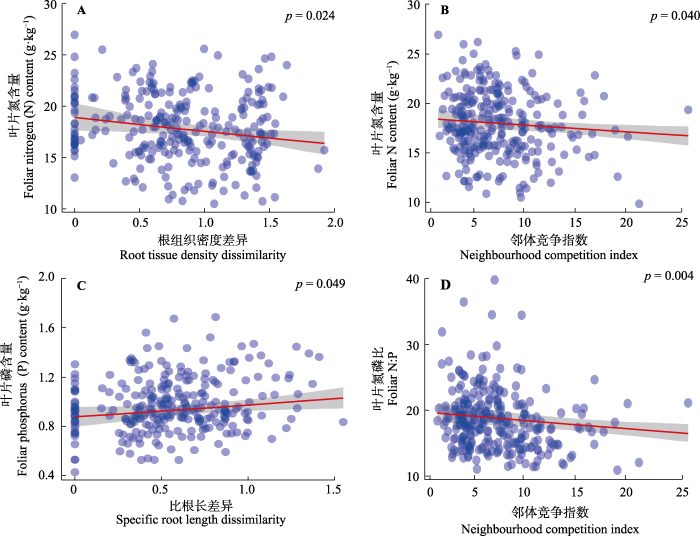
图1
邻域树种功能性状差异和邻体竞争指数对杉木叶片养分含量的影响。
Fig. 1
Effects of functional traits dissimilarity and neighborhood competition index on foliar nutrient contents of Cunninghamia lanceolata.
表3 邻域树种多样性、功能性状差异和邻体竞争指数对杉木叶片氮磷含量及氮磷比影响的最优拟合模型结果
Table 3
| 变量 Variable | 系数 Estimate | 标准误 SE | df | t | p | R2m | R2c | |
|---|---|---|---|---|---|---|---|---|
| 叶片氮含量 Foliar N content | 截距 Intercept | 2.87 | 0.02 | 66.4 | 184.16 | <0.001 | 0.05 | 0.20 |
| NSR | 0.03 | 0.02 | 55.0 | 1.83 | 0.073 | |||
| NCI | -0.03 | 0.01 | 263.0 | -2.06 | 0.04 | |||
| RTD_diss | -0.04 | 0.02 | 93.5 | -2.30 | 0.024 | |||
| 叶片磷含量 Foliar P content | 截距 Intercept | -0.05 | 0.02 | 134.6 | -2.45 | 0.016 | 0.17 | 0.29 |
| NSR | 0.03 | 0.02 | 123.9 | 1.26 | 0.212 | |||
| NCI | 0.02 | 0.02 | 263.4 | 0.92 | 0.361 | |||
| SRL_diss | 0.05 | 0.02 | 191.1 | 1.98 | 0.049 | |||
| NSR × SRL_diss | -0.05 | 0.02 | 87.6 | -2.40 | 0.018 | |||
| NCI × SRL_diss | -0.05 | 0.02 | 263.8 | -2.25 | 0.026 | |||
| 叶片氮磷比 Foliar N:P | 截距 Intercept | 2.89 | 0.03 | 159.0 | 114.09 | <0.001 | 0.16 | 0.33 |
| NSR | 0.02 | 0.31 | 168.8 | 0.61 | 0.546 | |||
| NCI | -0.05 | 0.02 | 263.8 | -2.90 | 0.004 | |||
| NP_diss | -0.06 | 0.03 | 228.5 | -1.90 | 0.059 | |||
| NSR × NP_diss | 0.07 | 0.02 | 108.3 | 2.69 | 0.008 | |||
| NCI × NP_diss | 0.04 | 0.02 | 251.7 | 1.58 | 0.116 |
NCI, 邻体竞争指数; NP_diss, 邻域系统发育差异; NSR, 邻域树种丰富度; RTD_diss, 根组织密度差异; SRL_diss, 比根长差异。R2m和R2c分别是固定效应以及固定效应和随机效应的R2。
NCI, neighbourhood competition index; NP_diss, neighbourhood phylogenetic dissimilarity; NSR, neighbourhood species richness; RTD_diss, root tissue density dissimilarity; SRL_diss, specific root length dissimilarity. R2m and R2c are R2 of fixed effect, fixed effect and random effect, respectively.
2.2 邻域树种丰富度、功能性状差异和邻体竞争指数对杉木叶片磷含量的影响
图2
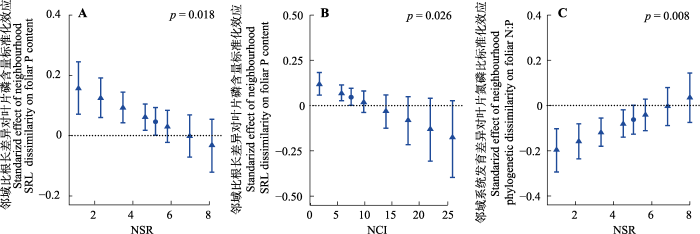
图2
邻域树种丰富度(NSR)、功能性状差异和邻体竞争指数(NCI)的交互作用对杉木叶片养分含量的影响(平均值±95%置信区间)。圆点表示NSR和NCI不同水平下邻域功能性状差异对叶片养分含量的影响。
Fig. 2
Interaction effects of neighborhood species richness (NSR), functional traits dissimilarity and neighborhood competition index (NCI) on foliar nutrients of Cunninghamia lanceolata (mean ± 95% confidence interval). The filled circle represent the effects of neighborhood functional traits dissimilarity on leaf nutrients at different level of NSR and NCI. N, nitrogen; P, phosphorus; SRL, specific root length.
2.3 邻域树种丰富度、功能性状差异和邻体竞争指数对杉木叶片氮磷比的影响
3 讨论
3.1 邻域树种丰富度与功能性状差异对杉木叶片氮磷含量的影响
本研究发现, 在亚热带混交林中, NSR对杉木叶片养分含量无显著影响。Pollastrini等(2017)研究发现, 北欧混交林中物种丰富度和物种组成对垂枝桦(Betula pendula)叶片N含量没有显著影响。杉木混交林随着林分树种多样性的增加, 杉木枝叶组织中N和P含量无显著变化(Bu et al., 2020)。同时, Zeugin等(2010)发现树种丰富度对不同树木N、P库的影响均无线性或递增关系。这些研究表明, 较难直接用树种丰富度来表征多样性对养分的影响。Firn等(2007)的研究结果表明, 植物多样性对P循环的影响不是简单由物种数量决定的, 而更有可能取决于物种的特定功能性状。
本研究中, 邻域树种和目标树之间的RTD_diss显著降低了杉木叶片N含量(图1A), 而邻域树种和目标树之间SRL_diss显著增加了杉木叶片P含量(图1C)。表明当杉木与具有不同养分获取能力的树种混合时, 根系之间的性状差异可能会增加资源利用的互补效应, 提高杉木对P的可利用性。RTD_diss对叶片N含量产生负效应, 表明在N饱和的土壤中树种会减少对N的竞争, 树种间对P的互补性作用增强(Lu et al., 2018)。N饱和的亚热带地区, P是限制性养分(Yang et al., 2014), 树木对土壤中P的利用率仅为10%-20% (Zou et al., 2015), 所以互补效应主要体现在树种多样性增强了树木对P的吸收与利用效率(Rieger et al., 2019)。N添加会增加土壤的矿质N含量和树木生长速率, 但会降低叶片或树枝的N含量, 可能是因为随着植物生物量的增加, N被“稀释” (Xu & Timmer, 1999)。
NSR对杉木叶片养分含量的影响, 随着邻域功能性状差异的变化而变化。在本研究中, 邻域树和目标树间SRL_diss对杉木叶片P含量的正影响随着NSR的增加而降低(图2A)。此外, 邻域树和目标树间NP_diss对杉木叶片N:P的负效应随着NSR的增加而降低(图2C)。综上, 随着NSR增加, 树种之间功能性状的差异降低了目标树叶片P含量, 从而增加了叶片N:P。有研究发现, 当草地植物多样性增加时, 地上植物组织N:P随着植物功能多样性的增加而增加(Abbas et al., 2013), 表明了功能性状差异可以反映资源利用的差异, 不同物种对本地资源的利用促进了生态位划分, 可以加强对有限资源的获取(Violle et al., 2012)。
本研究表明, 树种丰富度不是杉木叶片养分获取能力的主要驱动因素, 树种丰富度对养分获取能力的影响普遍较弱。邻域树种和目标树间的RTD_diss和SRL_diss越大, 对地下资源利用能力的差异越大, 邻域树种和目标树间的生态位互补作用越强, 有利于杉木对P的获取, 也证实了邻域尺度上, 功能性状差异对多样性效应具有较好的指示意义。
3.2 邻体竞争对杉木叶片氮磷含量的影响
本研究发现, 随着NCI的增加, 杉木叶片N含量显著降低(图1B), 叶片P含量无变化, 叶片N:P显著降低(图1D)。植物组织较低的N含量可能是由竞争引起的(Walker et al., 2017), 杉木暴露于强竞争环境中会表现出较低的N吸收率(Guo et al., 2020)。同时, 有研究报道混交红树林中秋茄树(Kandelia obovata)和蜡烛果(Aegiceras corniculatum)叶片N:P和竞争是负相关关系(Zhu et al., 2020), 本研究结果与之相似。Miller等(2007)发现, 与没有竞争的植物相比, 在激烈竞争下的植物N吸收下降了50%。有研究结果表明, 邻域树种竞争会降低树木对N的获取能力, 可能是由于树种不同的生长策略导致目标树在种间竞争下对N的吸收能力降低(Simon et al., 2014), 也有可能是因为密植导致N养分有限, 竞争加剧了树木对N的争夺(Nickmans et al., 2017)。此外, 有研究发现, 在没有树种竞争的情况下, 欧洲水青冈(Fagus sylvatica)对N的吸收率显著高于欧洲槭树Acer pseudoplatanus; 而在有竞争的情况下, 欧洲水青冈对N的吸收显著降低, 欧洲槭树表现出较高的N吸收率(Simon et al., 2010)。在杉木分别与马尾松、木荷、醉香含笑混交种植的盆栽实验中发现, 混交种植的杉木对N吸收能力要强于单一种植(Zhou et al., 2021), 这表明具有不同特性的相邻树种可以通过物种间相互作用影响杉木养分含量(Setiawan et al., 2016)。
NCI与邻域树和目标树间SRL_diss间的交互作用显著降低杉木叶片P含量, 表明随着NCI的增加, 树种之间功能性状的差异可能会对目标树叶片P含量产生负影响(图2B)。物种之间在功能性状上具有较大差异可以反映出它们在获取资源方面具有不同的竞争能力(Zemunik et al., 2015), 如比根长更大的目标物种在获取土壤养分方面比邻域物种具有竞争优势(Fort et al., 2014)。杉木对邻域树种的竞争反应进一步证实, 杉木与邻域树种之间的相互作用, 取决于树种特性和生长表现, 功能性状差异对竞争的调节作用也证实邻域树种对目标树的作用强度受到它们之间生态位互补的影响(Piao et al., 2013)。在群落中植物的分布具有明显的分层现象, 不同大小的植物共存在同一生境中。当邻域树个体大于目标树时, 邻域树在资源获取上占优势, 两者可能在资源获取策略上趋于一致, 生态位互补减弱(Mayfield & Levine, 2010)。综上所述, 竞争能力和生态位差异决定竞争的结果, 受杉木生长表现和养分获取策略的影响, 邻域树种的竞争力增强, 降低了杉木叶片N含量。
4 结论
由于混交林具有更好的生态功能和可持续性, 在杉木纯林中套种乡土树种是一种普遍趋势。在造林初期, 增加邻域树种丰富度主要通过改变邻体竞争、邻域树和目标树的性状差异从而影响叶片养分含量。功能性状差异比树种多样性能更好地指示多样性对杉木叶片养分的影响。混交林中竞争和性状差异的增大会导致树种间养分利用的生态位分化, 增加树种间互补作用, 增强生态系统功能。本研究结果为杉木人工林管理提供了启示, 即在人工林中引入合适的相邻树种可以促进树种对P的吸收, 改善养分循环, 进而提高生态系统功能。
致谢
感谢福建省龙岩市白砂国有林场对本研究的大力支持。
参考文献
Biodiversity effects on plant stoichiometry
DOI:10.1371/journal.pone.0058179 URL [本文引用: 1]
Food-web composition and plant diversity control foliar nutrient content and stoichiometry
DOI:10.1111/jec.2015.103.issue-6 URL [本文引用: 1]
Mixed broadleaved tree species increases soil phosphorus availability but decreases the coniferous tree nutrient concentration in subtropical China
DOI:10.3390/f11040461
URL
[本文引用: 1]

Phosphorus (P) is a key limiting nutrient in subtropical forests and mixed forests with broadleaved species have been expected to stimulate P cycling, compared to pure conifer plantations. However, the mixture effect of Chinese fir (Cunninghamia lanceolata (Lamb.) Hook.) and broadleaved species on rhizosphere soil and coniferous tree P dynamics is unclear. In our study, eight plots of a single species of a Chinese fir plantation (pure plantation, PP) and eight mixed plantations (mixed plantation, MP) with broadleaved tree species (Michelia macclurei Dandy in Hunan Province or Schima superba Gardn. et Champ. in Fujian Province) were selected in subtropical China. Six P fractions in the rhizosphere and bulk soils were analyzed by a modified Hedley P fractionation method. Phosphorus fractions and nitrogen (N) concentrations in different root orders, different age fresh needles and twigs, and needle and twig litter of Chinese fir were measured. Our results showed that available P, slowly released P, occluded P, and the total extractable P in rhizosphere soil were significantly higher in MP than PP (p < 0.05). In contrast, P and N concentrations in the transportive roots and two-year old needles were generally higher in PP than MP. Meanwhile, the slowly released P, occluded P, total extractable P, and residual P in rhizosphere soil were negatively correlated with P concentrations in young (absorptive and transportive roots, one- and two-year old needles) but not old tissues (storative roots, three-year old needles and litters). In conclusion, mixture may increase soil P availability through the rhizosphere effect, but can decrease P and N concentration of Chinese fir tissues by competition between Chinese fir and broadleaved species. Clearly, the mixture effect may differ in soil and plant nutrients, and this issue needs be taken into consideration when converting a pure conifer plantation into a mixed-species forest.
The ecology of differences: assessing community assembly with trait and evolutionary distances
DOI:10.1111/ele.12161
PMID:23910526
[本文引用: 1]
Species enter and persist in local communities because of their ecological fit to local conditions, and recently, ecologists have moved from measuring diversity as species richness and evenness, to using measures that reflect species ecological differences. There are two principal approaches for quantifying species ecological differences: functional (trait-based) and phylogenetic pairwise distances between species. Both approaches have produced new ecological insights, yet at the same time methodological issues and assumptions limit them. Traits and phylogeny may provide different, and perhaps complementary, information about species' differences. To adequately test assembly hypotheses, a framework integrating the information provided by traits and phylogenies is required. We propose an intuitive measure for combining functional and phylogenetic pairwise distances, which provides a useful way to assess how functional and phylogenetic distances contribute to understanding patterns of community assembly. Here, we show that both traits and phylogeny inform community assembly patterns in alpine plant communities across an elevation gradient, because they represent complementary information. Differences in historical selection pressures have produced variation in the strength of the trait-phylogeny correlation, and as such, integrating traits and phylogeny can enhance the ability to detect assembly patterns across habitats or environmental gradients. © 2013 John Wiley & Sons Ltd/CNRS.
Impacts of plant diversity on biomass production increase through time because of species complementarity
DOI:10.1073/pnas.0709069104
PMID:17991772
[本文引用: 1]
Accelerating rates of species extinction have prompted a growing number of researchers to manipulate the richness of various groups of organisms and examine how this aspect of diversity impacts ecological processes that control the functioning of ecosystems. We summarize the results of 44 experiments that have manipulated the richness of plants to examine how plant diversity affects the production of biomass. We show that mixtures of species produce an average of 1.7 times more biomass than species monocultures and are more productive than the average monoculture in 79% of all experiments. However, in only 12% of all experiments do diverse polycultures achieve greater biomass than their single most productive species. Previously, a positive net effect of diversity that is no greater than the most productive species has been interpreted as evidence for selection effects, which occur when diversity maximizes the chance that highly productive species will be included in and ultimately dominate the biomass of polycultures. Contrary to this, we show that although productive species do indeed contribute to diversity effects, these contributions are equaled or exceeded by species complementarity, where biomass is augmented by biological processes that involve multiple species. Importantly, both the net effect of diversity and the probability of polycultures being more productive than their most productive species increases through time, because the magnitude of complementarity increases as experiments are run longer. Our results suggest that experiments to date have, if anything, underestimated the impacts of species extinction on the productivity of ecosystems.
Positive effects of neighborhood complementarity on tree growth in a Neotropical forest
Numerous grassland experiments have found evidence for a complementarity effect, an increase in productivity with higher plant species richness due to niche partitioning. However, empirical tests of complementarity in natural forests are rare. We conducted a spatially explicit analysis of 518 433 growth records for 274 species from a 50-ha tropical forest plot to test neighborhood complementarity, the idea that a tree grows faster when it is surrounded by more dissimilar neighbors. We found evidence for complementarity: focal tree growth rates increased by 39.8% and 34.2% with a doubling of neighborhood multi-trait dissimilarity and phylogenetic dissimilarity, respectively. Dissimilarity from neighbors in maximum height had the most important effect on tree growth among the six traits examined, and indeed, its effect trended much larger than that of the multitrait dissimilarity index. Neighborhood complementarity effects were strongest for light-demanding species, and decreased in importance with increasing shade tolerance of the focal individuals. Simulations demonstrated that the observed neighborhood complementarities were sufficient to produce positive stand-level biodiversity-productivity relationships. We conclude that neighborhood complementarity is important for productivity in this tropical forest, and that scaling down to individual-level processes can advance our understanding of the mechanisms underlying stand-level biodiversity-productivity relationships.
Structural diversity promotes productivity of mixed, uneven-aged forests in southwestern Germany
DOI:10.1007/s00442-016-3623-4
PMID:27059713
[本文引用: 1]
Forest diversity-productivity relationships have been intensively investigated in recent decades. However, few studies have considered the interplay between species and structural diversity in driving productivity. We analyzed these factors using data from 52 permanent plots in southwestern Germany with more than 53,000 repeated tree measurements. We used basal area increment as a proxy for productivity and hypothesized that: (1) structural diversity would increase tree and stand productivity, (2) diversity-productivity relationships would be weaker for species diversity than for structural diversity, and (3) species diversity would also indirectly impact stand productivity via changes in size structure. We measured diversity using distance-independent indices. We fitted separate linear mixed-effects models for fir, spruce and beech at the tree level, whereas at the stand level we pooled all available data. We tested our third hypothesis using structural equation modeling. Structural and species diversity acted as direct and independent drivers of stand productivity, with structural diversity being a slightly better predictor. Structural diversity, but not species diversity, had a significant, albeit asymmetric, effect on tree productivity. The functioning of structurally diverse, mixed forests is influenced by both structural and species diversity. These sources of trait diversity contribute to increased vertical stratification and crown plasticity, which in turn diminish competitive interferences and lead to more densely packed canopies per unit area. Our research highlights the positive effects of species diversity and structural diversity on forest productivity and ecosystem dynamics.
Root responses to nutrients and soil biota: drivers of species coexistence and ecosystem productivity
DOI:10.1111/jec.2011.100.issue-1 URL [本文引用: 1]
Neighbourhood interactions drive overyielding in mixed-species tree communities
DOI:10.1038/s41467-018-03529-w
PMID:29559628
[本文引用: 1]
Theory suggests that plant interactions at the neighbourhood scale play a fundamental role in regulating biodiversity-productivity relationships (BPRs) in tree communities. However, empirical evidence of this prediction is rare, as little is known about how neighbourhood interactions scale up to influence community BPRs. Here, using a biodiversity-ecosystem functioning experiment, we provide insights into processes underlying BPRs by demonstrating that diversity-mediated interactions among local neighbours are a strong regulator of productivity in species mixtures. Our results show that local neighbourhood interactions explain over half of the variation in observed community productivity along a diversity gradient. Overall, individual tree growth increased with neighbourhood species richness, leading to a positive BPR at the community scale. The importance of local-scale neighbourhood effects for regulating community productivity, however, distinctly increased with increasing community species richness. Preserving tree species diversity at the local neighbourhood scale, thus seems to be a promising way for promoting forest productivity.
From competition to facilitation: How tree species respond to neighbourhood diversity
DOI:10.1111/ele.12786
PMID:28616871
[本文引用: 1]
Studies on tree communities have demonstrated that species diversity can enhance forest productivity, but the driving mechanisms at the local neighbourhood level remain poorly understood. Here, we use data from a large-scale biodiversity experiment with 24 subtropical tree species to show that neighbourhood tree species richness generally promotes individual tree productivity. We found that the underlying mechanisms depend on a focal tree's functional traits: For species with a conservative resource-use strategy diversity effects were brought about by facilitation, and for species with acquisitive traits by competitive reduction. Moreover, positive diversity effects were strongest under low competition intensity (quantified as the total basal area of neighbours) for acquisitive species, and under high competition intensity for conservative species. Our findings demonstrate that net biodiversity effects in tree communities can vary over small spatial scales, emphasising the need to consider variation in local neighbourhood interactions to better understand effects at the community level.© 2017 John Wiley & Sons Ltd/CNRS.
Woody species diversity influences productivity and soil nutrient availability in tropical plantations
We investigated the relationship between plant diversity and ecological function (production and nutrient cycling) in tropical tree plantations. Old plantations (65-72 years) of four different species, namely Araucaria cunninghamii, Agathis robusta, Toona ciliata and Flindersia brayleyana, as well as natural secondary forest were examined at Wongabel State Forest, in the wet tropics region of Queensland, Australia. Two young plantations (23 years) of Araucaria cunninghamii and Pinus caribaea were also examined. The close proximity of the older plantations and natural forests meant they had similar edaphic and climatic conditions. All plantations had been established as monocultures, but had been colonised by a range of native woody plants from the nearby rainforest. The extent to which this had occurred varied with the identity of the plantation species (from 2 to 17 species in 0.1 ha blocks). In many cases these additional species had grown up and joined the forest canopy. This study is one of the few to find a negative relationship between overstorey plant diversity and productivity. The conversion of natural forest with highly productive, low-diversity gymnosperm-dominated plantations (young and old Araucaria cunninghamii and Pinus caribaea) was found to be associated with lower soil nutrient availability (approximately five times less phosphorus and 2.5 times less nitrogen) and lower soil pH (mean=6.28) compared to the other, less productive plantations. The dominant effects of two species, Araucaria cunninghamii and Hodgkinsonia frutescens, indicate that ecosystem functions such as production and nutrient availability are not determined solely by the number of species, but are more likely to be determined by the characteristics of the species present. This suggests that monoculture plantations can be used to successfully restore some functions (e.g. nutrient cycling and production), but that the level to which such functions can be restored will depend upon the species chosen and site conditions.
A review of processes behind diversity-productivity relationships in forests
DOI:10.1007/s40725-016-0031-2 URL [本文引用: 1]
Hierarchy of root functional trait values and plasticity drive early-stage competition for water and phosphorus among grasses
DOI:10.1111/fec.2014.28.issue-4 URL [本文引用: 1]
Functional trait differences influence neighbourhood interactions in a hyperdiverse Amazonian forest
DOI:10.1111/ele.12642
PMID:27358248
[本文引用: 1]
As distinct community assembly processes can produce similar community patterns, assessing the ecological mechanisms promoting coexistence in hyperdiverse rainforests remains a considerable challenge. We use spatially explicit neighbourhood models of tree growth to quantify how functional trait and phylogenetic similarities predict variation in growth and crowding effects for the 315 most abundant tree species in a 25-ha lowland rainforest plot in Ecuador. We find that functional trait differences reflect variation in (1) species maximum potential growth, (2) the intensity of interspecific interactions for some species, and (3) species sensitivity to neighbours. We find that neighbours influenced tree growth in 28% of the 315 focal tree species. Neighbourhood effects are not detected in the remaining 72%, which may reflect the low statistical power to model rare taxa and/or species insensitivity to neighbours. Our results highlight the spectrum of ways in which functional trait differences can shape community dynamics in highly diverse rainforests.© 2016 John Wiley & Sons Ltd/CNRS.
Interspecific competition alters leaf stoichiometry in 20 grassland species
DOI:10.1111/oik.2017.v127.i7 URL [本文引用: 1]
Stronger intra-specific competition aggravates negative effects of drought on the growth of Cunninghamia lanceolata
DOI:10.1016/j.envexpbot.2020.104042 URL [本文引用: 1]
Overyielding in grassland communities: testing the sampling effect hypothesis with replicated biodiversity experiments
DOI:10.1046/j.1461-0248.2002.00337.x URL [本文引用: 1]
A simulation model for managing jack-pine stands
Effects of biodiversity on ecosystem functioning: a consensus of current knowledge
DOI:10.1890/04-0922 URL [本文引用: 1]
Impacts of species richness on productivity in a large-scale subtropical forest experiment
DOI:10.1126/science.aat6405
PMID:30287660
[本文引用: 1]
Biodiversity experiments have shown that species loss reduces ecosystem functioning in grassland. To test whether this result can be extrapolated to forests, the main contributors to terrestrial primary productivity, requires large-scale experiments. We manipulated tree species richness by planting more than 150,000 trees in plots with 1 to 16 species. Simulating multiple extinction scenarios, we found that richness strongly increased stand-level productivity. After 8 years, 16-species mixtures had accumulated over twice the amount of carbon found in average monocultures and similar amounts as those of two commercial monocultures. Species richness effects were strongly associated with functional and phylogenetic diversity. A shrub addition treatment reduced tree productivity, but this reduction was smaller at high shrub species richness. Our results encourage multispecies afforestation strategies to restore biodiversity and mitigate climate change.Copyright © 2018 The Authors, some rights reserved; exclusive licensee American Association for the Advancement of Science. No claim to original U.S. Government Works.
Soil microbial biomass, community composition and soil nitrogen cycling in relation to tree species in subtropical China
DOI:10.1016/j.soilbio.2013.03.008 URL [本文引用: 1]
High plant diversity is needed to maintain ecosystem services
DOI:10.1038/nature10282 [本文引用: 2]
Tree diversity drives forest stand resistance to natural disturbances
DOI:10.1007/s40725-017-0064-1 URL [本文引用: 1]
Functional trait differences and the outcome of community assembly: an experimental test with vernal pool annual plants
DOI:10.1111/more.2014.123.issue-11 URL [本文引用: 1]
Overyielding of fine root biomass as increasing plant species richness in subtropical forests in central southern China
DOI:10.3724/SP.J.1258.2011.00539 URL [本文引用: 1]
中亚热带森林植物多样性增加导致细根生物量“超产”
DOI:10.3724/SP.J.1258.2011.00539
[本文引用: 1]
细根在森林生态系统C分配和养分循环过程中发挥着重要作用, 但对地下细根与植物多样性之间关系的研究相对较少。该研究选择中亚热带从单一树种的杉木(Cunninghamia lanceolata)人工林到多树种的常绿阔叶林(青冈(Cyclobalanopsis glauca)-石栎(Lithocarpus glaber)林)的不同植物多样性梯度, 用根钻法采集细根并测定其生物量, 用Win-RHIZO 2005C根系分析系统测定细根形态参数, 以验证以下3个假设: 1)植物种类丰富度高的林分其细根生产存在“地下超产”现象; 2)根系空间生态位的分离水平是否随着植物多样性增多而增大? 3)细根是否通过形态可塑性对林木竞争做出响应?结果显示: 从单一树种的杉木人工林到植物种类较复杂的青冈-石栎常绿阔叶林, 0–30 cm土层的林分细根总生物量和活细根生物量均呈增加的趋势, 即细根总生物量为杉木林(305.20 g·m<sup>–2</sup>) Pinus massoniana)林(374.25 g·m<sup>–2</sup>) Choerospondias axillaris)林(537.42 g·m<sup>–2</sup>) –2</sup>), 活细根生物量为杉木林(268.74 g·m<sup>–2</sup>) –2</sup>) –2</sup>) –2</sup>), 各森林类型之间的细根总生物量差异显著(p
Development strategy and management countermeasures of planted forests in China: transforming from timber-centered single objective management towards multi-purpose management for enhancing quality and benefits of ecosystem services
DOI:10.1016/j.chnaes.2017.02.003 URL [本文引用: 1]
中国人工林经营发展战略与对策: 从追求木材产量的单一目标经营转向提升生态系统服务质量和效益的多目标经营
Biodiversity and ecosystem functioning: recent theoretical advances
DOI:10.1034/j.1600-0706.2000.910101.x URL [本文引用: 1]
Species and soil effects on overyielding of tree species mixtures in the Netherlands
DOI:10.1016/j.foreco.2017.11.010 URL [本文引用: 1]
Effect of Close-to-Nature management on the natural regeneration and species diversity in a masson pine plantation
DOI:10.5846/stxb URL [本文引用: 1]
马尾松人工林近自然化改造对植物自然更新及物种多样性的影响
The relationship between species richness and productivity in four typical grasslands of northern China
DOI:10.1360/biodiv.050146
[本文引用: 1]
The relationship between plant species diversity and primary productivity has long been a hot topic in biodiversity research. We examined the relationship between species richness and productivity in four typical grasslands of northern China at different spatial scales. At the community scale, a positive correlation was found for six of seven communities, and a unimodal pattern was found only for one community (<i>Stipa glareosa community</i>). At large scale (vegetation type or landscape/region), a significant positive relationship was found. Species richness ranged from 4 to 35 species, and community above-ground productivity from 13 to 368 g·m<sup>–2</sup>·yr<sup>–1</sup>. The highest species richness and above-ground productivity were found in the alpine meadow community, followed by meadow steppe, typical steppe and desert steppe.
中国北方典型草地物种丰富度与生产力的关系
DOI:10.1360/biodiv.050146
[本文引用: 1]
利用2002–2004年内蒙古和甘肃南部几种典型草地的实测资料, 研究了不同尺度物种丰富度与生产力的关系, 并初步探讨了其形成机制。结果显示, 温带草地的物种丰富度随生产力的增加而增加, 但受空间尺度影响。在群落尺度(同一群落), 在7种样方数大于15的群落中, 仅沙生针茅(Stipa glareosa)群落物种丰富度与生产力呈现单峰型关系, 其余均呈现线性正相关关系; 在植被类型尺度, 物种丰富度–生产力之间表现为显著的正相关关系; 在研究区尺度, 物种丰富度随生产力的增加而显著增加。研究还表明, 研究区群落生产力的变化范围为13–368 g·m<sup>–2</sup>·yr<sup>–1</sup>, 物种丰富度为4–35 种; 生产力从高到低的顺序为: 高寒草甸>草甸草原>典型草原>荒漠草原。
Opposing effects of competitive exclusion on the phylogenetic structure of communities
DOI:10.1111/j.1461-0248.2010.01509.x
PMID:20576030
[本文引用: 1]
Though many processes are involved in determining which species coexist and assemble into communities, competition is among the best studied. One hypothesis about competition's contribution to community assembly is that more closely related species are less likely to coexist. Though empirical evidence for this hypothesis is mixed, it remains a common assumption in certain phylogenetic approaches for inferring the effects of environmental filtering and competitive exclusion. Here, we relate modern coexistence theory to phylogenetic community assembly approaches to refine expectations for how species relatedness influences the outcome of competition. We argue that two types of species differences determine competitive exclusion with opposing effects on relatedness patterns. Importantly, this means that competition can sometimes eliminate more different and less related taxa, even when the traits underlying the relevant species differences are phylogenetically conserved. Our argument leads to a reinterpretation of the assembly processes inferred from community phylogenetic structure.
Relationships between long-term trends of air temperature, precipitation, nitrogen nutrition and growth of coniferous stands in central Europe and Finland
DOI:10.1007/s10342-008-0233-7 URL [本文引用: 1]
Plant uptake of inorganic and organic nitrogen: neighbor identity matters
The importance of interspecific competition as a cause of resource partitioning among species has been widely assumed but rarely tested. Using neighbor removals in combination with 15N tracer additions in the field, we examined variation among three alpine species in the uptake of 15N-NH4+, 15N-NO3-, and 15N-13C-[2]-glycine in intact neighborhoods, when paired with a specific neighbor, and when all neighbors were removed. Species varied in the capacity to take up 15N-labeled NH4+, NO3-, and glycine in intact neighborhoods and in interspecific pairs. When interspecific neighbor pairs were compared with no neighbor controls, neighbors reduced 15N uptake in target species by as much as 50%, indicating competition for N. Furthermore, neighbor identity influenced the capacity of species to take up different forms of N. Thus, competition within interspecific neighbor pairs often caused reduced uptake of a particular form of N, as well as shifts to uptake of an alternative form of N. Such shifts in resource use as a result of competition are an implicit assumption in studies of resource partitioning but have rarely been documented. Our study suggests that plasticity in the uptake of different forms of N may be a mechanism by which cooccurring plants reduce competition for N.
Tree growth, recruitment, and survival in a tropical dry woodland: the importance of soil and functional identity of the neighbourhood
DOI:10.1016/j.foreco.2020.117894 URL [本文引用: 1]
Tree size and local neighbourhood affect foliar nutrient content in a mixed plantation of beech (Fagus sylvatica) and maple (Acer pseudoplatanus)
DOI:10.1016/j.foreco.2017.05.051 URL [本文引用: 1]
Tree mixture effects on aboveground nutrient pools of trees in an experimental plantation in Panama
DOI:10.1007/s11104-009-9997-x URL [本文引用: 2]
Phylogenetic density dependence and environmental filtering predict seedling mortality in a tropical forest
DOI:10.1111/j.1461-0248.2011.01705.x
PMID:22004454
[本文引用: 1]
Negative density dependence (NDD) and environmental filtering (EF) shape community assembly, but their relative importance is poorly understood. Recent studies have shown that seedling's mortality risk is positively related to the phylogenetic relatedness of neighbours. However, natural enemies, whose depredations often cause NDD, respond to functional traits of hosts rather than phylogenetic relatedness per se. To understand the roles of NDD and EF in community assembly, we assessed the effects on seedling mortality of functional similarity, phylogenetic relatedness and stem density of neighbouring seedlings and adults in a species-rich tropical forest. Mortality risks increased for common species when their functional traits departed substantially from the neighbourhood mean, and for all species when surrounded by close relatives. This indicates that NDD affects community assembly more broadly than does EF, and leads to the tentative conclusion that natural enemies respond to phylogenetically correlated traits. Our results affirm the prominence of NDD in structuring species-rich communities.© 2011 Blackwell Publishing Ltd/CNRS.
Leaf N:P stoichiometry across plant functional groups in the karst region of southwestern China
DOI:10.1007/s00468-015-1170-y URL [本文引用: 1]
Phylogenetic structure and host abundance drive disease pressure in communities
DOI:10.1038/nature14372 [本文引用: 1]
Density dependence across multiple life stages in a temperate old-growth forest of northeast China
DOI:10.1007/s00442-012-2481-y
PMID:23053238
[本文引用: 1]
Recent studies on species coexistence suggest that density dependence is an important mechanism regulating plant populations. However, there have been few studies of density dependence conducted for more than one life-history stage or that control for habitat heterogeneity, which may influence spatial patterns of survival and mask density dependence. We explored the prevalence of density dependence across multiple life stages, and the effects of controlling for habitat heterogeneity, in a temperate forest in northeast China. We used generalized linear mixed-effects models to test for density-dependent mortality of seedlings and spatial point pattern analysis to detect density dependence for sapling-to-juvenile transitions. Conspecific neighbors had a negative effect on survival of plants in both life stages. At the seedling stage, we found a negative effect of conspecific seedling neighbors on survival when analyzing all species combined. However, in species-level analyses, only 2 of 11 focal species were negatively impacted by conspecific neighbors, indicating wide variation among species in the strength of density dependence. Controlling for habitat heterogeneity did not alter our findings of density dependence at the seedling stage. For the sapling-to-juvenile transition stage, 11 of 15 focal species showed patterns of local scale (<10 m) conspecific thinning, consistent with negative density dependence. The results varied depending on whether we controlled for habitat heterogeneity, indicating that a failure to account for habitat heterogeneity can obscure patterns of density dependence. We conclude that density dependence may promote tree species coexistence by acting across multiple life-history stages in this temperate forest.
Tree diversity affects chlorophyll a fluorescence and other leaf traits of tree species in a boreal forest
DOI:10.1093/treephys/tpw132
PMID:28100710
[本文引用: 1]
An assemblage of tree species with different crown properties creates heterogeneous environments at the canopy level. Changes of functional leaf traits are expected, especially those related to light interception and photosynthesis. Chlorophyll a fluorescence (ChlF) properties in dark-adapted leaves, specific leaf area, leaf nitrogen content (N) and carbon isotope composition (δ13C) were measured on Picea abies (L.) H.Karst., Pinus sylvestris L. and Betula pendula Roth. in monospecific and mixed boreal forests in Europe, in order to test whether they were affected by stand species richness and composition. Photosynthetic efficiency, assessed by induced emission of leaf ChlF, was positively influenced in B. pendula by species richness, whereas P. abies showed higher photosynthetic efficiency in monospecific stands. Pinus sylvestris had different responses when it coexisted with P. abies or B. pendula. The presence of B. pendula, but not of P. abies, in the forest had a positive effect on the efficiency of photosynthetic electron transport and N in P. sylvestris needles, and the photosynthetic responses were positively correlated with an increase of leaf δ13C. These effects on P. sylvestris may be related to high light availability at the canopy level due to the less dense canopy of B. pendula. The different light requirements of coexisting species was the most important factor affecting the distribution of foliage in the canopy, driving the physiological responses of the mixed species. Future research directions claim to enhance the informative potential of the methods to analyse the responses of pure and mixed forests to environmental factors, including a broader set of plant species' functional traits and physiological responses.© The Author 2017. Published by Oxford University Press. All rights reserved. For Permissions, please email: journals.permissions@oup.com.
Impacts of biodiversity loss escalate through time as redundancy fades
DOI:10.1126/science.1217909
PMID:22556253
[本文引用: 1]
Plant diversity generally promotes biomass production, but how the shape of the response curve changes with time remains unclear. This is a critical knowledge gap because the shape of this relationship indicates the extent to which loss of the first few species will influence biomass production. Using two long-term (≥13 years) biodiversity experiments, we show that the effects of diversity on biomass productivity increased and became less saturating over time. Our analyses suggest that effects of diversity-dependent ecosystem feedbacks and interspecific complementarity accumulate over time, causing high-diversity species combinations that appeared functionally redundant during early years to become more functionally unique through time. Consequently, simplification of diverse ecosystems will likely have greater negative impacts on ecosystem functioning than has been suggested by short-term experiments.
The influence of mixed tree plantations on the nutrition of individual species: a review
DOI:10.1093/treephys/tpq035
PMID:20472645
[本文引用: 1]
Productivity of tree plantations is a function of the supply, capture and efficiency of use of resources, as outlined in the Production Ecology Equation. Species interactions in mixed-species stands can influence each of these variables. The importance of resource-use efficiency in determining forest productivity has been clearly demonstrated in monocultures; however, substantial knowledge gaps remain for mixtures. This review examines how the physiology and morphology of a given species can vary depending on whether it grows in a mixture or monoculture. We outline how physiological and morphological shifts within species, resulting from interactions in mixtures, may influence the three variables of the Production Ecology Equation, with an emphasis on nutrient resources [nitrogen (N) and phosphorus (P)]. These include (i) resource availability, including soil nutrient mineralization, N₂ fixation and litter decomposition; (ii) proportion of resources captured, resulting from shifts in spatial, temporal and chemical patterns of root dynamics; (iii) resource-use efficiency. We found that more than 50% of mixed-species studies report a shift to greater above-ground nutrient content of species grown in mixtures compared to monocultures, indicating an increase in the proportion of resources captured from a site. Secondly, a meta-analysis showed that foliar N concentrations significantly increased for a given species in a mixture containing N₂-fixing species, compared to a monoculture, suggesting higher rates of photosynthesis and greater resource-use efficiency. Significant shifts in N- and P-use efficiencies of a given species, when grown in a mixture compared to a monoculture, occurred in over 65% of studies where resource-use efficiency could be calculated. Such shifts can result from changes in canopy photosynthetic capacities, changes in carbon allocation or changes to foliar nutrient residence times of species in a mixture. We recommend that future research focus on individual species' changes, particularly with respect to resource-use efficiency (including nutrients, water and light), when trees are grown in mixtures compared to monocultures. A better understanding of processes responsible for changes to tree productivity in mixed-species tree plantations can improve species, and within-species, selection so that the long-term outcome of mixtures is more predictable.
Linkages between phosphorus and plant diversity in central European forest ecosystems—Complementarity or competition?
DOI:10.3390/f10121156
URL
[本文引用: 1]
The phosphorus nutrition status of European forests has decreased significantly in recent decades. For a deeper understanding of complementarity and competition in terms of P acquisition in temperate forests, we have analyzed α-diversity, organic layer and mineral soil P, P nutrition status, and different concepts of P use efficiency (PUE) in Fagus sylvatica L. (European beech) and Picea abies (L.) H. Karst. (Norway spruce). Using a subset of the Second National Soil Survey in Germany, we correlated available data on P in the organic layer and soil with α-diversity indices for beech and spruce forests overall and for individual vegetation layers (tree, shrub, herb, and moss layers). Moreover, we investigated α-diversity feedbacks on P nutrition status and PUE of both tree species. The overall diversity of both forest ecosystems was largely positively related to P content in the organic layer and soil, but there were differences among the vegetation layers. Diversity in the tree layer of both forest ecosystems was negatively related to the organic layer and soil P. By contrast, shrub diversity showed no correlation to P, while herb layer diversity was negatively related to P in the organic layer but positively to P in soil. A higher tree layer diversity was slightly related to increased P recycling efficiency (PPlant/Porganic layer) in European beech and P uptake efficiency (PPlant/Psoil) in Norway spruce. The diversity in the herb layer was negatively related to P recycling and uptake efficiency in European beech and slightly related to P uptake efficiency in Norway spruce. In spruce forests, overall and herb species richness led to significantly improved tree nutrition status. Our results confirm significant, non-universal relationships between P and diversity in temperate forests with variations among forest ecosystems, vegetation layers, and P in the organic layer or soil. In particular, tree species diversity may enhance complementarity and hence also P nutrition of dominant forest trees through higher PUE, whereas moss and herb layers seemed to show competitive relationships among each other in nutrient cycling.
Contrasting effects of intraspecific trait variation on trait- based niches and performance of legumes in plant mixtures
DOI:10.1371/journal.pone.0119786 URL [本文引用: 1]
Does neighbourhood tree diversity affect the crown arthropod community in saplings?
DOI:10.1007/s10531-015-1044-z URL [本文引用: 1]
On the maintenance of long-term productivity of plantation in China
关于我国人工林长期生产力的保持
Competition for nitrogen between European beech and sycamore maple shifts in favour of beech with decreasing light availability
DOI:10.1093/treephys/tpt112
PMID:24391164
[本文引用: 1]
Plant species use different strategies for maximizing growth and fitness under changing environmental conditions. At the ecosystem level, seedlings in particular compete with other vegetation components for light and nitrogen (N), which often constitute growth-limiting resources. In this study, we investigated the effect of light availability on the competition for N between seedlings of European beech and sycamore maple and analysed the consequences of this competition for the composition of N metabolites in fine roots. Our results show different strategies in N acquisition between beech and sycamore maple. Both species responded to reduced light availability by adapting their morphological and physiological traits with a decrease in biomass and net assimilation rate and an increase in specific leaf area and leaf area ratio. For beech seedlings, competition with sycamore maple led to a reduction in organic N uptake capacity. Reduced light availability led to a decrease in ammonium, but an increase in glutamine-N uptake capacity in sycamore maple. However, this response was stronger compared with that of beech and was accompanied by reduced growth. Thus, our results suggest better adaptation of N acquisition to reduced light availability in beech compared with sycamore maple seedlings.
Competition for nitrogen sources between European beech (Fagus sylvatica) and sycamore maple (Acer pseudoplatanus) seedlings
DOI:10.1111/j.1438-8677.2009.00225.x
PMID:20522181
[本文引用: 1]
To investigate the short-term consequences of direct competition between beech and sycamore maple on root N uptake and N composition, mycorrhizal seedlings of both tree species were incubated for 4 days (i.e. beech only, sycamore maple only or both together) in an artificial nutrient solution with low N availability. On the fourth day, N uptake experiments were conducted to study the effects of competition on inorganic and organic N uptake. For this purpose, multiple N sources were applied with a single label. Furthermore, fine roots were sampled and analysed for total amino acids, soluble protein, total nitrogen, nitrate and ammonium content. Our results clearly show that both tree species were able to use inorganic and organic N sources. Uptake of inorganic and organic N by beech roots was negatively affected in the presence of the competing tree species. In contrast, the presence of beech stimulated inorganic N uptake by sycamore maple roots. Both the negative effect of sycamore maple on N uptake of beech and the positive effect of beech on N uptake of sycamore maple led to an increase in root soluble protein in beech, despite an overall decrease in total N concentration. Thus, beech compensated for the negative effects of the tree competitor on N uptake by incorporating less N into structural N components, but otherwise exhibited the same strategy as the competitor, namely, enhancing soluble protein levels in roots when grown under competition. It is speculated that enhanced enzyme activities of so far unknown nature are required in beech as a defence response to inter-specific competition.
Increasing crop heterogeneity enhances multitrophic diversity across agricultural regions
DOI:10.1073/pnas.1906419116
PMID:31358630
[本文引用: 1]
Agricultural landscape homogenization has detrimental effects on biodiversity and key ecosystem services. Increasing agricultural landscape heterogeneity by increasing seminatural cover can help to mitigate biodiversity loss. However, the amount of seminatural cover is generally low and difficult to increase in many intensively managed agricultural landscapes. We hypothesized that increasing the heterogeneity of the crop mosaic itself (hereafter "crop heterogeneity") can also have positive effects on biodiversity. In 8 contrasting regions of Europe and North America, we selected 435 landscapes along independent gradients of crop diversity and mean field size. Within each landscape, we selected 3 sampling sites in 1, 2, or 3 crop types. We sampled 7 taxa (plants, bees, butterflies, hoverflies, carabids, spiders, and birds) and calculated a synthetic index of multitrophic diversity at the landscape level. Increasing crop heterogeneity was more beneficial for multitrophic diversity than increasing seminatural cover. For instance, the effect of decreasing mean field size from 5 to 2.8 ha was as strong as the effect of increasing seminatural cover from 0.5 to 11%. Decreasing mean field size benefited multitrophic diversity even in the absence of seminatural vegetation between fields. Increasing the number of crop types sampled had a positive effect on landscape-level multitrophic diversity. However, the effect of increasing crop diversity in the landscape surrounding fields sampled depended on the amount of seminatural cover. Our study provides large-scale, multitrophic, cross-regional evidence that increasing crop heterogeneity can be an effective way to increase biodiversity in agricultural landscapes without taking land out of agricultural production.
Diversity and productivity in a long-term grassland experiment
Plant diversity and niche complementarity had progressively stronger effects on ecosystem functioning during a 7-year experiment, with 16-species plots attaining 2.7 times greater biomass than monocultures. Diversity effects were neither transients nor explained solely by a few productive or unviable species. Rather, many higher-diversity plots outperformed the best monoculture. These results help resolve debate over biodiversity and ecosystem functioning, show effects at higher than expected diversity levels, and demonstrate, for these ecosystems, that even the best-chosen monocultures cannot achieve greater productivity or carbon stores than higher-diversity sites.
Functional identity is the main driver of diversity effects in young tree communities
DOI:10.1111/ele.12600
PMID:27072428
[本文引用: 1]
Two main effects are proposed to explain biodiversity-ecosystem functioning relationships: niche complementarity and selection effects. Both can be functionally defined using the functional diversity (FD) and functional identity (FI) of the community respectively. Herein, we present results from the first tree diversity experiment that separated the effect of selection from that of complementarity by varying community composition in high-density plots along a gradient of FD, independent of species richness and testing for the effects of FD and community weighted means of traits (a proxy for FI) on stem biomass increment (a proxy for productivity). After 4 years of growth, most mixtures did not differ in productivity from the averages of their respective monocultures, but some did overyield significantly. Those positive diversity effects resulted mostly from selection effects, primarily driven by fast-growing deciduous species and associated traits. Net diversity effect did not increase with time over 4 years. © 2016 John Wiley & Sons Ltd/CNRS.
Understanding the value of plant diversity for ecosystem functioning through niche theory
DOI:10.1098/rspb.2016.0536 [本文引用: 1]
Disentangling biodiversity and climatic determinants of wood production
DOI:10.1371/journal.pone.0053530 URL [本文引用: 1]
The return of the variance: intraspecific variability in community ecology
DOI:10.1016/j.tree.2011.11.014 URL [本文引用: 1]
Functional trait dissimilarity drives both species complementarity and competitive disparity
DOI:10.1111/fec.2017.31.issue-12 URL [本文引用: 1]
Competition from Bromus tectorum removes differences between perennial grasses in N capture and conservation strategies
DOI:10.1007/s11104-016-3053-4 URL [本文引用: 1]
Growth and nitrogen nutrition of Chinese fir seedlings exposed to nutrient loading and fertilization
DOI:10.1023/A:1004733714217 URL [本文引用: 1]
The role of phosphorus dynamics in tropical forests—A modeling study using CLM-CNP
DOI:10.5194/bg-11-1667-2014
URL
[本文引用: 1]
. Tropical forests play a significant role in the global carbon cycle and global climate. However, tropical carbon cycling and the feedbacks from tropical ecosystems to the climate system remain critical uncertainties in the current generation of carbon–climate models. One of the major uncertainties comes from the lack of representation of phosphorus (P), currently believed to be the most limiting nutrient in tropical regions. Here we introduce P dynamics and C–N–P interactions into the CLM4-CN (Community Land Model version 4 with prognostic Carbon and Nitrogen) model and investigate the role of P cycling in controlling the productivity of tropical ecosystems. The newly developed CLM-CNP model includes all major biological and geochemical processes controlling P availability in soils and the interactions between C, N, and P cycles. Model simulations at sites along a Hawaiian soil chronosequence indicate that the introduction of P limitation greatly improved the model performance at the P-limited site. The model is also able to capture the shift in nutrient limitation along this chronosequence (from N limited to P limited), as shown in the comparison of model-simulated plant responses to fertilization with the observed data. Model simulations at Amazonian forest sites show that CLM-CNP is capable of capturing the overall trend in NPP (net primary production) along the P availability gradient. This comparison also suggests a significant interaction between nutrient limitation and land use history. Model experiments under elevated atmospheric CO2 ([CO2]) conditions suggest that tropical forest responses to increasing [CO2] will interact strongly with changes in the P cycle. We highlight the importance of two feedback pathways (biochemical mineralization and desorption of secondary mineral P) that can significantly affect P availability and determine the extent of P limitation in tropical forests under elevated [CO2]. Field experiments with elevated CO2 are therefore needed to help quantify these important feedbacks. CO2 doubling model experiments show that tropical forest response to elevated [CO2] can only be predicted if the interactions between C cycle and nutrient dynamics are well understood and represented in models. Predictive modeling of C–nutrient interactions will have important implications for the prediction of future carbon uptake and storage in tropical ecosystems and global climate change.\n
Nutrient cycling of N and P by a mixed forest of Cunninghamia lanceolata and Tsoongiodendron odorum in subtropical China
杉木-观光木混交林群落N、P养分循环的研究
通过对福建三明27年生杉木(Cunninghamia lanceolata)-观光木(Tsoongiodendron odorum)混交林(混交比例2:1)及杉木纯林群落N、P养分循环进行为期2年的研究。结果表明,混交林中杉木和观光木地上各组分的N、P含量大小均为叶>活枝(或皮)>枯枝>干,而根系的则随径级的减小而增大,且观光木各组分的N含量均高于杉木的;混交林群落的N、P总积累量达585.223 kg·hm-2和128.784 kg·hm-2,分别是纯林群落的1.5倍和1.3倍。混交林群落N、P养分年归
Diversity of plant nutrient-acquisition strategies increases during long-term ecosystem development
DOI:10.1038/nplants.2015.50 [本文引用: 1]
Is tree diversity an important driver for phosphorus and nitrogen acquisition of a young tropical plantation?
DOI:10.1016/j.foreco.2010.07.020 URL [本文引用: 2]
Effects of different mixing patterns on growth, litter production and soil nutrients in Eucalyptus plantations
不同混交模式对桉树林分生长、凋落物量和土壤养分的影响
Neighboring tree species alter uptake of NH+ 4 and NO- 3 by Chinese fir.
DOI:10.1007/s00468-020-02048-w [本文引用: 1]
Light and competition alter leaf stoichiometry of introduced species and native mangrove species
DOI:10.1016/j.scitotenv.2020.140301 URL [本文引用: 1]
Chinese fir root response to spatial and temporal heterogeneity of phosphorus availability in the soil
DOI:10.1139/cjfr-2014-0384
URL
[本文引用: 1]
Deficiency in availability of phosphorus (P) in forest soils of southern China, where Chinese fir (Cunninghamia lanceolata (Lamb.) Hook.) stands have been established, greatly affects Chinese fir productivity. Deploying clones with high P-use efficiency could be a more attractive option than P fertilization to enhance the commercial productivity of Chinese fir. Thus, an understanding of the adaptive responses of roots to spatiotemporal variability of P, which is often ignored in previous studies, is essential. In this study, we report the root responses of a Chinese fir clone with high P-use efficiency to the spatially heterogeneous P availability in soil during various periods of time when P availability was controlled. The results showed significantly (p < 0.05) more root proliferation in the form of root length, root surface area, root volume, and root dry matter accumulation in P-replete than in P-poor patches when the patch persisted for a short period of time (50 days). As the patches persisted longer (100–200 days), root proliferation in P-replete patches appeared to decline. P-replete patches that persisted for short (50 days) and long (200 days) periods resulted in high root P accumulation, whereas P-replete patches that persisted for 100–150 days resulted in lower root P accumulation than other patches. It seems that the observed responses in the roots of the Chinese fir clone to heterogeneous P availability might include a comprehensive adjustment of root growth and intraroot P translocation in patches so as to maintain internal P homeostasis, as well as a trade-off between energy cost and production of new roots when the patch persists longer.


