
植物生态学报 ›› 2012, Vol. 36 ›› Issue (4): 353-362.DOI: 10.3724/SP.J.1258.2012.00353 cstr: 32100.14.SP.J.1258.2012.00353
• 综述 • 上一篇
肖玉( ),谢高地,安凯,鲁春霞
收稿日期:2011-07-05
接受日期:2012-02-20
出版日期:2012-07-05
发布日期:2012-03-28
XIAO Yu(),XIE Gao-Di,AN Kai,LU Chun-Xia
Received:2011-07-05
Accepted:2012-02-20
Online:2012-07-05
Published:2012-03-28
摘要:
功能性状通过影响生态系统的属性和过程及其维持来影响生态系统服务。功能多样性-生态系统功能关系的研究有助于深入探讨生态系统服务形成机制, 也为生态系统服务研究提供了一个切入点。该文对目前的功能性状和生态系统服务研究框架进行了介绍, 回顾了功能多样性-生态系统功能关系的研究现状, 总结了目前功能性状在生态系统服务研究中的应用, 提出了基于功能性状的生态系统服务研究框架。在这个研究框架中, 首先选取对生态系统功能影响显著的非生物因子和功能多样性指数, 然后量化非生物因子和功能多样性与生态系统功能, 以及生态系统功能-生态系统服务之间的关系, 进而构建功能多样性与生态系统服务的数量关系。与此同时, 利用群落构建理论和物种共存机制分析功能多样性-生态系统功能变化的机制联系, 以研究生态系统服务形成和变化机制, 为生态系统服务管理决策提供科学依据。
肖玉,谢高地,安凯,鲁春霞. 基于功能性状的生态系统服务研究框架. 植物生态学报, 2012, 36(4): 353-362. DOI: 10.3724/SP.J.1258.2012.00353
XIAO Yu,XIE Gao-Di,AN Kai,LU Chun-Xia. A research framework of ecosystem services based on functional traits. Chinese Journal of Plant Ecology, 2012, 36(4): 353-362. DOI: 10.3724/SP.J.1258.2012.00353
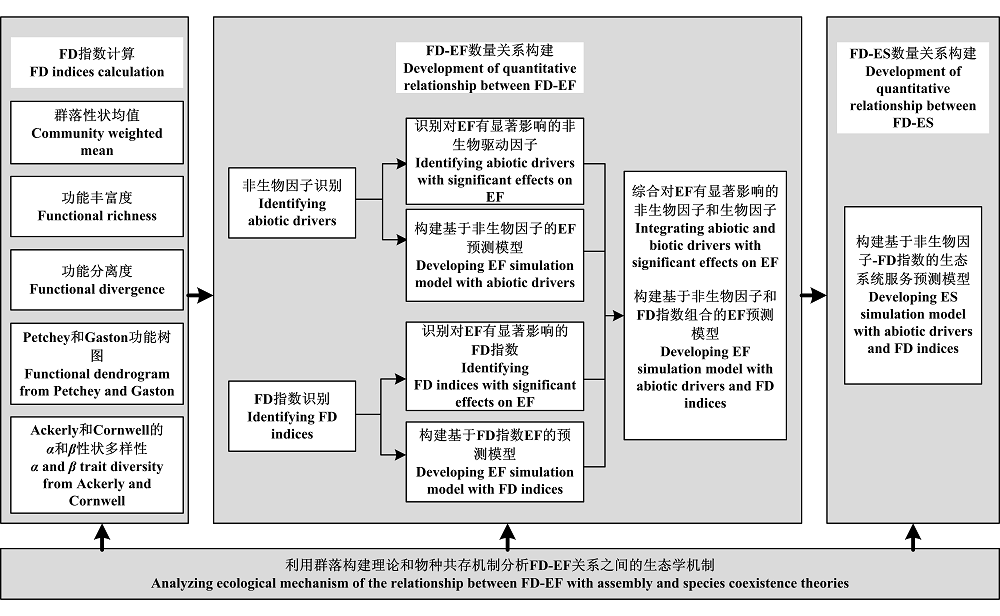
图1 基于功能多样性(FD)的生态系统功能(EF)-服务(ES)研究框架。
Fig. 1 A research framework of ecosystem function (EF)-services (ES) based on functional diversity (FD).
| [1] |
Ackerly DD, Cornwell WK (2007). A trait-based approach to community assembly: partitioning of species trait values into within- and among-community components. Ecology Letters, 10, 135-145.
DOI URL PMID |
| [2] |
Albert CH, de Bello F, Boulangeat I, Pellet G, Lavorel S, Thuiller W (2012). On the importance of intraspecific variability for the quantification of functional diversity. Oikos, 121, 116-126.
DOI URL |
| [3] |
Albert CH, Thuiller W, Yoccoz NG, Soudant A, Boucher F, Saccone P, Lavorel S (2010). Intraspecific functional variability: extent, structure and sources of variation. Journal of Ecology, 98, 604-613.
DOI URL |
| [4] |
Balvanera P, Pfisterer AB, Buchmann N, He JS, Nakashizuka T, Raffaelli D, Schmid B (2006). Quantifying the evidence for biodiversity effects on ecosystem functioning and services. Ecology Letters, 9, 1146-1156.
DOI URL PMID |
| [5] |
Barrios E (2007). Soil biota, ecosystem services and land productivity. Ecological Economics, 64, 269-285.
DOI URL |
| [6] |
Boyero L, Pearson RG, Bastian M (2007). How biological diversity influences ecosystem function: a test with a tropical stream detritivore guild. Ecological Research, 22, 551-558.
DOI URL |
| [7] |
Cadotte MW, Carscadden K, Mirotchnick N (2011). Beyond species: functional diversity and the maintenance of ecological processes and services. Journal of Applied Ecology, 48, 1079-1087.
DOI URL |
| [8] |
Cadotte MW, Cavender-Bares J, Tilman D, Oakley TH (2009). Using phylogenetic, functional and trait diversity to understand patterns of plant community productivity. PLoS ONE, 4, e5695.
DOI URL PMID |
| [9] |
Cardinale BJ, Wright JP, Cadotte MW, Carroll IT, Hector A, Srivastava DS, Loreau M, Weis JJ (2007). Impacts of plant diversity on biomass production increase through time because of species complementarity. Proceedings of the National Academy of Sciences of the United States of America, 104, 18123-18128.
DOI URL PMID |
| [10] |
Carvalheiro LG, Seymour CL, Veldtman R, Nicolson SW (2010). Pollination services decline with distance from natural habitat even in biodiversity-rich areas. Journal of Applied Ecology, 47, 810-820.
DOI URL |
| [11] |
Cornwell WK, Ackerly DD (2009). Community assembly and shifts in plant trait distributions across an environmental gradient in coastal California. Ecological Monographs, 79, 109-126.
DOI URL |
| [12] |
Cornwell WK, Schwilk DW, Ackerly DD (2006). A trait-based test for habitat filtering: convex hull volume. Ecology, 87, 1465-1471.
DOI URL PMID |
| [13] |
Costanza R (2008). Ecosystem services: multiple classification systems are needed. Biological Conservation, 141, 350-352.
DOI URL |
| [14] |
Costanza R, d’Arge R, de Groot R, Farber S, Grasso M, Hannon B, Limburg K, Naeem S, O’Neill RV, Paruelo J, Raskin RG, Sutton P, van den Belt M (1997). The value of the world’s ecosystem services and natural capital. Nature, 387, 253-260.
DOI URL |
| [15] |
Daily GC, Polasky S, Goldstein J, Kareiva PM, Mooney HA, Pejchar L, Ricketts TH, Salzman J, Shallenberger R (2009). Ecosystem services in decision making: time to deliver. Frontiers in Ecology and the Environment, 7, 21-28.
DOI URL |
| [16] |
de Bello F, Lavorel S, Díaz S, Harrington R, Cornelissen JHC, Bardgett RD, Berg MP, Cipriotti P, Feld CK, Hering D, da Silva PM, Potts SG, Sandin L, Sousa JP, Storkey J, Wardle DA, Harrison PA (2010). Towards an assessment of multiple ecosystem processes and services via func- tional traits. Biodiversity and Conservation, 19, 2873-2893.
DOI URL |
| [17] |
de Groot RS, Alkemade R, Braat L, Hein L, Willemen L (2010). Challenges in integrating the concept of ecosystem services and values in landscape planning, management and decision making. Ecological Complexity, 7, 260-272.
DOI URL |
| [18] |
Dı́az S, Cabido M (2001). Vive la différence: plant functional diversity matters to ecosystem processes. Trends in Ecology and Evolution, 16, 646-655.
DOI URL |
| [19] |
Díaz S, Lavorel S, de Bello F, Quétier F, Grigulis K, Robson TM (2007). Incorporating plant functional diversity effects in ecosystem service assessments. Proceedings of the National Academy of Sciences of the United States of America, 104, 20684-20689.
DOI URL PMID |
| [20] |
Díaz S, Quétier F, Cáceres DM, Trainor SF, Pérez- Harguindeguy N, Bret-Harte MS, Finegan B, Peña-Claros M, Poorter L (2011). Linking functional diversity and social actor strategies in a framework for interdisciplinary analysis of nature’s benefits to society. Proceedings of the National Academy of Sciences of the United States of America, 108, 895-902.
DOI URL PMID |
| [21] |
Dominati E, Patterson M, Mackay A (2010). A framework for classifying and quantifying the natural capital and ecosystem services of soils. Ecological Economics, 69, 1858-1868.
DOI URL |
| [22] |
Duffy JE, Cardinale BJ, France KE, McIntyre PB, Thébault E, Loreau M (2007). The functional role of biodiversity in ecosystems: incorporating trophic complexity. Ecology Letters, 10, 522-538.
DOI URL PMID |
| [23] |
Fisher B, Turner RK (2008). Ecosystem services: classification for valuation. Biological Conservation, 141, 1167-1169.
DOI URL |
| [24] |
Flynn DFB, Mirotchnick N, Jain M, Palmer MI, Naeem S (2011). Functional and phylogenetic diversity as predic- tors of biodiversity-ecosystem-function relationships. Ecology, 92, 1573-1581.
DOI URL PMID |
| [25] |
Garnier E, Cortez J, Billès G, Navas ML, Roumet C, Deb- ussche M, Laurent G, Blanchard A, Aubry D, Bellmann A, Neill C, Toussaint JP (2004). Plant functional markers capture ecosystem properties during secondary succession. Ecology, 85, 2630-2637.
DOI URL |
| [26] |
Grime JP (1998). Benefits of plant diversity to ecosystems: immediate, filter and founder effects. Journal of Ecology, 86, 902-910.
DOI URL |
| [27] |
Harrington R, Anton C, Dawson TP, de Bello F, Feld CK, Haslett JR, Kluvánkova-Oravská T, Kontogianni A, Lavorel S, Luck GW, Rounsevell MDA, Samways MJ, Settele J, Skourtos M, Spangenberg JH, Vandewalle M, Zobel M, Harrison PA (2010). Ecosystem services and biodiversity conservation: concepts and a glossary. Biodiversity and Conservation, 19, 2773-2790.
DOI URL |
| [28] |
Hector A, Bagchi R (2007). Biodiversity and ecosystem multifunctionality. Nature, 448, 188-190.
DOI URL PMID |
| [29] |
Hillebrand H, Matthiessen B (2009). Biodiversity in a complex world: consolidation and progress in functional biodi- versity research. Ecology Letters, 12, 1405-1419.
DOI URL PMID |
| [30] |
Hooper DU, Chapin FS, Ewel JJ, Hector A, Inchausti P, Lavorel S, Lawton JH, Lodge DM, Loreau M, Naeem S, Schmid B, Setälä H, Symstad AJ, Vandermeer J, Wardle DA (2005). Effects of biodiversity on ecosystem functioning: a consensus of current knowledge. Ecological Monographs, 75, 3-35.
DOI URL |
| [31] |
Hubbell SP (2005). Neutral theory in community ecology and the hypothesis of functional equivalence. Functional Ecology, 19, 166-172.
DOI URL |
| [32] |
Hulshof CM, Swenson NG (2010). Variation in leaf functional trait values within and across individuals and species: an example from a Costa Rican dry forest. Functional Ecology, 24, 217-223.
DOI URL |
| [33] |
Klumpp K, Soussana JF (2009). Using functional traits to predict grassland ecosystem change: a mathematical test of the response-and-effect trait approach. Global Change Biology, 15, 2921-2934.
DOI URL |
| [34] |
Kremen C (2005). Managing ecosystem services: what do we need to know about their ecology? Ecology Letters, 8, 468-479.
DOI URL PMID |
| [35] |
Kremen C, Williams NM, Aizen MA, Gemmill-Herren B, LeBuhn G, Minckley R, Packer L, Potts SG, Roulston T, Steffan-Dewenter I, Vázquez DP, Winfree R, Adams L, Crone EE, Greenleaf SS, Keitt TH, Klein AM, Regetz J, Ricketts TH (2007). Pollination and other ecosystem services produced by mobile organisms: a conceptual framework for the effects of land-use change. Ecology Letters, 10, 299-314.
DOI URL PMID |
| [36] |
Lavorel S, Grigulis K, Lamarque P, Colace MP, Garden D, Girel J, Pellet G, Douzet R (2011). Using plant functional traits to understand the landscape distribution of multiple ecosystem services. Journal of Ecology, 99, 135-147.
DOI URL |
| [37] | Lavorel S, Grigulis K, McIntyre S, Williams NSG, Garden D, Dorrough J, Berman S, Quétier F, Thébault A, Bonis A (2008). Assessing functional diversity in the field- methodology matters! Functional Ecology, 22, 134-147. |
| [38] |
Loreau M (1998). Biodiversity and ecosystem functioning: a mechanistic model. Proceedings of the National Academy of Sciences of the United States of America, 95, 5632-5636.
DOI URL PMID |
| [39] |
Loreau M, Hector A (2001). Partitioning selection and complementarity in biodiversity experiments. Nature, 412, 72-76.
DOI URL PMID |
| [40] |
Luck GW, Daily GC, Ehrlich PR (2003). Population diversity and ecosystem services. Trends in Ecology and Evolution, 18, 331-336.
DOI URL |
| [41] |
Luck GW, Harrington R, Harrison PA, Kremen C, Berry PM, Bugter R, Dawson TP, de Bello F, Díaz S, Feld CK, Haslett JR, Hering D, Kontogianni A, Lavorel S, Rounsevell M, Samways MJ, Sandin L, Settele J, Sykes MT, van den Hove S, Vandewalle M, Zobel M (2009). Quantifying the contribution of organisms to the provision of ecosystem services. BioScience, 59, 223-235.
DOI URL |
| [42] | MA (Millennium Ecosystem Assessment) (2005). Ecosystems and Human Well-being: Synthesis. Island Press, Wash-ington DC. |
| [43] |
Mason NWH, Lanoiselée C, Mouillot D, Irz P, Argillier C (2007). Functional characters combined with null models reveal inconsistency in mechanisms of species turnover in lacustrine fish communities. Oecologia, 153, 441-452.
DOI URL |
| [44] | Mayfield MM, Bonser SP, Morgan JW, Aubin I, McNamara S, Vesk PA (2010). What does species richness tell us about functional trait diversity? Predictions and evidence for responses of species and functional trait diversity to land-use change. Global Ecology and Biogeography, 19, 423-431. |
| [45] |
McGill BJ, Enquist BJ, Weiher E, Westoby M (2006). Rebuilding community ecology from functional traits. Trends in Ecology and Evolution, 21, 178-185.
DOI URL PMID |
| [46] | Meng XJ (孟祥江), Hou YZ (侯元兆) (2010). Research advance in valuation theory and assessment method of forest ecosystem services. World Forestry Research (世界林业研究) 23(6), 8-12. (in Chinese with English abstract) |
| [47] |
Messier J, McGill BJ, Lechowicz MJ (2010). How do traits vary across ecological scales? A case for trait-based ecology. Ecology Letters, 13, 838-848.
DOI URL PMID |
| [48] |
Mokany K, Ash J, Roxburgh S (2008). Functional identity is more important than diversity in influencing ecosystem processes in a temperate native grassland. Journal of Ecology, 96, 884-893.
DOI URL |
| [49] |
Mouchet MA, Villéger S, Mason NWH, Mouillot D (2010). Functional diversity measures: an overview of their redundancy and their ability to discriminate community assembly rules. Functional Ecology, 24, 867-876.
DOI URL |
| [50] |
Naeem S (2002). Disentangling the impacts of diversity on ecosystem functioning in combinatorial experiments. Ecology, 83, 2925-2935.
DOI URL |
| [51] |
Otto SB, Berlow EL, Rank NE, Smiley J, Brose U (2008). Predator diversity and identity drive interaction strength and trophic cascades in a food web. Ecology, 89, 134-144.
DOI URL PMID |
| [52] | Pacala SW, Tilman GD (2002). The transition from sampling to complementarity. In: Kinzig AP, Pacala SW, Tilman GD eds. The Functional Consequences of Biodiversity: Empirical Progress and Theoretical Extensions. Princeton University Press, Princeton. 151-166. |
| [53] |
Petchey OL, Gaston KJ (2002). Functional diversity (FD), species richness and community composition. Ecology Letters, 5, 402-411.
DOI URL |
| [54] |
Petchey OL, Gaston KJ (2006). Functional diversity: back to basics and looking forward. Ecology Letters, 9, 741-758.
DOI URL PMID |
| [55] |
Petchey OL, Hector A, Gaston KJ (2004). How do different measures of functional diversity perform? Ecology, 85, 847-857.
DOI URL |
| [56] |
Polley HW, Wilsey BJ, Derner JD, Johnson HB, Sanabria J (2006). Early-successional plants regulate grassland productivity and species composition. Oikos, 113, 287-295.
DOI URL |
| [57] |
Posthumus H, Rouquette JR, Morris J, Cowing DJG, Hess TM (2010). A framework for the assessment of ecosystem goods and services: a case study on lowland floodplains in England. Ecological Economics, 69, 1510-1523.
DOI URL |
| [58] |
Quétier F, Lavorel S, Thuiller W, Davies I (2007). Plant-trait-based modeling assessment of ecosystem-service sensitivity to land-use change. Ecological Applications, 17, 2377-2386.
DOI URL PMID |
| [59] |
Reiss J, Bridle JR, Montoya JM, Woodward G (2009). Emerging horizons in biodiversity and ecosystem functioning research. Trends in Ecology and Evolution, 24, 505-514.
DOI URL PMID |
| [60] |
Sandhu HS, Wratten SD, Cullen R, Case B (2008). The future of farming: the value of ecosystem services in conven- tional and organic arable land. An experimental approach. Ecological Economics, 64, 835-848.
DOI URL |
| [61] |
Sapijanskas J, Loreau M (2010). Cascading extinctions, func- tional complementarity, and selection in two-trophic-level model communities: a trait-based mechanistic approach. Journal of Theoretical Biology, 267, 375-387.
DOI URL PMID |
| [62] |
Schmitz OJ (2009). Effects of predator functional diversity on grassland ecosystem function. Ecology, 90, 2339-2345.
DOI URL PMID |
| [63] |
Shipley B (2007). Comparative plant ecology as a tool for integrating across scales. Annals of Botany, 99, 965-966.
DOI URL PMID |
| [64] |
Spehn EM, Scherer-Lorenzen M, Schmid B, Hector A, Caldeira MC, Dimitrakopoulos PG, Finn JA, Jumpponen A, O’Donnovan G, Pereira JS, Schulze ED, Troumbis AY, Körner C (2002). The role of legumes as a component of biodiversity in a cross-European study of grassland biomass nitrogen. Oikos, 98, 205-218.
DOI URL |
| [65] |
Spooner DE, Vaughn CC (2008). A trait-based approach to species’ roles in stream ecosystems: climate change, community structure, and material cycling. Oecologia, 158, 307-317.
DOI URL PMID |
| [66] |
Swetnam RD, Fisher B, Mbilinyi BP, Munishi PKT, Willcock S, Ricketts T, Mwakalila S, Balmford A, Burgess ND, Marshall AR, Lewis SL (2011). Mapping socio-economic scenarios of land cover change: a GIS method to enable ecosystem service modelling. Journal of Environmental Management, 92, 563-574.
DOI URL PMID |
| [67] | Swinton SM, Lupi F, Robertson GP, Hamilton SK (2007). Ecosystem services and agriculture: cultivating agricu- ltural ecosystems for diverse benefits. Ecological Econo- mics, 64, 245-252. |
| [68] |
Thompson R, Starzomski BM (2007). What does biodiversity actually do? A review for managers and policy makers. Biodiversity and Conservation, 16, 1359-1378.
DOI URL |
| [69] |
Tilman D, Knops J, Wedin D, Reich P, Ritchie M, Siemann E (1997). The influence of functional diversity and comp- osition on ecosystem processes. Science, 277, 1300-1302.
DOI URL |
| [70] |
Walker B, Kinzig A, Langridge J (1999). Original articles: plant attribute diversity, resilience, and ecosystem function: the nature and significance of dominant and minor species. Ecosystems, 2, 95-113.
DOI URL |
| [71] | Wall DH, Bardgett RD, Covich AR, Snelgrove PVR (2004). The need for understanding how biodiversity and ecosystem functioning affect ecosystem services in soils and sediments. In: Wall DH ed. Sustaining Biodiversity and Ecosystem Services in Soils and Sediments. Island Press, Washington DC. 1-12. |
| [72] | Wang P (王平), Sheng LX (盛连喜), Yan H (燕红), Zhou DW (周道玮), Song YT (宋彦涛) (2010). Plant functional traits influence soil carbon sequestration in wetland ecosystem. Acta Ecologica Sinica (生态学报) 30, 6990-7000. (in Chinese with English abstract) |
| [73] | Wang W (王伟), Lu JJ (陆健健) (2005). An approach on ecosystem services classification and valuation. Chinese Journal of Ecology (生态学杂志) 24, 1314-1316. (in Chinese with English abstract) |
| [74] | Xie GD (谢高地), Xiao Y (肖玉), Lu CX (鲁春霞) (2006). Study on ecosystem services: progress, limitation and basic paradigm. Journal of Plant Ecology (Chinese Version) ( 植物生态学报), 30, 191-199. (in Chinese with English abstract) |
| [75] | Zhang C (张诚), Yan DH (严登华), Hao CL (郝彩莲), Qin TL (秦天玲), Wang LH (王凌河) (2011). Advances in water ecosystem service study and its key supporting technologies. Advances in Water Science (水科学进展) 22, 126-134. (in Chinese with English abstract) |
| [76] | Zhang QG (张全国), Zhang DY (张大勇) (2003). Biodiversity and ecosystem functioning: recent advances and trends. Biodiversity Science (生物多样性) 11, 351-363. (in Chinese with English abstract) |
| [1] | 封逸凡, 朱时应, 周淑荣, 江乐乐, 陈隆, 王苗, 邓国芳, 刘兰. 热带次生林恢复中土壤微生物对菌根化树苗存活和生长性状的影响[J]. 植物生态学报, 2026, 50(预发表): 1-. |
| [2] | 饶朝康, 唐亮. 不同潮位红树植物叶际微生物群落特征及其影响因素[J]. 植物生态学报, 2026, 50(预发表): 1-. |
| [3] | 林琳琳, 肖劲祥, 黄深深, 赵杨梅, 张德旭, 程毅康, 龙文兴. 磷添加对热带云雾林幼苗及幼树功能性状的影响[J]. , 2026, 50(预发表): 0-. |
| [4] | 段建林, 孟晟, 陈仁利, 熊林峰, 卢春洋, 席念勋. 全球变化因子多样性对菌根植物性状的影响[J]. , 2026, 50(预发表): 0-. |
| [5] | 张安宁, 肖亚宁, 赵霞, 张淼, 崔瀚文, 陈书燕, 安黎哲. 青藏高原灌木化与氮添加对土壤线虫及功能性状的交互作用[J]. 植物生态学报, 2026, 50(预发表): 0-. |
| [6] | 张静, 陈洁, 李艳朋, 盘李军, 许涵, 李意德, 何海生. 南亚热带针阔混交人工林植物生物量比较及其影响因子分析[J]. 植物生态学报, 2026, 50(2): 400-416. |
| [7] | 张永军, 李敬东, 安琦, 洪翎桂, 任正炜, 张蕊, 周小龙. 氮添加和增温对天山高寒草地群落性状的影响[J]. 植物生态学报, 2026, 50(2): 417-428. |
| [8] | 戴丽君, 向玲艺, 蹇陈, 王晓锋. 三峡回水扰动增强入库小流域河岸带典型草本植物功能性状的局域分化[J]. 植物生态学报, 2026, 50(2): 442-460. |
| [9] | 王爽, 陈雅轩, 陈艳梅, 王佳乐, 刘倩愿. 太行山典型区不同生境酸枣根系资源获取策略[J]. 植物生态学报, 2026, 50(2): 374-387. |
| [10] | 陈雅轩, 韩雨音, 陈艳梅, 刘倩愿. 华北不同林龄人工林植物功能性状与碳氮化学计量[J]. 植物生态学报, 2026, 50(2): 318-333. |
| [11] | 梁天豪, 吴帆, 黄锦学, 景陈鸿, 傅贺菁, 杨智杰, 熊德成. 增温对中亚热带格氏栲天然林细根生长量及形态特征的影响[J]. 植物生态学报, 2026, 50(1): 94-106. |
| [12] | 郑子仪, 陈江慧, 刘慧颖. 气候变暖提高青藏高原高寒草甸优势物种的根系分泌速率[J]. 植物生态学报, 2025, 49(9): 1363-1373. |
| [13] | 陈凯, 杨艳, 徐玲, 蒋忠华. 滇西南山地球花报春种子形态与萌发沿海拔梯度的变异[J]. 植物生态学报, 2025, 49(7): 1119-1127. |
| [14] | 崔冬晴, 田晨, 宋慧敏, 鲁小名, 萨其日, 徐国庆, 杨培志, 白永飞, 田建卿. 典型草原优势植物根际细菌群落多样性和功能群组成对长期放牧的响应机制[J]. 植物生态学报, 2025, 49(7): 1163-1176. |
| [15] | 张箫荻, 王晓霞, 章毓文, 侯靖雨, 石骁鹏, 和璐璐, 刘亚栋, 薛柳, 何宝华, 段劼. 北京山区三种林下灌木水力结构、叶片功能性状及其环境适应策略[J]. 植物生态学报, 2025, 49(7): 1128-1143. |
| 阅读次数 | ||||||
|
全文 |
|
|||||
|
摘要 |
|
|||||
Copyright © 2026 版权所有 《植物生态学报》编辑部
地址: 北京香山南辛村20号, 邮编: 100093
Tel.: 010-62836134, 62836138; Fax: 010-82599431; E-mail: apes@ibcas.ac.cn, cjpe@ibcas.ac.cn
备案号: 京ICP备16067583号-19

