
Chin J Plant Ecol ›› 2026, Vol. 50 ›› Issue (2): 318-333.DOI: 10.17521/cjpe.2025.0183 cstr: 32100.14.cjpe.2025.0183
• Research Articles • Previous Articles Next Articles
CHEN Ya-Xuan, HAN Yu-Yin, CHEN Yan-Mei, LIU Qian-Yuan*( )
)
Received:2025-05-23
Accepted:2025-09-09
Online:2026-02-28
Published:2026-04-01
Contact:
LIU Qian-Yuan
Supported by:CHEN Ya-Xuan, HAN Yu-Yin, CHEN Yan-Mei, LIU Qian-Yuan. Plant functional traits and carbon-nitrogen stoichiometry of plantations at different forest ages in North China[J]. Chin J Plant Ecol, 2026, 50(2): 318-333.
Add to citation manager EndNote|Ris|BibTeX
URL: https://www.plant-ecology.com/EN/10.17521/cjpe.2025.0183
| 树种 Species | 林龄 Forest age (a) | 简称 Abbreviation | 经纬度 Longitude and latitude | 海拔 Altitude (m) | 郁闭度 Canopy density (%) | 平均胸径 Average diameter at breast height (cm) | 平均树高 Average height (m) |
|---|---|---|---|---|---|---|---|
| 毛白杨 Populus tomentosa | 10 | XY | 37.49° N, 114.38° E | 169 | 15 | 6.5 | 4.6 |
| 16 | ZY | 37.48° N, 114.38° E | 174 | 20 | 10.5 | 7.2 | |
| 30 | LY | 37.50° N, 114.39° E | 157 | 25 | 22.3 | 13.4 | |
| 侧柏 Platycladus orientalis | 12 | XB | 37.49° N, 114.39° E | 165 | 10 | 2.4 | 2.5 |
| 19 | ZB | 37.50° N, 114.39° E | 185 | 60 | 6.8 | 5.5 | |
| 36 | LB | 37.52° N, 114.39° E | 246 | 80 | 18.1 | 7.2 | |
| 国槐 Styphnolobium japonicum | 9 | XH | 37.45° N, 114.41° E | 99 | 10 | 4.0 | 3.7 |
| 13 | ZH | 37.45° N, 114.41° E | 47 | 40 | 10.1 | 9.5 | |
| 16 | LH | 37.51° N, 114.39° E | 199 | 65 | 12.5 | 7.1 |
Table 1 Basic information of the artificial plantations sample plots of each tree species
| 树种 Species | 林龄 Forest age (a) | 简称 Abbreviation | 经纬度 Longitude and latitude | 海拔 Altitude (m) | 郁闭度 Canopy density (%) | 平均胸径 Average diameter at breast height (cm) | 平均树高 Average height (m) |
|---|---|---|---|---|---|---|---|
| 毛白杨 Populus tomentosa | 10 | XY | 37.49° N, 114.38° E | 169 | 15 | 6.5 | 4.6 |
| 16 | ZY | 37.48° N, 114.38° E | 174 | 20 | 10.5 | 7.2 | |
| 30 | LY | 37.50° N, 114.39° E | 157 | 25 | 22.3 | 13.4 | |
| 侧柏 Platycladus orientalis | 12 | XB | 37.49° N, 114.39° E | 165 | 10 | 2.4 | 2.5 |
| 19 | ZB | 37.50° N, 114.39° E | 185 | 60 | 6.8 | 5.5 | |
| 36 | LB | 37.52° N, 114.39° E | 246 | 80 | 18.1 | 7.2 | |
| 国槐 Styphnolobium japonicum | 9 | XH | 37.45° N, 114.41° E | 99 | 10 | 4.0 | 3.7 |
| 13 | ZH | 37.45° N, 114.41° E | 47 | 40 | 10.1 | 9.5 | |
| 16 | LH | 37.51° N, 114.39° E | 199 | 65 | 12.5 | 7.1 |
| 功能性状 Functional trait | 缩写 Abbreviation | 单位 Unit | 计算公式 Calculation formula |
|---|---|---|---|
| 叶片含水量 Leaf water content | LWC | % | LWC = (LFM-LDM)/LFM |
| 比叶面积 Specific leaf area | SLA | cm2∙g-1 | SLA = LA/LDM |
| 比叶质量 Leaf mass per area | LMA | g∙cm-2 | LMA = LDM/LA |
| 叶干物质含量 Leaf dry matter content | LDMC | g∙g-1 | LDMC = LDM/LFM |
| 叶片氮含量 Leaf nitrogen content | LNC | % | |
| 叶片碳含量 Leaf carbon content | LCC | % | |
| 叶片碳氮比 Leaf carbon to nitrogen ratio | LC:N | LC:N =LCC/LNC | |
| 枝条氮含量 Branch nitrogen content | BNC | % | |
| 枝条碳含量 Branch carbon content | BCC | % | |
| 枝条碳氮比 Branch carbon to nitrogen ratio | BC:N | BC:N =BCC/BNC | |
| 根系生物量 Root biomass | RB | kg∙m-3 | RB = RDM/SV |
| 根平均直径 Root average diameter | RD | mm | |
| 根长密度 Root length density | RLD | km∙m-3 | RLD = RL/SV |
| 根表面积密度 Root surface area density | RAD | m2∙m-3 | RAD = RA/SV |
| 比根长 Specific root length | SRL | m∙g-1 | SRL = RL/RDM |
| 根比表面积 Specific root area | SRA | m2∙g-1 | SRA = RA/RDM |
| 根组织密度 Root tissue density | RTD | g∙cm-3 | RTD = RDM/RV |
| 根氮含量 Root nitrogen content | RNC | % | |
| 根碳含量 Root carbon content | RCC | % | |
| 根碳氮比 Root carbon to nitrogen content | RC:N | RC:N = RCC/RNC |
Table 2 Attributes of plant functional traits
| 功能性状 Functional trait | 缩写 Abbreviation | 单位 Unit | 计算公式 Calculation formula |
|---|---|---|---|
| 叶片含水量 Leaf water content | LWC | % | LWC = (LFM-LDM)/LFM |
| 比叶面积 Specific leaf area | SLA | cm2∙g-1 | SLA = LA/LDM |
| 比叶质量 Leaf mass per area | LMA | g∙cm-2 | LMA = LDM/LA |
| 叶干物质含量 Leaf dry matter content | LDMC | g∙g-1 | LDMC = LDM/LFM |
| 叶片氮含量 Leaf nitrogen content | LNC | % | |
| 叶片碳含量 Leaf carbon content | LCC | % | |
| 叶片碳氮比 Leaf carbon to nitrogen ratio | LC:N | LC:N =LCC/LNC | |
| 枝条氮含量 Branch nitrogen content | BNC | % | |
| 枝条碳含量 Branch carbon content | BCC | % | |
| 枝条碳氮比 Branch carbon to nitrogen ratio | BC:N | BC:N =BCC/BNC | |
| 根系生物量 Root biomass | RB | kg∙m-3 | RB = RDM/SV |
| 根平均直径 Root average diameter | RD | mm | |
| 根长密度 Root length density | RLD | km∙m-3 | RLD = RL/SV |
| 根表面积密度 Root surface area density | RAD | m2∙m-3 | RAD = RA/SV |
| 比根长 Specific root length | SRL | m∙g-1 | SRL = RL/RDM |
| 根比表面积 Specific root area | SRA | m2∙g-1 | SRA = RA/RDM |
| 根组织密度 Root tissue density | RTD | g∙cm-3 | RTD = RDM/RV |
| 根氮含量 Root nitrogen content | RNC | % | |
| 根碳含量 Root carbon content | RCC | % | |
| 根碳氮比 Root carbon to nitrogen content | RC:N | RC:N = RCC/RNC |
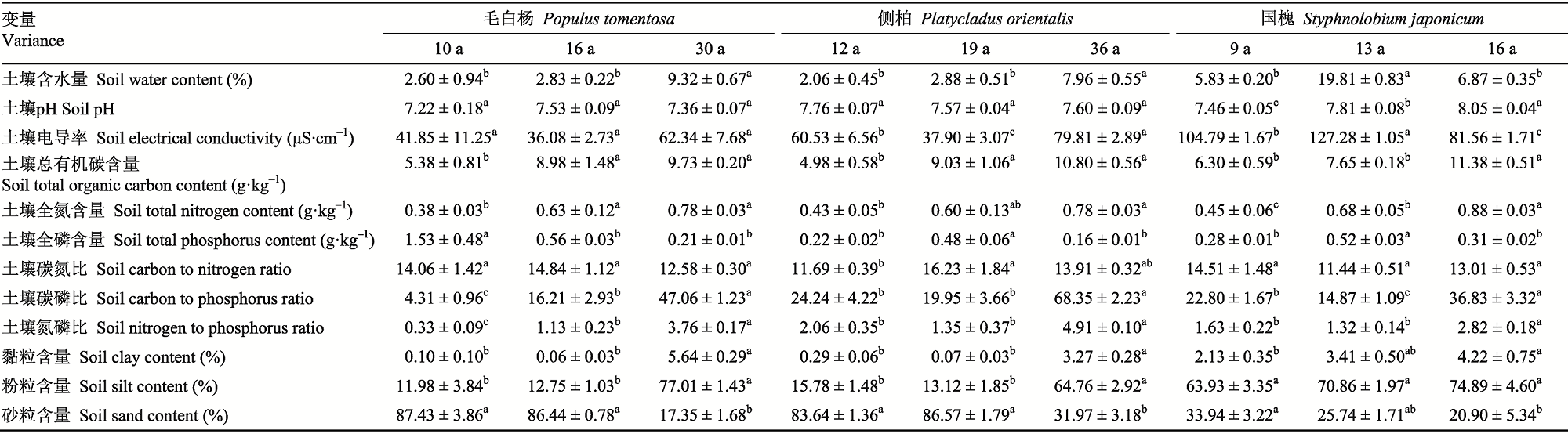 |
Table 4 Changes in soil physicochemical properties at different forest ages in north China
| |
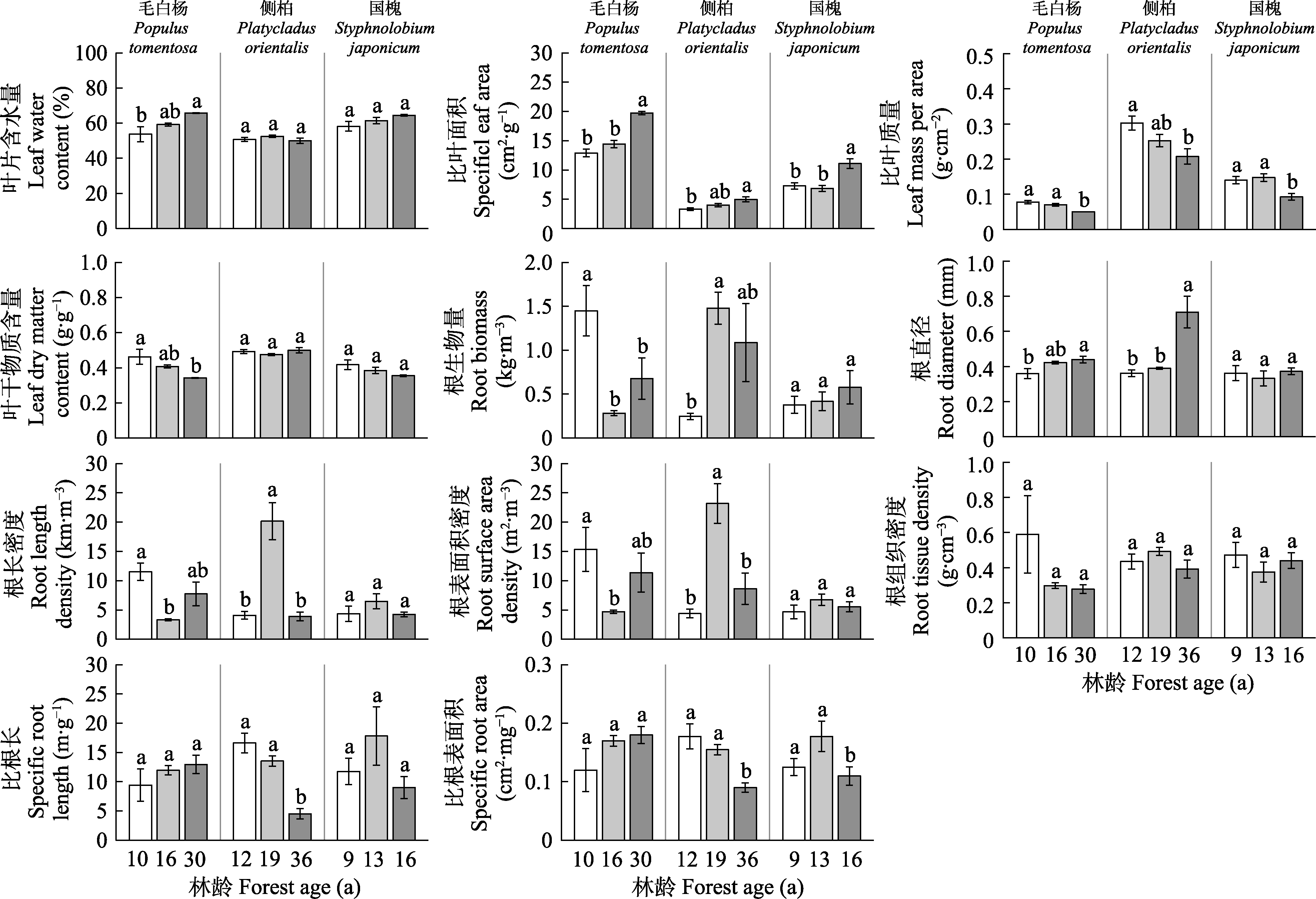
Fig. 1 Changes in functional traits of plantations at different forest ages in north China. Different lowercase letters indicate the significant differences of the same species at different forest ages (p < 0.05).
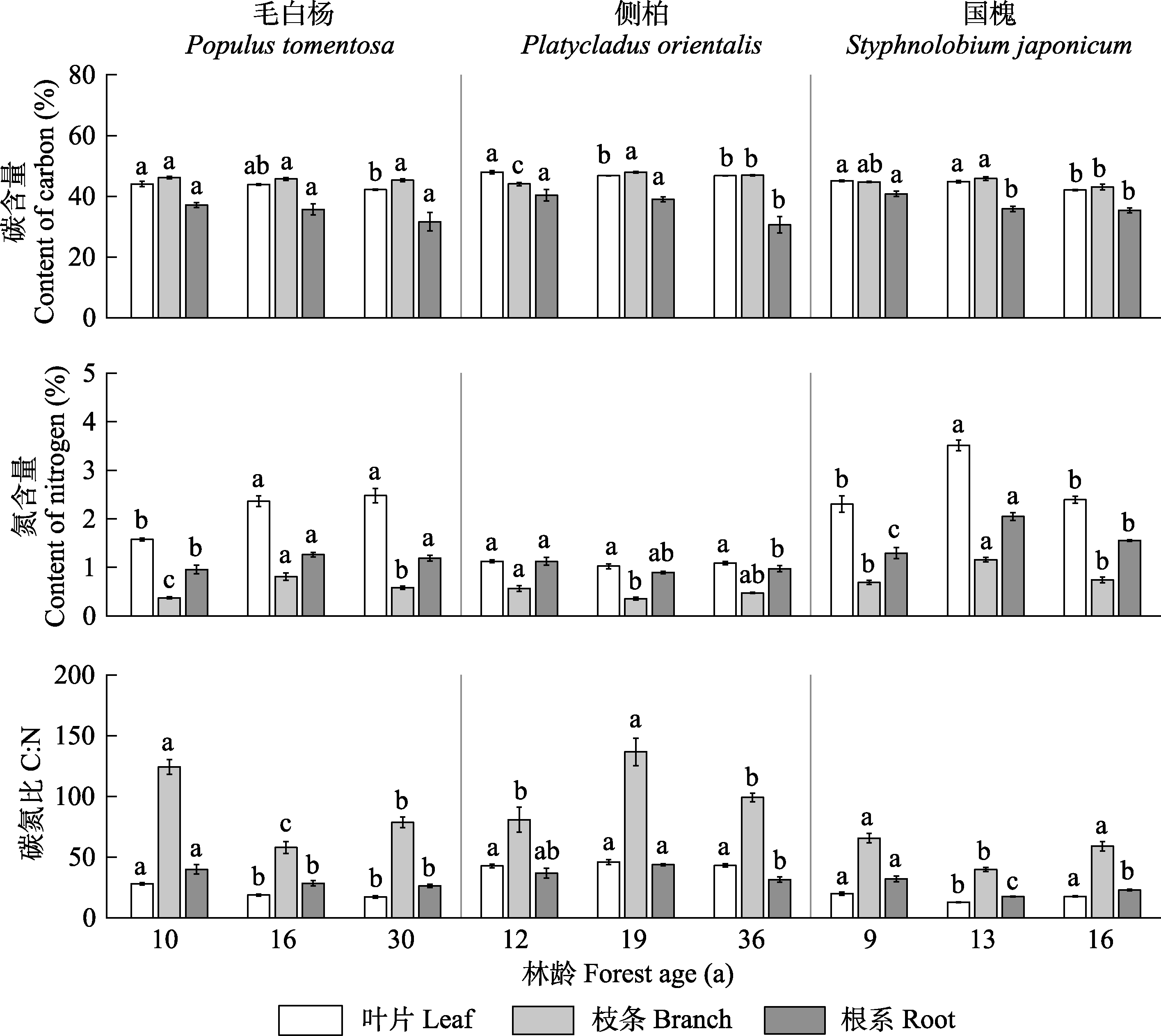
Fig. 2 Changes in carbon (C), nitrogen (N) content and stoichiometry of plantations at different ages. Different lowercase letters indicate the significant differences of the same species at different forest ages (p < 0.05).
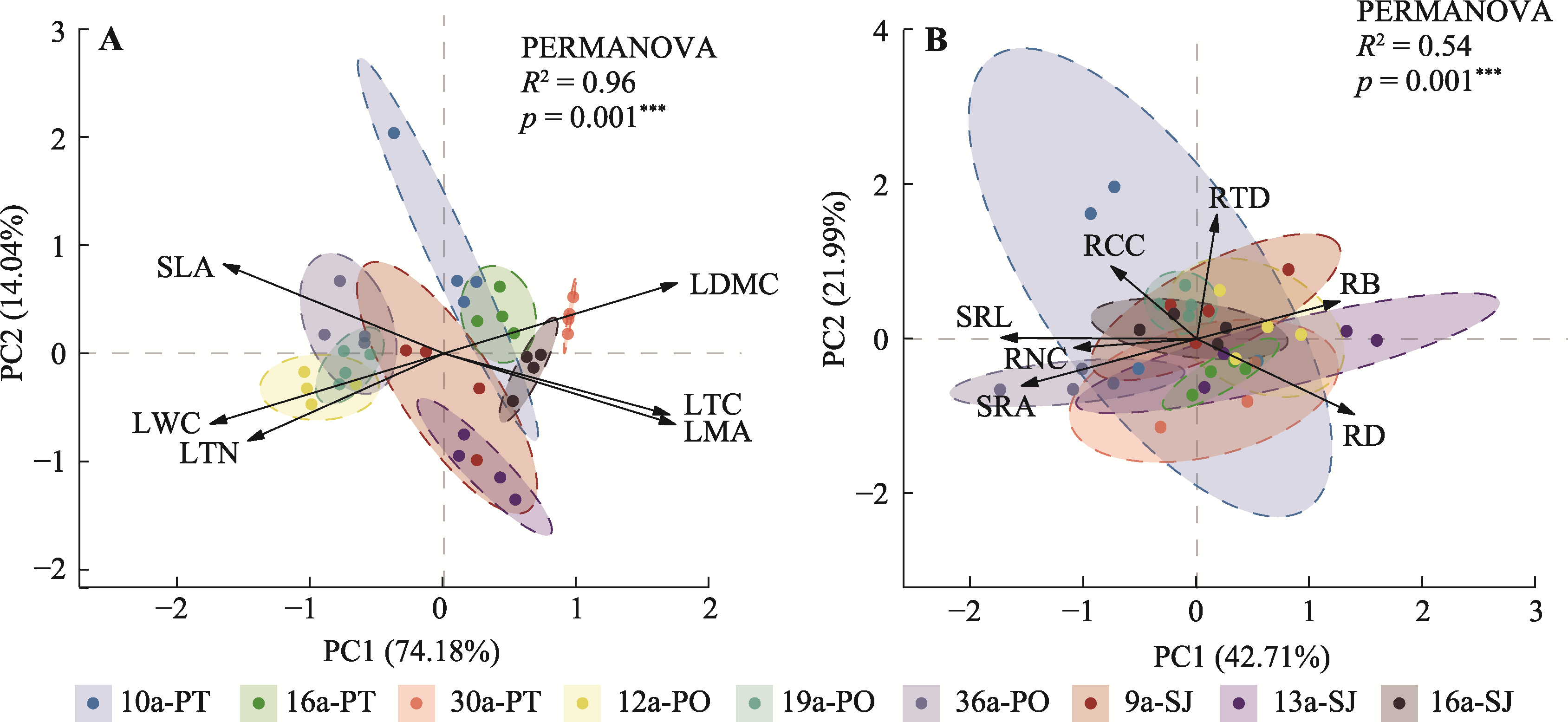
Fig. 3 Principal component (PC) analysis of leaf traits (A) and root traits (B). PO, Platycladus orientalis plantations; PT, Populus tomentosa plantations; SJ, Styphnolobium japonicum plantations. Abbreviations of plant functional traits are shown in Table 2. ***, p < 0.001.
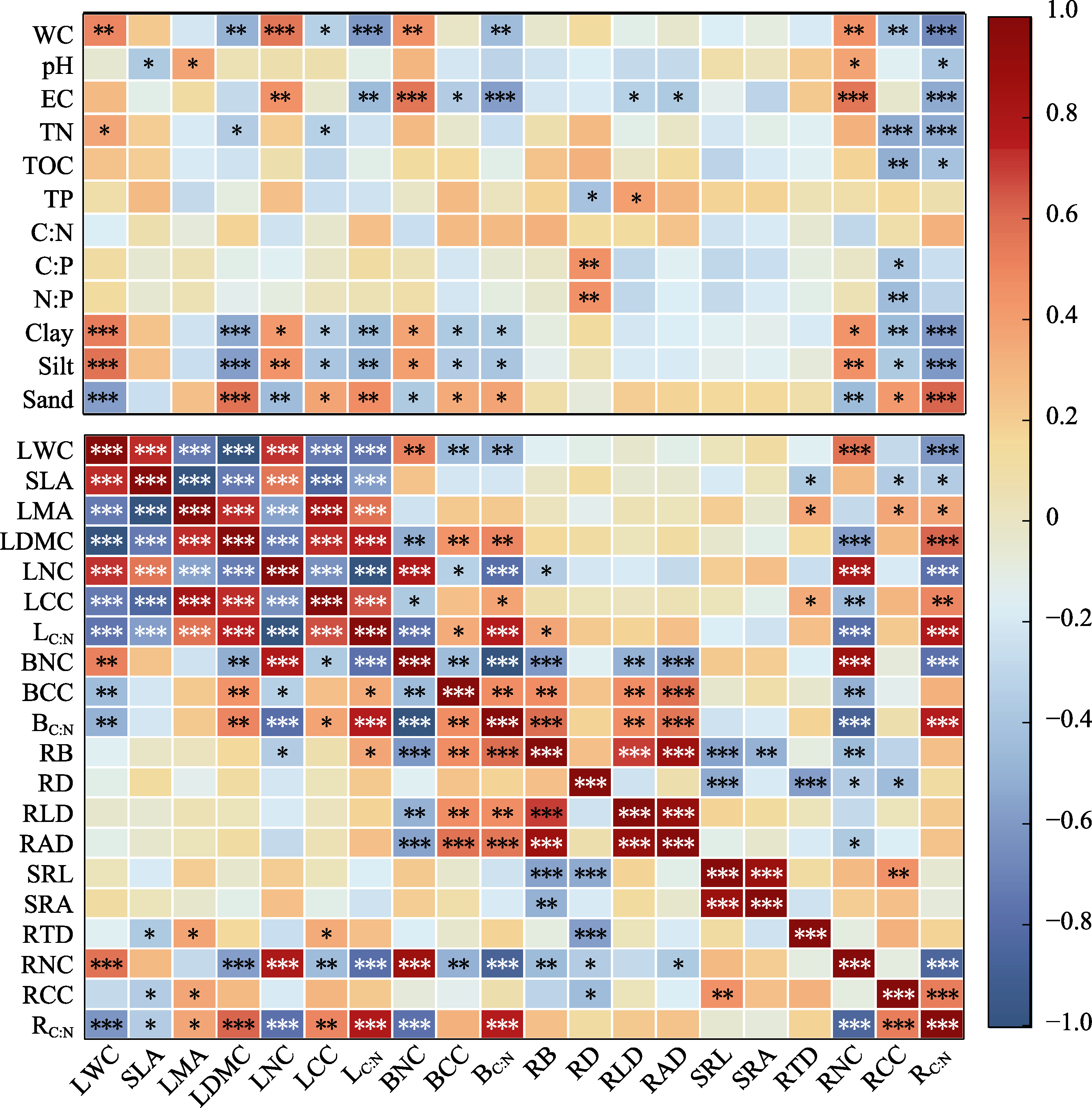
Fig. 4 Correlations among soil physicochemical properties, plant functional traits, and stoichiometry. C:N, soil carbon to nitrogen ratio; C:P, soil carbon to phosphorus ratio; Clay, soil clay content; EC, soil electrical conductivity; N:P, soil nitrogen to phosphorus ratio; pH, soil pH; Sand, soil sand content; Silt, soil silt content; TN, soil total nitrogen content; TOC, soil total organic carbon content; TP, soil total phosphorus content; WC, soil water content. Abbreviations of plant functional traits are shown in Table 2. *, p < 0.05; **, p < 0.01; ***, p < 0.001.
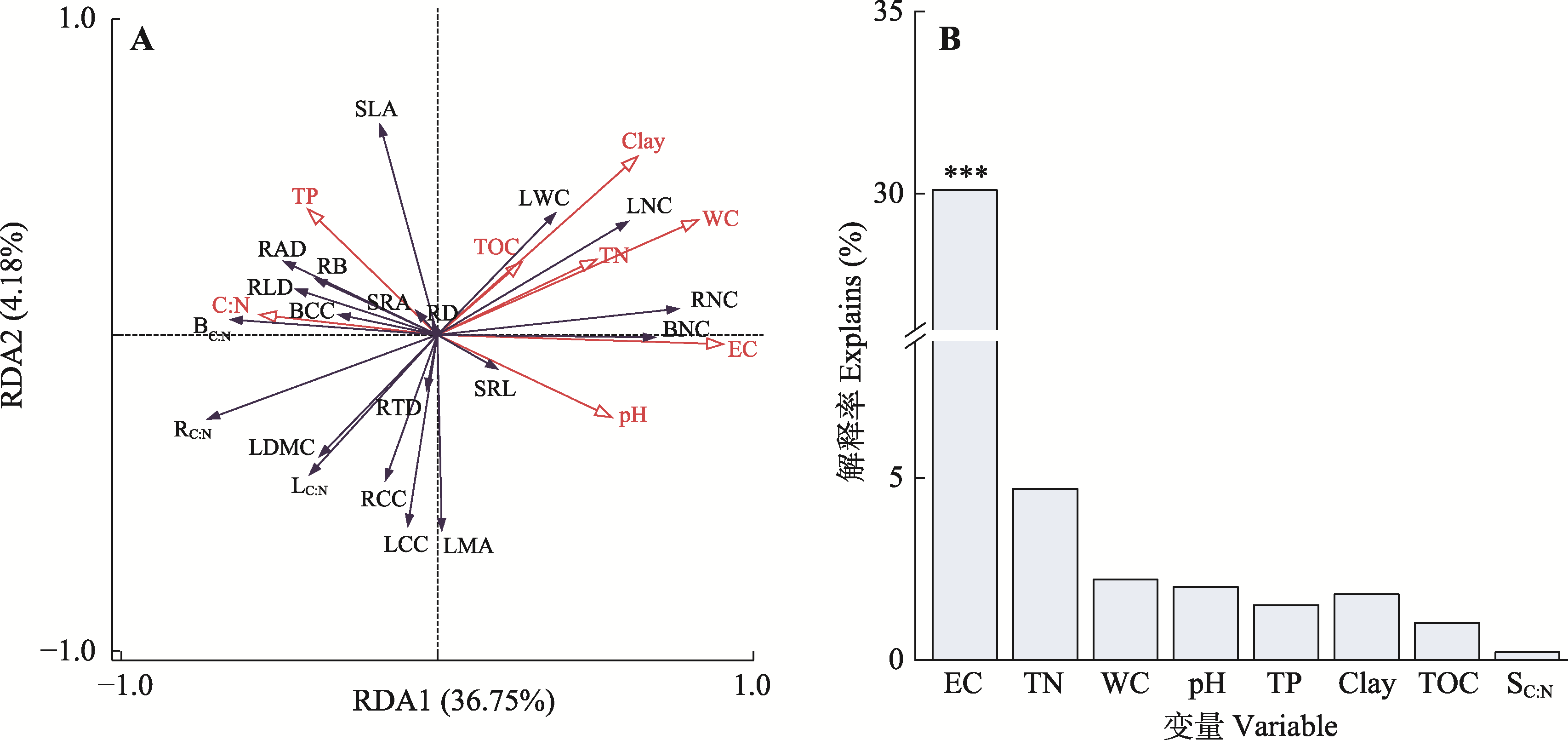
Fig. 5 Redundancy analysis (A) and explanation rate (B) of leaf and root functional traits, and soil physical and chemical properties. C:N, soil carbon to nitrogen ratio; C:P, soil carbon to phosphorus ratio; Clay, soil clay content; EC, soil electrical conductivity; N:P, soil nitrogen to phosphorus ratio; pH, soil pH; Sand, soil sand content; Silt, soil silt content; TN, soil total nitrogen content; TOC, soil total organic carbon content; TP, soil total phosphorus content; WC, soil water content. Abbreviations of plant functional traits are shown in Table 2. ***, p < 0.001.
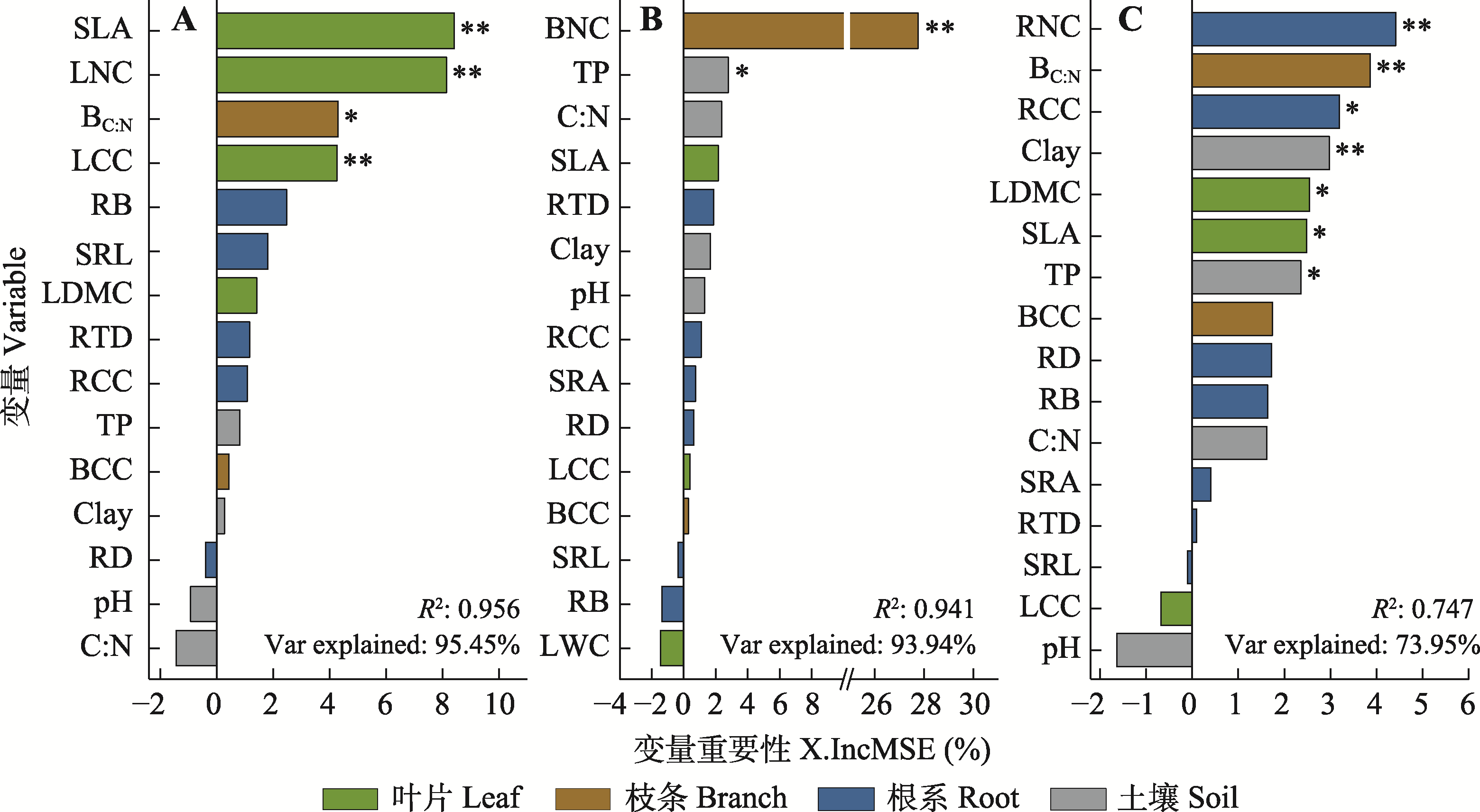
Fig. 6 Relative importance of indicators affecting carbon to nitrogen ratio of leaves (A), branches (B), and roots (C). C:N, soil carbon to nitrogen ratio; C:P, soil carbon to phosphorus ratio; Clay, soil clay content; EC, soil electrical conductivity; N:P, soil nitrogen to phosphorus ratio; pH, soil pH; Sand, soil sand content; Silt, soil silt content; TN, soil total nitrogen content; TOC, soil total organic carbon content; TP, soil total phosphorus content; WC, soil water content. Abbreviations of plant functional traits are shown in Table 2. Var, variance; X.IncMSE, Variable x’s increase in mean squared error. *, p < 0.05; **, p < 0.01.
| [1] | An SQ, Gong L, Zhu ML, Li HL, Xie LN, Luo Y (2017). Root stoichiometric characteristics of desert plants and their correlation with soil physicochemical factors in the northern Tarim Basin. Acta Ecologica Sinica, 37, 5444-5450. |
| [安申群, 贡璐, 朱美玲, 李红林, 解丽娜, 罗艳 (2017). 塔里木盆地北缘典型荒漠植物根系化学计量特征及其与土壤理化因子的关系. 生态学报, 37, 5444-5450.] | |
| [2] | Bergmann J, Weigelt A, van der Plas F, Laughlin DC, Kuyper TW, Guerrero-Ramirez N, Valverde-Barrantes OJ, Bruelheide H, Freschet GT, Iversen CM, Kattge J, McCormack ML, Meier IC, Rillig MC, Roumet C, et al. (2020). The fungal collaboration gradient dominates the root economics space in plants. Science Advances, 6, eaba3756. DOI: 10.1126/sciadv.aba3756. |
| [3] |
Bielczynski LW, Łącki MK, Hoefnagels I, Gambin A, Croce R (2017). Leaf and plant age affects photosynthetic performance and photoprotective capacity. Plant Physiology, 175, 1634-1648.
DOI PMID |
| [4] | Chang YN, Zhong QL, Yang H, Xu CB, Hua WP, Li BY (2022). Patterns and driving factors of leaf C, N, and P stoichiometry in two forest types with different stand ages in a mid-subtropical zone. Forest Ecosystems, 9, 100005. DOI: 10.1016/j.fecs.2022.100005. |
| [5] | Chen CX, Xie XH, Wang YP, Li JP, Xin J, Zhu TT, Liu J, Chen M (2019). Effects of salt and drought on the physiological characteristics of Elaeagnus angustifolia L. seedlings. Acta Ecologica Sinica, 39, 4540-4550. |
| [陈春晓, 谢秀华, 王宇鹏, 李俊朋, 信健, 朱婷婷, 刘静, 陈敏 (2019). 盐分和干旱对沙枣幼苗生理特性的影响. 生态学报, 39, 4540-4550.] | |
| [6] |
Chen YH, Han WX, Tang LY, Tang ZY, Fang JY (2013). Leaf nitrogen and phosphorus concentrations of woody plants differ in responses to climate, soil and plant growth form. Ecography, 36, 178-184.
DOI URL |
| [7] |
Claus A, George E (2005). Effect of stand age on fine-root biomass and biomass distribution in three European forest chronosequences. Canadian Journal of Forest Research, 35, 1617-1625.
DOI URL |
| [8] | Crous KY, Wujeska-Klause A, Jiang M, Medlyn BE, Ellsworth DS (2019). Nitrogen and phosphorus retranslocation of leaves and stemwood in a mature Eucalyptus forest exposed to 5 years of elevated CO2. Frontiers in Plant Science, 10, 664. DOI: 10.3389/fpls.2019.00664. |
| [9] | Deng BW, Xu YY, Chen YF, Zhang S, Zheng DX, Liao XL, Lin RZ, Jin SF (2020). Stoichiometry and homesotasis of nitrogen, phosphorus and potassium in leaf of dominant tree species in China’s coniferous forests. Forest Research, 33(6), 81-87. |
| [邓博文, 许瑶瑶, 陈逸飞, 张硕, 郑德祥, 廖晓丽, 林仁忠, 靳少非 (2020). 中国针叶林优势树种叶片氮磷钾生态化学计量特征及内稳态分析. 林业科学研究, 33(6), 81-87.] | |
| [10] |
Dı́az S, Cabido M (2001). Vive la différence: plant functional diversity matters to ecosystem processes. Trends in Ecology & Evolution, 16, 646-655.
DOI URL |
| [11] |
Elser JJ, Fagan WF, Denno RF, Dobberfuhl DR, Folarin A, Huberty A, Interlandi S, Kilham SS, McCauley E, Schulz KL, Siemann EH, Sterner RW (2000a). Nutritional constraints in terrestrial and freshwater food webs. Nature, 408, 578-580.
DOI |
| [12] |
Elser JJ, Fagan WF, Kerkhoff AJ, Swenson NG, Enquist BJ (2010). Biological stoichiometry of plant production: metabolism, scaling and ecological response to global change. New Phytologist, 186, 593-608.
DOI PMID |
| [13] |
Elser JJ, Sterner RW, Gorokhova E, Fagan WF, Markow TA, Cotner JB, Harrison JF, Hobbie SE, Odell GM, Weider LW (2000b). Biological stoichiometry from genes to ecosystems. Ecology Letters, 3, 540-550.
DOI URL |
| [14] | Emiru N, Gebrekidan H (2013). Effect of land use changes and soil depth on soil organic matter, total nitrogen and available phosphorus contents of soils in Senbat Watershed, Western Ethiopia. ARPN Journal of Agricultural and Biological Science, 8, 206-212. |
| [15] | Gan ZJ (2023). Analysis of soil physical and chemical properties of Chinese fir plantations with different ages. Special Economic Animal and Plants, 26(5), 58-60. |
| [甘忠娇 (2023). 不同林龄杉木人工林土壤理化性质分析. 特种经济动植物, 26(5), 58-60.] | |
| [16] | Guo W, Xu RJ, Qi LH, Hu X, Ding X, Cheng CJ, Zhang J, Lei G (2018). Research progress of photosynthetic characteristics and leaf functional traits of bamboo plants. World Forestry Research, 31(4), 29-35. |
| [郭雯, 徐瑞晶, 漆良华, 胡璇, 丁霞, 程昌锦, 张建, 雷刚 (2018). 竹类植物光合特性与叶片功能性状研究. 世界林业研究, 31(4), 29-35.] | |
| [17] | Guo XY, Yang G, Wu J, Qiao S, Tao L (2024). Impacts of forest age on soil characteristics and fertility quality of Populus simonii shelter forest at the southern edge of the Horqin Sandy Land, China. PeerJ, 12, e17512. DOI: 10.7717/peerj.17512. |
| [18] |
Han MG, Zhu B (2021). Linking root respiration to chemistry and morphology across species. Global Change Biology, 27, 190-201.
DOI PMID |
| [19] | He B, Li Q, Feng T, Xue XH, Li WJ, Liu Y (2020). Variation in leaf functional traits of different-aged Pinus massoniana communities and relationships with soil nutrients. Journal of Nanjing Forestry University (Natural Sciences Edition), 44, 181-190. |
| [何斌, 李青, 冯图, 薛晓辉, 李望军, 刘勇 (2020). 不同林龄马尾松人工林针叶功能性状及其与土壤养分的关系. 南京林业大学学报 (自然科学版), 44, 181-190.] | |
| [20] | Huo JX, Ren L, Pan YP, Zhao J, Xiang X, Yu C, Meng DH, Wang YY, Lu RJ, Huang YM (2022). Functional traits of desert plants and their responses to environmental factors in Qaidam Basin, China. Acta Ecologica Sinica, 42, 4494-4503. |
| [霍佳璇, 任梁, 潘莹萍, 赵瑾, 向响, 余程, 孟德惠, 王源源, 鲁瑞洁, 黄永梅 (2022). 柴达木盆地荒漠植物功能性状及其对环境因子的响应. 生态学报, 42, 4494-4503.] | |
| [21] |
Isaac ME, Martin AR, de Melo Virginio Filho E, Rapidel B, Roupsard O, van den Meersche K (2017). Intraspecific trait variation and coordination: root and leaf economics spectra in coffee across environmental gradients. Frontiers in Plant Science, 8, 1196. DOI: 10.3389/fpls.2017.01196.
PMID |
| [22] | Ji CH, Huang YY, Yang HZ, Zhao JL, Cha ZZ (2022). Stoichiometric characteristics of soil nutrient absorption and distribution in young rubber plants under fertilizer treatment. Journal of Tropical Biology, 13, 519-523. |
| [冀春花, 黄艳艳, 杨红竹, 赵家连, 茶正早 (2022). 不同施肥处理下橡胶苗对土壤养分吸收和分配的化学计量特征. 热带生物学报, 13, 519-523.] | |
| [23] |
Jönsson U, Rosengren U, Thelin G, Nihlgård B (2003). Acidification-induced chemical changes in coniferous forest soils in southern Sweden 1988-1999. Environmental Pollution, 123, 75-83.
PMID |
| [24] | Leng F, Yang ZJ, Wu YC, He DW (2020). Physiological and photosynthetic characteristics and active component contents of Polygonum multiflorum Thunb. under different soil pH values. Acta Botanica Boreali-Occidentalia Sinica, 40, 1566-1573. |
| [冷芬, 杨在君, 吴一超, 何道文 (2020). 土壤pH值对何首乌生理及其光合特性和有效成分含量的影响. 西北植物学报, 40, 1566-1573.] | |
| [25] | Li HL, Crabbe MJC, Xu FL, Wang WL, Ma LH, Niu RL, Gao X, Li XX, Zhang P, Ma X, Chen HK (2017). Seasonal variations in carbon, nitrogen and phosphorus concentrations and C:N:P stoichiometry in different organs of a Larix principis-rupprechtii Mayr. plantation in the Qinling Mountains, China. PLoS ONE, 12, e0185163. DOI: 10.1371/journal.pone.0185163. |
| [26] | Li L (2023). Leaf Functional Traits and Community Characteristics of Caragana liouana at Different Ages in Mu Us Sandland. Master degree dissertation, Inner Mongolia University, Hohhot. |
| [李琳 (2023). 毛乌素沙地不同林龄中间锦鸡儿(Caragana liouana)叶功能性状及群落特征研究. 硕士学位论文, 内蒙古大学, 呼和浩特.] | |
| [27] | Li P, Ling TW, Yang ZQ, Chen H, Yan PD, Lu SH, Ling JY, Tang SS (2023). Ecological stoichiometric characteristics of leaf-soil carbon, nitrogen and phosphorus in Pinus massoniana plantations with different forest ages. Journal of Southwest Forestry University (Natural Sciences), 43(1), 88-98. |
| [李鹏, 零天旺, 杨章旗, 陈虎, 颜培栋, 陆绍浩, 凌金燕, 唐生森 (2023). 不同林龄马尾松人工林叶片-土壤碳氮磷生态化学计量特征研究. 西南林业大学学报(自然科学), 43(1), 88-98.] | |
| [28] | Li T, Zhang ZH, Sun JK, Fu ZY, Zhao YH, Xu WJ (2022). Seasonal variation characteristics of C, N, and P stoichiometry and water use efficiency of Messerschmidia sibirica and its relationship with soil nutrients. Frontiers in Ecology and Evolution, 10, 948682. DOI: 10.3389/fevo.2022.948682. |
| [29] |
Li XY, Zhang JJ, Zhou JY, Chen M, Li M, Zhang X, Zhao Y, Cao Y (2023). Ecological stoichiometry of leaf-litter-fine roots in mixed plantations in mountainous area of Southern Ningxia, China. Chinese Journal of Applied Ecology, 34, 2889-2897.
DOI |
| [李欣阳, 张娟娟, 周建云, 陈萌, 李明, 张旭, 赵妍, 曹扬 (2023). 宁南山区人工混交林叶片-凋落物-细根生态化学计量特征. 应用生态学报, 34, 2889-2897.] | |
| [30] | Li ZW (2022). Rhizosphere Effect and Influencing Factors of Four Coniferous Plantations at Different Stand Ages. Master degree dissertation, Northeast Forestry University, Harbin. |
| [李祖旺 (2022). 不同年龄4种针叶人工林根际效应及影响因子研究. 硕士学位论文. 东北林业大学, 哈尔滨.] | |
| [31] | Li ZW, Liu Z, Gao GQ, Yang XL, Gu JC, Li ZW, Liu Z, Gao GQ, Yang XL, Gu JC (2021). Shift from acquisitive to conservative root resource acquisition strategy associated with increasing tree age: a case study of Fraxinus mandshurica. Forests, 12, 1797. DOI: 10.3390/f12121797. |
| [32] | Liang MJ, Chen LC, Wang SL (2016). The allocation pattern of carbon storage and carbon sequestration potential in Chinese fir plantation ecosystems in Hunan Province. Chinese Journal of Ecology, 35, 896-902. |
| [梁萌杰, 陈龙池, 汪思龙 (2016). 湖南省杉木人工林生态系统碳储量分配格局及固碳潜力. 生态学杂志, 35, 896-902.] | |
| [33] | Lin CF, Peng JQ, Hong HB, Yang ZJ, Yang YS (2017). Effect of nitrogen and phosphorus availability on forest litter decomposition. Acta Ecologica Sinica, 37, 54-62. |
| [林成芳, 彭建勤, 洪慧滨, 杨智杰, 杨玉盛 (2017). 氮、磷养分有效性对森林凋落物分解的影响研究进展. 生态学报, 37, 54-62.] | |
| [34] | Liu KH, Liang XL, Li CM, Yu FM, Li Y (2020). Nutrient status and pollution levels in five areas around a manganese mine in southern China. Frontiers of Environmental Science & Engineering, 14, 100. DOI: 10.1007/s11783-020-1279-0. |
| [35] | Liu QY, Chen YX, Chen YM (2024). Nitrogen acquisition strategy shifts with tree age depending on root functional traits and soil properties in Larix principis-rupprechtii plantations. Frontiers in Plant Science, 15, 1358367. DOI: 10.3389/fpls.2024.1358367. |
| [36] |
Ma SH, He F, Tian D, Zou DT, Yan ZB, Yang YL, Zhou TC, Huang KY, Shen HH, Fang JY (2018). Variations and determinants of carbon content in plants: a global synthesis. Biogeosciences, 15, 693-702.
DOI URL |
| [37] |
Makino W, Cotner JB, Sterner RW, Elser JJ (2003). Are bacteria more like plants or animals? Growth rate and resource dependence of bacterial C:N:P stoichiometry. Functional Ecology, 17, 121-130.
DOI URL |
| [38] |
Munns R, Tester M (2008). Mechanisms of salinity tolerance. Annual Review of Plant Biology, 59, 651-681.
DOI PMID |
| [39] |
Nikolova PS, Bauerle TL, Häberle KH, Blaschke H, Brunner I, Matyssek R (2020). Fine-root traits reveal contrasting ecological strategies in European beech and Norway spruce during extreme drought. Frontiers in Plant Science, 11, 1211. DOI: 10.3389/fpls.2020.01211.
PMID |
| [40] | Niu YL, Li KM, Wang XY, Wei C, Wang WX, Su HH, Zhang XF, Cao JJ (2020). Responses of ecological stoichiometric characteristics and functional traits of Heteropappus hispidus to slope aspect. Chinese Journal of Ecology, 39, 1946-1955. |
| [牛亚琳, 李空明, 王雪艳, 魏晨, 王卫轩, 苏昊海, 张小芳, 曹建军 (2020). 狗娃花叶片生态化学计量特征及功能性状对坡向的响应. 生态学杂志, 39, 1946-1955.] | |
| [41] |
Peichl M, Arain MA (2006). Above-and belowground ecosystem biomass and carbon pools in an age-sequence of temperate pine plantation forests. Agricultural and Forest Meteorology, 140, 51-63.
DOI URL |
| [42] | Peng ST, Wang QX, Wang J, Xu Q, Tao HR, Wu YF, Huang LJ (2024). Exploring the plant community assembly of the wetland in Fuzhou section of the Minjiang River based on functional traits and phylogeny. Acta Ecologica Sinica, 44, 6783-6794. |
| [彭书婷, 王秋雪, 王洁, 徐琪, 陶浩然, 武艳芳, 黄柳菁 (2024). 基于功能性状及系统发育的闽江福州段湿地植物群落构建. 生态学报, 44, 6783-6794.] | |
| [43] |
Pinno BD, Wilson SD (2013). Fine root response to soil resource heterogeneity differs between grassland and forest. Plant Ecology, 214, 821-829.
DOI URL |
| [44] |
Poorter H, Niklas KJ, Reich PB, Oleksyn J, Poot P, Mommer L (2012). Biomass allocation to leaves, stems and roots: meta-analyses of interspecific variation and environmental control. New Phytologist, 193, 30-50.
DOI PMID |
| [45] |
Qu ZK, Zhu LQ, Jiang Q, Wang XH, Yao XD, Cai SF, Luo SZ, Chen GS (2024). Nutrient foraging strategies of arbuscular mycorrhizal tree species in a subtropical evergreen broadleaf forest and their relationship with fine root morphology. Chinese Journal of Plant Ecology, 48, 416-427.
DOI URL |
|
[曲泽坤, 朱丽琴, 姜琦, 王小红, 姚晓东, 蔡世锋, 罗素珍, 陈光水 (2024). 亚热带常绿阔叶林丛枝菌根树种养分觅食策略及其与细根形态间的关系. 植物生态学报, 48, 416-427.]
DOI |
|
| [46] | Rawat M, Arunachalam K, Arunachalam A, Alatalo JM, Pandey R (2021). Assessment of leaf morphological, physiological, chemical and stoichiometry functional traits for understanding the functioning of Himalayan temperate forest ecosystem. Scientific Reports, 11, 23807. DOI: 10.1038/s41598-021-03235-6. |
| [47] |
Reich PB (2014). The world-wide ‘fast-slow’ plant economics spectrum: a traits manifesto. Journal of Ecology, 102, 275-301.
DOI URL |
| [48] | Ren Y, Gao GL, Ding GD, Zhang Y, Zhao PS (2024). Patterns and environmental drivers of C, N, and P stoichiometry in the leaf-litter-soil system associated with Mongolian pine forests. Ecology and Evolution, 14, e11172. DOI: 10.1002/ece3.11172. |
| [49] |
Rose L, Rubarth MC, Hertel D, Leuschner C (2013). Management alters interspecific leaf trait relationships and trait-based species rankings in permanent meadows. Journal of Vegetation Science, 24, 239-250.
DOI URL |
| [50] |
Sepaskhah AR, Tafteh A (2013). Pedotransfer function for estimation of soil-specific surface area using soil fractal dimension of improved particle-size distribution. Archives of Agronomy and Soil Science, 59, 93-103.
DOI URL |
| [51] |
Sobrado MA (1991). Cost-benefit relationships in deciduous and evergreen leaves of tropical dry forest species. Functional Ecology, 5, 608-616.
DOI URL |
| [52] | Song G, Wen ZM, Zheng Y, Ding M (2013). Relationships between plant functional traits of Robinia Pseudoacacia and meteorological factors in Loess Plateau, north Shaanxi, China. Research of Soil and Water Conservation, 20(3), 125-130. |
| [宋光, 温仲明, 郑颖, 丁曼 (2013). 陕北黄土高原刺槐植物功能性状与气象因子的关系. 水土保持研究, 20(3), 125-130.] | |
| [53] |
Sun JH, Shi HL, Chen KY, Ji BM, Zhang J (2023). Research advances on trade-off relationships of plant fine root functional traits. Chinese Journal of Plant Ecology, 47, 1055-1070.
DOI URL |
|
[孙佳慧, 史海兰, 陈科宇, 纪宝明, 张静 (2023). 植物细根功能性状的权衡关系研究进展. 植物生态学报, 47, 1055-1070.]
DOI |
|
| [54] |
Tixier A, Barnard RL, Jeudy C, Prudent M (2025). Sugar and amino acid exhibit different spatial patterns of root exudation in response to water stress and n limitation in pea. Plant and Soil, 512, 1261-1277.
DOI |
| [55] |
Vendramini F, Díaz S, Gurvich DE, Wilson PJ, Thompson K, Hodgson JG (2002). Leaf traits as indicators of resource-use strategy in floras with succulent species. New Phytologist, 154, 147-157.
DOI URL |
| [56] | Wang F, Guo SJ, Fan BL, Zhang WX, Wang FL, Han FG, Zhang YN, Sun T (2020). Variation in leaf functional traits of different-aged Haloxylon ammodendron communities, and the relationship with soil factors. Pratacultural Science, 37, 2486-2496. |
| [王飞, 郭树江, 樊宝丽, 张卫星, 王方琳, 韩福贵, 张裕年, 孙涛 (2020). 不同年代梭梭叶功能性状差异及其与土壤因子的关系. 草业科学, 37, 2486-2496.] | |
| [57] | Wang LJ, Jing X, Han JC, Yu L, Wang YT, Liu P (2021). How C:N:P stoichiometry in soils and carbon distribution in plants respond to forest age in a Pinus tabuliformis plantation in the mountainous area of eastern Liaoning Province, China. PeerJ, 9, e11873. DOI: 10.7717/peerj.11873. |
| [58] | Wang NJ, Lv T, Wang L, Chen SF, Xie L, Fang YM, Ding H (2024). Leaf functional traits and ecological strategies of common plant species in evergreen broad-leaved forests on Huangshan Mountain. Journal of Forestry Research, 35, 130. DOI: 10.3389/fpls.2023.1169558. |
| [59] | Wang P (2020). Ecological Stoichiometric Analysis of Larix principis-rupprechtii Plantations of Different Stand Ages. Master degree dissertation, Shanxi Agricultural University, Jinzhong, Shanxi. |
| [王平 (2020). 华北落叶松不同林龄人工林生态化学计量特征分析. 硕士学位论文, 山西农业大学, 山西晋中.] | |
| [60] | Wang XY, Zhang XX, Hu YZ, Mu W, Fang HJ (2024). Soil fertility and influencing factors of cultivated land based on the geodetector. Environmental Science, 45, 7378-7389. |
| [王翔宇, 张学霞, 胡韵哲, 穆微, 方华军 (2024). 基于地理探测器的耕地土壤肥力及影响因子. 环境科学, 45, 7378-7389.] | |
| [61] | Wen CJ, Wu JW, Zhao ZJ, Chen G, Li ZQ, Duan GH, Du GB, Liang W (2025). Response of growth and organ carbon, nitrogen and phosphorus stoichiometry to nitrogen addition in a Ochroma lagopus plantation forest. Plant Nutrition and Fertilizer Science, 31, 188-200. |
| [文程敬, 吴俊文, 赵志娟, 陈刚, 李志琪, 段贵河, 杜官本, 梁文 (2025). 轻木人工林生长及各器官碳、氮、磷化学计量对氮添加的响应. 植物营养与肥料学报, 31, 188-200.] | |
| [62] |
Wilson PJ, Thompson K, Hodgson JG (1999). Specific leaf area and leaf dry matter content as alternative predictors of plant strategies. New Phytologist, 143, 155-162.
DOI URL |
| [63] |
Wright IJ, Reich PB, Westoby M, Ackerly DD, Baruch Z, Bongers F, Cavender-Bares J, Chapin T, Cornelissen JHC, Diemer M, Flexas J, Garnier E, Groom PK, Gulias J, Hikosaka K, et al. (2004). The worldwide leaf economics spectrum. Nature, 428, 821-827.
DOI |
| [64] | Wu YB, Jin GZ (2021). Nitrogen and phosphorus allocation traits of shrub organs at different successional stages in the mixed broadleaved-Korean pine forest. Acta Ecologica Sinica, 41, 9796-9804. |
| [吴一博, 金光泽 (2021). 阔叶红松林不同演替阶段灌木器官的N、P分配特征. 生态学报, 41, 9796-9804.] | |
| [65] |
Xiong YM, Xia HP, Li ZA, Cai XA, Fu SL (2008). Impacts of litter and understory removal on soil properties in a subtropical Acacia mangium plantation in China. Plant and Soil, 304, 179-188.
DOI URL |
| [66] | Yang XY, Yang MY, Wang EH, Xia XY, Chen XW (2014). Soil phosphorus sorption and desorption characteristics of larch plantations at different ages in black soil region. Journal of Beijing Forestry University, 36(5), 39-43. |
| [杨小燕, 杨淼焱, 王恩姮, 夏祥友, 陈祥伟 (2014). 黑土区不同林龄落叶松人工林土壤磷的吸附与解吸特性. 北京林业大学学报, 36(5), 39-43.] | |
| [67] | Yao LH, Kang WX, Zhao ZH, He JN (2015). Carbon fixed characteristics of plant of Chinese fir (Cunninghamia lanceolata) plantation at different growth stages in Huitong. Acta Ecologica Sinica, 35, 1187-1197. |
| [姚利辉, 康文星, 赵仲辉, 何介南 (2015). 会同杉木人工林不同生长阶段植物固碳特征. 生态学报, 35, 1187-1197.] | |
| [68] | Zeng FP, Chi GY, Chen X, Shi Y (2016). The stoichiometric characteristics of C, N and P in soil and root of larch (Larix spp.) plantation at different stand ages in mountainous region of eastern Liaoning Province, China. Chinese Journal of Ecology, 35, 1819-1825. |
| [曾凡鹏, 迟光宇, 陈欣, 史奕 (2016). 辽东山区不同林龄落叶松人工林土壤-根系C:N:P生态化学计量特征. 生态学杂志, 35, 1819-1825.] | |
| [69] | Zhang HW, Ma JY, Sun W, Chen FH (2010). Altitudinal variation in functional traits of Picea schrenkiana var. tianschanica and their relationship to soil factors in Tianshan Mountains, Northwest China. Acta Ecologica Sinica, 30, 5747-5758. |
| [张慧文, 马剑英, 孙伟, 陈发虎 (2010). 不同海拔天山云杉叶功能性状及其与土壤因子的关系. 生态学报, 30, 5747-5758.] | |
| [70] | Zhang JX, Li YX, Cao JS, Li W, Wang N, Zhang Y (2024). Ecological stoichiometry in leaves, branches, and soils of Pinus tabuliformis at different stand ages in the Taihang Mountains, China. Chinese Journal of Applied Ecology, 35, 2966-2974. |
|
[张佳鑫, 李一萱, 曹建生, 李炜, 王楠, 张瑜 (2024). 太行山区不同林龄油松叶片-枝条-土壤生态化学计量特征. 应用生态学报, 35, 2966-2974.]
DOI |
|
| [71] | Zhang ZK, Wu YH, Huang LJ, Liu XZ (2019). C, N, and P stoichiometry of soil and plant in different forest successional stages in island. Acta Botanica Boreali-Occidentalia Sinica, 39, 925-934. |
| [张增可, 吴雅华, 黄柳菁, 刘兴诏 (2019). 海岛森林不同演替阶段土壤和植物的碳、氮、磷化学计量特征. 西北植物学报, 39, 925-934.] | |
| [72] | Zhao FZ, Sun J, Ren CJ, Kang D, Deng J, Han XH, Yang GH, Feng YZ, Ren GX (2015). Land use change influences soil C, N and P stoichiometry under ‘Grain-to-Green Program’ in China. Scientific Reports, 5, 10195. DOI: 10.1038/srep10195. |
| [73] | Zhao PY, Feng M, Jiao PP, Li ZJ (2016). Relationship between morphological or anatomical features of leaves and trunk diameter at breast height at different growing stages of Populus euphratica. Arid Zone Research, 33, 1071-1080. |
| [赵鹏宇, 冯梅, 焦培培, 李志军 (2016). 胡杨不同发育阶段叶片形态解剖学特征及其与胸径的关系. 干旱区研究, 33, 1071-1080.] | |
| [74] | Zheng GC, Su XP, Wang SR, Chen XL, Hu MY, Ju W, Zou BZ (2023). Analysis of the variation characteristics of fine root morphological traits in Cunninghamia lanceolata plantation forests at different forest ages. Fujian Agricultural Science and Technology, 54(8), 17-25. |
| [郑高超, 苏香萍, 王思荣, 陈晓琳, 胡明艳, 鞠雯, 邹秉章 (2023). 不同林龄杉木人工林细根形态性状的变化特征分析. 福建农业科技, 54(8), 17-25.] | |
| [75] | Zhu LQ, Sun J, Yao XD, Wang XH, Huang JX, Xiong DC, Chen GS (2022). Fine root nutrient foraging ability in relation to carbon availability along a chronosequence of Chinese fir plantations. Forest Ecology and Management, 507, 120003. DOI: 10.1016/j.foreco.2021.120003. |
| [76] | Zhu S, Cao JH, Yang H, Liang JH, Lao CL (2023). A review of the interaction mechanism and law between vegetation and rock geochemical background in karst areas. Rock and Mineral Analysis, 42(1), 59-71. |
| [朱帅, 曹建华, 杨慧, 梁建宏, 劳昌玲 (2023). 岩溶区植被与岩石地球化学背景间相互作用机制研究进展. 岩矿测试, 42(1), 59-71.] | |
| [77] | Zhu YF (2019). Understory Plant Diversity and Ecological Stoichiometry Characteristics in Eucalyptus Plantations with Different Stand Ages in Southern Guangxi Zhuang Autonomous Region. PhD dissertation, Hunan Agricultural University, Changsha. |
| [朱育锋 (2019). 桂南不同林龄桉树人工林的林下植物多样性和生态化学计量特征. 博士学位论文, 湖南农业大学, 长沙.] |
| Viewed | ||||||
|
Full text |
|
|||||
|
Abstract |
|
|||||
Copyright © 2026 Chinese Journal of Plant Ecology
Tel: 010-62836134, 62836138, E-mail: apes@ibcas.ac.cn, cjpe@ibcas.ac.cn

