
Chin J Plant Ecol ›› 2026, Vol. 50 ›› Issue (6): 1316-1330.DOI: 10.17521/cjpe.2025.0085 cstr: 32100.14.cjpe.2025.0085
• Research Articles • Previous Articles Next Articles
YUAN Shu-Ya1, HE Jing1,2,*( ), GUO Jia-Qing1, SU De-Rong1,2
Received:2025-03-07
Accepted:2025-10-17
Online:2026-06-28
Published:2026-08-26
Contact:
HE Jing
Supported by:YUAN Shu-Ya, HE Jing, GUO Jia-Qing, SU De-Rong. Effects of grassland utilization and altered precipitation intervals on soil inorganic phosphorus fractions in a temperate meadow steppe[J]. Chin J Plant Ecol, 2026, 50(6): 1316-1330.
Add to citation manager EndNote|Ris|BibTeX
URL: https://www.plant-ecology.com/EN/10.17521/cjpe.2025.0085
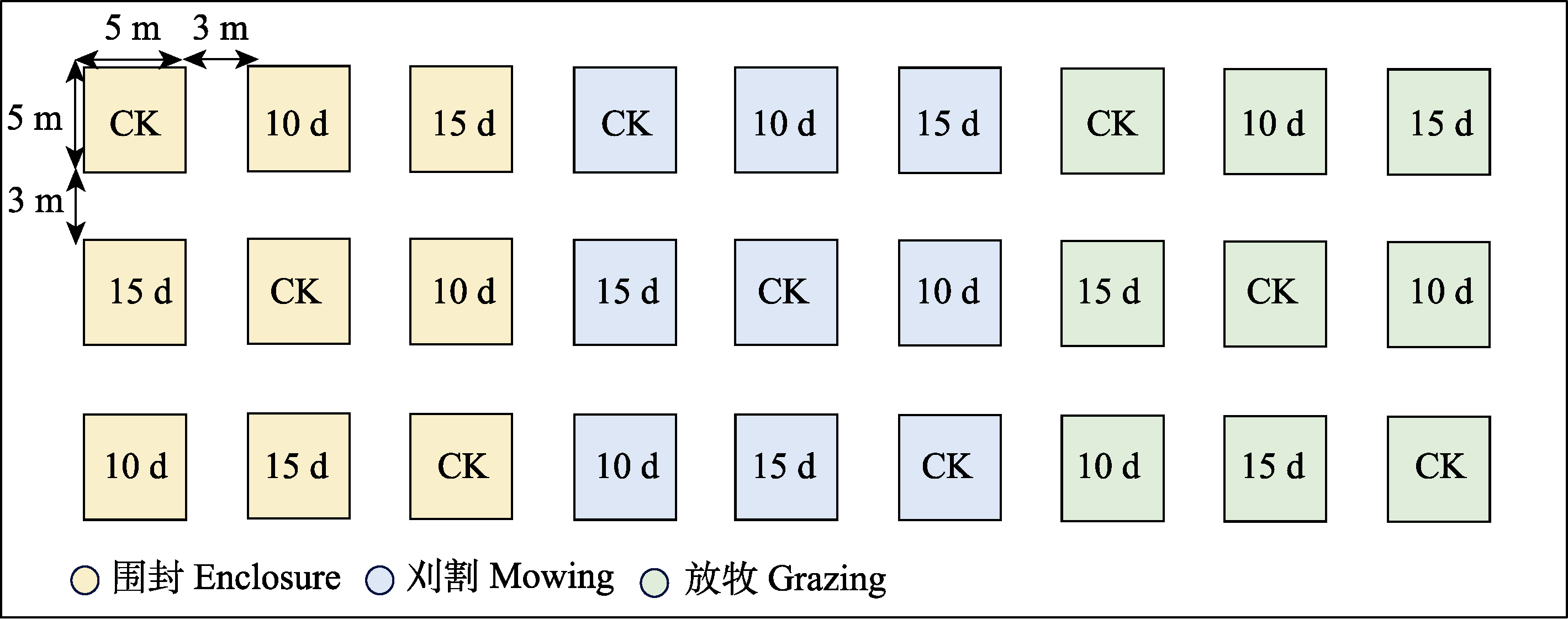
Fig. 1 Layout diagram of experimental plots for experiments on different grassland utilization methods and control of precipitation time intervals. A two-factor random complete block design was adopted. The two fixed factors were the grassland utilization methods (enclosure, mowing, grazing) and the precipitation time intervals (normal precipitation interval (CK), precipitation interval of 10 days (10 d), precipitation interval of 15 days (15 d)). There were a total of 9 treatment combinations, and each treatment was replicated 3 times.
| pH | SOC (g·kg-1) | TP (mg·kg-1) | AP (mg·kg-1) | MBC (mg·kg-1) | MBN (mg·kg-1) | MBP (mg·kg-1) | ||
|---|---|---|---|---|---|---|---|---|
| CK | M | 7.23 ± 0.35a | 13.52 ± 3.21a | 129.33 ± 21.89a | 6.04 ± 2.03a | 284.73 ±70.70a | 48.85 ± 9.75a | 14.18 ± 9.95a |
| E | 7.20 ± 0.14a | 12.35 ± 3.11a | 130.53 ± 14.84a | 3.64 ± 0.98b | 425.63 ± 285.00a | 81.84 ± 62.86a | 12.82 ± 8.87a | |
| G | 7.24 ± 0.25a | 12.88 ± 5.14a | 148.47 ± 40.30a | 5.81 ± 2.30a | 390.91 ± 26.16a | 67.36 ± 18.96a | 14.49 ± 7.40a | |
| 10 d | M | 7.09 ± 0.14a | 11.09 ± 2.91a | 107.81 ± 24.04b | 6.31 ± 3.76a | 501.60 ± 288.84a | 87.30 ± 69.46a | 9.71 ± 8.77b |
| E | 7.11 ± 0.12a | 13.73 ± 5.64a | 147.90 ± 26.58a | 7.92 ± 3.46a | 390.96 ± 187.04a | 76.80 ± 16.49a | 10.11 ± 8.88b | |
| G | 6.92 ± 0.26b | 14.58 ± 4.86a | 125.69 ± 20.97ab | 5.44 ± 2.87a | 505.84 ± 176.42a | 88.20 ± 28.96a | 45.21 ± 34.51a | |
| 15 d | M | 7.06 ± 0.20a | 15.63 ± 4.63a | 129.72 ± 20.33a | 6.60 ± 10.10a | 513.24 ± 245.32a | 82.25 ± 42.63ab | 17.44 ± 12.83a |
| E | 7.09 ± 0.17a | 18.45 ± 3.05a | 143.38 ± 31.78a | 6.77 ± 2.98a | 722.20 ± 219.73a | 121.69 ± 31.95a | 12.90 ± 5.05a | |
| G | 7.20 ± 0.33a | 14.52 ± 4.90a | 120.28 ± 26.03a | 7.30 ± 3.90a | 602.79 ± 146.47a | 73.92 ± 46.55b | 17.95 ± 16.43a |
Table 1 Soil physicochemical properties at different precipitation intervals and different grassland utilization methods (mean ± SE)
| pH | SOC (g·kg-1) | TP (mg·kg-1) | AP (mg·kg-1) | MBC (mg·kg-1) | MBN (mg·kg-1) | MBP (mg·kg-1) | ||
|---|---|---|---|---|---|---|---|---|
| CK | M | 7.23 ± 0.35a | 13.52 ± 3.21a | 129.33 ± 21.89a | 6.04 ± 2.03a | 284.73 ±70.70a | 48.85 ± 9.75a | 14.18 ± 9.95a |
| E | 7.20 ± 0.14a | 12.35 ± 3.11a | 130.53 ± 14.84a | 3.64 ± 0.98b | 425.63 ± 285.00a | 81.84 ± 62.86a | 12.82 ± 8.87a | |
| G | 7.24 ± 0.25a | 12.88 ± 5.14a | 148.47 ± 40.30a | 5.81 ± 2.30a | 390.91 ± 26.16a | 67.36 ± 18.96a | 14.49 ± 7.40a | |
| 10 d | M | 7.09 ± 0.14a | 11.09 ± 2.91a | 107.81 ± 24.04b | 6.31 ± 3.76a | 501.60 ± 288.84a | 87.30 ± 69.46a | 9.71 ± 8.77b |
| E | 7.11 ± 0.12a | 13.73 ± 5.64a | 147.90 ± 26.58a | 7.92 ± 3.46a | 390.96 ± 187.04a | 76.80 ± 16.49a | 10.11 ± 8.88b | |
| G | 6.92 ± 0.26b | 14.58 ± 4.86a | 125.69 ± 20.97ab | 5.44 ± 2.87a | 505.84 ± 176.42a | 88.20 ± 28.96a | 45.21 ± 34.51a | |
| 15 d | M | 7.06 ± 0.20a | 15.63 ± 4.63a | 129.72 ± 20.33a | 6.60 ± 10.10a | 513.24 ± 245.32a | 82.25 ± 42.63ab | 17.44 ± 12.83a |
| E | 7.09 ± 0.17a | 18.45 ± 3.05a | 143.38 ± 31.78a | 6.77 ± 2.98a | 722.20 ± 219.73a | 121.69 ± 31.95a | 12.90 ± 5.05a | |
| G | 7.20 ± 0.33a | 14.52 ± 4.90a | 120.28 ± 26.03a | 7.30 ± 3.90a | 602.79 ± 146.47a | 73.92 ± 46.55b | 17.95 ± 16.43a |
| pH | SOC | TP | AP | MBC | MBN | MBP | ||||||||
|---|---|---|---|---|---|---|---|---|---|---|---|---|---|---|
| F | p | F | p | F | p | F | p | F | p | F | p | F | p | |
| 草地利用方式 Grassland utilization method | 0.06 | 0.94 | 0.76 | 0.47 | 3.315 | 0.04 | 0.017 | 0.98 | 1.21 | 0.30 | 1.919 | 0.15 | 6.840 | <0.01** |
| 降水时间间隔 Precipitation interval | 4.58 | 0.01* | 4.97 | <0.01** | 0.800 | 0.45 | 1.198 | 0.31 | 10.13 | <0.001*** | 2.923 | 0.06 | 1.944 | 0.15 |
| 草地利用方式×降水时间间隔 Utilization method × precipitation interval | 1.56 | 0.20 | 1.53 | 0.20 | 2.645 | 0.04* | 0.815 | 0.52 | 1.67 | 0.17 | 1.586 | 0.19 | 5.002 | <0.01*** |
Table 2 Two-factor ANOVA of soil physicochemical properties at different precipitation intervals and different grassland utilization methods
| pH | SOC | TP | AP | MBC | MBN | MBP | ||||||||
|---|---|---|---|---|---|---|---|---|---|---|---|---|---|---|
| F | p | F | p | F | p | F | p | F | p | F | p | F | p | |
| 草地利用方式 Grassland utilization method | 0.06 | 0.94 | 0.76 | 0.47 | 3.315 | 0.04 | 0.017 | 0.98 | 1.21 | 0.30 | 1.919 | 0.15 | 6.840 | <0.01** |
| 降水时间间隔 Precipitation interval | 4.58 | 0.01* | 4.97 | <0.01** | 0.800 | 0.45 | 1.198 | 0.31 | 10.13 | <0.001*** | 2.923 | 0.06 | 1.944 | 0.15 |
| 草地利用方式×降水时间间隔 Utilization method × precipitation interval | 1.56 | 0.20 | 1.53 | 0.20 | 2.645 | 0.04* | 0.815 | 0.52 | 1.67 | 0.17 | 1.586 | 0.19 | 5.002 | <0.01*** |
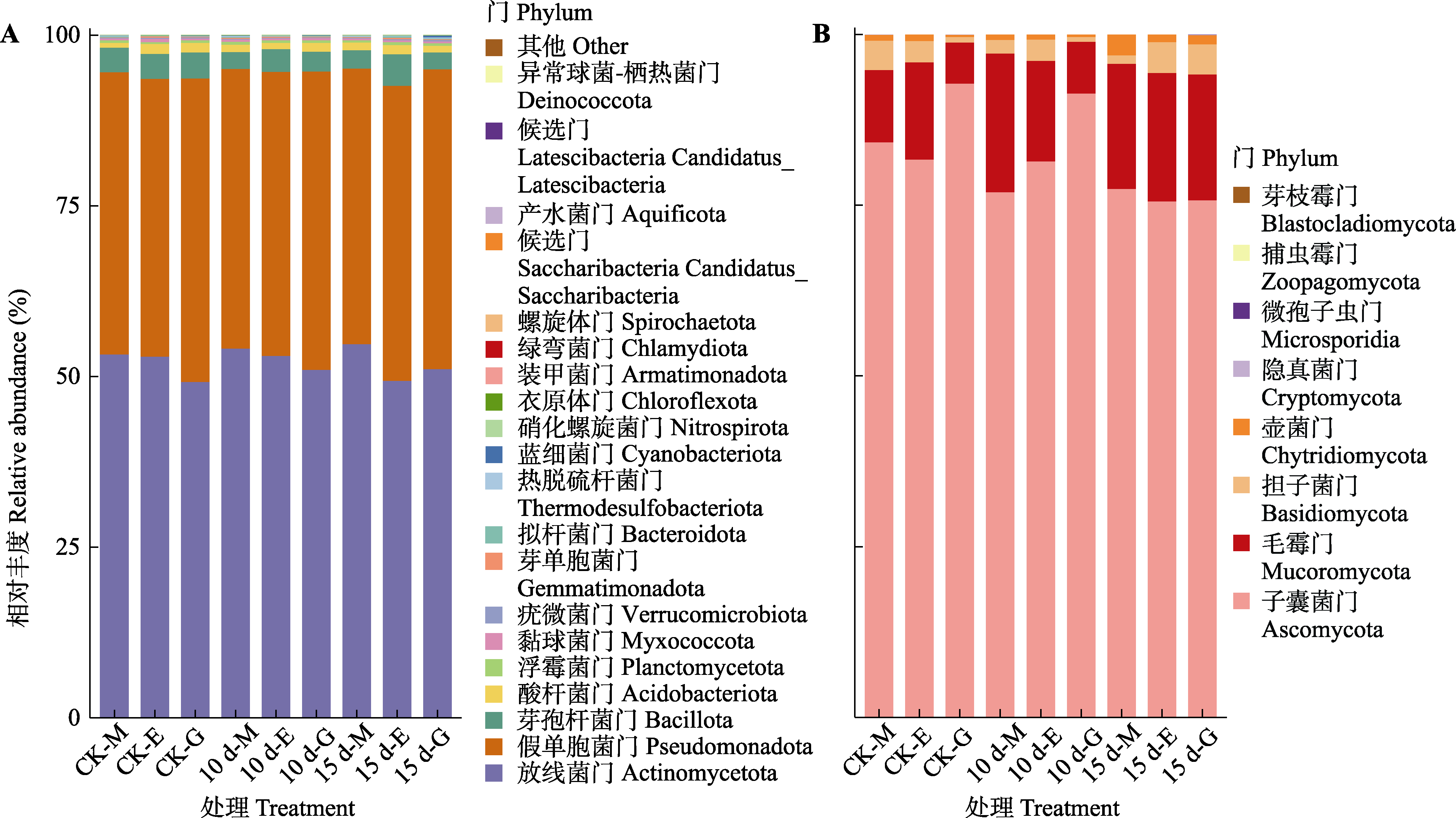
Fig. 2 Relative abundances of bacterial (A) and fungal (B) communities at the phylum level at different precipitation intervals under different grassland utilization methods. CK-M, mowing at regular precipitation intervals; CK-E, enclosure at regular precipitation intervals; CK-G, grazing at regular precipitation intervals; 10 d-M, mowing 10 days apart from precipitation; 10 d-E, enclosure 10 days apart from precipitation; 10 d-G, grazing 10 days apart from precipitation; 15 d-M, mowing 15 days apart from precipitation; 15 d-E, enclosure 15 days apart from precipitation; 15 d-G, grazing 15 days apart from precipitation.
| Al-P (mg·kg-1) | Fe-P (mg·kg-1) | O-P (mg·kg-1) | Ca-P (mg·kg-1) | ||
|---|---|---|---|---|---|
| CK | M | 4.04 ± 1.60a | 8.96 ± 1.32b | 1.26 ± 0.23a | 17.29 ± 2.14b |
| E | 3.96 ± 1.11a | 13.89 ± 4.01a | 1.52 ± 0.51a | 22.83 ± 3.54a | |
| G | 3.96 ± 1.11a | 13.75 ± 4.00a | 1.63 ± 0.30a | 17.85 ± 0.82b | |
| 10 d | M | 2.86 ± 0.32b | 12.09 ± 2.45a | 1.30 ± 0.28b | 17.09 ± 1.24b |
| E | 6.09 ± 0.87a | 13.86 ± 5.16a | 1.79 ± 0.36a | 19.82 ± 1.94a | |
| G | 3.23 ± 0.35b | 11.39 ± 3.80a | 1.50 ± 0.30ab | 16.25 ± 2.18b | |
| 15 d | M | 3.69 ± 1.72ab | 10.12 ± 2.33b | 1.69 ± 0.29a | 18.41 ± 1.25a |
| E | 5.01 ± 2.04a | 13.11 ± 3.10a | 1.97 ± 0.59a | 19.01 ± 0.56a | |
| G | 2.89 ± 0.29b | 8.78 ± 1.84b | 1.30 ± 0.82b | 18.05 ± 3.81a |
Table 3 Comparison of inorganic soil inorganic phosphorus (Pi) fractions concentrations at different precipitation intervals and different grassland utilization methods (mean ± SE)
| Al-P (mg·kg-1) | Fe-P (mg·kg-1) | O-P (mg·kg-1) | Ca-P (mg·kg-1) | ||
|---|---|---|---|---|---|
| CK | M | 4.04 ± 1.60a | 8.96 ± 1.32b | 1.26 ± 0.23a | 17.29 ± 2.14b |
| E | 3.96 ± 1.11a | 13.89 ± 4.01a | 1.52 ± 0.51a | 22.83 ± 3.54a | |
| G | 3.96 ± 1.11a | 13.75 ± 4.00a | 1.63 ± 0.30a | 17.85 ± 0.82b | |
| 10 d | M | 2.86 ± 0.32b | 12.09 ± 2.45a | 1.30 ± 0.28b | 17.09 ± 1.24b |
| E | 6.09 ± 0.87a | 13.86 ± 5.16a | 1.79 ± 0.36a | 19.82 ± 1.94a | |
| G | 3.23 ± 0.35b | 11.39 ± 3.80a | 1.50 ± 0.30ab | 16.25 ± 2.18b | |
| 15 d | M | 3.69 ± 1.72ab | 10.12 ± 2.33b | 1.69 ± 0.29a | 18.41 ± 1.25a |
| E | 5.01 ± 2.04a | 13.11 ± 3.10a | 1.97 ± 0.59a | 19.01 ± 0.56a | |
| G | 2.89 ± 0.29b | 8.78 ± 1.84b | 1.30 ± 0.82b | 18.05 ± 3.81a |
| Al-P | Fe-P | O-P | Ca-P | |||||
|---|---|---|---|---|---|---|---|---|
| F | p | F | p | F | p | F | p | |
| 草地利用方式 Grassland utilization methods | 15.35 | <0.001*** | 6.78 | <0.01** | 6.83 | <0.01** | 17.15 | <0.001*** |
| 降水时间间隔 Precipitation interval | 0.18 | 0.83 | 2.28 | 0.11 | 1.80 | 0.17 | 3.53 | 0.04* |
| 草地利用方式×降水时间间隔 Utilization methods × precipitation interval | 5.47 | <0.01** | 2.49 | 0.05 | 3.72 | <0.01** | 3.28 | 0.02* |
Table 4 Two-factor analysis results of soil inorganic phosphorus (Pi) fractions concentrations at different precipitation intervals under different grassland utilization methods
| Al-P | Fe-P | O-P | Ca-P | |||||
|---|---|---|---|---|---|---|---|---|
| F | p | F | p | F | p | F | p | |
| 草地利用方式 Grassland utilization methods | 15.35 | <0.001*** | 6.78 | <0.01** | 6.83 | <0.01** | 17.15 | <0.001*** |
| 降水时间间隔 Precipitation interval | 0.18 | 0.83 | 2.28 | 0.11 | 1.80 | 0.17 | 3.53 | 0.04* |
| 草地利用方式×降水时间间隔 Utilization methods × precipitation interval | 5.47 | <0.01** | 2.49 | 0.05 | 3.72 | <0.01** | 3.28 | 0.02* |
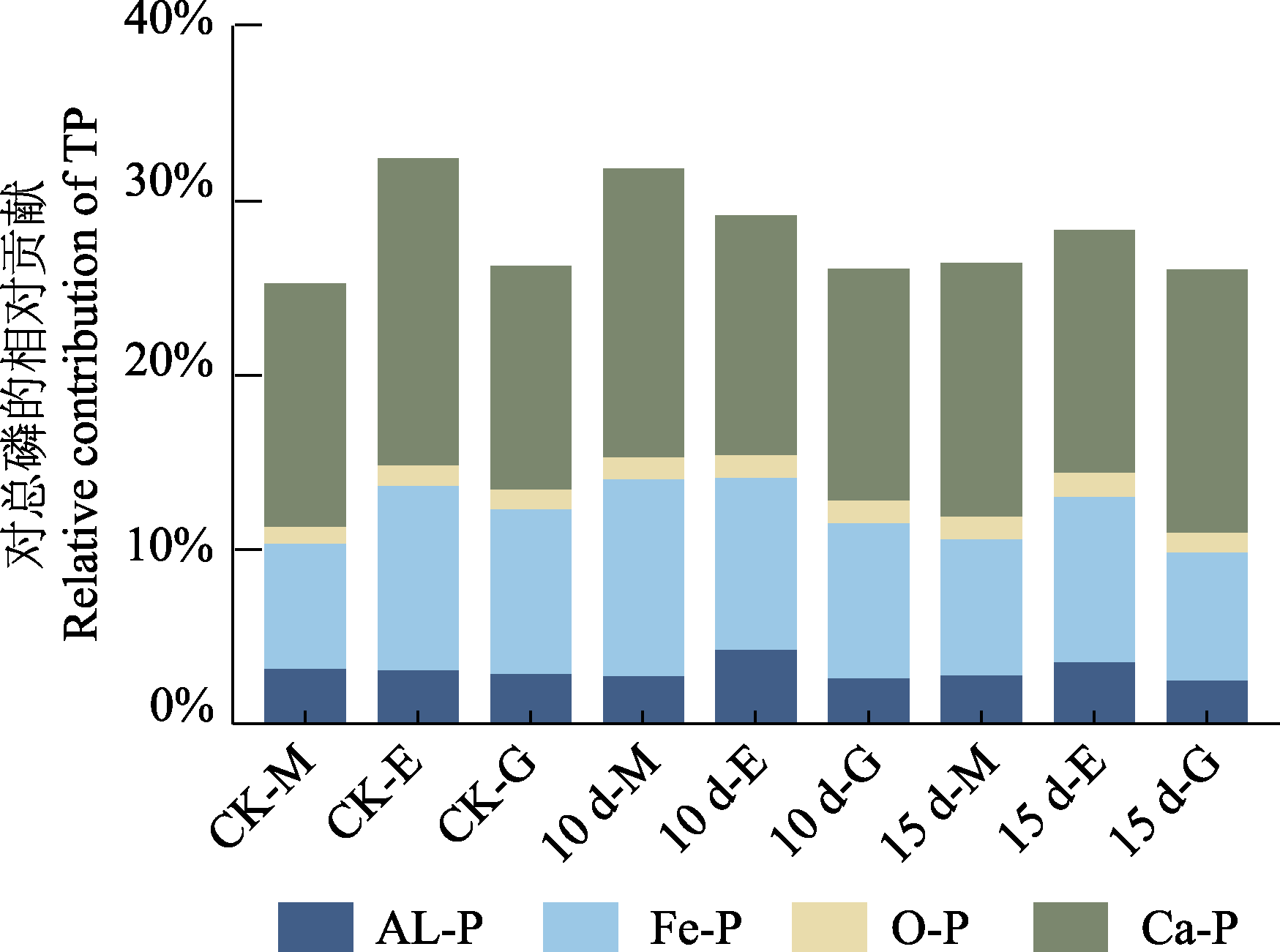
Fig. 3 Percentage of inorganic phosphorus content (Pi) fractions in total phosphorus content (TP). CK-M, mowing at regular precipitation intervals; CK-E, enclosure at regular precipitation intervals; CK-G, grazing at regular precipitation intervals; 10 d-M, mowing 10 days apart from precipitation; 10 d-E, enclosure 10 days apart from precipitation; 10 d-G, grazing 10 days apart from precipitation; 15 d-M, mowing 15 days apart from precipitation; 15 d-E, enclosure 15 days apart from precipitation; 15 d-G, grazing 15 days apart from precipitation. Al-P, the content of aluminum-bound phosphorus; Fe-P,the contents of ferrum-bound phosphorus; O-P, the content of occluded phosphate; Ca-P, the content of calcium-bound phosphorus.
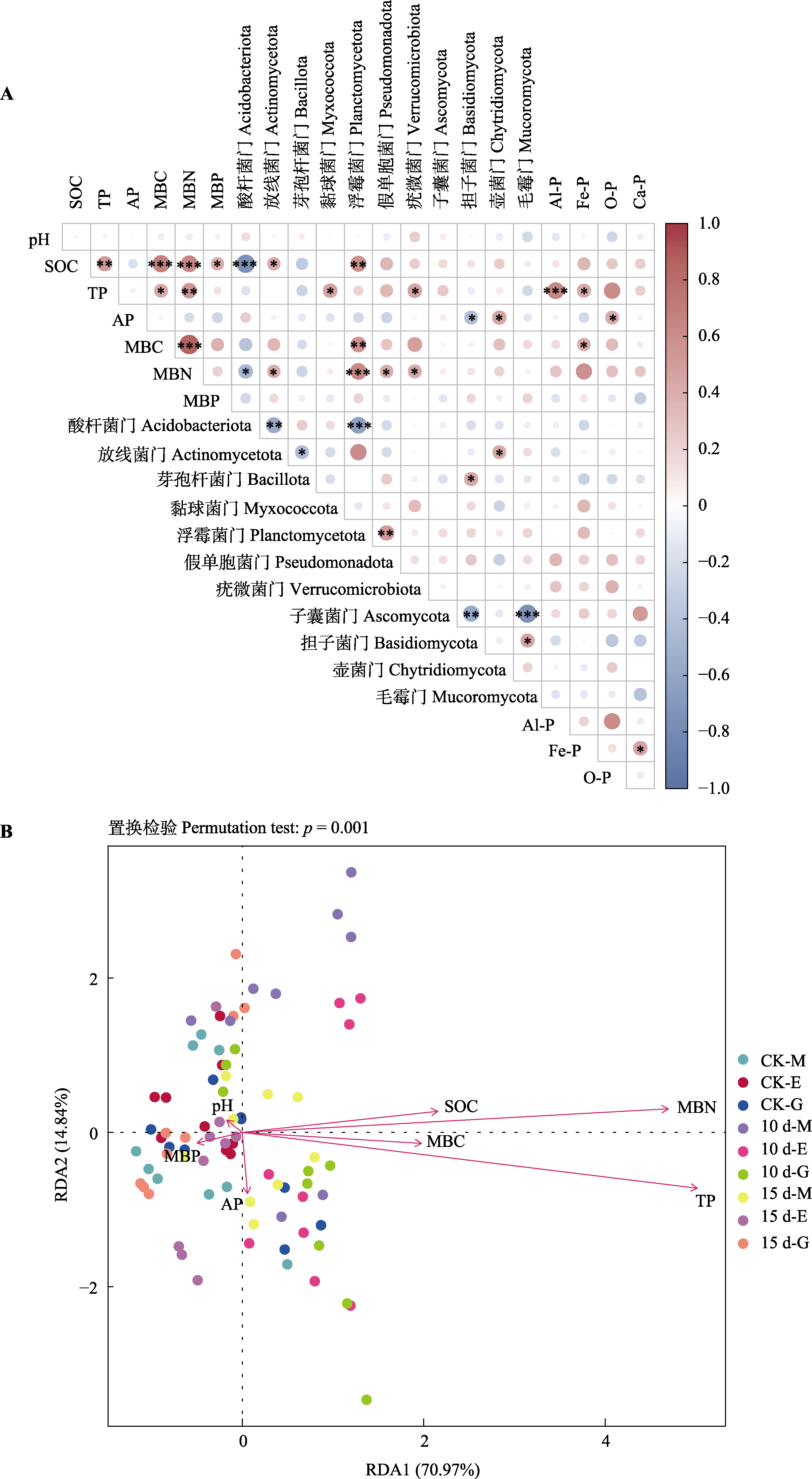
Fig. 4 Correlation analysis of inorganic phosphorus (Pi) fractions in different soils and related soil properties. In the Pearson correlation analysis (A), red indicates a positive correlation, and blue indicates a negative correlation. The redundancy analysis (RDA) (B) takes pH, SOC, TP, AP, MBC, MBN, and MBP contents as environmental factors, and the four inorganic phosphorus components (Al-P, Fe-P, O-P, and Ca-P) contents as the explained variables. CK-M, mowing at regular precipitation intervals; CK-E, enclosure at regular precipitation intervals; CK-G, grazing at regular precipitation intervals; 10 d-M, mowing 10 days apart from precipitation; 10 d-E, enclosure 10 days apart from precipitation; 10 d-G, grazing 10 days apart from precipitation; 15 d-M, mowing 15 days apart from precipitation; 15 d-E, enclosure 15 days apart from precipitation; 15 d-G, grazing 15 days apart from precipitation; AP, available phosphorus content in soil; MBC, microbial biomass carbon in soil; MBN, microbial biomass nitrogen in soil; MBP, microbial biomass phosphorus in soil; SOC, soil organic carbon content; TP, total phosphorus content in soil; Al-P, the content of aluminum-bound phosphorus; Fe-P,the contents of ferrum-bound phosphorus; O-P, the content of occluded phosphate; Ca-P, the content of calcium-bound phosphorus. *, p < 0.05; **, p < 0.01; ***, p < 0.001.
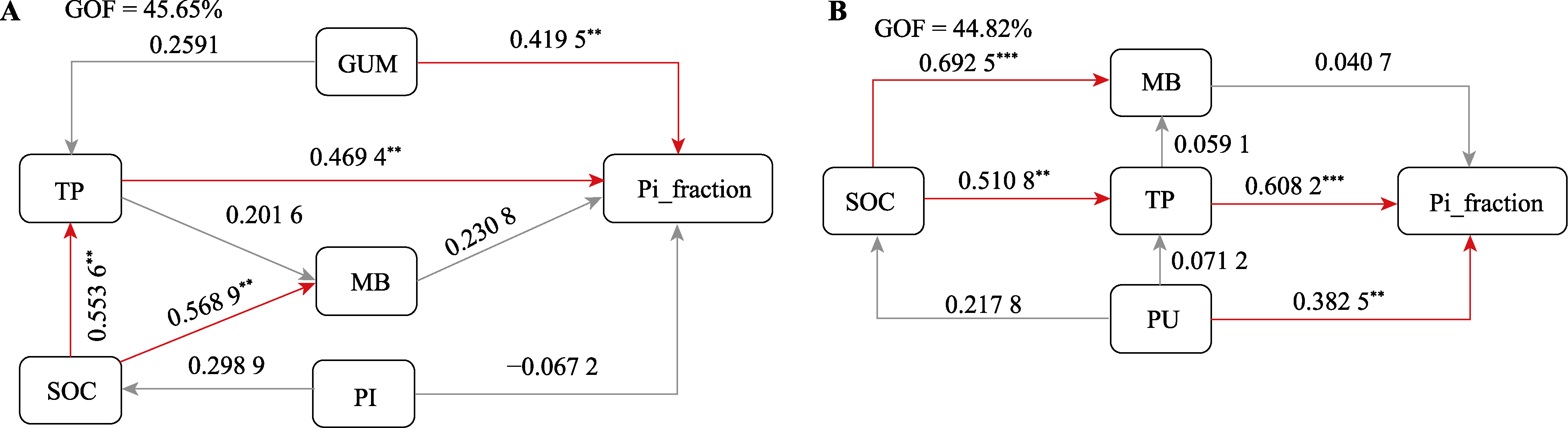
Fig. 5 Effects of precipitation interval and utilization pattern on soil inorganic phosphorus (Pi) fractions were investigated using Partial least squares path modeling (PLS-PM). The numbers on the arrows are the effect values of the relationships, with the red line indicating a significant positive relationship and the gray color indicating an insignificant relationship. GUM, grassland utilization methods; MB, microbial biomass carbon, nitrogen and phosphorus content; PI, precipitation intervals; Pi_fraction, soil inorganic phosphorus component; PU, precipitation intervals and grassland utilization methods; SOC, soil organic carbon content; TP, total phosphorus content in soil. GOF, goodness of fit. **, p < 0.01; ***, p < 0.001.
| [1] |
Alori ET, Glick BR, Babalola OO (2017). Microbial phosphorus solubilization and its potential for use in sustainable agriculture. Frontiers in Microbiology, 8, 971. DOI: 10.3389/fmicb.2017.00971.
PMID |
| [2] | Anon (2013). Detection and attribution of climate change: from global to regional//IPCC (Intergovernmental Panel On Climate Change). Climate Change 2013—The Physical Science Basis. Cambridge University Press, Cambridge, UK. 867-952. |
| [3] | Anon (2015). Phosphorus reactions and cycling in soils//Thomas SJ, Sharpley AN. Phosphorus: Agriculture and the Environment. American Society of Agronomy, Crop Science Society of America, and Soil Science Society of America, Madison, USA. |
| [4] | Bao SD (2000). Soil Agrochemical Analysis. China Agricultural Press, Beijing. 25-97. |
| [鲍士旦 (2000). 土壤农化分析. 中国农业出版社, 北京. 25-97.] | |
| [5] |
Bing HJ, Wu YH, Zhou J, Sun HY, Luo J, Wang JP, Yu D (2016). Stoichiometric variation of carbon, nitrogen, and phosphorus in soils and its implication for nutrient limitation in alpine ecosystem of eastern Tibetan Plateau. Journal of Soils and Sediments, 16, 405-416.
DOI URL |
| [6] |
Bissett A, Burke C, Cook PLM, Bowman JP (2007). Bacterial community shifts in organically perturbed sediments. Environmental Microbiology, 9, 46-60.
PMID |
| [7] |
Blackwell MSA, Carswell AM, Bol R (2013). Variations in concentrations of N and P forms in leachates from dried soils rewetted at different rates. Biology and Fertility of Soils, 49, 79-87.
DOI URL |
| [8] | Bremer DJ, Ham JM, Owensby CE, Knapp AK (1998). Responses of soil respiration to clipping and grazing in a tallgrass prairie. Journal of Environmental Quality, 27, 1539-1548. |
| [9] |
Chang SC, Jackson ML (1957). Fractionation of soil phosphorus. Soil Science, 84, 133-144.
DOI URL |
| [10] |
Cleveland CC, Liptzin D (2007). C:N:P stoichiometry in soil: Is there a “Redfield ratio” for the microbial biomass? Biogeochemistry, 85, 235-252.
DOI URL |
| [11] |
Cleveland CC, Townsend AR, Taylor P, Alvarez-Clare S, Bustamante MMC, Chuyong G, Dobrowski SZ, Grierson P, Harms KE, Houlton BZ, Marklein A, Parton W, Porder S, Reed SC, Sierra CA, et al. (2011). Relationships among net primary productivity, nutrients and climate in tropical rain forest: a pan-tropical analysis. Ecology Letters, 14, 1313-1317.
DOI URL |
| [12] |
Delmont TO, Quince C, Shaiber A, Esen ÖC, Lee ST, Rappé MS, McLellan SL, Lücker S, Eren AM (2018). Nitrogen- fixing populations of Planctomycetes and Proteobacteria are abundant in surface ocean metagenomes. Nature Microbiology, 3, 804-813.
DOI PMID |
| [13] | Dong HX, Zhang S, Lin JJ, Zhu B (2021). Responses of soil microbial biomass carbon and dissolved organic carbon to drying-rewetting cycles: a meta-analysis. Catena, 207, 105610. DOI: 10.1016/j.catena.2021.105610. |
| [14] |
Du K, Kang YK, Zhang DG, Su JH (2020). Effects of different grazing patterns on organic carbon and nitrogen pools in alpine meadow in the Qilian Mountains. Acta Agrestia Sinica, 28, 1412-1420.
DOI |
|
[杜凯, 康宇坤, 张德罡, 苏军虎 (2020). 不同放牧方式对祁连山高寒草甸有机碳、氮库的影响. 草地学报, 28, 1412-1420.]
DOI |
|
| [15] |
Eldridge DJ, Delgado-Baquerizo M, Travers SK, Val J, Oliver I, Hamonts K, Singh BK (2017). Competition drives the response of soil microbial diversity to increased grazing by vertebrate herbivores. Ecology, 98, 1922-1931.
DOI PMID |
| [16] |
Elser JJ, Bracken MES, Cleland EE, Gruner DS, Harpole WS, Hillebrand H, Ngai JT, Seabloom EW, Shurin JB, Smith JE (2007). Global analysis of nitrogen and phosphorus limitation of primary producers in freshwater, marine and terrestrial ecosystems. Ecology Letters, 10, 1135-1142.
DOI PMID |
| [17] | Engelhardt IC, Welty A, Blazewicz SJ, Bru D, Rouard N, Breuil MC, Gessler A, Galiano L, Miranda JC, Spor A, Barnard RL (2018). Depth matters: effects of precipitation regime on soil microbial activity upon rewetting of a plant-soil system. The ISME Journal, 12, 1061-1071. |
| [18] | Fang X, Guo XL, Zheng RB, Fu Q (2020). Effect of difference grazing distributions on soil ecological stoichiometric characteristics in peatland of northwest Yunnan Plateau. Research of Soil and Water Conservation, 27(2), 9-14. |
| [方昕, 郭雪莲, 郑荣波, 付倩 (2020). 不同放牧干扰对滇西北高原泥炭沼泽土壤生态化学计量特征的影响. 水土保持研究, 27(2), 9-14.] | |
| [19] |
Filippidou S, Wunderlin T, Junier T, Jeanneret N, Dorador C, Molina V, Johnson DR, Junier P (2016). A combination of extreme environmental conditions favor the prevalence of endospore-forming firmicutes. Frontiers in Microbiology, 7, 1707. DOI: 10.3389/fmicb.2016.01707.
PMID |
| [20] | Gao YZ, Han XG, Wang SP (2004). The effects of grazing on grassland soils. Acta Ecologica Sinica, 24, 790-797. |
| [高英志, 韩兴国, 汪诗平 (2004). 放牧对草原土壤的影响. 生态学报, 24, 790-797.] | |
| [21] |
Gilbert N (2009). Environment: the disappearing nutrient. Nature, 461, 716-718.
DOI |
| [22] |
Gu S, Gruau G, Malique F, Dupas R, Petitjean P, Gascuel- Odoux C (2018). Drying/rewetting cycles stimulate release of colloidal-bound phosphorus in riparian soils. Geoderma, 321, 32-41.
DOI URL |
| [23] | He M, Zhou GY, Yuan TF, van Groenigen KJ, Shao JJ, Zhou XH (2020). Grazing intensity significantly changes the C:N:P stoichiometry in grassland ecosystems. Global Ecology and Biogeography, 29, 355-369. |
| [24] |
Hou EQ, Lu XJ, Jiang LF, Wen DZ, Luo YQ (2019). Quantifying soil phosphorus dynamics: a data assimilation approach. Journal of Geophysical Research: Biogeosciences, 124, 2159-2173.
DOI |
| [25] |
Huang L, Ning J, Zhu P, Zheng YH, Zhai J (2021). The conservation patterns of grassland ecosystem in response to the forage-livestock balance in North China. Journal of Geographical Sciences, 31, 518-534.
DOI |
| [26] |
Katsalirou E, Deng SP, Gerakis A, Nofziger DL (2016). Long-term management effects on soil P, microbial biomass P, and phosphatase activities in prairie soils. European Journal of Soil Biology, 76, 61-69.
DOI URL |
| [27] |
Kehler A, Haygarth P, Tamburini F, Blackwell M (2021). Cycling of reduced phosphorus compounds in soil and potential impacts of climate change. European Journal of Soil Science, 72, 2517-2537.
DOI URL |
| [28] |
Lai JS, Zou Y, Zhang JL, Peres-Neto PR (2022). Generalizing hierarchical and variation partitioning in multiple regression and canonical analyses using the rdacca.hp R package. Methods in Ecology and Evolution, 13, 782-788.
DOI URL |
| [29] |
Lang F, Bauhus J, Frossard E, George E, Kaiser K, Kaupenjohann M, Krüger J, Matzner E, Polle A, Prietzel J, Rennenberg H, Wellbrock N (2016). Phosphorus in forest ecosystems: new insights from an ecosystem nutrition perspective. Journal of Plant Nutrition and Soil Science, 179, 129-135.
DOI URL |
| [30] | Li MX, Wang DM, Ren Y, Wang XL (2018). Influence of different drying-rewetting frequencies on available soil nutrients and DOC. Acta Ecologica Sinica, 38, 1542-1549. |
| [李梦寻, 王冬梅, 任远, 汪西林 (2018). 不同干湿交替频率对土壤速效养分、水溶性有机碳的影响. 生态学报, 38, 1542-1549.] | |
| [31] | Li Q, Song YT, Zhou DW, Wang ML, Chen XY (2014). Effects of fencing and grazing on soil carbon, nitrogen, phosphorus storage in degraded alkali-saline grassland. Pratacultural Science, 31, 1811-1819. |
| [李强, 宋彦涛, 周道玮, 王敏玲, 陈笑莹 (2014). 围封和放牧对退化盐碱草地土壤碳、氮、磷储量的影响. 草业科学, 31, 1811-1819.] | |
| [32] |
Li RN, Wang ZP, Batbayar J, Zhang DJ, Zhang SL, Yang XY (2019). Relationship between soil available phosphorus and inorganic phosphorus forms under equivalent organic matter condition in a tier soil. Scientia Agricultura Sinica, 52, 3852-3865.
DOI |
|
[李若楠, 王政培, Batbayar J, 张东杰, 张树兰, 杨学云 (2019). 等有机质土有效磷和无机磷形态的关系. 中国农业科学, 52, 3852-3865.]
DOI |
|
| [33] | Li Y, Xu C, Zhang WL, Lin L, Wang LF, Niu LH, Zhang HJ, Wang PF, Wang C (2020). Response of bacterial community in composition and function to the various DOM at river confluences in the urban area. Water Research, 169, 115293. DOI: 10.1016/j.watres.2019.115293. |
| [34] | Li YS (2020). Effects of Different Measures on Vegetation and Soil in Moderate Degraded Meadow Steppe Due to Mowing. Master degree dissertation, Inner Mongolia University, Hohhot. 18-54. |
| [李雅舒 (2020). 不同措施对刈割中度退化草甸草原植被和土壤的影响. 硕士学位论文, 内蒙古大学, 呼和浩特. 18-54.] | |
| [35] |
Liang YM, Pan FJ, Ma JM, Yang ZQ, Yan PD (2021). Long-term forest restoration influences succession patterns of soil bacterial communities. Environmental Science and Pollution Research, 28, 20598-20607.
DOI |
| [36] |
Liao JD, Boutton TW, Jastrow JD (2006). Storage and dynamics of carbon and nitrogen in soil physical fractions following woody plant invasion of grassland. Soil Biology & Biochemistry, 38, 3184-3196.
DOI URL |
| [37] | Liu CL, Li WL, Xu J, Wei W, Xue PF, Yan HP (2021). Response of soil nutrients and stoichiometry to grazing management in alpine grassland on the Qinghai-Tibet Plateau. Soil and Tillage Research, 206, 104822. DOI: 10.1016/j.still.2020.104822. |
| [38] | Luo YL, Li QQ, Wang CQ, Xin ZY, Wang YH, Song AJ, Wan AR, Tang K (2016). Last 30 a changes of C, N and P ecological stoichiometry of different land use types in hilly area of mid-Sichuan basin, southwest China. Soils, 48, 726-733. |
| [罗由林, 李启权, 王昌全, 辛志远, 王永豪, 宋安军, 万傲然, 唐科 (2016). 近30年川中丘陵区不同土地利用方式土壤碳氮磷生态化学计量特征变化. 土壤, 48, 726-733.] | |
| [39] |
Neal AL, Rossmann M, Brearley C, Akkari E, Guyomar C, Clark IM, Allen E, Hirsch PR (2017). Land-use influences phosphatase gene microdiversity in soils. Environmental Microbiology, 19, 2740-2753.
DOI PMID |
| [40] | Ning ZY, Li YL, Yang HL, Zhang ZQ, Zhang JP (2019). Stoichiometry and effects of carbon, nitrogen, and phosphorus in soil of desertified grasslands on community productivity and species diversity. Acta Ecologica Sinica, 39, 3537-3546. |
| [宁志英, 李玉霖, 杨红玲, 张子谦, 张建鹏 (2019). 沙化草地土壤碳氮磷化学计量特征及其对植被生产力和多样性的影响. 生态学报, 39, 3537-3546.] | |
| [41] |
Niu KC, He JS, Zhang ST, Lechowicz MJ (2016). Tradeoffs between forage quality and soil fertility: lessons from Himalayan rangelands. Agriculture, Ecosystems & Environment, 234, 31-39.
DOI URL |
| [42] |
Oberson A, Friesen DK, Rao IM, Bühler S, Frossard E (2001). Phosphorus transformations in an oxisol under contrasting land-use systems: the role of the soil microbial biomass. Plant and Soil, 237, 197-210.
DOI |
| [43] |
Orwin KH, Buckland SM, Johnson D, Turner BL, Smart S, Oakley S, Bardgett RD (2010). Linkages of plant traits to soil properties and the functioning of temperate grassland. Journal of Ecology, 98, 1074-1083.
DOI URL |
| [44] |
Raghothama KG (1999). Phosphate acquisition. Annual Review of Plant Physiology and Plant Molecular Biology, 50, 665-693.
PMID |
| [45] |
Richardson AE, Simpson RJ (2011). Soil microorganisms mediating phosphorus availability. Plant Physiology, 156, 989-996.
DOI PMID |
| [46] |
Rousk J, Bååth E, Brookes PC, Lauber CL, Lozupone C, Caporaso JG, Knight R, Fierer N (2010). Soil bacterial and fungal communities across a pH gradient in an arable soil. The ISME Journal, 4, 1340-1351.
DOI URL |
| [47] | Shao LY, Peng Y, Liu HY, Zhao RN, Jiang LC, Li Y, Han P, Jiang Y, Wei CZ, Han XG, Huang JH (2023). Applied phosphorus is maintained in labile and moderately occluded fractions in a typical meadow steppe with the addition of multiple nutrients. Journal of Environmental Management, 345, 118807. DOI: 10.1016/j.jenvman.2023.118807. |
| [48] |
Spain AM, Krumholz LR, Elshahed MS (2009). Abundance, composition, diversity and novelty of soil Proteobacteria. The ISME Journal, 3, 992-1000.
DOI URL |
| [49] |
Spohn M (2020). Increasing the organic carbon stocks in mineral soils sequesters large amounts of phosphorus. Global Change Biology, 26, 4169-4177.
DOI URL |
| [50] |
Steffens M, Kölbl A, Totsche KU, Kögel-Knabner I (2008). Grazing effects on soil chemical and physical properties in a semiarid steppe of Inner Mongolia (P. R. China). Geoderma, 143, 63-72.
DOI URL |
| [51] | Su HY, Zhang ZH, She YD, Ma L, Mao XF, Jia SB, Ma Z, Zhou HK, Huang XT (2022). Effects of different managements on soil nutrients in alpine grassland in the Qinghai Lake Basin. Acta Agrestia Sinica, 30, 1071-1076. |
|
[苏洪烨, 张中华, 佘延娣, 马丽, 毛旭锋, 贾顺斌, 马真, 周华坤, 黄小涛 (2022). 不同管理措施对青海湖流域高寒草地土壤养分的影响. 草地学报, 30, 1071-1076.]
DOI |
|
| [52] | Sun GF, Jin JY, Shi YL (2011). Research advance on soil phosphorous forms and their availability to crops in soil. Soil and Fertilizer Sciences in China, (2), 1-9. |
| [孙桂芳, 金继运, 石元亮 (2011). 土壤磷素形态及其生物有效性研究进展. 中国土壤与肥料, (2), 1-9.] | |
| [53] |
Tan H, Barret M, Mooij MJ, Rice O, Morrissey JP, Dobson A, Griffiths B, O’Gara F (2013). Long-term phosphorus fertilisation increased the diversity of the total bacterial community and the phoD phosphorus mineraliser group in pasture soils. Biology and Fertility of Soils, 49, 661-672.
DOI URL |
| [54] | The Ministry of Agriculture of the People’s Republic of China (2015). Calculation of reasonable livestock carrying capacity of natural grassland: NY/T 635-2015[S]. Standards Press of China, Beijing. |
| [中华人民共和国农业部 (2015). 天然草地合理载畜量的计算: NY/T 635-2015[S]. 中国标准出版社, 北京.] | |
| [55] | Tian LY, Guo QJ, Yu GR, Zhu YG, Lang YC, Wei RF, Hu J, Yang XR, Ge TD (2020). Phosphorus fractions and oxygen isotope composition of inorganic phosphate in typical agricultural soils. Chemosphere, 239, 124622. DOI: 10.1016/j.chemosphere.2019.124622. |
| [56] |
Trivedi P, Delgado-Baquerizo M, Jeffries TC, Trivedi C, Anderson IC, Lai KT, McNee M, Flower K, Pal Singh B, Minkey D, Singh BK (2017). Soil aggregation and associated microbial communities modify the impact of agricultural management on carbon content. Environmental Microbiology, 19, 3070-3086.
DOI PMID |
| [57] |
van Gestel M, Merckx R, Vlassak K (1993). Microbial biomass responses to soil drying and rewetting: the fate of fast- and slow-growing microorganisms in soils from different climates. Soil Biology & Biochemistry, 25, 109-123.
DOI URL |
| [58] |
Villanueva RAM, Chen ZJ (2019). ggplot2: elegant graphics for data analysis (2nd ed.). Measurement: Interdisciplinary Research and Perspectives, 17, 160-167.
DOI URL |
| [59] |
Vitousek PM, Porder S, Houlton BZ, Chadwick OA (2010). Terrestrial phosphorus limitation: mechanisms, implications, and nitrogen-phosphorus interactions. Ecological Applications, 20, 5-15.
PMID |
| [60] |
Walker TW, Syers JK (1976). The fate of phosphorus during pedogenesis. Geoderma, 15, 1-19.
DOI URL |
| [61] |
Wan WJ, Hao XL, Xing YH, Liu S, Zhang XY, Li X, Chen WL, Huang QY (2021). Spatial differences in soil microbial diversity caused by pH-driven organic phosphorus mineralization. Land Degradation & Development, 32, 766-776.
DOI URL |
| [62] |
Wang J, Liu WZ, Mu HF, Dang TH (2010a). Inorganic phosphorus fractions and phosphorus availability in a calcareous soil receiving 21-year superphosphate application. Pedosphere, 20, 304-310.
DOI URL |
| [63] |
Wang YP, Law RM, Pak B (2010b). A global model of carbon, nitrogen and phosphorus cycles for the terrestrial biosphere. Biogeosciences, 7, 2261-2282.
DOI URL |
| [64] | Wang YZ, Chen X, Shi Y (2013). Phosphorus availability in cropland soils of China and related affecting factors. Chinese Journal of Applied Ecology, 24, 260-268. |
| [王永壮, 陈欣, 史奕 (2013). 农田土壤中磷素有效性及影响因素. 应用生态学报, 24, 260-268.] | |
| [65] |
Wissuwa M (2003). How do plants achieve tolerance to phosphorus deficiency? Small causes with big effects. Plant physiology, 133, 1947-1958.
DOI PMID |
| [66] |
Yao XD, Zhang NL, Zeng H, Wang W (2018). Effects of soil depth and plant-soil interaction on microbial community in temperate grasslands of northern China. Science of the Total Environment, 630, 96-102.
DOI URL |
| [67] |
Yuan JH, Wang L, Chen H, Chen GL, Wang SQ, Zhao X, Wang Y (2021). Responses of soil phosphorus pools accompanied with carbon composition and microorganism changes to phosphorus-input reduction in paddy soils. Pedosphere, 31, 83-93.
DOI URL |
| [68] | Zeng QC, Li X, Dong YH, Li YY, An SS (2015). Soil microbial biomass nitrogen and carbon, water soluble nitrogen and carbon under different arbors forests on the Loess Plateau. Acta Ecologica Sinica, 35, 3598-3605. |
| [69] |
Zhang FY, Quan Q, Ma FF, Zhou QP, Niu SL (2021). Clipping increases ecosystem carbon sequestration and its sensitivity to precipitation change in an alpine meadow. Plant and Soil, 458, 165-174.
DOI |
| [70] | Zhang H, Li JP, Wang YT, Zhang Y, Zhang J, Luo X, Zhang R (2020). Effect of enclosure and grazing on the soil stoichiometry characteristics of natural grassland on the Loess Plateau. Journal of Soil and Water Conservation, 34(5), 251-258. |
| [张昊, 李建平, 王誉陶, 张翼, 张娟, 罗叙, 张茹 (2020). 封育与放牧对黄土高原天然草地土壤化学计量特征的影响. 水土保持学报, 34(5), 251-258.] | |
| [71] |
Zhao BZ, Chen J, Zhang JB, Qin SW (2010). Soil microbial biomass and activity response to repeated drying-rewetting cycles along a soil fertility gradient modified by long-term fertilization management practices. Geoderma, 160, 218-224.
DOI URL |
| [72] |
Zhou GY, Luo Q, Chen YJ, He M, Zhou LY, Frank D, He YH, Fu YL, Zhang BC, Zhou XH (2019). Effects of livestock grazing on grassland carbon storage and release override impacts associated with global climate change. Global Change Biology, 25, 1119-1132.
DOI PMID |
| [73] |
Zhou JQ, Tian Y, Wu YQ, Liu JK, Zhang KB (2019). Characteristics of grassland vegetation community under different grazing management and its relationship with soil factors: a case study of Xin Barag Zuoqi. Ecology and Environment Sciences, 28, 1117-1126.
DOI |
|
[周建琴, 田赟, 吴雨晴, 刘建康, 张克斌 (2019). 不同放牧方式下的草场植被群落特征及其与土壤因子的关系——以新巴尔虎左旗为例. 生态环境学报, 28, 1117-1126.]
DOI |
|
| [74] |
Zornoza R, Guerrero C, Mataix-Solera J, Arcenegui V, García-Orenes F, Mataix-Beneyto J (2007). Assessing the effects of air-drying and rewetting pre-treatment on soil microbial biomass, basal respiration, metabolic quotient and soluble carbon under Mediterranean conditions. European Journal of Soil Biology, 43, 120-129.
DOI URL |
| [1] | ZHOU Shuang-Xi, WU Dong-Xiu, ZHANG Lin, SHI Hui-Qiu. Effects of changing precipitation patterns on seedlings of Stipa grandis, a dominant plant of typical grassland of Inner Mongolia, China [J]. Chin J Plant Ecol, 2010, 34(10): 1155-1164. |
| Viewed | ||||||
|
Full text |
|
|||||
|
Abstract |
|
|||||
Copyright © 2026 Chinese Journal of Plant Ecology
Tel: 010-62836134, 62836138, E-mail: apes@ibcas.ac.cn, cjpe@ibcas.ac.cn

