
Chin J Plant Ecol ›› 2026, Vol. 50 ›› Issue (3): 722-730.DOI: 10.17521/cjpe.2025.0297 cstr: 32100.14.cjpe.2025.0297
• Research Articles • Previous Articles Next Articles
ZOU Ji-Kai, WU Jia-Yi, GU Yun-Yi, CHEN Bao-Ming*( )(
)( )
)
Received:2025-08-10
Accepted:2025-10-17
Online:2026-03-20
Published:2026-04-15
Contact:
CHEN Bao-Ming
Supported by:ZOU Ji-Kai, WU Jia-Yi, GU Yun-Yi, CHEN Bao-Ming. Effects of different nitrogen forms and arbuscular mycorrhizal fungi on competitive ability of invasive alien plant Bidens alba[J]. Chin J Plant Ecol, 2026, 50(3): 722-730.
Add to citation manager EndNote|Ris|BibTeX
URL: https://www.plant-ecology.com/EN/10.17521/cjpe.2025.0297
| 处理 Treatment | 自由度 df | 白花鬼针草 B. alba | 一点红 E. sonchifolia | ||||||
|---|---|---|---|---|---|---|---|---|---|
| 单种 Monoculture | 混种 Mixture | 单种 Monoculture | 混种 Mixture | ||||||
| F | p | F | p | F | p | F | p | ||
| AMF | 1 | 0.147 | 0.704 | 7.537 | 0.010 | 251.740 | <0.001 | 149.333 | <0.001 |
| N | 2 | 3.235 | 0.054 | 16.456 | <0.001 | 7.060 | 0.003 | 3.501 | 0.043 |
| AMF × N | 2 | 0.501 | 0.611 | 0.985 | 0.385 | 8.259 | 0.001 | 4.041 | 0.028 |
Table 1 Results of two-way ANOVA for the effects of arbuscular mycorrhizal fungi (AMF) and nitrogen (N) on the total biomass of Bidens alba and Emilia sonchifolia
| 处理 Treatment | 自由度 df | 白花鬼针草 B. alba | 一点红 E. sonchifolia | ||||||
|---|---|---|---|---|---|---|---|---|---|
| 单种 Monoculture | 混种 Mixture | 单种 Monoculture | 混种 Mixture | ||||||
| F | p | F | p | F | p | F | p | ||
| AMF | 1 | 0.147 | 0.704 | 7.537 | 0.010 | 251.740 | <0.001 | 149.333 | <0.001 |
| N | 2 | 3.235 | 0.054 | 16.456 | <0.001 | 7.060 | 0.003 | 3.501 | 0.043 |
| AMF × N | 2 | 0.501 | 0.611 | 0.985 | 0.385 | 8.259 | 0.001 | 4.041 | 0.028 |
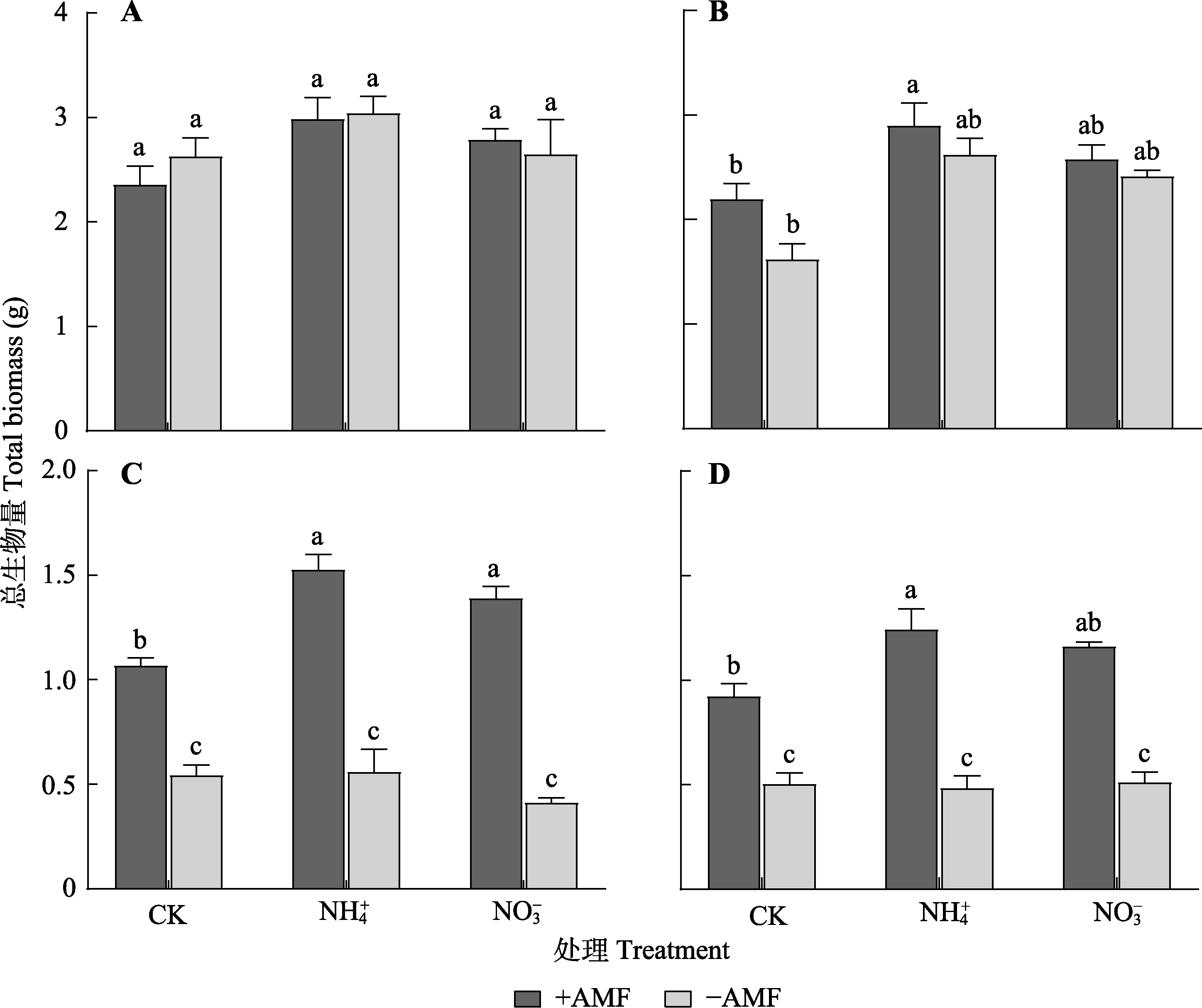
Fig. 1 Effects of arbuscular mycorrhizal fungi (AMF) and nitrogen (N) addition on the total biomass of Bidens alba and Emilia sonchifolia (mean ± SE, n = 6). +AMF, AMF treatment; -AMF, non-AMF treatment. A, Monocultured B. alba. B, Mixtured B. alba. C, Monocultured E. sonchifolia. D, Mixtured E. sonchifolia. Different lowercase letters indicate significant differences between treatments (p < 0.05). CK, control (no N addition).
| 处理 Treatment | 自由度 df | 单种 Monoculture | 混种 Mixture | ||
|---|---|---|---|---|---|
| F | p | F | p | ||
| Species | 1 | 61.268 | <0.001 | 48.516 | <0.001 |
| N | 2 | 3.558 | 0.041 | 1.097 | 0.347 |
| Species × N | 2 | 3.150 | 0.057 | 4.091 | 0.027 |
Table 2 Results of two-way ANOVA for the effects of species and nitrogen (N) on mycorrhizal growth response of Bidens alba and Emilia sonchifolia
| 处理 Treatment | 自由度 df | 单种 Monoculture | 混种 Mixture | ||
|---|---|---|---|---|---|
| F | p | F | p | ||
| Species | 1 | 61.268 | <0.001 | 48.516 | <0.001 |
| N | 2 | 3.558 | 0.041 | 1.097 | 0.347 |
| Species × N | 2 | 3.150 | 0.057 | 4.091 | 0.027 |
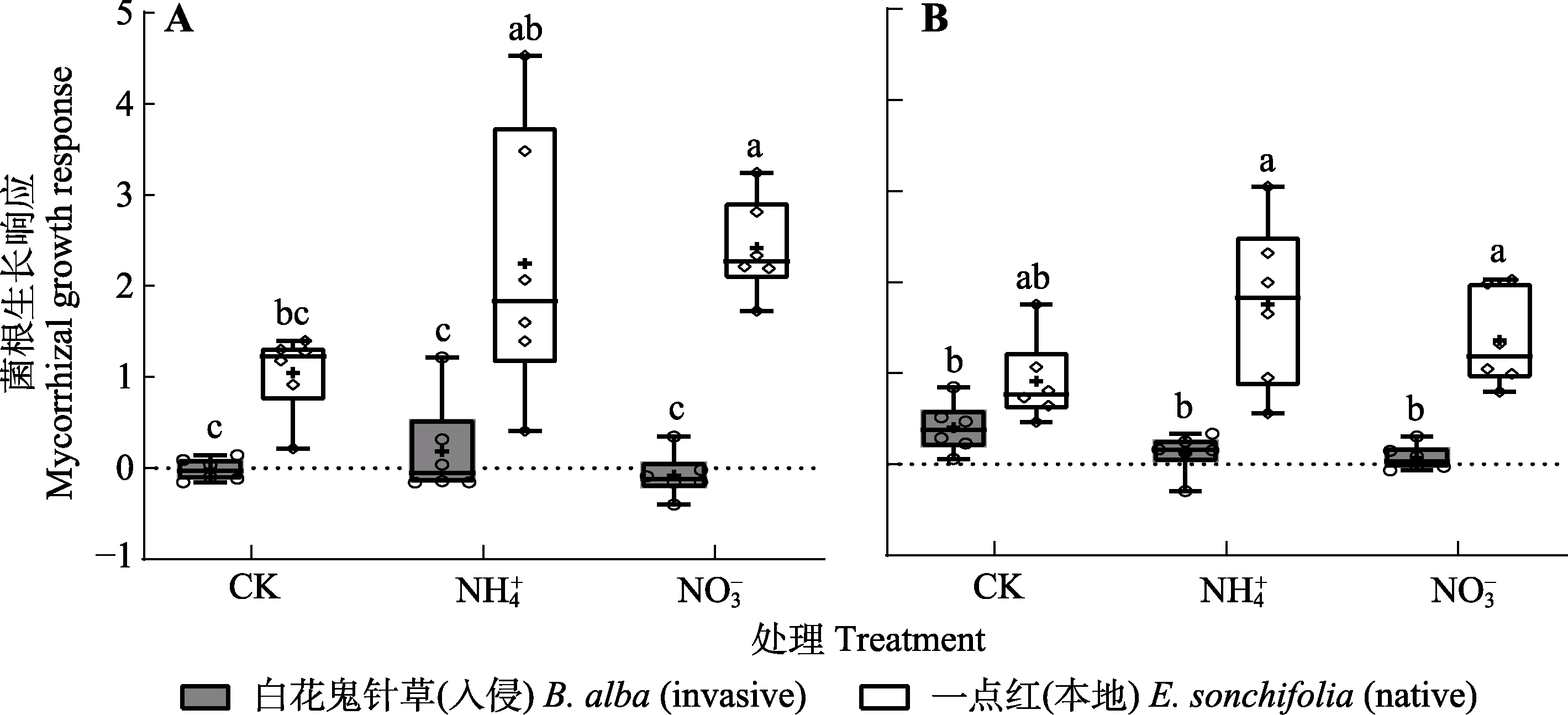
Fig. 2 Mycorrhizal growth response of Bidens alba and Emilia sonchifolia under nitrogen addition treatments (means ± SE, n = 6). A, Monoculture. B, Mixture. Different lowercase letters indicate significant differences between treatments (p < 0.05). CK, control (no N addition).
| 处理 Treatment | 自由度 df | 白花鬼针草 B. alba | 一点红 E. sonchifolia | ||
|---|---|---|---|---|---|
| F | p | F | p | ||
| AMF | 1 | 4.295 | 0.047 | 4.113 | 0.052 |
| N | 2 | 2.737 | 0.081 | 1.190 | 0.318 |
| AMF × N | 2 | 2.744 | 0.081 | 1.054 | 0.361 |
Table 3 Results of two-way ANOVA for the effects of arbuscular mycorrhizal fungi (AMF), nitrogen addition (N), and their interaction on competitive response of Bidens alba and Emilia sonchifolia
| 处理 Treatment | 自由度 df | 白花鬼针草 B. alba | 一点红 E. sonchifolia | ||
|---|---|---|---|---|---|
| F | p | F | p | ||
| AMF | 1 | 4.295 | 0.047 | 4.113 | 0.052 |
| N | 2 | 2.737 | 0.081 | 1.190 | 0.318 |
| AMF × N | 2 | 2.744 | 0.081 | 1.054 | 0.361 |
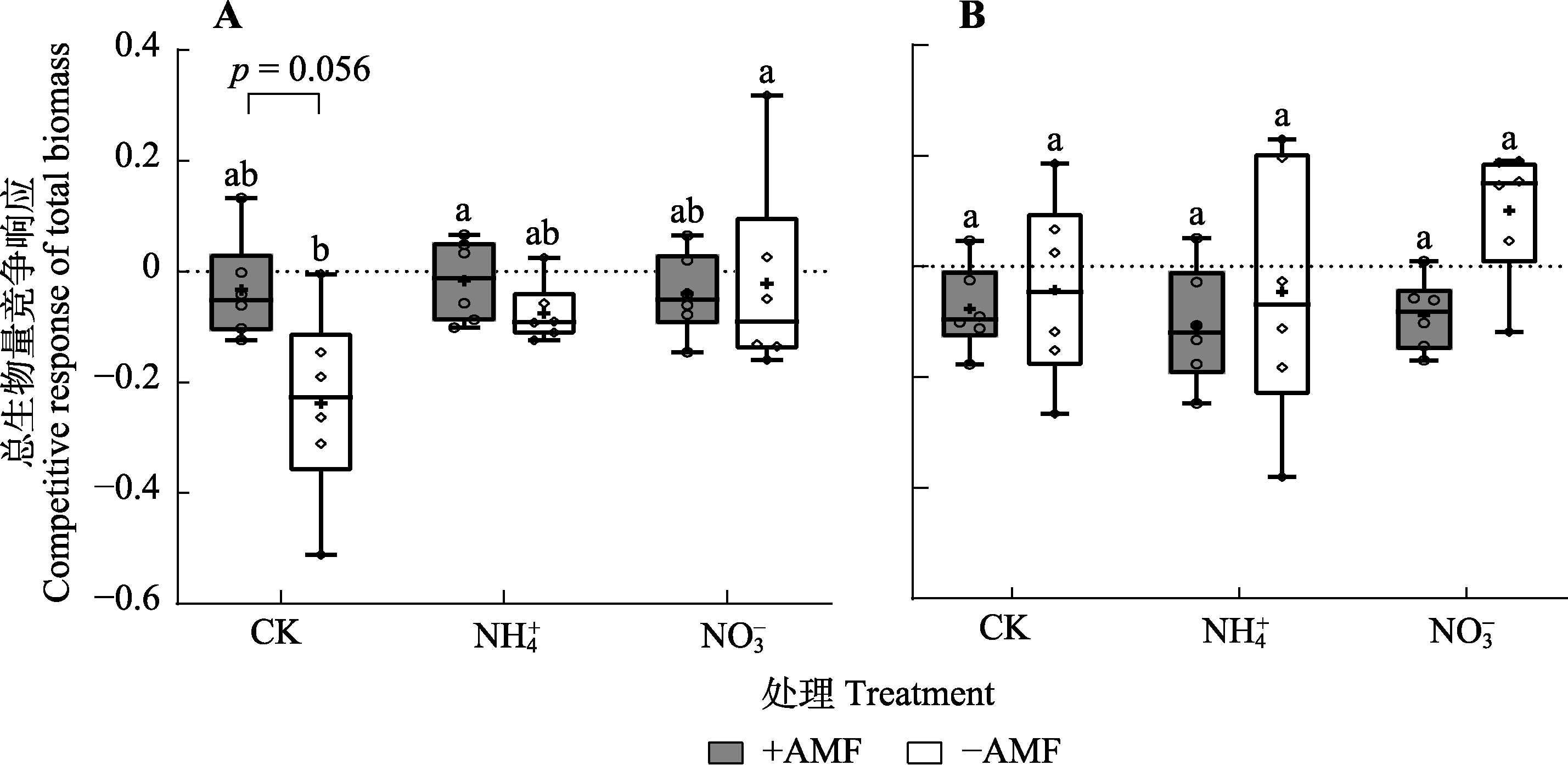
Fig. 3 Competitive response of total biomass of Bidens alba and Emilia sonchifolia under arbuscular mycorrhizal fungi (AMF) and nitrogen (N) treatments (means ± SE, n = 6). +AMF, AMF treatment. -AMF, non-AMF treatment. A, Bidens alba. B, Emilia sonchifolia. Different lowercase letters indicate significant differences between treatments (p < 0.05).
| [1] |
Armas C, Ordiales R, Pugnaire FI (2004). Measuring plant interactions: a new comparative index. Ecology, 85, 2682-2686.
DOI URL |
| [2] |
Ashton IW, Miller AE, Bowman WD, Suding KN (2010). Niche complementarity due to plasticity in resource use: plant partitioning of chemical N forms. Ecology, 91, 3252-3260.
PMID |
| [3] |
Aslani F, Juraimi AS, Ahmad-Hamdani MS, Alam MA, Hasan MM, Hashemi FSG, Bahram M (2019). The role of arbuscular mycorrhizal fungi in plant invasion trajectory. Plant and Soil, 441, 1-14.
DOI |
| [4] |
Bennett AE, Groten K (2022). The costs and benefits of plant-arbuscular mycorrhizal fungal interactions. Annual Review of Plant Biology, 73, 649-672.
DOI URL |
| [5] |
Bunn RA, Ramsey PW, Lekberg Y (2015). Do native and invasive plants differ in their interactions with arbuscular mycorrhizal fungi? A meta-analysis. Journal of Ecology, 103, 1547-1556.
DOI URL |
| [6] | Chen BX, Sun YF, Han ZH, Huang HK, Zhang HB, Li YK, Zhang GL, Liu WX (2020). Challenges in preventing and controlling invasive alien species in China. Journal of Biosafety, 29(3), 157-163. |
| [陈宝雄, 孙玉芳, 韩智华, 黄宏坤, 张宏斌, 李垚奎, 张国良, 刘万学 (2020). 我国外来入侵生物防控现状、问题和对策. 生物安全学报, 29(3), 157-163.] | |
| [7] | Chen DQ (2012). Ecology of Arbuscular Mycorrhizal Associations in Flaveria bidentis, a Invasive Alien Plant. Master degree dissertation, Chinese Academy of Agricultural Sciences, Beijing. |
| [陈冬青 (2012). 外来入侵植物黄顶菊的菌根生态学研究. 硕士学位论文, 中国农业科学院, 北京.] | |
| [8] |
Chen EJ, Liao HX, Chen BM, Peng SL (2020). Arbuscular mycorrhizal fungi are a double-edged sword in plant invasion controlled by phosphorus concentration. New Phytologist, 226, 295-300.
DOI PMID |
| [9] |
Chen WB, Chen BM (2019). Considering the preferences for nitrogen forms by invasive plants: a case study from a hydroponic culture experiment. Weed Research, 59, 49-57.
DOI |
| [10] | Chen YL, Chen BD, Liu L, Hu YJ, Xu TL, Zhang X (2014). The role of arbuscular mycorrhizal fungi in soil nitrogen cycling. Acta Ecologica Sinica, 34, 4807-4815. |
| [陈永亮, 陈保冬, 刘蕾, 胡亚军, 徐天乐, 张莘 (2014). 丛枝菌根真菌在土壤氮素循环中的作用. 生态学报, 34, 4807-4815.] | |
| [11] |
Cheng JK, Yue MF, Yang HR, Chen BM, Xin GR (2019). Do arbuscular mycorrhizal fungi help the native species Bidens biternata resist the invasion of Bidens alba? Plant and Soil, 444, 443-455.
DOI |
| [12] |
Enders M, Havemann F, Ruland F, Bernard-Verdier M, Catford JA, Gómez-Aparicio L, Haider S, Heger T, Kueffer C, Kühn I, Meyerson LA, Musseau C, Novoa A, Ricciardi A, Sagouis A, et al. (2020). A conceptual map of invasion biology: integrating hypotheses into a consensus network. Global Ecology and Biogeography, 29, 978-991.
DOI PMID |
| [13] |
Harrison KA, Bol R, Bardgett RD (2007). Preferences for different nitrogen forms by coexisting plant species and soil microbes. Ecology, 88, 989-999.
PMID |
| [14] |
Hawkes CV, Wren IF, Herman DJ, Firestone MK (2005). Plant invasion alters nitrogen cycling by modifying the soil nitrifying community. Ecology Letters, 8, 976-985.
DOI PMID |
| [15] | Huang D, Sang WG, Zhu L, Song YY, Wang JP (2010). Effects of nitrogen and carbon addition and arbuscular mycorrhiza on alien invasive plant Ambrosia artemisiifolia. Chinese Journal of Applied Ecology, 21, 3056-3062. |
| [黄栋, 桑卫国, 朱丽, 宋迎迎, 王晋萍 (2010). 氮碳添加和丛枝菌根对外来入侵植物豚草的影响. 应用生态学报, 21, 3056-3062.] | |
| [16] | Huang P, Shen FY, Abbas A, Wang H, Du YZ, Du DL, Hussain S, Javed T, Alamri S (2022). Effects of different nitrogen forms and competitive treatments on the growth and antioxidant system of Wedelia trilobata and Wedelia chinensis under high nitrogen concentrations. Frontiers in Plant Science, 13, 851099. DOI: 10.3389/fpls.2022.851099. |
| [17] |
Huangfu CH, Li HY, Chen XW, Liu HM, Wang H, Yang DL (2016). Response of an invasive plant, Flaveria bidentis, to nitrogen addition: a test of form-preference uptake. Biological Invasions, 18, 3365-3380.
DOI URL |
| [18] |
Huangfu CH, Li KL, Hui DF (2019). Influences of plant interspecific competition and arbuscular mycorrhizal fungi on nitrogen form preference of an invasive plant. Biogeochemistry, 145, 295-313.
DOI |
| [19] |
Kahiluoto H, Ketoja E, Vestberg M (2000). Creation of a non-mycorrhizal control for a bioassay of AM effectiveness. Mycorrhiza, 9, 241-258.
DOI URL |
| [20] |
Li QW, Zhang XY, Liang JF, Gao JQ, Xu XL, Yu FH (2021). High nitrogen uptake and utilization contribute to the dominance of invasive Spartina alterniflora over native Phragmites australis. Biology and Fertility of Soils, 57, 1007-1013.
DOI |
| [21] | Li X, Zhang JL (2008). Contribution of arbuscular mycorrhizal fungi to N uptake by plants. Journal of Shanxi Datong University (Natural Science Edition), 24(6), 75-78. |
| [李侠, 张俊伶 (2008). 丛枝菌根真菌对氮素的吸收作用和机制. 山西大同大学学报(自然科学版), 24(6), 75-78.] | |
| [22] | Liao HX, Zhou T, Chen BM, Chen EJ, Zhang HJ, Peng SL (2021). Ecological control of exotic invasive plants. Acta Scientiarum Naturalium Universitatis Sunyatseni, 60(4), 1-11. |
| [廖慧璇, 周婷, 陈宝明, 陈恩健, 张海杰, 彭少麟 (2021). 外来入侵植物的生态控制. 中山大学学报(自然科学版), 60(4), 1-11.] | |
| [23] |
Lin GG, McCormack ML, Guo DL (2015). Arbuscular mycorrhizal fungal effects on plant competition and community structure. Journal of Ecology, 103, 1224-1232.
DOI URL |
| [24] | Lin QW, Xiao C, Ma JS (2022). A dataset on catalogue of alien plants in China. Biodiversity Science, 30(5), 110-117. |
| [林秦文, 肖翠, 马金双 (2022). 中国外来植物数据集. 生物多样性, 30(5), 110-117.] | |
| [25] | Liu YJ, Huang W, Yang Q, Zheng YL, Li SP, Wu H, Ju RT, Sun Y, Ding JQ (2022). Research advances of plant invasion ecology over the past 10 years. Biodiversity Science, 30, 22438. DOI: 10.17520/biods.2022438. |
| [刘艳杰, 黄伟, 杨强, 郑玉龙, 黎绍鹏, 吴昊, 鞠瑞亭, 孙燕, 丁建清 (2022). 近十年植物入侵生态学重要研究进展. 生物多样性, 30, 22438. DOI: 10.17520/biods.2022438.] | |
| [26] | Loch-Temzelides T (2021). Walrasian equilibrium behavior in nature. Proceedings of the National Academy of Sciences of the United States of America, 118, 1-6. |
| [27] | Luo JJ, Gao YM, Feng WW, Liu MC, Qu B, Zhang C, Feng YL (2022). Stronger ability to absorb nitrate and associated transporters in the invasive plant Xanthium strumarium compared with its native congener. Environmental and Experimental Botany, 198, 104851. DOI: 10.1016/j.envexpbot.2022.104851. |
| [28] | McKane RB, Johnson LC, Shaver GR, Nadelhoffer KJ, Rastetter EB, Fry B, Giblin AE, Kielland K, Kwiatkowski BL, Laundre JA, Murray G (2002). Resource-based niches provide a basis for plant species diversity and dominance in arctic tundra. Nature, 415, 68-71. |
| [29] |
Ngwene B, Gabriel E, George E (2013). Influence of different mineral nitrogen sources (NO3--N vs. NH4+-N) on arbuscular mycorrhiza development and N transfer in a Glomus intraradices-cowpea symbiosis. Mycorrhiza, 23, 107-117.
DOI URL |
| [30] |
Read DJ, Perez-Moreno J (2003). Mycorrhizas and nutrient cycling in ecosystems—A journey towards relevance? New Phytologist, 157, 475-492.
DOI PMID |
| [31] |
Reinhart KO, Callaway RM (2004). Soil biota facilitate exotic Acer invasions in Europe and North America. Ecological Applications, 14, 1737-1745.
DOI URL |
| [32] |
Shannon-Firestone S, Reynolds HL, Phillips RP, Flory SL, Yannarell A (2015). The role of ammonium oxidizing communities in mediating effects of an invasive plant on soil nitrification. Soil Biology & Biochemistry, 90, 266-274.
DOI URL |
| [33] |
Shi JC, Wang XL, Wang ET (2023). Mycorrhizal symbiosis in plant growth and stress adaptation: from genes to ecosystems. Annual Review of Plant Biology, 74, 569-607.
DOI URL |
| [34] |
Smith FA, Smith SE (2013). How useful is the mutualism-parasitism continuum of arbuscular mycorrhizal functioning? Plant and Soil, 363, 7-18.
DOI URL |
| [35] |
Song MH, Zheng LL, Suding KN, Yin TF, Yu FH (2015). Plasticity in nitrogen form uptake and preference in response to long-term nitrogen fertilization. Plant and Soil, 394, 215-224.
DOI URL |
| [36] |
Sun DS, Yang XP, Wang Y, Fan Y, Ding PC, Song XE, Yuan XY, Yang XF (2022). Stronger mutualistic interactions with arbuscular mycorrhizal fungi help Asteraceae invaders outcompete the phylogenetically related natives. New Phytologist, 236, 1487-1496.
DOI URL |
| [37] |
Sun SM, Chen JX, Feng WW, Zhang C, Huang K, Guan M, Sun JK, Liu MC, Feng YL (2021). Plant strategies for nitrogen acquisition and their effects on exotic plant invasions. Biodiversity Science, 29, 72-80.
DOI URL |
| [孙思邈, 陈吉欣, 冯炜炜, 张昶, 黄凯, 管铭, 孙建坤, 刘明超, 冯玉龙 (2021). 植物氮形态利用策略及对外来植物入侵性的影响. 生物多样性, 29, 72-80.] | |
| [38] | Wang CY, Zhou JW, Liu J, Jiang K (2017). Differences in functional traits between invasive and native Amaranthus species under different forms of N deposition. The Science of Nature, 104, 59. DOI: 10.1007/s00114-017-1482-4. |
| [39] | Wang SS, Ye HH, Yang CF, Zhang Y, Pu JW, Ren YH, Xie K, Wang LX, Zeng DC, He HQ, Ji HY, Herrera-Estrella LR, Xu GH, Chen AQ (2025). OsNLP3 and OsPHR2 orchestrate direct and mycorrhizal pathways for nitrate uptake by regulating NAR2.1-NRT2s complexes in rice. Proceedings of the National Academy of Sciences of the United States of America, 122, e2416345122. DOI: 10.1073/pnas.2416345122. |
| [40] |
Wei HJ, Chen BM (2023). Competition shifts the advantage of the invasive plant Bidens alba to a disadvantage under soil ammonia nitrogen. Biological Invasions, 25, 2277-2292.
DOI |
| [41] |
Xiao R, Qiu YP, Tao JJ, Zhang XL, Chen HH, Reberg-Horton SC, Shi W, Shew HD, Zhang Y, Hu SJ (2020). Biological controls over the abundances of terrestrial ammonia oxidizers. Global Ecology and Biogeography, 29, 384-399.
DOI |
| [42] |
Xie K, Ren YH, Chen AQ, Yang CF, Zheng QS, Chen J, Wang DS, Li YT, Hu SJ, Xu GH (2022). Plant nitrogen nutrition: the roles of arbuscular mycorrhizal fungi. Journal of Plant Physiology, 269, 153591.
DOI URL |
| [43] |
Xu LJ, Jiang XL, Hao ZP, Li T, Wu ZX, Chen BD (2017). Arbuscular mycorrhiza improves plant adaptation to phosphorus deficiency through regulating the expression of genes relevant to carbon and phosphorus metabolism. Chinese Journal of Plant Ecology, 41, 815-825.
DOI |
|
[徐丽娇, 姜雪莲, 郝志鹏, 李涛, 吴照祥, 陈保冬 (2017). 丛枝菌根通过调节碳磷代谢相关基因的表达增强植物对低磷胁迫的适应性. 植物生态学报, 41, 815-825.]
DOI |
|
| [44] |
Yang JT, Pan YJ, Chang CL, Liu YJ (2024). Effects of native plant-soil microbe interaction on plant invasion. Chinese Journal of Plant Ecology, 48, 1547-1560.
DOI URL |
|
[杨佳婷, 潘应骥, 常春玲, 刘艳杰 (2024). 本地植物与土壤微生物互作对植物入侵影响的研究进展. 植物生态学报, 48, 1547-1560.]
DOI |
|
| [45] | Yin JL, Zhang XY, Yan J, Li Q, Jia YY, Zhang FJ, Wan FH (2015). The feedback of arbuscular mycorrhizal fungi on the competition between Flaveria bidentis and cotton. Ecology and Environmental Sciences, 24, 1132-1136. |
|
[殷吉林, 张晓亚, 闫静, 李乔, 贾月月, 张风娟, 万方浩 (2015). AMF对入侵植物黄顶菊与棉花竞争生长的反馈作用. 生态环境学报, 24, 1132-1136.]
DOI |
|
| [46] | Yoshida LC, Allen EB (2004). 15N uptake by mycorrhizal native and invasive plants from a N-eutrophied shrubland:a greenhouse experiment. Biology and Fertility of Soils, 39, 243-248. |
| [47] |
Zhang FJ, Li Q, Chen FX, Xu HY, Wan FH (2017). Arbuscular mycorrhizal fungi facilitate growth and competitive ability of an exotic species Flaveria bidentis. Soil Biology & Biochemistry, 115, 275-284.
DOI URL |
| [1] | Ma Yunhan, Lu Xiankai, Jia Yongxia, Zhu Xiaomin. Long-term nitrogen deposition alters the regulatory pathways of lignin phenol accumulation in tropical forest [J]. Chin J Plant Ecol, 2026, 50(预发表): 0-. |
| [2] | Qing He, Xudong Yuan, Boshen Ren, Zhiyang Feng, Mengzhen Lu, Qiaoling Lin, Qinghu Jiang, Linsen Yang, Huiliang Yu, Hui Yao, Jingyuan Yang, Feng Liu, Mingxi Jiang. Effects of Erigeron annuus invasion on plant community structure and diversity in subalpine peat wetlands [J]. Chin J Plant Ecol, 2026, 50(4): 895-906. |
| [3] | ZHOU Chun-Han, XIONG Zhi-Cheng, YANG Ming-Xin, SHI Hai-Lan, ZHOU Ya-Xing, TANG Yu, ZHANG Jing, JI Bao-Ming, DAI Xin-Ling. Community characteristics and drivers of arbuscular mycorrhizal fungi in alpine wetlands of the Yellow River Source Region [J]. Chin J Plant Ecol, 2026, 50(3): 625-638. |
| [4] | JIANG Qing-Hong, DING Lu, WANG Zhe, ZHENG Chun-Li, FENG Zhao-Chuo. Growth-promoting effects of arbuscular mycorrhizal fungi combined with different functional bacteria on Medicago sativa [J]. Chin J Plant Ecol, 2026, 50(3): 774-788. |
| [5] | REN Xi-Tong, LI Ying, ZHANG Yu, XIONG Hu-An-He, ZHANG Rui-Ke, QI Shan-Shan, DAI Zhi-Cong, DU Dao-Lin. Interaction between arbuscular mycorrhizal fungi and litter contributes to responses of Solidago canadensis to nutrient stress [J]. Chin J Plant Ecol, 2026, 50(3): 710-721. |
| [6] | MA Jian-Hui, TONG Xin, ZHANG Si-Rong, MAO Zi-Kun, QIN Jun, MA Ke-Ping. Research advances and perspectives on physiological and ecological functions of mycorrhizal fungi [J]. Chin J Plant Ecol, 2026, 50(3): 498-514. |
| [7] | WANG Hai-Lang, FU Wei, WU Song-Lin, CHEN Bao-Dong. Ecological functions and community regulation of arbuscular mycorrhizal fungi [J]. Chin J Plant Ecol, 2026, 50(3): 515-535. |
| [8] | QIN Fei-Fei, TANG Zhao-Hui, SI Tong, CI Dun-Wei. Response mechanisms of growth and rhizosphere soil properties in salt-tolerant and salt-sensitive peanut (Arachis hypogaea) to arbuscular mycorrhizal fungi [J]. Chin J Plant Ecol, 2026, 50(3): 742-759. |
| [9] | HE Zheng-Jia, ZENG Xin-Ran, WANG Lin-Ying, XUE Xin-Yu, SU Qin-Ze, LI Yu, ZHANG Yin-Jie, WU Hui-Huang, CHEN Cheng-Cong, WU Liang-Quan, WEI An-Ni, QIU Yun-Peng, GUO Li-Jin. Response of arbuscular mycorrhizal fungal communities and soil organic carbon to magnesium fertilization in tea plantations [J]. Chin J Plant Ecol, 2026, 50(3): 700-709. |
| [10] | DUAN Shi-Long, YU Cheng-Jin, XU Xin-Yao, FENG Gu, XIE Xian-An, ZHANG Lin. Plant-arbuscular mycorrhizal fungi-bacteria continuum and its maintenance mechanisms [J]. Chin J Plant Ecol, 2026, 50(3): 600-611. |
| [11] | JIANG Kang-Wei, LÜ Cheng, WANG Ya-Fei, LI Hong, ZHANG Zhi-Qing, WANG Yu, ZHANG Qing-Qing, Tuerxunnayi REYIMU. Effects of soil arbuscular mycorrhizal fungal communities on soil multifunctionality under grazing disturbance [J]. Chin J Plant Ecol, 2026, 50(3): 685-699. |
| [12] | HE Tang-Qing, WANG Bian-Bian, CAO Xin-Xin, ZHANG Kang-Cheng, WANG Xiao-Dong, WANG Hao, BAI Tong-Shuo, ZHAO Ye-Xin, ZHANG Yi, WANG Yi, QIU Yun-Peng, HU Shui-Jin. Responses of plants and arbuscular mycorrhizal fungal communities to long-term precipitation increase in a semi-arid grassland [J]. Chin J Plant Ecol, 2026, 50(3): 674-684. |
| [13] | WEI Li, WANG Peng-Sen, LIU Shan, FAN Rui, HUANG Nan, ZHANG Jian-Guo, Qimeilamu , GOU Yang, LIU Mo-Han, HUANG Ting, ZHOU Ji-Qiong. Arbuscular mycorrhizal fungi influence nutrient uptake along vertical niches in legume-grass mixtures [J]. Chin J Plant Ecol, 2026, 50(3): 760-773. |
| [14] | ZHANG Cheng-Hang, WEI Xing, WU Chun-Ze, WANG Yu-Yao, LI Hao-Nan. Growth response of mycorrhizal Fraxinus mandshurica and Larix gmelinii seedlings to dry and wet deposition of atmospheric reduced nitrogen [J]. Chin J Plant Ecol, 2026, 50(3): 649-659. |
| [15] | WANG Meng-Xue, HU Ming-Yan, CHU Cheng-Jin, CHEN Yang, LUO Wen-Qi, MA Zi-Long. C, N, P stoichiometric characteristics of leaves and fine roots in different mycorrhizal tree species in subtropical forests [J]. Chin J Plant Ecol, 2026, 50(2): 334-343. |
| Viewed | ||||||
|
Full text |
|
|||||
|
Abstract |
|
|||||
Copyright © 2026 Chinese Journal of Plant Ecology
Tel: 010-62836134, 62836138, E-mail: apes@ibcas.ac.cn, cjpe@ibcas.ac.cn

