
Chinese Journal of Plant Ecology >
Variation and correlation of plant functional traits in the riparian zone of the Lijiang River, Guilin, Southwest China
Received date: 2018-05-20
Accepted date: 2018-12-08
Online published: 2019-04-25
Supported by
Supported by the National Science and Technology Pillary Program during the Twelfth Five-year Plan Period of China(2012BAC16B03);the National Natural Science Foundation of China(31860124)
Aims Patterns of variation in plant functional traits and the correlation among them are important for understanding species coexistence and the maintenance of biodiversity. Our objectives in this study were to understand how variation and correlation of plant functional traits, at both the species and community levels, influence 1) plants adaptation to changing environments, and 2) the mechanisms of community assembly.
Methods We investigated species composition of riparian plant communities in 36 plots along the longitudinal gradient (represented by upstream, midstream, downstream) of the Lijiang River, Guilin, Southwest China. We measured three functional traits for 42 woody plant species: leaf area (LA), specific leaf area (SLA), and wood density (WD). For each plant community, we calculated 1) species abundance-weighted mean community trait values, and 2) species-level mean trait values. For each of these calculations, we used trait-gradient analysis to partition the three traits into alpha and beta components. We then conducted Pearson correlations to analyze the relationships among the three traits along the longitudinal gradient. Finally we tested the strength of environmental filtering using a null model that generates randomly assembled communities with species richness given by observed values.
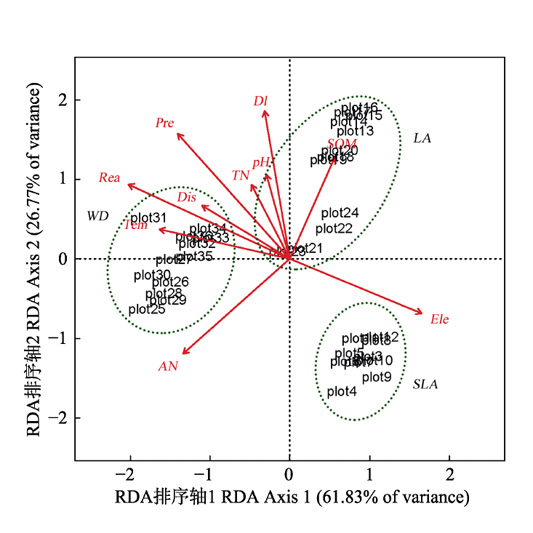
Important findings The species abundance-weighted mean community value of LA was lowest in the midstream communities, which was significantly different from that in the downstream communities. The mean community value of WD for midstream and upstream communities was significantly higher than that for downstream communities. Mean community value of SLA was significantly different among the three reaches. The beta components of the three functional traits significantly differed among the three reaches and had observed values that are, on average, lower than simulated values. However, alpha components for all three traits were not significantly different among the three reaches and had consistently lower variation than beta components. This implies that the variation in the mean community trait value across plots was greater than trait variation between species within plots. The observed and simulated values of the alpha components for both LA and SLA were weakly correlated with each other within and among communities, which suggests that there are independent axes of differentiation among coexisting species. On the other hand, comparisons between observed and simulated values indicated that significantly negative correlations between SLA and WD were largely the result of strong environmental filters. Finally, these results imply that variation of plant functional traits is greater among communities than within communities.
LIANG Shi-Chu, LIU Run-Hong, RONG Chun-Yan, CHANG Bin, JIANG Yong . Variation and correlation of plant functional traits in the riparian zone of the Lijiang River, Guilin, Southwest China[J]. Chinese Journal of Plant Ecology, 2019 , 43(1) : 16 -26 . DOI: 10.17521/cjpe.2018.0119
| [1] | Ackerly DD, Cornwell WK ( 2007). A trait-based approach to community assembly: Partitioning of species trait values into within- and among-community components. Ecology Letters, 10, 135-145. |
| [2] | Ackerly DD, Knight CA, Weiss SB, Barton K, Starmer KP ( 2002). Leaf size, specific leaf area and microhabitat distribution of chaparral woody plants: Contrasting patterns in species level and community level analyses. Oecologia, 130, 449-457. |
| [3] | Agricultural Chemistry Committee of Soil Science Society of China ( 1983). Conventional Methods for the Agricultural Chemical Analysis of Soil. Science Press, Beijing. |
| [3] | [ 中国土壤学会农业化学专业委员会 ( 1983). 土壤农业化学常规分析方法. 科学出版社, 北京.] |
| [4] | Baraloto C, Timothy Paine CE, Poorter L ( 2010). Decoupled leaf and stem economics in rain forest trees. Ecology Letters, 13, 1338-1347. |
| [5] | Bu WS, Zang RG, Ding Y, Zhang JY, Ruan YZ ( 2013). Relationships between plant functional traits at the community level and environmental factors during succession in a tropical lowland rainforest on Hainan Island, South China. Biodiversity Science, 21, 278-287. |
| [5] | [ 卜文圣, 臧润国, 丁易, 张俊艳, 阮云泽 ( 2013). 海南岛热带低地雨林群落水平植物功能性状与环境因子相关性随演替阶段的变化. 生物多样性, 21, 278-287.] |
| [6] | Cao K ( 2014). The Phylogeny Signal of Functional Traits and Their Relationship between Each Other and Effects on Community Structure. Master degree dissertation, Zhejiang Normal University, Jinhua, Zhejiang. |
| [6] | [ 曹科 ( 2014). 古田山植物功能性状的系统发育信号、不同性状之间的关系及其对群落结构的影响. 硕士学位论文, 浙江师范大学, 浙江金华.] |
| [7] | Cornelissen JHC, Lavorel S, Garnier E, Díaz S, Buchmann N, Gurvich DE, Reich PB, Steege H, Morgan HD, Heijden MGA, Pausas JG, Poorter H ( 2003). A handbook of protocols for standardized and easy measurement of plant functional traits worldwide. Australian Journal of Botany, 51, 335-380. |
| [8] | Cornwell WK, Schwilk DW, Ackerly DD ( 2006). A trait-based test for habitat filtering: Convex hull volume. Ecology, 87, 1465-1471. |
| [9] | Craine JM, Lee WG ( 2003). Covariation in leaf and root traits for native and non-native grasses along an altitudinal gradient in New Zealand. Oecologia, 134, 471-478. |
| [10] | Donovan LA, Maherali H, Caruso CM, Huber H, Kroom HD ( 2011). The evolution of the worldwide leaf economics spectrum. Trends in Ecology and Evolution, 26, 88-95. |
| [11] | Duan WJ, Wang JY, Zhang LJ, Li HF, Huang HQ ( 2014). Characteristics of precipitation in Lijiang River Basin during 1960~2010. Journal of China Hydrology, 34(5), 88-93. |
| [11] | [ 段文军, 王金叶, 张立杰, 李海防, 黄华乾 ( 2014). 1960~2010年漓江流域降水变化特征研究. 水文, 34(5), 88-93.] |
| [12] | Fonseca CR, Overton JM, Collins B, Westoby M ( 2000). Shifts in trait-combinations along rainfall and phosphorus gradients. Journal of Ecology, 88, 964-977. |
| [13] | Gewin V ( 2006). Beyond neutrality—Ecology finds its niche. PLOS Biology, 4, 1306-1310. |
| [14] | Grime JP ( 2006). Trait convergence and trait divergence in herbaceous plant communities: Mechanisms and consequences. Journal of Vegetation Science, 17, 255-260. |
| [15] | Grubb P ( 1998). A reassessment of the strategies of plants which cope with shortages of resources. Perspectives in Plant Ecology, Evolution and Systematics, 1, 3-31. |
| [16] | Han L, Wang HZ, Yu J ( 2013). Research progress and prospects on riparian zone ecology. Ecology and Environmental Sciences, 22, 879-886. |
| [16] | [ 韩路, 王海珍, 于军 ( 2013). 河岸带生态学研究进展与展望. 生态环境学报, 22, 879-886.] |
| [17] | Hu YK, Pan X, Liu GF, Li WB, Dai WH, Tang SL, Zhang YL, Xiao T, Chen LY, Xiong W, Zhou MY, Song YB, Dong M ( 2015). Novel evidence for within-species leaf economics spectrum at multiple spatial scales. Frontiers in Plant Science, 6, 901. DOI: 10.3389/fpls.2015.00901. |
| [18] | Huang D, Wang DM, Ren Y, Qin YB, Wu LC ( 2017). Responses of leaf traits to submergence stress and analysis of the economic spectrum of plant species in an aquatic-?terrestrial ecotone, the Li River. Acta Ecologica Sinica, 37, 750-759. |
| [18] | [ 黄端, 王冬梅, 任远, 覃云斌, 吴林川 ( 2017). 漓江水陆交错带植物叶性状对水淹胁迫的响应及经济谱分析. 生态学报, 37, 750-759. ] |
| [19] | Huang Y, Que XX, Li CY ( 2013). Study on landscape ecological restoration technology of land/inland water ecotones along Li River. Journal of Southern Agriculture, 44, 1700-1704. |
| [19] | [ 黄莹, 阙欣欣, 李彩云 ( 2013). 漓江沿岸水陆交错带景观调查与生态修复技术. 南方农业学报, 44, 1700-1704.] |
| [20] | Jung V, Violle C, Mondy C, Hoffmann L, Muller S ( 2010). Intraspecific variability and trait-based community assembly. Journal of Ecology, 98, 1134-1140. |
| [21] | Kraft NJB, Valencia R, Ackerly DD ( 2008). Functional traits and niche-based tree community, assembly in an Amazonian forest. Science, 322, 580-582. |
| [22] | Kunstler G, Falster D, Coomes DA, Hui F, Kooyman RM, Laughlin DC, Poorter L, Vanderwel M, Vieilledent G, Wright SJ, Aiba M, Baraloto C, Caspersen J, Cornelissen JHC, Gourlet-Fleury S, Hanewinkel M, Herault B, Kattge J, Kurokawa H, Onoda Y, Peñuelas J, Poorter H, Uriarte M, Richardson S, Ruiz-Benito P, Sun I-F, Ståhl G, Swenson NG, Thompson J, Westerlund B, Wirth C, Zavala MA, Zeng H, Zimmerman JK, Zimmermann NE, Westoby M ( 2016). Plant functional traits have globally consistent effects on competition. Nature, 529, 204-207. |
| [23] | Li QS, Wang DM, Xin ZB, Li Y, Ren Y ( 2014). Root distribution in typical sites of Lijiang ecotone and their relationship to soil properties. Acta Ecologica Sinica, 34, 2003-2011. |
| [23] | [ 李青山, 王冬梅, 信忠保, 李扬, 任远 ( 2014). 漓江水陆交错带典型立地根系分布与土壤性质的关系. 生态学报, 34, 2003-2011.] |
| [24] | Li Y, Wang DM, Xin ZB, Wang J, Ren Y, Li QS ( 2015). Plant diversity and soil characteristics of different inundation zones in an aquatic-terrestrial ecotone, Li River. Acta Ecologica Sinica, 35, 5121-5130. |
| [24] | [ 李扬, 王冬梅, 信忠保, 王晶, 任远, 李青山 ( 2015). 漓江水陆交错带不同淹没区植物多样性与土壤特征. 生态学报, 35, 5121-5130.] |
| [25] | Liu JR, Feng H, Yu XL, Song GJ, Ye Q ( 2003). A preliminary discussion on the historic change of the name for the Lijiang River system. Carsologica Sinica, 22(1), 77-83. |
| [25] | [ 刘金荣, 冯红, 俞秀兰, 宋桂金, 叶青 ( 2003). 历史上漓江(桂江)水系名称的变化浅议. 中国岩溶, 22(1), 77-83.] |
| [26] | Liu XJ, Ma KP ( 2015). Plant functional traits—Concepts, applications and future directions. Scientia Sinica (Vitae), 45, 325-339. |
| [26] | [ 刘晓娟, 马克平 ( 2015). 植物功能性状研究进展. 中国科学: 生命科学, 45, 325-339.] |
| [27] | McGill BJ, Enquist BJ, Weiher E, Westoby M ( 2006). Rebuilding community ecology from functional traits. Trends in Ecology & Evolution, 21, 178-185. |
| [28] | Meng TT, Ni J, Wang GH ( 2007). Plant functional traits, environments and ecosystem functioning. Journal of Plant Ecology (Chinese Version), 31, 150-165. |
| [28] | [ 孟婷婷, 倪健, 王国宏 ( 2007). 植物功能性状与环境和生态系统功能. 植物生态学报, 31, 150-165.] |
| [29] | Nilsson C, Berggren K ( 2000). Alterations of riparian ecosystems caused by river regulation. Bioscience, 50, 783-792. |
| [30] | Shipley B ( 1995). Structured interspecific determinants of specific leaf area in 34 species of herbaceous angiosperms. Functional Ecology, 9, 312-319. |
| [31] | Stubbs WJ, Wilson JB ( 2004). Evidence for limiting similarity in a sand dune community. Journal of Ecology, 92, 557-567. |
| [32] | Suding KN, Goldstein LJ ( 2008). Testing the Holy Grail framework: Using functional traits to predict ecosystem change. New Phytologist, 180, 559-562. |
| [33] | Sun R, Yuan XZ, Chen ZL, Zhang YW, Liu H ( 2010). Patterns of plant community species richness in the fluctuating water level zone along the Pengxihe River of the Three Gorges Reservoir. Research of Environmental Sciences, 23, 1382-1389. |
| [33] | [ 孙荣, 袁兴中, 陈忠礼, 张跃伟, 刘红 ( 2010). 三峡水库澎溪河消落带植物群落物种丰富度格局. 环境科学研究, 23, 1382-1389.] |
| [34] | Sun SC, Jin DM, Shi PL ( 2006). The leaf size-twig size spectrum of temperate woody species along an altitudinal gradient: An invariant allometric scaling relationship. Annals of Botany, 97, 97-107. |
| [35] | Vannote RL, Minshall GW, Cumins KW, Sedell JR, Cushing CE ( 1980). The river continuum concept. Canadian Journal of Fisheries and Aquatic Sciences, 37, 130-137. |
| [36] | Wright IJ, Ackerly DD, Bongers F, Harms KE, Ibarra- Manriquez G, Martinez-Ramos M, Mazer SJ, Muller-Landau HC, Paz H, Pitman NCA, Poorter L, Silman MR, Vriesendorp CF, Webb CO, Westoby M, Wright SJ ( 2007). Relationships among ecologically important dimensions of plant trait variation in seven Neotropical forests. Annals of Botany, 99, 1003-1015. |
| [37] | Xi XQ, Zhao YJ, Liu YG, Wang X, Gao XM ( 2011). Variation and correlation of plant functional traits in karst area of central Guizhou Province, China. Chinese Journal of Plant Ecology, 35, 1000-1008. |
| [37] | [ 习新强, 赵玉杰, 刘玉国, 王欣, 高贤明 ( 2011). 黔中喀斯特山区植物功能性状的变异与关联. 植物生态学报, 35, 1000-1008.] |
| [38] | Xin ZB, Xiao YL, Wang DM, Li Y, Ren Y, Li QS ( 2014). Spatial patterns of riparian vegetations and its optimization in Lijiang River: An intensive tourism karsts river in the southern subtropical China. Ecological Science, 33, 631-641. |
| [38] | [ 信忠保, 肖玉玲, 王冬梅, 李扬, 任远, 李青山 ( 2014). 广西桂林漓江河岸带植被配置类型与退化机制研究. 生态科学, 33, 631-641.] |
/
| 〈 |
|
〉 |
Copyright © 2026 Chinese Journal of Plant Ecology
Tel: 010-62836134, 62836138, E-mail: apes@ibcas.ac.cn, cjpe@ibcas.ac.cn

