
Chinese Journal of Plant Ecology >
Spatio-temporal characteristics of vegetation water use efficiency and its relationship with climate factors in Tianshan Mountains in Xinjiang from 2000 to 2017
Received date: 2019-01-08
Revised date: 2019-06-12
Online published: 2019-09-30
Supported by
Supported by the National Natural Science Foundation of China(U1703341);Supported by the National Natural Science Foundation of China(41764003)
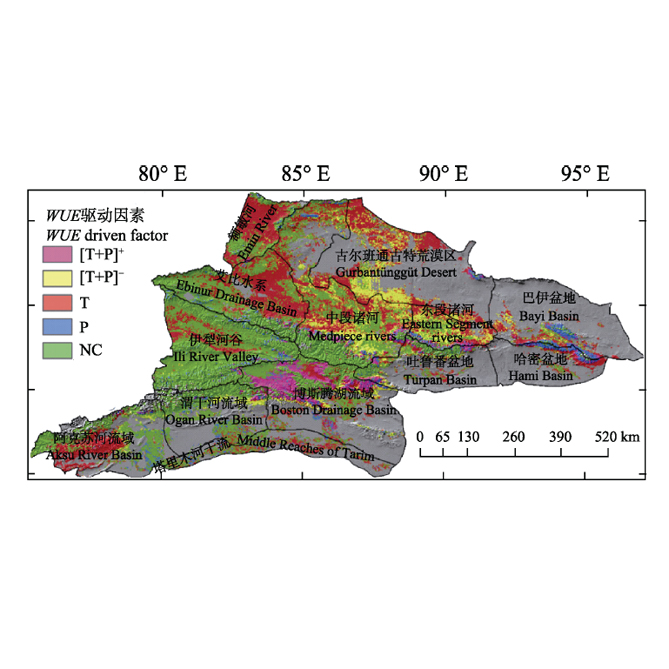
Aims Water use efficiency (WUE) is a key index to measure the coupling degree of carbon and water cycle in ecosystems. The WUE of vegetation in Tianshan Mountains in Xinjiang and the north and south sites of the main oasis was estimated and then the spatio-temporal distribution of vegetation WUE was analyzed to explore its influencing factors, which will be of great significance to the protection of ecosystem and the rational utilization and development of agricultural water resources in this region. Methods This study used data from moderate-resolution imaging spectroradiometer (MODIS), meteorological and land use type data to estimate the vegetation WUE. The spatio-temporal characteristics of vegetation WUE were analyzed in Tianshan Mountains in Xinjiang over the last 18 years, and the relationship of WUE with climatic factors was evaluated. Important findings The results indicated that: (1) From 2000 to 2017, the average annual vegetation WUE for Tianshan Mountains in Xinjiang was 1.11 g·mm -1·m -2, ranging from 0.84 to 1.34 g·mm -1·m -2. As a whole, the annual decrease trend of vegetation WUE was 0.014 1 g·mm -1·m -2·a -1, and vegetation WUE showed a strong vertical zonality in Tianshan Mountains in Xinjiang, as indicated by the decrease with the altitude above 1 000 m. (2) The vegetation WUE in Tianshan Mountains in Xinjiang showed a unimodal change pattern with significant seasonal difference, in order of summer > spring > autumn > winter. (3) Correlation analysis and statistical results indicated that the dynamic change of vegetation WUE in Tianshan Mountains in Xinjiang was closely related to temperature and rainfall. The regions with vegetation WUE changes resulting from non-climate factors accounted for 39.26% in Tianshan Mountains in Xinjiang. However, the factors of temperature and precipitation contributed to the change of vegetation WUE as 33.23% and 8.57%, respectively. On the other hand, the combination of temperature and precipitation with heavy impact and light impact contributed to WUE by 5.63% and 13.13%, respectively. Overall, temperature played the most important role among all climate factors in the changes in vegetation WUE. (4) The WUE of paddy field and dryland decreased continuously with time, and these areas were mainly affected by non-climatic factors, suggesting the irrationality in local human activities.
Aizezitiyuemaier MAIMAITI, Yusufujiang RUSULI, HE Hui, Baihetinisha ABUDUKERIMU . Spatio-temporal characteristics of vegetation water use efficiency and its relationship with climate factors in Tianshan Mountains in Xinjiang from 2000 to 2017[J]. Chinese Journal of Plant Ecology, 2019 , 43(6) : 490 -500 . DOI: 10.17521/cjpe.2019.0006
| [1] | An YZ, Gao W, Gao ZQ, Shi RH (2016). Autumn vegetation change and response on climate change in northern China. Geomatics & Spatial Information Technology, 39, 25-29, 35. |
| [1] | [ 安佑志, 高炜, 高志强, 施润和 (2016). 中国北方地区秋季植被变化及对气候变化的响应研究. 测绘与空间地理信息, 39, 25-29, 35.] |
| [2] | Chen HB, Diao LJ (2005). Some extreme events of weather, climate and related phenomena in 2004. Climatic and Environmental Research, 10, 140-144. |
| [2] | [ 陈洪滨, 刁丽军 (2005). 2004年的极端天气和气候事件及其他相关事件的概要回顾. 气候与环境研究, 10, 140-144.] |
| [3] | Chen XG, Pan WJ, Zhang JY, Luo XL (2007). The extreme climate events in Guangzhou are increased due to the significant warming of the climate. Guangdong Meteorology, 29, 24-25. |
| [3] | [ 陈新光, 潘蔚娟, 张江勇, 罗晓玲 (2007). 气候显著变暖使广州极端气候事件增多. 广东气象, 29, 24-25.] |
| [4] | Chen YH, Li XB, Shi PJ (2001). Variation in NDVI driven by climate factors across China, 1983-1992. Acta Phytoecologica Sinica, 25, 716-720. |
| [4] | [ 陈云浩, 李晓兵, 史培军 (2001). 1983-1992年中国陆地NDVI变化的气候因子驱动分析. 植物生态学报, 25, 716-720.] |
| [5] | Dilixiati M, Rusuli Y, Jiang H (2018). Temporal and spatial variation of vegetation phenology and its driving factor analysis in the Bosten Lake Drainage Basin from 2001 to 2014. Acta Ecologica Sinica, 38, 6921-6931. |
| [5] | [ 玛地尼亚提?地里夏提, 玉素甫江?如素力, 姜红, (2018). 2001- 2014年博斯腾湖流域植被物候时空变化及其驱动因子. 生态学报, 38, 6921-6931.] |
| [6] | Du XZ, Zhao X, Wang HY, He B (2018). Responses of terrestrial ecosystem water use efficiency to climate change: A review. Acta Ecologica Sinica, 38, 8296-8305. |
| [6] | [ 杜晓铮, 赵祥, 王昊宇, 何斌 (2018). 陆地生态系统水分利用效率对气候变化的响应研究进展. 生态学报, 38, 8296-8305.] |
| [7] | Gang CC, Wang ZQ, Chen YZ, Yang Y, Li JL, Cheng JM, Qi JG, Odeh I (2016). Drought-induced dynamics of carbon and water use efficiency of global grasslands from 2000 to 2011. Ecological Indicators, 67, 788-797. |
| [8] | Heinsch FA, Reeves M, Votava P, Kang S, Milesi C, Zhao M, Glassy J, Jolly WM, Loehman R, Bowker CF, Kimball JS, Nemani RR, Running SW (2003). User’s guide: GPP and NPP (MOD17A2/A3) Products NASA MODIS Land Algorithm, Version 2.0. The University of Montana, Missoula. 31-33. |
| [9] | Hu ZM, Yu GR, Wang QF, Zhao FH (2009). Ecosystem level water use efficiency: A review. Acta Ecologica Sinica, 29, 1498-1507. |
| [9] | [ 胡中民, 于贵瑞, 王秋凤, 赵风华 (2009). 生态系统水分利用效率研究进展. 生态学报, 29, 1498-1507.] |
| [10] | Jassal RS, Black TA, Spittlehouse DL, Brümmer C, Nesic Z (2009). Evapotranspiration and water use efficiency in different-aged Pacific Northwest Douglas-fir stands. Agricultural and Forest Meteorology, 149, 1168-1178. |
| [11] | Klein T, Shpringer I, Fikler B, Elbaz G, Cohen S, Yakir D (2013). Relationships between stomatal regulation, water-?use, and water-use efficiency of two coexisting key Mediterranean tree species. Forest Ecology and Management, 302, 34-42. |
| [12] | Li HD, Guan DX, Yuan FH, Wang AZ, Jin CJ, Wu JB, Li Z, Jing YL (2015). Water use efficiency and its influential factor over Horqin Meadow. Acta Ecologica Sinica, 35, 478-488. |
| [12] | [ 李辉东, 关德新, 袁凤辉, 王安志, 金昌杰, 吴家兵, 李峥, 井艳丽 (2015). 科尔沁草甸生态系统水分利用效率及影响因素. 生态学报, 35, 478-488.] |
| [13] | Li MX, Yang YZ, Zhu QA, Chen H, Peng CH (2016). Evaluating water use efficiency patterns of Qinling Mountains under climate change. Acta Ecologica Sinica, 36, 936-945. |
| [13] | [ 李明旭, 杨延征, 朱求安, 陈槐, 彭长辉 (2016). 气候变化背景下秦岭地区陆地生态系统水分利用率变化趋势. 生态学报, 36, 936-945.] |
| [14] | Li XJ, Zhang FP, Wang HW, Lei SJ, Gao Z (2017). Analysis of the spatio-temporal characteristics of water use efficiency of vegetation and its relationship with climate in the Heihe river basin. Journal of Desert Research, 37, 733-741. |
| [14] | [ 李肖娟, 张福平, 王虎威, 雷声剑, 高张 (2017). 黑河流域植被水分利用效率时空变化特征及其与气候因子的关系. 中国沙漠, 37, 733-741.] |
| [15] | Li YJ, Ding JL, Zhang JY, Wu PF (2019). Response of vegetation cover to drought in the northern slope of the Tianshan Mountains during 2001-2015 based on the land-use and land-cover change. Acta Ecologica Sinica, 39, 6206-6217. |
| [15] | [ 李艳菊, 丁建丽, 张钧泳, 武鹏飞 (2019). 基于土地利用/土地覆盖分析的2001-2015年天山北坡植被覆盖对干旱的响应. 生态学报, 39, 6206-6217.] |
| [16] | Liu X, Qi C, Yan YL, Yuan GF (2017). Revised algorithm of ecosystem water use efficiency for semi-arid steppe in the Loess Plateau of China. Chinese Journal of Plant Ecology, 41, 497-505. |
| [16] | [ 刘晓, 戚超, 闫艺兰, 袁国富 (2017). 不同生态系统水分利用效率指标在黄土高原半干旱草地应用的适宜性评价. 植物生态学报, 41, 497-505.] |
| [17] | Lu L, Li X, Huang CL, Frank V (2007). Analysis of the spatio-?temporal characteristics of water use efficiency of vegetation in west China. Journal of Glaciology and Geocryology, 29, 777-784. |
| [17] | [ 卢玲, 李新, 黄春林 Frank V, (2007). 中国西部植被水分利用效率的时空特征分析. 冰川冻土, 29, 777-784.] |
| [18] | Lyapustin A, Wang Y, Xiong X, Meister G, Platnick S, Levy R, Franz B, Korkin S, Hilker T, Tucker J, Hall F, Sellers P, Wu A, Angal A (2014). Scientific impact of MODIS C5 calibration degradation and C6+ improvements. Atmospheric Measurement Techniques, 7, 4353-4365. |
| [19] | Maimaiti A, Rusuli Y, Jiang H, Abudukerimu B, He H (2018). Spatio-temporal variations and impacting factors of vegetation NPP in Bosten Lake Drainage Basin from 2000 to 2014. Pratacultural Science, 35, 1743-1753. |
| [19] | [ 艾则孜提约麦尔?麦麦提, 玉素甫江?如素力, 姜红, 拜合提尼沙?阿不都克日木, 何辉 (2018). 2000-2014年博斯腾湖流域NPP时空变化特征及影响因子分析. 草业科学, 35, 1743-1753.] |
| [20] | Qiu KB, Cheng JF (2015). Vegetation water use efficiency and its relationship with climate in Shaanxi Province. Research of Soil and Water Conservation, 22, 256-260. |
| [20] | [ 仇宽彪, 成军锋 (2015). 陕西省植被水分利用效率及与气候因素的关系. 水土保持研究, 22, 256-260.] |
| [21] | Running SW, Mu QZ, Zhao MS, Moreno A (2018). User’s Guide MODIS Global Terrestrial Evapotranspiration (ET) Product (NASA MOD16A2/A3) NASA Earth Observing System MODIS Land Algorithm, Version 1.6. The University of Montana, Missoula. 20-33. |
| [22] | Running SW, Zhao MS (2015). User’s Guide Daily GPP and NPP (MOD17A2/A3) Products NASA Earth Observing System MODIS Land Algorithm Version 3.0. Land Processes Distributed Active Archive Center, South Dakota. 9-14. |
| [23] | Wang F, Wang Z, Huang J, Yang SJ, He GJ, Zhang Y (2018). Spatio-temporal distribution characteristics of cropland water use efficiency and its relationship with climate in Anhui Province. Acta Ecologica Sinica, 38, 6268-6279. |
| [23] | [ 王芳, 汪左, 黄静, 杨淑杰, 贺广均, 张运 (2018). 安徽省农田水分利用效率时空特征及其与气候因子的关系. 生态学报, 38, 6268-6279.] |
| [24] | Wang J, Jiang DK, Zhang YJ (2012). Analysis on spatial and temporal variation of extreme climate events in North China. Chinese Journal of Agrometeorology, 33, 166-173. |
| [24] | [ 王冀, 蒋大凯, 张英娟 (2012). 华北地区极端气候事件的时空变化规律分析. 中国农业气象, 33, 166-173.] |
| [25] | Wang LC, Zhu HJ, Lin AW, Zou L, Qin WM, Du QY (2017). Evaluation of the latest MODIS GPP products across multiple biomes using global eddy covariance flux data. Remote Sensing, 9, 418. DOI: 10.3390/rs9050418. |
| [26] | Wang Q, Zhang TB, Yi GH, Chen TT, Bie XJ, He YX (2017). Tempo-spatial variations and driving factors analysis of net primary productivity in the Hengduan mountain area from 2004 to 2014. Acta Ecologica Sinica, 37, 3084-3095. |
| [26] | [ 王强, 张廷斌, 易桂花, 陈田田, 别小娟, 何奕萱 (2017). 横断山区2004-2014年植被NPP时空变化及其驱动因子. 生态学报, 37, 3084-3095.] |
| [27] | Wang QW, Yu DP, Dai LM, Zhou L, Zhou WM, Qi G, Qi L, Ye YJ (2010). Research progress in water use efficiency of plants under global climate change. Chinese Journal of Applied Ecology, 21, 3255-3265. |
| [27] | [ 王庆伟, 于大炮, 代力民, 周莉, 周旺明, 齐光, 齐麟, 叶雨静 (2010). 全球气候变化下植物水分利用效率研究进展. 应用生态学报, 21, 3255-3265.] |
| [28] | Wei HJ, Zhang YF, Dong XB, Lu NC, Wang XC (2016). Estimating the spatio-temporal characteristic of vegetation water use efficiency over Weihe River basin. Journal of Natural Resources, 31, 1275-1288. |
| [28] | [ 位贺杰, 张艳芳, 董孝斌, 鲁纳川, 王雪超 (2016). 渭河流域植被WUE遥感估算及其时空特征. 自然资源学报, 31, 1275-1288.] |
| [29] | Wei WS, Hu RJ (1990). Precipitation and climate conditions of Tianshan Mountains. Arid Land Geography, 13, 29-36. |
| [29] | [ 魏文寿, 胡汝骥 (1990). 中国天山的降水与气候效应. 干旱区地理, 13, 29-36.] |
| [30] | Wu XQ, Wang RH, Li C, Jiang YL, Peng Q, Li Y (2016). Spatial-?temporal characteristics of NPP and its response to climatic factors in Tianshan Mountains region. Ecology and Environmental Sciences, 25, 1848-1855. |
| [30] | [ 吴晓全, 王让会, 李成, 蒋烨林, 彭擎, 李焱 (2016). 天山植被NPP时空特征及其对气候要素的响应. 生态环境学报, 25, 1848-1855.] |
| [31] | Wufu A, Rusuli Y, Kadeer R, Jiang H (2017). Spatio-temporal distribution and evolution trend of evapotranspiration in Xinjiang based on MOD16 data. Geographical Research, 36, 1245-1256. |
| [31] | [ 阿迪来?乌甫, 玉素甫江?如素力, 热伊莱?卡得尔, 姜红 (2017). 基于MODIS数据的新疆地表蒸散量时空分布及变化趋势分析. 地理研究, 36, 1245-1256.] |
| [32] | Zhang YD, Pang R, Gu FX, Liu SR (2016). Temporal-spatial variations of WUE and its response to climate change in alpine area of southwestern China. Acta Ecologica Sinica, 36, 1515-1525. |
| [32] | [ 张远东, 庞瑞, 顾峰雪, 刘世荣 (2016). 西南高山地区水分利用效率时空动态及其对气候变化的响应. 生态学报, 36, 1515-1525.] |
| [33] | Zheng JY, Hao ZX, Fang XQ, Ge QS (2014). Changing characteristics of extreme climate events during past 2000 years in China. Progress in Geography, 33, 3-12. |
| [33] | [ 郑景云, 郝志新, 方修琦, 葛全胜 (2014). 中国过去2000年极端气候事件变化的若干特征. 地理科学进展, 33, 3-12.] |
| [34] | Zhu HJ, Lin AW, Wang LC, Xia Y, Zou L (2016). Evaluation of MODIS gross primary production across multiple biomes in China using eddy covariance flux data. Remote Sensing, 8, 395. DOI: 10.3390/rs8050395. |
/
| 〈 |
|
〉 |
Copyright © 2026 Chinese Journal of Plant Ecology
Tel: 010-62836134, 62836138, E-mail: apes@ibcas.ac.cn, cjpe@ibcas.ac.cn

