
Chinese Journal of Plant Ecology >
Hydraulic and photosynthetic characteristics differ between co-generic tree and liana species: a case study of Millettia and Gnetum in tropical forest
Received date: 2019-11-07
Accepted date: 2020-02-01
Online published: 2020-03-26
Supported by
National Natural Science Foundation of China(31470468)
Aims Liana is an important component of tropical forest, and exert a significant impact on community structure and function. Previous studies have found significant differences in hydraulic traits between lianas and trees, as indicated that lianas tended to have large and long vessels to compensate hydraulically to their thin stems, resulting in high hydraulic conductivity but low resistant to drought-induced cavitation. In order to reduce the influence of different genotypes on the comparative results, we aimed to compare the differences in hydraulic and photosynthetic characteristics between the two life forms from two genera Millettia and Gnetum.
Methods We measured branch and leaf hydraulic properties, sapwood density, gas exchange rates in the dry season for nine tree and liana species grown in common garden. We compared the hydraulic and photosynthetic traits between each species using one-way ANOVA. In addition, we analyzed hydraulic efficiency-safety trade-off, and the relationship between dry-season photosynthetic rates and hydraulic traits.
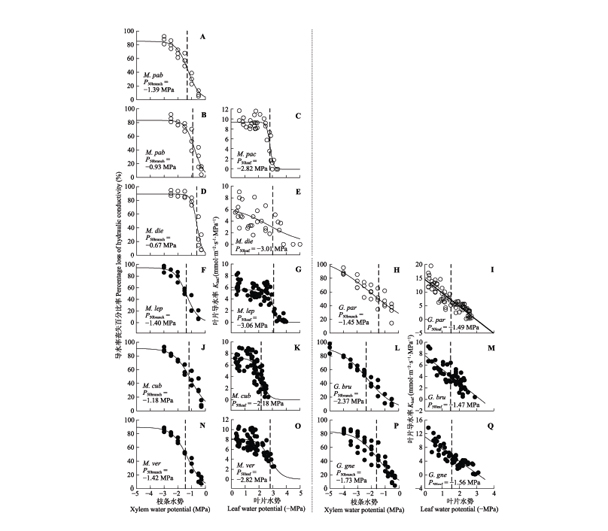
Important findings (1) There was a significant variations in hydraulic traits in genus Millettia, which was related to their light requirements and life forms. Compared with trees, the shade-tolerant liana species had lower hydraulic conductivity and higher resistance to cavitation. (2) Despite angiosperm-like characteristics such as vessels and broad pinnate-veined leaves, the Gnetum tree species had the lowest hydraulic conductivity among the nine species. However, the Gnetum liana species had higher hydraulic conductivity, comparable to light-demanding angiosperm species in this study. (3) There was no significant trade-off between hydraulic conductivity efficiency and hydraulic safety in both branch- and leaf-level across all the species, or within each plant group. (4) Compared to co-generic tree species, liana species’ leaves were more resistant to cavitation than branches, as indicated by higher maximum net photosynthetic rates and stomatal conductance during the dry season. These results support the hypothesis of “growth advantages at dry season” for liana species. This study reveals the high diversity and significance of hydraulic functioning in tropical lianas. Extensive measurements of hydraulic properties are needed to promote understanding of tropical species response to environmental change.
SONG Hui-Qing, NI Ming-Yuan, ZHU Shi-Dan . Hydraulic and photosynthetic characteristics differ between co-generic tree and liana species: a case study of Millettia and Gnetum in tropical forest[J]. Chinese Journal of Plant Ecology, 2020 , 44(3) : 192 -204 . DOI: 10.17521/cjpe.2019.0304
| [1] | Allen CD, MacAlady AK, Chenchouni H, Bachelet D, McDowell N, Vennetier M, Kitzberger T, Rigling A, Breshears DD, Hogg EHT, Gonzalez P, Fensham R, Zhang Z, Castro J, Demidova N, Lim JH, Allard G, Running SW, Semerci A, Cobb N (2010). A global overview of drought and heat-induced tree mortality reveals emerging climate change risks for forests. Forest Ecology and Management, 259, 660-684. |
| [2] | Angyalossy V, Pace MR, Lima AC (2014). Liana anatomy: a broad perspective on structural evolution of the vascular system//Schnitzer SA, Bongers F, Burnham RJ, Putz FE. Ecology of Lianas. John Wiley & Sons, Chichester, UK. 253-287. |
| [3] | Bittencourt PRL, Pereira L, Oliveira RS (2016). On xylem hydraulic efficiencies, wood space-use and the safety-efficiency tradeoff. New Phytologist, 211, 1152-1155. |
| [4] | Blackman CJ, Brodribb TJ, Jordan GJ (2010). Leaf hydraulic vulnerability is related to conduit dimensions and drought resistance across a diverse range of woody angiosperms. New Phytologist, 188, 1113-1123. |
| [5] | Brodribb TJ, Bowman DJMS, Nichols S, Delzon S, Burlett R (2010). Xylem function and growth rate interact to determine recovery rates after exposure to extreme water deficit. New Phytologist, 188, 533-542. |
| [6] | Brodribb TJ, Feild TS (2000). Stem hydraulic supply is linked to leaf photosynthetic capacity: evidence from New Caledonian and Tasmanian rainforests. Plant, Cell & Environment, 23, 1381-1388. |
| [7] | Brodribb TJ, Holbrook NM (2003). Stomatal closure during leaf dehydration, correlation with other leaf physiological traits. Plant Physiology, 132, 2166-2173. |
| [8] | Brodribb TJ, Holbrook NM (2004). Stomatal protection against hydraulic failure: a comparison of coexisting ferns and angiosperms. New Phytologist, 162, 663-670. |
| [9] | Brodribb TJ, Holbrook NM (2006). Declining hydraulic efficiency as transpiring leaves desiccate: two types of response. Plant, Cell & Environment, 29, 2205-2215. |
| [10] | Bucci SJ, Scholz FG, Campanello PI, Montti L, Jimenez- Castillo M, Rockwell FA, Manna LL, Guerra P, Bernal PL, Troncoso O, Enricci J, Holbrook MN, Goldstein G (2012). Hydraulic differences along the water transport system of South American Nothofagus species: Do leaves protect the stem functionality? Tree Physiology, 32, 880-893. |
| [11] | Buckley TN, John GP, Scoffoni C, Sack L (2015). How does leaf anatomy influence water transport outside the xylem? Plant Physiology, 168, 1616-1635. |
| [12] | Cai ZQ, Schnitzer SA, Bongers F (2009). Seasonal differences in leaf-level physiology give lianas a competitive advantage over trees in a tropical seasonal forest. Oecologia, 161, 25-33. |
| [13] | Campbell MJ, Edwards W, Magrach A, Alamgir M, Porolak G, Mohandass D, Laurance WF (2018). Edge disturbance drives liana abundance increase and alteration of Liana- host tree interactions in tropical forest fragments. Ecology and Evolution, 8, 4237-4251. |
| [14] | Celis G, Avalos G (2013). Acclimation of seedlings of Gnetum leyboldii Tul.(Gnetaceae) to light changes in a tropical rain forest. Revista De Biologia Tropical, 61, 1859-1868. |
| [15] | Chen YJ, Cao KF, Schnitzer SA, Fan ZX, Zhang JL, Bongers F (2015). Water-use advantage for lianas over trees in tropical seasonal forests. New Phytologist, 205, 128-136. |
| [16] | Choat B, Drayton WM, Brodersen C, Mattthews MA, Shackel KA, Wada H, McElrone AJ (2010). Measurement of vulnerability to water stress-induced cavitation in grapevine: a comparison of four techniques applied to a long-vesseled species. Plant, Cell & Environment, 33, 1502-1512. |
| [17] | Choat B, Jansen S, Brodribb TJ, Cochard H, Delzon S, Bhaskar R, Bucci SJ, Feild TS, Gleason SM, Hacke UG, Jacobsen AL, Lens F, Maherali H, Martínez-Vilalta J, Mayr S, Mencuccini M, Mitchell PJ, Nardini A, Pittermann J, Pratt RB, Sperry JS, Westoby M, Wright IJ, Zanne AE (2012). Global convergence in the vulnerability of forests to drought. Nature, 491, 752-755. |
| [18] | Cochard H, Cruiziat P, Tyree MT (1992). Use of positive pressures to establish vulnerability curves: further support for the air-seeding hypothesis and implications for pressure- volume analysis. Plant Physiology, 100, 205-209. |
| [19] | Collins CG, Wright SJ, Wurzburger N (2016). Root and leaf traits reflect distinct resource acquisition strategies in tropical lianas and trees. Oecologia, 180, 1037-1047. |
| [20] | Cruiziat P, Cochard H, Améglio T (2002). Hydraulic architecture of trees: main concepts and results. Annals of Forest Science, 59, 723-752. |
| [21] | de Guzman ME, Santiago LS, Schnitzer SA, álvarez-Cansino L (2017). Trade-offs between water transport capacity and drought resistance in neotropical canopy liana and tree species. Tree Physiology, 37, 1404-1414. |
| [22] | Deng N, Hou C, Liu CX, Li MH, Bartish I, Tian YX, Chen W, Du CJ, Jiang ZP, Shi SQ (2019). Significance of photosynthetic characters in the evolution of Asian Gnetum(Gnetales). Frontiers in Plant Science, 10, 39. DOI: 10.3389/fpls.2019.00039. |
| [23] | Doyle JA, Donoghue MJ (1986). Seed plant phylogeny and the origin of angiosperms: an experimental cladistic approach. The Botanical Review, 52, 321-431. |
| [24] | Editorial Committee of Flora of China, Chinese Academy of Sciences (1993). Flora Reipublicae Popularis Sinicae. Science Press, Beijing. |
| [24] | [ 中国科学院中国植物志编辑委员会(1993). 中国植物志. 科学出版社, 北京.] |
| [25] | Ennajeh M, Sim?es F, Khemira H, Cochard H (2011). How reliable is the double-ended pressure sleeve technique for assessing xylem vulnerability to cavitation in woody angiosperms? Physiologia Plantarum, 142, 205-210. |
| [26] | Ewers FW, Rosell JA, Olson ME (2015). Lianas as structural parasites//Hacke U. Functional and Ecological Xylem Anatomy. Springer,Cham. 163-188. |
| [27] | Feild TS, Balun L (2008). Xylem hydraulic and photosynthetic function of Gnetum(Gnetales) species from Papua New Guinea. New Phytologist, 177, 665-675. |
| [28] | Fu PL, Jiang YJ, Wang AY, Brodribb TJ, Zhang JL, Zhu SD, Cao KF (2012). Stem hydraulic traits and leaf water-stress tolerance are co-ordinated with the leaf phenology of angiosperm trees in an Asian tropical dry karst forest. Annals of Botany, 110, 189-199. |
| [29] | Gleason SM, Westoby M, Jansen S, Choat B, Hacke UG, Pratt RB, Bhaskar R, Brodribb TJ, Bucci SJ, Cao KF, Cochard H, Delzon S, Domec JC, Fan ZX, Feild TS, Jacobsen AL, Johnson DM, Lens F, Maherali H, Martínez-Vilalta J, Mayr S, McCulloh KA, Mencuccini M, Mitchell PJ, Morris H, Nardini A, Pittermann J, Plavcová L, Schreiber SG, Sperry JS, Wright IJ, Zanne AE (2016). Weak tradeoff between xylem safety and xylem-specific hydraulic efficiency across the world’s woody plant species. New Phytologist, 209, 123-136. |
| [30] | Isnard S, Feild TS (2014). The evolution of angiosperm lianescence: a perspective from xylem structure-function //Schnitzer SA, Bongers F, Burnham RJ, Putz FE. Ecology of Lianas. John Wiley & Sons,Chichester,UK. 221-238. |
| [31] | Isnard S, Silk WK (2009). Moving with climbing plants from Charles Darwin’s time into the 21st century. American Journal of Botany, 96, 1205-1221. |
| [32] | Kotowska MM, Hertel D, Rajab YA, Barus H, Schuldt B (2015). Patterns in hydraulic architecture from roots to branches in six tropical tree species from cacao agroforestry and their relation to wood density and stem growth. Frontiers in Plant Science, 6, 191. DOI: 10.3389/fpls.2015.00191. |
| [33] | Li YH, Pei SJ, Xu ZF (1996). List of Palnt in Xishuangbanna. Yunnan Nationality Press, Kunming. |
| [33] | [ 李延辉, 裴盛基, 许再富 (1996). 西双版纳高等植物名录. 云南民族出版社, 昆明.] |
| [34] | Ma RY, Zhang JL, Cavaleri MA, Sterck F, Strijk JS, Cao KF (2015). Convergent evolution towards high net carbon gain efficiency contributes to the shade tolerance of palms (Arecaceae). PLOS ONE, 10, e0140384. DOI: 10.1371/journal.pone.0140384. |
| [35] | Maréchaux I, Bartlett MK, Iribar A, Sack L, Chave J (2017). Stronger seasonal adjustment in leaf turgor loss point in lianas than trees in an Amazonian forest. Biology Letters, 13, 20160819. DOI: 10.1098/rsbl.2016.0819. |
| [36] | Markesteijn L, Poorter L, Bongers F, Paz H, Sack L (2011). Hydraulics and life history of tropical dry forest tree species: coordination of species’ drought and shade tolerance. New Phytologist, 191, 480-495. |
| [37] | McCulloh KA, Johnson DM, Meinzer FC, Woodruff DR (2014). The dynamic pipeline: hydraulic capacitance and xylem hydraulic safety in four tall conifer species. Plant, Cell & Environment, 37, 1171-1183. |
| [38] | Meinzer FC, McCulloh KA, Lachenbruch B, Woodruff DR, Johnson DM (2010). The blind men and the elephant: the impact of context and scale in evaluating conflicts between plant hydraulic safety and efficiency. Oecologia, 164, 287-296. |
| [39] | Mencuccini M, Minunno F, Salmon Y, Martínez-Vilalta J, H?ltt? T (2015). Coordination of physiological traits involved in drought-induced mortality of woody plants. New Phytologist, 208, 396-409. |
| [40] | Pammenter NW, van der Willigen C (1998). A mathematical and statistical analysis of the curves illustrating vulnerability of xylem to cavitation. Tree Physiology, 18, 589-593. |
| [41] | Pivovaroff AL, Pasquini SC, de Guzman ME, Alstad KP, Stemke JS, Santiago LS (2016). Multiple strategies for drought survival among woody plant species. Functional Ecology, 30, 517-526. |
| [42] | Putz FE (1984). The natural history of lianas on barro Colorado Island, Panama. Ecology, 65, 1713-1724. |
| [43] | Rodríguez-Ronderos ME, Bohrer G, Sanchez-Azofeifa A, Powers JS, Schnitzer SA (2016). Contribution of lianas to plant area index and canopy structure in a Panamanian forest. Ecology, 97, 3271-3277. |
| [44] | Sack L, Frole K (2006). Leaf structural diversity is related to hydraulic capacity in tropical rain forest trees. Ecology, 87, 483-491. |
| [45] | Sack L, Holbrook NM (2006). Leaf hydraulics. Annual Review of Plant Biology, 57, 361-381. |
| [46] | Santiago LS, de Guzman ME, Baraloto C, Vogenberg JE, Brodie M, Hérault B, Fortunel C, Bonal D (2018). Coordination and trade-offs among hydraulic safety, efficiency and drought avoidance traits in Amazonian rainforest canopy tree species. New Phytologist, 218, 1015-1024. |
| [47] | Santiago LS, Goldstein G, Meinzer FC, Fisher JB, MacHado K, Woodruff D, Jones T (2004). Leaf photosynthetic traits scale with hydraulic conductivity and wood density in Panamanian forest canopy trees. Oecologia, 140, 543-550. |
| [48] | Santiago LS, Pasquini SC, de Guzman ME (2014). Physiological implications of the liana growth form//Schnitzer SA, Bongers F, Burnham RJ, Putz FE. Ecology of Lianas. John Wiley & Sons, Chichester, UK. 288-298. |
| [49] | Santiago LS, Wright SJ (2007). Leaf functional traits of tropical forest plants in relation to growth form. Functional Ecology, 21, 19-27. |
| [50] | Schnitzer SA (2005). A mechanistic explanation for global patterns of liana abundance and distribution. The American Naturalist, 166, 262-276. |
| [51] | Schnitzer SA, Bongers F (2011). Increasing liana abundance and biomass in tropical forests: emerging patterns and putative mechanisms. Ecology Letters, 14, 397-406. |
| [52] | Schnitzer SA, Dalling JW, Carson WP (2000). The impact of lianas on tree regeneration in tropical forest canopy gaps: evidence for an alternative pathway of gap-phase regeneration. Journal of Ecology, 88, 655-666. |
| [53] | Schnitzer SA, van der Heijden GMF (2019). Lianas have a seasonal growth advantage over co-occurring trees. Ecology, 100, e02655. DOI: 10.1002/ecy.2655. |
| [54] | Schulte PJ, Hinckley TM (1985). A comparison of pressure- volume curve data analysis techniques. Journal of Experimental Botany, 36, 1590-1602. |
| [55] | Scoffoni C, Albuquerque C, Brodersen CR, Townes SV, John GP, Bartlett MK, Buckley TN, McElrone AJ, Sack L (2017a). Outside-xylem vulnerability, not xylem embolism, controls leaf hydraulic decline during dehydration. Plant Physiology, 173, 1197-1210. |
| [56] | Scoffoni C, Albuquerque C, Brodersen CR, Townes SV, John GP, Cochard H, Buckley TN, McElrone AJ, Sack L (2017b). Leaf vein xylem conduit diameter influences susceptibility to embolism and hydraulic decline. New Phytologist, 213, 1076-1092. |
| [57] | Scoffoni C, Vuong C, Diep S, Cochard H, Sack L (2014). Leaf shrinkage with dehydration: coordination with hydraulic vulnerability and drought tolerance. Plant Physiology, 164, 1772-1788. |
| [58] | Smith-Martin CM, Skelton RP, Johnson KM, Lucani C, Brodribb TJ (2020). Lack of vulnerability segmentation among woody species in a diverse dry sclerophyll woodland community. Functional Ecology, 34, 777-787. |
| [59] | Sperry JS, Donnelly JR, Tyree MT (1988). A method for measuring hydraulic conductivity and embolism in xylem. Plant, Cell & Environment, 11, 35-40. |
| [60] | Sperry JS, Saliendra NZ (1994). Intra- and inter-plant variation in xylem cavitation in Betula occidentalis. Plant, Cell & Environment, 17, 1233-1241. |
| [61] | Tomlinson PB, Fisher JB (2005). Development of nonlignified fibers in leaves of Gnetum gnemon(Gnetales). American Journal of Botany, 92, 383-389. |
| [62] | Trifiló P, Raimondo F, Savi T, Lo Gullo MA, Nardini A (2016). The contribution of vascular and Extra-vascular water pathways to drought-induced decline of leaf hydraulic conductance. Journal of Experimental Botany, 67, 5029-5039. |
| [63] | Tyree MT, Ewers FW (1991). The hydraulic architecture of trees and other woody plants. New Phytologist, 119, 345-360. |
| [64] | van der Sande MT, Poorter L, Schnitzer SA, Engelbrecht BMJ, Markesteijn L (2019). The hydraulic efficiency-safety trade-off differs between lianas and trees. Ecology, 100, e02666. DOI: 10.1002/ecy.2666. |
| [65] | Villagra M, Campanello PI, Bucci SJ, Goldstein G (2013). Functional relationships between leaf hydraulics and leaf economic traits in response to nutrient addition in subtropical tree species. Tree Physiology, 33, 1308-1318. |
| [66] | Yin PX, Cai J (2018). New possible mechanisms of embolism formation when measuring vulnerability curves by air injection in a pressure sleeve. Plant, Cell & Environment, 41, 1361-1368. |
| [67] | Zhang L, Chen YJ, Ma KP, Bongers F, Sterck FJ (2019). Fully exposed canopy tree and liana branches in a tropical forest differ in mechanical traits but are similar in hydraulic traits. Tree Physiology, 39, 1713-1724. |
| [68] | Zhu SD, Cao KF (2009). Hydraulic properties and photosynthetic rates in co-occurring lianas and trees in a seasonal tropical rainforest in southwestern China. Plant Ecology, 204, 295-304. |
| [69] | Zhu SD, Chen YJ, Cao KF, Ye Q (2015). Interspecific variation in branch and leaf traits among three Syzygium tree species from different successional tropical forests. Functional Plant Biology, 42, 423-432. |
| [70] | Zhu SD, Chen YJ, Fu PL, Cao KF (2017). Different hydraulic traits of woody plants from tropical forests with contrasting soil water availability. Tree Physiology, 37, 1469-1477. |
| [71] | Zhu SD, Liu H, Xu QY, Cao KF, Ye Q (2016). Are leaves more vulnerable to cavitation than branches? Functional Ecology, 30, 1740-1744. |
| [72] | Zimmerman MH, Brown CL (1971). Trees: Structure and Function. Springer-Verlag, New York. |
/
| 〈 |
|
〉 |
Copyright © 2026 Chinese Journal of Plant Ecology
Tel: 010-62836134, 62836138, E-mail: apes@ibcas.ac.cn, cjpe@ibcas.ac.cn

