
Chinese Journal of Plant Ecology >
Variation and correlation in functional traits of main woody plants in the Cyclobalanopsis glauca community in the karst hills of Guilin, southwest China
Received date: 2019-06-13
Accepted date: 2020-04-13
Online published: 2020-07-09
Supported by
National Natural Science Foundation of China(31860124);Guangxi Natural Science Foundation(2016GXNSFBA380030)
Aims Exploring the variation and the relationship between different functional traits of different growth forms and life forms woody species is helpful to understand the adaptation strategies of plants to the external environment, and is of great significance for understanding community assembly and biodiversity maintenance mechanisms.
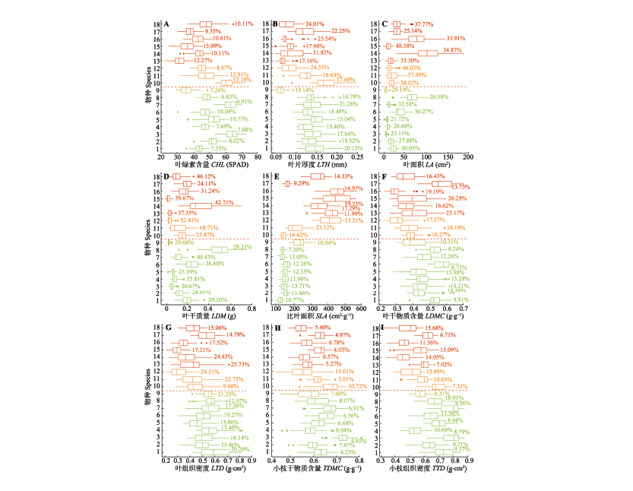
Methods We measured leaf chlorophyll content (CHL), leaf thickness (LTH), leaf area (LA), leaf dry mass (LDM), specific leaf area (SLA), leaf dry matter content (LDMC), leaf tissue density (LTD), twig dry matter content (TDMC) and twig tissue density (TTD) of 18 main woody species from the Cyclobalanopsis glauca community in karst hills of Guilin, southwest China. Traits variations among different plant functional types (growth form and life form) of woody species were analyzed by a series of methods, including the one-way analysis of variance (one-way ANOVA), and the linear mixed-effects model. In addition, the relationships between nine functional traits on individual and species levels were assessed by the Pearson’s correlation test and principal component analysis (PCA).
Important findings The results showed that: (1) The nine functional traits had different degrees of variation. Specifically, LA and LDM had the maximum coefficient of intraspecific and interspecific variation, while the intraspecific and interspecific variation coefficients of TDMC and TTD were the lowest. (2) For different growth forms, there were significant differences in most functional traits between trees, shrubs and woody lianas. (3) For different life forms, except that the deciduous species showed significantly higher LA and SLA values than evergreen species, and for the other seven functional traits, evergreen species showed significantly higher values than those of deciduous species. (4) There were differences in the intraspecific and interspecific variation of functional traits between different growth forms and life forms plants. Except for some plant functional traits showing the intraspecific variation higher than interspecific variation, most of the other functional traits showed the interspecific variation was higher than intraspecific variation. (5) The relationships between nine functional traits are roughly the same at the individual level and the species level, while the significant correlation ratio at the individual level is higher than the species level. In conclusion, the interspecific variation of plant functional traits is basically higher than the intraspecific variation, but the intraspecific variation cannot be ignored. In addition, species with different growth forms and life forms adopt different ecological strategies to adapt to the karst habitat. Future research should be based on sampling at the individual level, and in combination with environmental factors to explore the variation and correlation in functional traits of different plant functional types at different scales.
LIU Run-Hong, BAI Jin-Lian, BAO Han, NONG Juan-Li, ZHAO Jia-Jia, JIANG Yong, LIANG Shi-Chu, LI Yue-Juan . Variation and correlation in functional traits of main woody plants in the Cyclobalanopsis glauca community in the karst hills of Guilin, southwest China[J]. Chinese Journal of Plant Ecology, 2020 , 44(8) : 828 -841 . DOI: 10.17521/cjpe.2019.0146
| [1] | Ackerly DD, Reich PB (1999). Convergence and correlations among leaf size and function in seed plants: a comparative test using independent contrasts. American Journal of Botany, 86, 1272-1281. |
| [2] | Albert CH, Thuiller W, Yoccoz NG, Douzet R, Aubert S, Lavorel S (2010a). A multi-trait approach reveals the structure and the relative importance of intra- vs. interspecific variability in plant traits. Functional Ecology, 24, 1192-1201. |
| [3] | Albert CH, Thuiller W, Yoccoz NG, Soudant A, Boucher F, Saccone P, Lavorel S (2010b). Intraspecific functional variability: extent, structure and sources of variation. Journal of Ecology, 98, 604-613. |
| [4] | Anderegg WRL (2015). Spatial and temporal variation in plant hydraulic traits and their relevance for climate change impacts on vegetation. New Phytologist, 205, 1008-1014. |
| [5] | Auger S, Shipley B (2013). Inter-specific and intra-specific trait variation along short environmental gradients in an old- growth temperate forest. Journal of Vegetation Science, 24, 419-428. |
| [6] | Baraloto C, Timothy Paine CE, Poorter L, Beauchene J, Bonal D, Domenach AM, Hérault B, Pati?o S, Roggy JC, Chave J (2010). Decoupled leaf and stem economics in rain forest trees. Ecology Letters, 13, 1338-1347. |
| [7] | Bolmgren K, Cowan PD (2008). Time-size tradeoffs: a phylogenetic comparative study of flowering time, plant height and seed mass in a north-temperate flora. Oikos, 117, 424-429. |
| [8] | Bucci SJ, Goldstein G, Meinzer FC, Scholz FG, Franco AC, Bustamante M (2004). Functional convergence in hydraulic architecture and water relations of tropical savanna trees: from leaf to whole plant. Tree Physiology, 24, 891-899. |
| [9] | Cadotte MW, Arnillas CA, Livingstone SW, Yasui SLE (2015). Predicting communities from functional traits. Trends in Ecology & Evolution, 30, 510-511. |
| [10] | Castro-Díe P, Montserrat-Martí G, Cornelissen JHC (2003). Trade-offs between phenology, relative growth rate, life form and seed mass among 22 Mediterranean woody species. Plant Ecology, 166, 117-129. |
| [11] | Chalmandrier L, Münkemüller T, Colace MP, Renaud J, Aubert S, Carlson BZ, Clément JC, Legay N, Pellet G, Saillard A, Lavergne S, Thuiller W (2017). Spatial scale and intraspecific trait variability mediate assembly rules in alpine grasslands. Journal of Ecology, 105, 277-287. |
| [12] | Chave J, Coomes D, Jansen S, Lewis SL, Swenson NG, Zanne AE (2009). Towards a worldwide wood economics spectrum. Ecology Letters, 12, 351-366. |
| [13] | Cheng W, Yu YH, Xiong KN, Zhang Y, Xu M, Tan DJ (2019). Leaf functional traits of dominant species in karst plateau- canyon areas. Guihaia, 39, 1039-1049. |
| [13] | [ 程雯, 喻阳华, 熊康宁, 张俞, 许敏, 谭代军 (2019). 喀斯特高原峡谷优势种叶片功能性状分析. 广西植物, 39, 1039-1049.] |
| [14] | de la Riva EG, Tosto A, Pérez-Ramos IM, Navarro-Fernández CM, Olmo M, Anten NPR, Mara?ón T, Villar R (2016). A plant economics spectrum in Mediterranean forests along environmental gradients: Is there coordination among leaf, stem and root traits? Journal of Vegetation Science, 27, 187-199. |
| [15] | Díaz S, Hodgson JG, Thompson K, Cabido M, Cornelissen JHC, Jalili A, Montserrat-Martí G, Grime JP, Zarrinkamar F, Asri Y, Band SR, Basconcelo S, Castro-Díez P, Hamzehee GFB, Khoshnevi M, Pérez-Harguindeguy N, Pérez-Rontomé MC, Shirvany FA, Vendramini F, Yazdani S, Abbas-Azimi R, Bogaard A, Boustani S, Charles M, Dehghan M, de Torres-Espuny L, Falczuk V, Guerrero- Campo J, Hynd A, Jones G, Kowsary E, Kazemi-Saeed F, Maestro-Martínez M, Romo-Díez A, Shaw S, Siavash B, Villar-Salvador P, Zak MR (2004). The plant traits that drive ecosystems: evidence from three continents. Journal of Vegetation Science, 15, 295-304. |
| [16] | Díaz S, Kattge J, Cornelissen JHC, Wright IJ, Lavorel S, Dray S, Reu B, Kleyer M, Wirth C, Colin Prentice I, Garnier E, B?nisch G, Westoby M, Poorter H, Reich PB, Moles AT, Dickie J, Gillison AN, Zanne AE, Chave J, Joseph Wright S, Sheremet?ev SN, Jactel H, Baraloto C, Cerabolini B, Pierce S, Shipley B, Kirkup D, Casanoves F, Joswig JS, Günther A, Falczuk V, Rüger N, Mahecha MD, Gorné LD (2016). The global spectrum of plant form and function. Nature, 529, 167-171. |
| [17] | Funk JL, Standish RJ, Stock WD, Valladares F (2016). Plant functional traits of dominant native and invasive species in mediterranean-climate ecosystems. Ecology, 97, 75-83. |
| [18] | Garnier E, Laurent G, Bellmann A, Debain S, Berthelier P, Ducout B, Roumet C, Navas ML (2001). Consistency of species ranking based on functional leaf traits. New phytologist, 152, 69-83. |
| [19] | Grime JP (1977). Evidence for the existence of three primary strategies in plants and its relevance to ecological and evolutionary theory. The American Naturalist, 111, 1169-1194. |
| [20] | He D (2016). Plant Functional Trait Variation and Community Assembly: A Case Study in A Subtropical Evergreen Forest. PhD dissertation, Sun Yat-Sen University, Guangzhou. |
| [20] | [ 何东 (2016). 植物功能性状变异与群落构建: 以黑石顶常绿阔叶林为例. 博士学位论文, 中山大学, 广州.] |
| [21] | Jackson BG, Peltzer DA, Wardle DA (2013). The within- species leaf economic spectrum does not predict leaf litter decomposability at either the within-species or whole community levels. Journal of Ecology, 101, 1409-1419. |
| [22] | Jiang Y, Chen XB, Ma JM, Liang SC, Huang J, Liu RH, Pan YF (2016). Interspecific and intraspecific variation in functional traits of subtropical evergreen and deciduous broadleaved mixed forests in karst topography, Guilin, Southwest China. Tropical Conservation Science, 9, 194008291668021. DOI: 10.1177/1940082916680211. |
| [23] | Jung V, Violle C, Mondy C, Hoffmann L, Muller S (2010). Intraspecific variability and trait-based community assembly. Journal of Ecology, 98, 1134-1140. |
| [24] | Kang M, Chang SX, Yan ER, Wang XH (2014). Trait variability differs between leaf and wood tissues across ecological scales in subtropical forests. Journal of Vegetation Science, 25, 703-714. |
| [25] | Li DX, Li G, Shen ZH, Xu SD, Han QY, Wang GF, Tian FL (2017). Growth-form regulates the altitudinal variation of interspecific seed mass of woody plants in Mt. Dalaoling, the Three Gorges Region, China. Chinese Journal of Plant Ecology, 41, 539-548. |
| [25] | [ 李道新, 李果, 沈泽昊, 徐慎东, 韩庆瑜, 王功芳, 田风雷 (2017). 植物生长型显著影响三峡大老岭地区木本植物种子质量的海拔格局. 植物生态学报, 41, 539-548.] |
| [26] | Liu HW, Wang W, Zuo J, Tao JP (2014). Leaf traits of main plants on limestone area in Zhongliang Mountain. Journal of Southwest China Normal University (Natural Science Edition), 39, 50-55. |
| [26] | [ 刘宏伟, 王微, 左娟, 陶建平 (2014). 中梁山石灰岩山地30种主要植物叶片性状研究. 西南师范大学学报(自然科学版), 39, 50-55.] |
| [27] | Liu RH (2018). Variation in Functional Traits of Woody Plants in Aquatic-terrestrial Ecotone, Lijiang River. Master degree dissertation, Guangxi Normal University, Guilin, Guangxi. |
| [27] | [ 刘润红 (2018). 漓江水陆交错带木本植物功能性状变异研究. 硕士学位论文, 广西师范大学, 广西桂林.] |
| [28] | Liu RH, Liang SC, Huang DL, Huang CY, Li JF, Chang B, Jiang Y (2019). Variation in functional traits of woody species across organizational scales in a riparian zone of Lijiang River, Southwest China. Acta Ecologica Sinica, 39, 8038-8047. |
| [28] | [ 刘润红, 梁士楚, 黄冬柳, 黄昶吟, 李娇凤, 常斌, 姜勇 (2019). 漓江河岸带木本植物功能性状跨尺度变异研究. 生态学报, 39, 8038-8047.] |
| [29] | Liu XJ, Ma KP (2015). Plant functional traits—Concepts, applications and future directions. Scientia Sinica (Vitae), 45, 325-339. |
| [29] | [ 刘晓娟, 马克平 (2015). 植物功能性状研究进展. 中国科学: 生命科学, 45, 325-339.] |
| [30] | Méndez-Alonzo R, Paz H, Zuluaga RC, Rosell JA, Olson ME (2012). Coordinated evolution of leaf and stem economics in tropical dry forest trees. Ecology, 93, 2397-2406. |
| [31] | Meng TT, Ni J, Wang GH (2007). Plant functional traits, environments and ecosystem functioning. Journal of Plant Ecology (Chinese Version), 31, 150-165. |
| [31] | [ 孟婷婷, 倪健, 王国宏 (2007). 植物功能性状与环境和生态系统功能. 植物生态学报, 31, 150-165.] |
| [32] | Messier J, McGill BJ, Enquist BJ, Lechowicz MJ (2017). Trait variation and integration across scales: Is the leaf economic spectrum present at local scales? Ecography, 40, 685-697. |
| [33] | Messier J, McGill BJ, Lechowicz MJ (2010). How do traits vary across ecological scales? A case for trait-based ecology. Ecology Letters, 13, 838-848. |
| [34] | Mouillot D, Graham NAJ, Villéger S, Mason NWH, Bellwood DR (2013). A functional approach reveals community responses to disturbances. Trends in Ecology & Evolution, 28, 167-177. |
| [35] | Niu CJ, Lou AR, Sun RY, Li QF (2015). Basic Ecology. 3rd ed. Higher Education Press, Beijing. 157-158. |
| [35] | [ 牛翠娟, 娄安如, 孙儒泳, 李庆芬 (2015). 基础生态学. 3版. 高等教育出版社, 北京.] |
| [36] | Osnas JLD, Lichstein JW, Reich PB, Pacala SW (2013). Global leaf trait relationships: mass, area, and the leaf economics spectrum. Science, 340, 741-744. |
| [37] | Pang ZQ, Lu WL, Jiang LS, Jin K, Qi Z (2019). Leaf traits of different growing plants in karst area of Shilin, China. Guihaia, 39, 1126-1138. |
| [37] | [ 庞志强, 卢炜丽, 姜丽莎, 靳珂, 亓峥 (2019). 滇中喀斯特41种不同生长型植物叶性状研究. 广西植物, 39, 1126-1138.] |
| [38] | Pérez-Harguindeguy N, Díaz S, Garnier E, Lavorel S, Poorter H, Jaureguiberry P, Bret-Harte MS, Cornwell WK, Craine JM, Gurvich DE, Urcelay C, Veneklaas EJ, Reich PB, Poorter L, Wright IJ, Ray P, Enrico L, Pausas JG, de Vos AC, Buchmann N, Funes G, Quétier F, Hodgson JG, Thompson K, Morgan HD, ter Steege H, Sack L, Blonder B, Poschlod P, Vaieretti MV, Conti G, Staver AC, Aquino S, Cornelissen JHC (2013). New handbook for standardised measurement of plant functional traits worldwide. Australian Journal of Botany, 61, 167-234. |
| [39] | Poorter L, Wright SJ, Paz H, Ackerly DD, Condit R, Ibarra- Manríouez G, Harms KE, Licona JC, Martínez-Ramos M, Mazer SJ, Muller-Landau HC, Pe?a-Claros M, Webb CO, Wright IJ (2008). Are functional traits good predictors of demographic rates? Evidence from five neotropical forests. Ecology, 89, 1908-1920. |
| [40] | Reich PB, Walters MB, Ellsworth DS (1992). Leaf life-span in relation to leaf, plant, and stand characteristics among diverse ecosystems. Ecological Monographs, 62, 365-392. |
| [41] | Rowe N, Speck T (2005). Plant growth forms: an ecological and evolutionary perspective. New Phytologist, 166, 61-72. |
| [42] | Santiago LS, Wright SJ (2007). Leaf functional traits of tropical forest plants in relation to growth form. Functional Ecology, 21, 19-27. |
| [43] | Siefert A, Violle C, Chalmandrier L, Albert CH, Taudiere A, Fajardo A, Aarssen LW, Baraloto C, Carlucci MB, Cianciaruso MV, de L Dantas V, de Bello F, Duarte LDS, Fonseca CR, Freschet GT, Gaucherand S, Gross N, Hikosaka K, Jackson B, Jung V, Kamiyama C, Katabuchi M, Kembel SW, Kichenin E, Kraft NJB, Lagerstr?m A, Le Bagousse-Pinguet Y, Li Y, Mason N, Messier J, Nakashizuka T, Overton JM, Peltzer DA, Pérez-Ramos IM, Pillar VD, Prentice HC, Richardson S, Sasaki T, Schamp BS, Sch?b C, Shipley B, Sundqvist M, Sykes MT, Vandewalle M, Wardle DA (2015). A global meta-analysis of the relative extent of intraspecific trait variation in plant communities. Ecology Letters, 18, 1406-1419. |
| [44] | Silvertown J (2004). Plant coexistence and the niche. Trends in Ecology & Evolution, 19, 605-611. |
| [45] | Spasojevic MJ, Turner BL, Myers JA (2016). When does intraspecific trait variation contribute to functional beta- diversity? Journal of Ecology, 104, 487-496. |
| [46] | Tang QQ, Huang YT, Ding Y, Zang RG (2016). Interspecific and intraspecific variation in functional traits of subtropical evergreen and deciduous broad-leaved mixed forests. Biodiversity Science, 24, 262-270. |
| [46] | [ 唐青青, 黄永涛, 丁易, 臧润国 (2016). 亚热带常绿落叶阔叶混交林植物功能性状的种间和种内变异. 生物多样性, 24, 262-270.] |
| [47] | Tomlinson KW, Poorter L, Bongers F, Borghetti F, Jacobs L, van Langevelde F (2014). Relative growth rate variation of evergreen and deciduous savanna tree species is driven by different traits. Annals of Botany, 114, 315-324. |
| [48] | Violle C, Enquist BJ, McGill BJ, Jiang L, Albert CH, Hulshof C, Jung V, Messier J (2012). The return of the variance: intraspecific variability in community ecology. Trends in Ecology & Evolution, 27, 244-252. |
| [49] | Violle C, Navas ML, Vile D, Kazakou E, Fortunel C, Hummel I, Garnier E (2007). Let the concept of trait be functional!. Oikos, 116, 882-892. |
| [50] | Wang KL, Chen HS, Zeng FP, Yue YM, Zhang W, Fu ZY (2018). Ecological research supports eco-environmental management and poverty alleviation in karst region of southwest China. Bulletin of the Chinese Academy of Sciences, 33, 213-222. |
| [50] | [ 王克林, 陈洪松, 曾馥平, 岳跃民, 张伟, 付智勇 (2018). 生态学研究支撑喀斯特区域生态环境治理与科技扶贫. 中国科学院院刊, 33, 213-222. ] |
| [51] | Wang RL, Yu GR, He NP, Wang QF, Zhao N, Xu ZW (2016). Altitudinal variation in the covariation of stomatal traits with leaf functional traits in Changbai Mountain. Acta Ecologica Sinica, 36, 2175-2184. |
| [51] | [ 王瑞丽, 于贵瑞, 何念鹏, 王秋凤, 赵宁, 徐志伟 (2016). 气孔特征与叶片功能性状之间关联性沿海拔梯度的变化规律——以长白山为例. 生态学报, 36, 2175-2184.] |
| [52] | Weemstra M, Mommer L, Visser EJW, van Ruijven J, Kuyper TW, Mohren GMJ, Sterck FJ (2016). Towards a multidimensional root trait framework: a tree root review. New Phytologist, 211, 1159-1169. |
| [53] | Westoby M (1998). A leaf-height-seed (LHS) plant ecology strategy scheme. Plant and Soil, 199, 213-227. |
| [54] | Wright IJ, Ackerly DD, Bongers F, Harms KE, Ibarra-Manriquez G, Martinez-Ramos M, Mazer SJ, Muller-Landau HC, Paz H, Pitman NCA, Poorter L, Silman MR, Vriesendorp CF, Webb CO, Westoby M, Wright SJ (2007). Relationships among ecologically important dimensions of plant trait variation in seven Neotropical forests. Annals of Botany, 99, 1003-1015. |
| [55] | Wright IJ, Falster DS, Pickup M, Westoby M (2006). Cross- species patterns in the coordination between leaf and stem traits, and their implications for plant hydraulics. Physiologia Plantarum, 127, 445-456. |
| [56] | Wright IJ, Reich PB, Westoby M, Ackerly DD, Baruch Z, Bongers F, Cavender-Bares J, Chapin T, Cornelissen JHC, Diemer M, Flexas J, Garnier E, Groom PK, Gulias J, Hikosaka K, Lamont BB, Lee T, Lee W, Lusk C, Midgley JJ, Navas ML, Niinemets ü, Oleksyn J, Osada N, Poorter H, Poot P, Prior L, Pyankov VI, Roumet C, Thomas SC, Tjoelker MG, Veneklaas EJ, Villar R (2004). The worldwide leaf economics spectrum. Nature, 428, 821-827. |
| [57] | Zhong QL, Liu LB, Xu X, Yang Y, Guo YM, Xu HY, Cai XL, Ni J (2018). Variations of plant functional traits and adaptive strategy of woody species in a karst forest of central Guizhou Province, Southwestern China. Chinese Journal of Plant Ecology, 42, 562-572. |
| [57] | [ 钟巧连, 刘立斌, 许鑫, 杨勇, 郭银明, 许海洋, 蔡先立, 倪健 (2018). 黔中喀斯特木本植物功能性状变异及其适应策略. 植物生态学报, 42, 562-572.] |
/
| 〈 |
|
〉 |
Copyright © 2026 Chinese Journal of Plant Ecology
Tel: 010-62836134, 62836138, E-mail: apes@ibcas.ac.cn, cjpe@ibcas.ac.cn

