
Chinese Journal of Plant Ecology >
Soil enzyme activities and their influencing factors among different alpine grasslands on the Qingzang Plateau
Received date: 2020-05-11
Accepted date: 2020-07-17
Online published: 2020-08-10
Supported by
the National Natural Science Foundation of China(41671262);the National Natural Science Foundation of China(41877338)
Aims As a key factor of nutrient cycling in ecosystems, soil enzyme activity is an important indicator of soil quality and ecosystem function. However, there have been very few studies on the differences of soil enzyme activities among different types of alpine grassland ecosystems. Thus, the aims of this study were to compare the differences of soil enzyme activities among five different types of alpine grassland and to reveal their influencing environmental factors on the Qingzang Plateau.
Methods Totally, 21 samples of five alpine grassland types, including alpine meadow, alpine steppe, alpine meadow steppe, alpine desert steppe and alpine desert on northern Qingzang Plateau, were selected for field in-situ investigation and sampling. The activities of 14 enzymes involved in the cycling of carbon (C), nitrogen (N) and phosphorus (P) were determined, and the relationships between enzymatic activities and environmental factors in alpine grassland were established.
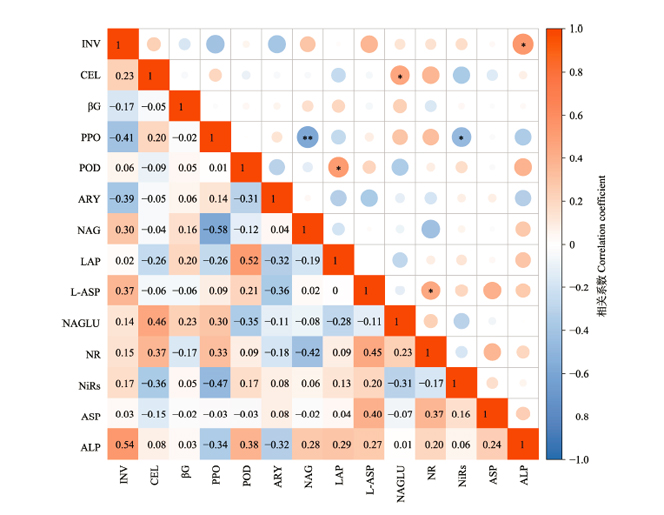
Important findings The activities of C-acquisition (invertase, cellulase, β-1,4-glucosidse, polyphenol oxidase and peroxidase), P-acquisition (alkaline phosphatase) enzymes and two N-acquisition (arylamidase and nitrite reductase) were significantly different among different alpine grassland types. Moreover, correlations were found among C-acquisition, N-acquisition and P-acquisition enzymes. A significant positive correlation was found between invertase and alkaline phosphatase, and between cellulase and N-acetyl-α-D-glucosaminidase. A significant negative correlation was found between polyphenol oxidase and nitrite reductase, N-acetyl-β-D- glucosaminidase. Soil organic matter (SOM) content, gram-negative bacteria content, ratio of nitrogen to phosphorus, gram-positive bacteria content, bacteria content, actinomycetes content, total nitrogen content and fungi content were the key factors influencing soil enzyme activity among the 19 environmental indicators, and SOM content had the greatest impact (explained 11.9%). The results demonstrated that the activities of C-acquisition, P-acquisition and two N-acquisition (arylamidase and nitrite reductase) enzymes were significantly different among different types of alpine grassland, and soil enzyme activities were mainly controlled by SOM content, microbes and N elements in alpine grassland ecosystems.
WANG Zi-Wei, WAN Song-Ze, JIANG Hong-Mao, HU Yang, MA Shu-Qin, CHEN You-Chao, LU Xu-Yang . Soil enzyme activities and their influencing factors among different alpine grasslands on the Qingzang Plateau[J]. Chinese Journal of Plant Ecology, 2021 , 45(5) : 528 -538 . DOI: 10.17521/cjpe.2020.0139
| [1] | Adamczyk B,Kilpeläinen P,Kitunen V,Smolander A(2014).Potential activities of enzymes involved in N, C, P and S cycling in boreal forest soil under different tree species.Pedobiologia,57, 97-102. |
| [2] | Bach HJ,Munch JC(2000).Identification of bacterial sources of soil peptidases.Biology and Fertility of Soils,31, 219-224. |
| [3] | Bao SD(2000).Agrochemical Analysis of Soil.Agricultural Press,Beijing. 30-83. |
| [3] | [鲍士旦(2000).土壤农化分析.农业出版社,北京. 30-83.] |
| [4] | Burns RG,Deforest JL,Marxsen J,Sinsabaugh RL,Stromberger ME,Wallenstein MD,Weintraub MN,Zoppini A(2013).Soil enzymes in a changing environment: current knowledge and future directions.Soil Biology & Biochemistry,58, 216-234. |
| [5] | Chen H,Li DJ,Zhao J,Zhang W,Xiao KC,Wang KL(2018).Nitrogen addition aggravates microbial carbon limitation: Evidence from ecoenzymatic stoichiometry.Geoderma,329, 61-64. |
| [6] | Djukic I,Zehetner F,Mentler A,Gerzabek MH(2010).Microbial community composition and activity in different Alpine vegetation zones.Soil Biology & Biochemistry,42, 155-161. |
| [7] | Duan MJ,Gao QZ,Guo YQ,Wan YF,Li YE,Ganzhuzhabu ,Danjiuluobu ,Wei LT,Xiraozhuoma LT(2011).Species diversity distribution pattern of alpine grassland communities along an altitudinal gradient in the Northern Tibet.Pratacultural Science,28, 1845-1850. |
| [7] | [段敏杰,高清竹,郭亚奇,万运帆,李玉娥,干珠扎布,旦久罗布,韦兰亭,西饶卓玛(2011).藏北高寒草地植物群落物种多样性沿海拔梯度的分布格局.草业科学,28, 1845-1850.] |
| [8] | Fu G,Shen ZX(2017).Response of alpine soils to nitrogen addition on the Tibetan Plateau: a meta-analysis.Applied Soil Ecology,114, 99-104. |
| [9] | Guan SY(1986).Journal of Natural Resources,Agriculture Press,Beijing. 294-297. |
| [9] | [关松荫(1986).土壤酶及其研究方法.农业出版社,北京. 294-297.] |
| [10] | He QQ,Wu YH,Bing HJ,Zhou J,Wang JP(2020).Vegetation type rather than climate modulates the variation in soil enzyme activities and stoichiometry in subalpine forests in the eastern Tibetan Plateau.Geoderma,374, 114424. DOI:10.1016/j.geoderma.2020.114424. |
| [11] | Henry HAL(2013).Reprint of “Soil extracellular enzyme dynamics in a changing climate”.Soil Biology & Biochemistry,56, 53-59. |
| [12] | Hernández DL,Hobbie SE(2010).The effects of substrate composition, quantity, and diversity on microbial activity.Plant and Soil,335, 397-411. |
| [13] | Hong JT,Wang XD,Wu JB(2014).Stoichiometry of root and leaf nitrogen and phosphorus in a dry alpine steppe on the Northern Tibetan Plateau.PLOS ONE,9, e109052. DOI:10.1371/journal.pone.0109052. |
| [14] | Jian SY,Li JW,Chen J,Wang GS,Mayes MA,Dzantor KE,Hui DF,Luo YQ(2016).Soil extracellular enzyme activities, soil carbon and nitrogen storage under nitrogen fertilization: a meta-analysis.Soil Biology & Biochemistry,101, 32-43. |
| [15] | Jing X,Chen X,Xiao W,Lin L,Wang C,He JS,Zhu B(2018).Soil enzymatic responses to multiple environmental drivers in the Tibetan grasslands: insights from two manipulative field experiments and a meta-analysis.Pedobiologia,71, 50-58. |
| [16] | Jing X,Sanders NJ,Shi Y,Chu HY,Classen AT,Zhao K,Chen LT,Shi Y,Jiang YX,He JS(2015).The links between ecosystem multifunctionality and above- and belowground biodiversity are mediated by climate.Nature Communications,6, 8159. DOI:10.1038/ncomms9159. |
| [17] | Katsuyama C,Kondo N,Suwa Y,Yamagishi T,Itoh M,Ohte N,Kimura H,Nagaosa K,Kato K(2008).Denitrification activity and relevant bacteria revealed by nitrite reductase gene fragments in soil of temperate mixed forest.Microbes and Environments,23, 337-345. |
| [18] | Keeler BL,Hobbie SE,Kellogg LE(2009).Effects of long- term nitrogen addition on microbial enzyme activity in eight forested and grassland sites: implications for litter and soil organic matter decomposition.Ecosystems,12, 1-15. |
| [19] | Kivlin SN,Treseder KK(2014).Soil extracellular enzyme activities correspond with abiotic factors more than fungal community composition.Biogeochemistry,117, 23-37. |
| [20] | Kuypers MMM,Marchant HK,Kartal B(2018).The microbial nitrogen-cycling network.Nature Reviews Microbiology,16, 263-276. |
| [21] | Li GL,Kim S,Han SH,Chang HN,Du DL,Son YW(2018).Precipitation affects soil microbial and extracellular enzymatic responses to warming.Soil Biology & Biochemistry,120, 212-221. |
| [22] | Li Y,Nie C,Liu YH,Du W,He P(2019).Soil microbial community composition closely associates with specific enzyme activities and soil carbon chemistry in a long-term nitrogen fertilized grassland.Science of the Total Environment,654, 264-274. |
| [23] | Lin B,Zhao XR,Zheng Y,Qi S,Liu XZ(2017).Effect of grazing intensity on protozoan community, microbial biomass, and enzyme activity in an alpine meadow on the Tibetan Plateau.Journal of Soils and Sediments,17, 2752-2762. |
| [24] | Liu SB,Razavi BS,Su X,Maharjan M,Zarebanadkouki M,Blagodatskaya E,Kuzyakov Y(2017).Spatio-temporal patterns of enzyme activities after manure application reflect mechanisms of niche differentiation between plants and microorganisms.Soil Biology & Biochemistry,112, 100-109. |
| [25] | Liu XC,Zhang ST(2019).Nitrogen addition shapes soil enzyme activity patterns by changing pH rather than the composition of the plant and microbial communities in an alpine meadow soil.Plant and Soil,440, 11-24. |
| [26] | Liu XJ,Zhang Y,Han WX,Tang AH,Shen JL,Cui ZL,Vitousek P,Erisman JW,Goulding K,Christie P,Fangmeier A,Zhang FS(2013).Enhanced nitrogen deposition over China.Nature,494, 459-462. |
| [27] | Lopez-Aizpun M,Arango-Mora C,Santamaria C,Lasheras E,Santamaria JM,Ciganda VS,Cardenas LM,Elustondo D(2018).Atmospheric ammonia concentration modulates soil enzyme and microbial activity in an oak forest affecting soil microbial biomass.Soil Biology & Biochemistry,116, 378-387. |
| [28] | Lu XY,Yan Y,Sun J,Zhang XK,Chen YC,Wang XD,Cheng GW(2015).Carbon, nitrogen, and phosphorus storage in alpine grassland ecosystems of Tibet: effects of grazing exclusion.Ecology and Evolution,5, 4492-4504. |
| [29] | Ma WJ,Li J,Gao Y,Xing F,Sun SN,Zhang T,Zhu XZ,Chen C,Li Z(2020).Responses of soil extracellular enzyme activities and microbial community properties to interaction between nitrogen addition and increased precipitation in a semi-arid grassland ecosystem.Science of the Total Environment,703, 134691. DOI:10.1016/S1002-0160(18) 60010-4. |
| [30] | Manzoni S,Jackson RB,Trofymow JA,Porporato A(2008).The global stoichiometry of litter nitrogen mineralization.Science,321, 684-686. |
| [31] | Mazzon M,Cavani L,Margon A,Sorrenti G,Ciavatta C,Marzadori C(2018).Changes in soil phenol oxidase activities due to long-term application of compost and mineral N in a walnut orchard.Geoderma,316, 70-77. |
| [32] | Marx MC,Wood M,Jarvis SC(2001).A microplate fluorimetric assay for the study of enzyme diversity in soils.Soil Biology & Biochemistry,33, 1633-1640. |
| [33] | Mo ZH,Li YE,Gao QZ(2012).Simulation on productivity of main grassland ecosystems responding to climate change.Chinese Journal of Agrometeorology,33, 545-554. |
| [33] | [莫志鸿,李玉娥,高清竹(2012).主要草原生态系统生产力对气候变化响应的模拟.中国农业气象,33, 545-554.] |
| [34] | Nannipieri P,Trasar-Cepeda C,Dick RP(2018).Soil enzyme activity: a brief history and biochemistry as a basis for appropriate interpretations and meta-analysis.Biology and Fertility of Soils,54, 11-19. |
| [35] | Niu L,Liu YH,Li Y,Ouyang SN(2015).Microbial community structure of the alpine meadow under different grazing styles in Naqu prefecture of Tibet.Chinese Journal of Applied Ecology,26, 2298-2306. |
| [35] | [牛磊,刘颖慧,李悦,欧阳胜男(2015).西藏那曲地区高寒草甸不同放牧方式下土壤微生物群落结构特征.应用生态学报,26, 2298-2306.] |
| [36] | Qing Q,Yang B,Wyman CE(2010).Xylooligomers are strong inhibitors of cellulose hydrolysis by enzymes.Bioresource Technology,101, 9624-9630. |
| [37] | Rui YC,Wang YF,Chen CR,Zhou XQ,Wang SP,Xu ZH,Duan JC,Kang XM,Lu SB,Luo CY(2012).Warming and grazing increase mineralization of organic P in an alpine meadow ecosystem of Qinghai-Tibet Plateau, China.Plant and Soil,357, 73-87. |
| [38] | Sardans J,Peñuelas J,Estiarte M(2008).Changes in soil enzymes related to C and N cycle and in soil C and N content under prolonged warming and drought in a Mediterranean shrubland.Applied Soil Ecology,39, 223-235. |
| [39] | Sinsabaugh RL(2010).Phenol oxidase, peroxidase and organic matter dynamics of soil.Soil Biology & Biochemistry,42, 391-404. |
| [40] | Sinsabaugh RL,Antibus RK,Linkins AE,Mcclaugherty C,Rayburn L,Repert D,Weiland T(1992).Wood decomposition over a first-order watershed: mass loss as a function of lignocellulase activity.Soil Biology & Biochemistry,24, 743-749. |
| [41] | Sinsabaugh RL,Belnap J,Findlay SG,Shah JJF,Hill BH,Kuehn KA,Kuske CR,Litvak ME,Martinez NG,Moorhead DL,Warnock DD(2014).Extracellular enzyme kinetics scale with resource availability.Biogeochemistry,121, 287-304. |
| [42] | Sinsabaugh RL,Follstad Shah JJ(2011).Ecoenzymatic stoichiometry of recalcitrant organic matter decomposition: the growth rate hypothesis in reverse.Biogeochemistry,102, 31-43. |
| [43] | Sinsabaugh RL,Gallo ME,Lauber C,Waldrop MP,Zak DR(2005).Extracellular enzyme activities and soil organic matter dynamics for northern hardwood forests receiving simulated nitrogen deposition.Biogeochemistry,75, 201-215. |
| [44] | Sinsabaugh RL,Lauber CL,Weintraub MN,Ahmed B,Allison SD,Crenshaw C,Contosta AR,Cusack D,Frey S,Gallo ME,Gartner TB,Hobbie SE,Holland K,Keeler BL,Powers JS,Stursova M,Takacs-Vesbach C,Waldrop MP,Wallenstein MD,Zak DR,Zeglin LH(2008).Stoichiometry of soil enzyme activity at global scale.Ecology Letters,11, 1252-1264. |
| [45] | Sinsabaugh RL,Moorhead DL(1994).Resource allocation to extracellular enzyme production: a model for nitrogen and phosphorus control of litter decomposition.Soil Biology & Biochemistry,26, 1305-1311. |
| [46] | Šnajdr J,Cajthaml T,Valášková V,Merhautová V,Petránková M,Spetz P,Leppänen K,Baldrian P(2011).Transformation of Quercus petraea litter: successive changes in litter chemistry are reflected in differential enzyme activity and changes in the microbial community composition.Fems Microbiology Ecology,75, 291-303. |
| [47] | Torres IF,Bastida F,Hernandez T,Albaladejo J,Garcia C(2015).Enzyme activity, microbial biomass and community structure in a long-term restored soil under semi-arid conditions.Soil Research,53, 553-560. |
| [48] | Veres Z,Kotroczó Z,Fekete I,Tóth JA,Lajtha K,Townsend K,Tóthmérész B(2015).Soil extracellular enzyme activities are sensitive indicators of detrital inputs and carbon availability.Applied Soil Ecology,92, 18-23. |
| [49] | von Sperber C,Kries H,Tamburini F,Bernasconi SM,Frossard E(2014).The effect of phosphomonoesterases on the oxygen isotope composition of phosphate.Geochimica Et Cosmochimica Acta,125, 519-527. |
| [50] | Wallenius K,Rita HN,Mikkonen A,Lappi K,Lindstrom K,Hartikainen H,Raateland A,Niemi R(2011).Effects of land use on the level, variation and spatial structure of soil enzyme activities and bacterial communities.Soil Biology & Biochemistry,43, 1464-1473. |
| [51] | Wallenstein MD,McMahon SK,Schimel JP(2009).Seasonal variation in enzyme activities and temperature sensitivities in Arctic tundra soils.Global Change Biology,15, 1631-1639. |
| [52] | Wang SG,Hou YL(2004).Application of phospholipid fatty acid method in soil microbial analysis.Microbiology,31, 114-117. |
| [52] | [王曙光,侯彦林(2004).磷脂脂肪酸方法在土壤微生物分析中的应用.微生物学通报,31, 114-117.] |
| [53] | Wang XX,Dong SK,Gao QZ,Zhou HK,Liu SL,Su XK,Li YY(2014).Effects of short-term and long-term warming on soil nutrients, microbial biomass and enzyme activities in an alpine meadow on the Qinghai-Tibet Plateau of China.Soil Biology & Biochemistry,76, 140-142. |
| [54] | Wanke AL,Rovenich H,Schwanke F,Velte S,Becker S,Hehemann JH,Wawra S,Zuccaro A(2020).Plant species- specific recognition of long and short β-1,3-linked glucans is mediated by different receptor systems.The Plant Journal,102, 1142-1156. |
| [55] | Weintraub SR,Wieder WR,Cleveland CC,Townsend AR(2013).Organic matter inputs shift soil enzyme activity and allocation patterns in a wet tropical forest.Biogeochemistry,114, 313-326. |
| [56] | Xiao W,Chen X,Jing X,Zhu B(2018).A meta-analysis of soil extracellular enzyme activities in response to global change.Soil Biology & Biochemistry,123, 21-32. |
| [57] | Xu G,Liu Y,Long ZJ,Hu SL,Zhang YB,Jiang H(2018).Effects of exotic plantation forests on soil edaphon and organic matter fractions.Science of the Total Environment,626, 59-68. |
| [58] | Xu ZF,Hu R,Xiong P,Wan C,Cao G,Liu Q(2010).Initial soil responses to experimental warming in two contrasting forest ecosystems, Eastern Tibetan Plateau, China: nutrient availabilities, microbial properties and enzyme activities.Applied Soil Ecology,46, 291-299. |
| [59] | Yan ZQ,Qi YC,Li SJ,Dong YS,Peng Q,He YL,Li ZL(2017).Soil microorganisms and enzyme activity of grassland ecosystem affected by changes in precipitation pattern and increase in nitrogen deposition—A review.Microbiology,44, 1481-1490. |
| [59] | [闫钟清,齐玉春,李素俭,董云社,彭琴,贺云龙,李兆林(2017).降水和氮沉降增加对草地土壤微生物与酶活性的影响研究进展.微生物学通报,44, 1481-1490.] |
| [60] | Yang YG,Yang Y,Geng YQ,Huang GL,Cui XQ,Hou M(2018).Effects of different land types on soil enzyme activity in the Qinghai lake region.Wetlands,38, 711-721. |
| [61] | Yu CQ,Zhang YJ,Claus H,Zeng R,Zhang XZ,Wang JS(2012).Ecological and environmental issues faced by a developing Tibet.Environmental Science & Technology,46, 1979-1980. |
| [62] | Zhang C,Wang J,Liu GB,Song ZL,Fang LC(2019).Impact of soil leachate on microbial biomass and diversity affected by plant diversity.Plant and Soil,439, 505-523. |
| [63] | Zhang XK,Lu XY,Wang XD(2014).The spatial and temporal variation of NDVI and its relationships to climatic factors in Northern Tibet over the period of 2000-2010—Take Shantsa for example.Journal of Mountain Research,32, 475-480. |
| [63] | [张晓克,鲁旭阳,王小丹(2014).2000-2010年藏北申扎县植被NDVI时空变化与气候因子的关系.山地学报,32, 475-480.] |
| [64] | Zhang Y,Dong SK,Gao QZ,Liu SL,Ganjurjav H,Wang XX,Su XK,Wu XY(2017).Soil bacterial and fungal diversity differently correlated with soil biochemistry in alpine grassland ecosystems in response to environmental changes.Scientific Reports,7, 43077. DOI:10.1038/srep43077. |
| [65] | Zhao SC,Li KJ,Zhou W,Qiu SJ,Huang SW,He P(2016).Changes in soil microbial community, enzyme activities and organic matter fractions under long-term straw return in north-central China.Agriculture Ecosystems & Environment,216, 82-88. |
/
| 〈 |
|
〉 |
Copyright © 2026 Chinese Journal of Plant Ecology
Tel: 010-62836134, 62836138, E-mail: apes@ibcas.ac.cn, cjpe@ibcas.ac.cn

