
Chinese Journal of Plant Ecology >
Effect of altitude on community-level plant functional traits in the Qinghai Lake Basin, China
Received date: 2020-05-11
Accepted date: 2020-08-23
Online published: 2021-01-05
Supported by
the National Natural Science Foundation of China(41730854)
Aims Altitude has prominent effects on many environmental factors, such as atmospheric pressure, temperature, precipitation, soil moisture and wind velocity. The relationship between plant functional traits and altitude are critical for predicting the effects of climate change on montane plants. Our objective is to examine the effect of altitude on community-level plant functional traits in the Qinghai Lake Basin, China.
Methods Five sites were selected with 200 m increase in altitude (3 400-4 200 m) in the Qinghai Lake Basin, China. Community structure, plant functional traits, soil property and atmospheric factors were surveyed and analyzed in this study. Community-weighted mean functional traits (CWM) was calculated according to the relative abundance of species.
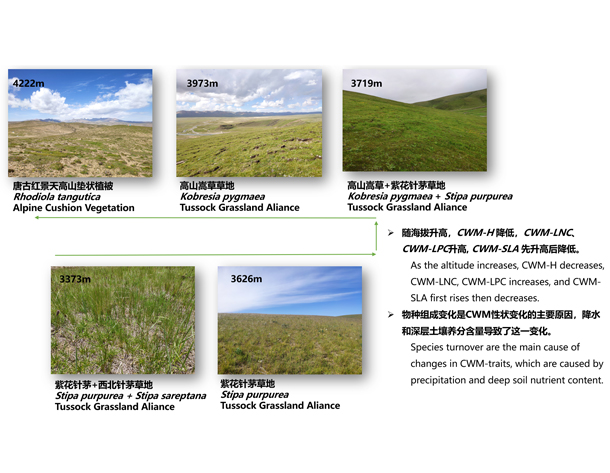
Important findings The results showed that: (1) Community-weighted mean plant height (H), leaf dry matter content (LDMC), leaf C:N ratio (C:N) and leaf N:P ratio (N:P) decreased significantly along altitude, while specific root surface area (SRA) fluctuated with altitude. Specific leaf area (SLA), leaf nitrogen content (LNC) and leaf phosphorus content (LPC) increased significantly along altitude, while altitude had no significant effect on leaf carbon content (LCC), root tissue density (RTD) and specific root length (SRL). (2) The variation in CWM along altitude could be explained by species turnover more rather than intraspecific variability. N:P and LPC had a positive covariation, other CWM had a negative covariation. (3) Precipitation and 0-10 cm depth soil nutrients content explained the largest proportion change of SLA. Temperature and 10-20 cm depth soil nutrients content explained the largest proportion change of other CWM along altitude. Overall, these findings suggested that the plant communities in our study adapted to altitude through species turnover, and the non-dominant species tended to occupy opposite trait spaces to the dominant species in the Qinghai Lake Basin, China. Temperature and deeper soil nutrients content had significant effects on CWM along altitude.
XIANG Xiang, HUANG Yong-Mei, YANG Chong-Yao, LI Ze-Qing, CHEN Hui-Ying, PAN Ying-Ping, HUO Jia-Xuan, REN Liang . Effect of altitude on community-level plant functional traits in the Qinghai Lake Basin, China[J]. Chinese Journal of Plant Ecology, 2021 , 45(5) : 456 -466 . DOI: 10.17521/cjpe.2020.0140
| [1] | Asner GP,Martin RE(2016).Convergent elevation trends in canopy chemical traits of tropical forests.Global Change Biology,22, 2216-2227. |
| [2] | Both S,Riutta T,Timothy Paine CE,Elias DMO,Cruz RS,Jain A,Johnson D,Kritzler UH,Kuntz M,Majalap-Lee N,Mielke N,Montoya Pillco MX,Ostle NJ,Teh YA,Malhi Y,Burslem DFRP(2019).Logging and soil nutrients independently explain plant trait expression in tropical forests.New Phytologist,221, 1853-1865. |
| [3] | Campetella G,Chelli S,Wellstein C,Farris E,Calvia G,Simonetti E,Borsukiewicz L,Vanderplank S,Marignani M(2019).Contrasting patterns in leaf traits of Mediterranean shrub communities along an elevation gradient: measurements matter.Plant Ecology,220, 765-776. |
| [4] | Chapin III FS(1980).The mineral nutrition of wild plants.Annual Review of Ecology and Systematics,11, 233-260. |
| [5] | Chen GC,Peng M(1993).Types and distribution of vegetation in Qinhai Lake region.Acta Phytoecologica et Geobotanica Sinica,17, 71-81. |
| [5] | [陈桂琛,彭敏(1993).青海湖地区植被及其分布规律.植物生态学与地植物学学报,17, 71-81.] |
| [6] | Chen HY,Huang YM,He KJ,Qi Y,Li EG,Jiang ZY,Sheng ZL,Li XY(2019).Temporal intraspecific trait variability drives responses of functional diversity to interannual aridity variation in grasslands.Ecology and Evolution,9, 5731-5742. |
| [7] | Chevan A,Sutherland M(1991).Hierarchical partitioning.American Statistician,45, 90-96. |
| [8] | Cingolani AM,Cabido M,Gurvich DE,Renison D,Díaz S(2007).Filtering processes in the assembly of plant communities: Are species presence and abundance driven by the same traits?Journal of Vegetation Science,18, 911-920. |
| [9] | Cornelissen JHC,Lavorel S,Garnier E,Díaz S,Buchmann N,Gurvich DE,Reich PB,ter Steege H,Morgan HD,van der Heijden MGA,Pausas JG,Poorter H(2003).A handbook of protocols for standardised and easy measurement of plant functional traits worldwide.Australian Journal of Botany,51, 335-380. |
| [10] | de Bello F,Lavorel S,Díaz S,Harrington R,Cornelissen JHC,Bardgett RD,Berg MP,Cipriotti P,Feld CK,Hering D,da Silva PM,Potts SG,Sandin L,Sousa JP,Storkey J,Wardle DA,Harrison PA(2010).Towards an assessment of multiple ecosystem processes and services via functional traits.Biodiversity and Conservation,19, 2873-2893. |
| [11] | de Bello F,Lavorel S,Albert CH,Thuiller W,Grigulis K,Dolezal J,Janeček Š,Lepš J(2011).Quantifying the relevance of intraspecific trait variability for functional diversity.Methods in Ecology and Evolution,2, 163-174. |
| [12] | de Frenne P,Graae BJ,Rodríguez-Sánchez F,Kolb A,Chabrerie O,Decocq G,de Kort H,De Schrijver A,Diekmann M,Eriksson O,Gruwez R,Hermy M,Lenoir J,Plue J,Coomes DA,Verheyen K(2013).Latitudinal gradients as natural laboratories to infer speciesʼ responses to temperature.Journal of Ecology,101, 784-795. |
| [13] | de la Riva E,Pérez-Ramos IM,Tosto A,Navarro-Fernández C,Olmo M,Marañón T,Villar R(2016).Disentangling the relative importance of species occurrence, abundance and intraspecific variability in community assembly: a trait- based approach at the whole-plant level in Mediterranean forests.Oikos,125, 354-363. |
| [14] | de Oliveira ACP,Nunes A,Rodrigues RG,Branquinho C(2020).The response of plant functional traits to aridity in a tropical dry forest.Science of the Total Environment,747, 141177. DOI:10.1016/j.scitotenv.2020.141177. |
| [15] | Díaz S,Lavorel S,de Bello F,Quétier F,Grigulis K,Robson TM(2007).Incorporating plant functional diversity effects in ecosystem service assessments.Proceedings of the National Academy of Sciences of the United States of America,104, 20684-20689. |
| [16] | Garnier E,Cortez J,Billès G,Navas ML,Roumet C,Debussche M,Laurent G,Blanchard A,Aubry D,Bellmann A,Neill C,Toussaint JP(2004).Plant functional markers capture ecosystem properties during secondary succession.Ecology,85, 2630-2637. |
| [17] | Geng Y,Wang L,Jin DM,Liu HY,He JS(2014).Alpine climate alters the relationships between leaf and root morphological traits but not chemical traits.Oecologia,175, 445-455. |
| [18] | Graae BJ,de Frenne P,Kolb A,Brunet J,Chabrerie O,Verheyen K,Pepin N,Heinken T,Zobel M,Shevtsova A,Nijs I,Milbau A(2012).On the use of weather data in ecological studies along altitudinal and latitudinal gradients.Oikos,121, 3-19. |
| [19] | Güsewell S(2004).N:P ratios in terrestrial plants: variation and functional significance.New Phytologist,164, 243-266. |
| [20] | He J,Yang K(2011).China Meteorological Forcing Dataset.Cold and Arid Regions Science Data Center,Lanzhou. |
| [20] | [何杰,阳坤(2011).中国区域高时空分辨率地面气象要素驱动数据集.中国科学院寒区旱区科学数据中心,兰州.] |
| [21] | Hu H,Bao WK,Li FL(2020).Differencial vertical distribuction of functional traits of fine roots of four cultivated tree species in the upper reaches of Minjiang River.Chinese Journal of Ecology,39, 46-56. |
| [21] | [胡慧,包维楷,李芳兰(2020).岷江上游4个栽培树种细根功能性状垂直分布的差异性.生态学杂志,39, 46-56.] |
| [22] | Huang JJ,Wang XH(2003).Leaf nutrient and structural characteristics of 32 evergreen broad-leaved species.Journal of East China Normal University (Natural Science),1, 92-97. |
| [22] | [黄建军,王希华(2003).浙江天童32种常绿阔叶树叶片的营养及结构特征.华东师范大学学报(自然科学版),1, 92-97.] |
| [23] | Huang YM,Chen HY,Zhang JH,Sheng ZL,Li EG,Liu HY(2018).Advances and prospects of plant trait biogeography.Progress in Geography,37, 93-101. |
| [23] | [黄永梅,陈慧颖,张景慧,盛芝露,李恩贵,刘鸿雁(2018).植物属性地理的研究进展与展望.地理科学进展,37, 93-101.] |
| [24] | Jung V,Albert CH,Violle C,Kunstler G,Loucougaray G,Spiegelberger T(2014).Intraspecific trait variability mediates the response of subalpine grassland communities to extreme drought events.Journal of Ecology,102, 45-53. |
| [25] | Kergunteuil A,Descombes P,Glauser G,Pellissier L,Rasmann S(2018).Plant physical and chemical defence variation along elevation gradients: a functional trait-based approach.Oecologia,187, 561-571. |
| [26] | Kichenin E,Wardle DA,Peltzer DA,Morse CW,Freschet GT(2013).Contrasting effects of plant inter- and intraspecific variation on community-level trait measures along an environmental gradient.Functional Ecology,27, 1254-1261. |
| [27] | Klimešová J,de Bello F(2009).CLO-PLA: the database of clonal and bud bank traits of Central European flora.Journal of Vegetation Science,20, 511-516. |
| [28] | Kleyer M,Bekker RM,Knevel IC,Bakker JP,Thompson K,Sonnenschein M,Poschlod P,van Groenendael JM,Klimeš L,Klimešová J,Klotz S,Rusch GM,Hermy M,Adriaens D,Boedeltje G,et al.(2008).The LEDA Traitbase: a database of life-history traits of the Northwest European flora.Journal of Ecology,96, 1266-1274. |
| [29] | Körner C(2007).The use of “altitude” in ecological research.Trends in Ecology & Evolution,22, 569-574. |
| [30] | Laliberté E,Legendre P(2010).A distance-based framework for measuring functional diversity from multiple traits.Ecology,91, 299-305. |
| [31] | Lamarque P,Lavorel S,Mouchet M,Quétier F(2014).Plant trait-based models identify direct and indirect effects of climate change on bundles of grassland ecosystem services.Proceedings of the National Academy of Sciences of the United States of America,111, 13751-13756. |
| [32] | Lepš J,de Bello F,Šmilauer P,Doležal J(2011).Community trait response to environment: disentangling species turnover vs intraspecific trait variability effects.Ecography,34, 856-863. |
| [33] | Midolo G,de Frenne P,Hölzel N,Wellstein C(2019).Global patterns of intraspecific leaf trait responses to elevation.Global Change Biology,25, 2485-2498. |
| [34] | Mitchell RM,Ames GM,Wright JP(2020).Intraspecific trait variability shapes leaf trait response to altered fire regimes.Annals of Botany,126, mcaa179. DOI:10.1093/aob/mcaa179. |
| [35] | Moles AT,Warton DI,Warman L,Swenson NG,Laffan SW,Zanne AE,Pitman A,Hemmings FA,Leishman MR(2009).Global patterns in plant height.Journal of Ecology,97, 923-932. |
| [36] | Mooney HA,Billings WD(1961).Comparative physiological ecology of arctic and alpine populations of Oxyria digyna.Ecological Monographs,31, 1-29. |
| [37] | Mouillot D,Graham NAJ,Villéger S,Mason NWH,Bellwood DR(2013).A functional approach reveals community responses to disturbances.Trends in Ecology and Evolution,28, 167-177. |
| [38] | Nian K,Zhang DS,Zhang YS,Chen JF,Huang M(1997).Distribution characteristics of plant communities in Qinghai Lake Basin.Science and Technology of Qinghai Agriculture and Forestry, (4), 9-12. |
| [38] | [年奎,张登山,张有生,陈进福,荒漠(1997).青海湖流域植物群落分布特点.青海农林科技, (4), 9-12.] |
| [39] | Niu KC,He JS,Lechowicz MJ(2016).Grazing-induced shifts in community functional composition and soil nutrient availability in Tibetan alpine meadows.Journal of Applied Ecology,53, 1554-1564. |
| [40] | Nunes A,Köbel M,Pinho P,Matos P,de Bello F,Correia O,Branquinho C(2017).Which plant traits respond to aridity? A critical step to assess functional diversity in Mediterranean drylands.Agricultural and Forest Meteorology,239, 176-184. |
| [41] | Pfennigwerth AA,Bailey JK,Schweitzer JA(2017).Trait variation along elevation gradients in a dominant woody shrub is population-specific and driven by plasticity.AoB Plants,9, plx027. DOI:10.1093/aobpla/plx027. |
| [42] | Poorter H,Niinemets Ü,Poorter L,Wright IJ,Villar R(2009).Causes and consequences of variation in leaf mass per area (LMA): a meta-analysis.New Phytologist,182, 565-588. |
| [43] | R Core Team(2019).R: a language and environment for statistical computing. [2020-05-11]. https://www.R-project.org/. |
| [44] | Reich PB,Oleksyn J(2004).Global patterns of plant leaf N and P in relation to temperature and latitude.Proceedings of the National Academy of Sciences of the United States of America,101, 11001-11006. |
| [45] | Reich PB,Rich RL,Lu X,Wang YP,Oleksyn J(2014).Biogeographic variation in evergreen conifer needle longevity and impacts on boreal forest carbon cycle projections.Proceedings of the National Academy of Sciences of the United States of America,111, 13703-13708. |
| [46] | Roche P,Díaz-Burlinson N,Gachet S(2004).Congruency analysis of species ranking based on leaf traits: Which traits are the more reliable?Plant Ecology,174, 37-48. |
| [47] | Siefert A,Ritchie ME(2016).Intraspecific trait variation drives functional responses of old-field plant communities to nutrient enrichment.Oecologia,181, 245-255. |
| [48] | Siefert A,Violle C,Chalmandrier L,Albert CH,Taudiere A,Fajardo A,Aarssen LW,Baraloto C,Carlucci MB,Cianciaruso MV,Dantas VdL,de Bello F,Duarte LDS,Fonseca CR,Freschet GT,et al.(2015).A global meta-analysis of the relative extent of intraspecific trait variation in plant communities.Ecology Letters,18, 1406-1419. |
| [49] | Valencia E,Maestre FT,Le Bagousse-Pinguet Y,Quero LJ,Tamme R,Bӧrger L,García-Gómez M,Gross N(2015).Functional diversity enhances the resistance of ecosystem multifunctionality to aridity in Mediterranean drylands.New Phytologist,206, 660-671. |
| [50] | van Wijk MT,Williams M,Gough L,Hobbie SE,Shaver GR(2003).Luxury consumption of soil nutrients: a possible competitive strategy in above-ground and below-ground biomass allocation and root morphology for slow-growing arctic vegetation?Journal of Ecology,91, 664-676. |
| [51] | Violle C,Navas ML,Vile D,Kazakou E,Fortunel C,Hummel I,Garnier E(2007).Let the concept of trait be functional!Oikos,116, 882-892. |
| [52] | Violle C,Reich PB,Pacala SW,Enquist BJ,Kattge J(2014).The emergence and promise of functional biogeography.Proceedings of the National Academy of Sciences of the United States of America,111, 13690-13696. |
| [53] | Volf M,Redmond C,Albert ÁJ,Le Bagousse-Pinguet Y,Biella P,Götzenberger L,Hrázský Z,Janeček Š,Klimešová J,Lepš J,Šebelíková L,Vlasatá T,de Bello F(2016).Effects of long- and short-term management on the functional structure of meadows through species turnover and intraspecific trait variability.Oecologia,180, 941-950. |
| [54] | Wang RL,Yu GR,He NP,Wang QF,Zhao N,Xu ZW(2016).Latitudinal variation of leaf morphological traits from species to communities along a forest transect in eastern China.Journal of Geographical Sciences,26,15-26. |
| [55] | Zhou XL,Guo Z,Zhang PF,Du GZ(2018).Shift in community functional composition following nitrogen fertilization in an alpine meadow through intraspecific trait variation and community composition change.Plant and Soil,431, 289-302. |
/
| 〈 |
|
〉 |
Copyright © 2026 Chinese Journal of Plant Ecology
Tel: 010-62836134, 62836138, E-mail: apes@ibcas.ac.cn, cjpe@ibcas.ac.cn

