
Chinese Journal of Plant Ecology >
Effects of long-term simulated acid rain on soil microbial community structure in a monsoon evergreen broad-leaved forest in southern China
Received date: 2020-06-29
Accepted date: 2020-09-27
Online published: 2021-02-07
Supported by
National Natural Science Foundation of China(31870461);Young Top-Notch Talent Project in “Pearl River Talent Plan” of Guangdong, China(2019QN01L763)
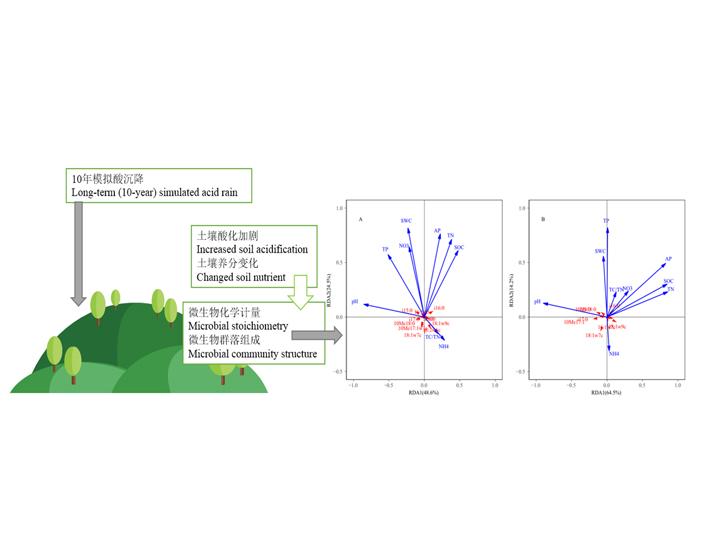
Aims Soil microorganisms are an important component of terrestrial ecosystems and play a critical role in regulating multiple ecological processes such as nutrient acquisition, carbon cycle, and soil formation, especially in the tropical forests where soils are highly weathered with poor nutrients. The objective of this study was to examine the response of soil microbial community under long-term simulated acid rain (SAR) and investigate the most important factors influencing microbial community structure.
Methods Based on a long-term (10-year) field SAR experiment, we investigate the response of soil microbial community structure to soil acidification in the south subtropical monsoon evergreen broad-leaved forest of Dinghushan National Nature Reserve. Four levels of SAR treatments were set by adding the following amount of H+: 0 (CK), 9.6, 32 and 96 mol·hm-2·a-1.
Important findings 1) The SAR treatment significantly reduced the pH value of soil (i.e., increased soil acidification). 2) Soil acidification did not significantly influence microbial carbon (C) content, but changed microbial nitrogen (N) and phosphorus (P) contents, leading to significant increases in microbial C:P and N:P in topsoil (0-10 cm). This result indicated that soil acidification might aggravate microbial P limitation. 3) Soil acidification also altered the microbial community structure and significantly increased the fungal/bacterial ratio in the subsoil (10-20 cm). Further analysis showed that soil pH and available P content were the most important factors affecting the soil microbial communities under the SAR treatment.
HU Yuan-Liu, CHEN Guo-Yin, CHEN Jing-Wen, SUN Lian-Wei, LI Jian-Ling, DOU Ning, ZHANG De-Qiang, DENG Qi . Effects of long-term simulated acid rain on soil microbial community structure in a monsoon evergreen broad-leaved forest in southern China[J]. Chinese Journal of Plant Ecology, 2021 , 45(3) : 298 -308 . DOI: 10.17521/cjpe.2020.0217
| [1] | Achat DL, Morel C, Bakker MR, Augusto L, Pellerin S, Gallet- Budynek A, Gonzalez M (2010). Assessing turnover of microbial biomass phosphorus: combination of an isotopic dilution method with a mass balance model. Soil Biology & Biochemistry, 42, 2231-2240. |
| [2] | Allison VJ, Condron LM, Peltzer DA, Richardson SJ, Turner BL (2007). Changes in enzyme activities and soil microbial community composition along carbon and nutrient gradients at the Franz Josef chronosequence, New Zealand. Soil Biology & Biochemistry, 39, 1770-1781. |
| [3] | B??th E, Anderson TH (2003). Comparison of soil fungal/bacterial ratios in a pH gradient using physiological and PLFA- based techniques. Soil Biology & Biochemistry, 35, 955-963. |
| [4] | Bardgett RD, McAlister E (1999). The measurement of soil fungal:bacterial biomass ratios as an indicator of ecosystem self-regulation in temperate meadow grasslands. Biology and Fertility of Soils, 29, 282-290. |
| [5] | Bonan GB (2008). Forests and Forests and climate change: forcings, feedbacks, and the climate benefits of forests. Science, 320, 1444-1449. |
| [6] | Bouwman AF, van Vuuren DP, Derwent RG, Posch M (2002). A global analysis of acidification and eutrophication of terrestrial ecosystems. Water, Air, and Soil Pollution, 141, 349-382. |
| [7] | Chen D, Lan Z, Bai X, Grace JB, Bai Y (2013). Evidence that acidification-induced declines in plant diversity and productivity are mediated by changes in below-ground communities and soil properties in a semi-arid steppe. Journal of Ecology, 101, 1322-1334. |
| [8] | Cleveland CC, Houlton BZ, Smith WK, Marklein AR, Reed SC, Parton W, del Grosso SJ, Running SW (2013). Patterns of new versus recycled primary production in the terrestrial biosphere. Proceedings of the National Academy of Sciences of the United States of America, 110, 12733-12737. |
| [9] | Cleveland CC, Liptzin D (2007). C:N:P stoichiometry in soil: Is there a “Redfield ratio” for the microbial biomass? Biogeochemistry, 85, 235-252. |
| [10] | Cui J, Zhou J, Peng Y, He YQ, Yang H, Mao JD (2014). Atmospheric wet deposition of nitrogen and sulfur to a typical red soil agroecosystem in Southeast China during the ten-year monsoon seasons (2003-2012). Atmospheric Environment, 82, 121-129. |
| [11] | DeForest JL, Scott LG (2010). Available organic soil phosphorus has an important influence on microbial community composition. Soil Science Society of America Journal, 74, 2059-2066. |
| [12] | Delgado-Baquerizo M, Reich PB, Khachane AN, Campbell CD, Thomas N, Freitag TE, Abu Al-Soud W, S?rensen S, Bardgett RD, Singh BK (2017). It is elemental: soil nutrient stoichiometry drives bacterial diversity. Environmental Microbiology, 19, 1176-1188. |
| [13] | Deng Q, Hui DF, Dennis S, Dennis S, Reddy KC (2017). Responses of terrestrial ecosystem phosphorus cycling to nitrogen addition: a meta-analysis. Global Ecology and Biogeography, 26, 713-728. |
| [14] | Frosteg?rd A, B??th E (1996). The use of phospholipid fatty acid analysis to estimate bacterial and fungal biomass in soil. Biology and Fertility of Soils, 22, 59-65. |
| [15] | Frosteg?rd A, B??th E, Tunlio A (1993). Shifts in the structure of soil microbial communities in limed forests as revealed by phospholipid fatty acid analysis. Soil Biology & Biochemistry, 25, 723-730. |
| [16] | Grayston SJ, Griffith GS, Mawdsley JL, Campbell CD, Bardgett RD (2001). Accounting for variability in soil microbial communities of temperate upland grassland ecosystems. Soil Biology & Biochemistry, 33, 533-551. |
| [17] | Guo Q, Yan L, Korpelainen H, Niinemets ü, Li C (2019). Plant-plant interactions and N fertilization shape soil bacterial and fungal communities. Soil Biology & Biochemistry, 128, 127-138. |
| [18] | H?gberg MN, H?gberg P, Myrold DD (2007). Is microbial community composition in boreal forest soils determined by pH, C-to-N ratio, the trees, or all three? Oecologia, 150, 590-601. |
| [19] | Hou E, Wen D, Kuang Y, Cong J, Chen C, He X, Heenan M, Lu H, Zhang Y (2018). Soil pH predominantly controls the forms of organic phosphorus in topsoils under natural broadleaved forests along a 2500 km latitudinal gradient. Geoderma, 315, 65-74. |
| [20] | Hu L, Zi H, Wu P, Wang Y, Lerdau M, Wu X, Wang C (2019). Soil bacterial communities in grasslands revegetated using Elymus nutans are largely influenced by soil pH and total phosphorus across restoration time. Land Degradation & Development, 30, 2243-2256. |
| [21] | Jansson JK, Hofmockel KS (2020). Soil microbiomes and climate change. Nature Reviews Microbiology, 18, 35-46. |
| [22] | Jiang J, Wang YP, Yu MX, Cao NN, Yan JH (2018). Soil organic matter is important for acid buffering and reducing aluminum leaching from acidic forest soils. Chemical Geology, 501, 86-94. |
| [23] | Johnson AH, Frizano J, Vann DR (2003). Biogeochemical implications of labile phosphorus in forest soils determined by the Hedley fractionation procedure. Oecologia, 135, 487-499. |
| [24] | Jones DL, Oburger E (2011). Phosphorus in Action: Biological Processes in Soil Phosphorus Cycling. Springer, Berlin.169-198. |
| [25] | Kaiser EA, Mueller T, Joergensen RG, Insam H, Heinemeyer O (1992). Evaluation of methods to estimate the soil microbial biomass and the relationship with soil texture and organic matter. Soil Biology & Biochemistry, 24, 675-683. |
| [26] | Kang HZ, Gao HH, Yu WJ, Yi Y, Wang Y, Ning ML (2018). Changes in soil microbial community structure and function after afforestation depend on species and age: case study in a subtropical alluvial island. Science of the Total Environment, 625, 1423-1432. |
| [27] | Killham K, Firestone MK, Mc Coll JG (1983). Acid rain and soil microbial activity: effects and their mechanisms. Journal of Environmental Quality, 12, 133-137. |
| [28] | Kwak JH, Naeth MA, Chang SX (2018). Microbial activities and gross nitrogen transformation unaffected by ten-year nitrogen and sulfur addition. Soil Science Society of America Journal, 82, 362-370. |
| [29] | Lambers H, Mougel C, Jaillard B, Hinsinger P (2009). Plant-microbe-soil interactions in the rhizosphere: an evolutionary perspective. Plant and Soil, 321, 83-115. |
| [30] | Lauber CL, Strickland MS, Bradford MA, Fierer N (2008). The influence of soil properties on the structure of bacterial and fungal communities across land-use types. Soil Biology & Biochemistry, 40, 2407-2415. |
| [31] | Li CY, Wang Y, Brookes P, Dang TH, Wang WZ (2013). Effect of soil pH on soil microbial carbon phosphorus ratio. Scientia Agricultura Sinica, 46, 2709-2716. |
| [31] | [李春越, 王益, Philip Brookes, 党廷辉, 王万忠 (2013). pH对土壤微生物C/P比的影响. 中国农业科学, 46, 2709-2716.] |
| [32] | Li W, Sheng H, Ekawati D, Jiang Y, Yang H (2019). Variations in the compositions of soil bacterial and fungal communities due to microhabitat effects induced by simulated nitrogen deposition of a bamboo forest in wetland. Forests, 10, 1098. DOI: 10.3390/f10121098. |
| [33] | Li Y, Sun J, Tian D, Tian DS, Wang JS, Ha DL, Qu YX, Jing GW, Niu SL (2018). Soil acid cations induced reduction in soil respiration under nitrogen enrichment and soil acidification. Science of the Total Environment, 615, 1535-1546. |
| [34] | Liang GH, Wu JP, Xiong X, Wu XY, Chu GW, Zhou GY, Zeng RS, Zhang DQ (2015). Responses of soil pH value and soil microbial biomass carbon and nitrogen to simulated acid rain in three successional subtropical forests at Dinghushan nature reserve. Ecology and Environmental Sciences, 24, 911-918. |
| [34] | [梁国华, 吴建平, 熊鑫, 吴小映, 褚国伟, 周国逸, 曾任森, 张德强 (2015). 鼎湖山不同演替阶段森林土壤pH值和土壤微生物量碳氮对模拟酸雨的响应. 生态环境学报, 24, 911-918.] |
| [35] | Liu KH, Peng SL, Mo JM, Huang ZL, Fang YT (2005). The process and mechanism of rain deposition upon forest plants. Ecology and Environment, 14, 953-960. |
| [35] | [刘可慧, 彭少麟, 莫江明, 黄忠良, 方运霆 (2005). 酸沉降对森林植物影响过程和机理. 生态环境, 14, 953-960.] |
| [36] | Liu X, Zhang B, Zhao WR, Wang L, Xie DJ, Huo WT, Wu YW, Zhang JC (2017). Comparative effects of sulfuric and nitric acid rain on litter decomposition and soil microbial community in subtropical plantation of Yangtze River Delta region. Science of the Total Environment, 601, 669-678. |
| [37] | Liu XC, Zhang ST (2019). Nitrogen addition shapes soil enzyme activity patterns by changing pH rather than the composition of the plant and microbial communities in an alpine meadow soil. Plant and Soil, 440, 11-24. |
| [38] | Liu XJ, Zhang Y, Han WX, Tang AH, Shen JL, Cui ZL, Vitousek P, Erisman JW, Goulding K, Christie P, Fangmeier A, Zhang FS (2013). Enhanced nitrogen deposition over China. Nature, 494, 459-462. |
| [39] | Liu Z, Li D, Zhang J, Saleem M, Zhang Y, Ma R, He Y, Yang J, Xiang H, Wei H (2020). Effect of simulated acid rain on soil CO2, CH 4 and N2O emissions and microbial communities in an agricultural soil. Geoderma, 366, 114222. DOI: 10.1016/j.geoderma.2020.114222. |
| [40] | Lv YN, Wang CY, Jia YY, Wang WW, Ma X, Du JJ, Pu GZ, Tian XJ (2014). Effects of sulfuric, nitric, and mixed acid rain on litter decomposition, soil microbial biomass, and enzyme activities in subtropical forests of China. Applied Soil Ecology, 79, 1-9. |
| [41] | Ma H, Zou W, Yang J, Hogan JA, Xu H, Chen J (2019). Dominant tree species shape soil microbial community via regulating assembly processes in planted subtropical forests. Forests, 10, 978. DOI: 10.3390/f10110978. |
| [42] | Maltz MR, Chen Z, Cao J, Arogyaswamy K, Shulman H, Aronson EL (2019). Inoculation with Pisolithus tinctorius may ameliorate acid rain impacts on soil microbial communities associated with Pinus massoniana seedlings. Fungal Ecology, 40, 50-61. |
| [43] | Meng C, Tian DS, Zeng H, Li ZL, Yi CX, Niu SL (2019). Global soil acidification impacts on belowground processes. Environmental Research Letters, 14, 074003. DOI: 10.1088/1748-9326/ab239c. |
| [44] | Mo J, Zhang W, Zhu W, Gundersen P, Fang Y, Li D, Wang H (2008). Nitrogen addition reduces soil respiration in a mature tropical forest in southern China. Global Change Biology, 14, 403-412. |
| [45] | Nottingham AT, Hicks LC, Ccahuana AJQ, Salinas N, B??th E, Meir P (2018). Nutrient limitations to bacterial and fungal growth during cellulose decomposition in tropical forest soils. Biology and Fertility of Soils, 54, 219-228. |
| [46] | Oberson A, Friesen DK, Morel C, Tiessen H (1997). Determination of phosphorus released by chloroform fumigation from microbial biomass in high P sorbing tropical soils. Soil Biology & Biochemistry, 29, 1579-1583. |
| [47] | Oksanen JF, Blanchet G, Friendly M, Kindt R, Legendre P, McGlinn D, Minchin PR, O?Hara RB, Simpson GL, Solymos P, Stevens MHH, Szoecs E, Wagner H (2018). vegan: Community ecology package. R package version 2.5-2. [2020-03-06]. https://CRAN.R-project.org/package=vegan. |
| [48] | Pan GX (1990). Soil chemical analysis on the process of soil acidification. Journal of Ecology, 9(6), 48-52. |
| [48] | [潘根兴 (1990). 土壤酸化过程的土壤化学分析. 生态学杂志, 9(6), 48-52.] |
| [49] | Pennanen T, Fritze H, Vanhala P, Kiikkil? O, Neuvonen S, B??th E (1998). Structure of a microbial community in soil after prolonged addition of low levels of simulated acid rain. Applied and Environmental Microbiology, 64, 2173-2180. |
| [50] | Qiao X, Xiao W, Jaffe D, Kota SH, Ying Q, Tang Y (2015). Atmospheric wet deposition of sulfur and nitrogen in Jiuzhaigou National Nature Reserve, Sichuan Province, China. Science of the Total Environment, 511, 28-36. |
| [51] | R Core Team (2016). R: a Language and Environment for Statistical Computing. R Foundation for Statistical Computing, Vienna, Austria. |
| [52] | Richardson AE, Simpson RJ (2011). Soil microorganisms mediating phosphorus availability. Plant Physiology, 156, 989-996. |
| [53] | Spohn M, Klaus K, Wanek W, Richter A (2016). Microbial carbon use efficiency and biomass turnover times depending on soil depth—Implications for carbon cycling. Soil Biology & Biochemistry, 96, 74-81. |
| [54] | Strickland MS, Rousk J (2010). Considering fungal:bacterial dominance in soils—Methods, controls, and ecosystem implications. Soil Biology & Biochemistry, 42, 1385-1395. |
| [55] | Tomlinson GH (2003). Acidic deposition, nutrient leaching and forest growth. Biogeochemistry, 65, 51-81. |
| [56] | Treseder KK (2008). Nitrogen additions and microbial biomass: a meta-analysis of ecosystem studies. Ecology Letters, 11, 1111-1120. |
| [57] | van der Heijden MGA, Bardgett RD, van Straalen NM (2008). The unseen majority: soil microbes as drivers of plant diversity and productivity in terrestrial ecosystems. Ecology Letters, 11, 296-310. |
| [58] | van der Heijden MGA, Klironomos JN, Ursic M, Moutoglis P, Streitwolf-Engel R, Boller T, Wiemken A, Sanders IR (1998). Mycorrhizal fungal diversity determines plant biodiversity, ecosystem variability and productivity. Nature, 396, 69-72. |
| [59] | Vitousek PM, Porder S, Houlton BZ, Chadwick OA (2010). Terrestrial phosphorus limitation: mechanisms, implications, and nitrogen-phosphorus interactions. Ecological Applications, 20, 5-15. |
| [60] | Wang XL, Zhang WX, Shao YH, Zhao J, Zhou LX, Zou XM, Fu SL (2019). Fungi to bacteria ratio: historical misinterpretations and potential implications. Acta Oecologica, 95, 1-11. |
| [61] | Wang ZC, Ding LY, Liu W, Zhi SQ (2011). Current status and causes of acid rain in Guangzhou. Journal of Tropical Meteorology, 27, 717-722. |
| [61] | [王志春, 丁凌云, 刘尉, 植石群 (2011). 广州酸雨现状及影响因素分析. 热带气象学报, 27, 717-722.] |
| [62] | Wardle DA, Bardgett RD, Klironomos JN, Setala H, van der Putten WH, Wall DH (2004). Ecological linkages between aboveground and belowground biota. Science, 304, 1629-1633. |
| [63] | Ware GW, Niggs HN, Bevenue A (1990). Reviews of Environmental Contamination and Toxicology: Continuation of Residue Reviews . Springer, New York. |
| [64] | Wu JP, Liang GH, Hui DF, Deng Q, Xiong X, Qiu QY, Liu JX, Chu GW, Zhou GY, Zhang DQ (2016). Prolonged acid rain facilitates soil organic carbon accumulation in a mature forest in Southern China. Science of the Total Environment, 544, 94-102. |
| [65] | Xie SY, Wang RB, Zheng HH (2012). Analysis on the acid rain from 2005 to 2011 in China. Environmental Monitoring and Forewarning, 4(5), 33-37. |
| [65] | [解淑艳, 王瑞斌, 郑皓皓 (2012). 2005-2011年全国酸雨状况分析. 环境监控与预警, 4(5), 33-37.] |
| [66] | Xu X, Thornton PE, Post WM (2013). A global analysis of soil microbial biomass carbon, nitrogen and phosphorus in terrestrial ecosystems. Global Ecology and Biogeography, 22, 737-749. |
| [67] | Yang JL, Fu XL, Ma ZQ, Di YB, Liu QJ, Wang HM (2015). Characteristics of soil microbial community in five forest types in mid-subtropical China. Research of Environmental Sciences, 28, 720-727. |
| [67] | [杨君珑, 付晓莉, 马泽清, 邸月宝, 刘琪璟, 王辉民 (2015). 中亚热带5种类型森林土壤微生物群落特征. 环境科学研究, 28, 720-727.] |
| [68] | Zhang HL, Wu JP, Xiong X, Chu GW, Zhou GY, Zhang DQ (2018). Effects of simulated acid rain on soil labile organic carbon and carbon management index in subtropical forests of China. Acta Ecologica Sinica, 38, 657-667. |
| [68] | 张慧玲, 吴建平, 熊鑫, 褚国伟, 周国逸, 张德强 (2018). 南亚热带森林土壤碳库稳定性与碳库管理指数对模拟酸雨的响应. 生态学报, 38, 657-667.]. |
| [69] | Zhang XM, Chai FH, Wang SL, Sun XZ, Han M (2010). Research progress of acid precipitation in China. Research of Environmental Sciences, 23, 527-532. |
| [69] | [张新民, 柴发合, 王淑兰, 孙新章, 韩梅 (2010). 中国酸雨研究现状. 环境科学研究, 23, 527-532.] |
| [70] | Zhao D, Xiong J, Xu Y, Chan WH (1988). Acid rain in southwestern China. Atmospheric Environment, 22, 349-358. |
| [71] | Zheng K, Zhao TL, Zhang L, Zeng N, Zheng XB, Yang QJ (2019). Characteristics of wet deposition of sulfate and nitrate in three typical cities in China in 2001-2017. Ecology and Environmental Sciences, 28, 2390-2397. |
| [71] | [郑珂, 赵天良, 张磊, 曾宁, 郑小波, 杨清健 (2019). 2001-2017年中国3个典型城市硫酸盐和硝酸盐湿沉降特征. 生态环境学报, 28, 2390-2397.] |
| [72] | Zheng S, Bian HF, Quan Q, Xu L, Chen Z, He NP (2018). Effect of nitrogen and acid deposition on soil respiration in a temperate forest in China. Geoderma, 329, 82-90. |
| [73] | Zhou GY, Peng CH, Li YL, Liu SZ, Zhang QM, Tang XL, Liu JX, Yan JH, Zhang DQ, Chu GW (2013). A climate change-induced threat to the ecological resilience of a subtropical monsoon evergreen broad-leaved forest in Southern China. Global Change Biology, 19, 1197-1210. |
| [74] | Zhou XD, Xu ZF, Liu WJ, Wu Y, Zhao T, Jiang H, Zhang X, Zhang JY, Zhou L, Wang YC (2019). Chemical composition of precipitation in Shenzhen, a coastal mega-city in South China: influence of urbanization and anthropogenic activities on acidity and ionic composition. Science of the Total Environment, 662, 218-226. |
| [75] | Zhu Q, de Vries W, Liu X, Zeng M, Hao T, Du E, Zhang F, Shen J (2016). The contribution of atmospheric deposition and forest harvesting to forest soil acidification in China since 1980. Atmospheric Environment, 146, 215-222. |
| [76] | Ziegler SE, Billings SA, Lane CS, Li JW, Fogel ML (2013). Warming alters routing of labile and slower-turnover carbon through distinct microbial groups in boreal forest organic soils. Soil Biology & Biochemistry, 60, 23-32. |
| [77] | Zou S, Zhou GY, Zhang QM, Xu S, Xiong X, Xia YJ, Liu SZ, Meng Z, Chu GW (2018). Long-term (1992-2015) dynamics of community composition and structure in a monsoon evergreen broad-leaved forest in Dinghushan Biosphere Reserve. Chinese Journal of Plant Ecology, 42, 442-452. |
| [77] | [邹顺, 周国逸, 张倩媚, 徐姗, 熊鑫, 夏艳菊, 刘世忠, 孟泽, 褚国伟 (2018). 1992-2015年鼎湖山季风常绿阔叶林群落结构动态. 植物生态学报, 42, 442-452.] |
/
| 〈 |
|
〉 |
Copyright © 2026 Chinese Journal of Plant Ecology
Tel: 010-62836134, 62836138, E-mail: apes@ibcas.ac.cn, cjpe@ibcas.ac.cn

