
Chinese Journal of Plant Ecology >
Evolution characteristics and its driving forces analysis of vegetation ecological quality in Qinling Mountains region from 2000 to 2019
Received date: 2020-07-28
Accepted date: 2021-03-15
Online published: 2021-04-11
Supported by
National Natural Science Foundation of China(41705093);National Natural Science Foundation of China(41571175);National Natural Science Foundation of China(31661143028);National Key R&D Program of China(2018YFA0606103)
Aims This study was conducted to illustrate the spatial heterogeneity of vegetation ecological quality change, and to clarify the driving forces of ecological quality change in Qinling Mountains region from 2000 to 2019.
Methods The methods of model simulation and satellite observation were used.
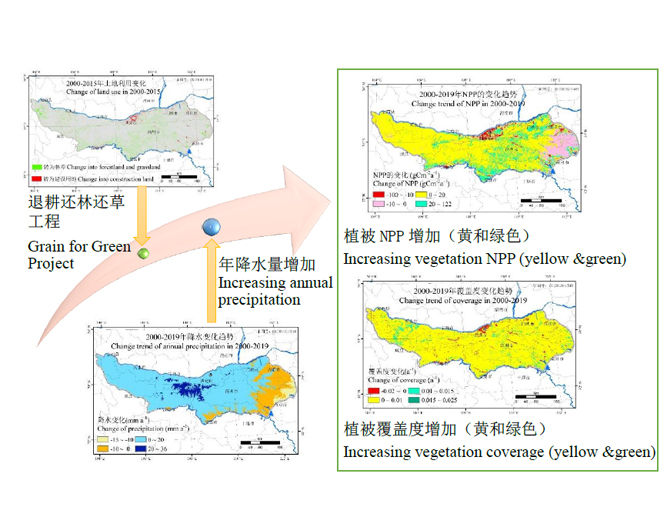
Important findings The results showed that (1) Vegetation ecological quality in Qinling Mountains region was significantly improved, and the average increase rates of net primary productivity (NPP) and vegetation fractional coverage (VFC) were 8 g C·m-2·a-1 and 0.005 4·a-1, respectively. Spatially, 85%-95% of the Qinling Mountains region showed a significant improvement in ecosystem quality, but NPP and VFC decreased significantly in some areas such as Xiʼan City. (2) 80%-85% of the Qinling Mountains region showed an increasing trend in precipitation and temperature, which was consistent with the distribution area increasing NPP and VFC. These evidence confirmed that warm and humid climate played an important role in improving vegetation ecological quality. (3) Human protection activities (Natural Forest Protection, Grain for Green Project, etc.) have increased the area of woodland, grassland and water area significantly, and a large range of vegetation ecosystems have been nurtured in the Qinling Mountains region. The expansion of construction land represented by the northern slope of Qinling Mountains was the main reason for the deterioration of vegetation ecological quality. However, human destructive activities were limited to local areas.
JI Yu-He, ZHOU Guang-Sheng, WANG Shu-Dong, WANG Li-Xia, ZHOU Meng-Zi . Evolution characteristics and its driving forces analysis of vegetation ecological quality in Qinling Mountains region from 2000 to 2019[J]. Chinese Journal of Plant Ecology, 2021 , 45(6) : 617 -625 . DOI: 10.17521/cjpe.2020.0253
| [1] | Chen XN, Jiang HC(2019). Climate response of NDVI index on Qinling Mountains in 25 years. Bulletin of Surveying and Mapping, (3), 103-107. |
| [1] | [ 陈晓宁, 蒋好忱(2019). 25年来秦岭NDVI指数的气候响应. 测绘通报, (3), 103-107.] |
| [2] | Deng CH, Bai HY, Gao S, Liu RJ, Ma XP, Huang XY, Meng Q(2018). Spatial-temporal variation of the vegetation coverage in Qinling Mountains and its dual response to climate change and human activities. Journal of Natural Resources, 33, 425-438. |
| [2] | [ 邓晨晖, 白红英, 高山, 刘荣娟, 马新萍, 黄晓月, 孟清(2018). 秦岭植被覆盖时空变化及其对气候变化与人类活动的双重响应. 自然资源学报, 33, 425-438.] |
| [3] | Deng CH, Bai HY, Gao S, Zhao T, Ma XP (2019a). Differences and variations in the elevation-dependent climatic growing season of the northern and southern slopes of the Qinling Mountains of China from 1985 to 2015. Theoretical and Applied Climatology, 137, 1159-1169. |
| [4] | Deng CH, Bai HY, Ma XP, Zhao T, Gao S, Huang XY (2019b). Spatiotemporal differences in the climatic growing season in the Qinling Mountains of China under the influence of global warming from 1964 to 2015. Theoretical and Applied Climatology, 138, 1899-1911. |
| [5] | Fang JY, Song YC, Liu HY, Piao SL (2002). Vegetation- climate relationship and its application in the division of vegetation zone in China. Acta Botanica Sinica, 44, 1105-1122. |
| [6] | Feng X, Liu G, Chen JM, Chen M, Liu J, Ju WM, Sun R, Zhou W (2007). Net primary productivity of China’s terrestrial ecosystems from a process model driven by remote sensing. Journal of Environmental Management, 85, 563-573. |
| [7] | Huang JJ(2015). Control of Qinling tectonic zone on climate and eco-environment in Shaanxi. Journal of Earth Sciences and Environment, 37(3), 81-86. |
| [7] | [ 黄建军(2015). 秦岭构造带对陕西气候和生态环境的控制作用. 地球科学与环境学报, 37(3), 81-86.] |
| [8] | IPCC (2018). Summary for policymakers//Masson-Delmotte V, Zhai P, Pörtner HO, Roberts D, Skea J, Shukla PR, Pirani A, Moufouma-Okia W, Péan C, Pidcock R, Connors S, Matthews JBR, Chen Y, Zhou X, Gomis MI, et al. Global Warming of 1.5 °C. World Meteorological Organization, Geneva, Switzerland. |
| [9] | Ji YH, Zhou GS, Luo TX, Dan Y, Zhou L, Lv XM (2020). Variation of net primary productivity and its drivers in China’s forests during 2000-2018. Forest Ecosystems, 7, 15. DOI: 10.1186/s40663-020-00229-0. |
| [10] | Jia K, Yao YJ, Wei XQ, Gao S, Jiang B, Zhao X(2013). A review on fractional vegetation cover estimation using remote sensing. Advances in Earth Science, 28, 774-782. |
| [10] | [ 贾坤, 姚云军, 魏香琴, 高帅, 江波, 赵祥(2013). 植被覆盖度遥感估算研究进展. 地球科学进展, 28, 774-782.] |
| [11] | Jiang C, Mu XM, Wang F, Zhao GJ (2016). Analysis of extreme temperature events in the Qinling Mountains and surrounding area during 1960-2012. Quaternary International, 392, 155-167. |
| [12] | Li CX, Gao X, Xi ZL (2019). Characteristics, hazards, and control of illegal villa (houses): evidence from the Northern Piedmont of Qinling Mountains, Shaanxi Province, China. Environmental Science and Pollution Research, 26, 21059-21064. |
| [13] | Li WZ, Huang CP, Ji WL(2000). A Study on the problems of implementing natural forests conservation programme in Qinling forest area. Journal of Northwest Forestry University, 15(1), 80-84. |
| [13] | [ 李卫忠, 黄春萍, 吉文丽(2000). 秦岭林区实施天然林保护工程若干问题的思考. 西北林学院学报, 15(1), 80-84.] |
| [14] | Li Y, Viña A, Yang W, Chen XD, Zhang JD, Ouyang ZY, Liang Z, Liu JG (2013). Effects of conservation policies on forest cover change in giant panda habitat regions, China. Land Use Policy, 33, 42-53. |
| [15] | Liu HY, Zhang MY, Lin ZS, Xu XJ (2018). Spatial heterogeneity of the relationship between vegetation dynamics and climate change and their driving forces at multiple time scales in Southwest China. Agricultural and Forest Meteorology, 256-257, 10-21. |
| [16] | Pi WQ, Du JM, Chen C, Zhu XB, Liu H(2018). Identification of vegetation in high-spectral images of desertification grassland based on normalized vegetation index. Journal of Inner Mongolia Agricultural University (Natural Science Edition), 39(4), 75-79. |
| [16] | [ 皮伟强, 杜健民, 陈程, 朱相兵, 刘浩(2018). 基于归一化植被指数对荒漠化草原地面高光谱影像中植被的识别. 内蒙古农业大学学报(自然科学版), 39(4), 75-79.] |
| [17] | Shao YT, Mu XM, He Y, Sun WY, Zhao GJ, Gao P (2019). Spatiotemporal variations of extreme precipitation events at multi-time scales in the Qinling-Daba mountains region, China. Quaternary International, 525, 89-102. |
| [18] | Sun YL, Yang YL, Zhang L, Wang ZL (2015). The relative roles of climate variations and human activities in vegetation change in North China. Physics and Chemistry of the Earth, 87-88, 67-78. |
| [19] | Wang J, Zhou WQ, Xu KP, Yan JL, Li WF, Han LJ(2017). Quantitative assessment of ecological quality in Beijing- Tianjin-Hebei urban megaregion, China. Chinese Journal of Applied Ecology, 28, 2667-2676. |
| [19] | [ 王静, 周伟奇, 许开鹏, 颜景理, 李伟峰, 韩立建(2017). 京津冀地区的生态质量定量评价. 应用生态学报, 28, 2667-2676.] |
| [20] | Xu B, Yang XC, Tao WG, Qin ZH, Liu HQ, Miao JM(2007). Remote sensing monitoring upon the grass production in China. Acta Ecologica Sinica, 27, 405-413. |
| [20] | [ 徐斌, 杨秀春, 陶伟国, 覃志豪, 刘海启, 缪建明(2007). 中国草原产草量遥感监测. 生态学报, 27, 405-413.] |
| [21] | Xu WH, Viña A, Qi ZX, Ouyang ZY, Liu JG, Liu W, Wan H (2014). Evaluating conservation effectiveness of nature reserves established for surrogate species: case of a giant panda nature reserve in Qinling Mountains, China. Chinese Geographical Science, 24(1), 60-70. |
| [22] | Xu ZX(2015). Grain for Green, full of green Qinling Mountains. Environmental Economy, (21), 33. |
| [22] | [ 徐祯霞(2015). 退耕还林, 绿满秦岭. 环境经济, (21), 33.] |
| [23] | Zhang HJ, Gao Y, Hua YW, Zhang Y, Liu K (2019). Assessing and mapping recreationists’ perceived social values for ecosystem services in the Qinling Mountains, China. Ecosystem Services, 39, 101006. DOI: 10.1016/j.ecoser.2019.101006. |
| [24] | Zhang W, Wang LC, Xiang FF, Qin WM, Jiang WX (2020). Vegetation dynamics and the relations with climate change at multiple time scales in the Yangtze River and Yellow River Basin, China. Ecological Indicators, 110, 105892. DOI: 10.1016/j.ecolind.2019.105892. |
| [25] | Zhang YB, Wang YZ, Phillips N, Ma KP, Li JS, Wang W (2017). Integrated maps of biodiversity in the Qinling Mountains of China for expanding protected areas. Biological Conservation, 210, 64-71. |
| [26] | Zhang ZW, Cui YW(1963). Vegetation regionalization in Qinling Mountains (draft). Acta Phytoecologia et Geobotanica Sinica, 1, 161-162. |
| [26] | [ 张珍萬, 崔友文(1963). 秦岭地区的植被区划(草案). 植物生态学与地植物学丛刊, 1, 161-162.] |
| [27] | Zhou GS, Zhang XS(1996). Study on NPP of natural vegetation in China under global climate change. Acta Phytoecologica Sinica, 20, 11-19. |
| [27] | [ 周广胜, 张新时(1996). 全球气候变化的中国自然植被的净第一性生产力研究. 植物生态学报, 20, 11-19.] |
| [28] | Zhou ZX, Li MT (2017). Spatial-temporal change in urban agricultural land use efficiency from the perspective of agricultural multi-functionality: a case study of the Xi’an metropolitan zone. Journal of Geographical Sciences, 27, 1499-1520. |
/
| 〈 |
|
〉 |
Copyright © 2026 Chinese Journal of Plant Ecology
Tel: 010-62836134, 62836138, E-mail: apes@ibcas.ac.cn, cjpe@ibcas.ac.cn

