
Chinese Journal of Plant Ecology >
Effects of different management methods on carbon, nitrogen, and phosphorus contents and their stoichiometric ratios in tea plants
Received date: 2021-03-04
Accepted date: 2021-05-19
Online published: 2021-06-28
Supported by
National Natural Science Foundation of China(41571287)
Aims The content of carbon (C), nitrogen (N) and phosphorus (P) in different plant organs and their stoichiometric characteristics can reflect the nutrient allocation and balance within the plant. In this paper, the response of C, N and P in different organs of tea plants to three management modes was investigated by field experiment. The purpose was to explore the variation characteristics of C, N and P contents and their stoichiometric ratios in roots, stems and leaves of tea plant and its allometric growth relationship under different management modes.
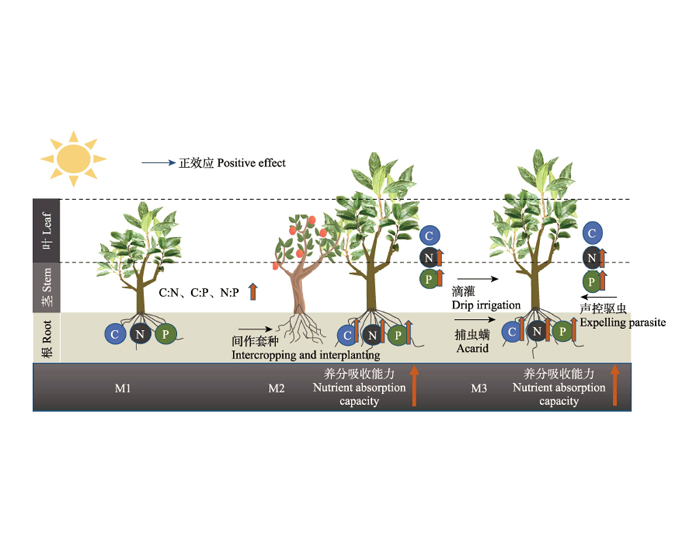
Methods We set up three different management modes in Tieguanyin tea plantations in Anxi, Fujian: routine management mode (M1), intercropping mode (M2) and modern technology mode (M3). In this paper, we investigated C, N, and P contents in the roots, stems, and leaves and their stoichiometric characteristics, nutrient variations and the allometric relationships of tea plants under different management modes.
Important findings The results showed that the N and P contents in roots, stems and leaves of tea plants under M2 and M3 management mode were significantly higher than those under M1 management mode, but no significant differences were observed for the C contents; the order of C:N, C:P and N:P ratios in roots, stems and leaves of tea plants was M1 > M2 > M3. The contents of C, N, and P varied significantly among different organs of tea plants. According to the analysis of variation sources, the management mode factors showed significant impacts on the content variation of all the three elements. The allometric relationships of N and P in roots, stems and leaves (N-P1.7456, p< 0.01; N-P1.0987, p< 0.01; N-P1.1993, p< 0.01) suggested that the nutrient requirements of different organs were similar. Soil pH and bulk density were important factors affecting C:N, C:P and N:P, while soil water content and salinity had great impacts on C content in roots and leaves of tea plants. In general, intercropping, as well as modern drip irrigation and fertilizer management technology, can improve the nutrient absorption efficiency of tea plants, and have positive effects on solving the problem of soil nutrient imbalance.
YIN Xiao-Lei, LIU Xu-Yang, JIN Qiang, LI Xian-De, LIN Shao-Ying, YANG Xiang, WANG Wei-Qi, ZHANG Yong-Xun . Effects of different management methods on carbon, nitrogen, and phosphorus contents and their stoichiometric ratios in tea plants[J]. Chinese Journal of Plant Ecology, 2021 , 45(7) : 749 -759 . DOI: 10.17521/cjpe.2021.0071
| [1] | Asseng S, Turner NC, Keating BA (2001). Analysis of water- and nitrogen-use efficiency of wheat in a Mediterranean climate. Plant and Soil, 233, 127-143. |
| [2] | Deng WW, Fei Y, Wang S, Wan XC, Zhang ZZ, Hu XY (2013). Effect of shade treatment on theanine biosynthesis in Camellia sinensis seedlings. Plant Growth Regulation, 71, 295-299. |
| [3] | Gitari HI, Karanja NN, Gachene CKK, Kamau S, Sharma K, Schulte-Geldermann E (2018). Nitrogen and phosphorous uptake by potato (Solanum tuberosum L.) and their use efficiency under potato-legume intercropping systems. Field Crops Research, 222, 78-84. |
| [4] | Graciano C, Guiamét JJ, Goya JF (2005). Impact of nitrogen and phosphorus fertilization on drought responses in Eucalyptus grandis seedlings. Forest Ecology and Management, 212, 40-49. |
| [5] | Gren GI, Weih M (2012). Plant stoichiometry at different scales: element concentration patterns reflect environment more than genotype. New Phytologist, 194, 944-952. |
| [6] | Han WX, Fang JY, Guo DL, Zhang Y (2005). Leaf nitrogen and phosphorus stoichiometry across 753 terrestrial plant species in China. New Phytologist, 168, 377-385. |
| [7] | He MZ, Zhang K, Tan HJ, Hu R, Su JQ, Wang J, Huang L, Zhang YF, Li XR (2015). Nutrient levels within leaves, stems, and roots of the xeric species Reaumuria soongorica in relation to geographical, climatic, and soil conditions. Ecology and Evolution, 5, 1494-1503. |
| [8] | Heuck C, Spohn M (2016). Carbon, nitrogen and phosphorus net mineralization in organic horizons of temperate forests: stoichiometry and relations to organic matter quality. Biogeochemistry, 131, 229-242. |
| [9] | Jin Q, An WL, Liu XY, Chen XX, Lin SY, Wang WQ (2020). Effects of simulated acid rain on carbon, nitrogen, phosphorus contents and the ecological stoichiometry of rice leaves in Fuzhou rice fields along the river. Acta Ecologica Sinica, 40, 3085-3095. |
| [9] | [ 金强, 安婉丽, 刘旭阳, 陈晓旋, 林少颖, 王维奇 (2020). 模拟酸雨对福州沿江稻田水稻叶片碳氮磷含量及其生态化学计量学特征的影响. 生态学报, 40, 3085-3095.] |
| [10] | Koojiman SALM (1995). The stoichiometry of animal energetics. Journal of Theoretical Biology, 177, 139-149. |
| [11] | Ku KM, Choi JN, Kim J, Kim JK, Yoo LG, Lee SJ, Hong YS, Lee CH (2010). Metabolomics analysis reveals the compositional differences of shade grown tea (Camellia sinensis L.). Journal of Agricultural and Food Chemistry, 58, 418-426. |
| [12] | Leishman MR, Haslehurst T, Ares A, Baruch Z (2007). Leaf trait relationships of native and invasive plants: community- and global-scale comparisons. New Phytologist, 176, 635-643. |
| [13] | Li F, Gao H, Zhu LL, Xie YH, Yang GS, Hu C, Chen XS, Deng ZM (2017). Foliar nitrogen and phosphorus stoichiometry of three wetland plants distributed along an elevation gradient in Dongting Lake, China. Scientific Reports, 7, 2820. DOI: 10.1038/s41598-017-03126-9. |
| [14] | Lin ZH, Chen LS, Chen RB, Peng A (2009). Effects of phosphorus deficiency on nutrient absorption of young tea bushes. Journal of Tea Science, 29, 295-300. |
| [14] | [ 林郑和, 陈立松, 陈荣冰, 彭艾 (2009). 缺磷对茶树幼苗养分吸收的影响. 茶叶科学, 29, 295-300.] |
| [15] | Liu FD, Yang WJ, Zhang M, Liu YH, Zheng JW, Wang WJ, Zhang ST, Wang ZS, An SQ (2010). Does strategy of resource acquisition in tropical woody species vary with life form, leaf texture, and canopy gradient? European Journal of Forest Research, 129, 1093-1108. |
| [16] | Liu MY, Yi XY, Shi YZ, Ma LF, Ruan JY (2015). Research progress of soil properties in tea gardens and the absorption and translocation mechanisms of nutrients and other elements in tea plant. Journal of Tea Science, 35, 110-120. |
| [16] | [ 刘美雅, 伊晓云, 石元值, 马立锋, 阮建云 (2015). 茶园土壤性状及茶树营养元素吸收、转运机制研究进展. 茶叶科学, 35, 110-120.] |
| [17] | Lu RK (1999). Soil and Agrochemistry Analysis. China Agricultural Science and Technology Press, Beijing. |
| [17] | [ 鲁如坤 (1999). 土壤化学农业分析方法. 中国农业科技出版社, 北京.] |
| [18] | Lu WX, Zhang HJ, Cheng JH, Wu YH, Wang HY, Li JQ, Wang W (2012). Effect of a hedgerow agroforestry system on the soil properties of sloping cultivated lands in the Three- Gorges area in China. Journal of Food, Agriculture and Environment, 10, 1368-1375. |
| [19] | Luo XZ, Hou EQ, Chen JQ, Li J, Zhang LL, Zang XW, Wen DZ (2020). Dynamics of carbon, nitrogen, and phosphorus stocks and stoichiometry resulting from conversion of primary broadleaf forest to plantation and secondary forest in subtropical China. Catena, 193, 104606. DOI: 10.1016/j.catena.2020.104606. |
| [20] | Ma R, Fang Y, An S (2016). Ecological stoichiometry of carbon, nitrogen, phosphorus and C:N:P in shoots and litter of plants in grassland in Yunwu Mountain. Acta Pedologica Sinica, 53, 1170-1180. |
| [21] | Ma W, Li J, Jimoh SO, Zhang Y, Guo F, Ding Y, Li X, Hou X (2019a). Stoichiometric ratios support plant adaption to grazing moderated by soil nutrients and root enzymes. PeerJ, 7, e7047. DOI: 10.7717/peerj.7047.eCollection2019. |
| [22] | Ma XX, Hong JT, Wang XD (2019b). C:N:P stoichiometry of perennial herbs’ organs in the alpine steppe of the northern Tibetan Plateau. Journal of Mountain Science, 16, 2039-2047. |
| [23] | Möller M, Weatherhead EK (2007). Evaluating drip irrigation in commercial tea production in Tanzania. Irrigation and Drainage Systems, 21, 17-34. |
| [24] | Mortimer PE, Gui H, Xu J, Zhang C, Barrios E, Hyde KD (2015). Alder trees enhance crop productivity and soil microbial biomass in tea plantations. Applied Soil Ecology, 96, 25-32. |
| [25] | Niklas KJ, Owens T, Reich PB, Cobb ED (2005). Nitrogen/ phosphorus leaf stoichiometry and the scaling of plant growth. Ecology Letters, 8, 636-642. |
| [26] | Sardans J, Rivas-Ubach A, Peñuelas J (2012). The elemental stoichiometry of aquatic and terrestrial ecosystems and its relationships with organismic lifestyle and ecosystem structure and function: a review and perspectives. Biogeochemistry, 111, 1-39. |
| [27] | Shi LJ, Li QK, Fu XL, Kou L, Dai XQ, Wang HM (2021). Foliar, root and rhizospheric soil C:N:P stoichiometries of overstory and understory species in subtropical plantations. Catena, 198, 105020. DOI: 10.1016/j.catena.2020.105020. |
| [28] | Shui W, Chen YP, Su ZA, Fan SS (2017). Agricultural ecosystem services function value evaluation under the influence of specialized tea planting: a case study in Anxi, Fujian Province. Acta Ecologica Sinica, 37, 3311-3326. |
| [28] | [ 税伟, 陈毅萍, 苏正安, 范水生 (2017). 专业化茶叶种植影响下的农业生态系统服务功能价值评价--以福建省安溪县为例. 生态学报, 37, 3311-3326.] |
| [29] | Sun LT, Wang Y, Ding ZT (2011). Effects of ground surface mulching in tea garden on soil water and nutrient dynamics and tea plant growth. Chinese Journal of Applied Ecology, 22, 2291-2296. |
| [29] | [ 孙立涛, 王玉, 丁兆堂 (2011). 地表覆盖对茶园土壤水分、养分变化及茶树生长的影响. 应用生态学报, 22, 2291-2296.] |
| [30] | Sun X, Yu K, Shugart HH, Wang G (2015). Species richness loss after nutrient addition as affected by N:C ratios and phytohormone GA3 contents in an alpine meadow community. Journal of Plant Ecology, 9, 201-211. |
| [31] | Tang H, Wu JY, Li JL, Wu LR, Tang JC (2013). Study on the influence of drip irrigated fertilization on tea yields, quality and soil nutrient effect. Journal of Tea Science, 33, 85-90. |
| [31] | [ 唐颢, 吴家尧, 黎健龙, 吴利荣, 唐劲驰 (2013). 茶园滴灌施肥的增产提质及土壤养分效应研究. 茶叶科学, 33, 85-90.] |
| [32] | Tessier JT, Raynal DJ (2003). Use of nitrogen to phosphorus ratios in plant tissue as an indicator of nutrient limitation and nitrogen saturation. Journal of Applied Ecology, 40, 523-534. |
| [33] | von Oheimb G, Power SA, Falk K, Friedrich U, Mohamed A, Krug A, Boschatzke N, Härdtle W (2010). N:P ratio and the nature of nutrient limitation in Calluna-dominated heathlands. Ecosystems, 13, 317-327. |
| [34] | Wang HB, Wang YH, Zhang Q, Lin SX, Zhang QX, Ye JH, Ding L, Lin S, He HB (2020). Construction of the microbial protein metabolism map of tea rhizosphere soil in acidified plantations. Scientia Sinica Vitae, 50, 849-865. |
| [34] | [ 王海斌, 王裕华, 张奇, 林舜贤, 张清旭, 叶江华, 丁力, 林生, 何海斌 (2020). 酸化茶园茶树根际土壤微生物蛋白质代谢图谱构建. 中国科学: 生命科学, 50, 849-865.] |
| [35] | Wang M, Moore TR (2014). Carbon, nitrogen, phosphorus, and potassium stoichiometry in an ombrotrophic peatland reflects plant functional type. Ecosystems, 17, 673-684. |
| [36] | Wu ZD, Jiang FY, Zhang L, You ZM (2020). Study on soil nitrogen status of Tieguanyin tea gardens in Anxi County of Fujian Province. Soils, 52, 16-24. |
| [36] | [ 吴志丹, 江福英, 张磊, 尤志明 (2020). 福建省安溪县铁观音茶园土壤氮素状况. 土壤, 52, 16-24.] |
| [37] | Yan Y, Lu XY (2020). Are N, P, and N:P stoichiometry limiting grazing exclusion effects on vegetation biomass and biodiversity in alpine grassland? Global Ecology and Conservation, 24, e01315. DOI: 10.1016/j.gecco.2020.e01315. |
| [38] | Yang DX, Song L, Jin GZ (2019). The soil C:N:P stoichiometry is more sensitive than the leaf C:N:P stoichiometry to nitrogen addition: a four-year nitrogen addition experiment in a Pinus koraiensis plantation. Plant and Soil, 442, 183-198. |
| [39] | Zeng Y, Yi XY, Li YS, Ma LF, Ruan JY, Tang Q (2016). The effect of nitrogen fertilization on biomass and nutrient storage in the fibrous roots of tea plants (Camellia sinensis) during summer and autumn. Acta Ecologica Sinica, 36, 411-419. |
| [39] | [ 曾艳, 伊晓云, 李延升, 马立锋, 阮建云, 唐茜 (2016). 氮肥对夏秋季茶树吸收根生物量和养分储量的影响. 生态学报, 36, 411-419.] |
| [40] | Zhang J, He N, Liu C, Xu L, Chen Z, Li Y, Wang R, Yu G, Sun W, Xiao C, Chen HYH, Reich PB (2020a). Variation and evolution of C:N ratio among different organs enable plants to adapt to N-limited environments. Global Change Biology, 26, 2534-2543. |
| [41] | Zhang QH, Sairebieli K, Zhao MM, Sun XH, Wang W, Yu XN, Du N, Guo WH (2020b). Nutrients have a different impact on the salt tolerance of two coexisting suaeda species in the Yellow River Delta. Wetlands, 40, 2811-2823. |
| [42] | Zhang YF, Fang XM, Chen FS, Zong YY, Gu HJ, Hu XF (2017). Influence of simulated acid rain on nitrogen and phosphorus contents and their stoichiometric ratios of tea organs in a red soil region, China. Chinese Journal of Applied Ecology, 28, 1309-1316. |
| [42] | [ 张宇飞, 方向民, 陈伏生, 宗莹莹, 顾菡娇, 胡小飞 (2017). 模拟酸雨对红壤区茶树器官氮磷含量及其化学计量比的影响. 应用生态学报, 28, 1309-1316.] |
| [43] | Zhang ZS, Song XL, Lu XG, Xue ZS (2013). Ecological stoichiometry of carbon, nitrogen, and phosphorus in estuarine wetland soils: influences of vegetation coverage, plant communities, geomorphology, and seawalls. Journal of Soils and Sediments, 13, 1043-1051. |
| [44] | Zhou GW, Zhang W, Ma LJ, Guo HJ, Min W, Li Q, Liao N, Hou ZN (2016). Effects of saline water irrigation and N application rate on NH3 volatilization and N use efficiency in a drip-irrigated cotton field. Water, Air, & Soil Pollution, 227, 103. DOI: 10.1007/s11270-016-2806-2. |
/
| 〈 |
|
〉 |
Copyright © 2026 Chinese Journal of Plant Ecology
Tel: 010-62836134, 62836138, E-mail: apes@ibcas.ac.cn, cjpe@ibcas.ac.cn

