
Chinese Journal of Plant Ecology >
Temporal effects of climate factors on vegetation growth on the Qingzang Plateau, China
Received date: 2021-04-28
Accepted date: 2021-08-19
Online published: 2021-10-15
Supported by
the Second Tibetan Plateau Scientific Expedition and Research (STEP) Program(2019QZKK0603);the National Natural Science Foundation of China(42077451)
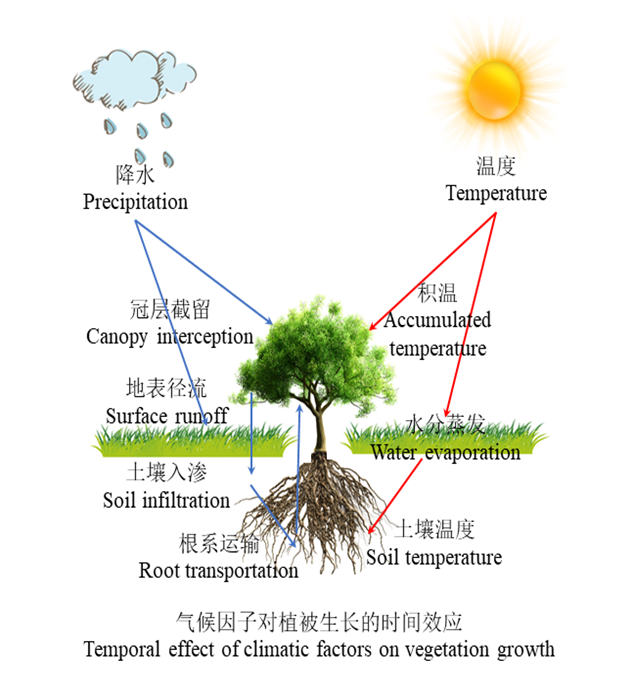
Aims The relationships between temporal changes in vegetation growth and climate change tend to be asymmetric. Considering the temporal effects of climate factors on vegetation growth can provide important scientific basis for accurately understanding vegetation-climate relationships and predicting the dynamic responses of vegetation to global climate change. Methods Based on the MODIS normalized difference vegetation index (NDVI), climate, and vegetation type data, this study investigated the temporal effects of climate factors on vegetation growth and the dominant factors influencing vegetation growth on the Qingzang Plateau through establishing four temporal effects equations between climate and vegetation NDVI. Important findings Among the four temporal effects, models considering both time lag and accumulation effects had the highest explanation degree (47%). Compared with model without considering temporal effect, the explanation power of the time lag and accumulation effects on vegetation would increase by 4%-18%. Vegetation dynamics on more than 43% of the Qingzang Plateau was dominated by the combined effects of time lag and accumulation, followed by the area only affected by time accumulation or lag effects, and the area without time effect. The partial correlation coefficient between NDVI and precipitation (0.25 ± 0.56) was overall higher than it between NDVI and temperature (0.08 ± 0.6). The areas dominated by the precipitation were mainly distributed on the northeast and southwest of the Qingzang Plateau with an area ratio of 40.1%, whereas the areas dominated by temperature were largely distributed on the center and southeast of the Qingzang Plateau with an area ratio of 29.7%. These research results can provide basic judgments for the relationships between vegetation growth and climate on the Qingzang Plateau.
Ning LIU, Shou-Zhang PENG, Yun-Ming CHEN . Temporal effects of climate factors on vegetation growth on the Qingzang Plateau, China[J]. Chinese Journal of Plant Ecology, 2022 , 46(1) : 18 -26 . DOI: 10.17521/cjpe.2021.0163
| [1] | Anderegg WRL, Schwalm C, Biondi F, Camarero JJ, Koch G, Litvak M, Ogle K, Shaw JD, Shevliakova E, Williams AP, Wolf A, Ziaco E, Pacala S (2015). Pervasive drought legacies in forest ecosystems and their implications for carbon cycle models. Science, 349, 528-532. |
| [2] | Cai J, Xie MS (2011). The relationship between grassland biomass and precipitation, temperature in alpine pastoral area. China Herbivores, 31(1), 44-46. |
| [2] | [ 才吉, 谢民生 (2011). 高寒牧区草原生物量与降水、温度的关系. 中国草食动物, 31(1), 44-46.] |
| [3] | Chen H, Ju PJ, Zhang J, Wang YY, Zhu QA, Yan L, Kang XM, He YX, Zeng Y, Hao YB, Wang YF (2020). Attribution analyses of changes in alpine grasslands on the Qinghai- Tibetan Plateau. Chinese Science Bulletin, 65, 2406-2418. |
| [3] | [ 陈槐, 鞠佩君, 张江, 王元云, 朱求安, 颜亮, 康晓明, 何奕忻, 曾源, 郝彦宾, 王艳芬 (2020). 青藏高原高寒草地生态系统变化的归因分析. 科学通报, 65, 2406-2418.] |
| [4] | Chen T, de Jeu RAM, Liu YY, van der Werf GR, Dolman AJ (2014). Using satellite based soil moisture to quantify the water driven variability in NDVI: a case study over mainland Australia. Remote Sensing of Environment, 140, 330-338. |
| [5] | Cleland EE, Chuine I, Menzel A, Mooney HA, Schwartz MD (2007). Shifting plant phenology in response to global change. Trends in Ecology & Evolution, 22, 357-365. |
| [6] | Cui QH, Jiang ZG, Liu JK, Su JP (2007). A review of the cause of rangeland degradation on Qinghai-Tibet Plateau. Pratacultural Science, 24(5), 20-26. |
| [6] | [ 崔庆虎, 蒋志刚, 刘季科, 苏建平 (2007). 青藏高原草地退化原因述评. 草业科学, 24(5), 20-26.] |
| [7] | Cui X, Graf HF, Langmann B, Chen W, Huang R (2006). Climate impacts of anthropogenic land use changes on the Tibetan Plateau. Global and Planetary Change, 54, 33-56. |
| [8] | Ding YX, Li Z, Peng SZ (2020). Global analysis of time-lag and -accumulation effects of climate on vegetation growth. International Journal of Applied Earth Observation and Geoinformation, 92, 102179. DOI: 10.1016/j.jag.2020. 102179. |
| [9] | Evans J, Geerken R (2004). Discrimination between climate and human-induced dryland degradation. Journal of Arid Environments, 57, 535-554. |
| [10] | Guo L, Cheng JM, Luedeling E, Koerner SE, He JS, Xu JC, Gang CC, Li W, Luo R, Peng C (2017). Critical climate periods for grassland productivity on China’s Loess Plateau. Agricultural and Forest Meteorology, 233, 101-109. |
| [11] | Guo L, Wang JH, Li MJ, Liu L, Xu JC, Cheng JM, Gang CC, Yu Q, Chen J, Peng CH, Luedeling E (2019). Distribution margins as natural laboratories to infer species’ flowering responses to climate warming and implications for frost risk. Agricultural and Forest Meteorology, 268, 299-307. |
| [12] | Hua T, Wang XM, Zhang CX, Lang LL, Li H (2017). Responses of vegetation activity to drought in Northern China. Land Degradation & Development, 28, 1913-1921. |
| [13] | Ivits E, Horion S, Erhard M, Fensholt R (2016). Assessing European ecosystem stability to drought in the vegetation growing season. Global Ecology and Biogeography, 25, 1131-1143. |
| [14] | Li PL, Zhu D, Wang YL, Liu D (2020). Elevation dependence of drought legacy effects on vegetation greenness over the Tibetan Plateau. Agricultural and Forest Meteorology, 295, 108190. DOI: 10.1016/j.agrformet.2020.108190. |
| [15] | Li YC, Li Y, Zhu GR (2018). A new definition method of climate- sensitive region and its prediction. Acta Geographica Sinica, 73, 1283-1295. |
| [15] | [ 李依婵, 李育, 朱耿睿 (2018). 一种新的气候变化敏感区的定义方法与预估. 地理学报, 73, 1283-1295.] |
| [16] | Liu B, Sun YL, Wang YC, Zhang Y (2013). Monitoring and assessment of vegetation variation in North China based on SPOT/NDVI. Journal of Arid Land Resources and Environment, 27(9), 98-103. |
| [16] | [ 刘斌, 孙艳玲, 王永财, 张悦 (2013). 基于SPOT/NDVI华北地区植被变化动态监测与评价. 干旱区资源与环境, 27(9), 98-103.] |
| [17] | Liu XD, Chen BD (2000). Climatic warming in the Tibetan Plateau during recent decades. International Journal of Climatology, 20, 1729-1742. |
| [18] | Mishra NB, Mainali KP (2017). Greening and browning of the Himalaya: spatial patterns and the role of climatic change and human drivers. Science of the Total Environment, 587- 588, 326-339. |
| [19] | Peng J, Wu CY, Zhang XY, Wang XY, Gonsamo A (2019a). Satellite detection of cumulative and lagged effects of drought on autumn leaf senescence over the Northern Hemisphere. Global Change Biology, 25, 2174-2188. |
| [20] | Peng SZ, Ding YX, Liu WZ, Li Z (2019b). 1 km monthly temperature and precipitation dataset for China from 1901 to 2017. Earth System Science Data, 11, 1931-1946. |
| [21] | Rees M, Condit R, Crawley M, Pacala S, Tilman D (2001). Long-term studies of vegetation dynamics. Science, 293, 650-655. |
| [22] | Schwalm CR, Anderegg WRL, Michalak AM, Fisher JB, Biondi F, Koch G, Litvak M, Ogle K, Shaw JD, Wolf A, Huntzinger DN, Schaefer K, Cook R, Wei YX, Fang YY, Hayes D, Huang MY, Jain A, Tian HQ (2017). Global patterns of drought recovery. Nature, 548, 202-205. |
| [23] | Shi CG, Sun G, Zhang HX, Xiao BX, Ze B, Zhang NN, Wu N (2014). Effects of warming on chlorophyll degradation and carbohydrate accumulation of alpine herbaceous species during plant senescence on the Tibetan Plateau. PLOS ONE, 9, e107874. DOI: 10.1371/journal.pone.0107874. |
| [24] | Stow D, Daeschner S, Hope A, Douglas D, Petersen A, Myneni R, Zhou L, Oechel W (2003). Variability of the seasonally integrated normalized difference vegetation index across the north slope of Alaska in the 1990s. International Journal of Remote Sensing, 24, 1111-1117. |
| [25] | Sun YL, Guo P (2012). Variation of vegetation coverage and its relationship with climate change in north China from 1982 to 2006. Ecology and Environmental Sciences, 21, 7-12. |
| [25] | [ 孙艳玲, 郭鹏 (2012). 1982-2006年华北植被覆盖变化及其与气候变化的关系. 生态环境学报, 21, 7-12.] |
| [26] | Sun YL, Shan M, Pei XR, Zhang XK, Yang YL (2020). Assessment of the impacts of climate change and human activities on vegetation cover change in the Haihe River basin, China. Physics and Chemistry of the Earth, 115, 102834. DOI: 10.1016/j.pce.2019.102834. |
| [27] | Vicente-Serrano SM, Beguería S, López-Moreno JI (2010). A multiscalar drought index sensitive to global warming: the standardized precipitation evapotranspiration index. Journal of Climate, 23, 1696-1718. |
| [28] | Wang Q, Zhang QP, Zhou W (2012). Grassland coverage changes and analysis of the driving forces in Maqu County. Physics Procedia, 33, 1292-1297. |
| [29] | Wang QX, Lv SH, Bao Y, Ma D, Li RQ (2014). Characteristics of vegetation change and its relationship with climate factors in different time-scales on Qinghai-Xizang Plateau. Plateau Meteorology, 33, 301-312. |
| [29] | [ 王青霞, 吕世华, 鲍艳, 马迪, 李瑞青 (2014). 青藏高原不同时间尺度植被变化特征及其与气候因子的关系分析. 高原气象, 33, 301-312.] |
| [30] | Wang ZP, Zhang XZ, He YT, Li M, Shi PL, Zu JX, Niu B (2018). Responses of normalized difference vegetation index (NDVI) to precipitation changes on the grassland of Tibetan Plateau from 2000 to 2015. Chinese Journal of Applied Ecology, 29, 75-83. |
| [30] | [ 王志鹏, 张宪洲, 何永涛, 李猛, 石培礼, 俎佳星, 牛犇 (2018). 2000-2015年青藏高原草地归一化植被指数对降水变化的响应. 应用生态学报, 29, 75-83.] |
| [31] | Wen YY, Liu XP, Pei FS, Li X, Du GM (2018). Non-uniform time-lag effects of terrestrial vegetation responses to asymmetric warming. Agricultural and Forest Meteorology, 252, 130-143. |
| [32] | Wu DH, Zhao X, Liang SL, Zhou T, Huang KC, Tang BJ, Zhao WQ (2015). Time-lag effects of global vegetation responses to climate change. Global Change Biology, 21, 3520-3531. |
| [33] | Xue YX, Lu HW (2020). Analysis of vegetation cover change and climate driving factors on the Qinghai-Tibet Plateau. Hubei Agricultural Sciences, 59(15), 44-48. |
| [33] | [ 薛宇轩, 卢宏玮 (2020). 青藏高原植被覆盖变化及气候驱动因子分析. 湖北农业科学, 59(15), 44-48.] |
| [34] | Yang W, Yang L, Merchant JW (1997). An assessment of AVHRR/NDVI-ecoclimatological relations in Nebraska, USA. International Journal of Remote Sensing, 18, 2161-2180. |
| [35] | Zhang GL, Xu XL, Zhou CP, Zhang HB, Ouyang H (2011). Responses of vegetation changes to climatic variations in Hulun Buir Grassland in past 30 years. Acta Geographica Sinica, 66, 47-58. |
| [35] | [ 张戈丽, 徐兴良, 周才平, 张宏斌, 欧阳华 (2011). 近30年来呼伦贝尔地区草地植被变化对气候变化的响应. 地理学报, 66, 47-58.] |
| [36] | Zhang HC, Liu SG, Regnier P, Yuan WP (2018). New insights on plant phenological response to temperature revealed from long-term widespread observations in China. Global Change Biology, 24, 2066-2078. |
| [37] | Zhang YL, Li BY, Zheng D (2002). A discussion on the boundary and area of the Tibetan Plateau in China. Geographical Research, 21(1), 1-8. |
| [37] | [ 张镱锂, 李炳元, 郑度 (2002). 论青藏高原范围与面积. 地理研究, 21(1), 1-8.] |
| [38] | Zhang YL, Liu LS, Wang ZF, Bai WQ, Ding MJ, Wang XH, Yan JZ, Xu EQ, Wu X, Zhang BH, Liu QH, Zhao ZL, Liu FG, Zheng D (2019). Spatial and temporal characteristics of land use and cover changes in the Tibetan Plateau. Chinese Science Bulletin, 64, 2865-2875. |
| [38] | [ 张镱锂, 刘林山, 王兆锋, 摆万奇, 丁明军, 王秀红, 阎建忠, 许尔琪, 吴雪, 张炳华, 刘琼欢, 赵志龙, 刘峰贵, 郑度 (2019). 青藏高原土地利用与覆被变化的时空特征. 科学通报, 64, 2865-2875.] |
| [39] | Zhao QQ, Zhang JP, Zhao TB, Li JH (2021). Vegetation changes and its response to climate change in China since 2000. Plateau Meteorology, 40, 292-301. |
| [39] | [ 赵倩倩, 张京朋, 赵天保, 李建华 (2021). 2000年以来中国区域植被变化及其对气候变化的响应. 高原气象, 40, 292-301.] |
| [40] | Zheng D (1996). Research on the natural territory system of the Qinghai-Tibet Plateau. Science in China (Series D), 26, 336-341. |
| [40] | [ 郑度 (1996). 青藏高原自然地域系统研究. 中国科学(D辑), 26, 336-341.] |
/
| 〈 |
|
〉 |
Copyright © 2026 Chinese Journal of Plant Ecology
Tel: 010-62836134, 62836138, E-mail: apes@ibcas.ac.cn, cjpe@ibcas.ac.cn

