
Chinese Journal of Plant Ecology >
Functional trait variation of plant communities in canopy gaps of Castanopsis kawakamii natural forest
Received date: 2021-10-04
Accepted date: 2022-01-14
Online published: 2022-01-24
Supported by
National Natural Science Foundation of China(31700550);Natural Science Foundation of Fujian Province(2019J01367)
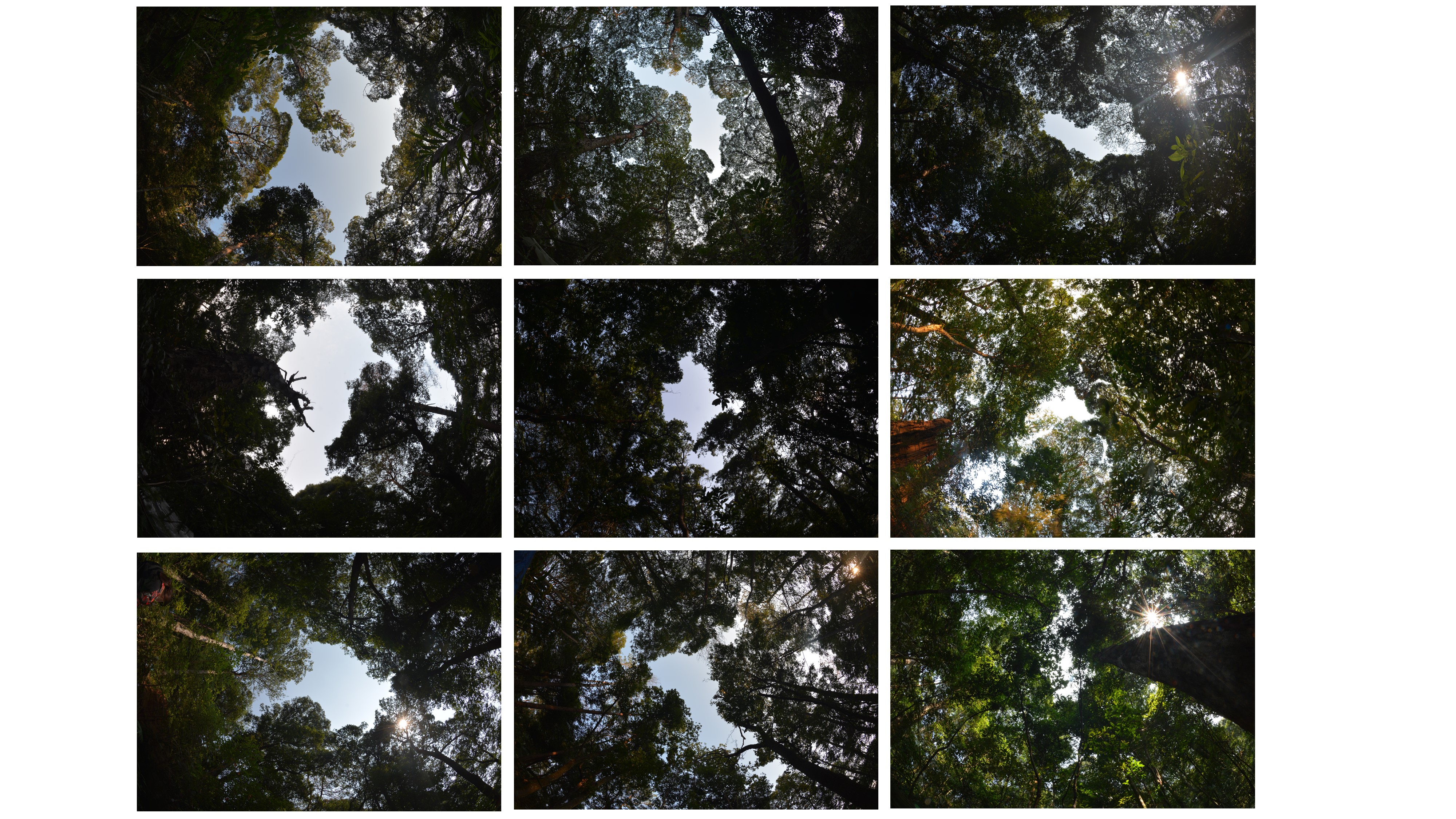
Aims Canopy gaps are a vital part of forest regeneration and succession. This paper aims to reveal the sources of functional trait variations and their relative contributions under forest canopy gaps. This will help to clarify the response of the plants to canopy gaps.
Methods The study was conducted in a natural forest of Castanopsis kawakamii in the central subtropical zone. Nine permanent plots with different sizes were set up under canopy gaps of this forest. The relative contributions of the gaps, species, and individuals to leaf trait variations were investigated using variance decomposition. Linear regression was used to analyze the importance of community mean trait variation and inter- and intraspecific trait variation among the different sizes of canopy gaps.
Important findings The variations of specific leaf area, leaf dry matter content, leaf thickness, and chlorophyll content of plants under canopy gaps were dominated by interspecific trait differences. Leaf nitrogen content was mainly varied within species, while the leaf phosphorus content was most affected by the size of canopy gap. The leaf phosphorus content had a significant positive correlation with gap size. This correlation may be mediated by the positive effect of soil temperature and hydrolyzed nitrogen and the negative effect of available phosphorus content. With the increase of canopy openness, the change of community phosphorus content was mainly caused by intraspecific trait variation, in which the dominant species played an important role. In conclusion, plant functional traits were still dominated by interspecific trait variation (41% on average) in the Castanopsis kawakamii natural forest, but the changes in community traits along the gap size gradients were mainly originated from intraspecific trait variation, which responded to the environmental changes through plant phenotypic plasticity, especially for dominant species.
JIANG Lan, WEI Chen-Si, HE Zhong-Sheng, ZHU Jing, XING Cong, WANG Xue-Lin, LIU Jin-Fu, SHEN Cai-Xia, SHI You-Wen . Functional trait variation of plant communities in canopy gaps of Castanopsis kawakamii natural forest[J]. Chinese Journal of Plant Ecology, 2022 , 46(3) : 267 -279 . DOI: 10.17521/cjpe.2021.0350
| [1] | Albert CH, Thuiller W, Yoccoz NG, Douzet R, Aubert S, Lavorel S (2010). A multi-trait approach reveals the structure and the relative importance of intra-vs. interspecific variability in plant traits. Functional Ecology, 24, 1192-1201. |
| [2] | Auger S, Shipley B (2013). Inter-specific and intra-specific trait variation along short environmental gradients in an old-growth temperate forest. Journal of Vegetation Science, 24, 419-428. |
| [3] | Benavides R, Carvalho B, Bastias CC, López-Quiroga D, Mas A, Cavers S, Gray A, Albet A, Alía R, Ambrosio O, Aravanopoulos F, Auñón F, Avanzi C, Avramidou EV, Bagnoli F, et al. (2021). The GenTree Leaf Collection: inter- and intraspecific leaf variation in seven forest tree species in Europe. Global Ecology and Biogeography, 30, 590-597. |
| [4] | Chapin III FS (1980). The mineral nutrition of wild plants. Annual Review of Ecology and Systematics, 11, 233-260. |
| [5] | Chen B, Jiang L, Xie ZY, Li YD, Li JX, Li MJ, Wei CS, Xing C, Liu JF, He ZS (2021). Taxonomic and phylogenetic diversity of plants in a Castanopsis kawakamii natural forest. Biodiversity Science, 29, 439-448. |
| [5] | [陈博, 江蓝, 谢子扬, 李阳娣, 李佳萱, 李梦佳, 魏晨思, 邢聪, 刘金福, 何中声 (2021). 格氏栲天然林林窗植物物种多样性与系统发育多样性. 生物多样性, 29, 439-448.] |
| [6] | Cheng B, Zhao YJ, Zhang WG, An SQ (2010). The research advances and prospect of ecological stoichiometry. Acta Ecologica Sinica, 30, 1628-1637. |
| [6] | [程滨, 赵永军, 张文广, 安树青 (2010). 生态化学计量学研究进展. 生态学报, 30, 1628-1637.] |
| [7] | Chen HY, Huang YM, He KJ, Qi Y, Li EG, Jiang ZY, Sheng ZL, Li XY (2019). Temporal intraspecific trait variability drives responses of functional diversity to interannual aridity variation in grasslands. Ecology and Evolution, 9, 5731-5742. |
| [8] | Cornwell WK, Ackerly DD (2009). Community assembly and shifts in plant trait distributions across an environmental gradient in coastal California. Ecological Monographs, 79, 109-126. |
| [9] | Díaz S, Hodgson JG, Thompson K, Cabido M, Cornelissen JHC, Jalili A, Montserrat-Martí G, Grime JP, Zarrinkamar F, Asri Y, Band SR, Basconcelo S, Castro-Díez P, Funes G, Hamzehee B, et al. (2004). The plant traits that drive ecosystems: evidence from three continents. Journal of Vegetation Science, 15, 295-304. |
| [10] | Elser JJ, Sterner RW, Gorokhova E, Fagan WF, Markow TA, Cotner JB, Harrison JF, Hobbie SE, Odell GM, Weider LJ (2000). Biological stoichiometry from genes to ecosystems. Ecology Letters, 3, 540-550. |
| [11] | Feng XP, Liu JF, Supaporn B, He ZS, Jiang L, Hong W, Shi YW (2017). Ecological stoichiometric characteristics of litter-soil in gap of Castanopsis kawakamii natural forest in Sanming of Fujian. Journal of Plant Resources and Environment, 26(4), 18-24. |
| [11] | [冯雪萍, 刘金福, Buajan Supaporn, 何中声, 江蓝, 洪伟, 施友文 (2017). 福建三明格氏栲天然林林窗凋落物-土壤的生态化学计量特征. 植物资源与环境学报, 26(4), 18-24.] |
| [12] | He ZS, Liu JF, Wu CT, Zheng SQ, Hong W, Su SJ, Wu CZ (2012). Effects of forest gaps on some microclimate variables in Castanopsis kawakamii natural forest. Journal of Mountain Science, 9, 706-714. |
| [13] | He ZS, Liu JF, Wu CT, Zheng SQ, Hong W, Xu DW, Wu CZ (2012a). The influence of forest gap on species competition of Castanopsis kawakamii natural forest updated layer. Journal of Mountain Science, 30, 165-171. |
| [13] | [何中声, 刘金福, 吴彩婷, 郑世群, 洪伟, 徐道炜, 吴承祯 (2012a). 林窗对格氏栲天然林更新层物种竞争的影响. 山地学报, 30, 165-171.] |
| [14] | He ZS, Liu JF, Zhu DH, Hong W, Zheng SQ, Su SJ, Wu CZ (2012b). Effects of forest gaps on species niche in regeneration layers of Castanopsis kawakamii natural forest. Guihaia, 32, 624-629. |
| [14] | [何中声, 刘金福, 朱德煌, 洪伟, 郑世群, 苏松锦, 吴承祯 (2012b). 林窗对格氏栲天然林更新层物种生态位的影响. 广西植物, 32, 624-629.] |
| [15] | He ZS, Liu JF, Su SJ, Zheng SQ, Xu DW, Wu ZY, Hong W, Wang JLM (2015). Effects of forest gaps on soil properties in Castanopsis kawakamii nature forest. PLOS ONE, 10, e0141203. DOI: 10.1371/journal.pone.0141203. |
| [16] | Hu LL, Zhu JJ (2009). Determination of the tridimensional shape of canopy gaps using two hemispherical photographs. Agricultural and Forest Meteorology, 149, 862-872. |
| [17] | Jung VC, Violle C, Mondy C, Hoffmann L, Muller S (2010). Intraspecific variability and trait-based community assembly. Journal of Ecology, 98, 1134-1140. |
| [18] | Laforest-Lapointe I, Martínez-Vilalta J, Retana J (2014). Intraspecific variability in functional traits matters: case study of Scots pine. Oecologia, 175, 1337-1348. |
| [19] | Li Q, Wang B, Deng Y, Lin LX, Dawa ZX, Zhang ZM (2019). Correlation between spatial distribution of forest canopy gaps and plant diversity indices in Xishuangbanna tropical forests. Biodiversity Science, 27, 273-285. |
| [19] | [李强, 王彬, 邓云, 林露湘, 达佤扎喜, 张志明 (2019). 西双版纳热带雨林林窗空间分布格局及其特征指数与林窗下植物多样性的相关性. 生物多样性, 27, 273-285.] |
| [20] | Liang XD, Ye WH (2001). Advances in study on forest gaps. Journal of Tropical and Subtropical Botany, 9, 355-364. |
| [20] | [梁晓东, 叶万辉 (2001). 林窗研究进展. 热带亚热带植物学报, 9, 355-364.] |
| [21] | Liu HM, Yang QS, Fang XF, Ma ZP, Shen GC, Zhang ZG, Wang ZH, Wang XH (2015). Influences on gap species richness in a subtropical evergreen broadleaved forest. Biodiversity Science, 23, 149-156. |
| [21] | [刘何铭, 杨庆松, 方晓峰, 马遵平, 沈国春, 张志国, 王樟华, 王希华 (2015). 亚热带常绿阔叶林林窗物种丰富度的影响因素. 生物多样性, 23, 149-156.] |
| [22] | Liu JF, Hong W, Li JQ (2006). Characteristics of gaps renewal in Castanopsis kawakamii forests. Journal of Beijing Forestry University, 28(3), 14-19. |
| [22] | [刘金福, 洪伟, 李俊清 (2006). 格氏栲林林窗更新特征的研究. 北京林业大学学报, 28(3), 14-19.] |
| [23] | Liu XJ, Ma KP (2015). Plant functional traits—Concepts, applications and future directions. Scientia Sinica (Vitae), 45, 325-339. |
| [23] | [刘晓娟, 马克平 (2015). 植物功能性状研究进展. 中国科学: 生命科学, 45, 325-339.] |
| [24] | Long CL (2006). Study on the regeneration niche of major tree species in gaps in the karst forest in Maolan Nature Reserve. Journal of Mountain Agriculture and Biology, 25, 302-306. |
| [24] | [龙翠玲 (2006). 茂兰喀斯特森林林隙更新生态位的研究. 山地农业生物学报, 25, 302-306.] |
| [25] | Long CL (2008). Effects of gaps size on regeneration of karst forest in Maolan Natural Reserve of Guizhou Province. Journal of Nanjing Forestry University (Natural Sciences Edition), 32(2), 34-38. |
| [25] | [龙翠玲 (2008). 茂兰喀斯特森林林隙大小对树种更新的影响. 南京林业大学学报(自然科学版), 32(2), 34-38.] |
| [26] | Luo SQ, Zhang GQ, Guo QQ, Liu SQ, Qi YJ (2020). Regeneration composition of woody plant species under forest gap in Maolan karst evergreen deciduous broad-leaved mixed forest. Chinese Journal of Ecology, 39, 2131-2139. |
| [26] | [罗丝琼, 张广奇, 郭其强, 刘莎茜, 戚玉娇 (2020). 茂兰喀斯特常绿落叶阔叶混交林林窗下木本植物更新组成. 生态学杂志, 39, 2131-2139.] |
| [27] | Messier J, McGill BJ, Lechowicz MJ (2010). How do traits vary across ecological scales? A case for trait-based ecology. Ecology Letters, 13, 838-848. |
| [28] | Nishimura E, Suzaki E, Irie M, Nagashima H, Hirose T (2010). Architecture and growth of an annual plant Chenopodium album in different light climates. Ecological Research, 25, 383-393. |
| [29] | Oguchi R, Hiura T, Hikosaka K (2017). The effect of interspecific variation in photosynthetic plasticity on 4-year growth rate and 8-year survival of understorey tree seedlings in response to gap formations in a cool-temperate deciduous forest. Tree Physiology, 37, 1113-1127. |
| [30] | Oksanen J, Blanchet FG, Friendly M, Kindt R, Legendre P, McGlinn D, Minchin PR, O’Hara RB, Simpson GL, Solymos P, Stevens MHH, Szoecs E, Wagner H (2020). vegan: Community ecology package. R package version 2.5-7. [2020-11-28]. https://CRAN.R-project.org/package=vegan. |
| [31] | Paradis E, Schliep K (2019). ape 5.0: An environment for modern phylogenetics and evolutionary analyses in R. Bioinformatics, 35, 526-528. |
| [32] | Pérez-Harguindeguy N, Díaz S, Garnier E, Lavorel S, Poorter H, Jaureguiberry P, Bret-Harte MS, Cornwell WK, Craine JM, Gurvich DE, Urcelay C, Veneklaas EJ, Reich PB, Poorter L, Wright IJ, et al. (2013). New handbook for standardised measurement of plant functional traits worldwide. Australian Journal of Botany, 61, 167-234. |
| [33] | Pinheiro J, Bates D, DebRoy S, Sarkar D, R Core Team (2020). nlme: Linear and nonlinear mixed effects models. R package version 3.1-155. [2020-08-23]. https://CRAN.R-project.org/package=nlme. |
| [34] | Reich PB, Oleksyn J (2004). Global patterns of plant leaf N and P in relation to temperature and latitude. Proceedings of the National Academy of Sciences of United States of America, 101, 11001-11006. |
| [35] | Shipley B, de Bello F, Cornelissen JHC, Laliberté E, Laughlin DC, Reich PB (2016). Reinforcing loose foundation stones in trait-based plant ecology. Oecologia, 180, 923-931. |
| [36] | Siefert A (2012). Incorporating intraspecific variation in tests of trait-based community assembly. Oecologia, 170, 767-775. |
| [37] | Siefert A, Violle C, Chalmandrier L, Albert CH, Taudiere A, Fajardo A, Aarssen LW, Baraloto C, Carlucci MB, Cianciaruso MV, de L Dantas V, de Bello F, Duarte LDS, Fonseca CR, Freschet GT, et al. (2015). A global meta- analysis of the relative extent of intraspecific trait variation in plant communities. Ecology Letters, 18, 1406-1419. |
| [38] | State Forestry Administration (1999). Forestry Industry Standard of the People’s Republic of China LY/T 1210- 1275-1999. Forest Soil Analysis Method. Standards Press of China, Beijing. |
| [38] | [国家林业局 (1999). 中华人民共和国林业行业标准LY/T 1210-1275-1999 森林土壤分析方法. 中国标准出版社, 北京.] |
| [39] | Tang QQ, Huang YT, Ding Y, Zang RG (2016). Interspecific and intraspecific variation in functional traits of subtropical evergreen and deciduous broad-leaved mixed forests. Biodiversity Science, 24, 262-270. |
| [39] | [唐青青, 黄永涛, 丁易, 臧润国 (2016). 亚热带常绿落叶阔叶混交林植物功能性状的种间和种内变异. 生物多样性, 24, 262-270.] |
| [40] | Violle C, Navas ML, Vile D, Kazakou E, Fortunel C, Hummel I, Garnier E (2007). Let the concept of trait be functional! Oikos, 116, 882-892. |
| [41] | Violle C, Enquist BJ, McGill BJ, Jiang L, Albert CH, Hulshof C, Jung V, Messier J (2012). The return of the variance: intraspecific variability in community ecology. Trends in Ecology & Evolution, 27, 244-252. |
| [42] | Watt AS (1947). Pattern and process in the plant community. Journal of Ecology, 35, 1-22. |
| [43] | Webb CT, Hoeting JA, Ames GM, Pyne MI, LeRoy Poff N (2010). A structured and dynamic framework to advance traits-based theory and prediction in ecology. Ecology Letters, 13, 267-283. |
| [44] | Wu ML, Zhu J, Zhu Q, Huang X, Wang J, Liu Y (2019). Analysis of leaf functional traits and functional diversity of woody plants in evergreen and deciduous broad-leaved mixed forest of Xingdoushan. Acta Botanica Boreali-Occidentalia Sinica, 39, 1678-1691. |
| [44] | [吴漫玲, 朱江, 朱强, 黄小, 王进, 刘易 (2019). 星斗山常绿落叶阔叶混交林木本植物叶功能性状及其多样性特征分析. 西北植物学报, 39, 1678-1691.] |
| [45] | Yan QL, Zhu JJ, Zhang JP, Yu LZ, Hu ZB (2010). Spatial distribution pattern of soil seed bank in canopy gaps of various sizes in temperate secondary forests, Northeast China. Plant and Soil, 329, 469-480. |
| [46] | Zhang JL, Zhang JZ, Shen JB, Tian J, Jin KM, Zhang FS (2020). Soil health and agriculture green development: opportunities and challenges. Acta Pedologica Sinica, 57, 783-796. |
| [46] | [张俊伶, 张江周, 申建波, 田静, 金可默, 张福锁 (2020). 土壤健康与农业绿色发展: 机遇与对策. 土壤学报, 57, 783-796.] |
| [47] | Zhang L, Wen ZM, Miao LP (2013). Source of variation of plant functional traits in the Yanhe River watershed: the influence of environment and phylogenetic background. Acta Ecologica Sinica, 33, 6543-6552. |
| [47] | [张莉, 温仲明, 苗连朋 (2013). 延河流域植物功能性状变异来源分析. 生态学报, 33, 6543-6552.] |
| [48] | Zhou JH, Cheng XR, Yu MK, Zhuge JJ (2015). Responses of growth, leaf traits and biomass allocation of Phoebe sheareri seedlings to different habitats in forest gap. Journal of Northeast Forestry University, 43(12), 21-24. |
| [48] | [周俊宏, 成向荣, 虞木奎, 诸葛建军 (2015). 紫楠幼苗生长、叶性状和生物量分配对林窗不同生境的响应. 东北林业大学学报, 43(12), 21-24.] |
| [49] | Zhu JJ, Lu DL, Zhang WD (2014). Effects of gaps on regeneration of woody plants: a meta-analysis. Journal of Forestry Research, 25, 501-510. |
| [50] | Zhu JJ (2003). Method for measurement of optical stratification porosity (OSP) and its application in studies of management for secondary forests. Chinese Journal of Applied Ecology, 14, 1229-1233. |
| [50] | [朱教君 (2003). 透光分层疏透度测定及其在次生林结构研究中的应用. 应用生态学报, 14, 1229-1233.] |
/
| 〈 |
|
〉 |
Copyright © 2026 Chinese Journal of Plant Ecology
Tel: 010-62836134, 62836138, E-mail: apes@ibcas.ac.cn, cjpe@ibcas.ac.cn

