
Chinese Journal of Plant Ecology >
Effects of warming on fine root growth, mortality and turnover: a review
Received date: 2022-05-18
Accepted date: 2022-10-10
Online published: 2022-10-10
Supported by
National Natural Science Foundation of China(32071743);National Natural Science Foundation of China(31930071);National Natural Science Foundation of China(31901132);National Key Basic Research and Development Plan of China(2014CB954003)
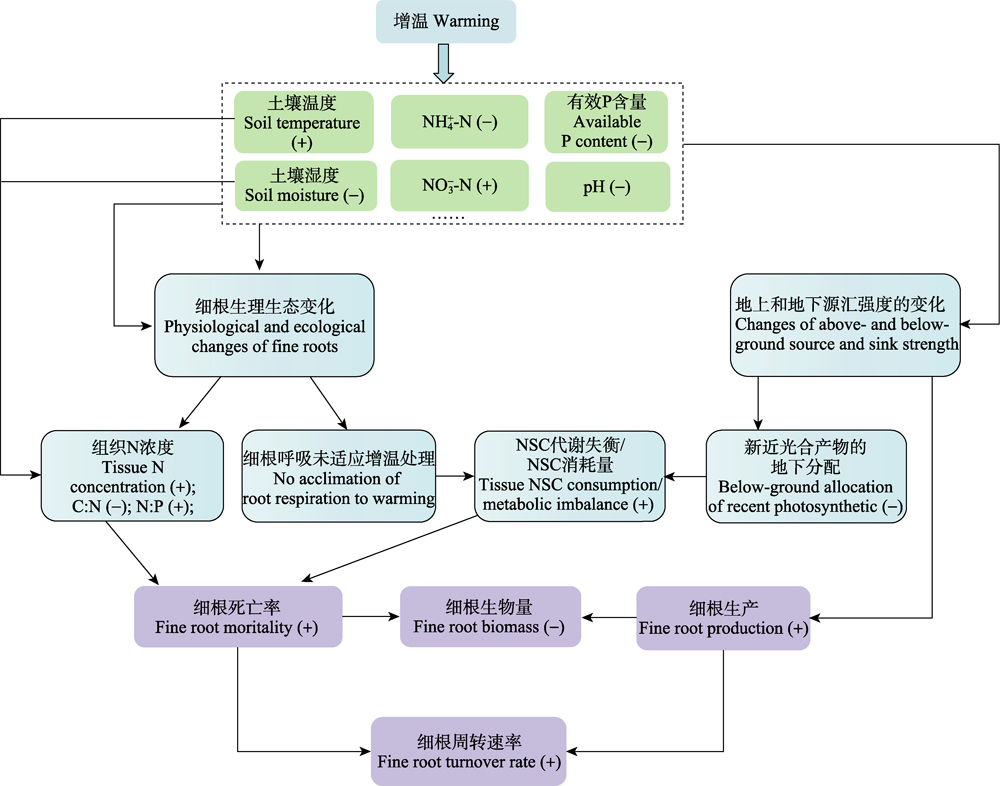
Fine roots are the most active and sensitive part of the root system, and play an important role in the biogeochemical cycles of forest ecosystems. Fine root growth and turnover have a strong impact on the root carbon flux into soil. The effect of global warming on below-ground ecological processes has become a hot issue in global change research, and the response of fine root dynamics to warming will directly affect the carbon balance of forest ecosystems. In this paper, the effects of warming on fine root production, mortality, biomass and turnover are reviewed to reveal the effects of warming on fine root dynamics. Generally, warming affects the fine root production and mortality by changing soil moisture, nutrient availability and distribution of recent photosynthetic products, accelerates fine root turnover process, and then reduces fine root biomass. However, fine root growth is affected by many factors, making the research results of the impact of warming on fine roots inconsistent among different studies, due to the difference in tree species, regions, warming methods and other factors. Therefore, comprehensively analyzing the response of forest fine roots under warming is very important for studies on below-ground ecological processes. In the future, we call for more research in the following aspects: (1) according to the advantages and disadvantages of each warming method, compare the effects of different warming methods and warming durations on the growth dynamics of fine roots and above-ground parts; (2) combined with various fine root observation and experimental methods, comprehensively analyze the effect of warming on fine root growth dynamics, and strengthen the research on the effect of warming on fine root order structure; (3) strengthen the research on the interaction of warming and nutrient, water and CO2 on fine root growth dynamics; (4) focus on the effects of warming on fine root dynamics in different soil layers, especially in deep soils; and (5) deeply study the potential response of the relationship among fine roots, soils and microorganisms to warming.
WU Chen, CHEN Xin-Yi, LIU Yuan-Hao, HUANG Jin-Xue, XIONG De-Cheng . Effects of warming on fine root growth, mortality and turnover: a review[J]. Chinese Journal of Plant Ecology, 2023 , 47(8) : 1043 -1054 . DOI: 10.17521/cjpe.2022.0202
| [1] | Alvarez-Uria P, K?rner C (2007). Low temperature limits of root growth in deciduous and evergreen temperate tree species. Functional Ecology, 21, 211-218. |
| [2] | Arft AM, Walker MD, Gurevitch J, Alatalo JM, Bret-harte MS, Dale M, Diemer M, Gugerli F, Henry GHR, Jones MH, Hollister RD, Jonsdottir IS, Laine K, Lévesque E, Marion GM, et al. (1999). Responses of tundra plants to experimental warming: meta-analysis of the international tundra experiment. Ecological Monographs, 69, 491-511. |
| [3] | Atkin OK, Edwards EJ, Loveys BR (2000). Response of root respiration to changes in temperature and its relevance to global warming. New Phytologist, 147, 141-154. |
| [4] | Bai WM, Wan SQ, Niu SL, Liu WX, Chen QS, Wang QB, Zhang WH, Han XG, Li LH (2010). Increased temperature and precipitation interact to affect root production, mortality, and turnover in a temperate steppe: implications for ecosystem C cycling. Global Change Biology, 16, 1306-1316. |
| [5] | Barthel M, Hammerle A, Sturm P, Baur T, Gentsch L, Knohl A (2011). The diel imprint of leaf metabolism on the δ13C signal of soil respiration under control and drought conditions. New Phytologist, 192, 925-938. |
| [6] | Bj?rk RG, Majdi H, Klemedtsson L, Lewis-Jonsson L, Molau U (2007). Long-term warming effects on root morphology, root mass distribution, and microbial activity in two dry tundra plant communities in northern Sweden. New Phytologist, 176, 862-873. |
| [7] | Bloomfield J, Vogt KA, Wargo PM (1996). Tree root turnover and senescence//Waisel Y, Eshel A, Kafkafi U. Plant Roots: The Hidden Half. 2nd ed. Marcel Dekker, New York. 363-381. |
| [8] | Bronson DR, Gower ST, Tanner M, Linder S, van Herk I (2008). Response of soil surface CO2 flux in a boreal forest to ecosystem warming. Global Change Biology, 14, 856-867. |
| [9] | Bronson DR, Gower ST, Tanner M, van Herk I (2009). Effect of ecosystem warming on boreal black spruce bud burst and shoot growth. Global Change Biology, 15, 1534-1543. |
| [10] | Burton AJ, Pregitzer KS, Hendrick RL (2000). Relationships between fine root dynamics and nitrogen availability in Michigan northern hardwood forests. Oecologia, 125, 389-399. |
| [11] | Burton AJ, Jarvey JC, Jarvi MP, Zak DR, Pregitzer KS (2012). Chronic N deposition alters root respiration-tissue N relationship in northern hardwood forests. Global Change Biology, 18, 258-266. |
| [12] | Cavaleri MA, Reed SC, Smith WK, Wood TE (2015). Urgent need for warming experiments in tropical forests. Global Change Biology, 21, 2111-2121. |
| [13] | Chen HYH, Brassard BW (2013). Intrinsic and extrinsic controls of fine root life span. Critical Reviews in Plant Sciences, 32, 151-161. |
| [14] | Choat B (2013). Predicting thresholds of drought-induced mortality in woody plant species. Tree Physiology, 33, 669-671. |
| [15] | Choat B, Jansen S, Brodribb TJ, Cochard H, Delzon S, Bhaskar R, Bucci SJ, Feild TS, Gleason SM, Hacke UG, Jacobsen AL, Lens F, Maherali H, Martínez-Vilalta J, Mayr S, et al. (2012). Global convergence in the vulnerability of forests to drought. Nature, 491, 752-755. |
| [16] | Dawes MA, Schleppi P, H?ttenschwiler S, Rixen C, Hagedorn F (2017). Soil warming opens the nitrogen cycle at the alpine treeline. Global Change Biology, 23, 421-434. |
| [17] | Dusenge ME, Duarte AG, Way DA (2019). Plant carbon metabolism and climate change: elevated CO2 and temperature impacts on photosynthesis, photorespiration and respiration. New Phytologist, 221, 32-49. |
| [18] | Eissenstat DM, McCormack ML, Du Q (2013). Global change and root lifespan//Eshel A, Beeckman T. Plant Roots: The Hidden Half. 4th ed. CRC Press, Boca Raton, USA. |
| [19] | Eissenstat DM, Wells CE, Yanai RD, Whitbeck JL (2000). Building roots in changing environment: implications for root longevity. New Phytologist, 147, 33-42. |
| [20] | Eissenstat DM, Yanai RD (1997). The ecology of root lifespan//Begon M, Fitter AH. Advances in Ecological Research: Vol. 27. Academic Press, Amsterdam. 1-60. |
| [21] | Finér L, Ohashi M, Noguchi K, Hirano Y (2011). Factors causing variation in fine root biomass in forest ecosystems. Forest Ecology and Management, 261, 265-277. |
| [22] | Fitter AH, Graves JD, Self GK, Brown TK, Bogie DS, Taylor K (1998). Root production, turnover and respiration under two grassland types along an altitudinal gradient: influence of temperature and solar radiation. Oecologia, 114, 20-30. |
| [23] | Gao W, Schlüter S, Blaser SRGA, Shen JB, Vetterlein D (2019). A shape-based method for automatic and rapid segmentation of roots in soil from X-ray computed tomography images: rootine. Plant and Soil, 441, 643-655. |
| [24] | Germon A, Cardinael R, Dupraz C, Laclau JP, Jourdan C (2015). Fine root lifespan depending on their diameter and soil depth//International Society of Root Research. Roots Down Under, Belowground Solutions to Global Challenges, International Symposium. Canberra, Australia. DOI: 10.13140/RG.2.1.3101.0967. |
| [25] | Germon A, Laclau JP, Robin A, Jourdan C (2020). Deep fine roots in forest ecosystems: Why dig deeper? Forest Ecology and Management, 466, 118135. DOI: 10.1016/j. foreco.2020.118135. |
| [26] | Gill RA, Jackson RB (2000). Global patterns of root turnover for terrestrial ecosystems. New Phytologist, 147, 13-31. |
| [27] | Guo D, Li H, Mitchell RJ, Han W, Hendricks JJ, Fahey TJ, Hendrick RL (2008). Fine root heterogeneity by branch order: exploring the discrepancy in root turnover estimates between minirhizotron and carbon isotopic methods. New Phytologist, 177, 443-456. |
| [28] | Guo DL, Mitchell RJ, Hendricks JJ (2004). Fine root branch orders respond differentially to carbon source-sink manipulations in a longleaf pine forest. Oecologia, 140, 450-457. |
| [29] | Haichar FEZ, Santaella C, Heulin T, Achouak W (2014). Root exudates mediated interactions belowground. Soil Biology & Biochemistry, 77, 69-80. |
| [30] | Han S, Kim S, Li GL, Chang HN, Yun S, An JE, Son Y (2017). Effects of warming and precipitation manipulation on fine root dynamics of Pinus densiflora Sieb. et Zucc. seedlings. Forests, 9, 14. DOI: 10.3390/f9010014. |
| [31] | Hartley AE, Neill C, Melillo JM, Crabtree R, Bowles FP (1999). Plant performance and soil nitrogen mineralization in response to simulated climate change in subarctic dwarf shrub heath. Oikos, 86, 331-343. |
| [32] | Hendrick RL, Pregitzer KS (1993). The dynamics of fine root length, biomass, and nitrogen content in two northern hardwood ecosystems. Forest Research of Canadian Journal, 23, 2507-2520. |
| [33] | Hertel D, Strecker T, Müller-Haubold H, Leuschner C (2013). Fine root biomass and dynamics in beech forests across a precipitation gradient—Is optimal resource partitioning theory applicable to water-limited mature trees? Journal of Ecology, 101, 1183-1200. |
| [34] | Hinsinger P, Bengough AG, Vetterlein D, Young IM (2009). Rhizosphere: biophysics, biogeochemistry and ecological relevance. Plant and Soil, 321, 117-152. |
| [35] | Hutchings MJ, John EA (2003). Distribution of roots in soil, and root foraging activity//Kroon H, Visser EJW. Root Ecology. Springer, Berlin. 33-60. |
| [36] | Iversen CM, Ledford J, Norby RJ (2008). CO2 enrichment increases carbon and nitrogen input from fine roots in a deciduous forest. New Phytologist, 179, 837-847. |
| [37] | Jarvi MP, Burton AJ (2013). Acclimation and soil moisture constrain sugar maple root respiration in experimentally warmed soil. Tree Physiology, 33, 949-959. |
| [38] | Johnson MG, Rygiewicz PT, Tingey DT, Phillips DL (2006). Elevated CO2and elevated temperature have no effect on Douglas-fir fine-root dynamics in nitrogen-poor soil. New Phytologist, 170, 345-356. |
| [39] | Jones DL, Hodge A, Kuzyakov Y (2004). Plant and mycorrhizal regulation of rhizodeposition. New Phytologist, 163, 459-480. |
| [40] | King JS, Albaugh TJ, Allen HL, Buford M, Strain BR, Dougherty P (2002). Below-ground carbon input to soil is controlled by nutrient availability and fine root dynamics in loblolly pine. New Phytologist, 154, 389-398. |
| [41] | Kitajima K, Anderson KE, Allen MF (2010). Effect of soil temperature and soil water content on fine root turnover rate in a California mixed conifer ecosystem. Journal of Geophysical Research: Biogeosciences, 115, G04032. DOI: 1029/2009JG001210. |
| [42] | Klein JA, Harte J, Zhao XQ (2005). Dynamic and complex microclimate responses to warming and grazing manipulations. Global Change Biology, 11, 1440-1451. |
| [43] | Kozlowski TT, Kramer PJ, Pallardy SG (1990). The Physiological Ecology of Woody Plants. Academic Press, San Diego, USA. |
| [44] | Krause GH, Cheesman AW, Winter K, Krause B, Virgo A (2013). Thermal tolerance net CO2 exchange and growth of a tropical tree species Ficus insipida cultivated at elevated daytime and nighttime temperatures. Journal of Plant Physiology, 170, 822-827. |
| [45] | Kwatcho Kengdo S, Per?oh D, Schindlbacher A, Heinzle J, Tian Y, Wanek W, Borken W (2022). Long-term soil warming alters fine root dynamics and morphology, and their ectomycorrhizal fungal community in a temperate forest soil. Global Change Biology, 28, 3441-3458. |
| [46] | Lahti M, Aphalo PJ, Finér L, Ryypp? A, Lehto T, Mannerkoski H (2005). Effects of soil temperature on shoot and root growth and nutrient uptake of 5-year-old Norway spruce seedlings. Tree Physiology, 25, 115-122. |
| [47] | Lee EH, Tingey DT, Beedlow PA, Johnson MG, Burdick CA (2007). Relating fine root biomass to soil and climate conditions in the Pacific Northwest. Forest Ecology and Management, 242, 195-208. |
| [48] | Lei PF, Scherer-Lorenzen M, Bauhus J (2012). The effect of tree species diversity on fine-root production in a young temperate forest. Oecologia, 169, 1105-1115. |
| [49] | Lepp?lammi-Kujansuu J, Ostonen I, Str?mgren M, Nilsson LO, Kleja DB, Sah SP, Helmisaari HS (2013). Effects of long term temperature and nutrient manipulation on Norway spruce fine roots and mycelia production. Plant and Soil, 366, 287-303. |
| [50] | Lepp?lammi-Kujansuu J, Salemaa M, Kleja DB, Linder S, Helmisaari HS (2014). Fine root turnover and litter production of Norway spruce in a long-term temperature and nutrient manipulation experiment. Plant and Soil, 374, 73-88. |
| [51] | Liu HY, Wang H, Li N, Shao JJ, Zhou XH, van Groenigen KJ, Thakur MP (2022). Phenological mismatches between above- and belowground plant responses to climate warming. Nature Climate Change, 12, 97-102. |
| [52] | Liu L, Zhang J, Yang WQ, Wang M, Xue Q, Dong SG (2008). Biomass and carbon stock of fine roots in the representative subalpine and alpine forests in western Sichuan. Journal of Sichuan Forestry Science and Technology, 29(1), 7-10. |
| [52] | [刘利, 张健, 杨万勤, 汪明, 薛樵, 董生刚 (2008). 川西亚高山高山典型森林细根生物量及其碳储量特征. 四川林业科技, 29(1), 7-10.] |
| [53] | Liu YC, Liu SR, Wan SQ, Wang JX, Wang H, Liu K (2017). Effects of experimental throughfall reduction and soil warming on fine root biomass and its decomposition in a warm temperate oak forest. Science of the Total Environment, 574, 1448-1455. |
| [54] | Luo YQ, Sherry R, Zhou XH, Wan SQ (2009). Terrestrial carbon-cycle feedback to climate warming: experimental evidence on plant regulation and impacts of biofuel feedstock harvest. GCB Bioenergy, 1, 62-74. |
| [55] | Lyr H, Garbe V (1995). Influence of root temperature on growth of Pinus sylvestris, Fagus sylvatica, Tilia cordata and Quercus robur. Trees, 9, 220-223. |
| [56] | Majdi H, ?hrvik J (2004). Interactive effects of soil warming and fertilization on root production, mortality, and longevity in a Norway spruce stand in Northern Sweden. Global Change Biology, 10, 182-188. |
| [57] | Makita N, Hirano Y, Dannoura M, Kominami Y, Mizoguchi T, Ishii H, Kanazawa Y (2009). Fine root morphological traits determine variation in root respiration of Quercus strrata. Tree Physiology, 29, 579-585. |
| [58] | McMichael BL, Burke JJ (1998). Soil temperature and root growth. Hortscience, 33, 947-951. |
| [59] | Melillo JM, Steudler PA, Aber JD, Newkirk K, Lux H, Bowles FP, Catricala C, Magill A, Ahrens T, Morrisseau S (2002). Soil warming and carbon-cycle feedbacks to the climate system. Science, 298, 2173-2176. |
| [60] | Niu SL, Han XG, Ma KP, Wan SQ (2007). Field facilities in global warming and terrestrial ecosystem research. Journal of Plant Ecology (Chinese Version), 31, 262-271. |
| [60] | [牛书丽, 韩兴国, 马克平, 万师强 (2007). 全球变暖与陆地生态系统研究中的野外增温装置. 植物生态学报, 31, 262-271.] |
| [61] | Noguchi K, Nagakura J, Kon?pka B, Sakata T, Kaneko S, Takahashi M (2013). Fine-root dynamics in sugi (Cryptomeria japonica) under manipulated soil nitrogen conditions. Plant and Soil, 364, 159-169. |
| [62] | Noormets A, Chen JQ, Bridgham SD, Weltzin JF, Pastor J, Dewey B, LeMoine J (2004). The effects of infrared loading and water table on soil energy fluxes in northern peatlands. Ecosystems, 7, 573-582. |
| [63] | Norby RJ, Jackson RB (2000). Root dynamics and global change: seeking an ecosystem perspective. New Phytologist, 147, 3-12. |
| [64] | Pilon R, Picon-Cochard C, Bloor JMG, Revaillot S, Kuhn E, Falcimagne R, Balandier P, Soussana JF (2013). Grassland root demography responses to multiple climate change drivers depend on root morphology. Plant and Soil, 364, 395-408. |
| [65] | Pinno BD, Wilson SD (2013). Fine root response to soil resource heterogeneity differs between grassland and forest. Plant Ecology, 214, 821-829. |
| [66] | Pregitzer KS, King JS (2005). Effects of soil temperature on nutrient uptake//BassiriRad H. Nutrient Acquisition by Plants: An Ecological Perspective. Springer, Berlin. 277-310. |
| [67] | Pregitzer KS, King JS, Burton AJ (2000). Responses of tree fine roots to temperature. New Phytologist, 147, 105-115. |
| [68] | Pregitzer KS, Kubiske ME, Yu CK, Hendrick RL (1997). Relationships among root branch order, carbon, and nitrogen in four temperate species. Oecologia, 111, 302-308. |
| [69] | Radville L, Post E, Eissenstat DM (2016). Root phenology in an arctic shrub-graminoid community: the effects of long- term warming and herbivore exclusion. Climate Change Responses, 3, 4. DOI: 10.1186/s40665-016-0017-0. |
| [70] | Rustad L, Campbell J, Marion G, Norby R, Mitchell M, Hartley A, Cornelissen J, Gurevitch J, GCTE-NEWS (2001). A meta-analysis of the response of soil respiration, net nitrogen mineralization, and aboveground plant growth to experimental ecosystem warming. Oecologia, 126, 543-562. |
| [71] | Salazar A, Rousk K, Jónsdóttir IS, Bellenger JP, Andrésson óS (2020). Faster nitrogen cycling and more fungal and root biomass in cold ecosystems under experimental warming: a meta-analysis. Ecology, 101, e02938. DOI: 10.1002/ecy.2938. |
| [72] | Song ML, Wen XZ, Li YL (2010). Effects of high rhizosphere temperature on plant growth and metabolism: a review. Chinese Journal of Ecology, 29, 2258-2264. |
| [72] | [宋敏丽, 温祥珍, 李亚灵 (2010). 根际高温对植物生长和代谢的影响综述. 生态学杂志, 29, 2258-2264.] |
| [73] | Steele SJ, Gower ST, Vogel JG, Norman JM (1997). Root mass, net primary production and turnover in aspen, Jack pine and black spruce forests in Saskatchewan and Manitoba, Canada. Tree Physiology, 17, 577-587. |
| [74] | Steinaker DF, Wilson SD, Peltzer DA (2009). Asynchronicity in root and shoot phenology in grasses and woody plants. Global Change Biology, 16, 2241-2251. |
| [75] | Steinmann K, Siegwolf RTW, Saurer M, K?rner C (2004). Carbon fluxes to the soil in a mature temperate forest assessed by 13C isotope tracing. Oecologia, 141, 489-501. |
| [76] | Sullivan PF, Welker JM (2005). Warming chambers stimulate early season growth of an arctic sedge: results of a minirhizotron field study. Oecologia, 142, 616-626. |
| [77] | Talkner U, Riek W, Dammann I, Kohler M, G?ttlein A, Mellert KH, Meiwes KJ (2019). Nutritional status of major forest tree species in Germany//Wellbrock N, Bolte A. Status and Dynamics of Forests in Germany. Springer, Cham, Switzerland. 261-293. |
| [78] | Tierney GL, Fahey TJ, Groffman PM, Hardy JP, Fitzhugh RD, Driscoll CT, Yavitt JB (2003). Environmental control of fine root dynamics in a northern hardwood forest. Global Change Biology, 9, 670-679. |
| [79] | Tingey DT, Phillips DL, Johnson MG, Rygiewicz PT, Beedlow PA, Hogsett WE (2005). Estimates of Douglas-fir fine root production and mortality from minirhizotrons. Forest Ecology and Management, 204, 359-370. |
| [80] | Tryon PR, Chapin III FS (1983). Temperature control over root growth and root biomass in taiga forest trees. Canadian Journal of Forest Research, 13, 827-833. |
| [81] | Wan SQ, Norby RJ, Pregitzer KS, Ledford J, O’Neill EG (2004). CO2 enrichment and warming of the atmosphere enhance both productivity and mortality of maple tree fine roots. New Phytologist, 162, 437-446. |
| [82] | Wang J, Defrenne C, McCormack ML, Yang L, Tian D, Luo Y, Hou E, Yan T, Li Z, Bu W, Chen Y, Niu S (2021). Fine- root functional trait responses to experimental warming: a global meta-analysis. New Phytologist, 230, 1856-1867. |
| [83] | Wang SZ, Wang ZQ, Gu JC (2017). Variation patterns of fine root biomass, production and turnover in Chinese forests. Journal of Forestry Research, 28, 1185-1194. |
| [84] | Wang XH, Xu CS, Xiong DC, Yao XD, Chen TT, Jiang Q, Jia LQ, Fan AL, Chen GS (2022). Root age-related response of fine root respiration of Chinese fir seedlings to soil warming. Tree Physiology, 42, 1177-1187. |
| [85] | Wei CX, Yang L, Wang JS, Yang JM, Shi JW, Tian DS, Zhou QP, Niu SL (2021). Effects of experimental warming on root biomass in terrestrial ecosystems. Chinese Journal of Plant Ecology, 45, 1203-1212. |
| [85] | [魏春雪, 杨璐, 汪金松, 杨家明, 史嘉炜, 田大栓, 周青平, 牛书丽 (2021). 实验增温对陆地生态系统根系生物量的影响. 植物生态学报, 45, 1203-1212.] |
| [86] | Wei L (2017). Effects of Nitrogen Addition and Mowing on Key Processes of Belowground Carbon Cycling in Natural Grassland Ecosystem on the Loess Plateau. PhD dissertation, University of Chinese Academy of Sciences, Beijing. |
| [86] | [魏琳 (2017). 氮添加和刈割对黄土高原天然草地生态系统地下碳循环关键过程的影响. 博士学位论文, 中国科学院大学, 北京.] |
| [87] | Wu YB, Zhang J, Deng YC, Wu J, Wang SP, Tang YH, Cui XY (2014). Effects of warming on root diameter, distribution, and longevity in an alpine meadow. Plant Ecology, 215, 1057-1066. |
| [88] | Wu ZT, Dijkstra P, Koch GW, Pe?uelas J, Hungate BA (2011). Responses of terrestrial ecosystems to temperature and precipitation change: a meta-analysis of experimental manipulation. Global Change Biology, 17, 927-942. |
| [89] | Xia M, Guo D, Pregitzer KS (2010). Ephemeral root modules in Fraxinus mandshurica. New Phytologist, 188, 1065-1074. |
| [90] | Xiong DC, Yang ZJ, Chen GS, Liu XF, Lin WS, Huang JX, Bowles FP, Lin CF, Xie JS, Li YQ, Yang YS (2018). Interactive effects of warming and nitrogen addition on fine root dynamics of a young subtropical plantation. Soil Biology & Biochemistry, 123, 180-189. |
| [91] | Yaffar D, Wood TE, Reed SC, Branoff BL, Cavaleri MA, Norby RJ (2021). Experimental warming and its legacy effects on root dynamics following two hurricane disturbances in a wet tropical forest. Global Change Biology, 27, 6423-6435. |
| [92] | Yang Y, Wang GX, Yang LD, Guo JY (2013). Effects of drought and warming on biomass, nutrient allocation, and oxidative stress in Abies fabri in eastern Tibetan Plateau. Journal of Plant Growth Regulation, 32, 298-306. |
| [93] | Yuan ZY, Chen HY (2012). Indirect methods produce higher estimates of fine root production and turnover rates than direct methods. PLoS ONE, 7, e48989. DOI: 10.1371/journal.pone.0048989. |
| [94] | Zadworny M, Eissenstat DM (2011). Contrasting the morphology, anatomy and fungal colonization of new pioneer and fibrous roots. New Phytologist, 190, 213-221. |
| [95] | Zhang XQ, Wu KH, Murach D (2000). A review of methods for fine-root production and turnover of trees. Acta Ecologica Sinica, 20, 875-883. |
| [95] | [张小全, 吴可红, Murach D (2000). 树木细根生产与周转研究方法评述. 生态学报, 20, 875-883.] |
| [96] | Zhang YY, Sun XF, Zhang LF, Li YC, Wang CK, Wang XC (2021). Fine root biomass, production, and turnover rate in a temperate deciduous broadleaved forest in the Maoer Mountain, China. Chinese Journal of Applied Ecology, 32, 3053-3060. |
| [96] | [张云宇, 孙晓凤, 张临峰, 李颖池, 王传宽, 王兴昌 (2021). 帽儿山温带落叶阔叶林细根生物量、生产力和周转率. 应用生态学报, 32, 3053-3060.] |
| [97] | Zhao HY (2019). Adaptation Strategies of Fine Roots of Chinese Fir Seedlings to Soil Warming and Precipitation Exclusion. PhD dissertation, Fujian Normal University, Fuzhou. |
| [97] | [赵海英 (2019). 杉木幼苗细根对土壤增温和隔离降雨的适应策略. 博士学位论文, 福建师范大学, 福州.] |
| [98] | Zhao JX, Li RC, Li X, Tian LH (2017). Environmental controls on soil respiration in alpine meadow along a large altitudinal gradient on the central Tibetan Plateau. Catena, 159, 84-92. |
/
| 〈 |
|
〉 |
Copyright © 2026 Chinese Journal of Plant Ecology
Tel: 010-62836134, 62836138, E-mail: apes@ibcas.ac.cn, cjpe@ibcas.ac.cn

