
Chinese Journal of Plant Ecology >
Vegetation-soil interaction on carbon, nitrogen, and phosphorus and associated microbial driving mechanisms at Hulun Buir Sandy Land
Received date: 2024-04-15
Accepted date: 2024-10-09
Online published: 2024-10-10
Supported by
Strategic Priority Research Program of the Chinese Academy of Sciences(XDA26020104)
Aims Vegetation-soil nutrient interation is a key process in maintaining stability and multifunctionality of terrestrial ecosystems. However, vegetation-soil interaction on carbon (C), nitrogen (N) and phosphorus (P) and the key drivers in promoting plant succession during sandy land restoration are still unclear. In this study, based on ecological stoichiometry theory, the vegetation-soil nutrient interaction in sandy land from the perspective of soil microorganisms was explored, and the limiting factors for ecological restoration of degraded vegetation in sandy land were also investigated.
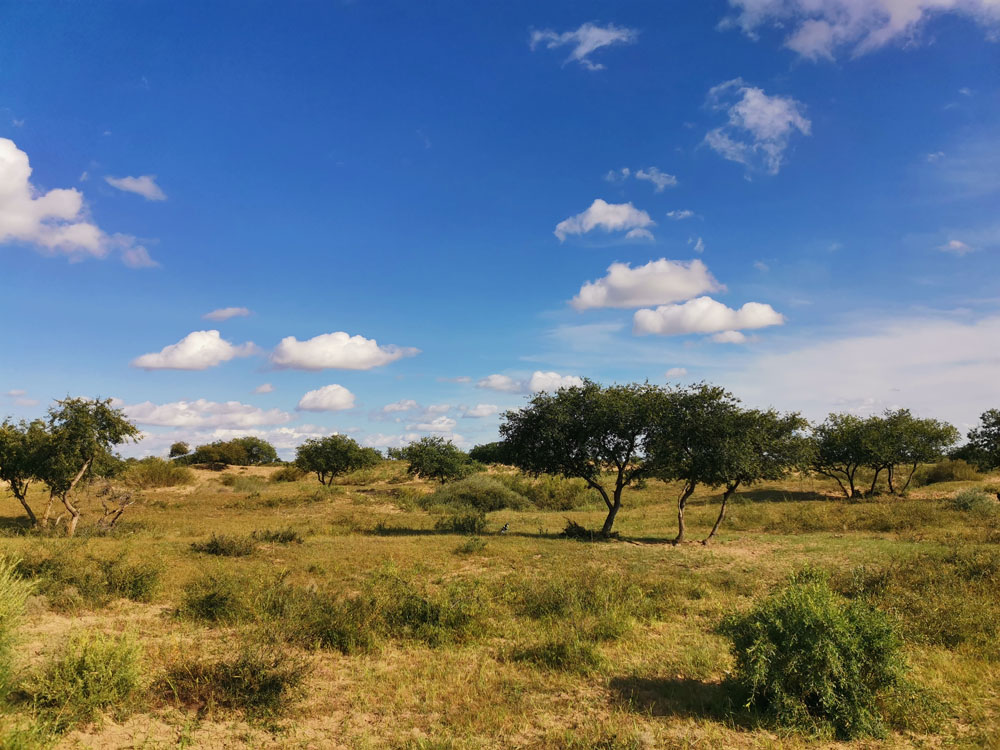
Methods We selected different landscape types in Hulun Buir Sandy Land, including mobile dunes, semi-mobile dunes, semi-fixed dunes, fixed dunes, and sandy grassland. The space-for-time substitution approach was used to investigate the characteristics of the C, N, and P stochastic geometries of the vegetation-soil coordination equilibrium and the key drivers in the restoration processes. In addition, a correlation analysis between vegetation-soil stoichiometry and soil microbial communities was performed to reveal multiple driving mechanisms of soil physicochemical factors, plant communities, and soil microbial communities on plant-soil stoichiometry during plant restoration in degraded sandy areas.
Important findings 1) With vegetation restoration in degraded sandy land, soil C, N, and P contents, as well as the ratio of C:P and N:P showed significant increasing trends. Conversely, C, N, and P contents and their stoichiometry in living plants and roots did not show clear trends. These results suggest that sandy plant communities are still capable of maintaining their nutrient balance, and that their stoichiometric balance is relatively stable with environmental conditions recover and change. 2) Soil C:P (12.08-38.40) was at a low level, resulting in net soil P mineralization, and microbial decomposition of organic matter was not limited by P, and above-ground plant N:P was all lower than 10, indicating that the growth of vegetation in Hulun Buir Sandy Land was mainly limited by N. 3) Meanwhile, the soil N:P continued to increase, indicating that the supply of soil N gradually increased, while the supply of P gradually decreased, and P could be a limiting element in the later stages of vegetation restoration. 4) During vegetation restoration in the Hulun Buir Sandy Land, soil stoichiometry and pH had direct significant positive effects on plant stoichiometry, while soil microorganisms indirectly affected plant stoichiometry by regulating soil stoichiometry. In addition, the indirect effects of soil moisture, soil texture, and electrical conductivity on soil and plant stoichiometry should not be neglected. Thus, this study provides a theoretical basis for adaptive management and prediction of ecosystem restoration in degraded sandy soils.
YAO Bo , CHEN Yun , CAO Wen-Jie , GONG Xiang-Wen , LUO Yong-Qing , ZHENG Cheng-Zhuo , WANG Xu-Yang , WANG Zheng-Wen , LI Yu-Qiang . Vegetation-soil interaction on carbon, nitrogen, and phosphorus and associated microbial driving mechanisms at Hulun Buir Sandy Land[J]. Chinese Journal of Plant Ecology, 2025 , 49(1) : 59 -73 . DOI: 10.17521/cjpe.2024.0107
| [1] | Bao SD (2005). Soil and Agricultural Chemistry Analysis. 3rd ed. China Agricultural Science and Technology Press, Beijing. |
| [鲍士旦 (2005). 土壤农化分析. 3版. 中国农业科技出版社, 北京.] | |
| [2] | Berg B, McClaugherty C (2014). Plant Litter: Decomposition, Humus Formation, Carbon Sequestration. Springer-Verlag, Berlin, Germany. |
| [3] | Bitas V, Kim HS, Bennett JW, Kang S (2013). Sniffing on microbes: diverse roles of microbial volatile organic compounds in plant health. Molecular Plant-Microbe Interactions, 26, 835-843. |
| [4] | Chapin III FS, Matson PA, Mooney HA (2002). Principles of Terrestrial Ecosystem Ecology. Springer-Verlag, New York. |
| [5] | Cleveland CC, Liptzin D (2007). C:N:P stoichiometry in soil: Is there a “Redfield ratio” for the microbial biomass? Biogeochemistry, 85, 235-252. |
| [6] | Cline LC, Zak DR (2015). Soil microbial communities are shaped by plant-driven changes in resource availability during secondary succession. Ecology, 96, 3374-3385. |
| [7] | Coban O, de Deyn GB, van der Ploeg M (2022). Soil microbiota as game-changers in restoration of degraded lands. Science, 375, abe0725. DOI: 10.1126/science.abe0725. |
| [8] | Dennis KL, Wang Y, Blatner NR, Wang S, Saadalla A, Trudeau E, Roers A, Weaver CY, Lee JJ, Gilbert JA, Chang EB, Khazaie K (2013). Adenomatous polyps are driven by microbe-instigated focal inflammation and are controlled by IL-10-producing T cells. Cancer Research, 73, 5905-5913. |
| [9] | Ding F, Lian PY, Zeng DH (2011). Characteristics of plant leaf nitrogen and phosphorus stoichiometry in relation to soil nitrogen and phosphorus concentrations in Songnen Plain meadow. Chinese Journal of Ecology, 30, 77-81. |
| [丁凡, 廉培勇, 曾德慧 (2011). 松嫩平原草甸三种植物叶片N、P化学计量特征及其与土壤N、P浓度的关系. 生态学杂志, 30, 77-81.] | |
| [10] | Forero LE, Kulmatiski A, Grenzer J, Norton JM (2021). Plant-soil feedbacks help explain biodiversity-productivity relationships. Communications Biology, 4, 789. DOI: 10.1038/s42003-021-02329-1. |
| [11] | Gao DX (2019). Response of Soil Ecoenzymatic Stoichiometry to Carbon, Nitrogen and Phosphorus in Soil-Plant System Following Returning Farmland to Forests (Abandon Land). Master degree dissertation, Northwest A&F University, Yangling, Shaanxi. |
| [高德新 (2019). 典型退耕林(草)地土壤酶化学计量特征与土壤-植物碳氮磷元素的响应关系. 硕士学位论文, 西北农林科技大学, 陕西杨凌.] | |
| [12] | Gao Y, He NP, Yu GR, Chen WL, Wang QF (2014). Long-term effects of different land use types on C, N, and P stoichiometry and storage in subtropical ecosystems: a case study in China. Ecological Engineering, 67, 171-181. |
| [13] | Gou F, Liang W, Sun SB, Jin Z, Zhang WB, Yan JW (2021). Analysis of the desertification dynamics of sandy lands in northern China over the period 2000-2017. Geocarto International, 36, 1938-1959. |
| [14] | Guo EH, Fang X, Ma L, Yang XY, Yang XT (2020). Effects of different recovery years on the ecological stoichiometry characteristics of soil carbon, nitrogen and phosphorus in riparian farmland: a case study of Wenyu River. Acta Ecologica Sinica, 40, 3785-3794. |
| [郭二辉, 方晓, 马丽, 杨小燕, 杨喜田 (2020). 河岸带农田不同恢复年限对土壤碳氮磷生态化学计量特征的影响——以温榆河为例. 生态学报, 40, 3785-3794.] | |
| [15] | Güsewell S (2004). N:P ratios in terrestrial plants: variation and functional significance. New Phytologist, 164, 243-266. |
| [16] | Güsewell S (2005). Responses of wetland graminoids to the relative supply of nitrogen and phosphorus. Plant Ecology, 176, 35-55. |
| [17] | Han WX, Fang JY, Guo DL, Zhang Y (2005). Leaf nitrogen and phosphorus stoichiometry across 753 terrestrial plant species in China. New Phytologist, 168, 377-385. |
| [18] | He JS, Wang L, Flynn DFB, Wang X, Ma W, Fang J (2008). Leaf nitrogen: phosphorus stoichiometry across Chinese grassland biomes. Oecologia, 155, 301-310. |
| [19] | He JZ, Lu YH, Fu BJ (2015). Frontiers in Soil Biology. Science Press, Beijing. |
| [贺纪正, 陆雅海, 傅伯杰 (2015). 土壤生物学前沿. 科学出版社, 北京.] | |
| [20] | Kardol P, Wardle DA (2010). How understanding aboveground-belowground linkages can assist restoration ecology. Trends in Ecology & Evolution, 25, 670-679. |
| [21] | Koerselman W, Meuleman AFM (1996). The vegetation N:P ratio: a new tool to detect the nature of nutrient limitation. Journal of Applied Ecology, 33, 1441-1450. |
| [22] | Li YQ, Zhao XY, Chen YP, Luo YQ, Wang SK (2012). Effects of grazing exclusion on carbon sequestration and the associated vegetation and soil characteristics at a semi-arid desertified sandy site in Inner Mongolia, northern China. Canadian Journal of Soil Science, 92, 807-819. |
| [23] | Liu C, Wang Y, Wang N, Wang GX (2012). Advances research in plant nitrogen, phosphorus and their stoichiometry in terrestrial ecosystems: a review. Chinese Journal of Plant Ecology, 36, 1205-1216. |
| [刘超, 王洋, 王楠, 王根轩 (2012). 陆地生态系统植被氮磷化学计量研究进展. 植物生态学报, 36, 1205-1216.] | |
| [24] | Liu XM, Zhao HL, Xu B (1992). Destruction causes of Korqin sandyland and approaches to its restoration. Chinese Journal of Ecology, 11(5), 38-41. |
| [刘新民, 赵哈林, 徐斌 (1992). 科尔沁沙地破坏起因及恢复途径. 生态学杂志, 11(5), 38-41.] | |
| [25] | Liu Y, Li XJ, Duan YX, Wang B, Wang WF, Liu ZQ, Feng T (2022). Effects of vegetation restoration on soil stoichiometry in the eastern Hobq Desert. Arid Zone Research, 39, 924-932. |
| [刘源, 李晓晶, 段玉玺, 王博, 王伟峰, 刘宗奇, 冯涛 (2022). 库布齐沙漠东部植被恢复对土壤生态化学计量的影响. 干旱区研究, 39, 924-932.] | |
| [26] | Lu RK (2000). Methods of Agricultural Chemical Analysis of Soil. China Agricultural Science and Technology Press, Beijing. |
| [鲁如坤 (2000). 土壤农业化学分析方法. 中国农业科技出版社, 北京.] | |
| [27] | Luo YQ, Zhao XY, Wang T, Li YQ (2017). Characteristics of the plant-root system and its relationships with soil organic carbon and total nitrogen in a degraded sandy grassland. Acta Prataculturae Sinica, 26(8), 200-206. |
| [罗永清, 赵学勇, 王涛, 李玉强 (2017). 沙地植物根系特征及其与土壤有机碳和总氮的关系. 草业学报, 26(8), 200-206.] | |
| [28] | Lyu P, Zuo XA, Sun SS, Zhang J, Zhao SL, Cheng QP, Hu Y (2019). Changes of carbon and nitrogen stoichiometry in the restoration process of degraded vegetation in Horqin Sandy Land. Arid Land Geography, 42, 606-614. |
| [吕朋, 左小安, 孙珊珊, 张晶, 赵生龙, 程清平, 胡亚 (2019). 科尔沁沙地退化植被恢复过程中碳氮化学计量特征的变化. 干旱区地理, 42, 606-614.] | |
| [29] | Moore TR, Trofymow JA, Prescott CE, Fyles J, Titus BD (2006). Patterns of carbon, nitrogen and phosphorus dynamics in decomposing foliar litter in Canadian forests. Ecosystems, 9, 46-62. |
| [30] | Na RS, Du HB, Na L, Shan Y, He HS, Wu ZF, Zong SW, Yang Y, Huang LR (2019). Spatiotemporal changes in the Aeolian desertification of Hulunbuir Grassland and its driving factors in China during 1980-2015. Catena, 182, 104123. DOI: 10.1016/j.catena.2019.104123. |
| [31] | Ning ZY, Zhao XY, Li YL, Wang LL, Lian J, Yang HL, Li YQ (2021). Plant community C:N:P stoichiometry is mediated by soil nutrients and plant functional groups during grassland desertification. Ecological Engineering, 162, 106179. DOI: 10.1016/j.ecoleng.2021.106179. |
| [32] | Niu CJ, Lou AR, Sun RY, Li QF (2023). Basic Ecology. 4th ed. Higher Education Press, Beijing. |
| [牛翠娟, 娄安如, 孙儒泳, 李庆芬 (2023). 基础生态学. 4版. 高等教育出版社, 北京.] | |
| [33] | Orozco-Aceves M, Standish RJ, Tibbett M (2015). Soil conditioning and plant-soil feedbacks in a modified forest ecosystem are soil-context dependent. Plant and Soil, 390, 183-194. |
| [34] | Ouyang SN, Tian YQ, Liu QY, Zhang L, Wang RX, Xu XL (2016). Nitrogen competition between three dominant plant species and microbes in a temperate grassland. Plant and Soil, 408, 121-132. |
| [35] | Parton W, Silver WL, Burke IC, Grassens L, Harmon ME, Currie WS, King JY, Carol Adair E, Brandt LA, Hart SC, Fasth B (2007). Global-scale similarities in nitrogen release patterns during long-term decomposition. Science, 315, 361-364. |
| [36] | Paterson E, Gebbing T, Abel C, Sim A, Telfer G (2007). Rhizodeposition shapes rhizosphere microbial community structure in organic soil. New Phytologist, 173, 600-610. |
| [37] | Persson J, Fink P, Goto A, Hood JM, Jonas J, Kato S (2010). To be or not to be what you eat: regulation of stoichiometric homeostasis among autotrophs and heterotrophs. Oikos, 119, 741-751. |
| [38] | Pocock MJO, Evans DM, Memmott J (2012). The robustness and restoration of a network of ecological networks. Science, 335, 973-977. |
| [39] | Pugnaire FI, Morillo JA, Pe?uelas J, Reich PB, Bardgett RD, Gaxiola A, Wardle DA, van der Putten WH (2019). Climate change effects on plant-soil feedbacks and consequences for biodiversity and functioning of terrestrial ecosystems. Science Advances, 5, eaaz1834. DOI: 10.1126/sciadv.aaz1834. |
| [40] | Rousk J, B??th E, Brookes PC, Lauber CL, Lozupone C, Gregory Caporaso J, Knight R, Fierer N (2010). Soil bacterial and fungal communities across a pH gradient in an arable soil. The ISME Journal, 4, 1340-1351. |
| [41] | Sardans J, Pe?uelas J (2013a). Plant-soil interactions in Mediterranean forest and shrublands: impacts of climatic change. Plant and Soil, 365, 1-33. |
| [42] | Sardans J, Pe?uelas J (2013b). Tree growth changes with climate and forest type are associated with relative allocation of nutrients, especially phosphorus, to leaves and wood. Global Ecology and Biogeography, 22, 494-507. |
| [43] | Schlesinger WH, Pilmanis AM (1998). Plant-soil Interactions in deserts//van Breemen N. Plant-induced Soil Changes: Processes and Feedbacks. Developments in Biogeochemistry: Vol. 4. Springer, Dordrecht. |
| [44] | Schlesinger WH, Reynolds JF, Cunningham GL, Huenneke LF, Jarrell WM, Virginia RA, Whitford WG (1990). Biological feedbacks in global desertification. Science, 247, 1043-1048. |
| [45] | Steinweg JM, Dukes JS, Wallenstein MD (2012). Modeling the effects of temperature and moisture on soil enzyme activity: linking laboratory assays to continuous field data. Soil Biology & Biochemistry, 55, 85-92. |
| [46] | Sterner RW, Elser JJ (2002). Ecological Stoichiometry: the Biology of Elements from Molecules to the Biosphere. Princeton University Press, Princeton, USA. |
| [47] | Sun Y, Ding GD, Wu B, Guo JB, Liu YH (2007). Research on the cause and prevention of desertification of Hunlunbeier sand land. Research of Soil and Water Conservation, 14(6), 122-124. |
| [孙毅, 丁国栋, 吴斌, 郭建斌, 刘艳辉 (2007). 呼伦贝尔沙地沙化成因及防治研究. 水土保持研究, 14(6), 122-124.] | |
| [48] | Sun Y, Hasi E, Liu M, Du H, Guan C, Tao B (2016). Airflow and sediment movement within an inland blowout in Hulun Buir sandy grassland, Inner Mongolia, China. Aeolian Research, 22, 13-22. |
| [49] | Sun YF, Zhang YQ, Feng W, Qin SG, Liu Z, Bai YX, Yan R, Fa KY (2017). Effects of xeric shrubs on soil microbial communities in a desert in northern China. Plant and Soil, 414, 281-294. |
| [50] | Tian H, Chen G, Zhang C, Melillo JM, Hall CAS (2010). Pattern and variation of C:N:P ratios in China’s soils: a synthesis of observational data. Biogeochemistry, 98, 139-151. |
| [51] | Wang JL, Zhong ZM, Wang ZH, Yu CQ, Shen ZX, Zhang XZ, Hu XX, Dacizhuoga (2014). Soil C/P distribution characteristics of alpine steppe ecosystems in the Qinghai-Tibetan Plateau. Acta Prataculturae Sinica, 23(2), 9-19. |
| [王建林, 钟志明, 王忠红, 余成群, 沈振西, 张宪洲, 胡兴祥, 大次卓嘎 (2014). 青藏高原高寒草原生态系统土壤碳磷比的分布特征. 草业学报, 23(2), 9-19.] | |
| [52] | Wang M, Gong Y, Lafleur P, Wu Y (2021). Patterns and drivers of carbon, nitrogen and phosphorus stoichiometry in Southern China’s grasslands. Science of the Total Environment, 785, 147201. DOI: 10.1016/j.scitotenv.2021.147201. |
| [53] | Wang SQ, Zhou CH, Li KR, Zhu SL, Huang FH (2000). Analysis on spatial distribution characteristics of soil organic carbon reservoir in China. Acta Geographica Sinica, 55, 533-544. |
| [王绍强, 周成虎, 李克让, 朱松丽, 黄方红 (2000). 中国土壤有机碳库及空间分布特征分析. 地理学报, 55, 533-544.] | |
| [54] | Wang T, Wu W, Xue X, Sun QW, Zhang WM, Han ZW (2004). Spatial-temporal changes of sandy desertified land during last 5 decades in northern China. Acta Geographica Sinica, 59, 203-212. |
| [王涛, 吴薇, 薛娴, 孙庆伟, 张为民, 韩致文 (2004). 近50年来中国北方沙漠化土地的时空变化. 地理学报, 59, 203-212.] | |
| [55] | Wilschut RA, Hume BCC, Mamonova E, van Kleunen M (2023). Plant-soil feedback effects on conspecific and heterospecific successors of annual and perennial Central European grassland plants are correlated. Nature Plants, 9, 1057-1066. |
| [56] | Wright IJ, Reich PB, Westoby M, Ackerly DD, Baruch Z, Bongers F, Cavender-Bares J, Chapin T, Cornelissen JHC, Diemer M, Flexas J, Garnier E, Groom PK, Gulias J, Hikosaka K, et al. (2004). The worldwide leaf economics spectrum. Nature, 428, 821-827. |
| [57] | Yamamuro M, Kamiya H (2014). Elemental (C, N, P) and isotopic (δ13C, δ15N) signature of primary producers and their contribution to the organic matter in coastal lagoon sediment. Landscape and Ecological Engineering, 10, 65-75. |
| [58] | Yan JH, Li K, Peng XJ, Huang ZL, Liu SZ, Zhang QM (2015). The mechanism for exclusion of Pinus massoniana during the succession in subtropical forest ecosystems: light competition or stoichiometric homoeostasis? Scientific Reports, 5, 10994. DOI: 10.1038/srep10994. |
| [59] | Yao B, Wang XY, Li YQ, Lian J, Li YQ, Luo YY, Li YL (2023). Soil extracellular enzyme activity reflects the change of nitrogen to phosphorus limitation of microorganisms during vegetation restoration in semi-arid sandy land of northern China. Frontiers in Environmental Science, 11, 1298027. DOI: 10.3389/fenvs.2023.1298027. |
| [60] | Yu J, Yin Q, Niu JM, Yan ZJ, Wang H, Wang YQ, Chen DM (2022). Consistent effects of vegetation patch type on soil microbial communities across three successional stages in a desert ecosystem. Land Degradation & Development, 33, 1552-1563. |
| [61] | Yu Q, Chen Q, Elser JJ, He N, Wu H, Zhang G, Wu J, Bai Y, Han X (2010). Linking stoichiometric homoeostasis with ecosystem structure, functioning and stability. Ecology Letters, 13, 1390-1399. |
| [62] | Zan GS, Wang CP, Li F, Liu Z, Sun T (2023). Key data results and trend analysis of the sixth national survey on desertification and sandification. Forest Resources Management, (1), 1-7. |
| [昝国盛, 王翠萍, 李锋, 刘政, 孙涛 (2023). 第六次全国荒漠化和沙化调查主要结果及分析. 林业资源管理, (1), 1-7.] | |
| [63] | Zeng QC, Li X, Dong YH, Li YY, Cheng M, An SS (2015). Ecological stoichiometry characteristics and physical- chemical properties of soils at different latitudes on the Loess Plateau. Journal of Natural Resources, 30, 870-879. |
| [曾全超, 李鑫, 董扬红, 李娅芸, 程曼, 安韶山 (2015). 陕北黄土高原土壤性质及其生态化学计量的纬度变化特征. 自然资源学报, 30, 870-879.] | |
| [64] | Zhang LX, Bai YF, Han XG (2004). Differential responses of N:P stoichiometry of Leymus chinensis and Carex korshinskyi to N additions in a steppe ecosystem in Nei Mongol. Bibliography of Chinese Systematic Botany, 46, 259-270. |
| [65] | Zhang SB, Zhang JL, Ferry Slik JW, Cao KF (2012). Leaf element concentrations of terrestrial plants across China are influenced by taxonomy and the environment. Global Ecology and Biogeography, 21, 809-818. |
| [66] | Zhang YW, Deng L, Yan WM, Shangguan ZP (2016). Interaction of soil water storage dynamics and long-term natural vegetation succession on the Loess Plateau, China. Catena, 137, 52-60. |
| [67] | Zhao HL, Zhou RL, Zhao XY, Zhang TH (2008). Ground discriminance on positive and negative processes of land desertification in Horqin Sand Land. Journal of Desert Research, 28, 8-15. |
| [赵哈林, 周瑞莲, 赵学勇, 张铜会 (2008). 科尔沁沙地沙漠化正、逆过程的地面判别方法. 中国沙漠, 28, 8-15.] | |
| [68] | Zhao HL, Zhou RL, Zhao XY, Zhang TH, Wang J (2012). Desertification mechanisms and process of soil chemical and physical properties in Hulunbeir sandy grassland, Inner Mongolia. Acta Prataculturae Sinica, 21(2), 1-7. |
| [赵哈林, 周瑞莲, 赵学勇, 张铜会, 王进 (2012). 呼伦贝尔沙质草地土壤理化特性的沙漠化演变规律及机制. 草业学报, 21(2), 1-7.] | |
| [69] | Zhao XY, Zhang CM, Zuo XA, Huang G, Huang YX, Luo YY, Wang SQ, Qu H (2009). Challenges to land restoration of desertified land in the Horqin sandy land. Chinese Journal of Applied Ecology, 20, 33-38. |
| [赵学勇, 张春民, 左小安, 黄刚, 黄迎新, 罗亚勇, 王少昆, 曲浩 (2009). 科尔沁沙地沙漠化土地恢复面临的挑战. 应用生态学报, 20, 33-38.] | |
| [70] | Zhou RL, Li YQ, Zhao HL, Drake S (2008). Desertification effects on C and N content of sandy soils under grassland in Horqin, northern China. Geoderma, 145, 370-375. |
| [71] | Zhu QL, Xing XY, Zhang H, An SS (2013). Soil ecological stoichiometry under different vegetation area on loess hilly-gully region. Acta Ecologica Sinica, 33, 4674-4682. |
| [朱秋莲, 邢肖毅, 张宏, 安韶山 (2013). 黄土丘陵沟壑区不同植被区土壤生态化学计量特征. 生态学报, 33, 4674-4682.] | |
| [72] | Zuo XA, Wang SK, Lv P, Zhou X, Zhao XY, Zhang TH, Zhang J (2016). Plant functional diversity enhances associations of soil fungal diversity with vegetation and soil in the restoration of semiarid sandy grassland. Ecology and Evolution, 6, 318-328. |
/
| 〈 |
|
〉 |
Copyright © 2026 Chinese Journal of Plant Ecology
Tel: 010-62836134, 62836138, E-mail: apes@ibcas.ac.cn, cjpe@ibcas.ac.cn

