


工业革命以来, 化石燃料燃烧和农业生产等人类活动导致进入陆地生态系统的活性氮显著增加。据估计, 目前人为活性氮输入量已超过生物固氮产生的活性氮量, 约为210 Tg·a-1 (1 Tg = 1012 g; Fowler et al., 2013)。草地是陆地生态系统的重要组成部分, 约占全球陆地面积的40% (Suttie et al., 2005)。草地生态系统碳储量达520 Pg (1 Pg = 1015 g; Carvalhais et al., 2014), 在调节陆地碳汇年际变异方面起着关键作用(Ahlström et al., 2015)。同时, 草地生态系统在维持生物多样性方面也发挥着重要功能(方精云等, 2018)。然而, 全球变化背景下, 草地生态系统结构和功能会受到外源氮输入等全球变化要素的影响。通常来讲, 活性氮增加会改变植物群落组成(Avolio et al., 2014; Tognetti et al., 2021), 降低物种多样性(Isbell et al., 2013; Tian et al., 2016b; 张世虎等, 2022)。同时, 氮富集会提高植被生产力(LeBauer & Treseder, 2008; 杨晓霞等, 2014), 导致生态系统碳库增大(Yue et al., 2016; 秦加敏等, 2022)。此外, 外源氮输入增加还会改变土壤氮转化过程(Lu et al., 2011; Mao et al., 2021), 促进N2O排放(Lu et al., 2011; Shcherbak et al., 2014; Peng et al., 2018)。因此, 理解草地生态系统结构和功能对氮富集的响应及其机制有助于综合评估外源氮输入的生态效应。
为了揭示草地生态系统结构和功能对外源氮输入的响应及其机制, 生态学家在全球草地生态系统开展了大量氮添加控制实验。然而, 早期的实验大多仅设置氮添加和对照两个处理(Neff et al., 2002; Dijkstra et al., 2004)。事实上, 持续的氮输入会使生态系统经历从“氮限制”到“氮饱和”再到“氮过量”的过程, 进而可能导致生态系统结构和功能呈非线性变化(Aber et al., 1989, 1998; 吕超群等, 2007; Niu et al., 2016; Peng et al., 2020)。和单个水平的氮添加控制实验相比, 全球范围内建立的多水平氮添加控制实验平台为揭示草地生态系统结构和功能对氮输入的非线性响应机制提供了有效途径。早在20世纪80年代, 著名生态学家David Tilman教授(1987)在Cedar Creek建立了草地生态系统多水平氮添加控制实验平台。该实验共设置8个氮添加水平, 即0、1、2、3.4、5.4、9.5、17、27.2 g·m-2·a-1。自此之后, 特别是近20年来不少学者在热带草地(Raposo et al., 2020; Silva et al., 2020)、温带草地(Bai et al., 2010; Tian et al., 2016b; Zhang et al., 2016; McHugh et al., 2017; 王玉冰等, 2020; Yang et al., 2022)、高寒草地(Liu et al., 2013; Peng et al., 2017a; Ma et al., 2021; 图1)等建立了多水平氮添加控制实验平台。这些实验的氮水平设置与Cedar Creek氮添加实验类似, 均远高于当地氮沉降量, 但能模拟生态系统从“氮限制”到“氮饱和”再到“氮过量”的情景。依托这些实验平台, 不少研究揭示了草地生态系统结构和功能沿氮添加梯度的非线性变化, 并从温度、土壤pH、植物功能性状和土壤微生物功能基因等角度阐述了其响应机制(Peng et al., 2018; Zhang et al., 2019; Liu et al., 2021; Wei et al., 2022), 很大程度上推动了该领域的快速发展。
图1
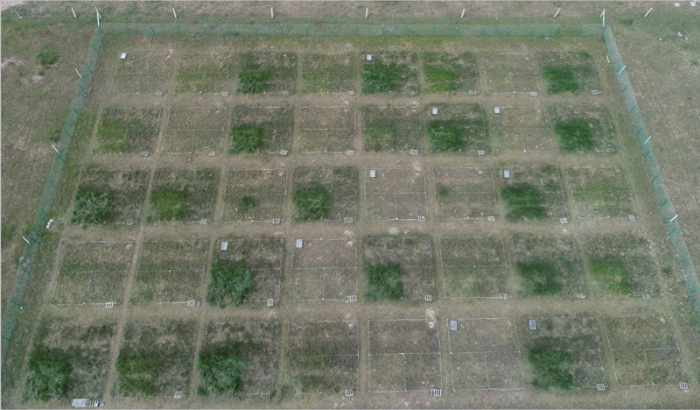
图1
青藏高原高寒草原多水平氮添加实验平台景观(刘洋摄)。该实验平台隶属于中国科学院植物研究所杨元合课题组, 位于青海省刚察县三角城种羊场, 开始于2013年5月, 涉及8个氮添加水平(0, 1, 2, 4, 8, 16, 24, 32 g·m-2·a-1), 所施氮肥类型为NH4NO3。
Fig. 1
Multi-level nitrogen (N) manipulation experiment in an alpine steppe on the Qingzang Plateau (photo credit: LIU Yang). This experiment was maintained by Dr. YANG Yuan-He’s group in Institute of Botany, Chinese Academy of Sciences, and located in Sanjiaocheng sheep farm, Gangca County, Qinghai Province. It was conducted since May 2013, with eight N levels (0, 1, 2, 4, 8, 16, 24, 32 g·m-2·a-1). The form of N fertilizer is NH4NO3.
为了系统反映学术界在该领域取得的进展, 本文从群落多样性等5个方面梳理了目前的研究进展, 并从根际过程对氮输入的响应等4个方面对未来研究提出了展望。通过上述总结, 本文试图阐明草地群落多样性与生态系统碳氮循环对多水平氮添加的响应机理, 进而为改进陆面过程模型提供实验依据。需要说明的是, 为了全面反映草地群落多样性和生态系统碳氮循环对氮输入的响应趋势, 本文同时也总结了无法用非线性衡量的相关指标。
1 氮输入对草地群落多样性的影响
1.1 氮输入对植物物种多样性的影响
外源氮输入对植物物种多样性的影响一直是全球变化领域关注的热点话题。早期来自英国草地氮沉降梯度的调查结果显示, 大气氮沉降速率每增加2.5 kg·hm-2·a-1会导致4 m2的样方内丢失一个物种(Stevens et al., 2004)。之后, 很多氮添加控制实验的研究结果证实了这一现象。其中比较有代表性的是Clark和Tilman (2008)在Cedar Creek的长期氮添加实验研究, 他们发现长期低水平氮添加会显著降低植物多样性, 尤其是导致稀有物种丧失。来自内蒙古温带草原(Zhang et al., 2014; Lan et al., 2015; Tian et al., 2016b; Yang et al., 2022; Zhao et al., 2022)和青藏高原高寒草原(Ma et al., 2021; Zhang et al., 2021a)的多水平氮添加实验也表明, 植物物种多样性随施氮量增加持续降低。与上述样点尺度的案例研究一致, 全球尺度的meta分析(Humbert et al., 2016; Midolo et al., 2019)和养分添加联网实验(Nutrient Network; Borer et al., 2014; Harpole et al., 2016; Seabloom et al., 2021)进一步证实草地植物物种多样性对外源氮输入的响应规律具有普适性。
氮输入导致的草地植物物种多样性降低主要与资源竞争和土壤酸化有关(Cleland & Harpole, 2010; DeMalach, 2018; Band et al., 2022; 张世虎等, 2022; 图2)。通常来讲, 施氮会缓解植物氮限制, 但会加剧植物光、磷和微量元素限制(Cleland & Harpole, 2010)。按照资源竞争排除理论, 氮添加引起的物种间限制资源趋同会降低生态位维度、加剧种间竞争, 最终导致群落多样性下降(Cleland & Harpole, 2010; Harpole et al., 2016)。以光资源竞争为例, 不少研究发现氮添加会促进喜氮植物生长, 提高冠层上方植物光拦截(Borer et al., 2014)以及光的不对称性(高大的植物每单位生物量获得的光资源比低矮的植物多; DeMalach et al., 2017; Xiao et al., 2021), 导致低矮且对光敏感的物种丢失。加光-加氮交互实验进一步证明植物冠层下方加光之后施氮处理下的群落多样性与对照没有显著差异, 为氮富集通过增加光竞争导致物种多样性丧失提供了直接证据(Hautier et al., 2009)。
图2
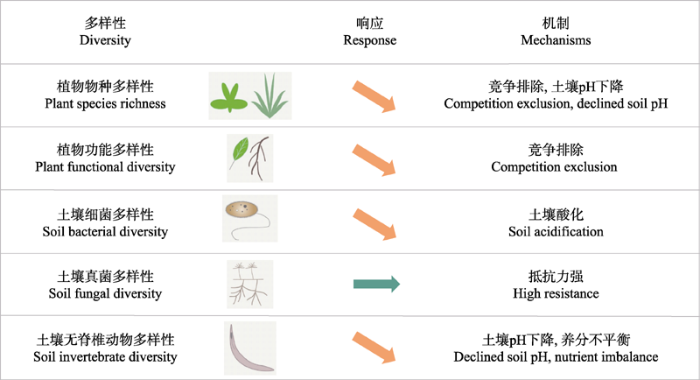
图2
多维度生物多样性对氮输入的响应及其主要机制。橙色箭头代表下降趋势,绿色箭头代表没有显著变化。
Fig. 2
Responses of multidimensional biodiversity to nitrogen input and their primary mechanisms. Orange arrows indicate downward trends, while green arrows indicate non-significant changes.
除了资源竞争排除, 施氮引起的土壤酸化也是导致草地植物物种多样性降低的重要原因。氮添加会降低土壤盐基离子含量(秦书琪等, 2018), 导致土壤酸化(Tian & Niu, 2015), 进而降低植物物种多样性(Lan & Bai, 2012; Zhang et al., 2014; DeMalach, 2018)。具体来讲, 对于酸性土壤, pH降低会活化土壤中的Al3+, 而Al3+的增加会抑制植物根系生长(即“铝毒”), 导致植物物种多样性下降(Horswill et al., 2008)。对于碱性土壤, pH降低会活化土壤中的Mn2+, 使植物叶片锰含量增加(Tian et al., 2016b); 而叶片锰含量的增加会抑制植物光合作用, 进而降低群落植物多样性(Tian et al., 2016b)。进一步研究发现, 施氮引起的土壤Al3+和Mn2+胁迫增强主要影响杂类草多样性: 随着施氮量增加, 禾草和莎草会通过扩大根鞘来增强植物对施氮引起土壤Al3+和Mn2+胁迫的耐受性; 而杂类草没有保护性根鞘, 使其对土壤Al3+和Mn2+胁迫增强的响应更为敏感, 从而导致其多样性随施氮量增加而降低(Tian et al., 2022)。此外, 一些研究还报道氮添加引起的植物种群更新限制(施氮后凋落物增加会抑制幼苗生长; Tilman, 1993)和元素化学计量失衡(氮磷比下降; Cleland & Harpole, 2010)等也会导致物种多样性下降。总体而言, 氮富集导致的草地植物物种多样性降低是上述多种机制共同作用的结果(Cleland & Harpole, 2010; Lan & Bai, 2012; DeMalach, 2018)。
1.2 氮输入对植物功能多样性的影响
植物功能性状是指可以反映植物对环境变化的适应策略, 也可以显著影响生态系统功能的植物属性(McGill et al., 2006; 刘晓娟和马克平, 2015; Faucon et al., 2017; He et al., 2019)。很多研究发现, 氮富集会改变植物形态和养分性状, 比如提高植物叶片和根系氮含量(Xia & Wan, 2008), 增加植株高度、叶面积和比叶面积(La Pierre & Smith, 2015; Zhang et al., 2019; 周一平等, 2020), 降低叶片和根系磷含量、根冠比、比根长和菌根侵染率等(Li et al., 2015; Deng et al., 2017; Zhang et al., 2019, 2021b)。施氮引起的植物物种多样性和功能性状的改变会影响植物功能多样性(物种间性状值的差异; Díaz et al., 2007; 图2)。理论上讲, 施氮引起的光和磷资源竞争的加剧会促进物种间竞争排除(Cleland & Harpole, 2010), 使植物物种多样性降低, 物种间性状值趋同, 导致植物功能多样性下降(Grime, 2006)。来自温带草原(王玉冰等, 2020)和高寒草原(Zhang et al., 2021a)多水平氮添加控制实验的结果均支持这一观点。然而, 也有研究报道了相反的响应规律(Niu et al., 2014; Xu et al., 2018), 认为施肥后光不对称性增加引起的禾草和杂类草光获取性状差异增加(Niu et al., 2014), 以及具有特异性状物种相对丰度的增加(Xu et al., 2018)使得性状功能多样性增加。不同研究中观察到的植物功能多样性对氮富集的响应差异可能与群落物种组成不同有关(Xu et al., 2018; Zhang et al., 2019)。
1.3 氮输入对土壤微生物多样性的影响
氮添加会改变土壤微生物多样性, 但不同微生物类群的响应存在差异(图2)。尽管Cedar Creek长期氮添加实验(Ramirez et al., 2010; Fierer et al., 2012)和Nutrient Network联网实验(Leff et al., 2015)均报道施氮并未显著影响土壤细菌多样性, 但meta分析的结果显示外源氮输入会降低土壤细菌多样性(Wang et al., 2018)。来自内蒙古温带草原(Yao et al., 2014; Zeng et al., 2016; 刘红梅等, 2019)和青藏高原高寒草原(Zhang et al., 2021a)的多水平氮添加实验也发现土壤细菌多样性随着施氮量的增加呈线性或者指数下降趋势。这些研究还发现, 施氮引起的土壤酸化是导致土壤细菌多样性丧失的主要因素(Koyama et al., 2014; Liu et al., 2020)。对于真菌而言, 尽管有研究报道施氮导致草地土壤真菌多样性降低(Wang et al., 2018), 但多数氮添加实验并未观察到土壤真菌多样性沿氮添加梯度的显著变化(McHugh et al., 2017; Liu et al., 2021; Zhang et al., 2021a), 这可能是由于真菌对环境变化的抵抗力比细菌更强所致(Strickland & Rousk, 2010)。除了微生物多样性, 氮添加也会改变土壤动物多样性。内蒙古温带草原(Chen et al., 2015)和青藏高原高寒草原(Zhang et al., 2021a)多水平氮添加实验的研究显示, 土壤线虫等无脊椎动物多样性沿氮添加梯度持续下降。伴随着土壤细菌和无脊椎动物多样性的变化, 土壤生物整体多样性也会随施氮量增加呈下降趋势(Zhang et al., 2021a)。施氮导致的土壤酸化、磷及微量元素限制是导致土壤动物多样性以及整体生物多样性下降的主要原因(Mulder & Elser, 2009; Chen et al., 2015; Nessel et al., 2021)。
2 氮输入对草地植被生产力的影响
2.1 氮输入对生态系统生产力的影响
生产力是草地生态系统功能的核心与基础(Migliavacca et al., 2021)。氮饱和假说认为, 低氮情景下净初级生产力(NPP)随氮输入量增加呈增加趋势, 并在氮输入达到氮饱和点时出现峰值; 当氮输入超过氮饱和点之后NPP下降(Aber et al., 1989, 1998)。和氮饱和假说一致, 来自氮添加控制实验的观测证据显示草地生态系统地上净初级生产力(ANPP)随氮输入量增加整体呈现“先上升后饱和”的变化趋势(Tilman, 1993; Bowman et al., 2006; Bai et al., 2010; Tian et al., 2016b; 图3)。然而, 不同研究中观察到的氮饱和阈值存在差异, 全球尺度上ANPP的氮饱和阈值随年降水量的增加而增加, 平均值为15.0 g·m-2·a-1 (Peng et al., 2020)。类似地, 总初级生产力(GPP)和净生态系统生产力(NEP)随施氮量的增加可能呈“先上升后饱和” (Tian et al., 2016a)或者单峰趋势(Peng et al., 2017c; Song et al., 2017; 董斅晓等, 2019), 并且氮饱和阈值的大小在不同研究中差异较大, 范围处于1.75-15 g·m-2·a-1之间。
图3
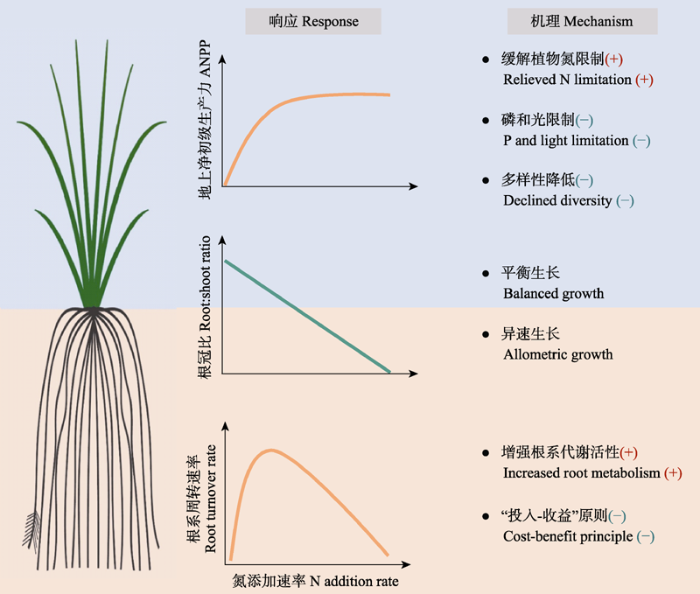
图3
植被生产力及其分配对氮输入的响应及其主要机制。正号表示氮输入的促进效应, 负号表示氮输入的抑制效应。
Fig. 3
Responses of vegetation productivity and its allocation to nitrogen (N) input and their primary mechanisms. ANPP, aboveground net primary productivity; P, phosphorus. The positive sign means the stimulating effects of N input, and vice versa.
生态系统生产力对氮添加非线性响应的原因可以概括为以下3个方面: 1)高氮引起的磷限制会导致氮对生产力的促进效应减弱。比如, 在青藏高原高寒草原, 随着氮添加量增加植物磷限制的加剧是导致ANPP、GPP和NEP响应下降的主要原因(Peng et al., 2017c)。全球尺度分析的结果也证实, 施氮引起的植物氮磷比变化能够较好地解释ANPP的非线性响应趋势(Peng et al., 2019a)。2)光限制也是导致生态系统生产力响应下降的重要因素。施氮引起植物地上生物量增加, 进而促进凋落物积累, 凋落物量增加会通过遮阴作用降低群落中低矮植被光资源的可获取性, 从而降低生态系统光合碳固定(Seabloom et al., 2021)。3)高氮引起的植物物种多样性和功能多样性下降也能解释生态系统生产力的非线性响应。来自明尼苏达州Cedar Creek的温带草原和青藏高原高寒草甸的多水平氮添加实验均显示, 高氮水平下生态系统生产力响应的下降主要与植物物种多样性的丢失有关(Isbell et al., 2013; Ma et al., 2020)。除了物种多样性, 近期研究还强调功能多样性的调控作用。来自青藏高原高寒草原的研究显示, 沿氮添加梯度植物叶片磷含量功能多样性下降引起的光和磷在植物冠层分配的不匹配, 导致光利用效率和磷利用效率显著降低。同时, 叶面积增加引起的群落光拦截增加的正效应, 以及叶片磷含量功能多样性下降引起的光和磷利用效率下降的负效应, 共同导致生态系统生产力沿氮梯度呈“先上升后下降”的趋势(Zhang et al., 2019)。
2.2 氮输入对生产力地上-地下分配的影响
根冠比是刻画生产力地上-地下分配的重要指标(Müller et al., 2000)。按照目前的研究, 草地植物根冠比随施氮量增加呈现出“先上升后饱和” (Wei et al., 2013)、指数下降(Clark et al., 2009; He et al., 2013; Peng et al., 2017c)和无显著变化(辛小娟等, 2014) 3种趋势, 但总体上以“下降趋势”为主(Clark et al., 2009; Fornara & Tilman, 2012; He et al., 2013; Peng et al., 2017c; 图3)。“平衡生长假说”和“异速生长假说”是目前用于解释生产力地上-地下分配规律的两种代表性假说(Shipley & Meziane, 2002; McCarthy & Enquist, 2007; 平晓燕等, 2010)。其中, 平衡生长假说认为, 外源氮输入引起的土壤氮有效性增加会缓解草地植物氮限制(Fay et al., 2015), 进而使得植物会将更大比例的碳水化合物分配至地上部分来竞争更多光资源(Weiner, 2004), 从而导致根冠比降低(Cleland et al., 2019)。异速生长假说则认为, 生产力地上-地下分配的斜率不受环境条件变化的影响, 但其截距存在变异。由于施氮与对照条件下地上-地下分配关系截距的差异, 碳向地上部分的分配量高于根系(异速生长), 因此根冠比下降(韩文轩和方精云, 2008; Peng & Yang, 2016)。
2.3 氮输入对根系生产力及其周转的影响
根系生产和周转是植物向土壤输送碳氮的重要途径。外源氮输入通常会降低草地根系生产量(Picek et al., 2008; 字洪标等, 2018; Wang et al., 2019a; 刘洋等, 2021)。来自内蒙古温带草原和青藏高原高寒草原的多水平氮添加控制实验结果表明, 根系生产力随着施氮量的增加分别呈指数衰减(Wang et al., 2019a)和线性下降趋势(刘洋等, 2021)。根系生产力的降低主要与植物地上和地下部分碳的分配有关。根据最优分配理论(Chapin III et al., 1987), 氮限制植物生长的情景下植物会将更多的光合产物分配至根系以满足其氮需求; 反之, 植物则会降低生产力向地下分配的比例。氮输入背景下,植物氮限制缓解会导致分配至根系的碳水化合物比例降低, 进而导致根系生产量下降(刘洋等, 2021)。
按照目前的研究, 草地根系周转速率随氮输入量增加呈“先上升后下降”的单峰趋势(字洪标等, 2018; 刘洋等, 2021; 图3)。导致这一响应格局的可能原因如下: 由于草地植物生长通常受氮限制(LeBauer & Treseder, 2008), 适量氮添加会提高根系代谢活性用以吸收更多的水分和养分(Peng et al., 2017a), 进而加快根系周转速率。然而, 随着氮输入的持续增加, 特别是当土壤氮可利用性满足植物氮需求时, 植物向根系投入的碳比例下降(Chapin III et al., 1987)。在有限碳投入情景下, 根据“投入-收益”原则(Burton et al., 2000; Peng et al., 2017b), 植物通过延长根系寿命获得的收益(如吸收养分和水分)大于维持根系生长付出的成本(消耗光合产物)。因此, 根系为了维持其寿命会降低其周转速率(Burton et al., 2000; 郭大立和范萍萍, 2007)。
3 氮输入背景下的草地碳分解过程
3.1 氮输入对凋落物分解的影响
凋落物分解会影响土壤有机质形成等生态系统关键过程(Wardle, 2002; Jackson et al., 2017)。多水平氮添加控制实验发现凋落物分解速率沿氮添加梯度呈现“指数衰减趋势” (Wei et al., 2022)、“线性增加” (Liu et al., 2006; Gong et al., 2020; Silva et al., 2020; Hou et al., 2021)或“无显著变化” (文海燕等, 2017)等多元响应。不同研究从多个角度解释了凋落物分解对外源氮输入的多元响应规律。氮输入可以通过改变土壤温度、pH、凋落物质量、土壤微生物生物量和胞外酶活性等非生物和生物因素影响凋落物分解(杨丽丽等, 2017)。其中, 氮输入引起的土壤pH、凋落物质量和微生物酶活性变化被认为是外源氮输入促进凋落物分解过程的关键因素。一方面, 氮输入可以通过降低凋落物碳氮比(C:N)来促进其分解(Hobbie et al., 2012)。同时, 氮输入引起的土壤酸化通过增加土壤锰元素的有效性促进过氧化物酶活性, 进而氧化和解聚木质素等难降解化合物, 最终也会促进凋落物分解(Berg, 2014; Berg et al., 2015; Hou et al., 2021)。另一方面, 微生物掘氮假说被用于解释凋落物分解速率沿施氮梯度的下降趋势。该假说认为, 微生物通过降解易分解碳源获得能量, 进而合成并分泌木质素降解酶来分解木质素等难分解的有机质获取氮; 当土壤氮可利用性满足微生物的氮需求时, 微生物则会减少这些胞外酶的产生(Moorhead & Sinsabaugh, 2006; Craine et al., 2007; Entwistle et al., 2018), 最终导致凋落物分解速率下降。此外, 来自青藏高原高寒草原的研究发现, 施氮引起的冠层光拦截增加和土壤细菌多样性下降可以通过减弱非生物光降解和生物降解过程抑制凋落物分解, 导致凋落物分解速率沿氮添加梯度呈指数衰减趋势(Wei et al., 2022)。
3.2 氮输入对土壤呼吸的影响
土壤呼吸是生物圈与大气圈之间的第二大气体交换通量, 在陆地生态系统碳循环中起着关键作用(Luo & Zhou, 2006)。按照目前的研究, 土壤呼吸与氮添加量之间的关系呈多样化趋势, 二者的关系大致可分为以下5种类型: 单调递增(Luo et al., 2016)、单调递减(Ward et al., 2017; Wang et al., 2019b)、单峰(Peng et al., 2017a; Wang et al., 2020)、U形(Picek et al., 2008)和无显著关系(Raposo et al., 2020)。通过文献meta分析, 发现土壤呼吸与施氮量的关系以单峰趋势为主(刘洋等, 未发表数据)。
土壤呼吸随施氮量的变化趋势主要受自养呼吸和异养呼吸两种组分变化的驱动。其中, 自养呼吸沿氮梯度一般呈单峰趋势(Peng et al., 2017a; 图4)。这一趋势主要与植物光合作用沿着氮梯度的变化趋势有关。低水平氮添加会缓解植物氮限制, 促进植物光合作用(LeBauer & Treseder, 2008; Peng et al., 2020)。在此情景下, 植物向根系投入更多的光合产物, 导致低氮水平下自养呼吸随氮添加量的增加而增加(Fornara & Tilman 2012; Peng et al., 2017a)。然而, 随着施氮量的持续增加, 土壤中过量的NH4+离子和NO3-离子会对植物生长产生抑制作用(Marschner, 2012)。同时, 施氮引起的土壤pH下降以及盐基离子的淋溶也可能不利于植物生长(Chen et al., 2016)。上述几个方面均可能会抵消氮输入对植物生长的促进作用, 最终导致自养呼吸速率下降。
图4
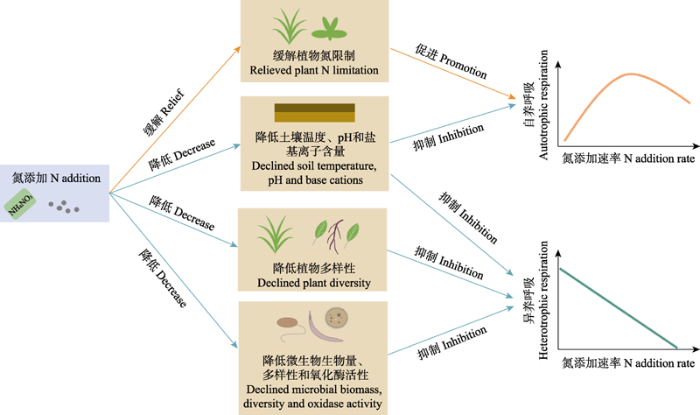
图4
土壤呼吸对氮输入的响应及其主要机制。
Fig. 4
Responses of soil respiration to nitrogen (N) input and their primary mechanisms.
不同草地生态系统中均观察到异养呼吸沿氮梯度的下降趋势(Peng et al., 2017a; Yang et al., 2019; Wang et al., 2020; 图4)。尤其是, 高氮处理下异养呼吸的下降较为明显。导致这种响应格局的可能机制包括以下4个方面。1)氮富集会通过降低土壤温度、pH及盐基离子含量影响异养呼吸(Chen et al., 2016; Peng et al., 2017a)。2)高氮输入可能增加微生物碳利用效率(Riggs & Hobbie, 2016)、增强微生物碳限制(Ning et al., 2021)、降低微生物生物量(Zhang et al., 2018)和微生物多样性(Zhang et al., 2021a)以及抑制酚氧化酶活性(Riggs & Hobbie, 2016), 从而降低异养呼吸。3)氮富集下植物功能多样性下降会使得土壤异养呼吸降低。鉴于不同土壤生物偏好的底物存在差异, 较高的植物多样性能为分解者提供多样化的底物, 进而使得土壤异养呼吸速率较高(Gessner et al., 2010; McGuire et al., 2010; Chen et al., 2019a)。然而, 氮富集导致植物功能多样性降低使得植物向分解者提供的底物趋同(Zhang et al., 2021a), 且氮输入引起的可分解性更高的物种丢失导致土壤中的底物以难分解物质为主(Yang et al., 2019), 进而导致异养呼吸下降。4)氮进入土壤后会与有机质结合, 形成含氮的杂环化合物(如吲哚)或者酚类物质, 使得土壤微生物更难分解此类有机质, 造成异养呼吸下降(Janssens et al., 2010)。
3.3 氮输入对土壤碳激发效应的影响
激发效应(priming effect)是指凋落物、根系分泌物等外源碳的输入促进或者抑制土壤有机碳分解的现象(Kuzyakov et al., 2000; Kuzyakov & Gavrichkova, 2010; 孙悦等, 2014), 在土壤碳循环中起着关键作用(Cheng et al., 2014)。单个水平的氮添加控制实验结果显示, 氮输入可能会促进(Mganga & Kuzyakov, 2018; Song et al., 2018)、抑制(Foereid et al., 2004; Li et al., 2018; Hicks et al., 2019), 或者并不影响土壤碳激发效应(Di Lonardo et al., 2019); 而meta分析的结果显示, 氮添加整体会抑制草地土壤碳激发效应(Feng & Zhu, 2021)。和单个水平的氮添加控制实验类似, 多水平氮添加控制实验结果也存在较大差异: 激发效应沿氮梯度显著降低(Liu et al., 2018)或者无显著变化(Zhang et al., 2020a)。
微生物掘氮假说和微生物化学计量学假说通常用于解释氮输入背景下激发效应的变化(Craine et al., 2007; Chen et al., 2014; 程淑兰等, 2018)。如前文所述, 微生物掘氮假说认为, 随着土壤氮有效性增加, 土壤微生物可以直接利用外源有效氮而较少分解土壤有机质以获取氮源(Moorhead & Sinsabaugh, 2006; Craine et al., 2007; Chen et al., 2014; 孙悦等, 2014; Liu et al., 2018), 进而导致激发效应强度降低。而微生物化学计量学假说则认为, 当碳、氮添加符合土壤微生物生长需求时, 微生物活性最高, 有机碳分解速率最大, 进而会产生较强的激发效应(Hessen et al., 2004; Craine et al., 2007; Chen et al., 2014)。
除了上述两种假说, 也有研究尝试从土壤微生物群落结构、微生物代谢效率等角度探究氮输入对激发效应的影响机制。从土壤微生物群落结构来看, 相较于以细菌为代表的r策略微生物而言, 以真菌为代表的K策略微生物能产生氧化酶利用难分解碳, 更能促进土壤有机质分解而产生较强的激发效应(Li et al., 2018; Liu et al., 2018)。随着外源氮输入的增加, 真菌生物量和真菌细菌比下降(Liu et al., 2018), r策略微生物主导了易分解碳的分解, 使得K策略微生物在种间竞争中处于劣势, 最终导致土壤碳激发效应降低(Fontaine et al., 2011; Garcia-Pausas & Paterson, 2011)。然而, 也有研究显示K策略微生物也能在高氮环境下参与易分解碳的同化, 导致激发效应在不同氮水平之间没有显著差异(Zhang et al., 2020a)。从土壤微生物代谢效率来看, 当外源氮输入增加时, 土壤微生物群落为了平衡其生物量C:N会提高碳利用效率, 进而导致激发效应减弱(Chen et al., 2018b; Liu et al., 2018)。总体来讲, 氮输入背景下参与激发效应的关键微生物类群及其潜在调控机制仍不明确, 需要更多深入系统的研究。
3.4 氮输入对土壤微生物碳利用效率的影响
微生物碳利用效率(carbon use efficiency, CUE)指土壤微生物将从土壤有机质中获取的碳转化为生物量碳的效率, 是调控土壤碳动态的重要生理参数(Manzoni et al., 2012; Sinsabaugh et al., 2013)。按照目前的研究, 施氮会促进(Spohn et al., 2016; Poeplau et al., 2019)、抑制(Luo et al., 2020)或者并不显著改变CUE (Widdig et al., 2020)。与这些单个水平的氮添加控制实验不同, 多梯度的氮添加实验一致表明微生物CUE沿施氮梯度呈线性增加趋势(Liu et al., 2018; Yuan et al., 2019; Feng et al., 2022)。不同研究中观察到CUE对施氮响应的差异可能与外源氮输入通过提高土壤碳氮可利用性、改变土壤微生物群落组成等多种途径调控CUE有关。一方面, 氮添加引起的土壤碳氮可利用性增加和土壤微生物群落变化可能会提高CUE (Manzoni et al., 2012)。根据化学计量内稳性理论, 土壤微生物会通过提高CUE来增加体内碳含量, 进而在高氮环境中维持体内的碳氮平衡(Sterner & Elser, 2002; Manzoni et al., 2017)。同时, 氮输入背景下土壤碳可获取性会随着矿物保护作用的减弱而增加, 进而会导致土壤微生物CUE增加(Feng et al., 2022)。此外, 氮输入可能会导致土壤微生物群落向富营养型转变, 进而提高土壤微生物群落对易分解碳源的CUE (Liu et al., 2018)。另一方面, 氮输入也可能通过改变土壤微生物群落组成或增强土壤环境胁迫等途径导致CUE下降。其中, 施氮可能促进快速生长型微生物(如革兰氏阴性细菌G-)的生长(Luo et al., 2020), 增加其在维持代谢中的能量投入(Fierer et al., 2007), 最终降低土壤微生物群落CUE。此外, 土壤微生物可能会增加耗能代谢途径以克服氮输入引起的环境胁迫(如土壤酸化、铵毒、铝毒、营养性盐基离子缺乏等; Treseder, 2008), 进而导致CUE下降(Jones et al., 2019; Horn et al., 2021)。
3.5 氮输入对土壤CH4通量的影响
草地土壤是重要的CH4汇(Peng et al., 2019b; Raposo et al., 2020; Zhang et al., 2020b), 其吸收强度受温度、降水、土壤质地和氮有效性的影响(Bodelier & Laanbroek, 2004; Yvon-Durocher et al., 2014; Kou et al., 2017)。早期很多研究报道活性氮输入会抑制土壤CH4吸收(King & Schnell, 1994; Liu & Greaver, 2009), 但也有一些研究发现较低的氮输入可能会促进土壤CH4氧化(Bodelier et al., 2000)。通过分析氮添加对全球干旱生态系统土壤CH4吸收的影响, Aronson和Helliker (2010)发现低氮和高氮处理分别促进和抑制CH4吸收。在这些研究的基础上, Peng等(2019b)基于野外氮添加梯度控制实验和meta分析等相结合的手段, 量化了土壤CH4吸收速率与氮添加量的关系, 发现CH4吸收速率随施氮量呈“先上升后下降”的变化趋势。
CH4氧化菌对不同氮水平的响应差异是导致草地土壤CH4吸收速率与施氮量之间单峰函数关系的主要原因。具体来讲, 由于草地土壤微生物受氮限制, 适量氮添加会促进CH4氧化微生物生长及活性, 进而促进CH4吸收速率。Peng等(2019b)在青藏高原高寒草原的氮添加实验发现, 低水平氮输入虽然没有改变土壤CH4氧化菌丰度, 但增加了其活性, 表明低氮输入通过改变CH4氧化酶活性而不是CH4氧化菌丰度来调控CH4氧化过程。高氮输入导致CH4吸收速率的降低主要存在3种可能机制: 1) CH4氧化菌不仅氧化CH4, 也会氧化土壤中的氨, 并且对氨的亲和力高于CH4。施氮增加土壤中氨的含量, 使CH4氧化菌优先氧化氨, 从而降低CH4氧化速率(Bodelier & Laanbroek, 2004; 方华军等, 2014; 潘红等, 2022)。2)氨氧化过程中的中间产物, 比如羟胺和亚硝酸盐, 会对CH4氧化菌产生毒害作用, 导致CH4氧化速率下降(Bodelier & Laanbroek, 2004; 方华军等, 2014)。3)施氮后土壤中的铵盐和硝酸盐浓度大幅增加, 通过产生渗透胁迫抑制CH4氧化菌生长, 从而降低CH4氧化速率(Bodelier & Laanbroek, 2004; 方华军等, 2014)。
尽管草地土壤以吸收CH4为主, 但一些季节性淹水草地也会释放CH4。整体而言, 外源氮输入对草地土壤CH4释放有促进作用(Liu & Greaver, 2009), 并且随着氮添加量的上升, 土壤CH4排放速率呈线性增加趋势, 这主要是由于氮富集有利于CH4产生菌的生长所致(Vivanco et al., 2015)。一方面, 氮输入能缓解土壤微生物氮限制, 有利于CH4产生菌的生长, 因此促进土壤CH4产生; 另一方面, 氮添加提高植物光合作用, 使得较多的光合产物运输至根系, 增加根系分泌物量, 为CH4产生菌提供更多的碳源, 进而促进CH4释放(Irvine et al., 2012)。
4 氮输入对土壤碳库及其组分的影响
土壤是陆地生态系统最大的碳库(Lal, 2004; Jackson et al., 2017), 理解土壤有机碳库及其组分对外源氮输入的响应及其机制对于准确预测未来气候变化至关重要(Neff et al., 2002; Maaroufi et al., 2019; 付伟等, 2020)。尽管meta分析的结果显示氮添加总体会增加草地土壤碳库(Yue et al., 2016; Chen et al., 2018a; Deng et al., 2018; Lu et al., 2021; Xu et al., 2021), 但基于Nutrient Network的研究表明氮添加并未改变草地土壤碳库(Crowther et al., 2019; Keller et al., 2022)。上述差异可能与Nutrient Network报道的短期(2-4年(Crowther et al., 2019)或者9-10年(Keller et al., 2022)氮添加效应有关。和这一推论一致, 多梯度氮添加实验显示中短期氮添加(小于10年)通常难以观察到土壤有机碳库的显著变化(Song et al., 2014; Chen et al., 2021), 而10年以上施氮处理的研究则发现土壤碳库随氮添加梯度呈现“先增加后饱和”的响应规律(Fornara & Tilman, 2012; Ye et al., 2018)。
除了碳库大小, 氮添加也会改变草地土壤有机碳的物理和化学组分。从化学组分来看, 氮添加会增加土壤中的木质素和纤维素含量, 但对蛋白类、酚类和非结构性碳类化合物的含量无显著影响(Liu et al., 2016)。从物理组分来看, 来自热带稀树草原(Tripathi et al., 2008)和温带草地(Song et al., 2014; Ye et al., 2018)的研究均发现氮添加会促进土壤中颗粒态有机碳或大团聚体中碳的积累。然而, 与颗粒态有机碳相比, 矿物结合态碳库或微团聚体结合碳沿氮添加梯度的变化存在较大差异: 增加(Tripathi et al., 2008; Chen et al., 2018a)、不变(郑娇娇等, 2012; 凌小莉等, 2021; Lu et al., 2021; Keller et al., 2022)或下降(Ye et al., 2018)的结果均有报道。
土壤碳库及其组分的变化取决于植物生长介导的碳输入和土壤微生物分解介导的碳输出过程之间的平衡(Davidson & Janssens, 2006)。氮添加导致的土壤有机碳库和颗粒态有机碳库的增加主要由三方面的原因所致(图5)。首先, 氮添加会显著促进植物生长, 增加凋落物和根系残体的输入(Neff et al., 2002; Song et al., 2014; Chen et al., 2018a; Ye et al., 2018; 凌小莉等, 2021), 造成植物来源的碳输入增加, 进而引起颗粒态有机碳库和总有机碳库的积累(Fornara & Tilman, 2012; Ziter & MacDougall 2013; Ye et al., 2018)。植物生产力随着氮梯度的非线性响应可能导致土壤颗粒态有机碳库和总有机碳库呈现“先增加后饱和”的响应趋势(Song et al., 2014)。其次, 氮添加引起的土壤酸化、铝毒和土壤碱性盐基离子的降低会导致土壤微生物生物量下降(Ye et al., 2018), 进而抑制土壤微生物对颗粒态有机碳的降解(Song et al., 2014; Lu et al., 2021)。再次, 氮添加通常会显著降低真菌生物量和微生物分泌的氧化酶活性(贺云龙等, 2018; Lu et al., 2021), 进而导致降解难分解化合物的土壤微生物比例及活性下降, 最终造成土壤总有机碳的积累(Fornara & Tilman, 2012)。
图5
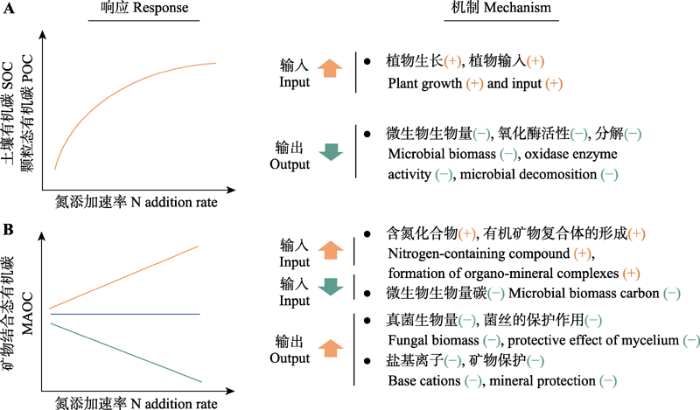
图5
不同土壤碳组分对氮输入的响应及其主要机制。向上的箭头或者正号表示氮添加的促进效应, 反之则表示氮添加的抑制效应。
Fig. 5
Responses of various soil carbon fractions to nitrogen input and their primary mechanisms. MAOC, mineral-associated organic carbon; POC, particulate organic carbon; SOC, soil organic carbon. The arrow-up or positive sign means the stimulating effects of nitrogen input, and vice versa.
和土壤总有机碳库和颗粒态有机碳库相比, 土壤矿物结合态碳库的变化更多与矿物-有机质复合体的形成与分解有关(图5)。研究表明, 氮添加可能通过降低矿物结合碳的输入, 并增加其输出导致矿物结合态有机碳库的下降(Ye et al., 2018)。这种下降趋势主要与以下3种途径有关: 1)考虑到矿物结合态碳是以微生物来源碳为主的碳组分, 氮添加引起的土壤微生物生物量碳的下降也可能是导致矿物结合碳库下降的重要原因(Song et al., 2014); 2)氮输入导致的真菌及其菌丝数量的下降会降低土壤中受团聚体保护的矿物结合态碳库的稳定性, 进而促进其分解; 3)氮添加导致土壤酸化和碱性盐基离子(Ca2+、Mg2+)下降, 会减弱矿物对土壤有机碳的保护作用, 加速矿物结合态碳库的分解(Ye et al., 2018)。然而, 也有研究认为如果氮输入对土壤pH和碱性盐基离子的影响不足以改变矿物对土壤有机碳的保护作用, 则会导致氮输入情景下矿物结合态碳相对稳定(Keller et al., 2022)。此外, 还有研究报道氮添加有利于土壤有机质和氮发生缩合反应, 促进植物来源碳进入矿物有机质复合体(Chen et al., 2018a); 氮添加还可能促进更多含氮化合物的产生, 有利于矿物-有机质复合体的形成(Chen et al., 2018a), 进而造成土壤矿物结合态碳含量的积累。
5 氮输入对草地生态系统氮循环的影响
5.1 氮输入对植物氮吸收的影响
外源氮输入会促进植物氮吸收(Fornara & Tilman, 2012; Peng et al., 2018)。不论是在我国温带草原(Song et al., 2011)、高寒草原(Peng et al., 2018), 还是在北美大草原(Fornara & Tilman, 2012), 植物氮吸收量均随着氮添加量的增加呈“先上升后饱和”的趋势。基于野外原位15N同位素标记实验也发现, 15N回收率与氮添加量呈对数增加的关系(Bowman et al., 2006; Song et al., 2011)。植物氮吸收量均随着氮添加量产生这种变化趋势的原因与生态系统生产力类似。由于自然状态下草地生态系统普遍受到氮限制, 低氮添加在短期内提高土壤氮有效性, 有助于根系对氮的吸收并转移至地上部, 促进叶片光合作用, 合成更多的碳水化合物并运输至根系, 进一步促进植物氮吸收; 而随着氮输入量的不断增加, 土壤有效氮含量超过植物氮需求, 植物氮吸收量将逐渐趋于平稳甚至下降, 达到氮饱和状态(Aber et al., 1989, 1998)。
5.2 氮输入对土壤氮转化过程的影响
土壤氮转化过程(包括氮矿化、硝化、反硝化作用、微生物固持等) (Booth et al., 2005; Chapin III et al., 2011)决定着土壤无机氮的总量及其比例, 进而会影响生态系统功能(Lu et al., 2011; Niu et al., 2016)。以往的研究表明, 氮输入对草地土壤净氮转化过程的影响呈现多样化格局: 沿氮添加梯度土壤净氮矿化速率呈现先增加后下降的响应(Chen et al., 2019b); 净硝化速率则呈现先增后降或指数增加的变化趋势(Cao et al., 2020)。土壤净氮矿化速率对氮输入的响应主要由土壤碳氮含量增加的促进作用以及土壤pH下降的抑制作用共同决定(Tian & Niu, 2015; Jian et al., 2016; Chen et al., 2019b; 陆姣云等, 2022)。与净氮矿化速率相似, 氮输入对净硝化速率的促进/抑制作用主要由土壤铵态氮含量和氨氧化微生物丰度增加或土壤pH下降驱动(Tian & Niu, 2015; Carey et al., 2016; 陆姣云等, 2022)。
相对于净氮转化过程, 目前仅有少数研究关注土壤总氮转化过程随氮添加梯度的变化趋势。按照目前的研究, 土壤总氮矿化速率、总硝化速率和微生物固持速率随氮输入量增加分别呈现先增加后饱和、线性增加和先增加后下降的变化趋势(Mao et al., 2021; Wang et al., 未发表数据)。这些观测证据并不完全支持Aber等(1998)预测的氮矿化速率沿着氮添加梯度“先增加后下降”的响应, 以及硝化速率随氮输入“先快速增加后变缓”的趋势。其中, 总氮矿化速率沿氮梯度呈“先增加后饱和”的趋势主要与植被生产力对氮输入的饱和响应有关, 这主要是因为植被生产力直接决定着土壤中植物来源有机氮的输入量(Chapin III et al., 2011; Mao et al., 2021)。总硝化速率沿氮梯度的线性增加趋势则主要与土壤NH4+含量以及功能微生物(氨氧化细菌和氨氧化古菌)丰度增加有关(Carey et al., 2016)。此外, 微生物固持速率沿氮梯度变化趋势主要由土壤微生物生物量的变化驱动。低水平氮输入对植被生产力的促进作用会增加土壤碳输入量, 促进微生物生长, 提高微生物生物量(Jian et al., 2016; Zhang et al., 2020c)。然而, 高水平氮输入下土壤pH的降低, 以及土壤NH4+积累引起的微生物铵毒害, 会降低微生物生物量(Omar & Ismail, 1999; Zhang et al., 2018)。因此, 土壤微生物生物量随氮输入量增加的非线性变化趋势导致微生物固持速率呈“先增加后下降”的响应(Mao et al., 2021)。
5.3 氮输入对N2O通量的影响
活性氮输入是土壤N2O排放量增加的重要原因(Kim et al., 2013; Shcherbak et al., 2014; 王霞等, 2021)。多水平氮添加实验研究发现, 随着氮输入量的持续增加, N2O排放速率呈指数增加趋势(Zhang & Han, 2008; Cardenas et al., 2010; Kim et al., 2010; Hoben et al., 2011)。通过整合全球3个以上氮水平研究, Shcherbak等(2014)发现土壤N2O排放速率与施氮量的指数关系在包括草地生态系统在内的陆地生态系统中普遍存在(图6A), 符合氮饱和假说的预测(Aber et al., 1989)。出现这种指数关系的原因是, 随着施氮量增加, 土壤氮有效性不断增加。在氮添加初始阶段, 由于植物和土壤微生物均受到氮限制, 二者会竞争土壤中的可利用氮, 导致硝化和反硝化微生物的底物数量受限, 因此N2O排放速率上升幅度较低; 然而, 随着施氮量的不断增加, 土壤有效氮含量超过植物的氮需求时, 大量氮残留在土壤中, 这部分氮会更多地被硝化和反硝化微生物利用, 进而释放大量N2O, 从而致使N2O排放速率随着施氮量呈现指数上升趋势(Kim et al., 2013)。
图6
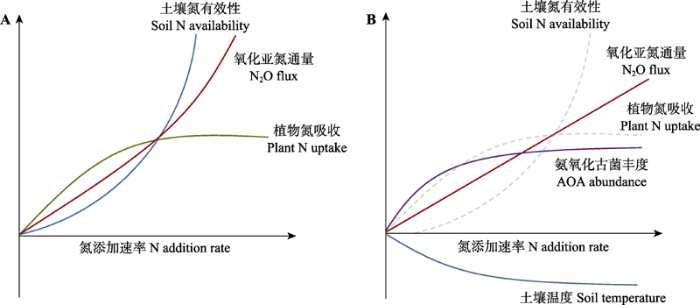
图6
热带-温带草地(A)和高寒草地(B)生态系统土壤N2O排放对氮输入的响应及主要其机制。
Fig. 6
Responses of nitrous oxide (N2O) emissions to nitrogen (N) input and their primary mechanisms in tropical and temperate (A) as well as alpine grasslands (B). AOA, ammonia-oxidizing archaea.
尽管以上研究促进了学术界对N2O排放与施氮量的关系及其机制的认识, 但已有的报道主要集中在热带(Raposo et al., 2020)和温带草地(Zhang & Han, 2008; Hoben et al., 2011), 来自高寒草地的观测证据较少。在青藏高原高寒草原, Liu等(2013)发现土壤N2O排放速率沿氮添加梯度并未出现指数增长的趋势, 而是呈“先上升后饱和”的变化趋势。另外一项来自高寒草原的研究也发现, 随着施氮量的增加, 土壤N2O排放速率线性增加; 即使施氮量超过了植物最大氮吸收量, N2O的排放速率也没有急剧上升(Peng et al., 2018; 图6B)。通过进一步分析, 该研究发现施氮之后植物生长的加快使得冠层郁闭度增加, 到达地表的太阳辐射强度降低, 导致土壤温度下降(Peng et al., 2018)。高施氮处理下, 土壤温度降低会抑制硝化微生物(氨氧化古菌)的生长, 进而减弱了N2O释放对氮添加的正响应(Peng et al., 2018)。这表明施氮引起的土壤温度变化显著影响了高寒生态系统N2O排放, 即温带生态系统中得到的土壤N2O排放速率与施氮量的关系不能简单地推广至高寒生态系统。
6 结论和展望
6.1 结论
通过梳理相关文献, 本文从群落多样性、植被生产力、碳分解过程等方面总结了草地群落多样性与生态系统碳氮循环对氮输入的非线性响应特征及其驱动机制, 主要得出如下结论:
1)外源氮输入导致草地植物物种多样性和功能多样性下降, 降低土壤细菌多样性, 对真菌多样性的影响较弱。其中, 植物物种和功能多样性的下降主要由资源竞争和土壤酸化两种机制驱动, 而土壤细菌多样性的下降则更多与土壤酸化有关。
2)地上生产力随施氮量增加呈“先上升后饱和”的变化规律, 根系生产量和根冠比呈下降趋势, 根系周转速率则呈“先上升后下降”的单峰格局。施氮引起的资源限制增强以及植物物种多样性和功能多样性下降是导致地上生产力对氮添加呈现非线性响应的重要原因, 而地下生产力沿氮添加梯度的下降则与更多的同化产物向地上分配有关。
3)凋落物分解速率沿氮添加梯度表现出“指数衰减、线性增加、无显著变化”的多元响应, 而土壤呼吸以及CH4吸收速率与施氮量的关系则以“低氮促进、高氮抑制”的单峰趋势为主; 土壤微生物CUE随施氮量增加呈线性增加的变化特征, 而土壤碳分解激发效应沿氮添加梯度的变化尚未取得一致的研究结果。其中, 土壤呼吸和CH4吸收速率与施氮量的单峰关系可归因于植物和土壤微生物生长低氮条件下受氮有效性的限制, 而高氮条件下土壤酸化、植物功能多样性下降导致的底物趋同抑制植物和土壤微生物呼吸、CH4氧化菌与土壤铵态氮竞争电子受体降低CH4吸收等过程有关。此外, 在季节性淹水草地, 氮输入还会促进土壤CH4释放。
4)氮输入总体会导致草地土壤有机碳库的增加和颗粒态有机碳的积累, 但对矿物结合态碳表现出“增加、不变或下降”的多元化影响。其中, 氮输入导致的颗粒态有机碳积累主要与凋落物和根系残体输入量增加造成的碳输入增强以及土壤微生物量下降造成的碳输出降低有关; 而氮输入引起的矿物结合态有机碳的变化则更多地与矿物-有机质复合体的形成与分解有关,受微生物生物量、微生物群落结构、土壤酸化以及盐基离子等多个因素的共同影响。
5)植物氮吸收沿着氮添加梯度呈现“先上升后饱和”的响应规律, 但总氮矿化速率、总硝化速率和微生物固持速率等土壤氮转化过程沿氮添加梯度呈现差异化响应。不同草地生态系统土壤N2O排放速率与施氮量之间的关系表现不同: 随氮输入量的增加, 温带草地土壤N2O排放速率呈指数增加, 而在高寒草地则呈现“先上升后饱和”或者“线性增加”的趋势。高寒草地土壤N2O排放速率增加幅度较弱可能是因为氮输入引起的土壤温度下降会抑制高寒草地土壤硝化微生物的生长。
6.2 展望
尽管学术界已在全球不同草地生态系统开展了大量多水平氮添加控制实验并取得了系列进展, 未来仍需加强以下4个方面的研究:
1)基于长期连续观测揭示草地群落多样性与生态系统碳氮循环对氮输入的非线性响应特征。以往氮添加控制实验多基于短期的观测结果表征氮输入对草地群落多样性与生态系统碳氮循环的影响。实际上, 气候年际变异, 尤其是降水的波动, 会显著影响植物和土壤微生物属性对外源氮输入的响应, 导致氮添加对草地群落多样性与生态系统碳氮循环的影响存在年际差异。更为重要的是, 在长时间尺度上, 植物和土壤微生物属性对环境变化的响应常表现出阶段性。因此, 需要长期连续观测来准确刻画草地群落多样性与生态系统碳氮循环对氮输入的非线性响应特征。
2)解析根际过程及地上-地下过程耦合关系对外源氮输入的非线性响应及其机制。以往的氮添加实验研究对地下过程的关注尚不全面, 忽视了根际过程。实际上, 根际是土壤生物地球化学循环过程的“热区”, 也是关联地上与地下过程的纽带, 在碳氮循环中起着重要作用。因此, 未来需开展更多的研究来明确多水平氮添加对草地生态系统根际过程(如根系分泌物、根际微生物和根际激发效应等)以及地上-地下过程耦合关系的影响, 以期全面揭示草地生态系统碳氮循环对外源氮输入的非线性响应。
3)揭示磷循环对外源氮输入的非线性响应及其机制。以往的研究大多考虑碳氮过程对外源氮输入的响应, 忽视了磷循环相关过程。事实上, 陆地生态系统碳氮磷循环过程之间存在紧密的耦合关系。因此, 研究磷循环过程(如土壤有机磷矿化、难溶性无机磷的增溶及磷酸盐在有机体内的转运和分配等)对多水平氮添加的响应有助于深入理解生物地球化学循环对外源氮输入的非线性响应机理。
4)从多维度生物多样性变化的角度探究多水平氮添加影响生物地球化学循环过程的机理。以往研究主要关注植物和土壤微生物物种多样性沿氮添加梯度的变化, 对功能多样性, 尤其是土壤微生物功能多样性变化的关注相对不足。越来越多的研究表明, 植物和土壤微生物功能多样性与生态系统功能密切相关, 其作用甚至超过了物种多样性。因此, 未来研究需同时考虑氮添加对物种多样性和功能多样性的影响, 并基于多维生物多样性变化解析多水平氮添加对草地生物地球化学循环过程的影响机理。
参考文献
Nitrogen saturation in temperate forest ecosystems: hypotheses revisited
DOI:10.2307/1313296 URL [本文引用: 4]
Nitrogen saturation in northern forest ecosystems: excess nitrogen from fossil fuel combustion may stress the biosphere
DOI:10.2307/1311067 URL [本文引用: 4]
The dominant role of semi-arid ecosystems in the trend and variability of the land CO2 sink
DOI:10.1126/science.aaa1668
PMID:25999504
[本文引用: 1]

The growth rate of atmospheric carbon dioxide (CO2) concentrations since industrialization is characterized by large interannual variability, mostly resulting from variability in CO2 uptake by terrestrial ecosystems (typically termed carbon sink). However, the contributions of regional ecosystems to that variability are not well known. Using an ensemble of ecosystem and land-surface models and an empirical observation-based product of global gross primary production, we show that the mean sink, trend, and interannual variability in CO2 uptake by terrestrial ecosystems are dominated by distinct biogeographic regions. Whereas the mean sink is dominated by highly productive lands (mainly tropical forests), the trend and interannual variability of the sink are dominated by semi-arid ecosystems whose carbon balance is strongly associated with circulation-driven variations in both precipitation and temperature. Copyright © 2015, American Association for the Advancement of Science.
Methane flux in non-wetland soils in response to nitrogen addition: a meta-analysis
The controls on methane (CH4) flux into and out of soils are not well understood. Environmental variables including temperature, precipitation, and nitrogen (N) status can have strong effects on the magnitude and direction (e.g., uptake vs. release) of CH4 flux. To better understand the interactions between CH4-cycling microorganisms and N in the non-wetland soil system, a meta-analysis was performed on published literature comparing CH4 flux in N amended and matched control plots. An appropriate study index was developed for this purpose. It was found that smaller amounts of N tended to stimulate CH4 uptake while larger amounts tended to inhibit uptake by the soil. When all other variables were accounted for, the switch occurred at 100 kg N x ha(-1) x yr(-1). Managed land and land with a longer duration of fertilization showed greater inhibition of CH4 uptake with added N. These results support the hypotheses that large amounts of available N can inhibit methanotrophy, but also that methanotrophs in upland soils can be N limited in their consumption of CH4 from the atmosphere. There were interactions between other variables and N addition on the CH4 flux response: lower temperature and, to a lesser extent, higher precipitation magnified the inhibition of CH4 uptake due to N addition. Several mechanisms that may cause these trends are discussed, but none could be conclusively supported with this approach. Further controlled and in situ study should be undertaken to isolate the correct mechanism(s) responsible and to model upland CH4 flux.
Changes in plant community composition, not diversity, during a decade of nitrogen and phosphorus additions drive above-ground productivity in a tallgrass prairie
DOI:10.1111/jec.2014.102.issue-6 URL [本文引用: 1]
Tradeoffs and thresholds in the effects of nitrogen addition on biodiversity and ecosystem functioning: evidence from Inner Mongolia Grasslands
DOI:10.1111/(ISSN)1365-2486 URL [本文引用: 2]
Assessing the roles of nitrogen, biomass, and niche dimensionality as drivers of species loss in grassland communities
DOI:10.1073/pnas.2112010119 [本文引用: 1]
Decomposition patterns for foliar litter—A theory for influencing factors
DOI:10.1016/j.soilbio.2014.08.005 URL [本文引用: 1]
Manganese in the litter fall-forest floor continuum of boreal and temperate pine and spruce forest ecosystems—A review
DOI:10.1016/j.foreco.2015.09.021 URL [本文引用: 1]
Nitrogen as a regulatory factor of methane oxidation in soils and sediments
DOI:10.1016/S0168-6496(03)00304-0
PMID:19712315
[本文引用: 4]
The oxidation of methane by methane-oxidising microorganisms is an important link in the global methane budget. Oxic soils are a net sink while wetland soils are a net source of atmospheric methane. It has generally been accepted that the consumption of methane in upland as well as lowland systems is inhibited by nitrogenous fertiliser additions. Hence, mineral nitrogen (i.e. ammonium/nitrate) has conceptually been treated as a component with the potential to enhance emission of methane from soils and sediments to the atmosphere, and results from numerous studies have been interpreted as such. Recently, ammonium-based fertilisation was demonstrated to stimulate methane consumption in rice paddies. Growth and activity of methane-consuming bacteria in microcosms as well as in natural rice paddies was N limited. Analysing the available literature revealed that indications for N limitation of methane consumption have been reported in a variety of lowland soils, upland soils, and sediments. Obviously, depriving methane-oxidising bacteria of a suitable source of N hampers their growth and activity. However, an almost instantaneous link between the presence of mineral nitrogen (i.e. ammonium, nitrate) and methane-oxidising activity, as found in rice soils and culture experiments, requires an alternative explanation. We propose that switching from mineral N assimilation to the fixation of molecular nitrogen may explain this phenomenon. However, there is as yet no experimental evidence for any mechanism of instantaneous stimulation, since most studies have assumed that nitrogenous fertiliser is inhibitory of methane oxidation in soils and have focused only on this aspect. Nitrogen as essential factor on the sink side of the global methane budget has been neglected, leading to erroneous interpretation of methane emission dynamics, especially from wetland environments. The purpose of this minireview is to summarise and balance the data on the regulatory role of nitrogen in the consumption of methane by soils and sediments, and thereby stimulate the scientific community to embark on experiments to close the existing gap in knowledge.
Stimulation by ammonium-based fertilizers of methane oxidation in soil around rice roots
DOI:10.1038/35000193 URL [本文引用: 1]
Controls on nitrogen cycling in terrestrial ecosystems: a synthetic analysis of literature data
DOI:10.1890/04-0988 URL [本文引用: 1]
Herbivores and nutrients control grassland plant diversity via light limitation
DOI:10.1038/nature13144 [本文引用: 2]
Nitrogen critical loads for alpine vegetation and terrestrial ecosystem response: Are we there yet?
DOI:10.1890/1051-0761(2006)016[1183:NCLFAV]2.0.CO;2 URL [本文引用: 2]
Relationships between fine root dynamics and nitrogen availability in Michigan northern hardwood forests
DOI:10.1007/s004420000455
PMID:28547334
[本文引用: 2]
Minirhizotrons were used to observe fine root (≤1 mm) production, mortality, and longevity over 2 years in four sugar-maple-dominated northern hardwood forests located along a latitudinal temperature gradient. The sites also differed in N availability, allowing us to assess the relative influences of soil temperature and N availability in controlling fine root lifespans. Root production and mortality occurred throughout the year, with most production occurring in the early portion of the growing season (by mid-July). Mortality was distributed much more evenly throughout the year. For surface fine roots (0-10 cm deep), significant differences in root longevity existed among the sites, with median root lifespans for root cohorts produced in 1994 ranging from 405 to 540 days. Estimates of fine root turnover, based on the average of annual root production and mortality as a proportion of standing crop, ranged from 0.50 to 0.68 year for roots in the upper 30 cm of soil. The patterns across sites in root longevity and turnover did not follow the north to south temperature gradient, but rather corresponded to site differences in N availability, with longer average root lifespans and lower root turnover occurring where N availability was greater. This suggests the possibility that roots are maintained as long as the benefit (nutrients) they provide outweighs the C cost of keeping them alive. Root N concentrations and respiration rates (at a given temperature) were also higher at sites where N availability was greater. It is proposed that greater metabolic activity for roots in nitrogen-rich zones leads to greater carbohydrate allocation to those roots, and that a reduction in root C sink strength when local nutrients are depleted provides a mechanism through which root lifespan is regulated in these forests.
Plant-bacteria-soil response to frequency of simulated nitrogen deposition has implications for global ecosystem change
DOI:10.1111/fec.v34.3 URL [本文引用: 1]
Quantifying annual N2O emission fluxes from grazed grassland under a range of inorganic fertiliser nitrogen inputs
DOI:10.1016/j.agee.2009.12.006 URL [本文引用: 1]
Meta-analysis reveals ammonia-oxidizing bacteria respond more strongly to nitrogen addition than ammonia-oxidizing archaea
DOI:10.1016/j.soilbio.2016.05.014 URL [本文引用: 2]
Global covariation of carbon turnover times with climate in terrestrial ecosystems
DOI:10.1038/nature13731 [本文引用: 1]
Plant responses to multiple environmental factors: physiological ecology provides tools for studying how interacting environmental resources control plant growth
DOI:10.2307/1310177 URL [本文引用: 2]
Meta-analysis shows positive effects of plant diversity on microbial biomass and respiration
DOI:10.1038/s41467-019-09258-y [本文引用: 1]
Direct and indirect effects of nitrogen enrichment on soil organisms and carbon and nitrogen mineralization in a semi-arid grassland
DOI:10.1111/fec.2019.33.issue-1 URL [本文引用: 2]
Effects of nitrogen enrichment on belowground communities in grassland: relative role of soil nitrogen availability vs. soil acidification
DOI:10.1016/j.soilbio.2015.06.028 URL [本文引用: 2]
Soil acidification exerts a greater control on soil respiration than soil nitrogen availability in grasslands subjected to long-term nitrogen enrichment
DOI:10.1111/fec.2016.30.issue-4 URL [本文引用: 2]
Different responses of soil organic carbon fractions to additions of nitrogen
DOI:10.1111/ejss.2018.69.issue-6 URL [本文引用: 5]
Nitrogen availability regulates topsoil carbon dynamics after permafrost thaw by altering microbial metabolic efficiency
DOI:10.1038/s41467-018-06232-y [本文引用: 1]
Soil C and N availability determine the priming effect: microbial N mining and stoichiometric decomposition theories
DOI:10.1111/gcb.12475
PMID:24273056
[本文引用: 3]
The increasing input of anthropogenically derived nitrogen (N) to ecosystems raises a crucial question: how does available N modify the decomposer community and thus affects the mineralization of soil organic matter (SOM). Moreover, N input modifies the priming effect (PE), that is, the effect of fresh organics on the microbial decomposition of SOM. We studied the interactive effects of C and N on SOM mineralization (by natural (13) C labelling adding C4 -sucrose or C4 -maize straw to C3 -soil) in relation to microbial growth kinetics and to the activities of five hydrolytic enzymes. This encompasses the groups of parameters governing two mechanisms of priming effects - microbial N mining and stoichiometric decomposition theories. In sole C treatments, positive PE was accompanied by a decrease in specific microbial growth rates, confirming a greater contribution of K-strategists to the decomposition of native SOM. Sucrose addition with N significantly accelerated mineralization of native SOM, whereas mineral N added with plant residues accelerated decomposition of plant residues. This supports the microbial mining theory in terms of N limitation. Sucrose addition with N was accompanied by accelerated microbial growth, increased activities of β-glucosidase and cellobiohydrolase, and decreased activities of xylanase and leucine amino peptidase. This indicated an increased contribution of r-strategists to the PE and to decomposition of cellulose but the decreased hemicellulolytic and proteolytic activities. Thus, the acceleration of the C cycle was primed by exogenous organic C and was controlled by N. This confirms the stoichiometric decomposition theory. Both K- and r-strategists were beneficial for priming effects, with an increasing contribution of K-selected species under N limitation. Thus, the priming phenomenon described in 'microbial N mining' theory can be ascribed to K-strategists. In contrast, 'stoichiometric decomposition' theory, that is, accelerated OM mineralization due to balanced microbial growth, is explained by domination of r-strategists.© 2013 John Wiley & Sons Ltd.
Particulate organic carbon is more vulnerable to nitrogen addition than mineral-associated organic carbon in soil of an alpine meadow
DOI:10.1007/s11104-019-04279-4 [本文引用: 1]
Regulation of plant-soil-microbe interactions to soil organic carbon in natural ecosystems under elevated nitrogen deposition: a review
氮沉降增加情景下植物-土壤-微生物交互对自然生态系统土壤有机碳的调控研究进展
Synthesis and modeling perspectives of rhizosphere priming
DOI:10.1111/nph.12440
PMID:23952258
[本文引用: 1]
The rhizosphere priming effect (RPE) is a mechanism by which plants interact with soil functions. The large impact of the RPE on soil organic matter decomposition rates (from 50% reduction to 380% increase) warrants similar attention to that being paid to climatic controls on ecosystem functions. Furthermore, global increases in atmospheric CO2 concentration and surface temperature can significantly alter the RPE. Our analysis using a game theoretic model suggests that the RPE may have resulted from an evolutionarily stable mutualistic association between plants and rhizosphere microbes. Through model simulations based on microbial physiology, we demonstrate that a shift in microbial metabolic response to different substrate inputs from plants is a plausible mechanism leading to positive or negative RPEs. In a case study of the Duke Free-Air CO2 Enrichment experiment, performance of the PhotoCent model was significantly improved by including an RPE-induced 40% increase in soil organic matter decomposition rate for the elevated CO2 treatment--demonstrating the value of incorporating the RPE into future ecosystem models. Overall, the RPE is emerging as a crucial mechanism in terrestrial ecosystems, which awaits substantial research and model development.No claim to original US government works. New Phytologist © 2013 New Phytologist Trust.
Long-lasting effects on nitrogen cycling 12 years after treatments cease despite minimal long-term nitrogen retention
DOI:10.1111/gcb.2009.15.issue-7 URL [本文引用: 2]
Loss of plant species after chronic low-level nitrogen deposition to prairie grasslands
DOI:10.1038/nature06503 [本文引用: 1]
Nitrogen enrichment and plant communities
Belowground biomass response to nutrient enrichment depends on light limitation across globally distributed grasslands
DOI:10.1007/s10021-019-00350-4
[本文引用: 1]
Anthropogenic activities are increasing nutrient inputs to ecosystems worldwide, with consequences for global carbon and nutrient cycles. Recent meta-analyses show that aboveground primary production is often co-limited by multiple nutrients; however, little is known about how root production responds to changes in nutrient availability. At twenty-nine grassland sites on four continents, we quantified shallow root biomass responses to nitrogen (N), phosphorus (P) and potassium plus micronutrient enrichment and compared below- and aboveground responses. We hypothesized that optimal allocation theory would predict context dependence in root biomass responses to nutrient enrichment, given variation among sites in the resources limiting to plant growth (specifically light versus nutrients). Consistent with the predictions of optimal allocation theory, the proportion of total biomass belowground declined with N or P addition, due to increased biomass aboveground (for N and P) and decreased biomass belowground (N, particularly in sites with low canopy light penetration). Absolute root biomass increased with N addition where light was abundant at the soil surface, but declined in sites where the grassland canopy intercepted a large proportion of incoming light. These results demonstrate that belowground responses to changes in resource supply can differ strongly from aboveground responses, which could significantly modify predictions of future rates of nutrient cycling and carbon sequestration. Our results also highlight how optimal allocation theory developed for individual plants may help predict belowground biomass responses to nutrient enrichment at the ecosystem scale across wide climatic and environmental gradients.
Microbial nitrogen limitation increases decomposition
With anthropogenic nutrient inputs to ecosystems increasing globally, there are long-standing, fundamental questions about the role of nutrients in the decomposition of organic matter. We tested the effects of exogenous nitrogen and phosphorus inputs on litter decomposition across a broad suite of litter and soil types. In one experiment, C mineralization was compared across a wide array of plants individually added to a single soil, while in the second, C mineralization from a single substrate was compared across 50 soils. Counter to basic stoichiometric decomposition theory, low N availability can increase litter decomposition as microbes use labile substrates to acquire N from recalcitrant organic matter. This "microbial nitrogen mining" is consistently suppressed by high soil N supply or substrate N concentrations. There is no evidence for phosphorus mining as P fertilization increases short- and long-term mineralization. These results suggest that basic stoichiometric decomposition theory needs to be revised and ecosystem models restructured accordingly in order to predict ecosystem carbon storage responses to anthropogenic changes in nutrient availability.
Sensitivity of global soil carbon stocks to combined nutrient enrichment
DOI:10.1111/ele.13258
PMID:30884085
[本文引用: 2]
Soil stores approximately twice as much carbon as the atmosphere and fluctuations in the size of the soil carbon pool directly influence climate conditions. We used the Nutrient Network global change experiment to examine how anthropogenic nutrient enrichment might influence grassland soil carbon storage at a global scale. In isolation, enrichment of nitrogen and phosphorous had minimal impacts on soil carbon storage. However, when these nutrients were added in combination with potassium and micronutrients, soil carbon stocks changed considerably, with an average increase of 0.04 KgCm year (standard deviation 0.18 KgCm year ). These effects did not correlate with changes in primary productivity, suggesting that soil carbon decomposition may have been restricted. Although nutrient enrichment caused soil carbon gains most dry, sandy regions, considerable absolute losses of soil carbon may occur in high-latitude regions that store the majority of the world's soil carbon. These mechanistic insights into the sensitivity of grassland carbon stocks to nutrient enrichment can facilitate biochemical modelling efforts to project carbon cycling under future climate scenarios.© 2019 John Wiley & Sons Ltd/CNRS.
Temperature sensitivity of soil carbon decomposition and feedbacks to climate change
DOI:10.1038/nature04514 [本文引用: 1]
Toward a mechanistic understanding of the effects of nitrogen and phosphorus additions on grassland diversity
DOI:10.1016/j.ppees.2018.04.003 URL [本文引用: 3]
Light asymmetry explains the effect of nutrient enrichment on grassland diversity
DOI:10.1111/ele.12706
PMID:27933739
[本文引用: 1]
One of the most ubiquitous patterns in plant ecology is species loss following nutrient enrichment. A common explanation for this universal pattern is an increase in the size asymmetry of light partitioning (the degree to which large plants receive more light per unit biomass than smaller plants), which accelerates the rates of competitive exclusions. This 'light asymmetry hypothesis' has been confirmed by mathematical models, but has never been tested in natural communities due to the lack of appropriate methodology for measuring the size asymmetry of light partitioning in natural communities. Here, we use a novel approach for quantifying the asymmetry of light competition which is based on measurements of the vertical distribution of light below the canopy. Using our approach, we demonstrate that an increase in light asymmetry is the main mechanism behind the negative effect of nutrient enrichment on species richness. Our results provide a possible explanation for one of the main sources of contemporary species loss in terrestrial plant communities.© 2016 John Wiley & Sons Ltd/CNRS.
Positive responses of belowground C dynamics to nitrogen enrichment in China
Responses of terrestrial ecosystem phosphorus cycling to nitrogen addition: a meta-analysis
DOI:10.1111/geb.2017.26.issue-6 URL [本文引用: 1]
Effect of the amount of organic trigger compounds, nitrogen and soil microbial biomass on the magnitude of priming of soil organic matter
DOI:10.1371/journal.pone.0216730 [本文引用: 1]
Incorporating plant functional diversity effects in ecosystem service assessments
DOI:10.1073/pnas.0704716104
PMID:18093933
[本文引用: 1]
Global environmental change affects the sustained provision of a wide set of ecosystem services. Although the delivery of ecosystem services is strongly affected by abiotic drivers and direct land use effects, it is also modulated by the functional diversity of biological communities (the value, range, and relative abundance of functional traits in a given ecosystem). The focus of this article is on integrating the different possible mechanisms by which functional diversity affects ecosystem properties that are directly relevant to ecosystem services. We propose a systematic way for progressing in understanding how land cover change affects these ecosystem properties through functional diversity modifications. Models on links between ecosystem properties and the local mean, range, and distribution of plant trait values are numerous, but they have been scattered in the literature, with varying degrees of empirical support and varying functional diversity components analyzed. Here we articulate these different components in a single conceptual and methodological framework that allows testing them in combination. We illustrate our approach with examples from the literature and apply the proposed framework to a grassland system in the central French Alps in which functional diversity, by responding to land use change, alters the provision of ecosystem services important to local stakeholders. We claim that our framework contributes to opening a new area of research at the interface of land change science and fundamental ecology.
Nitrogen deposition and plant species interact to influence soil carbon stabilization
DOI:10.1111/ele.2004.7.issue-12 URL [本文引用: 1]
Short term effects on ecosystem CO2 exchange in a semi-arid grassland agro-pastoral ecotone, following differing levels of nitrogen application
农牧交错带半干旱草地生态系统CO2交换对短期不同水平氮添加的响应
Anthropogenic N deposition increases soil C storage by reducing the relative abundance of lignolytic fungi
DOI:10.1002/ecm.2018.88.issue-2 URL [本文引用: 1]
Microbial mechanisms responsible for the effects of atmospheric nitrogen deposition on methane uptake and nitrous oxide emission in forest soils: a review
大气氮沉降对森林土壤甲烷吸收和氧化亚氮排放的影响及其微生物学机制
How many areas of grasslands are there in China?
我国草地面积有多大?
Plant functional traits: soil and ecosystem services
DOI:10.1016/j.tplants.2017.01.005 URL [本文引用: 1]
Grassland productivity limited by multiple nutrients
DOI:10.1038/nplants.2015.80 [本文引用: 1]
Global patterns and associated drivers of priming effect in response to nutrient addition
DOI:10.1016/j.soilbio.2020.108118 [本文引用: 1]
Nitrogen input enhances microbial carbon use efficiency by altering plant-microbe-mineral interactions
DOI:10.1111/gcb.16229
PMID:35650709
[本文引用: 2]
Microbial growth and respiration are at the core of the soil carbon (C) cycle, as these microbial physiological performances ultimately determine the fate of soil C. Microbial C use efficiency (CUE), a critical metric to characterize the partitioning of C between microbial growth and respiration, thus controls the sign and magnitude of soil C-climate feedback. Despite its importance, the response of CUE to nitrogen (N) input and the relevant regulatory mechanisms remain poorly understood, leading to large uncertainties in predicting soil C dynamics under continuous N input. By combining a multi-level field N addition experiment with a substrate-independent O-H O labelling approach as well as high-throughput sequencing and mineral analysis, here we elucidated how N-induced changes in plant-microbial-mineral interactions drove the responses of microbial CUE to N input. We found that microbial CUE increased significantly as a consequence of enhanced microbial growth after 6-year N addition. In contrast to the prevailing view, the elevated microbial growth and CUE were not mainly driven by the reduced stoichiometric imbalance, but strongly associated with the increased soil C accessibility from weakened mineral protection. Such attenuated organo-mineral association was further linked to the N-induced changes in the plant community and the increased oxalic acid in the soil. These findings provide empirical evidence for the tight linkage between mineral-associated C dynamics and microbial physiology, highlighting the need to disentangle the complex plant-microbe-mineral interactions to improve soil C prediction under anthropogenic N input.© 2022 John Wiley & Sons Ltd.
Toward an ecological classification of soil bacteria
DOI:10.1890/05-1839
PMID:17601128
[本文引用: 1]
Although researchers have begun cataloging the incredible diversity of bacteria found in soil, we are largely unable to interpret this information in an ecological context, including which groups of bacteria are most abundant in different soils and why. With this study, we examined how the abundances of major soil bacterial phyla correspond to the biotic and abiotic characteristics of the soil environment to determine if they can be divided into ecologically meaningful categories. To do this, we collected 71 unique soil samples from a wide range of ecosystems across North America and looked for relationships between soil properties and the relative abundances of six dominant bacterial phyla (Acidobacteria, Bacteroidetes, Firmicutes, Actinobacteria, alpha-Proteobacteria, and the beta-Proteobacteria). Of the soil properties measured, net carbon (C) mineralization rate (an index of C availability) was the best predictor of phylum-level abundances. There was a negative correlation between Acidobacteria abundance and C mineralization rates (r2 = 0.26, P < 0.001), while the abundances of beta-Proteobacteria and Bacteroidetes were positively correlated with C mineralization rates (r2 = 0.35, P < 0.001 and r2 = 0.34, P < 0.001, respectively). These patterns were explored further using both experimental and meta-analytical approaches. We amended soil cores from a specific site with varying levels of sucrose over a 12-month period to maintain a gradient of elevated C availabilities. This experiment confirmed our survey results: there was a negative relationship between C amendment level and the abundance of Acidobacteria (r2 = 0.42, P < 0.01) and a positive relationship for both Bacteroidetes and beta-Proteobacteria (r2 = 0.38 and 0.70, respectively; P < 0.01 for each). Further support for a relationship between the relative abundances of these bacterial phyla and C availability was garnered from an analysis of published bacterial clone libraries from bulk and rhizosphere soils. Together our survey, experimental, and meta-analytical results suggest that certain bacterial phyla can be differentiated into copiotrophic and oligotrophic categories that correspond to the r- and K-selected categories used to describe the ecological attributes of plants and animals. By applying the copiotroph-oligotroph concept to soil microorganisms we can make specific predictions about the ecological attributes of various bacterial taxa and better understand the structure and function of soil bacterial communities.
Comparative metagenomic, phylogenetic and physiological analyses of soil microbial communities across nitrogen gradients
DOI:10.1038/ismej.2011.159 [本文引用: 1]
Turnover of organic matter in a Miscanthus field: effect of time in Miscanthus cultivation and inorganic nitrogen supply
DOI:10.1016/j.soilbio.2004.03.002 URL [本文引用: 1]
Fungi mediate long term sequestration of carbon and nitrogen in soil through their priming effect
DOI:10.1016/j.soilbio.2010.09.017 URL [本文引用: 1]
Soil carbon sequestration in prairie grasslands increased by chronic nitrogen addition
Human-induced increases in nitrogen (N) deposition are common across many terrestrial ecosystems worldwide. Greater N availability not only reduces biological diversity, but also affects the biogeochemical coupling of carbon (C) and N cycles in soil ecosystems. Soils are the largest active terrestrial C pool and N deposition effects on soil C sequestration or release could have global importance. Here, we show that 27 years of chronic N additions to prairie grasslands increased C sequestration in mineral soils and that a potential mechanism responsible for this C accrual was an N-induced increase in root mass. Greater soil C sequestration followed a dramatic shift in plant community composition from native-species-rich C4 grasslands to naturalized-species-rich C3 grasslands, which, despite lower soil C gains per unit of N added, still acted as soil C sinks. Since both high plant diversity and elevated N deposition may increase soil C sequestration, but N deposition also decreases plant diversity, more research is needed to address the long-term implications for soil C storage of these two factors. Finally, because exotic C3 grasses often come to dominate N-enriched grasslands, it is important to determine if such N-dependent soil C sequestration occurs across C3 grasslands in other regions worldwide.
The global nitrogen cycle in the twenty-first century: introduction
DOI:10.1098/rstb.2013.0165 [本文引用: 1]
Ecological impacts of nitrogen deposition on terrestrial ecosystems: research progresses and prospects
DOI:10.17521/cjpe.2019.0163 URL [本文引用: 1]
陆地生态系统氮沉降的生态效应:研究进展与展望
DOI:10.17521/cjpe.2019.0163
[本文引用: 1]
随着人类对能源和食物需求的持续增长, 化石燃料和化学肥料的消耗随之急剧增加, 导致全球范围内大气氮沉降速率快速升高。目前, 我国已成为全球大气氮沉降的热点区域, 且氮沉降量可能会在较长一段时间内累积增加, 已严重威胁到生态系统结构和功能的稳定。该文梳理了近40年来国内外氮沉降生态效应研究的发展历史和前沿进展, 综述了氮沉降对陆地植被系统、土壤微生物群落和生态系统元素(碳、氮、磷)循环的影响及其作用机制。研究表明: 氮沉降导致的活性氮在陆地生态系统中的累积, 改变了土壤环境、元素平衡和物种共存关系, 驱动了生物多样性以及生态系统结构和功能的改变。氮沉降速率、沉降持续时间、氮输入形式、生物系统的生态化学计量内稳性和非生物环境条件共同决定了生态响应的性质和程度。基于对国内外氮沉降研究进展和发展趋势的分析, 该文讨论了我国在该研究领域存在的问题与不足, 倡议建立更为完善的全国性长期监测研究平台, 开展区域尺度甚至全球联网研究。同时, 要考虑多因子耦合, 从现象特征的描述向机理探究推进, 从而全面提升我国氮沉降生态效应基础研究与生态风险管理水平。
Microbial community abundance and structure are determinants of soil organic matter mineralisation in the presence of labile carbon
DOI:10.1016/j.soilbio.2011.04.016 URL [本文引用: 1]
Diversity meets decomposition
DOI:10.1016/j.tree.2010.01.010
PMID:20189677
[本文引用: 1]
Over 100 gigatons of terrestrial plant biomass are produced globally each year. Ninety percent of this biomass escapes herbivory and enters the dead organic matter pool, thus supporting complex detritus-based food webs that determine the critical balance between carbon mineralization and sequestration. How will changes in biodiversity affect this vital component of ecosystem functioning? Based on our analysis of concepts and experiments of leaf decomposition in forest floors and streams, we suggest that changes in species diversity within and across trophic levels can significantly alter decomposition. This happens through various mechanisms that are broadly similar in forest floors and streams. Differences in diversity effects between these systems relate to divergent habitat conditions and evolutionary trajectories of aquatic and terrestrial decomposers.Copyright (c) 2010 Elsevier Ltd. All rights reserved.
Effects of nitrogen addition on above- and belowground litter decomposition and nutrient dynamics in the litter-soil continuum in the temperate steppe of Inner Mongolia, China
DOI:10.1016/j.jaridenv.2019.104036 [本文引用: 1]
Trait convergence and trait divergence in herbaceous plant communities: mechanisms and consequences
DOI:10.1111/jvs.2006.17.issue-2 URL [本文引用: 1]
Four hypotheses about the effects of soil nitrogen availability on fine root production and turnover
关于氮有效性影响细根生产量和周转率的四个假说
Review on the mechanism models of allometric scaling laws: 3/4 vs. 2/3 power
幂指数异速生长机制模型综述
DOI:10.3773/j.issn.1005-264x.2008.04.025
[本文引用: 1]
个体大小对生物的各种生理属性有重要意义, 描述个体大小和生理属性关系的规律叫做异速生长。生物的异速生长通常以幂函数的形 式表示, 在众多的异速生长关系中, Kleiber定律所描述的新陈代谢率和个体大小的3/4幂指数关系最为重要和基本, 解释此有充分数据支持的 定律的机理也最具挑战性。围绕该著名的3/4幂指数异速生长关系, 该文回顾历史上主要的有关模型假说, 并重点介绍1990年代中期以来, 由 West等提出的分形分配网络模型和由其它研究人员建立的代表性模型: 最少载体网络模型、多因理论、最小总熵理论、构造理论、细胞优化生 长理论和能量消耗理论。
Addition of multiple limiting resources reduces grassland diversity
DOI:10.1038/nature19324 [本文引用: 2]
Competition for light causes plant biodiversity loss after eutrophication
DOI:10.1126/science.1169640
PMID:19407202
[本文引用: 1]
Human activities have increased the availability of nutrients in terrestrial and aquatic ecosystems. In grasslands, this eutrophication causes loss of plant species diversity, but the mechanism of this loss has been difficult to determine. Using experimental grassland plant communities, we found that addition of light to the grassland understory prevented the loss of biodiversity caused by eutrophication. There was no detectable role for competition for soil resources in diversity loss. Thus, competition for light is a major mechanism of plant diversity loss after eutrophication and explains the particular threat of eutrophication to plant diversity. Our conclusions have implications for grassland management and conservation policy and underscore the need to control nutrient enrichment if plant diversity is to be preserved.
Ecosystem traits linking functional traits to macroecology
DOI:S0169-5347(18)30275-1
PMID:30527959
[本文引用: 1]
As the range of studies on macroecology and functional traits expands, integration of traits into higher-level approaches offers new opportunities to improve clarification of larger-scale patterns and their mechanisms and predictions using models. Here, we propose a framework for quantifying 'ecosystem traits' and means to address the challenges of broadening the applicability of functional traits to macroecology. Ecosystem traits are traits or quantitative characteristics of organisms (plants, animals, and microbes) at the community level expressed as the intensity (or density) normalized per unit land area. Ecosystem traits can inter-relate and integrate data from field trait surveys, eddy-flux observation, remote sensing, and ecological models, and thereby provide new resolution of the responses and feedback at regional to global scale.Copyright © 2018 Elsevier Ltd. All rights reserved.
Enhancement of carbon sequestration in soil in the temperature grasslands of northern China by addition of nitrogen and phosphorus
DOI:10.1371/journal.pone.0077241 [本文引用: 2]
Effects of exogenous carbon and nitrogen addition on the key process of carbon cycle in grassland ecosystem: a review
外源碳氮添加对草地碳循环关键过程的影响
Carbon sequestration in ecosystems: the role of stoichiometry
DOI:10.1890/02-0251 URL [本文引用: 1]
Carbon and nitrogen inputs differentially affect priming of soil organic matter in tropical lowland and montane soils
DOI:10.1016/j.soilbio.2018.10.015 URL [本文引用: 1]
Response of decomposing litter and its microbial community to multiple forms of nitrogen enrichment
DOI:10.1890/11-1600.1 URL [本文引用: 1]
Nonlinear nitrous oxide (N2O) response to nitrogen fertilizer in on-farm corn crops of the US Midwest
Addition of base cations increases microbial carbon use efficiency and biomass in acidic soils
DOI:10.1016/j.soilbio.2021.108392 [本文引用: 1]
Base cation depletion, eutrophication and acidification of species-rich grasslands in response to long-term simulated nitrogen deposition
DOI:10.1016/j.envpol.2007.11.006
PMID:18164110
[本文引用: 1]
Pollutant nitrogen deposition effects on soil and foliar element concentrations were investigated in acidic and limestone grasslands, located in one of the most nitrogen and acid rain polluted regions of the UK, using plots treated for 8-10 years with 35-140 kg N ha(-2)y(-1) as NH(4)NO(3). Historic data suggests both grasslands have acidified over the past 50 years. Nitrogen deposition treatments caused the grassland soils to lose 23-35% of their total available bases (Ca, Mg, K, and Na) and they became acidified by 0.2-0.4 pH units. Aluminium, iron and manganese were mobilised and taken up by limestone grassland forbs and were translocated down the acid grassland soil. Mineral nitrogen availability increased in both grasslands and many species showed foliar N enrichment. This study provides the first definitive evidence that nitrogen deposition depletes base cations from grassland soils. The resulting acidification, metal mobilisation and eutrophication are implicated in driving floristic changes.
Increasing rates of long-term nitrogen deposition consistently increased litter decomposition in a semi-arid grassland
DOI:10.1111/nph.v229.1 URL [本文引用: 2]
Impacts of nitrogen addition on plant biodiversity in mountain grasslands depend on dose, application duration and climate: a systematic review
DOI:10.1111/gcb.12986 URL [本文引用: 1]
The effect of nitrogen enrichment on C1-cycling microorganisms and methane flux in salt marsh sediments
DOI:10.3389/fmicb.2012.00090 [本文引用: 1]
Nutrient enrichment, biodiversity loss, and consequent declines in ecosystem productivity
DOI:10.1073/pnas.1310880110
PMID:23818582
[本文引用: 2]
Anthropogenic drivers of environmental change often have multiple effects, including changes in biodiversity, species composition, and ecosystem functioning. It remains unknown whether such shifts in biodiversity and species composition may, themselves, be major contributors to the total, long-term impacts of anthropogenic drivers on ecosystem functioning. Moreover, although numerous experiments have shown that random losses of species impact the functioning of ecosystems, human-caused losses of biodiversity are rarely random. Here we use results from long-term grassland field experiments to test for direct effects of chronic nutrient enrichment on ecosystem productivity, and for indirect effects of enrichment on productivity mediated by resultant species losses. We found that ecosystem productivity decreased through time most in plots that lost the most species. Chronic nitrogen addition also led to the nonrandom loss of initially dominant native perennial C4 grasses. This loss of dominant plant species was associated with twice as great a loss of productivity per lost species than occurred with random species loss in a nearby biodiversity experiment. Thus, although chronic nitrogen enrichment initially increased productivity, it also led to loss of plant species, including initially dominant species, which then caused substantial diminishing returns from nitrogen fertilization. In contrast, elevated CO2 did not decrease grassland plant diversity, and it consistently promoted productivity over time. Our results support the hypothesis that the long-term impacts of anthropogenic drivers of environmental change on ecosystem functioning can strongly depend on how such drivers gradually decrease biodiversity and restructure communities.
The ecology of soil carbon: pools, vulnerabilities, and biotic and abiotic controls
DOI:10.1146/ecolsys.2017.48.issue-1 URL [本文引用: 2]
Reduction of forest soil respiration in response to nitrogen deposition
Soil extracellular enzyme activities, soil carbon and nitrogen storage under nitrogen fertilization: a meta-analysis
DOI:10.1016/j.soilbio.2016.07.003 URL [本文引用: 2]
pH and exchangeable aluminum are major regulators of microbial energy flow and carbon use efficiency in soil microbial communities
DOI:10.1016/j.soilbio.2019.107584 [本文引用: 1]
Soil carbon stocks in temperate grasslands differ strongly across sites but are insensitive to decade-long fertilization
DOI:10.1111/gcb.v28.4 URL [本文引用: 4]
Linear and nonlinear dependency of direct nitrous oxide emissions on fertilizer nitrogen input: a meta-analysis
DOI:10.1016/j.agee.2012.02.021 URL [本文引用: 2]
Effect of increased N use and dry periods on N2O emission from a fertilized grassland
DOI:10.1007/s10705-010-9365-5 URL [本文引用: 1]
Effect of increasing atmospheric methane concentration on ammonium inhibition of soil methane consumption
DOI:10.1038/370282a0 [本文引用: 1]
Scale-dependent key drivers controlling methane oxidation potential in Chinese grassland soils
Soil bacterial community composition altered by increased nutrient availability in Arctic tundra soils
DOI:10.3389/fmicb.2014.00516 [本文引用: 1]
Review of mechanisms and quantification of priming effects
DOI:10.1016/S0038-0717(00)00084-5 URL [本文引用: 1]
Time lag between photosynthesis and carbon dioxide efflux from soil: a review of mechanisms and controls
DOI:10.1111/j.1365-2486.2010.02179.x URL [本文引用: 1]
Functional trait expression of grassland species shift with short- and long-term nutrient additions
DOI:10.1007/s11258-014-0438-4 URL [本文引用: 1]
Soil carbon sequestration impacts on global climate change and food security
DOI:10.1126/science.1097396
PMID:15192216
[本文引用: 1]
The carbon sink capacity of the world's agricultural and degraded soils is 50 to 66% of the historic carbon loss of 42 to 78 gigatons of carbon. The rate of soil organic carbon sequestration with adoption of recommended technologies depends on soil texture and structure, rainfall, temperature, farming system, and soil management. Strategies to increase the soil carbon pool include soil restoration and woodland regeneration, no-till farming, cover crops, nutrient management, manuring and sludge application, improved grazing, water conservation and harvesting, efficient irrigation, agroforestry practices, and growing energy crops on spare lands. An increase of 1 ton of soil carbon pool of degraded cropland soils may increase crop yield by 20 to 40 kilograms per hectare (kg/ha) for wheat, 10 to 20 kg/ha for maize, and 0.5 to 1 kg/ha for cowpeas. As well as enhancing food security, carbon sequestration has the potential to offset fossil fuel emissions by 0.4 to 1.2 gigatons of carbon per year, or 5 to 15% of the global fossil-fuel emissions.
Testing mechanisms of N-enrichment-induced species loss in a semiarid Inner Mongolia grassland: critical thresholds and implications for long-term ecosystem responses
DOI:10.1098/rstb.2011.0352
URL
[本文引用: 2]
\n The increase in nutrient availability as a consequence of elevated nitrogen (N) deposition is an important component of global environmental change. This is likely to substantially affect the functioning and provisioning of ecosystem services by drylands, where water and N are often limited. We tested mechanisms of chronic N-enrichment-induced plant species loss in a 10-year field experiment with six levels of N addition rate. Our findings on a semi-arid grassland in Inner Mongolia demonstrated that: (i) species richness (SR) declined by 16 per cent even at low levels of additional N (1.75 g N m\n –2\n yr\n −1\n ), and 50–70% species were excluded from plots which received high N input (10.5–28 g N m\n −2\n yr\n −1\n ); (ii) the responses of SR and above-ground biomass (AGB) to N were greater in wet years than dry years; (iii) N addition increased the inter-annual variations in AGB, reduced the drought resistance of production and hence diminished ecosystem stability; (iv) the critical threshold for chronic N-enrichment-induced reduction in SR differed between common and rare species, and increased over the time of the experiment owing to the loss of the more sensitive species. These results clearly indicate that both abundance and functional trait-based mechanisms operate simultaneously on N-induced species loss. The low initial abundance and low above-ground competitive ability may be attributable to the loss of rare species. However, shift from below-ground competition to above-ground competition and recruitment limitation are likely to be the key mechanisms for the loss of abundant species, with soil acidification being less important. Our results have important implications for understanding the impacts of N deposition and global climatic change (e.g. change in precipitation regimes) on biodiversity and ecosystem services of the Inner Mongolian grassland and beyond.\n
Testing the scaling effects and mechanisms of N-induced biodiversity loss: evidence from a decade-long grassland experiment
DOI:10.1111/jec.2015.103.issue-3 URL [本文引用: 1]
Nitrogen limitation of net primary productivity in terrestrial ecosystems is globally distributed
Our meta-analysis of 126 nitrogen addition experiments evaluated nitrogen (N) limitation of net primary production (NPP) in terrestrial ecosystems. We tested the hypothesis that N limitation is widespread among biomes and influenced by geography and climate. We used the response ratio (R approximately equal ANPP(N)/ANPP(ctrl)) of aboveground plant growth in fertilized to control plots and found that most ecosystems are nitrogen limited with an average 29% growth response to nitrogen (i.e., R = 1.29). The response ratio was significant within temperate forests (R = 1.19), tropical forests (R = 1.60), temperate grasslands (R = 1.53), tropical grasslands (R = 1.26), wetlands (R = 1.16), and tundra (R = 1.35), but not deserts. Eight tropical forest studies had been conducted on very young volcanic soils in Hawaii, and this subgroup was strongly N limited (R = 2.13), which resulted in a negative correlation between forest R and latitude. The degree of N limitation in the remainder of the tropical forest studies (R = 1.20) was comparable to that of temperate forests, and when the young Hawaiian subgroup was excluded, forest R did not vary with latitude. Grassland response increased with latitude, but was independent of temperature and precipitation. These results suggest that the global N and C cycles interact strongly and that geography can mediate ecosystem response to N within certain biome types.
Consistent responses of soil microbial communities to elevated nutrient inputs in grasslands across the globe
DOI:10.1073/pnas.1508382112
PMID:26283343
[本文引用: 1]
Soil microorganisms are critical to ecosystem functioning and the maintenance of soil fertility. However, despite global increases in the inputs of nitrogen (N) and phosphorus (P) to ecosystems due to human activities, we lack a predictive understanding of how microbial communities respond to elevated nutrient inputs across environmental gradients. Here we used high-throughput sequencing of marker genes to elucidate the responses of soil fungal, archaeal, and bacterial communities using an N and P addition experiment replicated at 25 globally distributed grassland sites. We also sequenced metagenomes from a subset of the sites to determine how the functional attributes of bacterial communities change in response to elevated nutrients. Despite strong compositional differences across sites, microbial communities shifted in a consistent manner with N or P additions, and the magnitude of these shifts was related to the magnitude of plant community responses to nutrient inputs. Mycorrhizal fungi and methanogenic archaea decreased in relative abundance with nutrient additions, as did the relative abundances of oligotrophic bacterial taxa. The metagenomic data provided additional evidence for this shift in bacterial life history strategies because nutrient additions decreased the average genome sizes of the bacterial community members and elicited changes in the relative abundances of representative functional genes. Our results suggest that elevated N and P inputs lead to predictable shifts in the taxonomic and functional traits of soil microbial communities, including increases in the relative abundances of faster-growing, copiotrophic bacterial taxa, with these shifts likely to impact belowground ecosystems worldwide.
Soil microbial biomass size and soil carbon influence the priming effect from carbon inputs depending on nitrogen availability
DOI:10.1016/j.soilbio.2018.01.003 URL [本文引用: 2]
The effects of simulated nitrogen deposition on plant root traits: a meta-analysis
DOI:10.1016/j.soilbio.2015.01.001 URL [本文引用: 1]
Effects of nitrogen and phosphorus addition on soil aggregates structure and carbon content in Songnen grassland
氮磷添加对松嫩草地土壤团聚体结构及其碳含量的影响
Effects of simulated nitrogen deposition on soil nitrogen-transforming microorganisms in Stipa baicalensis steppe
模拟氮沉降对贝加尔针茅草原土壤氮转化微生物的影响
Nitrogen addition affects chemical compositions of plant tissues, litter and soil organic matter
DOI:10.1890/15-1683.1
PMID:27859176
[本文引用: 1]
Increasing nitrogen (N) deposition or fertilization has been found to significantly affect carbon (C) cycling. However, a comprehensive understanding of how different C chemical components of plant, litter, and soil would respond to external N addition is still lacking. We compiled data of 1,160 observations from 52 individual studies and conducted a meta-analysis of N addition effects on 18 variables related to C chemical compositions in terrestrial ecosystems. Results showed that plant lignin (+7.13%), plant protein (+25.94%), and soil lignin (+7.30%) were significantly increased by N addition, and plant hemicellulose (-4.39%) was significantly decreased, whereas plant fiber, plant cellulose, plant non-structural carbohydrate (NSC), litter lignin, and litter cellulose were not significantly changed. The effects of N addition on C chemical composition varied among different ecosystems/plant types and different forms of N addition. Increasing treatment duration did not significantly change the effects of N addition on the chemical composition of plant, litter, and soil C. With increasing N addition rate, the effect of N addition on plant lignin, plant fiber, plant cellulose, and plant protein increased, while the effect of N addition on plant hemicellulose, plant NSC, and litter cellulose became more negative. Our meta-analysis provided a systematic evaluation of the responses of different C chemical components to N addition in the plant-litter-soil continuum. Results suggest that the change of plant and soil C chemical composition under N addition may be beneficial for ecosystem C sequestration and could affect ecosystem structure and function in the future.© 2016 by the Ecological Society of America.
A review of nitrogen enrichment effects on three biogenic GHGs: the CO2 sink may be largely offset by stimulated N2O and CH4 emission
DOI:10.1111/ele.2009.12.issue-10 URL [本文引用: 2]
Differential responses of litter decomposition to increased soil nutrients and water between two contrasting grassland plant species of Inner Mongolia, China
DOI:10.1016/j.apsoil.2005.12.009 URL [本文引用: 1]
Critical transition of soil bacterial diversity and composition triggered by nitrogen enrichment
DOI:10.1002/ecy.3053 [本文引用: 1]
Long-term nitrogen input alters plant and soil bacterial, but not fungal beta diversity in a semiarid grassland
DOI:10.1111/gcb.v27.16 URL [本文引用: 2]
Microbial carbon use efficiency and priming effect regulate soil carbon storage under nitrogen deposition by slowing soil organic matter decomposition
DOI:10.1016/j.geoderma.2018.07.008 URL [本文引用: 7]
Plant functional traits—Concepts, applications and future directions
植物功能性状研究进展
Response of root dynamics to nitrogen addition and the influencing factors in a Tibetan alpine steppe, China
DOI:10.13287/j.1001-9332.202109.002
[本文引用: 4]
A field manipulative experiment was carried out during 2015 and 2016 to examine the changes and influencing factors of root production, turnover rate, and standing crop under different nitrogen (N) addition levels, <i>i.e</i>., 0, 1, 2, 4, 8 and 16 g N·m<sup>-2</sup>·a<sup>-1</sup>, in a Tibetan alpine steppe. The results showed that root production and standing crop decreased linearly or exponentially with increasing N addition rates. Compared with control, 16 g N·m<sup>-2</sup>·a<sup>-1</sup> significantly reduced the two-year average root production and standing crop by 43.0% and 45.7%, respectively. Root turnover rate increased first and then decreased along the N addition gradient, with the maximum appearing under 2 and 4 g N·m<sup>-2</sup>·a<sup>-1</sup> treatments for 2015 and 2016, respectively. Results from linear mixed-effects models showed that root starch content was the main factor modulating the N-induced changes in root production and turnover rate, explaining 21.7% and 25.4% of their variations. Root protein content mainly contributed to the variations in standing crop, with an explanation of 20.8% of its variance. Overall, N addition had negative effect on root production and standing crop, and low N promoted while high N inhibited root turnover rate. Root metabolic parameters were the main factors modulating the N-induced changes in root dynamics.
青藏高原高寒草原根系动态对氮添加的响应及其调控因素
DOI:10.13287/j.1001-9332.202109.002
[本文引用: 4]
本研究于2015—2016年进行野外控制试验,分析了不同施氮(N)水平(0、1、2、4、8、16 g N·m<sup>-2</sup>·a<sup>-1</sup>)对青藏高原高寒草原根系生产、周转速率和现存量的影响及其调控因素。结果表明: 随着施N量的增加,根系生产量和现存量呈线性或指数下降的趋势。与对照相比,16 g N·m<sup>-2</sup>·a<sup>-1</sup>处理根系生产量和现存量2年平均下降43.0%和45.7%。根系周转速率呈先上升后下降的趋势,2015年和2016年分别在2和4 g N·m<sup>-2</sup>·a<sup>-1</sup>处理达到峰值。线性混合模型结果显示,根系淀粉含量是调控根系生产量和周转速率的主要因素,分别解释二者变异的21.7%和25.4%;而根系现存量则受根系蛋白含量的影响,其解释率为20.8%。N富集对根系生产和现存量表现出抑制作用,低N促进而高N抑制根系周转速率,根系碳氮代谢指标是调控根系动态对N添加响应的主要因素。
Plant and soil responses of an alpine steppe on the Tibetan Plateau to multi-level nitrogen addition
DOI:10.1007/s11104-013-1814-x URL [本文引用: 2]
Research progress on effects of nitrogen deposition on soil nitrogen cycling in grassland ecosystems
氮沉降影响草地生态系统土壤氮循环过程的研究进展
Responses of ecosystem nitrogen cycle to nitrogen addition: a meta-analysis
DOI:10.1111/j.1469-8137.2010.03563.x
PMID:21138438
[本文引用: 3]
• Anthropogenic nitrogen (N) addition may substantially alter the terrestrial N cycle. However, a comprehensive understanding of how the ecosystem N cycle responds to external N input remains elusive. • Here, we evaluated the central tendencies of the responses of 15 variables associated with the ecosystem N cycle to N addition, using data extracted from 206 peer-reviewed papers. • Our results showed that the largest changes in the ecosystem N cycle caused by N addition were increases in soil inorganic N leaching (461%), soil NO₃⁻ concentration (429%), nitrification (154%), nitrous oxide emission (134%), and denitrification (84%). N addition also substantially increased soil NH₄+ concentration (47%), and the N content in belowground (53%) and aboveground (44%) plant pools, leaves (24%), litter (24%) and dissolved organic N (21%). Total N content in the organic horizon (6.1%) and mineral soil (6.2%) slightly increased in response to N addition. However, N addition induced a decrease in microbial biomass N by 5.8%. • The increases in N effluxes caused by N addition were much greater than those in plant and soil pools except soil NO₃⁻, suggesting a leaky terrestrial N system.© 2010 The Authors. New Phytologist © 2010 New Phytologist Trust.
Nitrogen addition stimulates soil aggregation and enhances carbon storage in terrestrial ecosystems of China: a meta-analysis
DOI:10.1111/gcb.15604
PMID:33742519
[本文引用: 4]
China is experiencing a high level of atmospheric nitrogen (N) deposition, which greatly affects the soil carbon (C) dynamics in terrestrial ecosystems. Soil aggregation contributes to the stability of soil structure and to soil C sequestration. Although many studies have reported the effects of N enrichment on bulk soil C dynamics, the underlying mechanisms explaining how soil aggregates respond to N enrichment remain unclear. Here, we used a meta-analysis of data from 76 N manipulation experiments in terrestrial ecosystems in China to assess the effects of N enrichment on soil aggregation and its sequestration of C. On average, N enrichment significantly increased the mean weight diameter of soil aggregates by 10%. The proportion of macroaggregates and silt-clay fraction were significantly increased (6%) and decreased (9%) by N enrichment, respectively. A greater response of macroaggregate C (+15%) than of bulk soil C (+5%) to N enrichment was detected across all ecosystems. However, N enrichment had minor effects on microaggregate C and silt-clay C. Magnitude of N enrichment effect on soil aggregation varied with ecosystem type and fertilization regime. Additionally, soil pH declined consistently and was correlated with soil aggregate C. Overall, our meta-analysis suggests that N enrichment promotes particulate organic C accumulation via increasing macroaggregate C and acidifying soils. In contrast, increases in soil aggregation could inhibit microbially-mediated breakdown of soil organic matter, causing minimal change in mineral-associated organic C. Our findings highlight that atmospheric N deposition may enhance the formation of soil aggregates and their sequestration of C in terrestrial ecosystems in China.This article is protected by copyright. All rights reserved.
The responses of soil respiration to nitrogen addition in a temperate grassland in northern China
Nutrient addition reduces carbon sequestration in a Tibetan grassland soil: disentangling microbial and physical controls
DOI:10.1016/j.soilbio.2020.107764 [本文引用: 2]
Ecological effects of increased nitrogen deposition in terrestrial ecosystems
DOI:10.17521/cjpe.2007.0025 URL [本文引用: 1]
陆地生态系统氮沉降增加的生态效应
DOI:10.17521/cjpe.2007.0025
[本文引用: 1]
人类活动在全球范围内极大地改变着氮素从大气向陆地生态系统输入的方式和速率,人为固定的氮素正在不断积累,并对生态系统的结构和功能产生显著影响。该文从以下几个方面综述了大气氮沉降增加对陆地生态系统的影响:1)氮输入增加可能影响植物生产力和生态系统碳蓄积能力,生态系统响应的方向和程度取决于系统的初始氮状况(氮限制或氮饱和)以及当地的植被和土壤特征;2)持续氮输入有可能改变土壤氮循环过程,降低土壤固持氮的能力,甚至导致土壤酸化、盐基离子损耗,进而影响到土壤有机碳的分解;3)高的氮沉降速率和持续氮输入都可能加速含氮痕量气体的释放,但其影响程度受生态系统初始状态的影响(例如磷限制和氮限制);4)氮沉降增加会影响生态系统的物种丰富度、植物群落结构和动态,促进森林扩张,改变菌根真菌的物种多样性;5)持续氮输入带来的植物群落结构和植物生理特征的变化可能影响昆虫取食特性,进而通过食物链改变生态系统的营养结构;6) 氮沉降增加对生态系统的影响并不是孤立存在的,它与CO<sub>2</sub>浓度升高和O<sub>3</sub>浓度变化有协同作用,但难以从其协同效应中区分出各自的影响。最后,该文总结了我国的氮沉降研究现状,并对今后的研究前景提出了展望。
Light competition and biodiversity loss cause saturation response of aboveground net primary productivity to nitrogen enrichment
DOI:10.1029/2019JG005556 [本文引用: 1]
Common species stability and species asynchrony rather than richness determine ecosystem stability under nitrogen enrichment
DOI:10.1007/s10021-020-00543-2 [本文引用: 2]
Anthropogenic nitrogen enrichment enhances soil carbon accumulation by impacting saprotrophs rather than ectomycorrhizal fungal activity
DOI:10.1111/gcb.14722
PMID:31166650
[本文引用: 1]
There is evidence that anthropogenic nitrogen (N) deposition enhances carbon (C) sequestration in boreal forest soils. However, it is unclear how free-living saprotrophs (bacteria and fungi, SAP) and ectomycorrhizal (EM) fungi responses to N addition impact soil C dynamics. Our aim was to investigate how SAP and EM communities are impacted by N enrichment and to estimate whether these changes influence decay of litter and humus. We conducted a long-term experiment in northern Sweden, maintained since 2004, consisting of ambient, low N additions (0, 3, 6, and 12 kg N ha year ) simulating current N deposition rates in the boreal region, as well as a high N addition (50 kg N ha year ). Our data showed that long-term N enrichment impeded mass loss of litter, but not of humus, and only in response to the highest N addition treatment. Furthermore, our data showed that EM fungi reduced the mass of N and P in both substrates during the incubation period compared to when only SAP organisms were present. Low N additions had no effect on microbial community structure, while the high N addition decreased fungal and bacterial biomasses and altered EM fungi and SAP community composition. Actinomycetes were the only bacterial SAP to show increased biomass in response to the highest N addition. These results provide a mechanistic understanding of how anthropogenic N enrichment can influence soil C accumulation rates and suggest that current N deposition rates in the boreal region (≤12 kg N ha year ) are likely to have a minor impact on the soil microbial community and the decomposition of humus and litter.© 2019 John Wiley & Sons Ltd.
Optimal metabolic regulation along resource stoichiometry gradients
DOI:10.1111/ele.12815
PMID:28756629
[本文引用: 1]
Most heterotrophic organisms feed on substrates that are poor in nutrients compared to their demand, leading to elemental imbalances that may constrain their growth and function. Flexible carbon (C)-use efficiency (CUE, C used for growth over C taken up) can represent a strategy to reduce elemental imbalances. Here, we argue that metabolic regulation has evolved to maximise the organism growth rate along gradients of nutrient availability and translated this assumption into an optimality model that links CUE to substrate and organism stoichiometry. The optimal CUE is predicted to decrease with increasing substrate C-to-nutrient ratio, and increase with nutrient amendment. These predictions are generally confirmed by empirical evidence from a new database of c. 2200 CUE estimates, lending support to the hypothesis that CUE is optimised across levels of organisation (microorganisms and animals), in aquatic and terrestrial systems, and when considering nitrogen or phosphorus as limiting nutrients.© 2017 The Authors. Ecology Letters published by CNRS and John Wiley & Sons Ltd.
Environmental and stoichiometric controls on microbial carbon-use efficiency in soils
DOI:10.1111/j.1469-8137.2012.04225.x
PMID:22924405
[本文引用: 2]
Carbon (C) metabolism is at the core of ecosystem function. Decomposers play a critical role in this metabolism as they drive soil C cycle by mineralizing organic matter to CO(2). Their growth depends on the carbon-use efficiency (CUE), defined as the ratio of growth over C uptake. By definition, high CUE promotes growth and possibly C stabilization in soils, while low CUE favors respiration. Despite the importance of this variable, flexibility in CUE for terrestrial decomposers is still poorly characterized and is not represented in most biogeochemical models. Here, we synthesize the theoretical and empirical basis of changes in CUE across aquatic and terrestrial ecosystems, highlighting common patterns and hypothesizing changes in CUE under future climates. Both theoretical considerations and empirical evidence from aquatic organisms indicate that CUE decreases as temperature increases and nutrient availability decreases. More limited evidence shows a similar sensitivity of CUE to temperature and nutrient availability in terrestrial decomposers. Increasing CUE with improved nutrient availability might explain observed declines in respiration from fertilized stands, while decreased CUE with increasing temperature and plant C : N ratios might decrease soil C storage. Current biogeochemical models could be improved by accounting for these CUE responses along environmental and stoichiometric gradients.© 2012 The Authors. New Phytologist © 2012 New Phytologist Trust.
Soil nitrogen transformations respond diversely to multiple levels of nitrogen addition in a Tibetan alpine steppe
DOI:10.1029/2020JG006211 [本文引用: 4]
Consistency between an allometric approach and optimal partitioning theory in global patterns of plant biomass allocation
DOI:10.1111/fec.2007.21.issue-4 URL [本文引用: 1]
Rebuilding community ecology from functional traits
DOI:10.1016/j.tree.2006.02.002
PMID:16701083
[本文引用: 1]
There is considerable debate about whether community ecology will ever produce general principles. We suggest here that this can be achieved but that community ecology has lost its way by focusing on pairwise species interactions independent of the environment. We assert that community ecology should return to an emphasis on four themes that are tied together by a two-step process: how the fundamental niche is governed by functional traits within the context of abiotic environmental gradients; and how the interaction between traits and fundamental niches maps onto the realized niche in the context of a biotic interaction milieu. We suggest this approach can create a more quantitative and predictive science that can more readily address issues of global change.
Functional diversity in resource use by fungi
Fungi influence nutrient cycling in terrestrial ecosystems, as they are major regulators of decomposition and soil respiration. However, little is known about the substrate preferences of individual fungal species outside of laboratory culture studies. If active fungi differ in their substrate preferences in situ, then changes in fungal diversity due to global change may dramatically influence nutrient cycling in ecosystems. To test the responses of individual fungal taxa to specific substrates, we used a nucleotide-analogue procedure in the boreal forest of Alaska (USA). Specifically, we added four organic N compounds commonly found in plant litter (arginine, glutamate, lignocellulose, and tannin-protein) to litterbags filled with decomposed leaf litter (black spruce and aspen) and assessed the responses of active fungal species using qPCR (quantitative polymerase chain reaction), oligonucleotide fingerprinting of rRNA genes, and sequencing. We also compared the sequences from our experiment with a concurrent warming experiment to see if active fungi that targeted more recalcitrant compounds would respond more positively to soil warming. We found that individual fungal taxa responded differently to substrate additions and that active fungal communities were different across litter types (spruce vs. aspen). Active fungi that targeted lignocellulose also responded positively to experimental warming. Additionally, resource-use patterns in different fungal taxa were genetically correlated, suggesting that it may be possible to predict the ecological function of active fungal communities based on genetic information. Together, these results imply that fungi are functionally diverse and that reductions in fungal diversity may have consequences for ecosystem functioning.
Bacterial, fungal, and plant communities exhibit no biomass or compositional response to two years of simulated nitrogen deposition in a semiarid grassland
DOI:10.1111/1462-2920.13678
PMID:28120480
[本文引用: 2]
Nitrogen (N) deposition affects myriad aspects of terrestrial ecosystem structure and function, and microbial communities may be particularly sensitive to anthropogenic N inputs. However, our understanding of N deposition effects on microbial communities is far from complete, especially for drylands where data are comparatively rare. To address the need for an improved understanding of dryland biological responses to N deposition, we conducted a two-year fertilization experiment in a semiarid grassland on the Colorado Plateau in the southwestern United States. We evaluated effects of varied levels of N inputs on archaeal, bacterial, fungal and chlorophyte community composition within three microhabitats: biological soil crusts (biocrusts), soil below biocrusts, and the plant rhizosphere. Surprisingly, N addition did not affect the community composition or diversity of any of these microbial groups; however, microbial community composition varied significantly among sampling microhabitats. Further, while plant richness, diversity, and cover showed no response to N addition, there were strong linkages between plant properties and microbial community structure. Overall, these findings highlight the potential for some dryland communities to have limited biotic ability to retain augmented N inputs, possibly leading to large N losses to the atmosphere and to aquatic systems.© 2017 Society for Applied Microbiology and John Wiley & Sons Ltd.
Land use and fertilisation affect priming in tropical andosols
DOI:10.1016/j.ejsobi.2018.04.001 URL [本文引用: 1]
Impacts of nitrogen addition on plant species richness and abundance: a global meta-analysis
DOI:10.1111/geb.v28.3 URL [本文引用: 1]
The three major axes of terrestrial ecosystem function
DOI:10.1038/s41586-021-03939-9
[本文引用: 1]
The leaf economics spectrum1,2 and the global spectrum of plant forms and functions3 revealed fundamental axes of variation in plant traits, which represent different ecological strategies that are shaped by the evolutionary development of plant species2. Ecosystem functions depend on environmental conditions and the traits of species that comprise the ecological communities4. However, the axes of variation of ecosystem functions are largely unknown, which limits our understanding of how ecosystems respond as a whole to anthropogenic drivers, climate and environmental variability4,5. Here we derive a set of ecosystem functions6 from a dataset of surface gas exchange measurements across major terrestrial biomes. We find that most of the variability within ecosystem functions (71.8%) is captured by three key axes. The first axis reflects maximum ecosystem productivity and is mostly explained by vegetation structure. The second axis reflects ecosystem water-use strategies and is jointly explained by variation in vegetation height and climate. The third axis, which represents ecosystem carbon-use efficiency, features a gradient related to aridity, and is explained primarily by variation in vegetation structure. We show that two state-of-the-art land surface models reproduce the first and most important axis of ecosystem functions. However, the models tend to simulate more strongly correlated functions than those observed, which limits their ability to accurately predict the full range of responses to environmental changes in carbon, water and energy cycling in terrestrial ecosystems7,8.
A theoretical model of litter decay and microbial interaction
DOI:10.1890/0012-9615(2006)076[0151:ATMOLD]2.0.CO;2 URL [本文引用: 2]
Soil acidity, ecological stoichiometry and allometric scaling in grassland food webs
DOI:10.1111/(ISSN)1365-2486 URL [本文引用: 1]
The effect of nutrient availability on biomass allocation patterns in 27 species of herbaceous plants
DOI:10.1078/1433-8319-00007 URL [本文引用: 1]
Variable effects of nitrogen additions on the stability and turnover of soil carbon
DOI:10.1038/nature01136 URL [本文引用: 3]
Nitrogen and phosphorus enrichment cause declines in invertebrate populations: a global meta-analysis
DOI:10.1111/brv.12771
PMID:34173704
[本文引用: 1]
Human-driven changes in nitrogen (N) and phosphorus (P) inputs are modifying biogeochemical cycles and the trophic state of many habitats worldwide. These alterations are predicted to continue to increase, with the potential for a wide range of impacts on invertebrates, key players in ecosystem-level processes. Here, we present a meta-analysis of 1679 cases from 207 studies reporting the effects of N, P, and combined N + P enrichment on the abundance, biomass, and richness of aquatic and terrestrial invertebrates. Nitrogen and phosphorus additions decreased invertebrate abundance in terrestrial and aquatic ecosystems, with stronger impacts under combined N + P additions. Likewise, N and N + P additions had stronger negative impacts on the abundance of tropical than temperate invertebrates. Overall, the effects of nutrient enrichment did not differ significantly among major invertebrate taxonomic groups, suggesting that changes in biogeochemical cycles are a pervasive threat to invertebrate populations across ecosystems. The effects of N and P additions differed significantly among invertebrate trophic groups but N + P addition had a consistent negative effect on invertebrates. Nutrient additions had weaker or inconclusive impacts on invertebrate biomass and richness, possibly due to the low number of case studies for these community responses. Our findings suggest that N and P enrichment affect invertebrate community structure mainly by decreasing invertebrate abundance, and these effects are dependent on the habitat and trophic identity of the invertebrates. These results highlight the important effects of human-driven nutrient enrichment on ecological systems and suggest a potential driver for the global invertebrate decline documented in recent years.© 2021 Cambridge Philosophical Society.
Carbon limitation overrides acidification in mediating soil microbial activity to nitrogen enrichment in a temperate grassland
DOI:10.1111/gcb.15819
PMID:34343388
[本文引用: 1]
Higher ecosystem nitrogen (N) inputs resulting from human activities often suppress soil microbial biomass and respiration, thereby altering biogeochemical cycling. Soil acidification and carbon (C) limitation may drive these microbial responses, yet their relative importance remains elusive, which limits our understanding of the longer-term effects of increasing N inputs. In a field experiment with continuous N addition at seven different rates from 0 to 50 g N m yr over six years in a temperate grassland of Inner Mongolia, China, we examined the responses of soil microbial biomass and respiration to changes in soil acidity and C availability by adding lime and/or glucose to soil samples. Soil microbial biomass and respiration did only weakly respond to increasing soil pH, but increased strongly in response to higher C availability with increasing N addition rates. Soil net N immobilization increased in response to glucose addition and soil microbial biomass increased at higher rates than microbial respiration along the gradient of previous N addition rates, both suggesting increasingly reinforced microbial C limitation with increasing N addition. Our results provide clear evidence for strong N-induced microbial C limitation, but only little support for soil acidity effects within the initial pH range of 4.73 to 7.86 covered by our study. Field data support this conclusion by showing reduced plant C allocation belowground in response to N addition, resulting in soil microbial C starvation over the long term. In conclusion, soil microbial biomass and respiration under N addition were strongly dependent on C availability, most likely originating from plant belowground C inputs, and was much less affected by changes in soil pH. Our data help clarify a long-standing debate about how increasing N input rates affect soil microbial biomass and respiration, and improve the mechanistic understanding of the linkages between ecosystem N enrichment and C cycling.This article is protected by copyright. All rights reserved.
Fertilization decreases species diversity but increases functional diversity: a three-year experiment in a Tibetan alpine meadow
DOI:10.1016/j.agee.2013.07.015 URL [本文引用: 2]
Global patterns and substrate-based mechanisms of the terrestrial nitrogen cycle
DOI:10.1111/ele.12591 URL [本文引用: 2]
Microbial populations, ammonification and nitrification in soil treated with urea and inorganic salts
Soil fertilization with urea at rates of 0.2 and 0.5 mg N/g soil was toxic for total counts of bacteria and fungi except with cellulolytic fungi where growth was promoted by addition of urea after 90-d incubation. Also, the population numbers of both bacteria and fungi were significantly decreased when soil was amended with CaCl2 and K2SO4 applied at two levels (50 and 100 mumol/g soil). Some alleviation of the toxic effect of either urea or the inorganic salts was observed when they were applied in combination. Fungal species composition was found to be affected in the treated soil. The most tolerant fungi were Alternaria alternata, Aspergillus flavus, A. fumigatus, A. niger, A. terreus, Eurotium amstelodami, E. chevalieri, Nectria haematococca, Paecilomyces variotii and Stachybotrys chartarum. Other species of fungi were either sensitive to all treatments or sensitive to some and tolerant to others. Ammonium nitrogen was found to be more accumulated in soil treated with urea mixed with inorganic salts compared with soil treated only with urea whereas NO3(-)-N (and NO2(-)-N) was decreased. The overall effect of the addition of inorganic salts on total mineralized nitrogen, however was promotive. Soil pH was increased in urea-treated soil but was depressed by application of CaCl2 or K2SO4 to values lower than that of untreated soil. The results may be of agronomical interest in overcoming problems encountered with urea application as N fertilizer.
Effects of nitrogen levels on interactions between active methanotrophs and nitrifiers
氮素水平对土壤甲烷氧化和硝化微生物相互作用的影响
Nonlinear response of soil respiration to increasing nitrogen additions in a Tibetan alpine steppe
DOI:10.1088/1748-9326/aa5ba6 [本文引用: 7]
Effects of nitrogen-phosphorus imbalance on plant biomass production: a global perspective
DOI:10.1007/s11104-018-03927-5 [本文引用: 1]
Global pattern and drivers of nitrogen saturation threshold of grassland productivity
DOI:10.1111/fec.v34.9 URL [本文引用: 3]
Global patterns of root dynamics under nitrogen enrichment
DOI:10.1111/geb.2017.26.issue-1 URL [本文引用: 1]
Linkages of plant stoichiometry to ecosystem production and carbon fluxes with increasing nitrogen inputs in an alpine steppe
Unimodal response of soil methane consumption to increasing nitrogen additions
Soil temperature dynamics modulate N2O flux response to multiple nitrogen additions in an alpine steppe
Allometric biomass partitioning under nitrogen enrichment: evidence from manipulative experiments around the world
DOI:10.1038/srep28918 [本文引用: 1]
Short term effects of experimental eutrophication on carbon and nitrogen cycling in two types of wet grassland
DOI:10.1556/ComEc.9.2008.S.12 URL [本文引用: 2]
Advances in the study of photosynthate allocation and its controls
植物光合产物分配及其影响因子研究进展
DOI:10.3773/j.issn.1005-264x.2010.01.013
[本文引用: 1]
植物光合产物分配受环境因子和生物因子的共同影响。为增进对植物对全球变化响应的理解, 从植物个体水平与群落/生态系统水平综述了植物光合产物分配的影响因子与影响机理的最新研究进展。植物个体在光照增强及受水分和养分胁迫时, 会将光合产物更多地分配到根系; CO<sub>2</sub>浓度升高对植物光合产物分配的影响受土壤氮素的制约, 植物受氮素胁迫时, CO<sub>2</sub>浓度升高会促进光合产物更多地分配到根系; 反之, 对植物光合产物分配没有影响。植物群落/生态系统的光合产物分配对环境因子的响应不敏感; 光合产物向根系的分配比例随其生长阶段逐渐降低。功能平衡假说、源汇关系假说和相关生长关系假说分别从环境因子、个体发育和环境因子与个体发育协同作用方面阐述了植物光合产物分配的影响机理。在此基础上,指出了未来拟重点加强的研究方向: 1)生态系统尺度的光合产物向呼吸部分的分配研究; 2)地下净初级生产力(belowground net primary productivity, BNPP)研究; 3)温室和野外条件下及幼苗和成熟林光合产物分配对环境因子响应的比较研究; 4)生态系统尺度的多因子控制试验; 5)整合环境因子和个体发育对植物光合产物分配格局的影响研究。
Increased microbial anabolism contributes to soil carbon sequestration by mineral fertilization in temperate grasslands
DOI:10.1016/j.soilbio.2018.12.019 URL [本文引用: 1]
Effects of nitrogen addition and mowing on plant carbon and nitrogen pools in typical grassland of Inner Mongolia
氮添加和刈割对内蒙古典型草原植被碳氮库的影响
DOI:10.11733/j.issn.1007-0435.2022.01.002
[本文引用: 1]
外源氮输入和割草是影响草地植被碳、氮库的两个重要因素,外源氮能否补充因割草带走的养分使得植被和土壤碳、氮库保持平衡尚不明确。为了解刈割和氮输入对植被碳、氮库的影响,本研究在内蒙古典型草原设置刈割和5水平氮添加交互试验。结果表明:刈割显著降低了植物生物量和碳、氮库(P < 0.05),氮添加可促进刈割后的生长补偿;氮添加显著提高了植物生物量及碳、氮库(P < 0.05),同时改变了地上、地下部分生物量和碳、氮库的分配;不同水平的氮添加影响植被碳、氮库,当氮添加水平为10 g·m<sup>-2</sup>·a<sup>-1</sup>时,植被碳、氮库最高。以上结果表明,刈割与10 g· m<sup>-2</sup>·a<sup>-1</sup>氮输入相结合可支持内蒙古典型草原的可持续利用。
Responses of exchangeable base cations to continuously increasing nitrogen addition in alpine steppe: a case study of Stipa purpurea steppe
DOI:10.17521/cjpe.2017.0100 URL [本文引用: 1]
高寒草原土壤交换性盐基离子对氮添加的响应: 以紫花针茅草原为例
DOI:10.17521/cjpe.2017.0100
[本文引用: 1]
土壤交换性盐基离子(Ca <sup>2+</sup>、Mg <sup>2+</sup>、K <sup>+</sup>、Na <sup>+</sup>)在维持土壤养分与缓冲土壤酸化中起着重要作用, 了解其对氮添加的响应有助于准确评估氮沉降背景下生态系统结构与功能的动态变化。然而, 目前关于土壤交换性盐基离子对氮添加响应的相关研究主要集中在酸性土中。鉴于目前在碱性土中研究相对较少的现状, 该研究以青藏高原高寒草原为研究对象, 依托氮添加控制实验平台, 通过连续3年(2014-2016)的测定, 考察了8个不同施氮水平(0、1、2、4、8、16、24、32 g·m <sup>-2</sup>·a <sup>-1</sup>)下土壤交换性盐基离子含量变化及其可能原因。结果显示: 随着施氮量的增加, 土壤交换性盐基离子, 尤其是Mg <sup>2+</sup>与Na <sup>+</sup>含量显著降低。并且, 盐基离子含量与植物地上生物量显著负相关(p p 4</sub> <sup>+</sup>与土壤吸附的盐基离子交换, 同时加剧NO<sub>3</sub> <sup>-</sup>淋溶, 带走等电荷阳离子。需要指出的是, 虽然连续施氮导致土壤pH值下降, 但该土壤目前仍处于碳酸盐缓冲阶段, 说明通常在酸性土中报道的“因缓冲土壤酸化引起的盐基离子损失机制”在碱性土中并不成立。这些结果意味着持续的氮输入会造成碱性土中盐基离子损失, 进而影响土壤缓冲能力与植被生产力, 未来草原生态系统管理中应重视这一问题。
Consistent effects of nitrogen fertilization on soil bacterial communities in contrasting systems
Ecosystems worldwide are receiving increasing amounts of reactive nitrogen (N) through anthropogenic activities. Although the effects of increased N inputs on plant communities have been reasonably well studied, few comparable studies have examined impacts on whole soil bacterial communities, though they play critical roles in ecosystem functioning. We sampled soils from two long-term ecological research (LTER) experimental N gradients, both of which have been amended with NH4NO3; a grassland at Cedar Creek (27 years of N additions) and an agricultural field at Kellogg Biological Station (8 years of N additions). By examining shifts in bacterial communities across these contrasting ecosystem types, we could test competing hypotheses about the direct and indirect factors that might drive bacterial responses to elevated N inputs. Bacterial community structure was highly responsive to N additions. We observed predictable and consistent changes in the structure of the bacterial communities across both ecosystem types. Our results suggest that bacterial communities across these gradients are more structured by N and/or soil carbon availability than by shifts in the plant community or soil pH associated with the elevated nitrogen inputs. In contrast to the pronounced shifts in bacterial community composition and in direct contrast to the patterns often observed in plant communities, increases in N availability did not have consistent effects on the richness and diversity of soil bacterial communities.
Greenhouse gases emissions from tropical grasslands affected by nitrogen fertilizer management
Mechanisms driving the soil organic matter decomposition response to nitrogen enrichment in grassland soils
DOI:10.1016/j.soilbio.2016.04.023 URL [本文引用: 2]
Increasing effects of chronic nutrient enrichment on plant diversity loss and ecosystem productivity over time
DOI:10.1002/ecy.3218 [本文引用: 2]
Global meta analysis of the nonlinear response of soil nitrous oxide (N2O) emissions to fertilizer nitrogen
DOI:10.1073/pnas.1322434111
PMID:24927583
[本文引用: 3]
Nitrous oxide (N2O) is a potent greenhouse gas (GHG) that also depletes stratospheric ozone. Nitrogen (N) fertilizer rate is the best single predictor of N2O emissions from agricultural soils, which are responsible for ∼ 50% of the total global anthropogenic flux, but it is a relatively imprecise estimator. Accumulating evidence suggests that the emission response to increasing N input is exponential rather than linear, as assumed by Intergovernmental Panel on Climate Change methodologies. We performed a metaanalysis to test the generalizability of this pattern. From 78 published studies (233 site-years) with at least three N-input levels, we calculated N2O emission factors (EFs) for each nonzero input level as a percentage of N input converted to N2O emissions. We found that the N2O response to N inputs grew significantly faster than linear for synthetic fertilizers and for most crop types. N-fixing crops had a higher rate of change in EF (ΔEF) than others. A higher ΔEF was also evident in soils with carbon >1.5% and soils with pH <7, and where fertilizer was applied only once annually. Our results suggest a general trend of exponentially increasing N2O emissions as N inputs increase to exceed crop needs. Use of this knowledge in GHG inventories should improve assessments of fertilizer-derived N2O emissions, help address disparities in the global N2O budget, and refine the accuracy of N2O mitigation protocols. In low-input systems typical of sub-Saharan Africa, for example, modest N additions will have little impact on estimated N2O emissions, whereas equivalent additions (or reductions) in excessively fertilized systems will have a disproportionately major impact.
The balanced-growth hypothesis and the allometry of leaf and root biomass allocation
DOI:10.1046/j.1365-2435.2002.00626.x URL [本文引用: 1]
Effects of experimental nitrogen enrichment on soil properties and litter decomposition in a Neotropical savanna
Carbon use efficiency of microbial communities: stoichiometry, methodology and modelling
DOI:10.1111/ele.12113
PMID:23627730
[本文引用: 1]
Carbon use efficiency (CUE) is a fundamental parameter for ecological models based on the physiology of microorganisms. CUE determines energy and material flows to higher trophic levels, conversion of plant-produced carbon into microbial products and rates of ecosystem carbon storage. Thermodynamic calculations support a maximum CUE value of ~ 0.60 (CUE max). Kinetic and stoichiometric constraints on microbial growth suggest that CUE in multi-resource limited natural systems should approach ~ 0.3 (CUE max /2). However, the mean CUE values reported for aquatic and terrestrial ecosystems differ by twofold (~ 0.26 vs. ~ 0.55) because the methods used to estimate CUE in aquatic and terrestrial systems generally differ and soil estimates are less likely to capture the full maintenance costs of community metabolism given the difficulty of measurements in water-limited environments. Moreover, many simulation models lack adequate representation of energy spilling pathways and stoichiometric constraints on metabolism, which can also lead to overestimates of CUE. We recommend that broad-scale models use a CUE value of 0.30, unless there is evidence for lower values as a result of pervasive nutrient limitations. Ecosystem models operating at finer scales should consider resource composition, stoichiometric constraints and biomass composition, as well as environmental drivers, to predict the CUE of microbial communities.© 2013 John Wiley & Sons Ltd/CNRS.
Soil carbon fractions in grasslands respond differently to various levels of nitrogen enrichments
DOI:10.1007/s11104-014-2219-1 URL [本文引用: 6]
Initial shifts in nitrogen impact on ecosystem carbon fluxes in an alpine meadow: patterns and causes
DOI:10.5194/bg-14-3947-2017
URL
[本文引用: 1]
. Increases in nitrogen (N) deposition can greatly stimulate ecosystem net carbon (C) sequestration through positive N-induced effects on plant productivity. However, how net ecosystem CO2 exchange (NEE) and its components respond to different N addition rates remains unclear. Using an N addition gradient experiment (six levels: 0, 2, 4, 8, 16, 32 gN m−2 yr−1) in an alpine meadow on the Qinghai–Tibetan Plateau, we explored the responses of different ecosystem C fluxes to an N addition gradient and revealed mechanisms underlying the dynamic responses. Results showed that NEE, ecosystem respiration (ER), and gross ecosystem production (GEP) all increased linearly with N addition rates in the first year of treatment but shifted to N saturation responses in the second year with the highest NEE (−7.77 ± 0.48 µmol m−2 s−1) occurring under an N addition rate of 8 gN m−2 yr−1. The saturation responses of NEE and GEP were caused by N-induced accumulation of standing litter, which limited light availability for plant growth under high N addition. The saturation response of ER was mainly due to an N-induced saturation response of aboveground plant respiration and decreasing soil microbial respiration along the N addition gradient, while decreases in soil microbial respiration under high N addition were caused by N-induced reductions in soil pH. We also found that various components of ER, including aboveground plant respiration, soil respiration, root respiration, and microbial respiration, responded differentially to the N addition gradient. These results reveal temporal dynamics of N impacts and the rapid shift in ecosystem C fluxes from N limitation to N saturation. Our findings bring evidence of short-term initial shifts in responses of ecosystem C fluxes to increases in N deposition, which should be considered when predicting long-term changes in ecosystem net C sequestration.
Nitrogen enrichment enhances the dominance of grasses over forbs in a temperate steppe ecosystem
DOI:10.5194/bg-8-2341-2011
URL
[本文引用: 2]
. Chinese grasslands are extensive natural ecosystems that comprise 40 % of the total land area of the country and are sensitive to N deposition. A field experiment with six N rates (0, 30, 60, 120, 240, and 480 kg N ha−1 yr−1) was conducted at Duolun, Inner Mongolia, during 2005 and 2010 to identify some effects of N addition on a temperate steppe ecosystem. The dominant plant species in the plots were divided into two categories, grasses and forbs, on the basis of species life forms. Enhanced N deposition, even as little as 30 kg N ha−1 yr−1 above ambient N deposition (16 kg N ha−1 yr−1), led to a decline in species richness. The cover of grasses increased with N addition rate but their species richness showed a weak change across N treatments. Both species richness and cover of forbs declined strongly with increasing N deposition as shown by linear regression analysis (p < 0.05). Increasing N deposition elevated aboveground production of grasses but lowered aboveground biomass of forbs. Plant N concentration, plant δ15N and soil mineral N increased with N addition, showing positive relationships between plant δ15N and N concentration, soil mineral N and/or applied N rate. The cessation of N application in the 480 kg N ha−1 yr−1 treatment in 2009 and 2010 led to a slight recovery of the forb species richness relative to total cover and aboveground biomass, coinciding with reduced plant N concentration and soil mineral N. The results show N deposition-induced changes in soil N transformations and plant N assimilation that are closely related to changes in species composition and biomass accumulation in this temperate steppe ecosystem.\n
Shifts in priming partly explain impacts of long-term nitrogen input in different chemical forms on soil organic carbon storage
DOI:10.1111/gcb.14304
PMID:29748989
[本文引用: 1]
Input of labile organic carbon can enhance decomposition of extant soil organic carbon (SOC) through priming. We hypothesized that long-term nitrogen (N) input in different chemical forms alters SOC pools by altering priming effects associated with N-mediated changes in plants and soil microbes. The hypothesis was tested by integrating field experimental data of plants, soil microbes and two incubation experiments with soils that had experienced 10 years of N enrichment with three chemical forms (ammonium, nitrate and both ammonium and nitrate) in an alpine meadow on the Tibetan Plateau. Incubations with glucose- C addition at three rates were used to quantify effects of exogenous organic carbon input on the priming of SOC. Incubations with microbial inocula extracted from soils that had experienced different long-term N treatments were conducted to detect effects of N-mediated changes in soil microbes on priming effects. We found strong evidence and a mechanistic explanation for alteration of SOC pools following 10 years of N enrichment with different chemical forms. We detected significant negative priming effects both in soils collected from ammonium-addition plots and in sterilized soils inoculated with soil microbes extracted from ammonium-addition plots. In contrast, significant positive priming effects were found both in soils collected from nitrate-addition plots and in sterilized soils inoculated with soil microbes extracted from nitrate-addition plots. Meanwhile, the abundance and richness of graminoids were higher and the abundance of soil microbes was lower in ammonium-addition than in nitrate-addition plots. Our findings provide evidence that shifts toward higher graminoid abundance and changes in soil microbial abundance mediated by N chemical forms are key drivers for priming effects and SOC pool changes, thereby linking human interference with the N cycle to climate change.© 2018 John Wiley & Sons Ltd.
Soil microbial carbon use efficiency and biomass turnover in a long-term fertilization experiment in a temperate grassland
DOI:10.1016/j.soilbio.2016.03.008 URL [本文引用: 1]
Impact of nitrogen deposition on the species richness of grasslands
A transect of 68 acid grasslands across Great Britain, covering the lower range of ambient annual nitrogen deposition in the industrialized world (5 to 35 kg Nha-1 year-1), indicates that long-term, chronic nitrogen deposition has significantly reduced plant species richness. Species richness declines as a linear function of the rate of inorganic nitrogen deposition, with a reduction of one species per 4-m2 quadrat for every 2.5 kg Nha-1 year-1 of chronic nitrogen deposition. Species adapted to infertile conditions are systematically reduced at high nitrogen deposition. At the mean chronic nitrogen deposition rate of central Europe (17 kg Nha-1 year-1), there is a 23% species reduction compared with grasslands receiving the lowest levels of nitrogen deposition.
Considering fungal: bacterial dominance in soils—Methods, controls, and ecosystem implications
DOI:10.1016/j.soilbio.2010.05.007 URL [本文引用: 1]
Mechanisms of rhizosphere priming effects and their ecological significance
DOI:10.3724/SP.J.1258.2014.00007 URL [本文引用: 2]
根际激发效应的发生机制及其生态重要性
DOI:10.3724/SP.J.1258.2014.00007
[本文引用: 2]
土壤激发效应是指由各种有机物质添加等处理所引起的土壤有机质周转强烈的短期改变。根际是激发效应最主要也是最重要的发生部位。根际激发效应能够反映生态系统土壤碳氮周转的速度, 并影响植物、土壤微生物等对养分的获取和竞争, 维持生态系统各组分间的养分平衡。虽然对根际激发效应的产生机制已取得一定程度的认知, 但是对根际激发效应在土壤碳氮转化过程中的作用机理及其生态重要性依然缺乏足够的理解。该文在论述激发效应的研究历史和主要发生部位的基础上对最新研究进展进行了综合分析, 提出了一个具体的根际激发效应的发生机制, 深入剖析了影响根际激发效应的生物与非生物因素, 并阐释了根际激发效应的生态重要性, 对未来根际激发效应的研究方向进行了展望。
A global analysis of soil acidification caused by nitrogen addition
DOI:10.1088/1748-9326/10/2/024019 [本文引用: 3]
Nonlinear responses of ecosystem carbon fluxes and water-use efficiency to nitrogen addition in Inner Mongolia grassland
DOI:10.1111/fec.2016.30.issue-3 URL [本文引用: 1]
A novel soil manganese mechanism drives plant species loss with increased nitrogen deposition in a temperate steppe
DOI:10.1890/15-0917.1 URL [本文引用: 6]
An integrated belowground trait-based understanding of nitrogen-driven plant diversity loss
DOI:10.1111/gcb.v28.11 URL [本文引用: 1]
Secondary succession and the pattern of plant dominance along experimental nitrogen gradients
DOI:10.2307/2937080 URL [本文引用: 1]
Species richness of experimental productivity gradients: How important is colonization limitation?
DOI:10.2307/1939572 URL [本文引用: 2]
Negative effects of nitrogen override positive effects of phosphorus on grassland legumes worldwide
DOI:10.1073/pnas.2023718118 [本文引用: 1]
Nitrogen additions and microbial biomass: a meta-analysis of ecosystem studies
DOI:10.1111/j.1461-0248.2008.01230.x
PMID:18673384
[本文引用: 1]
Nitrogen (N) enrichment is an element of global change that could influence the growth and abundance of many organisms. In this meta-analysis, I synthesized responses of microbial biomass to N additions in 82 published field studies. I hypothesized that the biomass of fungi, bacteria or the microbial community as a whole would be altered under N additions. I also predicted that changes in biomass would parallel changes in soil CO2 emissions. Microbial biomass declined 15% on average under N fertilization, but fungi and bacteria were not significantly altered in studies that examined each group separately. Moreover, declines in abundance of microbes and fungi were more evident in studies of longer durations and with higher total amounts of N added. In addition, responses of microbial biomass to N fertilization were significantly correlated with responses of soil CO2 emissions. There were no significant effects of biomes, fertilizer types, ambient N deposition rates or methods of measuring biomass. Altogether, these results suggest that N enrichment could reduce microbial biomass in many ecosystems, with corresponding declines in soil CO2 emissions.
Tropical forest and savanna ecosystems show differential impact of N and P additions on soil organic matter and aggregate structure
DOI:10.1111/j.1365-2486.2008.01702.x URL [本文引用: 2]
Nonlinear responses in salt marsh functioning to increased nitrogen addition
Salt marshes provide storm protection to shorelines, sequester carbon (C), and mitigate coastal eutrophication. These valuable coastal ecosystems are confronted with increasing nitrogen (N) inputs from anthropogenic sources, such as agricultural runoff, wastewater, and atmospheric deposition. To inform predictions of salt marsh functioning and sustainability in the future, we characterized the response of a variety of plant, microbial, and sediment responses to a seven-level gradient of N addition in three Californian salt marshes after 7 and 14 months of N addition. The marshes showed variable responses to the experimental N gradient that can be grouped as neutral (root biomass, sediment respiration, potential carbon mineralization, and potential net nitrification), linear (increasing methane flux, decreasing potential net N mineralization, and increasing sediment inorganic N), and nonlinear (saturating aboveground plant biomass and leaf N content, and exponentially increasing sediment inorganic and organic N). The three salt marshes showed quantitative differences in most ecosystem properties and processes rates; however, the form of the response curves to N addition were generally consistent across the three marshes, indicating that the responses observed may be applicable to other marshes in the region. Only for sediment properties (inorganic and organic N pool) did the shape of the response differ significantly between marshes. Overall, the study suggests salt marshes are limited in their ability to sequester C and N with future increases in N, even without further losses in marsh area.
Decreasing soil microbial diversity is associated with decreasing microbial biomass under nitrogen addition
DOI:10.1016/j.soilbio.2018.02.003 URL [本文引用: 2]
Variations in the nitrogen saturation threshold of soil respiration in grassland ecosystems
DOI:10.1007/s10533-020-00661-y [本文引用: 2]
Asymmetry in above- and belowground productivity responses to N addition in a semi-arid temperate steppe
DOI:10.1111/gcb.v25.9 URL [本文引用: 2]
Nitrogen addition reduces soil respiration but increases the relative contribution of heterotrophic component in an alpine meadow
DOI:10.1111/fec.v33.11 URL [本文引用: 1]
Effect of nitrogen deposition on grasslands nitrous oxide emission rates by Meta-analysis method
Meta分析模拟氮沉降对我国北方草地氧化亚氮排放速率的影响
Effects and pathways of long-term nitrogen addition on plant diversity and primary productivity in a typical steppe
DOI:10.17521/cjpe.2019.0260 URL [本文引用: 2]
长期氮添加对典型草原植物多样性与初级生产力的影响及途径
DOI:10.17521/cjpe.2019.0260
[本文引用: 2]
氮(N)沉降对陆地生态系统的结构和功能已产生了重要的影响, N也是中国北方草原植物生长和初级生产力的主要限制性元素。物种多样性和功能多样性是揭示生物多样性对生态系统功能维持机制的关键指标, 然而, 关于长期N添加下草原物种多样性与功能多样性的关系, 及其对初级生产力的影响途径及机制, 尚不十分清楚。为此, 该研究依托在内蒙古典型草原建立的长期N添加实验平台, 实验处理包括1个完全对照(不添加任何肥料)和6个N添加水平(0、1.75、5.25、10.50、17.50和28.00 g·m<sup>-2</sup>·a<sup>-1</sup>), 研究了长期N添加对典型草原物种多样性、功能多样性和初级生产力的影响大小及途径。结果表明: 1) N添加显著降低了典型草原的物种丰富度和Shannon-Wiener指数, 但对功能多样性(包括功能性状多样性指数和群落加权性状值)无显著的影响。2)结构方程模型分析表明, 功能多样性主要受物种丰富度的影响, 但是物种多样性减少并没有导致功能多样性降低, 其原因主要是功能群组成发生了改变, 即群落内多年生根茎禾草所占比例显著增加, 以致群落加权性状值变化不大。3) N通过影响物种丰富度和功能群组成, 间接影响群落加权性状值, 进而影响群落净初级生产力。其中, 群落加权性状值是最重要的影响因子, 可解释48%的初级生产力变化, 表明初级生产力主要是由群落内优势物种的生物量及功能性状所决定, 因此该研究的结果很好地支持了质量比假说。
Soil respiration declines with increasing nitrogen fertilization and is not related to productivity in long-term grassland experiments
DOI:10.1016/j.soilbio.2017.08.035 URL [本文引用: 1]
Decreased ultraviolet radiation and decomposer biodiversity inhibit litter decomposition under continuous nitrogen inputs
Nitrogen deposition weakens plant-microbe interactions in grassland ecosystems
DOI:10.1111/gcb.12348
PMID:23925948
[本文引用: 1]
Soil carbon (C) and nitrogen (N) stoichiometry is a main driver of ecosystem functioning. Global N enrichment has greatly changed soil C : N ratios, but how altered resource stoichiometry influences the complexity of direct and indirect interactions among plants, soils, and microbial communities has rarely been explored. Here, we investigated the responses of the plant-soil-microbe system to multi-level N additions and the role of dissolved organic carbon (DOC) and inorganic N stoichiometry in regulating microbial biomass in semiarid grassland in northern China. We documented a significant positive correlation between DOC and inorganic N across the N addition gradient, which contradicts the negative nonlinear correlation between nitrate accrual and DOC availability commonly observed in natural ecosystems. Using hierarchical structural equation modeling, we found that soil acidification resulting from N addition, rather than changes in the plant community, was most closely related to shifts in soil microbial community composition and decline of microbial respiration. These findings indicate a down-regulating effect of high N availability on plant-microbe interactions. That is, with the limiting factor for microbial biomass shifting from resource stoichiometry to soil acidity, N enrichment weakens the bottom-up control of soil microorganisms by plant-derived C sources. These results highlight the importance of integratively studying the plant-soil-microbe system in improving our understanding of ecosystem functioning under conditions of global N enrichment.© 2013 John Wiley & Sons Ltd.
Allocation, plasticity and allometry in plants
DOI:10.1078/1433-8319-00083 URL [本文引用: 1]
Influence of nitrogen addition on Stipa bungeana and Heteropappus altaicus litter decomposition and nutrient release in a steppe located on the Loess Plateau
黄土高原典型草原优势植物凋落物分解及养分释放对氮添加的响应
Microbial carbon use efficiency in grassland soils subjected to nitrogen and phosphorus additions
DOI:10.1016/j.soilbio.2020.107815 [本文引用: 1]
Global response patterns of terrestrial plant species to nitrogen addition
DOI:10.1111/j.1469-8137.2008.02488.x
PMID:19086179
[本文引用: 1]
Better understanding of the responses of terrestrial plant species under global nitrogen (N) enrichment is critical for projection of changes in structure, functioning, and service of terrestrial ecosystems. Here, a meta-analysis of data from 304 studies was carried out to reveal the general response patterns of terrestrial plant species to the addition of N. Across 456 terrestrial plant species included in the analysis, biomass and N concentration were increased by 53.6 and 28.5%, respectively, under N enrichment. However, the N responses were dependent upon plant functional types, with significantly greater biomass increases in herbaceous than in woody species. Stimulation of plant biomass by the addition of N was enhanced when other resources were improved. In addition, the N responses of terrestrial plants decreased with increasing latitude and increased with annual precipitation. Dependence of the N responses of terrestrial plants on biological realms, functional types, tissues, other resources, and climatic factors revealed in this study can help to explain changes in species composition, diversity, community structure and ecosystem functioning under global N enrichment. These findings are critical in improving model simulation and projection of terrestrial carbon sequestration and its feedbacks to global climate change, especially when progressive N limitation is taken into consideration.
The allometry of plant height explains species loss under nitrogen addition
DOI:10.1111/ele.13673
PMID:33423373
[本文引用: 1]
Light asymmetry, with a higher light acquisition per unit biomass for larger plants, has been proposed as a major mechanism of species loss after nitrogen addition. However, solid evidence for this has been scarce. We measured the allometric size-height relationships of 25 plant species along a nitrogen addition gradient manipulated annually for eight years in a speciose alpine meadow and found that the positive relationship between species relative abundance and the height scaling exponent in natural conditions disappeared after nitrogen addition. Those species with lower height scaling exponents increased in relative abundance after nitrogen addition, thereby decreasing the community weighted mean and dispersion of the height scaling exponent and ultimately the species richness. Our results provided some unique evidence for light asymmetry induced species loss after nitrogen addition and a new insight from the perspective of allometric scaling to explain biodiversity maintenance in the face of global changes.© 2021 John Wiley & Sons Ltd.
Effects of N, P addition on above/below ground biomass allocation in a subalpine meadow
氮、磷添加对亚高山草甸地上/地下生物量分配的影响
Long-term, amplified responses of soil organic carbon to nitrogen addition worldwide
DOI:10.1111/gcb.15489
PMID:33336457
[本文引用: 1]
Soil organic carbon (SOC) is the largest carbon sink in terrestrial ecosystems and plays a critical role in mitigating climate change. Increasing reactive nitrogen (N) in ecosystems caused by anthropogenic N input substantially affects SOC dynamics. However, uncertainties remain concerning the effects of N addition on SOC in both organic and mineral soil layers over time at the global scale. Here, we analysed a large empirical data set spanning 60 years across 369 sites worldwide to explore the temporal dynamics of SOC to N addition. We found that N addition significantly increased SOC across the globe by 4.2% (2.7%-5.8%). SOC increases were amplified from short- to long-term N addition durations in both organic and mineral soil layers. The positive effects of N addition on SOC were independent of ecosystem types, mean annual temperature and precipitation. Our findings suggest that SOC increases largely resulted from the enhanced plant C input to soils coupled with reduced C loss from decomposition and amplification was associated with reduced microbial biomass and respiration under long-term N addition. Our study suggests that N addition will enhance SOC sequestration over time and contribute to future climate change mitigation.© 2020 John Wiley & Sons Ltd.
Plant functional diversity modulates global environmental change effects on grassland productivity
DOI:10.1111/jec.2018.106.issue-5 URL [本文引用: 3]
Decoupled responses of above- and below-ground stability of productivity to nitrogen addition at the local and larger spatial scale
DOI:10.1111/gcb.v28.8 URL [本文引用: 2]
Advances in the effect of nitrogen deposition on grassland litter decomposition
DOI:10.17521/cjpe.2017.0023
[本文引用: 1]
Atmospheric nitrogen deposition has increased in the last several decades due to anthropogenic activities and global changes. Increasing nitrogen deposition has become an important factor regulating carbon cycle in grassland ecosystems. Litter decomposition, a key process of carbon and nutrient cycling in terrestrial ecosystems, is the main source of soil carbon pool and the basis of soil fertility maintenance. Elevated nitrogen deposition could affect litter decomposition by raising soil nitrogen availability, increasing the quantity and quality of litter inputs, and altering soil microorganism and soil conditions. Litter decomposition are complex biological, physical and chemical processes, which were affected by abiotic, biological factors and their interactions. The effects of nitrogen deposition on litter decomposition and the underlying mechanisms were discussed in this paper, including the aspactes of soil nitrogen availability, litter production, litter quality, microclimate, soil microorganism and enzyme activities. The main research contents, directions, methods and existing problems of litter decomposition in grasslands were discussed. We also discussed the prospect of future directions to study the interaction and feedback between nitrogen deposition and grassland ecosystem carbon cycling process.
氮沉降对草地凋落物分解的影响研究进展
DOI:10.17521/cjpe.2017.0023
[本文引用: 1]
随着人类干扰和全球变化的加剧, 大气氮沉降量迅速地增加, 对草地生态系统碳循环过程产生了显著影响。凋落物分解是陆地生态系统养分循环的关键过程, 也是土壤碳库的主要来源和维持土壤肥力的基础。凋落物分解深受非生物、生物因子及其交互作用的影响。氮沉降通过影响土壤氮有效性、凋落物产量和质量、土壤生物因子及凋落物分解环境来影响分解。该文综述了氮沉降对草地凋落物分解过程的影响及其机理, 包括对土壤氮有效性,凋落物产量、质量,土壤微生物和酶活性以及凋落物分解环境的影响, 在系统分析国内外研究现状的基础上, 探讨整合了目前氮沉降影响草地凋落物分解的主要研究内容、方向、方法以及存在的主要问题, 并对未来的重点研究方向进行了展望, 以期为深入研究草地生态系统碳循环过程与氮沉降之间的相互作用与反馈机制提供参考。
The decline in plant biodiversity slows down soil carbon turnover under increasing nitrogen deposition in a temperate steppe
DOI:10.1111/1365-2435.13338
[本文引用: 2]
1. Nitrogen (N) deposition not only alters the physiological processes of individual plant, but also leads to world-wide biodiversity loss. However, little is known about how the hierarchical responses from individual physiological processes to plant community structure would have cascading effects on soil carbon (C) cycling. 2. Here, we assessed whether changes in plant chemical composition and community composition under increasing N input would affect the turnover rate of litter layer and soil C loss via heterotrophic respiration (R-h) in a temperate grassland. 3. We showed that more than a decade's N addition significantly decreased plant species richness, litter layer turnover rate and R-h. The C-13-NMR results showed that, for individual species, N addition either increased the abundance of recalcitrant C groups such as alkyl and methoxyl, or decreased labile C groups such as carbohydrate, resulting in decreases in carbohydrate C-to-methoxyl C ratio (CC/MC) for most species. Our data also showed that with the increase in N deposition, the abundance of relatively high degradable dominant species, such as Agropyron cristatum and Artimesia frigida declined rapidly, and the relatively recalcitrant species such as Potentilla bifurca and Leymus chinensis become dominant. Changes in individual species' chemical composition and plant community composition significantly decreased litter quality at community level, as indicated by the lower community-level CC/MC at higher N addition rates. 4. The result of step-AIC model selection further showed that plant diversity loss and the decrease in community-level CC/MC jointly explained the decrease in R-h after N addition best, and further relative importance partition result showed that these two factors respectively contributed 65.1% and 34.9% of the explained variation. 5. Overall, we demonstrated that changes in plant chemical composition and diversity loss due to N addition reduced the quality of plant C input to soil, which further slowed down litter layer turnover rate and inhibited soil heterotrophic respiration. Our study complements the intermediate links of how shifts in plant community structure regulate soil C cycle under global changes.
Responses of plant community biomass to nitrogen and phosphorus additions in an alpine meadow on the Qinghai-Xizang Plateau
DOI:10.3724/SP.J.1258.2014.00014 URL [本文引用: 1]
青藏高原高寒草甸植物群落生物量对氮、磷添加的响应
DOI:10.3724/SP.J.1258.2014.00014
[本文引用: 1]
青藏高原正经历着明显的温暖化过程, 由此引起的土壤温度的升高促进了土壤中微生物的活性, 同时青藏高原东缘地区大气氮沉降十分明显, 并呈逐年增加的趋势, 这些环境变化均促使土壤中可利用营养元素增加, 因此深入了解青藏高原高寒草甸植物生物量对可利用营养元素增加的响应, 是准确预测未来全球变化背景下青藏高原高寒草甸碳循环过程的重要基础。该研究基于在青藏高原高寒草甸连续4年(2009-2012年)氮、磷添加后对不同功能群植物地上生物量、群落地上和地下生物量的测定, 探讨高寒草甸生态系统碳输入对氮、磷添加的响应。结果表明: (1)氮、磷添加均极显著增加了禾草的地上绝对生物量及其在群落总生物量中所占的比例, 同时均显著降低了杂类草在群落总生物量中的比例, 此外磷添加极显著降低了莎草地上绝对生物量及其在群落总生物量中所占的比例。(2)氮、磷添加均显著促进了青藏高原高寒草甸的地上生物量增加, 分别增加了24%和52%。(3)氮添加对高寒草甸地下生物量无显著影响, 而磷添加后地下生物量有增加的趋势。(4)氮添加对高寒草甸植物总生物量无显著影响, 而磷添加后植物总生物量显著增加。研究表明, 氮、磷添加可缓解青藏高原高寒草甸植物生长的营养限制, 促进植物地上部分的生长, 然而高寒草甸植物的生长极有可能更受土壤中可利用磷含量的限制。
Rate-specific responses of prokaryotic diversity and structure to nitrogen deposition in the Leymus chinensis steppe
DOI:10.1016/j.soilbio.2014.09.009 URL [本文引用: 1]
Reconciling multiple impacts of nitrogen enrichment on soil carbon: plant, microbial and geochemical controls
DOI:10.1111/ele.13083
PMID:29781214
[本文引用: 8]
Impacts of reactive nitrogen (N) inputs on ecosystem carbon (C) dynamics are highly variable, and the underlying mechanisms remain unclear. Here, we proposed a new conceptual framework that integrates plant, microbial and geochemical mechanisms to reconcile diverse and contrasting impacts of N on soil C. This framework was tested using long-term N enrichment and acid addition experiments in a Mongolian steppe grassland. Distinct mechanisms could explain effects of N on particulate and mineral-associated soil C pools, potentially explaining discrepancies among previous N addition studies. While plant production predominated particulate C changes, N-induced soil acidification strongly affected mineral-associated C through decreased microbial growth and pH-sensitive associations between iron and aluminium minerals and C. Our findings suggest that effects of N-induced acidification on microbial respiration and geochemical properties should be included in Earth system models that predict ecosystem C budgets under future N deposition/input scenarios.© 2018 John Wiley & Sons Ltd/CNRS.
Linkages of stoichiometric imbalances to soil microbial respiration with increasing nitrogen addition: evidence from a long-term grassland experiment
DOI:10.1016/j.soilbio.2019.107580 [本文引用: 1]
Stimulation of terrestrial ecosystem carbon storage by nitrogen addition: a meta-analysis
DOI:10.1038/srep19895 [本文引用: 2]
Methane fluxes show consistent temperature dependence across microbial to ecosystem scales
DOI:10.1038/nature13164 [本文引用: 1]
Nitrogen fertilization directly affects soil bacterial diversity and indirectly affects bacterial community composition
DOI:10.1016/j.soilbio.2015.09.018 URL [本文引用: 1]
Changes in above-/below-ground biodiversity and plant functional composition mediate soil respiration response to nitrogen input
Above- and below-ground resource acquisition strategies determine plant species responses to nitrogen enrichment
Trait identity and functional diversity co-drive response of ecosystem productivity to nitrogen enrichment
N2O emission from the semi-arid ecosystem under mineral fertilizer (urea and superphosphate) and increased precipitation in northern China
DOI:10.1016/j.atmosenv.2007.09.036 URL [本文引用: 2]
Microbes changed their carbon use strategy to regulate the priming effect in an 11-year nitrogen addition experiment in grassland
DOI:10.1016/j.scitotenv.2020.138645 [本文引用: 2]
Phosphorus alleviation of nitrogen-suppressed methane sink in global grasslands
DOI:10.1111/ele.v23.5 URL [本文引用: 1]
Mechanisms underlying loss of plant biodiversity by atmospheric nitrogen deposition in grasslands
大气氮沉降影响草地植物物种多样性机制研究综述
Global negative effects of nitrogen deposition on soil microbes
DOI:10.1038/s41396-018-0096-y [本文引用: 2]
Nitrogen enrichment weakens ecosystem stability through decreased species asynchrony and population stability in a temperate grassland
DOI:10.1111/gcb.13140
PMID:26511538
[本文引用: 1]
Biodiversity generally promotes ecosystem stability. To assess whether the diversity-stability relationship observed under ambient nitrogen (N) conditions still holds under N enriched conditions, we designed a 6-year field experiment to test whether the magnitude and frequency of N enrichment affects ecosystem stability and its relationship with species diversity in a temperate grassland. Results of this experiment showed that the frequency of N addition had no effect on either the temporal stability of ecosystem and population or the relationship between diversity and stability. Nitrogen addition decreased ecosystem stability significantly through decreases in species asynchrony and population stability. Species richness was positively associated with ecosystem stability, but no significant relationship between diversity and the residuals of ecosystem stability was detected after controlling for the effects of the magnitude of N addition, suggesting collinearity between the effects of N addition and species richness on ecosystem stability, with the former prevailing over the latter. Both population stability and the residuals of population stability after controlling for the effects of the magnitude of N addition were positively associated with ecosystem stability, indicating that the stabilizing effects of component populations were still present after N enrichment. Our study supports the theory predicting that the effects of environmental factors on ecosystem functioning are stronger than those of biodiversity. Understanding such mechanisms is important and urgent to protect biodiversity in mediating ecosystem functioning and services in the face of global changes. © 2015 John Wiley & Sons Ltd.
Rapid plant species loss at high rates and at low frequency of N addition in temperate steppe
DOI:10.1111/gcb.12611
PMID:24753127
[本文引用: 2]
Humans are both intentionally (fertilization) and unintentionally (atmospheric nutrient deposition) adding nutrients worldwide. Increasing availability of biologically reactive nitrogen (N) is one of the major drivers of plant species loss. It remains unclear, however, whether plant diversity will be equally reduced by inputs of reactive N coming from either small and frequent N deposition events or large and infrequent N fertilization events. By independently manipulating the rate and frequency of reactive N inputs, our study teases apart these potentially contrasting effects. Plant species richness decreased more quickly at high rates and at low frequency of N addition, which suggests that previous fertilization studies have likely over-estimated the effects of N deposition on plant species loss. N-induced species loss resulted from both acidification and ammonium toxicity. Further study of small and frequent N additions will be necessary to project future rates of plant species loss under increasing aerial N deposition. © 2014 John Wiley & Sons Ltd.
Effect of soil microorganisms and labile C availability on soil respiration in response to litter inputs in forest ecosystems: a meta-analysis
DOI:10.1002/ece3.v10.24 URL [本文引用: 1]
Intra-annual species gain overrides species loss in determining species richness in a typical steppe ecosystem after a decade of nitrogen enrichment
DOI:10.1111/jec.v110.8 URL [本文引用: 1]
Effects of N addition on soil organic carbon components in an alpine meadow on the eastern Qinghai-Tibetan Plateau
DOI:10.5846/stxb URL [本文引用: 1]
增氮对青藏高原东缘典型高寒草甸土壤有机碳组成的影响
Effects of nitrogen addition and water reduction on the traits of five plants in Hulunbeir Grassland
氮添加和干旱对呼伦贝尔草原5种植物性状的影响
DOI:10.16258/j.cnki.1674-5906.2020.01.005
[本文引用: 1]
可下载PDF全文。
Effects of nitrogen addition on root dynamics in an alpine meadow, Northwestern Sichuan
DOI:10.17521/cjpe.2017.0255 URL [本文引用: 2]
氮肥添加对川西北高寒草甸植物群落根系动态的影响
DOI:10.17521/cjpe.2017.0255
[本文引用: 2]
该文以川西北高寒草甸为研究对象, 采用微根管法研究了不同施氮(N)水平下高寒草甸植物群落根系现存量、生产量、死亡量和周转率的变化及其与土壤理化性质的相互关系。结果表明: N添加显著增加了土壤速效氮(AN)含量, 降低了土壤pH值, 但是对土壤有机质(SOM)和全氮(TN)含量无显著影响。在0-10 cm土层, 平均根系现存量和累积根系生产量无显著变化, 累积根系死亡量在N10处理下显著降低了206.1 g·m <sup>-2</sup>, 根系周转率在N30处理下显著提高了17%; 在10-20 cm土层, N添加处理的平均根系现存量和累积根系生产量分别显著降低了195.3和142.3 g·m <sup>-2</sup> (N10)、235.8和212.1 g·m <sup>-2</sup> (N20)、198.0和204.4 g·m <sup>-2</sup> (N30), 累积根系死亡量和周转率无显著变化。此外, 累积根系生产量、死亡量和周转率与AN含量相关性较大, 而平均根系现存量与SOM、AN和TN含量相关性较大。综上所述, N添加对高寒草甸的影响主要通过改变土壤可利用N含量, 进而影响根系的动态特征、空间分布格局和周转以及碳分配特征。
Nutrients and defoliation increase soil carbon inputs in grassland
Given the regulatory impact of resources and consumers on plant production, decomposition, and soil carbon sequestration, anthropogenic changes to nutrient inputs and grazing have likely transformed how grasslands process atmospheric CO2. The direction and magnitude of these changes, however, remain unclear in this system, whose soils contain -20% of the world's carbon pool. Nutrients stimulate production but can also increase tissue palatability and decomposition. Grazing variously affects tissue quality and quantity, decreasing, standing biomass, but potentially increasing leaf nutrient concentrations, root production, or investment in tissue defenses that slow litter decay. Here, we quantified individual and interactive impacts of nutrient addition and simulated grazing (mowing) on above- and belowground production, tissue quality, and soil carbon inputs in a western North American grassland with globally distributed agronomic species. Given that nutrients and grazing are often connected with increased root production and higher foliar tissue quality, we hypothesized that these treatments would combine to reduce inputs of recalcitrant-rich litter critical for C storage. This hypothesis was unsupported. Nutrients and defoliation combined to significantly increase belowground production but did not affect root tissue quality. There were no significant interactions between nutrients and defoliation for any measured response. Three years of nutrient addition increased root and shoot biomass by 37% and 23%, respectively, and had no impact on decomposition, resulting in a -15% increase in soil organic matter and soil carbon. Defoliation triggered a significant burst of short-lived lignin-rich roots, presumably a compensatory response to foliar loss, which increased root litter inputs by 33%. The majority of root and shoot responses were positively correlated, with aboveground biomass a reasonable proxy for whole plant responses. The exceptions were decomposition, with roots six times more decay resistant, and grazing impacts on tissue chemistry, with shoots undergoing significant alterations, while roots were unaffected. Because neither treatment affected concentrations of decay-resistant compounds in roots, the implied net effect is higher soil C inputs with potentially longer residency times. Areas managed with nutrients and moderate grazing in our study system could thus accumulate significantly more soil C than unmanaged areas, with a greater capacity to serve as sinks for atmospheric CO2.


