
植物生态学报 ›› 2026, Vol. 50 ›› Issue (4): 846-858.DOI: 10.17521/cjpe.2025.0108 cstr: 32100.14.cjpe.2025.0108
封逸凡, 朱时应, 周淑荣, 江乐乐, 陈隆, 王苗, 邓国芳, 刘兰*( )
)
收稿日期:2025-03-25
接受日期:2025-08-25
出版日期:2026-04-20
发布日期:2026-07-15
通讯作者:
*刘兰(liulan_sh@qq.com)基金资助:
FENG Yi-Fan, ZHU Shi-Ying, ZHOU Shu-Rong, JIANG Le-Le, CHEN Long, WANG Miao, DENG Guo-Fang, LIU Lan*()
Received:2025-03-25
Accepted:2025-08-25
Online:2026-04-20
Published:2026-07-15
Contact:
*LIU Lan(liulan_sh@qq.com)Supported by:摘要:
土壤微生物在植物群落动态中发挥着关键作用。然而, 目前尚不清楚土壤微生物如何影响不同菌根类型树种的存活和生长性状, 以及这些影响是否随植被恢复进程变化, 尤其是在热带森林生态系统中。该研究选择3种丛枝菌根和3种外生菌根热带树种(通过将其种植在原始热带雨林土壤中预先接种菌根真菌), 采用灭菌处理, 研究了植被恢复早期(约20年)和晚期(约60年)土壤中, 微生物的存在与否对树苗存活和生长性状的影响。研究结果表明: 1)灭菌显著提高了恢复早期土壤中丛枝菌根树苗的存活率, 但降低了恢复晚期土壤中外生菌根树苗的存活率。土壤微生物对幼苗性状的影响受到菌根类型和演替阶段的共同作用: 灭菌处理显著增加了恢复早期土壤中丛枝菌根树苗的比叶面积、叶长、叶宽, 以及恢复晚期的叶干质量、叶宽和菌根侵染率, 但降低了恢复早期树苗的叶片厚度和根平均直径; 灭菌还显著降低了恢复早期土壤中外生菌根树苗的比叶面积和根平均直径。在未灭菌条件下, 则促进恢复晚期树苗的地上生物量、叶干质量、叶长和根表面积增加。2)随种植的同种密度的增加, 恢复早期土壤微生物对树苗性状的影响强于恢复晚期: 未灭菌土壤中, 高密度显著促进树苗叶干质量、叶长、叶宽等生长性状。在灭菌土壤中, 除比叶面积以外, 大部分性状都受到抑制。此外, 不同树种的存活率和生长性状也表现出显著差异。因此, 土壤微生物对树苗存活和生长性状的影响因菌根类型、恢复阶段和种植密度不同而异, 将这些因素纳入考虑, 以减少土壤微生物的潜在不利影响, 可能有助于提高热带森林植被恢复的成功率。
封逸凡, 朱时应, 周淑荣, 江乐乐, 陈隆, 王苗, 邓国芳, 刘兰. 热带次生林恢复过程中土壤微生物对不同菌根类型树苗存活和生长性状的影响. 植物生态学报, 2026, 50(4): 846-858. DOI: 10.17521/cjpe.2025.0108
FENG Yi-Fan, ZHU Shi-Ying, ZHOU Shu-Rong, JIANG Le-Le, CHEN Long, WANG Miao, DENG Guo-Fang, LIU Lan. Impacts of soil microorganisms on survival and growth traits of different mycorrhizal tree seedlings in tropical secondary forest restoration. Chinese Journal of Plant Ecology, 2026, 50(4): 846-858. DOI: 10.17521/cjpe.2025.0108
| 菌根类型 Mycorrhizal type | 灭菌处理 Sterilization | 恢复阶段 Restoration stage | 菌根类型× 灭菌处理 Mycorrhizal type × sterilization | 菌根类型× 恢复阶段 Mycorrhizal type × restoration stage | 灭菌处理× 恢复阶段 Sterilization × restoration stage | 菌根类型×灭菌处理× 恢复阶段 Mycorrhizal type × sterilization × restoration stage | 随机效应 Random effect (χ2) | |
|---|---|---|---|---|---|---|---|---|
| 幼苗存活 Seedling survival | -1.13 | -0.89 | -0.75 | 2.07* | 0.40 | -0.43 | -1.60 | 11.96*** |
表1 广义线性混合效应模型检验菌根类型、灭菌处理与恢复阶段对幼苗存活的影响(估计值)
Table 1 Generalized linear mixed effect model examining effects of mycorrhizal type, sterilization, and restoration stage on seedling survival (estimate value)
| 菌根类型 Mycorrhizal type | 灭菌处理 Sterilization | 恢复阶段 Restoration stage | 菌根类型× 灭菌处理 Mycorrhizal type × sterilization | 菌根类型× 恢复阶段 Mycorrhizal type × restoration stage | 灭菌处理× 恢复阶段 Sterilization × restoration stage | 菌根类型×灭菌处理× 恢复阶段 Mycorrhizal type × sterilization × restoration stage | 随机效应 Random effect (χ2) | |
|---|---|---|---|---|---|---|---|---|
| 幼苗存活 Seedling survival | -1.13 | -0.89 | -0.75 | 2.07* | 0.40 | -0.43 | -1.60 | 11.96*** |
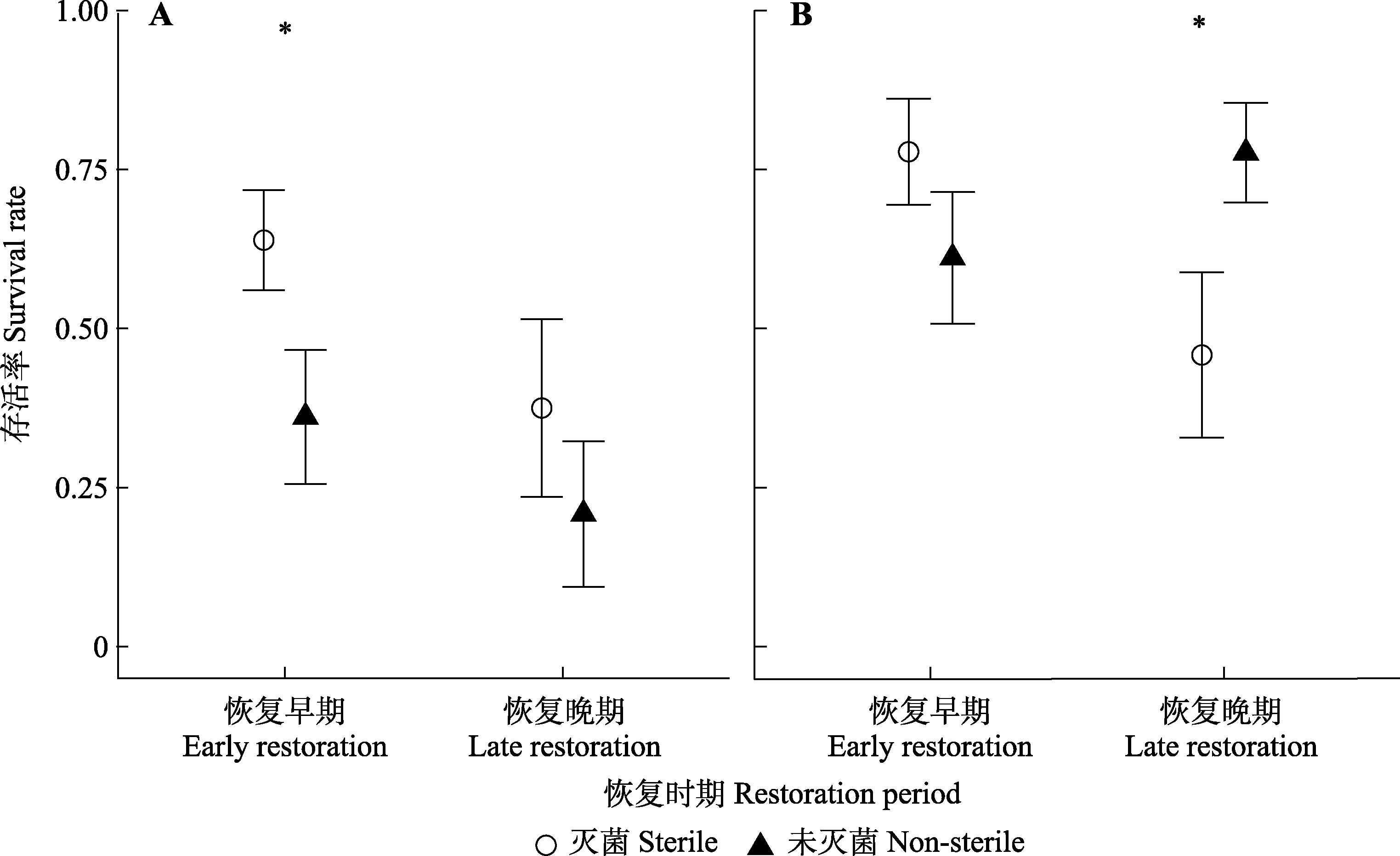
图1 灭菌处理对丛枝菌根(A)和外生菌根(B)树种在恢复早期和晚期土壤中幼苗存活率的影响(平均值±标准误)。*, p < 0.05。
Fig. 1 Effects of sterilization on seedlings survival rate (mean ± SE) of arbuscular mycorrhizal (A) and ectomycorrhizal (B) species in early and late restoration soils. *, p < 0.05.
| 性状 Trait | 菌根类型 Mycorrhizal type | 灭菌处理 Sterilization | 恢复阶段 Restoration stage | 菌根类型×灭菌处理 Mycorrhizal type × sterilization | 菌根类型× 恢复阶段 Mycorrhizal type × restoration stage | 灭菌处理× 恢复阶段 Sterilization × restoration stage | 菌根类型×灭菌处理 ×恢复阶段 Mycorrhizal type × sterilization × restoration stage | 随机效应 Random effect (χ2) |
|---|---|---|---|---|---|---|---|---|
| 地上生物量 Aboveground biomass | -0.28 | -0.19 | -0.01 | 0.22 | 0.36 | -0.22 | -0.01 | 13.80*** |
| 比叶面积 Specific leaf area | -0.63* | 0.08 | 0.07 | -0.10 | -0.14 | -0.14 | 0.23 | 227.36*** |
| 叶干质量 Leaf dry mass | 0.30 | -0.13 | -0.29** | 0.09 | 0.29 | -0.08 | 0.26 | 195.61*** |
| 叶长 Leaf length | -0.15 | -0.05 | -0.09 | -0.04 | 0.09 | -0.20* | 0.46 | 220.39*** |
| 叶宽 Leaf width | 0.01 | -0.09 | -0.11* | -0.04 | 0.00 | -0.03 | 0.51** | 229.87*** |
| 叶厚 Leaf thickness | 0.06 | -0.12** | -0.10* | -0.00 | 0.05 | 0.23*** | 0.10 | 411.49*** |
| 侵染率 Infection rate | -0.35 | -0.23*** | -0.02 | 0.20* | 0.19 | 0.11 | 0.02 | 53.38*** |
| 根表面积 Root surface area | -1.40 | -0.18 | -0.01 | 0.39 | 1.40** | 0.51 | -0.85 | 20.91*** |
| 根平均直径 Root average diameter | -0.02 | 0.11 | 0.27*** | -0.17 | -0.17 | 0.26* | 0.14 | 11.07*** |
表2 广义线性混合效应模型检验菌根类型、灭菌处理、恢复阶段对幼苗性状的影响(估计值)
Table 2 Generalized linear mixed effects model examining the effects of mycorrhizal type, sterilization, and restoration stage on seedling (estimate value)
| 性状 Trait | 菌根类型 Mycorrhizal type | 灭菌处理 Sterilization | 恢复阶段 Restoration stage | 菌根类型×灭菌处理 Mycorrhizal type × sterilization | 菌根类型× 恢复阶段 Mycorrhizal type × restoration stage | 灭菌处理× 恢复阶段 Sterilization × restoration stage | 菌根类型×灭菌处理 ×恢复阶段 Mycorrhizal type × sterilization × restoration stage | 随机效应 Random effect (χ2) |
|---|---|---|---|---|---|---|---|---|
| 地上生物量 Aboveground biomass | -0.28 | -0.19 | -0.01 | 0.22 | 0.36 | -0.22 | -0.01 | 13.80*** |
| 比叶面积 Specific leaf area | -0.63* | 0.08 | 0.07 | -0.10 | -0.14 | -0.14 | 0.23 | 227.36*** |
| 叶干质量 Leaf dry mass | 0.30 | -0.13 | -0.29** | 0.09 | 0.29 | -0.08 | 0.26 | 195.61*** |
| 叶长 Leaf length | -0.15 | -0.05 | -0.09 | -0.04 | 0.09 | -0.20* | 0.46 | 220.39*** |
| 叶宽 Leaf width | 0.01 | -0.09 | -0.11* | -0.04 | 0.00 | -0.03 | 0.51** | 229.87*** |
| 叶厚 Leaf thickness | 0.06 | -0.12** | -0.10* | -0.00 | 0.05 | 0.23*** | 0.10 | 411.49*** |
| 侵染率 Infection rate | -0.35 | -0.23*** | -0.02 | 0.20* | 0.19 | 0.11 | 0.02 | 53.38*** |
| 根表面积 Root surface area | -1.40 | -0.18 | -0.01 | 0.39 | 1.40** | 0.51 | -0.85 | 20.91*** |
| 根平均直径 Root average diameter | -0.02 | 0.11 | 0.27*** | -0.17 | -0.17 | 0.26* | 0.14 | 11.07*** |
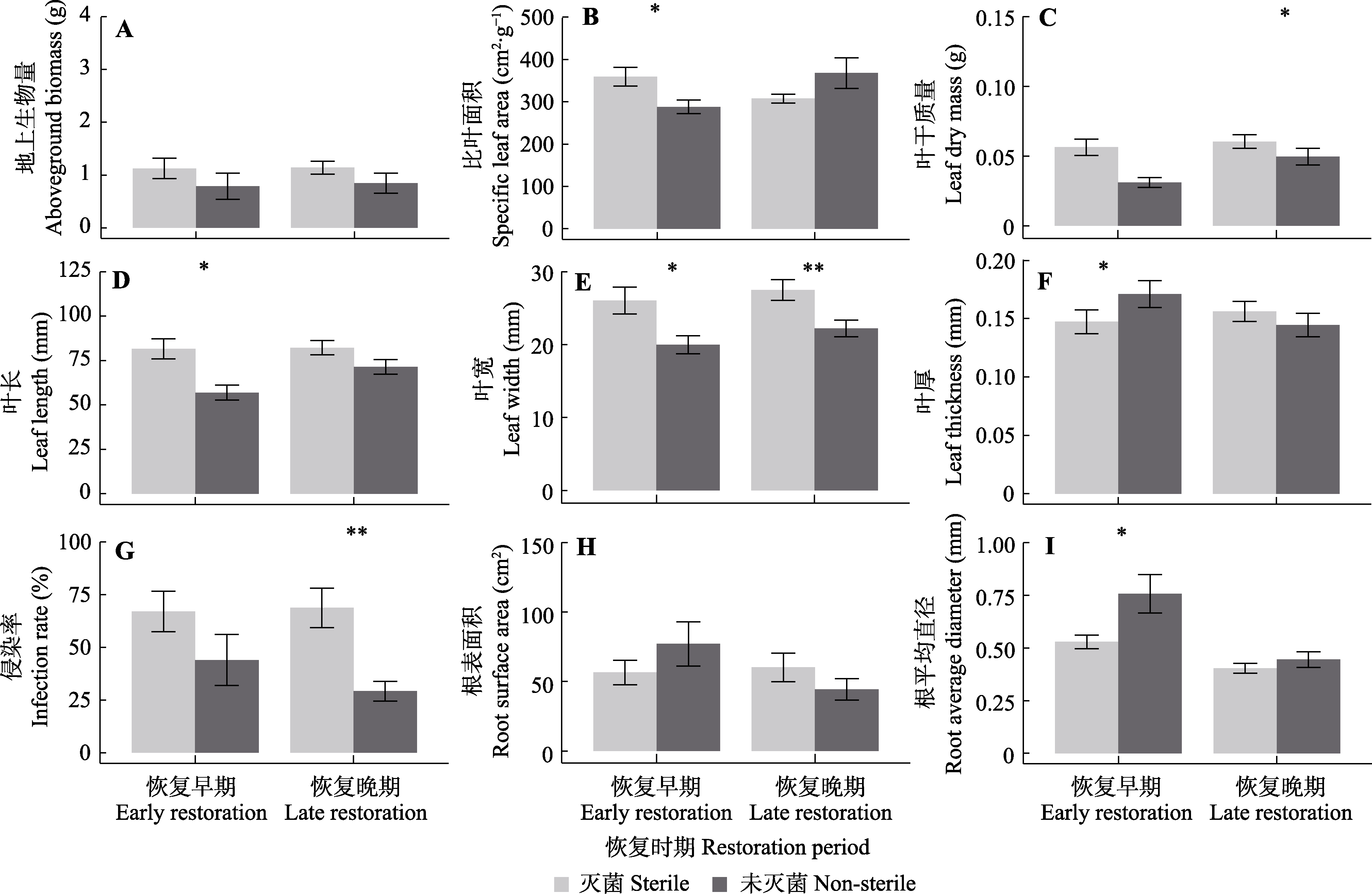
图2 灭菌处理对恢复早期和晚期土壤中丛枝菌根树种幼苗性状的影响(平均值±标准误)。*, p < 0.05; **, p < 0.01。
Fig. 2 Effects of sterilization on arbuscular mycorrhizal tree species seedling traits in early and late restoration soils (mean ± SE). *, p < 0.05; **, p < 0.01.
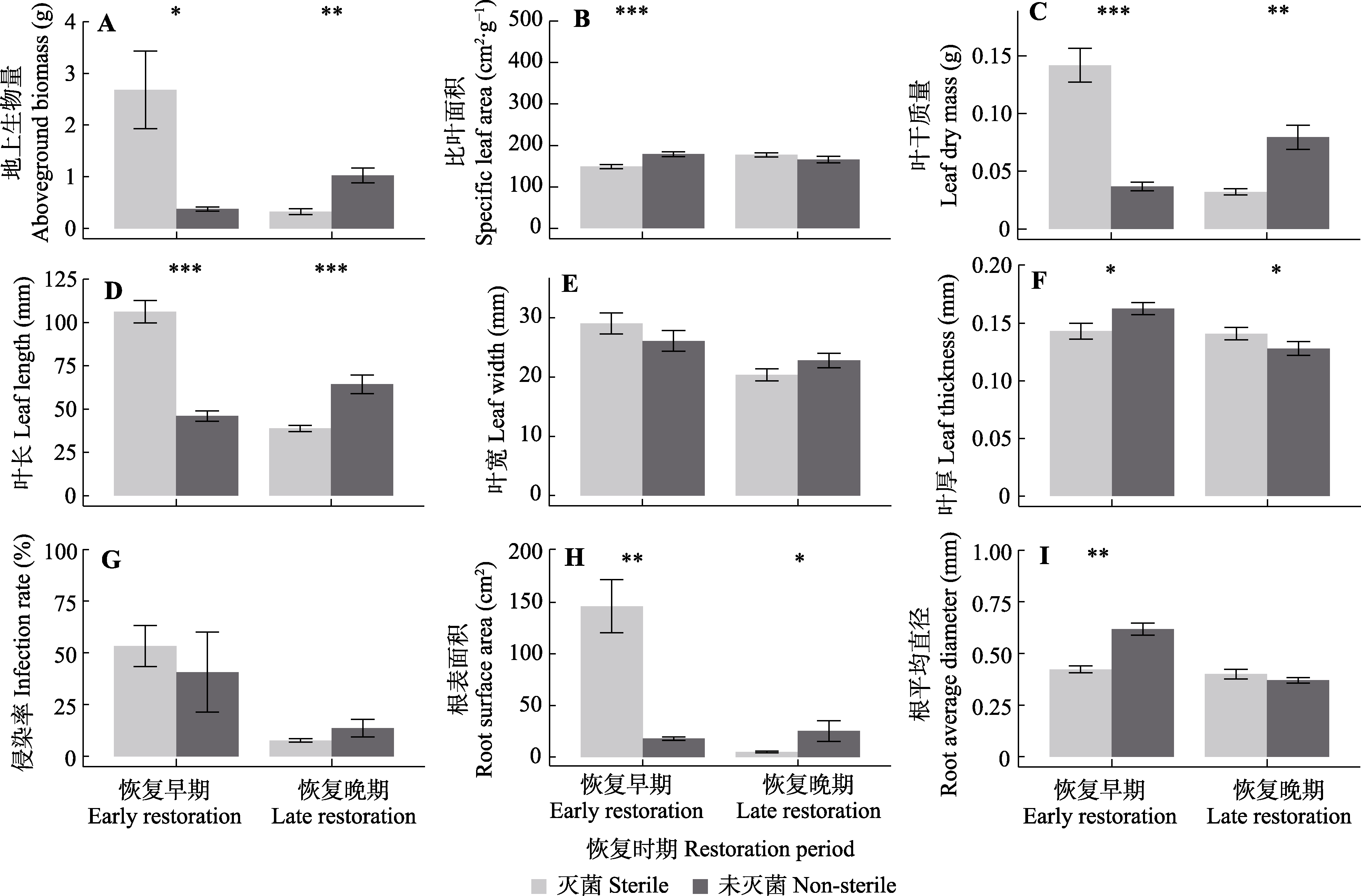
图3 灭菌处理对恢复早期和晚期土壤中外生菌根幼苗性状的影响(平均值±标准误)。*, p < 0.05; **, p < 0.01; ***, p < 0.001。
Fig. 3 Effects of sterilization on ectomycorrhizal seedling traits in early and late restoration soils (mean ± SE). *, p < 0.05; **, p < 0.01; ***, p < 0.001.
| 性状 Trait | 种植密度 Plant density | 种植密度×灭菌处理 Plant density ×sterilization | 种植密度×恢复阶段 Plant density ×restoration stage | 随机效应 Random effect (χ2) |
|---|---|---|---|---|
| 地上生物量 Aboveground biomass | -0.02 | 0.04* | -0.02 | 25.39*** |
| 比叶面积 Specific leaf area | 0.00 | -0.03*** | 0.01* | 351.46*** |
| 叶干质量 Leaf dry mass | -0.01 | 0.02* | -0.01 | 651.84*** |
| 叶长 Leaf length | -0.00 | 0.01 | -0.00 | 695.78*** |
| 叶宽 Leaf width | -0.00 | 0.00 | 0.00 | 659.11*** |
| 叶厚 Leaf thickness | -0.01** | 0.01*** | -0.00 | 1220.70*** |
| 侵染率 Infection rate | 0.01 | 0.00 | -0.00 | 88.12*** |
| 根表面积 Root surface area | -0.03 | 0.05* | -0.02 | 61.12*** |
| 根平均直径 Root average diameter | -0.01 | 0.00 | 0.01 | 130.31*** |
表3 广义线性混合效应模型检验幼苗密度及其与灭菌处理和恢复阶段的交互作用对幼苗性状的影响(估计值)
Table 3 Generalized linear mixed effects model examining the effects of seedling density and its interactions with sterilization and restoration stage on seedling traits (estimate value)
| 性状 Trait | 种植密度 Plant density | 种植密度×灭菌处理 Plant density ×sterilization | 种植密度×恢复阶段 Plant density ×restoration stage | 随机效应 Random effect (χ2) |
|---|---|---|---|---|
| 地上生物量 Aboveground biomass | -0.02 | 0.04* | -0.02 | 25.39*** |
| 比叶面积 Specific leaf area | 0.00 | -0.03*** | 0.01* | 351.46*** |
| 叶干质量 Leaf dry mass | -0.01 | 0.02* | -0.01 | 651.84*** |
| 叶长 Leaf length | -0.00 | 0.01 | -0.00 | 695.78*** |
| 叶宽 Leaf width | -0.00 | 0.00 | 0.00 | 659.11*** |
| 叶厚 Leaf thickness | -0.01** | 0.01*** | -0.00 | 1220.70*** |
| 侵染率 Infection rate | 0.01 | 0.00 | -0.00 | 88.12*** |
| 根表面积 Root surface area | -0.03 | 0.05* | -0.02 | 61.12*** |
| 根平均直径 Root average diameter | -0.01 | 0.00 | 0.01 | 130.31*** |
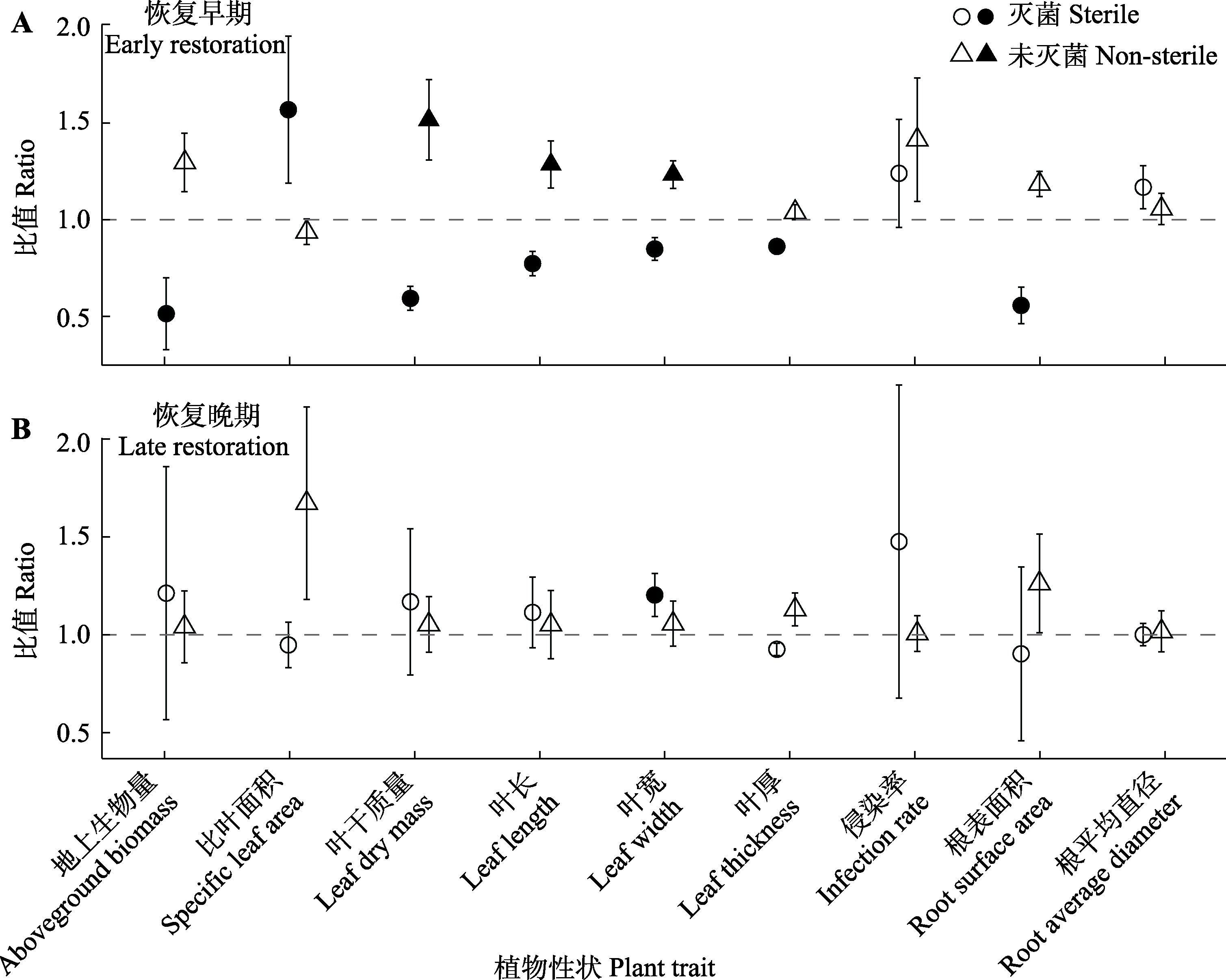
图4 幼苗密度对恢复早期和晚期不同土壤处理中幼苗性状的影响(平均值±标准误)。图中展示的是相应性状在幼苗密度为每盆6株与每盆1株的比值, 实心的圆和三角表示相应性状在密度6和密度1间具有显著差异(p < 0.05)。由于外生菌根真菌幼苗数量不足, 密度实验仅检验了丛枝菌根真菌树种。
Fig. 4 Effects of seedling density on seedling traits in early and late restoration soils with or without sterilization (mean ± SE). The ratios of the corresponding traits between densities 6 and 1 are shown. Solid black circles and triangles indicate significant differences between densities of 6 plants per pot and 1 plant per pot (p < 0.05). This experiment only examined arbuscular mycorrhizal fungi species owing to limited number of ectomycorrhizal fungi seedlings.
| [1] |
Aldrich-Wolfe L (2007). Distinct mycorrhizal communities on new and established hosts in a transitional tropical plant community. Ecology, 88, 559-566.
PMID |
| [2] | Asmara DH, Allaire S, van Noordwijk M, Khasa DP (2023). The effect of biochar amendment, microbiome inoculation, crop mixture and planting density on post-mining restoration. Forests, 14, 856. DOI: 10.3390/f14040856. |
| [3] | Ballarin CS, Hachuy-Filho L, Fontúrbel FE, Amorim FW (2022). Density-dependent effects on the reproductive outcome of a native tree at tropical restored habitats. Forest Ecology and Management, 520, 120391. DOI: 10.1016/j.foreco.2022.120391. |
| [4] |
Bardgett RD, Mommer L, de Vries FT (2014). Going underground: root traits as drivers of ecosystem processes. Trends in Ecology & Evolution, 29, 692-699.
DOI URL |
| [5] |
Bennett JA, Maherali H, Reinhart KO, Lekberg Y, Hart MM, Klironomos J (2017). Plant-soil feedbacks and mycorrhizal type influence temperate forest population dynamics. Science, 355, 181-184.
DOI PMID |
| [6] |
Bever JD, Westover KM, Antonovics J (1997). Incorporating the soil community into plant population dynamics: the utility of the feedback approach. Journal of Ecology, 85, 561-573.
DOI URL |
| [7] |
Bouma TJ, Yanai RD, Elkin AD, Hartmond U, Flores-Alva DE, Eissenstat DM (2001). Estimating age-dependent costs and benefits of roots with contrasting life span: comparing apples and oranges. New Phytologist, 150, 685-695.
DOI URL |
| [8] | Brown AJ, White PS, Peet RK (2021). Environmental context alters the magnitude of conspecific negative density dependence in a temperate forest. Ecosphere, 12, e03406. DOI: 10.1002/ecs2.3406. |
| [9] |
Bunn R, Lekberg Y, Zabinski C (2009). Arbuscular mycorrhizal fungi ameliorate temperature stress in thermophilic plants. Ecology, 90, 1378-1388.
DOI PMID |
| [10] |
Chen L, Swenson NG, Ji NN, Mi XC, Ren HB, Guo LD, Ma KP (2019). Differential soil fungus accumulation and density dependence of trees in a subtropical forest. Science, 366, 124-128.
DOI PMID |
| [11] |
Chu Q, Zhang L, Zhou JW, Yuan LX, Chen FJ, Zhang FS, Feng G, Rengel Z (2020). Soil plant-available phosphorus levels and maize genotypes determine the phosphorus acquisition efficiency and contribution of mycorrhizal pathway. Plant and Soil, 449, 357-371.
DOI |
| [12] | Das PP, Singh KRB, Nagpure G, Mansoori A, Singh RP, Ghazi IA, Kumar A, Singh J (2022). Plant-soil-microbes: a tripartite interaction for nutrient acquisition and better plant growth for sustainable agricultural practices. Environmental Research, 214, 113821. DOI: 10.1016/j.envres.2022.113821. |
| [13] |
Desai S, Naik D, Cumming JR (2014). The influence of phosphorus availability and Laccaria bicolor symbiosis on phosphate acquisition, antioxidant enzyme activity, and rhizospheric carbon flux in Populus tremuloides. Mycorrhiza, 24, 369-382.
DOI URL |
| [14] |
Ding K, Zhang YT, Zhang JH, Chai X, Zhou SS, Tong ZK (2021). Effects of Chinese fir plantations with different densities on understory vegetation and soil microbial community structure. Chinese Journal of Plant Ecology, 45, 62-73.
DOI URL |
| [丁凯, 张毓婷, 张俊红, 柴雄, 周世水, 童再康 (2021). 不同密度杉木林对林下植被和土壤微生物群落结构的影响. 植物生态学报, 45, 62-73.] | |
| [15] |
Ebenye HCM, Taudière A, Niang N, Ndiaye C, Sauve M, Awana NO, Verbeken M, de Kesel A, Séne S, Diédhiou AG, Sarda V, Sadio O, Cissoko M, Ndoye I, Selosse MA, et al. (2017). Ectomycorrhizal fungi are shared between seedlings and adults in a monodominant gilbertiodendron dewevrei rain forest in Cameroon. Biotropica, 49, 256-267.
DOI URL |
| [16] |
Fox TR (2000). Sustained productivity in intensively managed forest plantations. Forest Ecology and Management, 138, 187-202.
DOI URL |
| [17] | França FM, Benkwitt CE, Peralta G, Robinson JPW, Graham NAJ, Tylianakis JM, Berenguer E, Lees AC, Ferreira J, Louzada J, Barlow J (2020). Climatic and local stressor interactions threaten tropical forests and coral reefs. Philosophical Transactions of the Royal Society B: Biological Sciences, 375, 20190116. DOI: 10.1098/rstb.2019.0116. |
| [18] | Geng YC, Ding YA, Zhou PP, Wang ZC, Peng CR, Li DH (2023). Soil microbe-mediated carbon and nitrogen cycling during primary succession of biological soil crusts in tailings ponds. Science of the Total Environment, 894, 164969. DOI: 10.1016/j.scitotenv.2023.164969. |
| [19] | Gong MQ (1998). Study on mycorrhiza of tropical forests in China. Tropical Forestry, 26, 57-64. |
| [弓明钦 (1998). 我国热带林菌根研究. 热带林业, 26, 57-64.] | |
| [20] | Hijri M, Bâ A (2018). Mycorrhiza in tropical and neotropical ecosystems. Frontiers in Plant Science, 9, 308. DOI: 10.3389/fpls.2018.00308. |
| [21] | Hoang NT, Kanemoto K (2021). Mapping the deforestation footprint of nations reveals growing threat to tropical forests. Nature Ecology & Evolution, 5, 845-853. |
| [22] | Hu FM (2023). Effects of fine-root, mycorrhizal fungi and their interaction on the species coexistence in subtropical forests. Master degree dissertation, Zhejiang Normal University, Jinhua, Zhejiang. |
| [胡芳敏 (2023). 细根与菌根真菌及其相互作用对亚热带森林物种共存的影响研究. 硕士学位论文, 浙江师范大学, 浙江金华.] | |
| [23] | Jiang S, Xing YJ, Liu GC, Hu CY, Wang XC, Yan GY, Wang QG (2021). Changes in soil bacterial and fungal community composition and functional groups during the succession of boreal forests. Soil Biology & Biochemistry, 161, 108393. DOI: 10.1016/j.soilbio.2021.108393. |
| [24] |
Kardol P, Bezemer TM, van der Putten WH (2006). Temporal variation in plant-soil feedback controls succession. Ecology Letters, 9, 1080-1088.
DOI PMID |
| [25] |
Khan A, Najeeb U, Wang LS, Tan DKY, Yang GZ, Munsif F, Ali S, Hafeez A (2017). Planting density and sowing date strongly influence growth and lint yield of cotton crops. Field Crops Research, 209, 129-135.
DOI URL |
| [26] |
Kiers ET, Lovelock CE, Krueger EL, Herre EA (2000). Differential effects of tropical arbuscular mycorrhizal fungal inocula on root colonization and tree seedling growth: implications for tropical forest diversity. Ecology Letters, 3, 106-113.
DOI URL |
| [27] |
Koch A, Kaplan JO (2022). Tropical forest restoration under future climate change. Nature Climate Change, 12, 279-283.
DOI |
| [28] |
Kong DL, Ma CG, Zhang Q, Li L, Chen XY, Zeng H, Guo DL (2014). Leading dimensions in absorptive root trait variation across 96 subtropical forest species. New Phytologist, 203, 863-872.
DOI PMID |
| [29] | Lee H, Oh SY, Lee YM, Jang Y, Jang S, Kim C, Lim YW, Kim JJ (2020). Successional variation in the soil microbial community in Odaesan National Park, Korea. Sustainability, 12, 4795. DOI: 10.3390/su12114795. |
| [30] |
Leigh J, Fitter AH, Hodge A (2011). Growth and symbiotic effectiveness of an arbuscular mycorrhizal fungus in organic matter in competition with soil bacteria: interactions between AM fungi and bacteria in organic matter. FEMS Microbiology Ecology, 76, 428-438.
DOI PMID |
| [31] | Li K, Shi ZY, Wang FY (2017). Physiological and ecological functions of arbuscular mycorrhizas and their roles in ecological restoration. Chinese Journal of Soil Science, 48, 996-1002. |
| [李珂, 石兆勇, 王发园 (2017). 丛枝菌根生理生态功能及其在生态恢复中的作用. 土壤通报, 48, 996-1002.] | |
| [32] | Li WT, Lu Q, Alharbi SA, Soromotin AV, Kuzyakov Y, Lei YB (2023). Plant-soil-microbial interactions mediate vegetation succession in retreating glacial forefields. Science of the Total Environment, 873, 162393. DOI: 10.1016/j.scitotenv.2023.162393. |
| [33] |
Liu HW, Li JY, Carvalhais LC, Percy CD, Prakash Verma J, Schenk PM, Singh BK (2021). Evidence for the plant recruitment of beneficial microbes to suppress soil-borne pathogens. New Phytologist, 229, 2873-2885.
DOI URL |
| [34] |
Liu L, Yu SX, Xie ZP, Staehelin C (2016). Distance-dependent effects of pathogenic fungi on seedlings of a legume tree: impaired nodule formation and identification of antagonistic rhizosphere bacteria. Journal of Ecology, 104, 1009-1019.
DOI URL |
| [35] | Liu X, Parker IM, Gilbert GS, Lu YW, Xiao Y, Zhang L, Huang MJ, Cheng YK, Zhang ZH, Zhou SR (2022). Coexistence is stabilized by conspecific negative density dependence via fungal pathogens more than oomycete pathogens. Ecology, 103, e3841. DOI: 10.1002/ecy.3841. |
| [36] | Luo ZR, Jia J, Chen XR, Chen XB, Zhang YF, Lan RG (2024). Effect of species-independent conspecific and heterospecific density dependence is contingent on seedling growth stage, season, and climate conditions. Forest Ecology and Management, 565, 122045. DOI: 10.1016/j.foreco.2024.122045. |
| [37] |
Lynch JP (2018). Rightsizing root phenotypes for drought resistance. Journal of Experimental Botany, 69, 3279-3292.
DOI PMID |
| [38] |
Maron JL, Laney Smith AI, Ortega YK, Pearson DE, Callaway RM (2016). Negative plant-soil feedbacks increase with plant abundance, and are unchanged by competition. Ecology, 97, 2055-2063.
DOI PMID |
| [39] |
Maron JL, Marler M, Klironomos JN, Cleveland CC (2011). Soil fungal pathogens and the relationship between plant diversity and productivity. Ecology Letters, 14, 36-41.
DOI PMID |
| [40] |
Neuenkamp L, Prober SM, Price JN, Zobel M, Standish RJ (2019). Benefits of mycorrhizal inoculation to ecological restoration depend on plant functional type, restoration context and time. Fungal Ecology, 40, 140-149.
DOI URL |
| [41] |
Ni GF, Lappan R, Hernández M, Santini T, Tomkins AG, Greening C (2023). Functional basis of primary succession: traits of the pioneer microbes. Environmental Microbiology, 25, 171-176.
DOI URL |
| [42] |
Pent M, Põldmaa K, Bahram M (2017). Bacterial communities in boreal forest mushrooms are shaped both by soil parameters and host identity. Frontiers in Microbiology, 8, 836-849.
DOI PMID |
| [43] |
Prudent M, Dequiedt S, Sorin C, Girodet S, Nowak V, Duc G, Salon C, Maron PA (2020). The diversity of soil microbial communities matters when legumes face drought. Plant, Cell & Environment, 43, 1023-1035.
DOI URL |
| [44] |
Qu ZL, Liu B, Ma Y, Xu J, Sun H (2020). The response of the soil bacterial community and function to forest succession caused by forest disease. Functional Ecology, 34, 2548-2559.
DOI URL |
| [45] |
Rasmann S, Bauerle TL, Poveda K, Vannette R (2011). Predicting root defence against herbivores during succession. Functional Ecology, 25, 368-379.
DOI URL |
| [46] |
Reich PB (2014). The world-wide ‘fast-slow’ plant economics spectrum: a traits manifesto. Journal of Ecology, 102, 275-301.
DOI URL |
| [47] |
Rolli E, Marasco R, Vigani G, Ettoumi B, Mapelli F, Deangelis ML, Gandolfi C, Casati E, Previtali F, Gerbino R, Pierotti Cei F, Borin S, Sorlini C, Zocchi G, Daffonchio D (2015). Improved plant resistance to drought is promoted by the root-associated microbiome as a water stress-dependent trait. Environmental Microbiology, 17, 316-331.
DOI PMID |
| [48] |
Rondina ABL, Tonon BC, Lescano LEAM, Hungria M, Nogueira MA, Zangaro W (2019). Plants of distinct successional stages have different strategies for nutrient acquisition in an Atlantic rain forest ecosystem. International Journal of Plant Sciences, 180, 186-199.
DOI URL |
| [49] | Sagar A, Rathore P, Ramteke PW, Ramakrishna W, Reddy MS, Pecoraro L (2021). Plant growth promoting rhizobacteria, arbuscular mycorrhizal fungi and their synergistic interactions to counteract the negative effects of saline soil on agriculture: key macromolecules and mechanisms. Microorganisms, 9, 1491. DOI: 10.3390/microorganisms9071491. |
| [50] |
Siefert A, Zillig KW, Friesen ML, Strauss SY (2018). Soil microbial communities alter conspecific and congeneric competition consistent with patterns of field coexistence in three Trifolium congeners. Journal of Ecology, 106, 1876-1891.
DOI URL |
| [51] | Soudzilovskaia NA, Vaessen S, Barcelo M, He JH, Rahimlou S, Abarenkov K, Brundrett MC, Gomes SIF, Merckx VM, Tedersoo L (2020). FungalRoot: global online database of plant mycorrhizal associations. New Phytologist, 227, 955-966. |
| [52] | Stahlhut KN, Neupert DG, Laing JE, Witt LJ, Bauer JT (2024). Measuring leaf and root functional traits uncovers multidimensionality of plant responses to arbuscular mycorrhizal fungi. American Journal of Botany, 111, e16369. DOI: 10.1002/ajb2.16369. |
| [53] |
Suding KN, Gross KL, Houseman GR (2004). Alternative states and positive feedbacks in restoration ecology. Trends in Ecology & Evolution, 19, 46-53.
DOI URL |
| [54] |
Sun JH, Shi HL, Chen KY, Ji BM, Zhang J (2023). Research advances on trade-off relationships of plant fine root functional traits. Chinese Journal of Plant Ecology, 47, 1055-1070.
DOI URL |
|
[孙佳慧, 史海兰, 陈科宇, 纪宝明, 张静 (2023). 植物细根功能性状的权衡关系研究进展. 植物生态学报, 47, 1055-1070.]
DOI |
|
| [55] | Sun Y, Umer M, Wu P, Guo Y, Ren WD, Han X, Li Q, Wu BL, Shen KP, Xia TT, Zang LP, Wang SX, He YJ (2022). Indigenous microorganisms offset the benefits of growth and nutrition regulated by inoculated arbuscular mycorrhizal fungi for four pioneer herbs in karst soil. PLoS ONE, 17, e0266526. DOI: 10.1371/journal.pone.0266526. |
| [56] | Tello-García E, Mandolini E, Tasser E, Probst M, Peintner U, Tappeiner U, Leitinger G (2023). Red clover productivity under drought: Are soil microbes a burden or a treasure? Environmental and Experimental Botany, 214, 105486. DOI: 10.1016/j.envexpbot.2023.105486. |
| [57] |
van der Heijden MGA, Horton TR (2009). Socialism in soil? The importance of mycorrhizal fungal networks for facilitation in natural ecosystems. Journal of Ecology, 97, 1139-1150.
DOI URL |
| [58] |
van der Linde S, Suz LM, Orme CDL, Cox F, Andreae H, Asi E, Atkinson B, Benham S, Carroll C, Cools N, de Vos B, Dietrich HP, Eichhorn J, Gehrmann J, Grebenc T, et al. (2018). Environment and host as large-scale controls of ectomycorrhizal fungi. Nature, 558, 243-248.
DOI |
| [59] |
van Ruijven J, Ampt E, Francioli D, Mommer L (2020). Do soil-borne fungal pathogens mediate plant diversity-productivity relationships? Evidence and future opportunities. Journal of Ecology, 108, 1810-1821.
DOI URL |
| [60] | Wagg C, Hautier Y, Pellkofer S, Banerjee S, Schmid B, van der Heijden MG (2021). Diversity and asynchrony in soil microbial communities stabilizes ecosystem functioning. eLife, 10, e62813. DOI: 10.7554/eLife.62813. |
| [61] |
Wang GW, Jin ZX, George TS, Feng G, Zhang L (2023). Arbuscular mycorrhizal fungi enhance plant phosphorus uptake through stimulating hyphosphere soil microbiome functional profiles for phosphorus turnover. New Phytologist, 238, 2578-2593.
DOI URL |
| [62] | Wang ZH, Bai Y, Hou JF, Li F, Li XQ, Cao R, Deng YY, Wang HB, Jiang YR, Yang WQ (2022). The changes in soil microbial communities across a subalpine forest successional series. Forests, 13, 289. DOI: 10.3390/f13020289. |
| [63] |
Wardle DA, Walker LR, Bardgett RD (2004). Ecosystem properties and forest decline in contrasting long-term chronosequences. Science, 305, 509-513.
DOI PMID |
| [64] |
Wright IJ, Reich PB, Westoby M, Ackerly DD, Baruch Z, Bongers F, Cavender-Bares J, Chapin T, Cornelissen JHC, Diemer M, Flexas J, Garnier E, Groom PK, Gulias J, Hikosaka K, et al. (2004). The worldwide leaf economics spectrum. Nature, 428, 821-827.
DOI |
| [65] | Wu HM, Qin XJ, Wang JY, Wu LK, Chen J, Fan JK, Zheng L, Tangtai HP, Arafat Y, Lin WW, Luo XM, Lin S, Lin WX (2019). Rhizosphere responses to environmental conditions in Radix pseudostellariae under continuous monoculture regimes. Agriculture, Ecosystems & Environment, 270, 19-31. |
| [66] |
Wu SL, Ma CY (2024). The global forest ecosystem faces multiple challenges. Ecological Economy, 40, 1-4.
DOI URL |
| [吴石磊, 马程耀 (2024). 全球森林生态系统面临多重挑战. 生态经济, 40, 1-4.] | |
| [67] |
Xu SD, Liu YX, Cernava T, Wang HK, Zhou YQ, Xia T, Cao SG, Berg G, Shen XX, Wen ZY, Li CS, Qu BY, Ruan HF, Chai YR, Zhou XP, et al. (2022). Fusarium fruiting body microbiome member Pantoea agglomerans inhibits fungal pathogenesis by targeting lipid rafts. Nature Microbiology, 7, 831-843.
DOI |
| [68] |
Yao HS, Zhang YL, Yi XP, Hu YY, Luo HH, Gou L, Zhang WF (2015). Plant density alters nitrogen partitioning among photosynthetic components, leaf photosynthetic capacity and photosynthetic nitrogen use efficiency in field-grown cotton. Field Crops Research, 184, 39-49.
DOI URL |
| [69] | Yu JJ, Cong W, Ding Y, Jin LX, Zhang YG (2023). Natural restoration characteristics and assembly mechanisms of soil microbial community in tropical rain-forest under different disturbance types. Chinese Journal of Ecology, 42, 534-543. |
| [于晶晶, 丛微, 丁易, 靳利晓, 张于光 (2023). 不同干扰方式下热带雨林土壤微生物群落自然恢复特征和构建机制. 生态学杂志, 42, 534-543.] | |
| [70] | Yu L, Zhang H, Zhang WT, Liu KS, Liu M, Shao XQ (2022). Cooperation between arbuscular mycorrhizal fungi and plant growth-promoting bacteria and their effects on plant growth and soil quality. PeerJ, 10, e13080. DOI: 10.1016/j.sajb.2024.10.012. |
| [71] |
Zangaro W, de Assis RL, Rostirola LV, de Souza PB, Gonçalves MC, Andrade G, Nogueira MA (2008). Changes in arbuscular mycorrhizal associations and fine root traits in sites under different plant successional phases in southern Brazil. Mycorrhiza, 19, 37-45.
DOI PMID |
| [72] |
Zhang BB, Chang SX, Anyia AO (2016). Mycorrhizal inoculation and nitrogen fertilization affect the physiology and growth of spring wheat under two contrasting water regimes. Plant and Soil, 398, 47-57.
DOI URL |
| [73] | Zhang ET, Wang Y, Crowther TW, Sun WC, Chen SP, Zhou DW, Shangguan Z, Huang JH, He JS, Wang YF, Sheng JD, Tang LS, Li XR, Dong M, Wu Y, et al. (2025). Mycorrhiza increases plant diversity and soil carbon storage in grasslands. Proceedings of the National Academy of Sciences of the United States of America, 122, e2412556122. DOI: 10.1073/pnas.2412556122. |
| [74] | Zhang WH (2022). Study on the Formation Mechanism of Dual Mycorrhizae Based on Rhizosphere Microorganisms, Soil Physicochemical Properties and Plant Characteristics. Master degree dissertation, East China Normal University, Shanghai. |
| [张文华 (2022). 基于根际微生物、土壤理化性质和植物性状探究影响双菌根侵染形成的因素. 硕士学位论文, 华东师范大学, 上海.] | |
| [75] | Zhu KY, Wang QC, Zhang Y, Zarif N, Ma SJ, Xu LQ (2022). Variation in soil bacterial and fungal community composition at different successional stages of a broad-leaved Korean pine forest in the Lesser Hinggan Mountains. Forests, 13, 625. DOI: 10.3390/f13040625. |
| [76] |
Zhu Y, Mi XC, Ma KP (2009). A mechanism of plant species coexistence: the negative density-dependent hypothesis. Biodiversity Science, 17, 594-604.
DOI |
|
[祝燕, 米湘成, 马克平 (2009). 植物群落物种共存机制: 负密度制约假说. 生物多样性, 17, 594-604.]
DOI |
| [1] | 马云瀚, 鲁显楷, 贾永霞, 朱晓敏. 长期氮沉降改变热带森林土壤木质素酚积累的调控路径[J]. 植物生态学报, 2026, 50(预发表): 0-. |
| [2] | 许敏慧, 江子怡, 耿文迪, 王子晴, 林雨蝶, 王建青, 施秀珍. 不同邻体树种丰富度下亚热带杉木幼林凋落物碳氮磷生态化学计量特征[J]. 植物生态学报, 2026, 50(预发表): 0-. |
| [3] | 陈亚松, 兰志春, 王银柳, 姜昕怡, 牛国祥. 氮磷输入对鄱阳湖湿地优势植物种间竞争的影响[J]. 植物生态学报, 2026, 50(预发表): 1-. |
| [4] | 陈佳乐, 赵颖菲, 昌海超, 董必成, 于飞海. 基于大语言模型的植物性状自动提取框架构建与评价体系[J]. , 2026, 50(生态统计方法专题): 0-. |
| [5] | 丁明利, 魏瑶, 马健妤, 兰玉婷, 刘慧颖, 张振华. 典型高寒植物抗氧化与渗透调节系统对季节性干旱的响应及光合调控[J]. 植物生态学报, 2026, 50(5): 1187-1201. |
| [6] | 洪翎桂, 安琦, 张佛军, 任宇飞, 任正炜, 周小龙. 氮磷添加增强天山高寒草地群落构建中确定性过程[J]. 植物生态学报, 2026, 50(4): 883-894. |
| [7] | 饶朝康, 唐亮. 不同潮位红树植物叶际微生物群落特征及其影响因素[J]. 植物生态学报, 2026, 50(4): 987-1002. |
| [8] | 林琳琳, 肖劲祥, 黄深深, 赵杨梅, 张德旭, 程毅康, 龙文兴. 磷添加对热带云雾林幼苗及幼树功能性状的影响[J]. 植物生态学报, 2026, 50(4): 917-928. |
| [9] | 杨梅花, 张子嘉, 乔栋, 冯俊娜, 庞子杰, 钱龙, 刘志晖, 蔡娜娜, 胡中民, 杨国姣. 海南热带森林乔木树种每木清查和多样性数据集[J]. 植物生态学报, 2026, 50(4): 1016-1022. |
| [10] | 段建林, 孟晟, 陈仁利, 熊林峰, 卢春洋, 席念勋. 全球变化因子数量对菌根植物性状的影响[J]. 植物生态学报, 2026, 50(4): 907-916. |
| [11] | 张安宁, 肖亚宁, 赵霞, 张淼, 崔瀚文, 陈书燕, 安黎哲. 青藏高原灌丛化与氮添加对土壤线虫群落及功能性状的交互作用[J]. 植物生态学报, 2026, 50(4): 859-869. |
| [12] | 姜庆宏, 丁露, 王哲, 郑春丽, 冯昭绰. 丛枝菌根真菌与不同功能细菌联用对苜蓿的促生作用[J]. 植物生态学报, 2026, 50(3): 774-788. |
| [13] | 邹纪开, 吴佳怡, 谷云懿, 陈宝明. 不同形态氮添加与丛枝菌根真菌对外来入侵植物白花鬼针草竞争力的影响[J]. 植物生态学报, 2026, 50(3): 722-730. |
| [14] | 王蓉钧, 吴福忠, 吴秋霞, 朱晶晶, 倪祥银. 不同生活型植物叶片氮重吸收效率的差异[J]. 植物生态学报, 2026, 50(2): 344-351. |
| [15] | 张永军, 李敬东, 安琦, 洪翎桂, 任正炜, 张蕊, 周小龙. 氮添加和增温对天山高寒草地群落性状的影响[J]. 植物生态学报, 2026, 50(2): 417-428. |
| 阅读次数 | ||||||
|
全文 |
|
|||||
|
摘要 |
|
|||||
Copyright © 2026 版权所有 《植物生态学报》编辑部
地址: 北京香山南辛村20号, 邮编: 100093
Tel.: 010-62836134, 62836138; Fax: 010-82599431; E-mail: apes@ibcas.ac.cn, cjpe@ibcas.ac.cn
备案号: 京ICP备16067583号-19

