
植物生态学报 ›› 2024, Vol. 48 ›› Issue (12): 1602-1611.DOI: 10.17521/cjpe.2024.0060 cstr: 32100.14.cjpe.2024.0060
袁鹤洋1, 郝珉辉1,*( ), 何怀江2, 张春雨1, 赵秀海1
收稿日期:2024-03-05
接受日期:2024-06-20
出版日期:2024-12-20
发布日期:2024-12-20
通讯作者:
*郝珉辉(haomh@bjfu.edu.cn)基金资助:
YUAN He-Yang1, HAO Min-Hui1,*(), HE Huai-Jiang2, ZHANG Chun-Yu1, ZHAO Xiu-Hai1
Received:2024-03-05
Accepted:2024-06-20
Online:2024-12-20
Published:2024-12-20
Contact:
*HAO Min-Hui(haomh@bjfu.edu.cn)Supported by:摘要:
生物多样性是生态系统功能形成与维持的重要影响因素, 但其背后潜在的生态学机制仍存在较大争议。生态位互补效应和生物量比率效应是解释生物多样性与生态系统功能关系的两种主要假说, 但在温带森林中生态位互补效应和生物量比率效应对生态系统功能的相对贡献是否随森林演替而变化, 以及如何变化目前仍不清楚。该研究以长白山地区处于不同演替阶段的森林为研究对象, 分别在次生山杨(Populus davidiana) -白桦(Betula platyphylla)林(演替早期)、次生针阔混交林(演替中期)和原始紫椴(Tilia amurensis) -红松(Pinus koraiensis)林(演替后期)内设置3块面积为5.2 hm2的固定监测样地。基于两期样地调查数据, 分别采用物种丰富度和物种组成验证生态位互补效应和生物量比率效应, 采用地上生物量和森林生产力作为反映生态系统功能的指标, 通过结构方程模型检验生态位互补效应和生物量比率效应对生态系统功能的相对贡献及其随演替的变化。研究显示: 物种丰富度与生态系统功能关系随森林演替而变化, 演替初期物种丰富度的作用并不显著, 而在演替中后期物种丰富度的促进作用逐渐增强, 表明随着森林演替生态位互补效应逐渐增强。相比物种丰富度, 物种组成在森林演替的各个阶段都显著影响着生态系统功能, 表明生物量比率效应在森林演替过程中始终发挥着重要作用。此外, 地上生物量也是影响森林生产力的重要因素。该研究揭示了长白山森林生物多样性与生态系统功能关系及其随演替的变化规律, 研究结果能够为东北地区退化森林的生态恢复以及生物多样性保护提供一定的科学依据。
袁鹤洋, 郝珉辉, 何怀江, 张春雨, 赵秀海. 长白山物种丰富度与物种组成对森林生产力的影响及其随演替的变化. 植物生态学报, 2024, 48(12): 1602-1611. DOI: 10.17521/cjpe.2024.0060
YUAN He-Yang, HAO Min-Hui, HE Huai-Jiang, ZHANG Chun-Yu, ZHAO Xiu-Hai. Impact of species richness and composition on productivity and its changes with forest succession in Changbai Mountains, China. Chinese Journal of Plant Ecology, 2024, 48(12): 1602-1611. DOI: 10.17521/cjpe.2024.0060
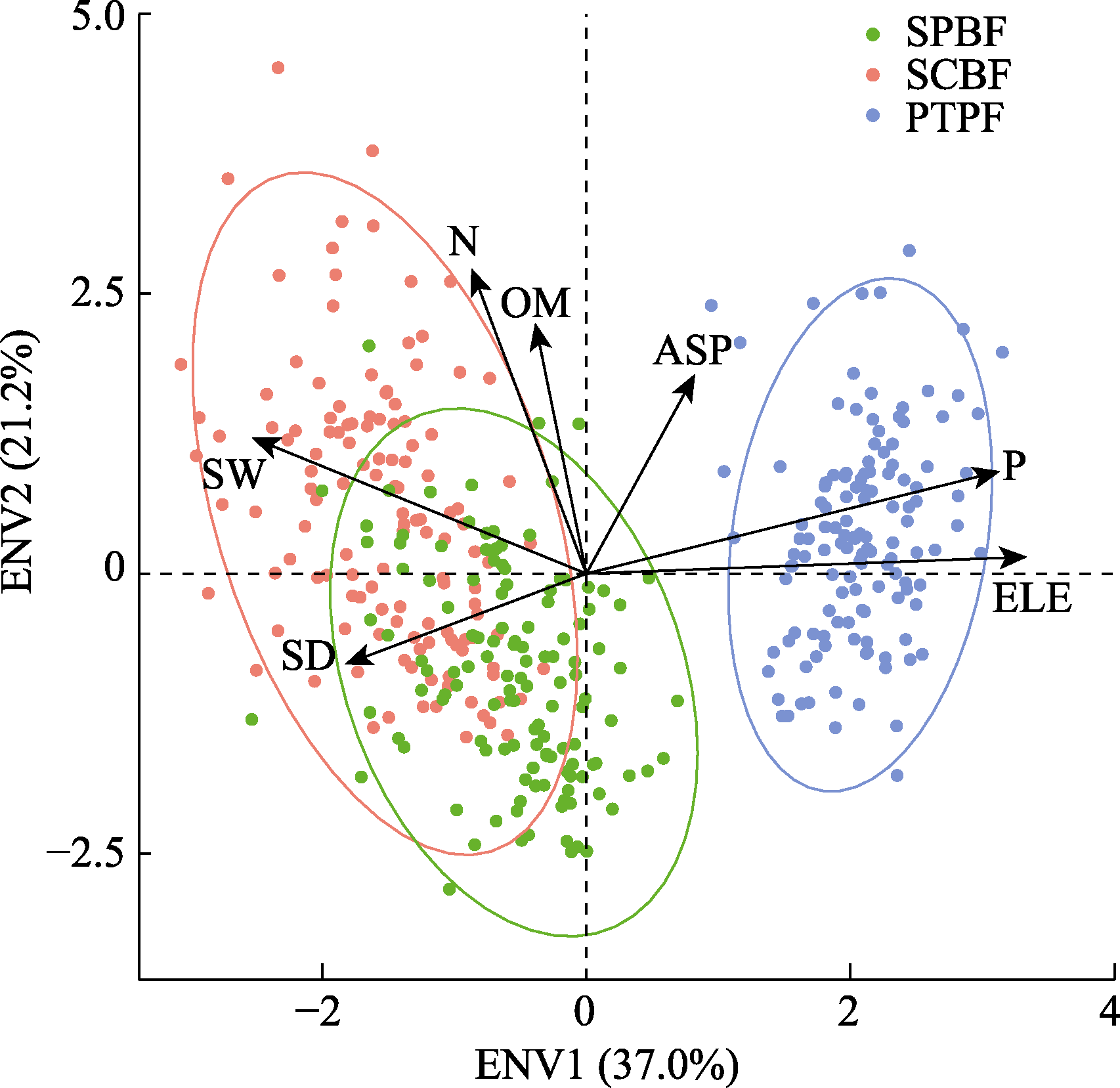
图1 长白山不同演替阶段森林环境因子的主成分分析结果排序图。ENV1, 环境第一主成分; ENV2, 环境第一主成分。PTPF, 原始紫椴-红松林; SCBF, 次生针阔混交林; SPBF, 次生山杨-白桦林。ASP, 坡度; ELE, 海拔; N, 土壤全氮含量; OM, 土壤有机质含量; P, 土壤全磷含量; SD, 土壤厚度; SW, 土壤含水量。
Fig. 1 Principal component analysis of environmental factors of forests at different succession stages in Changbai Mountains. ENV1, the first principal component of the environment; ENV2, the second principal component of the environment. PTPF, primary Tilia amurensis - Pinus koraiensis forest; SCBF, secondary needleleaf-broadleaf mixed forest; SPBF, secondary Populus davidiana - Betula platyphylla forest. ASP, aspect; ELE, elevation; N, soil nitrogen content; OM, soil organic matter content; P, soil phosphorus content; SD, soil depth; SW, soil water content.
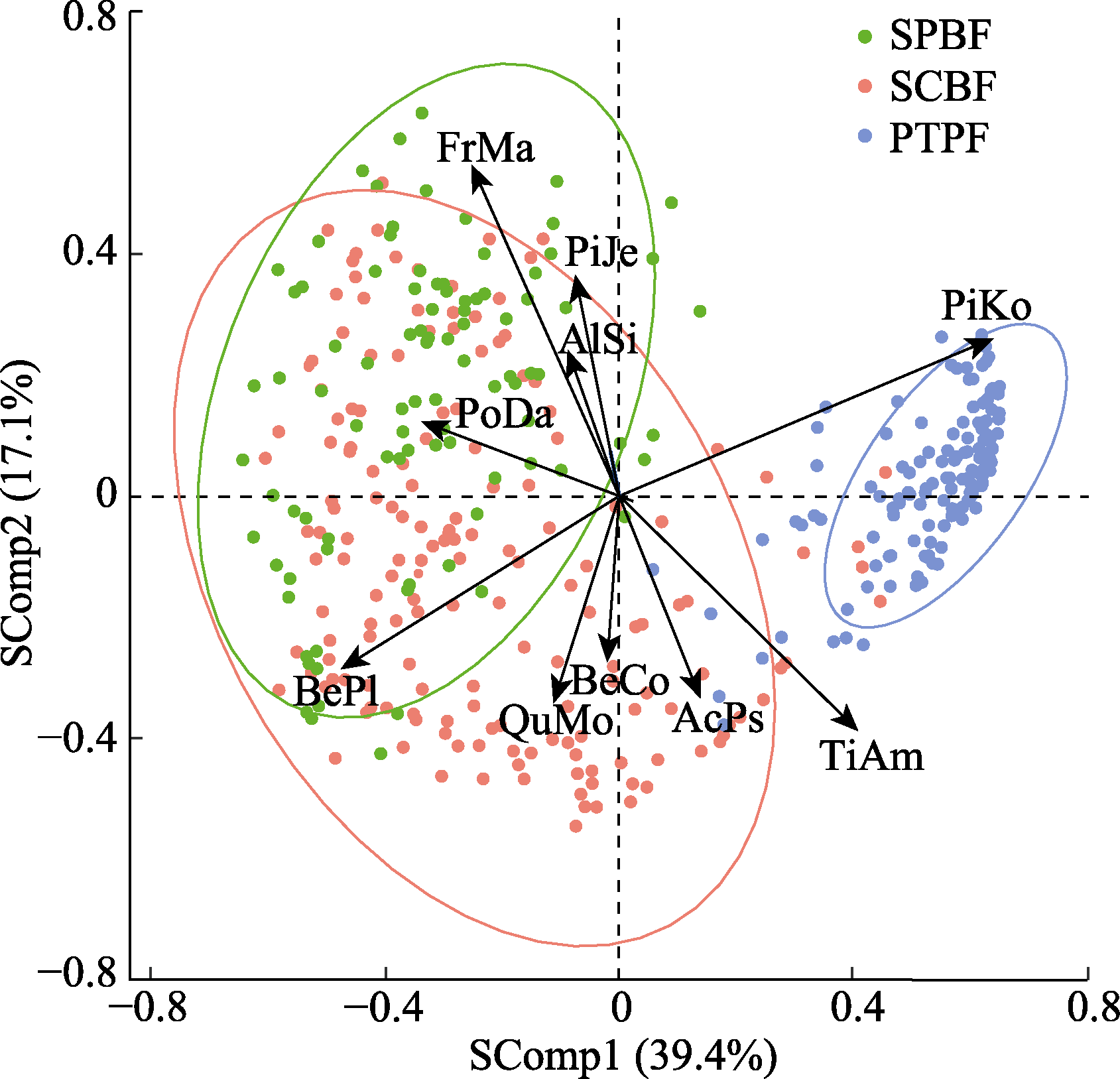
图2 长白山不同演替阶段森林物种组成的主坐标分析结果排序图。SComp1, 物种组成第一主坐标; SComp2, 物种组成第二主坐标。PTPF, 原始紫椴-红松林; SCBF, 次生针阔混交林; SPBF, 次生山杨-白桦林。AcPs, 紫花槭; AlSi, 辽东桤木; BeCo, 硕桦; BePl, 白桦; FrMa, 水曲柳; PiJe, 鱼鳞云杉; PiKo, 红松; PoDa, 山杨; QuMo, 蒙古栎; TiAm, 紫椴。
Fig. 2 Principal coordinate analysis of species composition of forests at different succession stages in Changbai Mountains. SComp1, the first principal coordinate of species composition; SComp2, the second principal coordinate of species composition. PTPF, primary Tilia amurensis - Pinus koraiensis forest; SCBF, secondary needleleaf-broadleaf mixed forest; SPBF, secondary Populus davidiana - Betula platyphylla forest. AcPs, Acer pseudosieboldianum; AlSi, Alnus sibirica; BeCo, Betula costata; BePl, Betula platyphylla; FrMa, Fraxinus mandshurica; PiJe, Picea jezoensis; PiKo, Pinus koraiensis; PoDa, Populus davidiana; QuMo, Quercus mongolica; TiAm, Tilia amurensis.
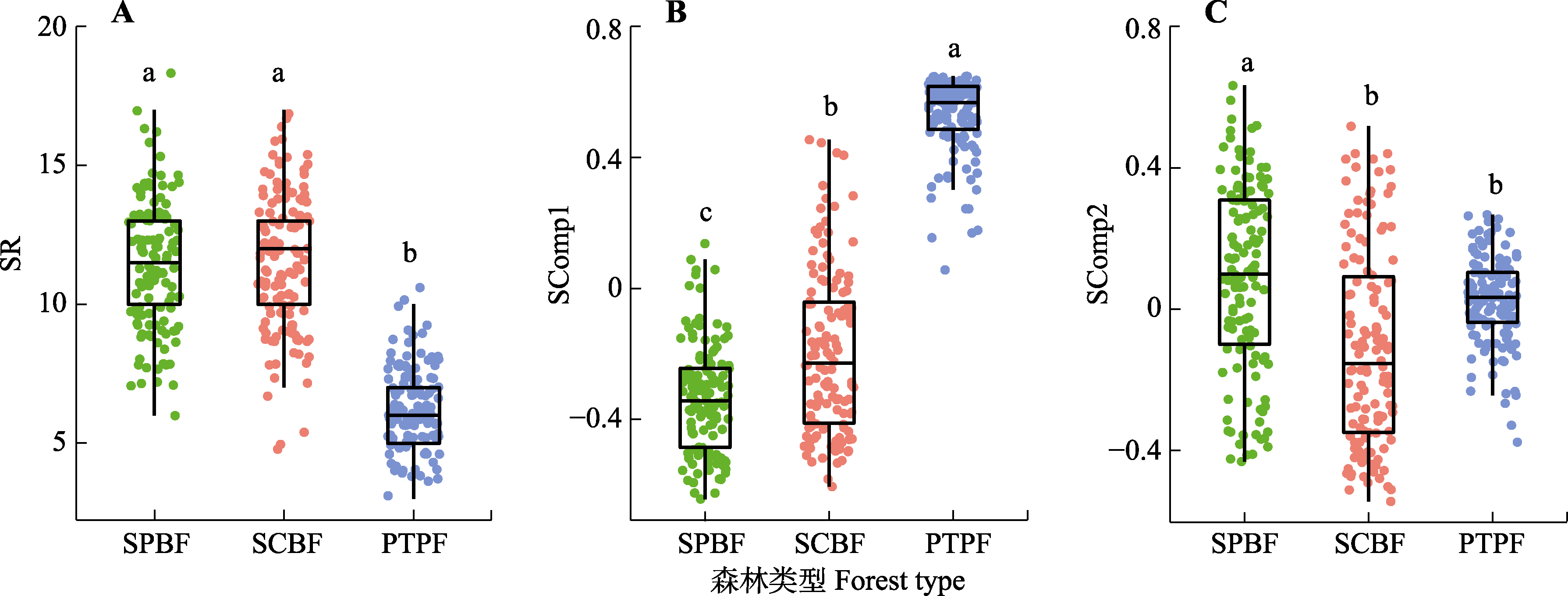
图3 长白山不同演替阶段物种丰富度与物种组成的变化。SComp1, 物种组成第一主坐标; SComp2, 物种组成第二主坐标; SR, 物种丰富度。PTPF, 原始紫椴-红松林; SCBF, 次生针阔混交林; SPBF, 次生山杨-白桦林。不同小写字母表示不同演替阶段间差异显著(p < 0.05)。
Fig. 3 Changes in species diversity and composition during forest succession in Changbai Mountains. SComp1, the first principal coordinate of species composition; SComp2, the second principal coordinate of species composition; SR, species richness. PTPF, primary Tilia amurensis - Pinus koraiensis forest; SCBF, secondary needleleaf-broadleaf mixed forest; SPBF, secondary Populus davidiana - Betula platyphylla forest. Different lowercase letters indicate significant differences between different succession stages (p < 0.05).
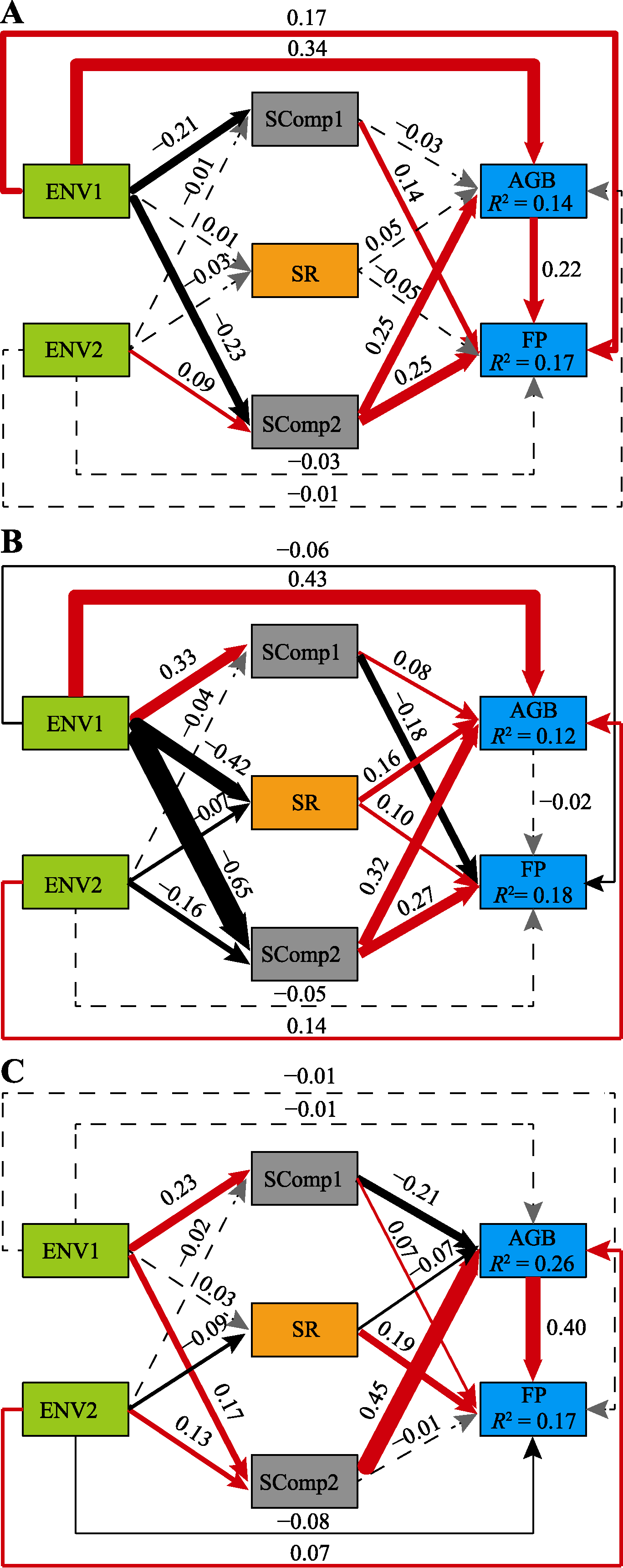
图4 长白山不同演替阶段物种丰富度和物种组成对生态系统功能的影响。A, 次生山杨-白桦林。B, 次生针阔混交林。C, 原始紫椴-红松林。AGB, 地上生物量; ENV1, 环境第一主成分; ENV2, 环境第二主成分; FP, 森林生产力; SComp1, 物种组成第一主坐标; SComp2, 物种组成第二主坐标; SR, 物种丰富度。红色实线代表显著正相关路径, 黑色实线代表显著负相关路径, 灰色虚线代表不显著路径, 线条上数值表示标准化路径系数, 线条粗细反映路径系数的大小。
Fig. 4 Impact of species richness and composition on ecosystem functions of forests at different succession stages in Changbai Mountains. A, Secondary Populus davidiana - Betula platyphylla forest. B, Secondary needleleaf -broadleaf mixed forest. C, Primary Tilia amurensis - Pinus koraiensis forest. AGB, aboveground biomass; ENV1, the first principal component of the environment; ENV2, the second principal component of the environment; FP, forest productivity; SComp1, the first principal coordinate of species composition; SComp2, the second principal coordinate of species composition; SR, species richness. Red solid lines represent significantly positively correlated paths, black solid lines represent significantly negatively correlated paths, and gray dashed lines represent insignificant paths, the values next to the lines represent the standardized path coefficients, and the line thickness is proportional to the standardized path coefficient.
| 样地 Plot | 样地位置 Location | 海拔 Altitude (m) | 主要树种 Main species |
|---|---|---|---|
| 次生山杨-白桦林 Secondary Populus davidiana - Betula platyphylla forest | 42.32° N, 128.13° E | 899 | 白桦、山杨、水曲柳、紫椴 Betula platyphylla, Populus davidiana, Fraxinus mandschurica, Tilia amurensis |
| 次生针阔混交林 Secondary needleleaf-broadleaf mixed forest | 42.35° N, 128.13° E | 748 | 白桦、蒙古栎、紫椴、臭冷杉 Betula platyphylla, Quercus mongolica, Tilia amurensis, Abies nephrolepis |
| 原始紫椴-红松林 Primary Tilia amurensis - Pinus koraiensis | 42.23° N, 128.08° E | 784 | 紫椴、红松、臭冷杉、大青杨 Tilia amurensis, Pinus koraiensis, Tilia amurensis, Populus ussuriensis |
附录I 长白山森林样地基本信息
Supplement I Basic information of the three forest plots in Changbai Mountains
| 样地 Plot | 样地位置 Location | 海拔 Altitude (m) | 主要树种 Main species |
|---|---|---|---|
| 次生山杨-白桦林 Secondary Populus davidiana - Betula platyphylla forest | 42.32° N, 128.13° E | 899 | 白桦、山杨、水曲柳、紫椴 Betula platyphylla, Populus davidiana, Fraxinus mandschurica, Tilia amurensis |
| 次生针阔混交林 Secondary needleleaf-broadleaf mixed forest | 42.35° N, 128.13° E | 748 | 白桦、蒙古栎、紫椴、臭冷杉 Betula platyphylla, Quercus mongolica, Tilia amurensis, Abies nephrolepis |
| 原始紫椴-红松林 Primary Tilia amurensis - Pinus koraiensis | 42.23° N, 128.08° E | 784 | 紫椴、红松、臭冷杉、大青杨 Tilia amurensis, Pinus koraiensis, Tilia amurensis, Populus ussuriensis |
| 编号 No. | 物种 Species | 异速生长方程 Allometric equation |
|---|---|---|
| 1 | 红松 Pinus koraiensis | Biomass = exp (-3.394 + 2.582 × ln (DBH)) |
| 2 | 臭冷杉 Abies nephrolepis | Biomass = exp (-2.989 + 2.613 × ln (DBH)) |
| 3 | 蒙古栎 Quercus mongolica | Biomass = exp (-2.797 + 2.571 × ln (DBH)) |
| 4 | 胡桃楸 Juglans mandshurica | Biomass = exp (-2.466 + 2.381 × ln (DBH)) |
| 5 | 五角槭 Acer pictum subsp. mono | Biomass = exp (-2.164 + 2.336 × ln (DBH)) |
| 6 | 东北槭 Acer mandshuricum | Biomass = exp (-2.111 + 2.310 × ln (DBH)) |
| 7 | 白桦 Betula platyphylla | Biomass = exp (-1.941 + 2.286 × ln (DBH)) |
| 8 | 水曲柳 Fraxinus mandschurica | Biomass = exp (-2.301 + 2.443 × ln (DBH)) |
| 9 | 山杨 Populus davidiana | Biomass = exp (-2.507 + 2.358 × ln (DBH)) |
| 10 | 紫椴 Tilia amurensis | Biomass = exp (-2.364 + 2.323 × ln (DBH)) |
| 11 | 水榆花楸 Sorbus alnifolia | Biomass = exp (-2.001 + 2.198 × ln (DBH)) |
| 12 | 春榆 Ulmus japonica | Biomass = exp (-2.058 + 2.271 × ln (DBH)) |
附录II 东北地区主要树种地上生物量异速生长方程
Supplement II Allometric equations of aboveground biomass of main tree species in northeast China
| 编号 No. | 物种 Species | 异速生长方程 Allometric equation |
|---|---|---|
| 1 | 红松 Pinus koraiensis | Biomass = exp (-3.394 + 2.582 × ln (DBH)) |
| 2 | 臭冷杉 Abies nephrolepis | Biomass = exp (-2.989 + 2.613 × ln (DBH)) |
| 3 | 蒙古栎 Quercus mongolica | Biomass = exp (-2.797 + 2.571 × ln (DBH)) |
| 4 | 胡桃楸 Juglans mandshurica | Biomass = exp (-2.466 + 2.381 × ln (DBH)) |
| 5 | 五角槭 Acer pictum subsp. mono | Biomass = exp (-2.164 + 2.336 × ln (DBH)) |
| 6 | 东北槭 Acer mandshuricum | Biomass = exp (-2.111 + 2.310 × ln (DBH)) |
| 7 | 白桦 Betula platyphylla | Biomass = exp (-1.941 + 2.286 × ln (DBH)) |
| 8 | 水曲柳 Fraxinus mandschurica | Biomass = exp (-2.301 + 2.443 × ln (DBH)) |
| 9 | 山杨 Populus davidiana | Biomass = exp (-2.507 + 2.358 × ln (DBH)) |
| 10 | 紫椴 Tilia amurensis | Biomass = exp (-2.364 + 2.323 × ln (DBH)) |
| 11 | 水榆花楸 Sorbus alnifolia | Biomass = exp (-2.001 + 2.198 × ln (DBH)) |
| 12 | 春榆 Ulmus japonica | Biomass = exp (-2.058 + 2.271 × ln (DBH)) |
| [1] | Bell T, Newman JA, Silverman BW, Turner SL, Lilley AK (2005). The contribution of species richness and composition to bacterial services. Nature, 436, 1157-1160. |
| [2] | Cardinale BJ, Duffy JE, Gonzalez A, Hooper DU, Perrings C, Venail P, Narwani A, Mace GM, Tilman D, Wardle DA, Kinzig AP, Daily GC, Loreau M, Grace JB, Larigauderie A, et al. (2012). Biodiversity loss and its impact on humanity. Nature, 486, 59-67. |
| [3] |
Davies GM, Gray A (2015). Don’t let spurious accusations of pseudoreplication limit our ability to learn from natural experiments (and other messy kinds of ecological monitoring). Ecology and Evolution, 5, 5295-5304.
DOI PMID |
| [4] | Duffy JE, Godwin CM, Cardinale BJ (2017). Biodiversity effects in the wild are common and as strong as key drivers of productivity. Nature, 549, 261-264. |
| [5] | Fan XH (2018). The Assembly and Development Mechanisms of Typical Natural Forest Community in Changbai Mountains. PhD dissertation,Beijing Forestry University, Beijing. |
| [ 范秀华 (2018). 长白山典型天然林群落形成与演变机制研究. 博士学位论文, 北京林业大学, 北京.] | |
| [6] | Finegan B, Peña-Claros M, de Oliveira A, Ascarrunz N, Bret-Harte MS, Carreño-Rocabado G, Casanoves F, Díaz S, Eguiguren Velepucha P, Fernandez F, Licona JC, Lorenzo L, Salgado Negret B, Vaz M, Poorter L (2015). Does functional trait diversity predict above-ground biomass and productivity of tropical forests? Testing three alternative hypotheses. Journal of Ecology, 103, 191-201. |
| [7] | Forrester DI, Bauhus J (2016). A review of processes behind diversity—Productivity relationships in forests. Current Forestry Reports, 2, 45-61. |
| [8] | Fotis AT, Murphy SJ, Ricart RD, Krishnadas M, Whitacre J, Wenzel JW, Queenborough SA, Comita LS (2018). Above-ground biomass is driven by mass-ratio effects and stand structural attributes in a temperate deciduous forest. Journal of Ecology, 106, 561-570. |
| [9] | García-Palacios P, Shaw EA, Wall DH, Hättenschwiler S (2017). Contrasting mass-ratio vs. niche complementarity effects on litter C and N loss during decomposition along a regional climatic gradient. Journal of Ecology, 105, 968-978. |
| [10] | Grime JP (1998). Benefits of plant diversity to ecosystems: immediate, filter and founder effects. Journal of Ecology, 86, 902-910. |
| [11] | Hao MH, Dai Y, Yue QM, Fan CY, Zhang CY (2022). Relationship between functional diversity of broadleaved Korean pine forest and forest carbon sink function. Journal of Beijing Forestry University, 44(10), 68-76. |
| [ 郝珉辉, 代莹, 岳庆敏, 范春雨, 张春雨 (2022). 阔叶红松林功能多样性与森林碳汇功能关系. 北京林业大学学报, 44(10), 68-76.] | |
| [12] | Hao M, Messier C, Geng Y, Zhang C, Zhao X, von Gadow K (2020). Functional traits influence biomass and productivity through multiple mechanisms in a temperate secondary forest. European Journal of Forest Research, 139, 959-968. |
| [13] |
Hao M, Zhang C, Zhao X, von Gadow K (2018). Functional and phylogenetic diversity determine woody productivity in a temperate forest. Ecology and Evolution, 8, 2395-2406.
DOI PMID |
| [14] | Harms KE, Condit R, Hubbell SP, Foster RB (2001). Habitat associations of trees and shrubs in a 50-ha neotropical forest plot. Journal of Ecology, 89, 947-959. |
| [15] | He HJ, Yeerjiang B, Zhang CY, Zuo Q, Pi TH, Gao HT (2016). Biomass allocation of twelve tree species in coniferous and broad-leaved mixed forest in Jiaohe, Jilin Province, northeast China. Journal of Beijing Forestry University, 38(4), 53-62. |
| [ 何怀江, 叶尔江·拜克吐尔汉, 张春雨, 左强, 邳田辉, 高海涛 (2016). 吉林蛟河针阔混交林12个树种生物量分配规律. 北京林业大学学报, 38(4), 53-62.] | |
| [16] | Hoyle RH (2012). Handbook of Structural Equation Modeling. Guilford Press, New York. |
| [17] |
Kahmen A, Perner J, Audorff V, Weisser W, Buchmann N (2005). Effects of plant diversity, community composition and environmental parameters on productivity in montane European grasslands. Oecologia, 142, 606-615.
PMID |
| [18] | Keith H, Lindenmayer D, MacKey B, Blair D, Carter L, McBurney L, Okada S, Konishi-Nagano T (2014). Managing temperate forests for carbon storage: impacts of logging versus forest protection on carbon stocks. Ecosphere, 5, 1-34. |
| [19] | Kinzig AP, Pacala S, Tilman D (2002). The Functional Consequences of Biodiversity: Empirical Progress and Theoretical Extensions. Princeton University Press, Princeton. |
| [20] |
Lasky JR, Uriarte M, Boukili VK, Chazdon RL (2014). Trait-mediated assembly processes predict successional changes in community diversity of tropical forests. Proceedings of the National Academy of Sciences of the United States of America, 111, 5616-5621.
DOI PMID |
| [21] | Legendre P, Gauthier O (2014). Statistical methods for temporal and space-time analysis of community composition data. Proceedings of the Royal Society B: Biological Sciences, 281, 20132728. DOI: 10.1098/rspb.2013.2728. |
| [22] | Legendre P, Legendre L (2012). Numerical Ecology. Elsevier, Amsterdam, the Netherlands. |
| [23] | Liang JJ, Crowther TW, Picard N, Wiser S, Zhou M, Alberti G, Schulze ED, Mcguire AD, Bozzato F, Pretzsch H, De-miguel S, Paquette A, Hérault B, Scherer-Lorenzen S, Barrett BC, et al. (2016). Positive biodiversity-productivity relationship predominant in global forests. Science, 354, aaf8957. DOI: 10.1126/science.aaf8957. |
| [24] |
Lohbeck M, Poorter L, Martínez-Ramos M, Bongers F (2015). Biomass is the main driver of changes in ecosystem process rates during tropical forest succession. Ecology, 96, 1242-1252.
PMID |
| [25] | Lohbeck M, Poorter L, Martínez-Ramos M, Rodriguez- Velázquez J, van Breugel M, Bongers F (2014). Changing drivers of species dominance during tropical forest succession. Functional Ecology, 28, 1052-1058. |
| [26] | MacKey B, Prentice IC, Steffen W, House JI, Lindenmayer D, Keith H, Berry S (2013). Untangling the confusion around land carbon science and climate change mitigation policy. Nature Climate Change, 3, 552-557. |
| [27] | Mokany K, Ash J, Roxburgh S (2008). Functional identity is more important than diversity in influencing ecosystem processes in a temperate native grassland. Journal of Ecology, 96, 884-893. |
| [28] | Mouquet N, Moore JL, Loreau M (2002). Plant species richness and community productivity: Why the mechanism that promotes coexistence matters. Ecology Letters, 5, 56-65. |
| [29] | Paquette A, Messier C (2011). The effect of biodiversity on tree productivity: from temperate to boreal forests. Global Ecology and Biogeography, 20, 170-180. |
| [30] |
Ruiz-Benito P, Ratcliffe S, Zavala MA, Martínez-Vilalta J, Vilà-Cabrera A, Lloret F, Madrigal-González J, Wirth C, Greenwood S, Kändler G, Lehtonen A, Kattge J, Dahlgren J, Jump AS (2017). Climate- and successional-related changes in functional composition of European forests are strongly driven by tree mortality. Global Change Biology, 23, 4162-4176.
DOI PMID |
| [31] |
Ruiz-Jaen MC, Potvin C (2011). Can we predict carbon stocks in tropical ecosystems from tree diversity? Comparing species and functional diversity in a plantation and a natural forest. New Phytologist, 189, 978-987.
DOI PMID |
| [32] | Sandau N, Fabian Y, Bruggisser OT, Rohr RP, Naisbit RE, Kehrli P, Aebi A, Bersier LF (2017). The relative contributions of species richness and species composition to ecosystem functioning. Oikos, 126, 782-791. |
| [33] | Tilman D (1999). The ecological consequences of changes in biodiversity: a search for general principles. Ecology, 80, 1455-1474. |
| [34] | Tilman D, Knops J, Wedin D, Reich P, Ritchie M, Siemann E (1997). The influence of functional diversity and composition on ecosystem processes. Science, 277, 1300-1302. |
| [35] | van der Plas F (2019). Biodiversity and ecosystem functioning in naturally assembled communities. Biological Reviews, 94, 1220-1245. |
| [36] | Yu DP, Zhou WM, Zhou L, Dai LM (2019). Exploring the history of the management theory and technology of broad-leaved Korean pine (Pinus koraiensis Sieb. et Zucc.) forest in Changbai Mountain Region, Northeast China. Chinese Journal of Applied Ecology, 30, 1426-1434. |
|
[ 于大炮, 周旺明, 周莉, 代力民 (2019). 长白山区阔叶红松林经营历史与研究历程. 应用生态学报, 30, 1426-1434.]
DOI |
|
| [37] | Yue QM, He HJ, Zhang CY, Zhao XH, Hao MH (2024). Responses of tree growth and stand productivity to harvesting disturbance in Korean pine-broadleaved forests. Acta Ecologica Sinica, 44, 2019-2028. |
| [ 岳庆敏, 何怀江, 张春雨, 赵秀海, 郝珉辉 (2024). 阔叶红松林林木与林分生长对采伐干扰的响应. 生态学报, 44, 2019-2028.] | |
| [38] | Zhang C, Zhao Y, Zhao X, von Gadow K (2012). Species-habitat associations in a northern temperate forest in China. Silva Fennica, 46, 501-519. |
| [39] | Zhu JJ, Zhang QL, Wang AZ, Wang CK, Yu LZ, Yu DP, Zhang QZ, Yan QL, Zheng XB, Wang B, Zhou ZH, Hao S, Zhang X, Song LN, Zheng X, et al. (2022). Suggestions for improving the qualities and functions of forest ecosystems in northeast China. Terrestrial Ecosystem and Conservation, 2(5), 41-48. |
| [ 朱教君, 张秋良, 王安志, 王传宽, 于立忠, 于大炮, 张全智, 闫巧玲, 郑兴波, 王冰, 周正虎, 郝帅, 张欣, 宋立宁, 郑晓, 等 (2022). 东北地区森林生态系统质量与功能提升对策建议. 陆地生态系统与保护学报, 2(5), 41-48.] |
| [1] | 杨梅花, 张子嘉, 乔栋, 冯俊娜, 庞子杰, 钱龙, 刘志晖, 蔡娜娜, 胡中民, 杨国姣. 海南热带森林乔木群落调查和多样性数据集[J]. 植物生态学报, 2026, 50(预发表): 0-. |
| [2] | 何青, 袁旭东, 任博申, 冯治洋, 鲁梦珍, 林巧玲, 姜庆虎, 杨林森, 余辉亮, 姚辉, 杨敬元, 刘峰, 江明喜. 一年蓬(Erigeron annuus)入侵对亚高山泥炭湿地植物群落结构与多样性的影响[J]. 植物生态学报, 2026, 50(预发表): 0-. |
| [3] | 徐恩相, 周蕾, 章晓炜, 张国萍, 仲杜伟, 黄智, 刘派, 迟永刚. 基于不同生育阶段冠层光谱和碳通量的水稻产量估算[J]. 植物生态学报, 2026, 50(1): 82-93. |
| [4] | 宋珊珊, 唐志尧. 河北塞罕坝草甸草原根际土壤真菌与植物地上生物量的关系[J]. 植物生态学报, 2025, 49(9): 1461-1471. |
| [5] | 蔡榕榕, 沈历都, 刘雅各, 费雯丽, 戴冠华. 2005-2010年长白山阔叶红松林长期监测样地植物物种组成和群落特征数据集[J]. 植物生态学报, 2025, 49(8): 1236-1245. |
| [6] | 白帆, 王杨. 2007-2015年北京东灵山暖温带落叶阔叶林长期监测样地植物物种组成和群落特征数据集[J]. 植物生态学报, 2025, 49(8): 1229-1235. |
| [7] | 赵常明, 熊高明, 申国珍, 葛结林, 徐文婷, 徐凯, 武元帅, 谢宗强. 2010年神农架常绿落叶阔叶混交林和亚高山针叶林长期监测样地植物物种组成和群落特征数据集[J]. 植物生态学报, 2025, 49(8): 1215-1228. |
| [8] | 饶兴权, 蔡锡安, 林永标, 刘素萍. 2005-2015年鹤山马占相思林长期监测样地植物物种组成和群落特征数据集[J]. 植物生态学报, 2025, 49(8): 1246-1254. |
| [9] | 徐志雄, 杞金华, 杨国平, 鲁志云, 杨效东, 范泽鑫. 2005-2010年哀牢山中山湿性常绿阔叶林长期监测样地植物物种组成和群落特征数据集[J]. 植物生态学报, 2025, 49(8): 1191-1204. |
| [10] | 周志琼, 丁建林, 李晓明, 何其华. 2005-2010年西南山地人工林长期监测样地植物物种组成与群落特征数据集[J]. 植物生态学报, 2025, 49(8): 1255-1262. |
| [11] | 刘世忠, 张倩媚, 张德强, 刘菊秀, 褚国伟, 李跃林. 1999-2015年鼎湖山季风常绿阔叶林长期监测样地植物物种组成和群落特征数据集[J]. 植物生态学报, 2025, 49(8): 1205-1214. |
| [12] | 张坤, 伊丽晴, 刘占军, 张志杰, 王顼, 李明乐, 苗百岭, 张景慧, 李智勇, 董雷, 梁存柱. 毛刺锦鸡儿群落特征及分类[J]. 植物生态学报, 2025, 49(6): 888-896. |
| [13] | 韩鹏宾, 裴康迪, 何斌, 肖书礼, 唐勤. 中国云南铁杉林的群落组成及特征[J]. 植物生态学报, 2025, 49(6): 840-851. |
| [14] | 何斌, 韩鹏宾, 唐勤. 中国铁坚油杉林的群落类型及特征[J]. 植物生态学报, 2025, 49(6): 833-839. |
| [15] | 韩鹏宾, 何斌, 陆树刚, 唐勤. 中国柔毛油杉林的群落类型及特征[J]. 植物生态学报, 2025, 49(6): 825-832. |
| 阅读次数 | ||||||
|
全文 |
|
|||||
|
摘要 |
|
|||||
Copyright © 2026 版权所有 《植物生态学报》编辑部
地址: 北京香山南辛村20号, 邮编: 100093
Tel.: 010-62836134, 62836138; Fax: 010-82599431; E-mail: apes@ibcas.ac.cn, cjpe@ibcas.ac.cn
备案号: 京ICP备16067583号-19

