
植物生态学报 ›› 2025, Vol. 49 ›› Issue (12): 2119-2136.DOI: 10.17521/cjpe.2025.0182 cstr: 32100.14.cjpe.2025.0182
宋思宇1,2, 杜飘1,2, 林琴2, 齐祥2, 杜柯芋1,2, 李聪1,2, 陈亚梅5, 黄尤优5, 刘洋1,2,3,4,*( )(
)( )
)
收稿日期:2025-05-20
接受日期:2025-08-25
出版日期:2025-12-20
发布日期:2025-12-26
通讯作者:
*刘洋(sicauliuyang@163.com),ORCID:0000-0002-4795-9169基金资助:
SONG Si-Yu1,2, DU Piao1,2, LIN Qin2, QI Xiang2, DU Ke-Yu1,2, LI Cong1,2, CHEN Ya-Mei5, HUANG You-You5, LIU Yang1,2,3,4,*()()
Received:2025-05-20
Accepted:2025-08-25
Online:2025-12-20
Published:2025-12-26
Supported by:摘要:
随着气候变化的加剧, 全球高海拔和高纬度地区的灌木扩张现象日益显著。然而, 高山地区灌木扩张过程中植物防御性化学物质(如总酚和缩合单宁)含量的变化规律及其驱动机制尚不明确。该研究以青藏高原东缘的川西高山灌丛-草甸交错带为研究区域, 沿灌木扩张梯度选取对照(盖度0%)、轻度扩张(盖度<30%)、轻中度扩张(盖度30%-45%)、中重度扩张(盖度45%-60%)和重度扩张(盖度>60%)样地, 采用空间代替时间的方法, 分析了灌木扩张对植物防御性化学物质含量的影响及其与环境因子(如海拔、土壤pH、含水量等)的关系。结果表明: (1)灌木扩张显著增加了川西高山灌丛-草甸交错带的灌丛数量、高度、体积和加权密度; (2)与草本植物和红毛花楸(Sorbus rufopilosa)相比, 高山杜鹃(Rhododendron lapponicum)在灌木扩张过程中表现出较高的酚类物质含量; (3)群落水平物种组成的变化对植物酚类物质变异的影响显著高于物种内个体间表型可塑性的种内变异; (4)植物叶片与根系的酚类物质含量均与其碳氮比显著相关, 而土壤因子影响较小, 支持了碳-养分平衡假说。该研究揭示了灌木扩张对植物防御物质的正向影响, 并为全球变化背景下的生态系统管理和植物保护提供了重要的理论依据。
宋思宇, 杜飘, 林琴, 齐祥, 杜柯芋, 李聪, 陈亚梅, 黄尤优, 刘洋. 高山灌木扩张梯度下植物叶片与根系酚类物质的响应特征. 植物生态学报, 2025, 49(12): 2119-2136. DOI: 10.17521/cjpe.2025.0182
SONG Si-Yu, DU Piao, LIN Qin, QI Xiang, DU Ke-Yu, LI Cong, CHEN Ya-Mei, HUANG You-You, LIU Yang. Response characteristics of phenolic compounds in plant leaves and roots along an alpine shrub encroachment gradient. Chinese Journal of Plant Ecology, 2025, 49(12): 2119-2136. DOI: 10.17521/cjpe.2025.0182
| 灌木扩张水平 Shrub encroachment level | 冠幅 Crown width (m2) | 盖度 Coverage (%) | 高度 Height (m) | 灌丛数量 Number of shrubs | 灌丛体积 Shrub volume (m3) | 灌丛加权密度 Weighted shrub density | 海拔 Altitude (m) |
|---|---|---|---|---|---|---|---|
| 对照(高山草甸) CK (alpine meadow) | 0.00 (0.00)e | 0.00 (0.00)e | 0.00 (0.00)c | 0.00 (0.00)c | 0.00 (0.00)e | 0.00 (0.00)c | 4 200.00 (0.00)a |
| 轻度扩张 SE-I | 106.31 (6.85)d | 26.58 (1.71)d | 1.44 (0.15)b | 49.80 (6.59)b | 77.14 (10.29)d | 653.33 (79.74)b | 4 110.00 (18.71)b |
| 轻中度扩张 SE-II | 153.35 (7.45)c | 38.34 (1.86)c | 1.88 (0.19)ab | 59.80 (5.64)b | 130.51 (12.35)c | 815.21 (67.40)b | 4 090.00 (18.71)b |
| 中重度扩张 SE-III | 212.50 (10.93)b | 53.12 (2.73)b | 1.68 (0.13)ab | 72.00 (12.02)ab | 175.71 (16.99)b | 978.73 (158.74)ab | 4 080.00 (33.91)b |
| 重度扩张 SE-IV | 280.47 (17.70)a | 70.12 (4.43)a | 1.97 (0.19)a | 92.40 (14.92)a | 281.87 (20.22)a | 1 288.15 (197.77)a | 4 020.00 (12.25)c |
| F | 105.88 | 105.87 | 29.18 | 13.46 | 58.58 | 15.26 | 10.63 |
| p | <0.001 | <0.001 | <0.001 | <0.001 | <0.001 | <0.001 | <0.001 |
表1 高山灌丛-草甸分布区不同灌木扩张水平下样方基本特征
Table 1 Basic characteristics of sample plots under different shrub expansion levels in alpine shrub-meadow distribution areas
| 灌木扩张水平 Shrub encroachment level | 冠幅 Crown width (m2) | 盖度 Coverage (%) | 高度 Height (m) | 灌丛数量 Number of shrubs | 灌丛体积 Shrub volume (m3) | 灌丛加权密度 Weighted shrub density | 海拔 Altitude (m) |
|---|---|---|---|---|---|---|---|
| 对照(高山草甸) CK (alpine meadow) | 0.00 (0.00)e | 0.00 (0.00)e | 0.00 (0.00)c | 0.00 (0.00)c | 0.00 (0.00)e | 0.00 (0.00)c | 4 200.00 (0.00)a |
| 轻度扩张 SE-I | 106.31 (6.85)d | 26.58 (1.71)d | 1.44 (0.15)b | 49.80 (6.59)b | 77.14 (10.29)d | 653.33 (79.74)b | 4 110.00 (18.71)b |
| 轻中度扩张 SE-II | 153.35 (7.45)c | 38.34 (1.86)c | 1.88 (0.19)ab | 59.80 (5.64)b | 130.51 (12.35)c | 815.21 (67.40)b | 4 090.00 (18.71)b |
| 中重度扩张 SE-III | 212.50 (10.93)b | 53.12 (2.73)b | 1.68 (0.13)ab | 72.00 (12.02)ab | 175.71 (16.99)b | 978.73 (158.74)ab | 4 080.00 (33.91)b |
| 重度扩张 SE-IV | 280.47 (17.70)a | 70.12 (4.43)a | 1.97 (0.19)a | 92.40 (14.92)a | 281.87 (20.22)a | 1 288.15 (197.77)a | 4 020.00 (12.25)c |
| F | 105.88 | 105.87 | 29.18 | 13.46 | 58.58 | 15.26 | 10.63 |
| p | <0.001 | <0.001 | <0.001 | <0.001 | <0.001 | <0.001 | <0.001 |
| 灌木 Shrub | 对照 CK | 轻度扩张 SE-I | 轻中度扩张 SE-II | 中重度扩张 SE-III | 重度扩张 SE-IV |
|---|---|---|---|---|---|
| 高山杜鹃 Rhododendron lapponicum | - | 11.16 ± 2.53Aa | 11.66 ± 4.04Aa | 21.04 ± 7.86Aa | 6.00 ± 1.88BCa |
| 红毛花楸 Sorbus rufopilosa | - | 7.70 ± 1.78Ab | 13.01 ± 3.83Ab | 22.30 ± 8.21Ab | 41.19 ± 3.41Aa |
| 金露梅 Dasiphora fruticosa | - | 2.95 ± 0.62Bab | 3.76 ± 1.41Bab | 0.79 ± 0.37Bb | 5.73 ± 1.55BCa |
| 软条七蔷薇 Rosa henryi | - | 2.32 ± 0.84Bb | 4.45 ± 1.22Bb | 2.55 ± 0.94Bb | 8.51 ± 2.06Ba |
| 绣线菊 Spiraea salicifolia | - | 0.23 ± 0.21Ba | 0.18 ± 0.18Ba | 0.40 ± 0.37Ba | 1.37 ± 1.00Ca |
| 高山柳 Salix takasagoalpina | - | 0.97 ± 0.36Ba | 2.65 ± 1.48Ba | 3.52 ± 1.68Ba | 2.94 ± 1.30BCa |
| 华西小檗 Berberis silva-taroucana | - | 0.03 ± 0.03Ba | 0.51 ± 0.19Ba | 0.58 ± 0.28Ba | 0.11 ± 0.08Ca |
| F | - | 11.56 | 5.05 | 5.13 | 58.56 |
| p | - | <0.001 | <0.01 | <0.01 | <0.001 |
表2 不同灌木扩张水平下高山灌丛-草甸分布区植物盖度特征(平均值±标准误, n = 5)
Table 2 Plant coverage characteristics under different shrub expansion levels in alpine shrub-meadow distribution areas (mean ± SE, n = 5)
| 灌木 Shrub | 对照 CK | 轻度扩张 SE-I | 轻中度扩张 SE-II | 中重度扩张 SE-III | 重度扩张 SE-IV |
|---|---|---|---|---|---|
| 高山杜鹃 Rhododendron lapponicum | - | 11.16 ± 2.53Aa | 11.66 ± 4.04Aa | 21.04 ± 7.86Aa | 6.00 ± 1.88BCa |
| 红毛花楸 Sorbus rufopilosa | - | 7.70 ± 1.78Ab | 13.01 ± 3.83Ab | 22.30 ± 8.21Ab | 41.19 ± 3.41Aa |
| 金露梅 Dasiphora fruticosa | - | 2.95 ± 0.62Bab | 3.76 ± 1.41Bab | 0.79 ± 0.37Bb | 5.73 ± 1.55BCa |
| 软条七蔷薇 Rosa henryi | - | 2.32 ± 0.84Bb | 4.45 ± 1.22Bb | 2.55 ± 0.94Bb | 8.51 ± 2.06Ba |
| 绣线菊 Spiraea salicifolia | - | 0.23 ± 0.21Ba | 0.18 ± 0.18Ba | 0.40 ± 0.37Ba | 1.37 ± 1.00Ca |
| 高山柳 Salix takasagoalpina | - | 0.97 ± 0.36Ba | 2.65 ± 1.48Ba | 3.52 ± 1.68Ba | 2.94 ± 1.30BCa |
| 华西小檗 Berberis silva-taroucana | - | 0.03 ± 0.03Ba | 0.51 ± 0.19Ba | 0.58 ± 0.28Ba | 0.11 ± 0.08Ca |
| F | - | 11.56 | 5.05 | 5.13 | 58.56 |
| p | - | <0.001 | <0.01 | <0.01 | <0.001 |
| 变异来源 Source of variation | 总酚 Total phenolic | 缩合单宁 Condensed tannin | 碳 Carbon | 氮 Nitrogen | 碳氮比 Carbon:nitrogen | 总酚RII Total phenolic RII | 缩合单宁RII Condensed tannin RII |
|---|---|---|---|---|---|---|---|
| 灌木扩张水平 SE | 1.98ns | 2.18ns | 0.94ns | 1.24ns | 1.16ns | 0.30ns | 2.03ns |
| 植物类群 Plant group | 136.32*** | 117.79*** | 2.99ns | 29.10*** | 72.88*** | 1.66ns | 2.87ns |
| 器官类型 Organ | 404.94*** | 112.01*** | 69.67*** | 127.36*** | 83.50*** | - | - |
| 灌木扩张水平×植物类群 SE × Plant group | 1.17ns | 2.25* | 1.10ns | 1.02ns | 1.03ns | - | - |
| 灌木扩张水平×器官类型 SE × Organ | 1.39ns | 0.84ns | 0.33ns | 1.66ns | 0.22ns | 0.42ns | 0.14ns |
| 植物类群×器官类型 Plant group × Organ | 76.90*** | 63.33*** | 0.21ns | 9.36*** | 4.04* | - | - |
| 灌木扩张水平×植物类群×器官类型 SE × Plant group × Organ | 0.72ns | 1.73ns | 0.77ns | 1.24ns | 1.29ns | - | - |
表3 不同灌木扩张水平下植物酚类物质及碳氮含量的三因素/双因素方差分析(F值)
Table 3 Three-way/two-way ANOVA of phenolic compounds and carbon-nitrogen content under different shrub expansion levels (F value)
| 变异来源 Source of variation | 总酚 Total phenolic | 缩合单宁 Condensed tannin | 碳 Carbon | 氮 Nitrogen | 碳氮比 Carbon:nitrogen | 总酚RII Total phenolic RII | 缩合单宁RII Condensed tannin RII |
|---|---|---|---|---|---|---|---|
| 灌木扩张水平 SE | 1.98ns | 2.18ns | 0.94ns | 1.24ns | 1.16ns | 0.30ns | 2.03ns |
| 植物类群 Plant group | 136.32*** | 117.79*** | 2.99ns | 29.10*** | 72.88*** | 1.66ns | 2.87ns |
| 器官类型 Organ | 404.94*** | 112.01*** | 69.67*** | 127.36*** | 83.50*** | - | - |
| 灌木扩张水平×植物类群 SE × Plant group | 1.17ns | 2.25* | 1.10ns | 1.02ns | 1.03ns | - | - |
| 灌木扩张水平×器官类型 SE × Organ | 1.39ns | 0.84ns | 0.33ns | 1.66ns | 0.22ns | 0.42ns | 0.14ns |
| 植物类群×器官类型 Plant group × Organ | 76.90*** | 63.33*** | 0.21ns | 9.36*** | 4.04* | - | - |
| 灌木扩张水平×植物类群×器官类型 SE × Plant group × Organ | 0.72ns | 1.73ns | 0.77ns | 1.24ns | 1.29ns | - | - |
| 灌木扩张水平 Shrub encroachment level | 植物类群 Plant group | 叶片碳 Leaf C (%) | 叶片氮 Leaf N (%) | 叶片碳氮比 Leaf C:N | 根系碳 Root C (%) | 根系氮 Root N (%) | 根系碳氮比 Root C:N |
|---|---|---|---|---|---|---|---|
| 对照(高山草甸) CK (alpine meadow) | 草本植物 Herb | 29.27 (2.23)a | 2.72 (0.21)a | 10.78 (0.07)b | 19.91 (1.36)a | 0.87 (0.06)a | 23.03 (1.62)a |
| 轻度扩张 SE-I | 草本植物 Herb | 31.95 (2.70)Aa | 1.96 (0.22)Aa | 16.68 (1.25)Ba | 25.41 (4.97)Aa | 0.88 (0.15)Aa | 29.68 (4.37)Ba |
| 高山杜鹃 Rhododendron lapponicum | 35.29 (0.93)Aa | 0.88 (0.07)Bb | 41.24 (4.26)Aa | 25.81 (2.04)Aa | 0.60 (0.04)Aab | 43.08 (2.59)Aa | |
| 红毛花楸 Sorbus rufopilosa | 31.55 (0.41)Aa | 2.18 (0.14)Aa | 14.67 (0.69)Ba | 22.76 (2.69)Aa | 0.66 (0.02)Aa | 34.43 (3.50)ABa | |
| 轻中度扩张 SE-II | 草本植物 Herb | 38.02 (4.99)Aa | 2.73 (0.49)Aa | 14.71 (1.48)Ba | 23.38 (1.52)Aa | 0.99 (0.27)Aa | 28.26 (5.34)Ba |
| 高山杜鹃 R. lapponicum | 36.76 (1.79)Aa | 1.16 (0.10)Ba | 32.43 (2.86)Aa | 25.31 (2.10)Aa | 0.54 (0.04)Ab | 48.09 (4.44)Aa | |
| 红毛花楸 S. rufopilosa | 28.98 (2.18)Aa | 2.12 (0.30)ABa | 14.46 (1.47)Ba | 24.40 (1.87)Aa | 0.87 (0.05)Aa | 28.51 (2.80)Ba | |
| 中重度扩张 SE-III | 草本植物 Herb | 30.12 (1.72)Aa | 2.18 (0.05)Aa | 13.81 (0.64)Bab | 21.45 (2.07)Aa | 1.64 (0.81)Aa | 20.85 (4.46)Ba |
| 高山杜鹃 R. lapponicum | 33.36 (1.33)Aa | 0.90 (0.01)Bb | 36.96 (1.69)Aa | 26.31 (2.09)Aa | 0.63 (0.04)Aab | 42.41 (3.92)Aa | |
| 红毛花楸 S. rufopilosa | 33.81 (2.31)Aa | 2.30 (0.18)Aa | 14.78 (0.27)Ba | 23.91 (4.79)Aa | 0.67 (0.11)Aa | 36.94 (5.56)Aa | |
| 重度扩张 SE-IV | 草本植物 Herb | 28.60 (1.58)Aa | 1.93 (0.17)Aa | 15.24 (1.38)Ba | 21.12 (2.46)Aa | 0.76 (0.06)Aa | 27.98 (3.04)Aa |
| 高山杜鹃 R. lapponicum | 32.68 (1.51)Aa | 1.04 (0.08)Bab | 32.01 (2.09)Aa | 26.96 (2.30)Aa | 0.66 (0.02)Aa | 40.67 (2.60)Aa | |
| 红毛花楸 S. rufopilosa | 32.33 (3.13)Aa | 1.92 (0.16)Aa | 17.83 (3.52)Ba | 24.84 (1.37)Aa | 0.98 (0.19)Aa | 30.89 (7.25)Aa |
表4 不同灌木扩张水平下植物不同器官(叶片、根系)碳氮含量及其比值
Table 4 Carbon and nitrogen content and their ratios in different plant organs (leaves, roots) under different shrub expansion levels
| 灌木扩张水平 Shrub encroachment level | 植物类群 Plant group | 叶片碳 Leaf C (%) | 叶片氮 Leaf N (%) | 叶片碳氮比 Leaf C:N | 根系碳 Root C (%) | 根系氮 Root N (%) | 根系碳氮比 Root C:N |
|---|---|---|---|---|---|---|---|
| 对照(高山草甸) CK (alpine meadow) | 草本植物 Herb | 29.27 (2.23)a | 2.72 (0.21)a | 10.78 (0.07)b | 19.91 (1.36)a | 0.87 (0.06)a | 23.03 (1.62)a |
| 轻度扩张 SE-I | 草本植物 Herb | 31.95 (2.70)Aa | 1.96 (0.22)Aa | 16.68 (1.25)Ba | 25.41 (4.97)Aa | 0.88 (0.15)Aa | 29.68 (4.37)Ba |
| 高山杜鹃 Rhododendron lapponicum | 35.29 (0.93)Aa | 0.88 (0.07)Bb | 41.24 (4.26)Aa | 25.81 (2.04)Aa | 0.60 (0.04)Aab | 43.08 (2.59)Aa | |
| 红毛花楸 Sorbus rufopilosa | 31.55 (0.41)Aa | 2.18 (0.14)Aa | 14.67 (0.69)Ba | 22.76 (2.69)Aa | 0.66 (0.02)Aa | 34.43 (3.50)ABa | |
| 轻中度扩张 SE-II | 草本植物 Herb | 38.02 (4.99)Aa | 2.73 (0.49)Aa | 14.71 (1.48)Ba | 23.38 (1.52)Aa | 0.99 (0.27)Aa | 28.26 (5.34)Ba |
| 高山杜鹃 R. lapponicum | 36.76 (1.79)Aa | 1.16 (0.10)Ba | 32.43 (2.86)Aa | 25.31 (2.10)Aa | 0.54 (0.04)Ab | 48.09 (4.44)Aa | |
| 红毛花楸 S. rufopilosa | 28.98 (2.18)Aa | 2.12 (0.30)ABa | 14.46 (1.47)Ba | 24.40 (1.87)Aa | 0.87 (0.05)Aa | 28.51 (2.80)Ba | |
| 中重度扩张 SE-III | 草本植物 Herb | 30.12 (1.72)Aa | 2.18 (0.05)Aa | 13.81 (0.64)Bab | 21.45 (2.07)Aa | 1.64 (0.81)Aa | 20.85 (4.46)Ba |
| 高山杜鹃 R. lapponicum | 33.36 (1.33)Aa | 0.90 (0.01)Bb | 36.96 (1.69)Aa | 26.31 (2.09)Aa | 0.63 (0.04)Aab | 42.41 (3.92)Aa | |
| 红毛花楸 S. rufopilosa | 33.81 (2.31)Aa | 2.30 (0.18)Aa | 14.78 (0.27)Ba | 23.91 (4.79)Aa | 0.67 (0.11)Aa | 36.94 (5.56)Aa | |
| 重度扩张 SE-IV | 草本植物 Herb | 28.60 (1.58)Aa | 1.93 (0.17)Aa | 15.24 (1.38)Ba | 21.12 (2.46)Aa | 0.76 (0.06)Aa | 27.98 (3.04)Aa |
| 高山杜鹃 R. lapponicum | 32.68 (1.51)Aa | 1.04 (0.08)Bab | 32.01 (2.09)Aa | 26.96 (2.30)Aa | 0.66 (0.02)Aa | 40.67 (2.60)Aa | |
| 红毛花楸 S. rufopilosa | 32.33 (3.13)Aa | 1.92 (0.16)Aa | 17.83 (3.52)Ba | 24.84 (1.37)Aa | 0.98 (0.19)Aa | 30.89 (7.25)Aa |
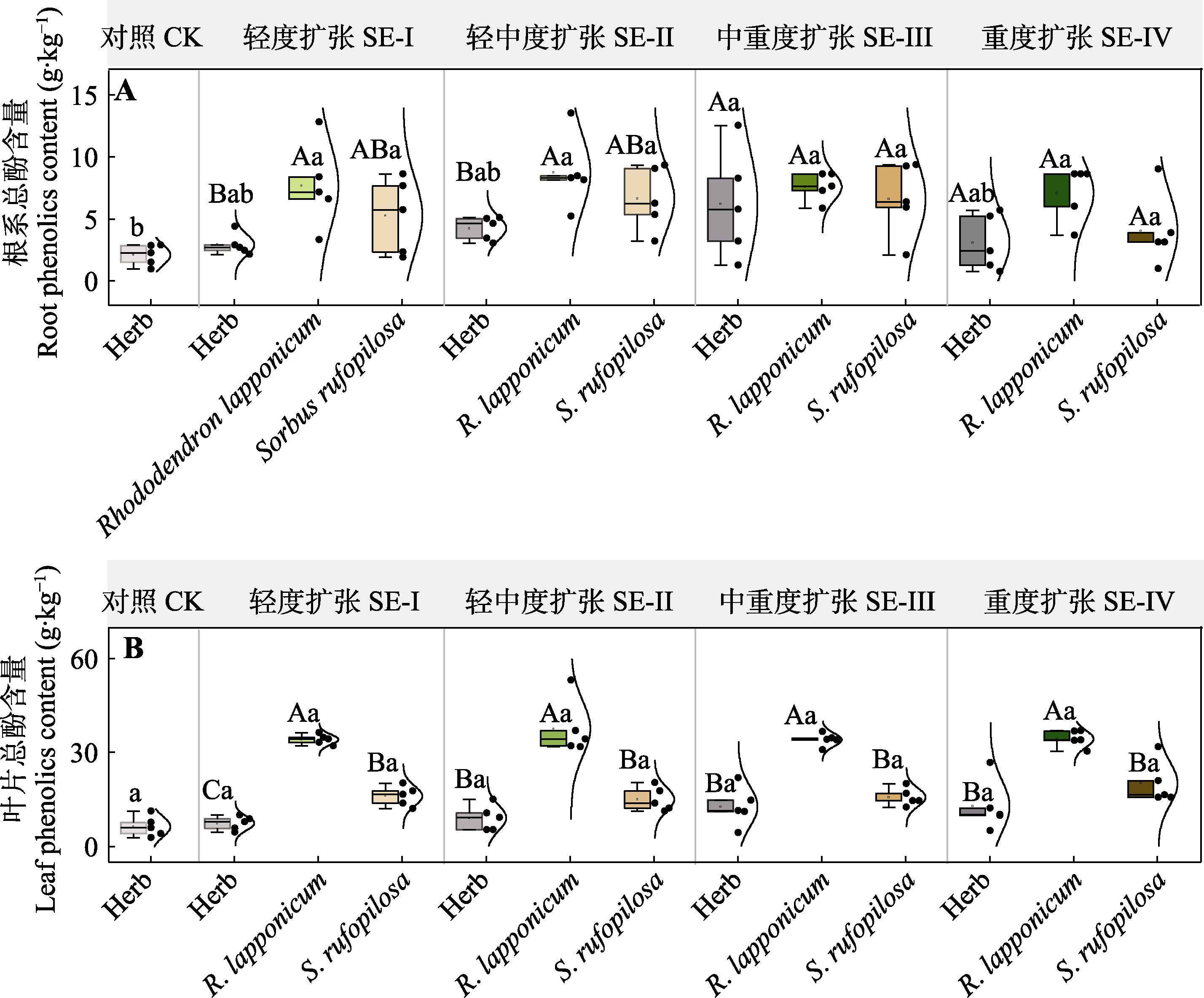
图1 不同灌木扩张水平下植物不同器官(叶片、根系)总酚含量。对照, 高山草甸; Herb, 草本植物; Rhododendron lapponicum, 高山杜鹃; Sorbus rufopilosa, 红毛花楸。不同小写字母表示同一个植物类群在不同灌木扩张水平下差异显著(单因素方差分析, p < 0.05), 不同大写字母表示同一灌木扩张水平下不同植物类群差异显著(单因素方差分析, p < 0.05)。
Fig. 1 Variations in total phenolics content in different plant organs (leaves, roots) under different shrub expansion levels. CK, alpine meadow. Different lowercase letters indicate significant differences in the same plant group across different shrub expansion levels (one-way ANOVA, p < 0.05), while different uppercase letters represent significant differences among plant groups within the same shrub expansion level (one-way ANOVA, p < 0.05). SE-I, light shrub expansion; SE-II, light-moderate shrub expansion; SE-III, moderate-heavy shrub expansion; SE-IV, heavy shrub expansion.
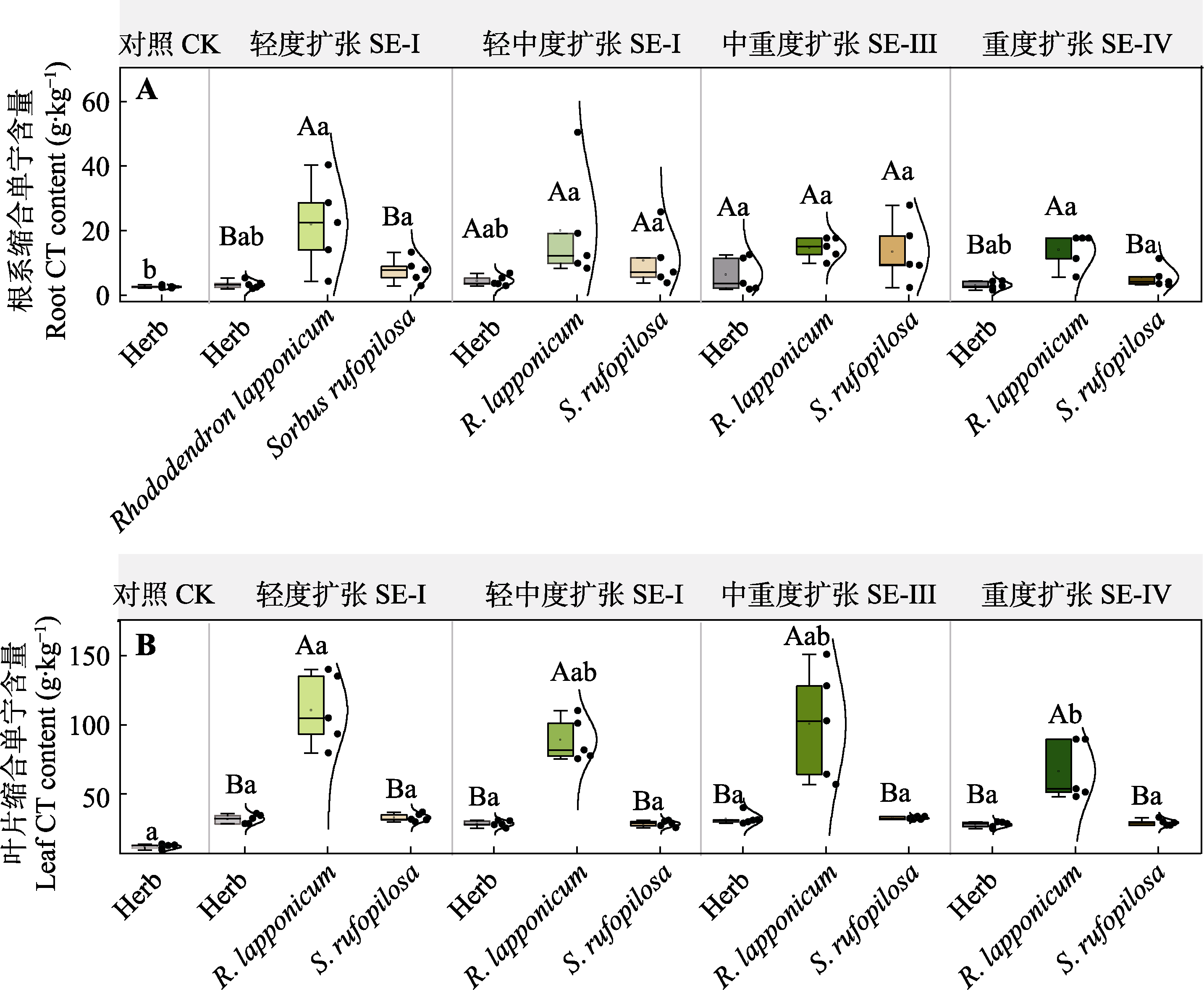
图2 不同灌木扩张水平下植物不同器官(叶片、根系)缩合单宁含量。对照, 高山草甸; Herb, 草本植物; Rhododendron lapponicum, 高山杜鹃; Sorbus rufopilosa, 红毛花楸。不同小写字母表示同一个植物类群在不同灌木扩张水平下差异显著(单因素方差分析, p < 0.05), 不同大写字母表示同一灌木扩张水平下不同植物类群差异显著(单因素方差分析, p < 0.05)。
Fig. 2 Variations in condensed tannins (CT) content in different plant organs (leaves, roots) under different shrub expansion levels. CK, alpine meadow. Different lowercase letters indicate significant differences in the same plant group across different shrub expansion levels (one-way ANOVA, p < 0.05), while different uppercase letters represent significant differences among plant groups within the same shrub expansion level (one-way ANOVA, p < 0.05). SE-I, light shrub expansion; SE-II, light-moderate shrub expansion; SE-III, moderate-heavy shrub expansion; SE-IV, heavy shrub expansion.
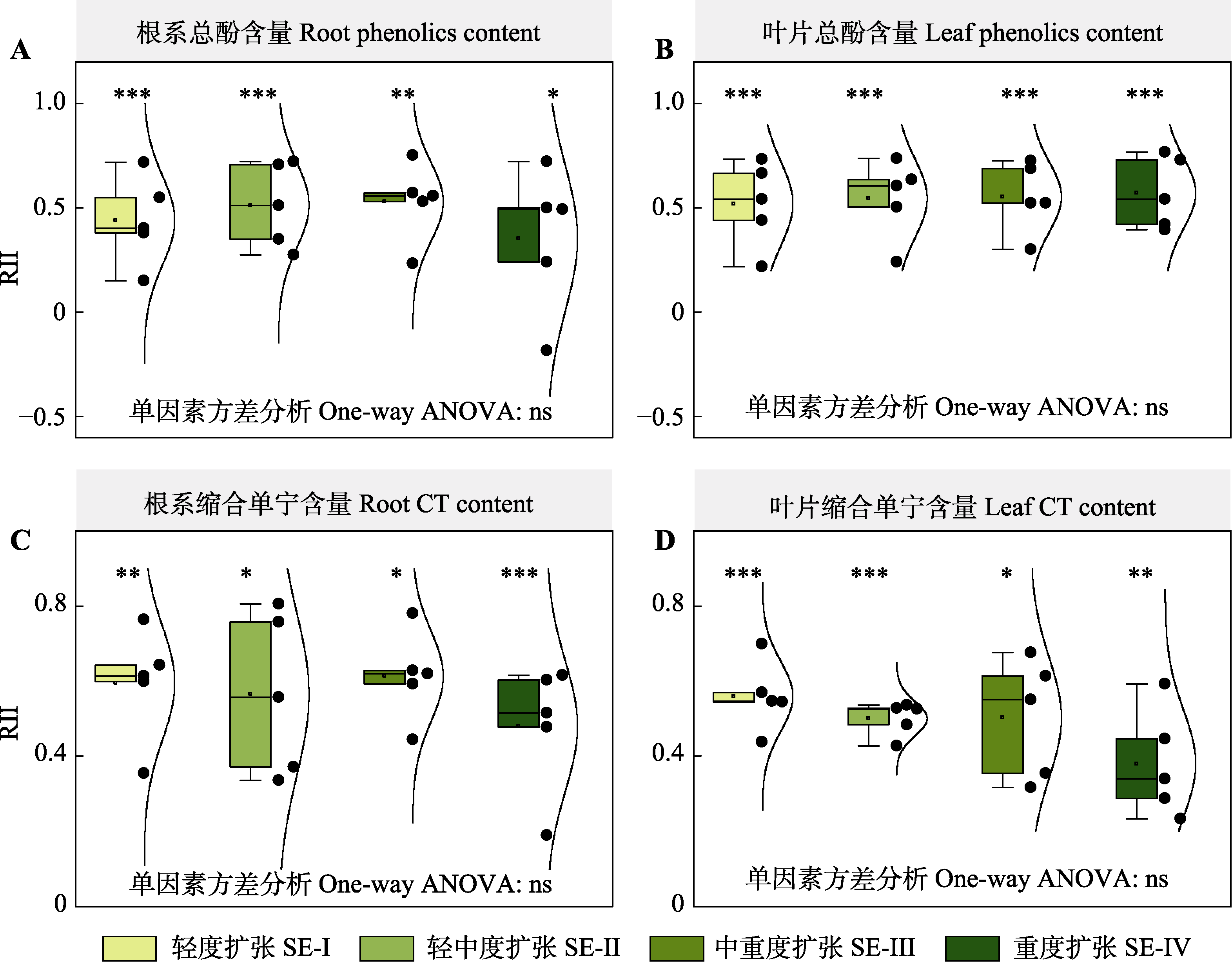
图3 不同灌木扩张水平下植物不同器官(叶片、根系)酚类物质相对作用指数(RII)。*, 灌木扩张组与对照组(未扩张高山草甸)独立t检验差异显著(ns, p > 0.05; *, p < 0.05; **, p < 0.01; ***, p < 0.001)。CT, 缩合单宁。
Fig. 3 Variations in relative interaction index (RII) of phenolic compounds in different plant organs (leaves, roots) under different shrub encroachment levels. *, indicates a significant difference between the shrub encroachment group and the control group (non-encroached alpine meadow) (ns, not significant; *, p < 0.05; **, p < 0.01; ***, p < 0.001). CT, condensed tannins. SE-I, light shrub expansion; SE-II, light-moderate shrub expansion; SE-III, moderate-heavy shrub expansion; SE-IV, heavy shrub expansion.
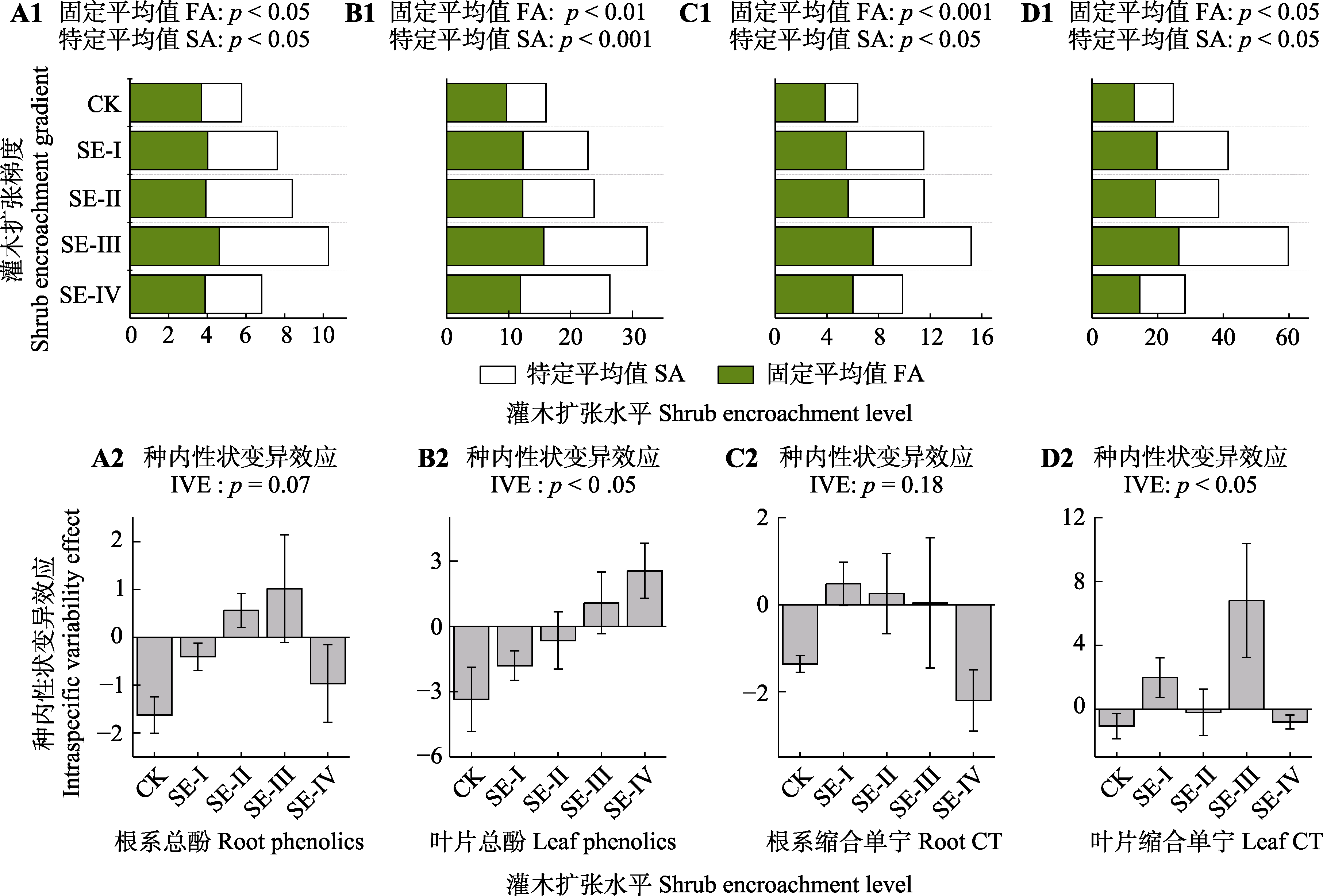
图4 灌木扩张水平下根系总酚、叶片总酚、根系缩合单宁和叶片缩合单宁含量的固定平均值、特定平均值及种内性状变异效应。固定平均值基于跨处理条件下不变的物种性状值, 特定平均值基于不同扩张水平下各性状的特定值。误差条表示标准误差。CK, 高山草甸; SE-I, 轻度灌木扩张; SE-II, 轻中度灌木扩张; SE-III, 中重度灌木扩张; SE-IV, 重度灌木扩张。CT, 缩合单宁。采用单因素方差分析检验不同灌木扩张水平间固定平均值、特定平均值及种内性状变异效应的差异。
Fig. 4 Variations in fixed averages (FA) and specific averages (SA), and intraspecific variability effects (IVE) on the content of total root phenol, total leaf phenol, root condensed tannin, and leaf condensed tannin across different shrub expansion levels. Fixed averages are based on species trait values that remain constant across treatments, while specific averages are based on the trait values specific to each expansion level. CK, alpine meadow; SE-I, light shrub expansion; SE-II, light-moderate shrub expansion; SE-III, moderate-heavy shrub expansion; SE-IV, heavy shrub expansion. CT, condensed tannins. The differences in the effects of fixed averages, specific averages, and intraspecific variability effects across different shrub encroachment levels were tested using One-way ANOVA.
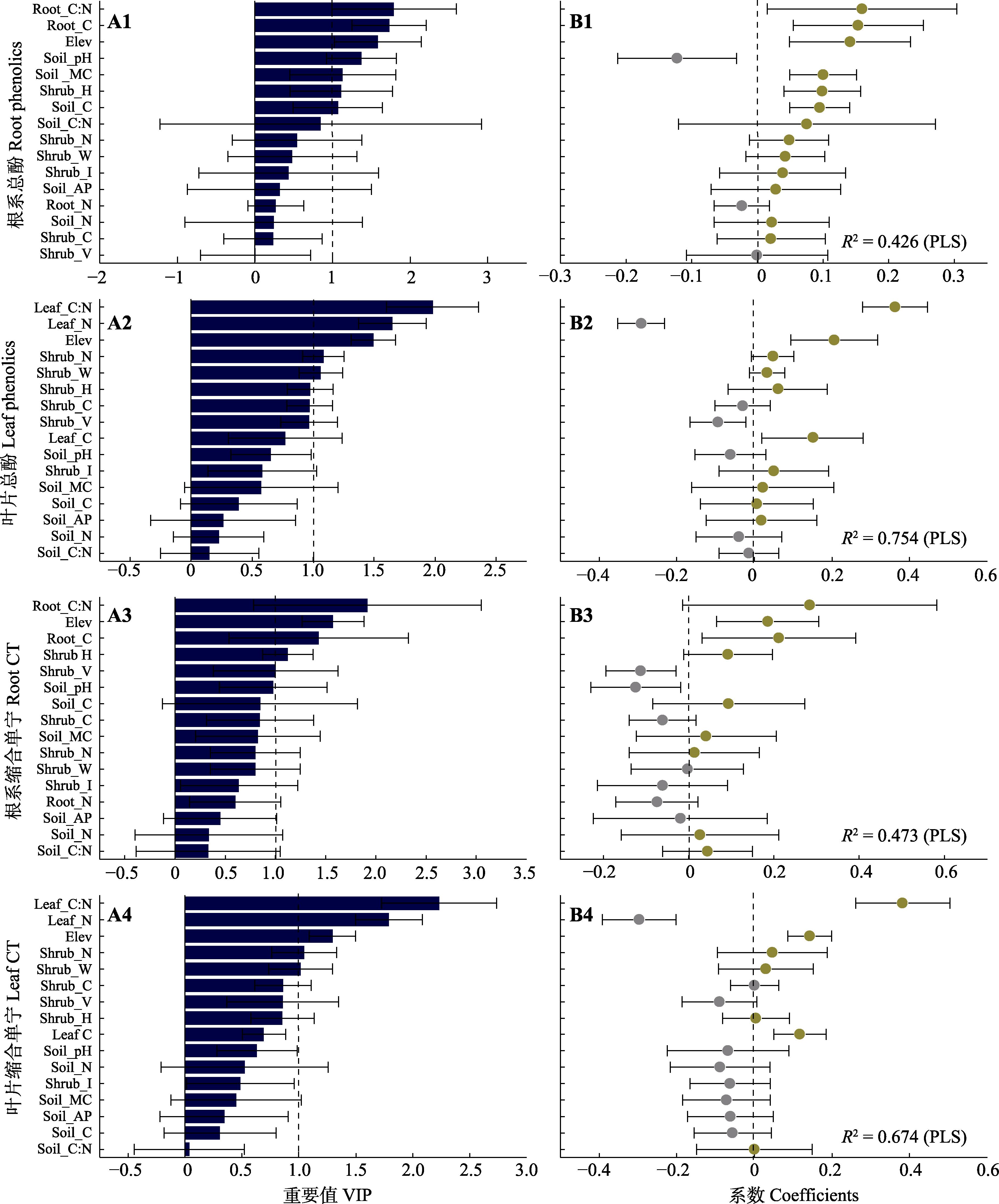
图5 环境因子对植物不同器官(叶片、根系)酚类物质含量的影响——基于偏最小二乘(PLS)分析(平均值±标准误)。PLS系数大于0表示正向影响, 系数小于0表示负向影响。R2代表模型拟合度。Alt, 海拔; CT, 缩合单宁; Leaf_C, 叶片碳含量; Leaf_N, 叶片氮含量; Leaf_C:N, 叶片碳氮比; Root_C, 根系碳含量; Root_N, 根系氮含量; Root_C:N, 根系碳氮比; Shrub_C, 灌丛盖度; Shrub_H, 灌丛高度; Shrub_L, 灌木扩张水平; Shrub_N, 灌丛数量; Shrub_V, 灌丛体积; Shrub_W, 灌丛加权密度; Soil_AP, 土壤速效磷含量; Soil_C, 土壤有机碳含量; Soil_C:N, 土壤碳氮比; Soil_MC, 土壤含水量; Soil_N, 土壤全氮含量; Soil_pH, 土壤pH。
Fig. 5 Effects of environmental factors on phenolic compound contents in different plant organs (leaves, roots) were quantified using partial least squares (PLS) analysis (mean ± SE). PLS coefficients > 0 indicate positive effects, while those < 0 indicate negative effects. R2 values represent the goodness of model fit. Alt, altitude; CT, condensed tannins; Leaf_C, leaf carbon content; Leaf_N, leaf nitrogen content; Leaf_C:N, leaf carbon-to-nitrogen ratio; Root_C, root carbon content; Root_N, root nitrogen content; Root_C:N, root carbon-to-nitrogen ratio; Shrub_C, shrub coverage; Shrub_H, shrub height; Shrub_L, shrub encroachment level; Shrub_N, number of shrubs; Shrub_V, shrub volume; Shrub_W, weighted shrub density; Soil_AP, soil available phosphorus content; Soil_C, soil organic carbon content; Soil_C:N, soil carbon-to-nitrogen ratio; Soil_MC, soil moisture content; Soil_N, soil total nitrogen content; Soil_pH, soil pH. VIP, value of importance.
| [1] |
Adamczyk B, Ahvenainen A, Sietiö OM, Kanerva S, Kieloaho AJ, Smolander A, Kitunen V, Saranpää P, Laakso T, Straková P, Heinonsalo J (2016). The contribution of ericoid plants to soil nitrogen chemistry and organic matter decomposition in boreal forest soil. Soil Biology & Biochemistry, 103, 394-404.
DOI URL |
| [2] |
Armas C, Ordiales R, Pugnaire FI (2004). Measuring plant interactions: a new comparative index. Ecology, 85, 2682-2686.
DOI URL |
| [3] | Atkins JW, Epstein HE, Welsch DL (2018). Using Landsat imagery to map understory shrub expansion relative to landscape position in a mid-Appalachian watershed. Ecosphere, 9, e02404. DOI: 10.1002/ecs2.2404. |
| [4] |
Barbehenn RV, Peter Constabel C (2011). Tannins in plant-herbivore interactions. Phytochemistry, 72, 1551-1565.
DOI PMID |
| [5] |
Bryant JP, Chapin III FS, Klein DR (1983). Carbon/nutrient balance of boreal plants in relation to vertebrate herbivory. Oikos, 40, 357-368.
DOI URL |
| [6] | Caldwell MM, Bornman JF, Ballaré CL, Flint SD, Kulandaivelu G (2007). Terrestrial ecosystems, increased solar ultraviolet radiation, and interactions with other climate change factors. Photochemical & Photobiological Sciences, 6, 252-266. |
| [7] |
Cappelli SL, Pichon NA, Kempel A, Allan E (2020). Sick plants in grassland communities: a growth-defense trade-off is the main driver of fungal pathogen abundance. Ecology Letters, 23, 1349-1359.
DOI PMID |
| [8] | Chen LY, Shen HH, Fang JY (2014). Shrub-encroached grassland: a new vegetation type. Chinese Journal of Nature, 36, 391-396. |
| [陈蕾伊, 沈海花, 方精云 (2014). 灌丛化草原: 一种新的植被景观. 自然杂志, 36, 391-396.] | |
| [9] |
Clemmensen KE, Finlay RD, Dahlberg A, Stenlid J, Wardle DA, Lindahl BD (2015). Carbon sequestration is related to mycorrhizal fungal community shifts during long-term succession in boreal forests. New Phytologist, 205, 1525-1536.
DOI PMID |
| [10] |
Close DC, McArthur C (2002). Rethinking the role of many plant phenolics-protection from photodamage not herbivores? Oikos, 99, 166-172.
DOI URL |
| [11] |
Coley PD, Bryant JP, Chapin III FS (1985). Resource availability and plant antiherbivore defense. Science, 230, 895-899.
DOI PMID |
| [12] |
Coley PD, Kursar TA (2014). On tropical forests and their pests. Science, 343, 35-36.
DOI URL |
| [13] |
Díaz S, Lavorel S, de Bello F, Quétier F, Grigulis K, Robson TM (2007). Incorporating plant functional diversity effects in ecosystem service assessments. Proceedings of the National Academy of Sciences of the United States of America, 104, 20684-20689.
DOI PMID |
| [14] | Ding JY, Eldridge DJ (2022). The success of woody plant removal depends on encroachment stage and plant traits. Nature Plants, 8, 1382-1390. |
| [15] | Drees T, Ochocki BM, Collins SL, Miller TEX (2023). Demography and dispersal at a grass-shrub ecotone: a spatial integral projection model for woody plant encroachment. Ecological Monographs, 93, e1574. DOI: 10.1002/ecm.1574. |
| [16] |
Eldridge DJ, Bowker MA, Maestre FT, Roger E, Reynolds JF, Whitford WG (2011). Impacts of shrub encroachment on ecosystem structure and functioning: towards a global synthesis. Ecology Letters, 14, 709-722.
DOI PMID |
| [17] | Elliott GP (2023). Windows of opportunity: a new tree-shrub dynamic at alpine treeline? National Science Review, 10, nwad212. DOI: 10.1093/nsr/nwad212. |
| [18] |
Endara MJ, Coley PD (2011). The resource availability hypothesis revisited: a meta-analysis. Functional Ecology, 25, 389-398.
DOI URL |
| [19] |
Fine PVA, Miller ZJ, Mesones I, Irazuzta S, Appel HM, Stevens MHH, Sääksjärvi I, Schultz JC, Coley PD (2006). The growth-defense trade-off and habitat specialization by plants in Amazonian forests. Ecology, 87, S150-S162.
DOI PMID |
| [20] |
Formica A, Farrer EC, Ashton IW, Suding KN (2014). Shrub expansion over the past 62 years in rocky mountain alpine tundra: possible causes and consequences. Arctic, Antarctic, and Alpine Research, 46, 616-631.
DOI URL |
| [21] |
Hagedorn F, Shiyatov SG, Mazepa VS, Devi NM, Grigor’ev AA, Bartysh AA, Fomin VV, Kapralov DS, Terent’ev M, Bugman H, Rigling A, Moiseev PA (2014). Treeline advances along the Urals mountain range-driven by improved winter conditions? Global Change Biology, 20, 3530-3543.
DOI PMID |
| [22] |
Hanley ME, Lamont BB, Fairbanks MM, Rafferty CM (2007). Plant structural traits and their role in anti-herbivore defence. Perspectives in Plant Ecology, Evolution and Systematics, 8, 157-178.
DOI URL |
| [23] |
Harding SA, Xue LJ, Du L, Nyamdari B, Lindroth RL, Sykes R, Davis MF, Tsai CJ (2014). Condensed tannin biosynthesis and polymerization synergistically condition carbon use, defense, sink strength and growth in Populus. Tree Physiology, 34, 1240-1251.
DOI PMID |
| [24] |
Hartzfeld PW, Forkner R, Hunter MD, Hagerman AE (2002). Determination of hydrolyzable tannins (gallotannins and ellagitannins) after reaction with potassium iodate. Journal of Agricultural and Food Chemistry, 50, 1785-1790.
PMID |
| [25] |
Hättenschwiler S, Hagerman AE, Vitousek PM (2003). Polyphenols in litter from tropical montane forests across a wide range in soil fertility. Biogeochemistry, 64, 129-148.
DOI |
| [26] |
Herms DA, Mattson WJ (1992). The dilemma of plants: to grow or defend. The Quarterly Review of Biology, 67, 283-335.
DOI URL |
| [27] |
Holopainen JK, Virjamo V, Ghimire RP, Blande JD, Julkunen-Tiitto R, Kivimäenpää M (2018). Climate change effects on secondary compounds of forest trees in the Northern Hemisphere. Frontiers in Plant Science, 9, 1445. DOI: 10.3389/fpls.2018.01445.
PMID |
| [28] |
Huot B, Yao J, Montgomery BL, He SY (2014). Growth-defense tradeoffs in plants: a balancing act to optimize fitness. Molecular Plant, 7, 1267-1287.
DOI PMID |
| [29] |
Ibrahim MH, Jaafar HZE (2011). The relationship of nitrogen and C/N ratio with secondary metabolites levels and antioxidant activities in three varieties of Malaysian Kacip Fatimah (Labisia pumila Blume). Molecules, 16, 5514-5526.
DOI PMID |
| [30] |
Isah T (2019). Stress and defense responses in plant secondary metabolites production. Biological Research, 52, 39.
DOI PMID |
| [31] | Kong GQ (2011). Study on the Change Mechanism of Growth Rate and Photosynthetic Capacity of Evergreen and Deciduous Shrubs Along Forest Lines in Southeastern Tibet with Altitude. PhD dissertation, University of Chinese Academy of Sciences, Beijing. |
| [孔高强 (2011). 藏东南林线常绿与落叶灌木的生长速率和光合能力随海拔的变化机理研究. 博士学位论文, 中国科学院大学, 北京.] | |
| [32] |
Kursar TA, Coley PD (2003). Convergence in defense syndromes of young leaves in tropical rainforests. Biochemical Systematics and Ecology, 31, 929-949.
DOI URL |
| [33] |
Laorden-Camacho L, Grigulis K, Tello-García E, Lyonnard B, Colace MP, Gallet C, Tappeiner U, Leitinger G, Lavorel S (2025). Shrub encroachment modifies soil properties through plant resource economics traits. Plant and Soil, 514, 2083-2104.
DOI |
| [34] |
Le Bot J, Bénard C, Robin C, Bourgaud F, Adamowicz S (2009). The ‘trade-off’ between synthesis of primary and secondary compounds in young tomato leaves is altered by nitrate nutrition: experimental evidence and model consistency. Journal of Experimental Botany, 60, 4301-4314.
DOI URL |
| [35] |
Lepš J, de Bello F, Šmilauer P, Doležal J (2011). Community trait response to environment: disentangling species turnover vs intraspecific trait variability effects. Ecography, 34, 856-863.
DOI URL |
| [36] | Li H (2015). Effects of Grassland Shrub on Soil Organic Carbon Pool in Inner Mongolia. PhD dissertation, University of Chinese Academy of Sciences, Beijing. |
| [李贺 (2015). 内蒙古草原灌丛化对土壤有机碳库的影响. 博士学位论文, 中国科学院大学, 北京.] | |
| [37] | Li X, Geng H, Gao YH, Chen DY, Li LA, Wang P (2024). Effects of Caragana erinacea shrub expansion on soil organic carbon mineralization in alpine grassland. Acta Ecologica Sinica, 44, 7150-7159. |
| [黎萱, 耿行, 高永恒, 陈东毅, 李良安, 王平 (2024). 川西锦鸡儿灌木扩张对高寒草地土壤有机碳矿化的影响. 生态学报, 44, 7150-7159.] | |
| [38] | Li XX, Liang EY, Camarero JJ, Rossi S, Zhang JT, Zhu HF, Fu YH, Sun J, Wang T, Piao SL, Peñuelas J (2023). Warming-induced phenological mismatch between trees and shrubs explains high-elevation forest expansion. National Science Review, 10, nwad182. DOI: 10.1093/nsr/nwad182. |
| [39] |
Liston GE, McFadden JP, Sturm M, Pielke RA (2002). Modelled changes in arctic tundra snow, energy and moisture fluxes due to increased shrubs. Global Change Biology, 8, 17-32.
DOI URL |
| [40] | Liu Y (2010). Patterns of Above- and Belowground Biodiversity of Alpine Timberline Ecotone and Forest-meadow Ecotone in Western Sichuan. PhD dissertation, Sichuan Agricultural University, Ya’an, Sichuan. |
| [刘洋 (2010). 川西高山林线交错带与林草交错带地上/地下生物多样性格局. 博士学位论文, 四川农业大学, 四川雅安.] | |
| [41] | Liu YF, Fang H, Huang Z, Leite PAM, Liu Y, López-Vicente M, Zhao JX, Shi ZH, Wu GL (2023a). Shrub encroachment increases soil erosion risk in hillside alpine meadows of the Qinghai-Tibetan Plateau, NW China. Catena, 222, 106842. DOI: 10.1016/j.catena.2022.106842. |
| [42] | Liu YF, Fang H, Shi JJ, Leite PAM, Zhao JX, Wu GL (2023b). Climate change-induced shrub encroachment changes soil hydraulic properties and inhibits herbaceous growth in alpine meadows. Agricultural and Forest Meteorology, 340, 109629. DOI: 10.1016/j.agrformet.2023.109629. |
| [43] | Loomis WF (1932). Growth-differentiation balance vs carbohydrate-nitrogen ratio. Proceedings of the American Society for Horticul-tural Science, 29, 240-245. |
| [44] |
Lu XM, Liang EY, Wang YF, Babst F, Camarero JJ (2021). Mountain treelines climb slowly despite rapid climate warming. Global Ecology and Biogeography, 30, 305-315.
DOI URL |
| [45] |
Maestre FT, Eldridge DJ, Soliveres S (2016). A multifaceted view on the impacts of shrub encroachment. Applied Vegetation Science, 19, 369-370.
DOI PMID |
| [46] |
Makkar HPS, Becker K (1993). Vanillin-HCl method for condensed tannins: Effect of organic solvents used for extraction of tannins. Journal of Chemical Ecology, 19, 613-621.
DOI PMID |
| [47] |
Malhotra B, Kumar P, Bisht NC (2023). Defense versus growth trade-offs: Insights from glucosinolates and their catabolites. Plant, Cell & Environment, 46, 2964-2984.
DOI URL |
| [48] |
Martínez-Vilalta J, Pockman WT (2002). The vulnerability to freezing-induced xylem cavitation of Larrea tridentata (Zygophyllaceae) in the Chihuahuan desert. American Journal of Botany, 89, 1916-1924.
DOI PMID |
| [49] | Massad TJ, Dyer LA, Vega CG (2012). Costs of defense and a test of the carbon-nutrient balance and growth-differentiation balance hypotheses for two co-occurring classes of plant defense. PLoS ONE, 7, e47554. DOI: 10.1371/journal.pone.0047554. |
| [50] |
Massad TJ, Trumbore SE, Ganbat G, Reichelt M, Unsicker S, Boeckler A, Gleixner G, Gershenzon J, Ruehlow S (2014). An optimal defense strategy for phenolic glycoside production in Populus trichocarpa-isotope labeling demonstrates secondary metabolite production in growing leaves. New Phytologist, 203, 607-619.
DOI PMID |
| [51] |
Morrow CJ, Jaeger SJ, Lindroth RL (2022). Intraspecific variation in plant economic traits predicts trembling aspen resistance to a generalist insect herbivore. Oecologia, 199, 119-128.
DOI PMID |
| [52] |
Pilsbacher AK, Lindgård B, Reiersen R, González VT, Bråthen KA (2020). Interfering with neighbouring communities: Allelopathy astray in the tundra delays seedling development. Functional Ecology, 35, 266-276.
DOI URL |
| [53] |
Ping XY, Du YQ, Lai SR, Kong MQ, Yu GJ (2025). Research progress of plant chemical defense strategies in response to herbivory. Chinese Journal of Plant Ecology, 49, 667-680.
DOI URL |
|
[平晓燕, 杜毅倩, 赖仕蓉, 孔梦桥, 余国杰 (2025). 植物应对食草动物采食的化学防御策略研究进展. 植物生态学报, 49, 667-680.]
DOI |
|
| [54] |
Poorter H, Niklas KJ, Reich PB, Oleksyn J, Poot P, Mommer L (2012). Biomass allocation to leaves, stems and roots: meta-analyses of interspecific variation and environmental control. New Phytologist, 193, 30-50.
DOI PMID |
| [55] | Qin YZ, Wang CR, Zhou TY, Fei YN, Xu YZ, Qiao XJ, Jiang MX (2024). Interactions between leaf traits and environmental factors help explain the growth of evergreen and deciduous species in a subtropical forest. Forest Ecology and Management, 560, 121854. DOI: 10.1016/j.foreco.2024.121854. |
| [56] | Raven PH, Evert RF, Eichhorn SE (2013). Biology of Plants. W.H. Freeman and Company Publishers, New York. |
| [57] |
Royer M, Larbat R, Le Bot J, Adamowicz S, Robin C (2013). Is the C:N ratio a reliable indicator of C allocation to primary and defence-related metabolisms in tomato? Phytochemistry, 88, 25-33.
DOI PMID |
| [58] | Salunke P, Koche D (2023). Role of phenolic compounds in plant defense mechanism: an updated review. Indian Journal of Applied and Pure Biology, 38, 1199-1215. |
| [59] |
Sanz-Elorza M, Dana ED, González A, Sobrino E (2003). Changes in the high-mountain vegetation of the Central Iberian Peninsula as a probable sign of global warming. Annals of Botany, 92, 273-280.
PMID |
| [60] |
Sekhwela MBM, Yates DJ (2007). A phenological study of dominant acacia tree species in areas with different rainfall regimes in the Kalahari of Botswana. Journal of Arid Environments, 70, 1-17.
DOI URL |
| [61] | Selmar D, Kleinwächter M (2013). Stress enhances the synthesis of secondary plant products: the impact of stress-related over-reduction on the accumulation of natural products. Plant & Cell Physiology, 54, 817-826. |
| [62] | Senthilkumar M, Amaresan N, Sankaranarayanan A (2020). Estimation of total phenol content of plant tissues// Senthilkumar M, Amaresan N, Sankaranarayanan A. Plant-Microbe Interactions. Springer, New York. |
| [63] |
Sørensen MV, Strimbeck R, Nystuen KO, Kapas RE, Enquist BJ, Graae BJ (2018). Draining the pool? Carbon storage and fluxes in three alpine plant communities. Ecosystems, 21, 316-330.
DOI URL |
| [64] |
Spertus JV (2021). Optimal sampling and assay for estimating soil organic carbon. Open Journal of Soil Science, 11, 93-121.
DOI URL |
| [65] | Sturm M, Douglas T, Racine C, Liston GE (2005). Changing snow and shrub conditions affect albedo with global implications. Journal of Geophysical Research: Biogeosciences, 110, 2005JG000013. DOI: 10.1029/2005JG000013. |
| [66] | Sun YM, Guo JJ, Li YR, Luo GW, Li L, Yuan HY, Mur LAJ, Guo SW (2020). Negative effects of the simulated nitrogen deposition on plant phenolic metabolism: a meta-analysis. Science of the Total Environment, 719, 137442. DOI: 10.1016/j.scitotenv.2020.137442. |
| [67] |
Tomlinson KW, van Langevelde F, Ward D, Bongers F, da Silva DA, Prins HHT, de Bie S, Sterck FJ (2013). Deciduous and evergreen trees differ in juvenile biomass allometries because of differences in allocation to root storage. Annals of Botany, 112, 575-587.
DOI PMID |
| [68] |
Varela MC, Arslan I, Reginato MA, Cenzano AM, Luna MV (2016). Phenolic compounds as indicators of drought resistance in shrubs from Patagonian shrublands (Argentina). Plant Physiology and Biochemistry, 104, 81-91.
DOI PMID |
| [69] |
Vogt T (2010). Phenylpropanoid biosynthesis. Molecular Plant, 3, 2-20.
DOI PMID |
| [70] |
Vowles T, Björk RG (2019). Implications of evergreen shrub expansion in the Arctic. Journal of Ecology, 107, 650-655.
DOI |
| [71] |
Wahren CHA, Walker MD, Bret-Harte MS (2005). Vegetation responses in Alaskan Arctic tundra after 8 years of a summer warming and winter snow manipulation experiment. Global Change Biology, 11, 537-552.
DOI URL |
| [72] |
Wang YF, Liang EY, Lu XM, Camarero JJ, Babst F, Shen MG, Peñuelas J (2021). Warming-induced shrubline advance stalled by moisture limitation on the Tibetan Plateau. Ecography, 44, 1631-1641.
DOI URL |
| [73] |
Wang YL, Gong R, Wu FM, Fan WW (2017). Temporal and spatial variation characteristics of China shrubland net primary production and its response to climate change from 2001 to 2013. Chinese Journal of Plant Ecology, 41, 925-937.
DOI URL |
|
[王亚林, 龚容, 吴凤敏, 范文武 (2017). 2001-2013年中国灌木生态系统净初级生产力的时空变化特征及其对气候变化的响应. 植物生态学报, 41, 925-937.]
DOI |
|
| [74] | Wardle DA, Nilsson MC, Gallet C, Zackrisson O (1998). An ecosystem-level perspective of allelopathy. Biological Reviews of the Cambridge Philosophical Society, 73, 305-319. |
| [75] | Wareing PF, Phillips IDJ (1981). Growth & Differentiation in Plants. 3rd ed. Pergamon Press, New York. |
| [76] |
Watanabe FS, Olsen SR (1965). Test of an ascorbic acid method for determining phosphorus in water and NaHCO3 extracts from soil. Soil Science Society of America Journal, 29, 677-678.
DOI URL |
| [77] |
Wright IJ, Reich PB, Westoby M, Ackerly DD, Baruch Z, Bongers F, Cavender-Bares J, Chapin T, Cornelissen JHC, Diemer M, Flexas J, Garnier E, Groom PK, Gulias J, Hikosaka K, et al. (2004). The worldwide leaf economics spectrum. Nature, 428, 821-827.
DOI |
| [78] | Yang YH, Shi Y, Sun WJ, Chang JF, Zhu JX, Chen LY, Wang X, Guo YP, Zhang HT, Yu LF, Zhao SQ, Xu K, Zhu JL, Shen HH, Wang YY, et al. (2022). Terrestrial carbon sinks in China and around the world and their contribution to carbon neutrality. Scientia Sinica (Vitae), 52, 534-574. |
| [杨元合, 石岳, 孙文娟, 常锦峰, 朱剑霄, 陈蕾伊, 王欣, 郭焱培, 张宏图, 于凌飞, 赵淑清, 徐亢, 朱江玲, 沈海花, 王媛媛, 等 (2022). 中国及全球陆地生态系统碳源汇特征及其对碳中和的贡献. 中国科学: 生命科学, 52, 534-574.] | |
| [79] |
Zhang AN, Chen SY, Chen JW, Cui HW, Jiang XX, Xiao S, Wang JJ, Gao HN, An LZ, Cardoso P (2023a). Shrub and precipitation interactions shape functional diversity of nematode communities on the Qinghai-Tibet Plateau. Global Change Biology, 29, 2746-2758.
DOI URL |
| [80] |
Zhang D, Hou C, Ma WM, Wang CT, Deng Z, Zhang T (2023). Study on soil enzyme activities under shrub encroachment gradients in alpine grassland. Acta Prataculturae Sinica, 32(9), 79-92.
DOI |
|
[张东, 侯晨, 马文明, 王长庭, 邓增卓玛, 张婷 (2023). 高寒草地不同灌丛化梯度下土壤酶活性研究. 草业学报, 32(9), 79-92.]
DOI |
|
| [81] |
Zhang Q, Feng K, Chang ZH, He SH, Xu WQ (2023). Effects of shrub encroachment on plant and soil microbial in the forest-grassland ecotone. Chinese Journal of Plant Ecology, 47, 770-781.
DOI |
|
[张琦, 冯可, 常智慧, 何双辉, 徐维启 (2023). 灌丛化对林草交错带植物和土壤微生物的影响. 植物生态学报, 47, 770-781.]
DOI |
|
| [82] |
Zhang T, Ma WM, Tian Y, Bai S, Dengzheng Z, Zhang D, Ma XL, Mu XR (2023b). The mitigation of microbial carbon and nitrogen limitations by shrub encroachment: extracellular enzyme stoichiometry of the alpine grassland on the Qinghai-Tibetan Plateau. Biogeochemistry, 165, 205-225.
DOI |
| [83] |
Zhao WQ, Reich PB, Yu QN, Zhao N, Yin CY, Zhao CZ, Li DD, Hu J, Li T, Yin HJ, Liu Q (2018). Shrub type dominates the vertical distribution of leaf C:N:P stoichiometry across an extensive altitudinal gradient. Biogeosciences, 15, 2033-2053.
DOI URL |
| [84] | Zheng HF, Liu Y, Chen YM, Zhang J, Li HJ, Wang LF, Chen QM (2020). Short-term warming shifts microbial nutrient limitation without changing the bacterial community structure in an alpine timberline of the eastern Tibetan Plateau. Geoderma, 360, 113985. DOI: 10.1016/j.geoderma.2019.113985. |
| [85] | Zhou HC, Kang HX, Wei J, Gao CJ, Hussain M, Fu YJ, Li MD, Li FL, Xu SJ, Lee FW, Jiang MG, Wang YB, Chen XX, Tam NF, Lang T (2023). Microcosm study on fate and dynamics of mangrove tannins during leaf litter leaching. Ecological Processes, 12, 37. DOI: 10.1186/s13717-023-00453-w. |
| [86] | Zhou LH (2018). Effects of Shrub on Grassland Community Structure and Soil Carbon Composition in Northern China. PhD dissertation, University of Chinese Academy of Sciences, Beijing. |
| [周鲁宏 (2018). 灌丛化对中国北方草原群落结构和土壤碳组分的影响. 博士学位论文, 中国科学院大学, 北京.] | |
| [87] | Zong WZ (2023). Study on Mechanism of Influence of Tannins on Soil Nitrogen Decomposition Process in Alpine Meadow. PhD dissertation, Lanzhou University, Lanzhou. |
| [宗文贞 (2023). 单宁对高寒草甸土壤氮分解过程的影响机制研究. 博士学位论文, 兰州大学, 兰州.] |
| [1] | 陈雅轩, 韩雨音, 陈艳梅, 刘倩愿. 华北不同林龄人工林植物功能性状与碳氮化学计量[J]. 植物生态学报, 2026, 50(2): 318-333. |
| [2] | 张永军, 李敬东, 安琦, 洪翎桂, 任正炜, 张蕊, 周小龙. 氮添加和增温对天山高寒草地群落性状的影响[J]. 植物生态学报, 2026, 50(2): 417-428. |
| [3] | 黄智军, 甘子莹, 祝嘉新, 丘清燕, 胡亚林. 杉木不同器官不同碳氮比对土壤激发效应的影响及其机理[J]. 植物生态学报, 2025, 49(10): 1710-1720. |
| [4] | 文佳, 张新娜, 王娟, 赵秀海, 张春雨. 性状调节幼苗存活率对邻体竞争和环境的响应[J]. 植物生态学报, 2024, 48(6): 719-729. |
| [5] | 江蓝, 魏晨思, 何中声, 朱静, 邢聪, 王雪琳, 刘金福, 沈彩霞, 施友文. 格氏栲天然林林窗植物群落功能性状的变异[J]. 植物生态学报, 2022, 46(3): 267-279. |
| [6] | 陈慧颖, 张景慧, 黄永梅, 龚吉蕊. 内蒙古大针茅草原常见植物在不同土地利用方式下的固碳相关属性[J]. 植物生态学报, 2014, 38(8): 821-832. |
| [7] | 葛顺峰,许海港,季萌萌,姜远茂. 土壤碳氮比对平邑甜茶幼苗生长和碳氮分配的影响[J]. 植物生态学报, 2013, 37(10): 942-948. |
| [8] | 刘佳, 项文化, 徐晓, 陈瑞, 田大伦, 彭长辉, 方晰. 湖南会同5个亚热带树种的细根构型及功能特征分析[J]. 植物生态学报, 2010, 34(8): 938-945. |
| [9] | 张利敏, 王传宽. 东北东部山区11种温带树种粗木质残体分解与碳氮释放[J]. 植物生态学报, 2010, 34(4): 368-374. |
| [10] | 田永超, 朱艳, 曹卫星. 利用叶色特征监测小麦叶片的碳氮状况[J]. 植物生态学报, 2005, 29(3): 457-460. |
| [11] | 陈龙池, 廖利平, 汪思龙, 黄志群, 高洪. 酚类物质对杉木幼苗15N养分吸收、分配的影响[J]. 植物生态学报, 2002, 26(5): 525-532. |
| 阅读次数 | ||||||
|
全文 |
|
|||||
|
摘要 |
|
|||||
Copyright © 2026 版权所有 《植物生态学报》编辑部
地址: 北京香山南辛村20号, 邮编: 100093
Tel.: 010-62836134, 62836138; Fax: 010-82599431; E-mail: apes@ibcas.ac.cn, cjpe@ibcas.ac.cn
备案号: 京ICP备16067583号-19

