
Chin J Plant Ecol ›› 2024, Vol. 48 ›› Issue (12): 1602-1611.DOI: 10.17521/cjpe.2024.0060 cstr: 32100.14.cjpe.2024.0060
• Research Articles • Previous Articles Next Articles
YUAN He-Yang1, HAO Min-Hui1,*( ), HE Huai-Jiang2, ZHANG Chun-Yu1, ZHAO Xiu-Hai1
Received:2024-03-05
Accepted:2024-06-20
Online:2024-12-20
Published:2024-12-20
Contact:
HAO Min-Hui
Supported by:YUAN He-Yang, HAO Min-Hui, HE Huai-Jiang, ZHANG Chun-Yu, ZHAO Xiu-Hai. Impact of species richness and composition on productivity and its changes with forest succession in Changbai Mountains, China[J]. Chin J Plant Ecol, 2024, 48(12): 1602-1611.
Add to citation manager EndNote|Ris|BibTeX
URL: https://www.plant-ecology.com/EN/10.17521/cjpe.2024.0060
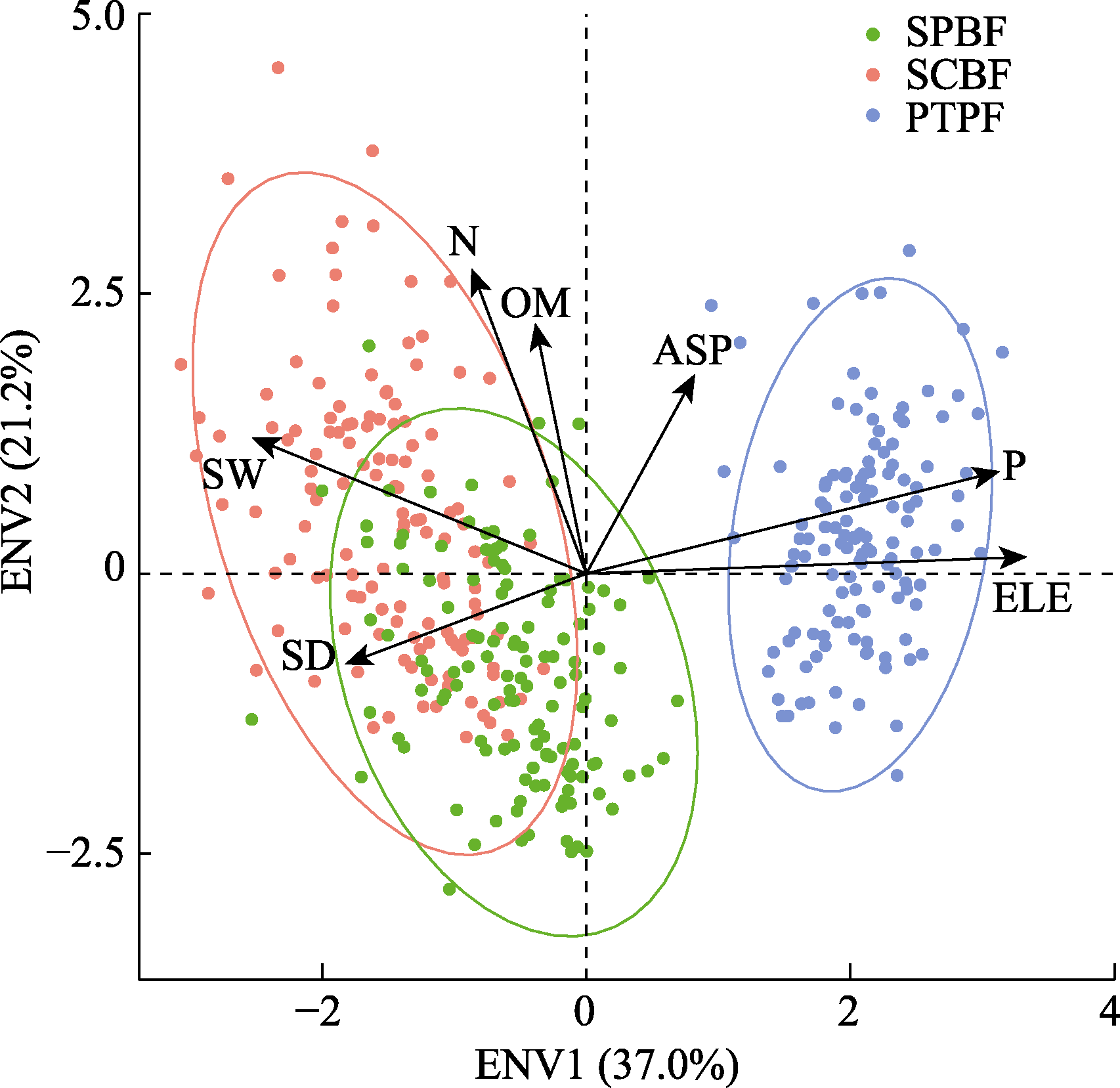
Fig. 1 Principal component analysis of environmental factors of forests at different succession stages in Changbai Mountains. ENV1, the first principal component of the environment; ENV2, the second principal component of the environment. PTPF, primary Tilia amurensis - Pinus koraiensis forest; SCBF, secondary needleleaf-broadleaf mixed forest; SPBF, secondary Populus davidiana - Betula platyphylla forest. ASP, aspect; ELE, elevation; N, soil nitrogen content; OM, soil organic matter content; P, soil phosphorus content; SD, soil depth; SW, soil water content.
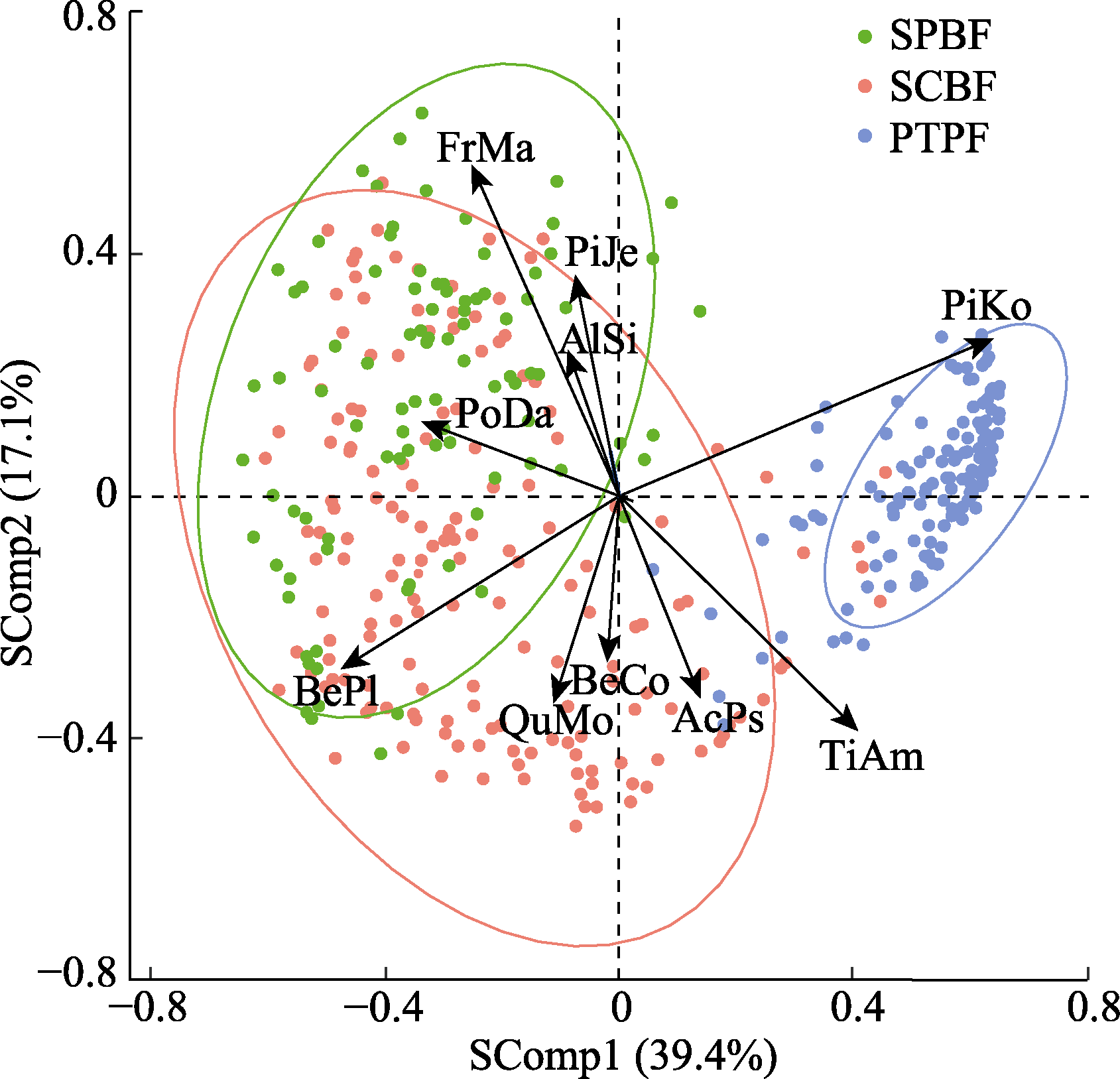
Fig. 2 Principal coordinate analysis of species composition of forests at different succession stages in Changbai Mountains. SComp1, the first principal coordinate of species composition; SComp2, the second principal coordinate of species composition. PTPF, primary Tilia amurensis - Pinus koraiensis forest; SCBF, secondary needleleaf-broadleaf mixed forest; SPBF, secondary Populus davidiana - Betula platyphylla forest. AcPs, Acer pseudosieboldianum; AlSi, Alnus sibirica; BeCo, Betula costata; BePl, Betula platyphylla; FrMa, Fraxinus mandshurica; PiJe, Picea jezoensis; PiKo, Pinus koraiensis; PoDa, Populus davidiana; QuMo, Quercus mongolica; TiAm, Tilia amurensis.
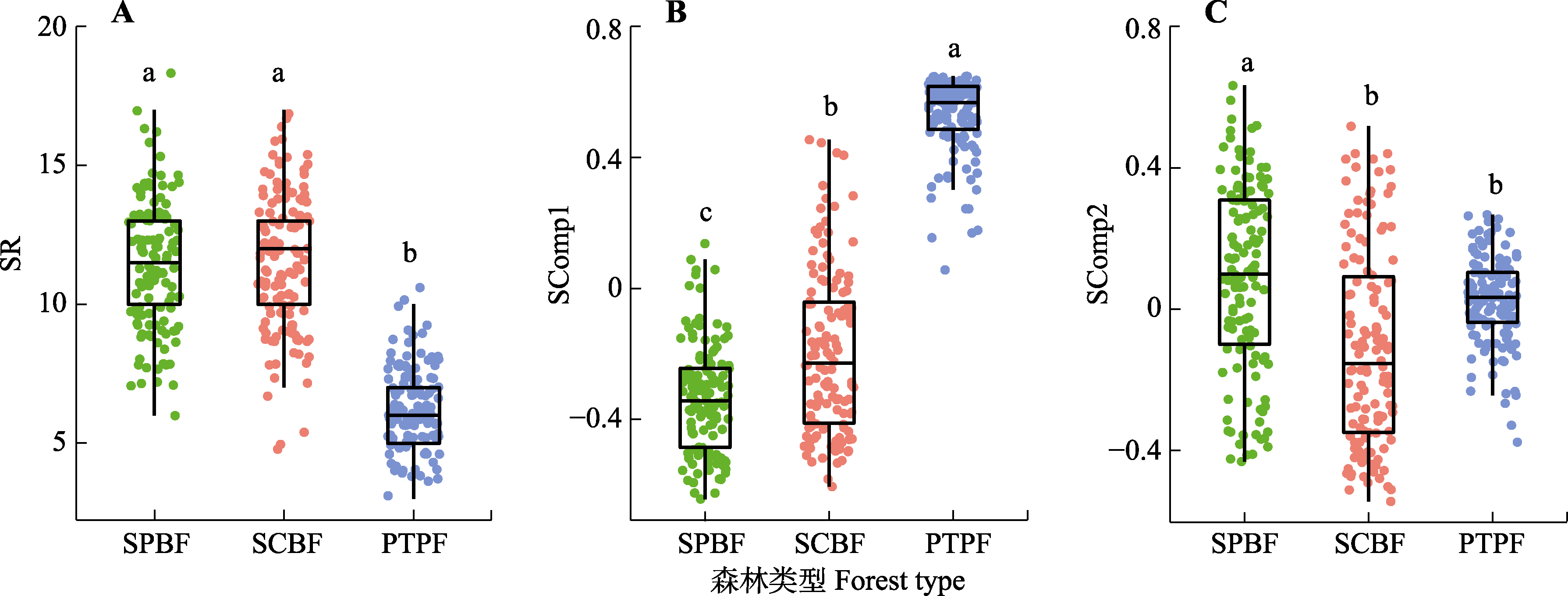
Fig. 3 Changes in species diversity and composition during forest succession in Changbai Mountains. SComp1, the first principal coordinate of species composition; SComp2, the second principal coordinate of species composition; SR, species richness. PTPF, primary Tilia amurensis - Pinus koraiensis forest; SCBF, secondary needleleaf-broadleaf mixed forest; SPBF, secondary Populus davidiana - Betula platyphylla forest. Different lowercase letters indicate significant differences between different succession stages (p < 0.05).
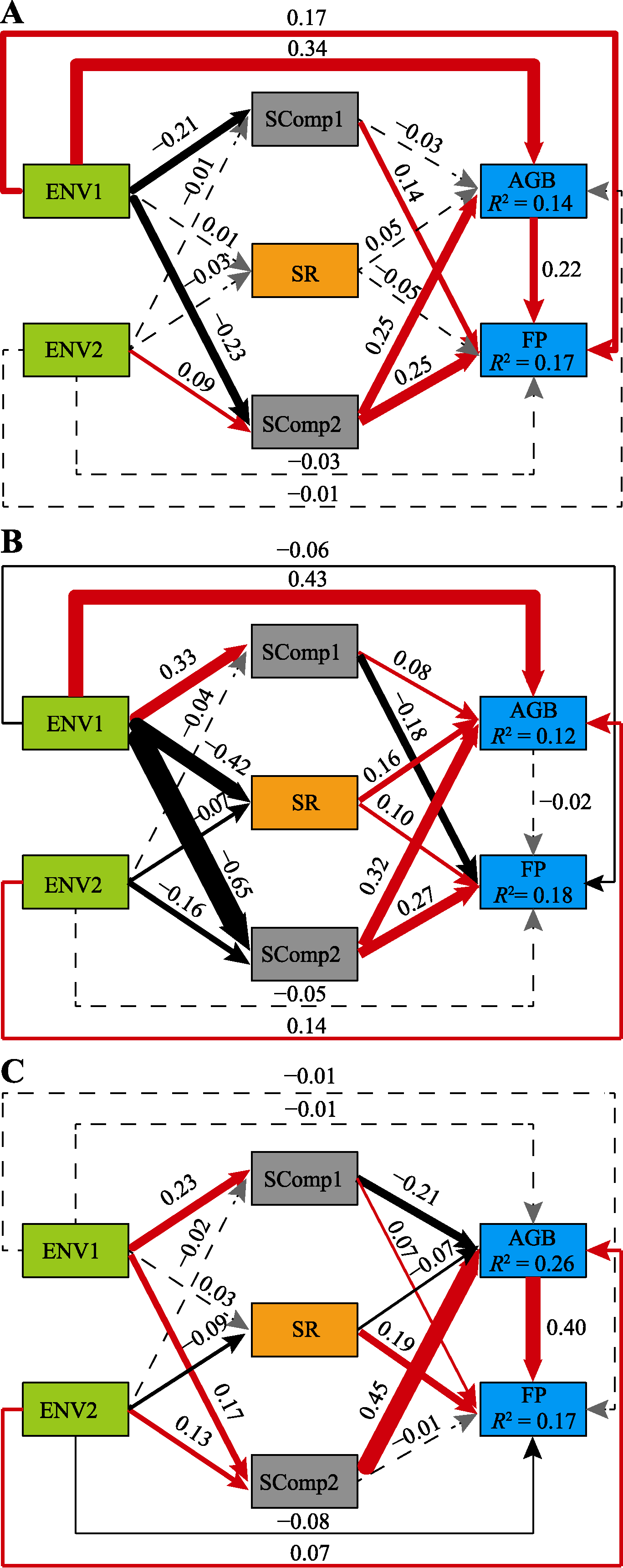
Fig. 4 Impact of species richness and composition on ecosystem functions of forests at different succession stages in Changbai Mountains. A, Secondary Populus davidiana - Betula platyphylla forest. B, Secondary needleleaf -broadleaf mixed forest. C, Primary Tilia amurensis - Pinus koraiensis forest. AGB, aboveground biomass; ENV1, the first principal component of the environment; ENV2, the second principal component of the environment; FP, forest productivity; SComp1, the first principal coordinate of species composition; SComp2, the second principal coordinate of species composition; SR, species richness. Red solid lines represent significantly positively correlated paths, black solid lines represent significantly negatively correlated paths, and gray dashed lines represent insignificant paths, the values next to the lines represent the standardized path coefficients, and the line thickness is proportional to the standardized path coefficient.
| 样地 Plot | 样地位置 Location | 海拔 Altitude (m) | 主要树种 Main species |
|---|---|---|---|
| 次生山杨-白桦林 Secondary Populus davidiana - Betula platyphylla forest | 42.32° N, 128.13° E | 899 | 白桦、山杨、水曲柳、紫椴 Betula platyphylla, Populus davidiana, Fraxinus mandschurica, Tilia amurensis |
| 次生针阔混交林 Secondary needleleaf-broadleaf mixed forest | 42.35° N, 128.13° E | 748 | 白桦、蒙古栎、紫椴、臭冷杉 Betula platyphylla, Quercus mongolica, Tilia amurensis, Abies nephrolepis |
| 原始紫椴-红松林 Primary Tilia amurensis - Pinus koraiensis | 42.23° N, 128.08° E | 784 | 紫椴、红松、臭冷杉、大青杨 Tilia amurensis, Pinus koraiensis, Tilia amurensis, Populus ussuriensis |
Supplement I Basic information of the three forest plots in Changbai Mountains
| 样地 Plot | 样地位置 Location | 海拔 Altitude (m) | 主要树种 Main species |
|---|---|---|---|
| 次生山杨-白桦林 Secondary Populus davidiana - Betula platyphylla forest | 42.32° N, 128.13° E | 899 | 白桦、山杨、水曲柳、紫椴 Betula platyphylla, Populus davidiana, Fraxinus mandschurica, Tilia amurensis |
| 次生针阔混交林 Secondary needleleaf-broadleaf mixed forest | 42.35° N, 128.13° E | 748 | 白桦、蒙古栎、紫椴、臭冷杉 Betula platyphylla, Quercus mongolica, Tilia amurensis, Abies nephrolepis |
| 原始紫椴-红松林 Primary Tilia amurensis - Pinus koraiensis | 42.23° N, 128.08° E | 784 | 紫椴、红松、臭冷杉、大青杨 Tilia amurensis, Pinus koraiensis, Tilia amurensis, Populus ussuriensis |
| 编号 No. | 物种 Species | 异速生长方程 Allometric equation |
|---|---|---|
| 1 | 红松 Pinus koraiensis | Biomass = exp (-3.394 + 2.582 × ln (DBH)) |
| 2 | 臭冷杉 Abies nephrolepis | Biomass = exp (-2.989 + 2.613 × ln (DBH)) |
| 3 | 蒙古栎 Quercus mongolica | Biomass = exp (-2.797 + 2.571 × ln (DBH)) |
| 4 | 胡桃楸 Juglans mandshurica | Biomass = exp (-2.466 + 2.381 × ln (DBH)) |
| 5 | 五角槭 Acer pictum subsp. mono | Biomass = exp (-2.164 + 2.336 × ln (DBH)) |
| 6 | 东北槭 Acer mandshuricum | Biomass = exp (-2.111 + 2.310 × ln (DBH)) |
| 7 | 白桦 Betula platyphylla | Biomass = exp (-1.941 + 2.286 × ln (DBH)) |
| 8 | 水曲柳 Fraxinus mandschurica | Biomass = exp (-2.301 + 2.443 × ln (DBH)) |
| 9 | 山杨 Populus davidiana | Biomass = exp (-2.507 + 2.358 × ln (DBH)) |
| 10 | 紫椴 Tilia amurensis | Biomass = exp (-2.364 + 2.323 × ln (DBH)) |
| 11 | 水榆花楸 Sorbus alnifolia | Biomass = exp (-2.001 + 2.198 × ln (DBH)) |
| 12 | 春榆 Ulmus japonica | Biomass = exp (-2.058 + 2.271 × ln (DBH)) |
Supplement II Allometric equations of aboveground biomass of main tree species in northeast China
| 编号 No. | 物种 Species | 异速生长方程 Allometric equation |
|---|---|---|
| 1 | 红松 Pinus koraiensis | Biomass = exp (-3.394 + 2.582 × ln (DBH)) |
| 2 | 臭冷杉 Abies nephrolepis | Biomass = exp (-2.989 + 2.613 × ln (DBH)) |
| 3 | 蒙古栎 Quercus mongolica | Biomass = exp (-2.797 + 2.571 × ln (DBH)) |
| 4 | 胡桃楸 Juglans mandshurica | Biomass = exp (-2.466 + 2.381 × ln (DBH)) |
| 5 | 五角槭 Acer pictum subsp. mono | Biomass = exp (-2.164 + 2.336 × ln (DBH)) |
| 6 | 东北槭 Acer mandshuricum | Biomass = exp (-2.111 + 2.310 × ln (DBH)) |
| 7 | 白桦 Betula platyphylla | Biomass = exp (-1.941 + 2.286 × ln (DBH)) |
| 8 | 水曲柳 Fraxinus mandschurica | Biomass = exp (-2.301 + 2.443 × ln (DBH)) |
| 9 | 山杨 Populus davidiana | Biomass = exp (-2.507 + 2.358 × ln (DBH)) |
| 10 | 紫椴 Tilia amurensis | Biomass = exp (-2.364 + 2.323 × ln (DBH)) |
| 11 | 水榆花楸 Sorbus alnifolia | Biomass = exp (-2.001 + 2.198 × ln (DBH)) |
| 12 | 春榆 Ulmus japonica | Biomass = exp (-2.058 + 2.271 × ln (DBH)) |
| [1] | Bell T, Newman JA, Silverman BW, Turner SL, Lilley AK (2005). The contribution of species richness and composition to bacterial services. Nature, 436, 1157-1160. |
| [2] | Cardinale BJ, Duffy JE, Gonzalez A, Hooper DU, Perrings C, Venail P, Narwani A, Mace GM, Tilman D, Wardle DA, Kinzig AP, Daily GC, Loreau M, Grace JB, Larigauderie A, et al. (2012). Biodiversity loss and its impact on humanity. Nature, 486, 59-67. |
| [3] |
Davies GM, Gray A (2015). Don’t let spurious accusations of pseudoreplication limit our ability to learn from natural experiments (and other messy kinds of ecological monitoring). Ecology and Evolution, 5, 5295-5304.
DOI PMID |
| [4] | Duffy JE, Godwin CM, Cardinale BJ (2017). Biodiversity effects in the wild are common and as strong as key drivers of productivity. Nature, 549, 261-264. |
| [5] | Fan XH (2018). The Assembly and Development Mechanisms of Typical Natural Forest Community in Changbai Mountains. PhD dissertation,Beijing Forestry University, Beijing. |
| [ 范秀华 (2018). 长白山典型天然林群落形成与演变机制研究. 博士学位论文, 北京林业大学, 北京.] | |
| [6] | Finegan B, Peña-Claros M, de Oliveira A, Ascarrunz N, Bret-Harte MS, Carreño-Rocabado G, Casanoves F, Díaz S, Eguiguren Velepucha P, Fernandez F, Licona JC, Lorenzo L, Salgado Negret B, Vaz M, Poorter L (2015). Does functional trait diversity predict above-ground biomass and productivity of tropical forests? Testing three alternative hypotheses. Journal of Ecology, 103, 191-201. |
| [7] | Forrester DI, Bauhus J (2016). A review of processes behind diversity—Productivity relationships in forests. Current Forestry Reports, 2, 45-61. |
| [8] | Fotis AT, Murphy SJ, Ricart RD, Krishnadas M, Whitacre J, Wenzel JW, Queenborough SA, Comita LS (2018). Above-ground biomass is driven by mass-ratio effects and stand structural attributes in a temperate deciduous forest. Journal of Ecology, 106, 561-570. |
| [9] | García-Palacios P, Shaw EA, Wall DH, Hättenschwiler S (2017). Contrasting mass-ratio vs. niche complementarity effects on litter C and N loss during decomposition along a regional climatic gradient. Journal of Ecology, 105, 968-978. |
| [10] | Grime JP (1998). Benefits of plant diversity to ecosystems: immediate, filter and founder effects. Journal of Ecology, 86, 902-910. |
| [11] | Hao MH, Dai Y, Yue QM, Fan CY, Zhang CY (2022). Relationship between functional diversity of broadleaved Korean pine forest and forest carbon sink function. Journal of Beijing Forestry University, 44(10), 68-76. |
| [ 郝珉辉, 代莹, 岳庆敏, 范春雨, 张春雨 (2022). 阔叶红松林功能多样性与森林碳汇功能关系. 北京林业大学学报, 44(10), 68-76.] | |
| [12] | Hao M, Messier C, Geng Y, Zhang C, Zhao X, von Gadow K (2020). Functional traits influence biomass and productivity through multiple mechanisms in a temperate secondary forest. European Journal of Forest Research, 139, 959-968. |
| [13] |
Hao M, Zhang C, Zhao X, von Gadow K (2018). Functional and phylogenetic diversity determine woody productivity in a temperate forest. Ecology and Evolution, 8, 2395-2406.
DOI PMID |
| [14] | Harms KE, Condit R, Hubbell SP, Foster RB (2001). Habitat associations of trees and shrubs in a 50-ha neotropical forest plot. Journal of Ecology, 89, 947-959. |
| [15] | He HJ, Yeerjiang B, Zhang CY, Zuo Q, Pi TH, Gao HT (2016). Biomass allocation of twelve tree species in coniferous and broad-leaved mixed forest in Jiaohe, Jilin Province, northeast China. Journal of Beijing Forestry University, 38(4), 53-62. |
| [ 何怀江, 叶尔江·拜克吐尔汉, 张春雨, 左强, 邳田辉, 高海涛 (2016). 吉林蛟河针阔混交林12个树种生物量分配规律. 北京林业大学学报, 38(4), 53-62.] | |
| [16] | Hoyle RH (2012). Handbook of Structural Equation Modeling. Guilford Press, New York. |
| [17] |
Kahmen A, Perner J, Audorff V, Weisser W, Buchmann N (2005). Effects of plant diversity, community composition and environmental parameters on productivity in montane European grasslands. Oecologia, 142, 606-615.
PMID |
| [18] | Keith H, Lindenmayer D, MacKey B, Blair D, Carter L, McBurney L, Okada S, Konishi-Nagano T (2014). Managing temperate forests for carbon storage: impacts of logging versus forest protection on carbon stocks. Ecosphere, 5, 1-34. |
| [19] | Kinzig AP, Pacala S, Tilman D (2002). The Functional Consequences of Biodiversity: Empirical Progress and Theoretical Extensions. Princeton University Press, Princeton. |
| [20] |
Lasky JR, Uriarte M, Boukili VK, Chazdon RL (2014). Trait-mediated assembly processes predict successional changes in community diversity of tropical forests. Proceedings of the National Academy of Sciences of the United States of America, 111, 5616-5621.
DOI PMID |
| [21] | Legendre P, Gauthier O (2014). Statistical methods for temporal and space-time analysis of community composition data. Proceedings of the Royal Society B: Biological Sciences, 281, 20132728. DOI: 10.1098/rspb.2013.2728. |
| [22] | Legendre P, Legendre L (2012). Numerical Ecology. Elsevier, Amsterdam, the Netherlands. |
| [23] | Liang JJ, Crowther TW, Picard N, Wiser S, Zhou M, Alberti G, Schulze ED, Mcguire AD, Bozzato F, Pretzsch H, De-miguel S, Paquette A, Hérault B, Scherer-Lorenzen S, Barrett BC, et al. (2016). Positive biodiversity-productivity relationship predominant in global forests. Science, 354, aaf8957. DOI: 10.1126/science.aaf8957. |
| [24] |
Lohbeck M, Poorter L, Martínez-Ramos M, Bongers F (2015). Biomass is the main driver of changes in ecosystem process rates during tropical forest succession. Ecology, 96, 1242-1252.
PMID |
| [25] | Lohbeck M, Poorter L, Martínez-Ramos M, Rodriguez- Velázquez J, van Breugel M, Bongers F (2014). Changing drivers of species dominance during tropical forest succession. Functional Ecology, 28, 1052-1058. |
| [26] | MacKey B, Prentice IC, Steffen W, House JI, Lindenmayer D, Keith H, Berry S (2013). Untangling the confusion around land carbon science and climate change mitigation policy. Nature Climate Change, 3, 552-557. |
| [27] | Mokany K, Ash J, Roxburgh S (2008). Functional identity is more important than diversity in influencing ecosystem processes in a temperate native grassland. Journal of Ecology, 96, 884-893. |
| [28] | Mouquet N, Moore JL, Loreau M (2002). Plant species richness and community productivity: Why the mechanism that promotes coexistence matters. Ecology Letters, 5, 56-65. |
| [29] | Paquette A, Messier C (2011). The effect of biodiversity on tree productivity: from temperate to boreal forests. Global Ecology and Biogeography, 20, 170-180. |
| [30] |
Ruiz-Benito P, Ratcliffe S, Zavala MA, Martínez-Vilalta J, Vilà-Cabrera A, Lloret F, Madrigal-González J, Wirth C, Greenwood S, Kändler G, Lehtonen A, Kattge J, Dahlgren J, Jump AS (2017). Climate- and successional-related changes in functional composition of European forests are strongly driven by tree mortality. Global Change Biology, 23, 4162-4176.
DOI PMID |
| [31] |
Ruiz-Jaen MC, Potvin C (2011). Can we predict carbon stocks in tropical ecosystems from tree diversity? Comparing species and functional diversity in a plantation and a natural forest. New Phytologist, 189, 978-987.
DOI PMID |
| [32] | Sandau N, Fabian Y, Bruggisser OT, Rohr RP, Naisbit RE, Kehrli P, Aebi A, Bersier LF (2017). The relative contributions of species richness and species composition to ecosystem functioning. Oikos, 126, 782-791. |
| [33] | Tilman D (1999). The ecological consequences of changes in biodiversity: a search for general principles. Ecology, 80, 1455-1474. |
| [34] | Tilman D, Knops J, Wedin D, Reich P, Ritchie M, Siemann E (1997). The influence of functional diversity and composition on ecosystem processes. Science, 277, 1300-1302. |
| [35] | van der Plas F (2019). Biodiversity and ecosystem functioning in naturally assembled communities. Biological Reviews, 94, 1220-1245. |
| [36] | Yu DP, Zhou WM, Zhou L, Dai LM (2019). Exploring the history of the management theory and technology of broad-leaved Korean pine (Pinus koraiensis Sieb. et Zucc.) forest in Changbai Mountain Region, Northeast China. Chinese Journal of Applied Ecology, 30, 1426-1434. |
|
[ 于大炮, 周旺明, 周莉, 代力民 (2019). 长白山区阔叶红松林经营历史与研究历程. 应用生态学报, 30, 1426-1434.]
DOI |
|
| [37] | Yue QM, He HJ, Zhang CY, Zhao XH, Hao MH (2024). Responses of tree growth and stand productivity to harvesting disturbance in Korean pine-broadleaved forests. Acta Ecologica Sinica, 44, 2019-2028. |
| [ 岳庆敏, 何怀江, 张春雨, 赵秀海, 郝珉辉 (2024). 阔叶红松林林木与林分生长对采伐干扰的响应. 生态学报, 44, 2019-2028.] | |
| [38] | Zhang C, Zhao Y, Zhao X, von Gadow K (2012). Species-habitat associations in a northern temperate forest in China. Silva Fennica, 46, 501-519. |
| [39] | Zhu JJ, Zhang QL, Wang AZ, Wang CK, Yu LZ, Yu DP, Zhang QZ, Yan QL, Zheng XB, Wang B, Zhou ZH, Hao S, Zhang X, Song LN, Zheng X, et al. (2022). Suggestions for improving the qualities and functions of forest ecosystems in northeast China. Terrestrial Ecosystem and Conservation, 2(5), 41-48. |
| [ 朱教君, 张秋良, 王安志, 王传宽, 于立忠, 于大炮, 张全智, 闫巧玲, 郑兴波, 王冰, 周正虎, 郝帅, 张欣, 宋立宁, 郑晓, 等 (2022). 东北地区森林生态系统质量与功能提升对策建议. 陆地生态系统与保护学报, 2(5), 41-48.] |
| [1] | Yang Meihua, Zhang ZiJia, Qiao Dong, Feng Junna, Pang ZiJie, Qian Long, Liu Zhihui, Cai Nana, Hu Zhongmin, Yang Guojiao. A dataset of arbor community surveys and species diversity in Hainan tropical forests [J]. Chin J Plant Ecol, 2026, 50(预发表): 0-. |
| [2] | Qing He, Xudong Yuan, Boshen Ren, Zhiyang Feng, Mengzhen Lu, Qiaoling Lin, Qinghu Jiang, Linsen Yang, Huiliang Yu, Hui Yao, Jingyuan Yang, Feng Liu, Mingxi Jiang. Effects of Erigeron annuus invasion on plant community structure and diversity in subalpine peat wetlands [J]. Chin J Plant Ecol, 2026, 50(预发表): 0-. |
| [3] | XU En-Xiang, ZHOU Lei, ZHANG Xiao-Wei, ZHANG Guo-Ping, ZHONG Du-Wei, HUANG Zhi, LIU Pai, CHI Yong-Gang. Estimation of rice yield based on canopy reflectance spectra and carbon flux in diverse growth phases [J]. Chin J Plant Ecol, 2026, 50(1): 82-93. |
| [4] | SONG Shan-Shan, TANG Zhi-Yao. Relationship between rhizosphere soil fungi and plant aboveground biomass in the meadow steppe of Saihanba, Hebei, China [J]. Chin J Plant Ecol, 2025, 49(9): 1461-1471. |
| [5] | CAI Rong-Rong, SHEN Li-Du, LIU Ya-Ge, FEI Wen-Li, DAI Guan-Hua. Dataset of plant species composition and community characteristics of the Changbai Mountain broadleaf Korean pine forest permanent plot from 2005 to 2010 [J]. Chin J Plant Ecol, 2025, 49(8): 1236-1245. |
| [6] | BAI Fan, WANG Yang. Dataset of plant species composition and community characteristics from a long-term observation plot of warm-temperate deciduous broadleaf forests in Dongling Mountain, Beijing from 2007 to 2015 [J]. Chin J Plant Ecol, 2025, 49(8): 1229-1235. |
| [7] | ZHAO Chang-Ming, XIONG Gao-Ming, SHEN Guo-Zhen, GE Jie-Lin, XU Wen-Ting, XU Kai, WU Yuan-Shuai, XIE Zong-Qiang. Dataset of plant species composition and community characteristics of mixed evergreen and deciduous broadleaf forest and subalpine coniferous forest of Shennongjia in 2010 [J]. Chin J Plant Ecol, 2025, 49(8): 1215-1228. |
| [8] | RAO Xing-Quan, CAI Xi-An, LIN Yong-Biao, LIU Su-Ping. Dataset of plant species composition and community characteristics of a long-term observation plot of Acacia mangium forest plantation at Heshan Station from 2005 to 2015 [J]. Chin J Plant Ecol, 2025, 49(8): 1246-1254. |
| [9] | XU Zhi-Xiong, QI Jin-Hua, YANG Guo-Ping, LU Zhi-Yun, YANG Xiao-Dong, FAN Ze-Xin. Dataset of plant species composition and community characteristics in a long-term observation plot of mid-mountain moist evergreen broadleaf forest at Ailaoshan Station from 2005 to 2010 [J]. Chin J Plant Ecol, 2025, 49(8): 1191-1204. |
| [10] | ZHOU Zhi-Qiong, DING Jian-Lin, LI Xiao-Ming, HE Qi-Hua. Dataset on plant species composition and community characteristics in a long-term observation plot of montane coniferous plantations in southwest China from 2005 to 2010 [J]. Chin J Plant Ecol, 2025, 49(8): 1255-1262. |
| [11] | LIU Shi-Zhong, ZHANG Qian-Mei, ZHANG De-Qiang, LIU Ju-Xiu, CHU Guo-Wei, LI Yue-Lin. Dataset of plant species composition and community characteristics in a long-term observation plot of monsoon evergreen broadleaf forest in Dinghushan from 1999 to 2015 [J]. Chin J Plant Ecol, 2025, 49(8): 1205-1214. |
| [12] | ZHANG Kun, YI Li-Qing, LIU Zhan-Jun, ZHANG Zhi-Jie, WANG Xu, LI Ming-Le, MIAO Bai-Ling, ZHANG Jing-Hui, LI Zhi-Yong, DONG Lei, LIANG Cun-Zhu. Characteristics and classification of Caragana tibetica community [J]. Chin J Plant Ecol, 2025, 49(6): 888-896. |
| [13] | HAN Peng-Bin, PEI Kang-Di, HE Bin, XIAO Shu-Li, TANG Cindy Q.. Community composition and characteristics of Tsuga dumosa forests in China [J]. Chin J Plant Ecol, 2025, 49(6): 840-851. |
| [14] | HE Bin, HAN Peng-Bin, TANG Cindy Q.. Community types and characteristics of Keteleeria davidiana forests in China [J]. Chin J Plant Ecol, 2025, 49(6): 833-839. |
| [15] | HAN Peng-Bin, HE Bin, LU Shu-Gang, TANG Cindy Q.. Community types and characteristics of Keteleeria pubescens forests in China [J]. Chin J Plant Ecol, 2025, 49(6): 825-832. |
| Viewed | ||||||
|
Full text |
|
|||||
|
Abstract |
|
|||||
Copyright © 2026 Chinese Journal of Plant Ecology
Tel: 010-62836134, 62836138, E-mail: apes@ibcas.ac.cn, cjpe@ibcas.ac.cn

