
Chin J Plant Ecol ›› 2005, Vol. 29 ›› Issue (3): 487-496.DOI: 10.17521/cjpe.2005.0065 cstr: 32100.14.cjpe.2005.0065
• Original article • Previous Articles Next Articles
WANG Yong-Feng1,2, LI Qing-Jun1,*( )
)
Received:2004-06-02
Accepted:2004-12-14
Online:2005-05-30
Published:2005-05-30
Contact:
LI Qing-Jun
WANG Yong-Feng, LI Qing-Jun. BVOCs EMITTED FROM PLANTS OF TERRESTRIAL ECOSYSTEMSAND THEIR ECOLOGICAL FUNCTIONS[J]. Chin J Plant Ecol, 2005, 29(3): 487-496.
Add to citation manager EndNote|Ris|BibTeX
URL: https://www.plant-ecology.com/EN/10.17521/cjpe.2005.0065
| 种类 Species | 在大气中的寿命 Lifetime in air (h) | 化学式 Formula | 全球年排放量 Global emission (Tg C·a-1) | 主要代表物 Example |
|---|---|---|---|---|
| 异戊二烯 Isoprene | 1~2 | C5H8 | 503 | 异戊二烯 Isoprene |
| 单萜 Monoterpene | 0.5~3 | C10H18 | 127 | α-蒎烯, β-蒎烯 α- pinene, β-pinene |
| 其它活性BVOCs Other reactive BVOCs | < 24 | CxHyOz | 260 | 甲基丁烯醇, 己烯醛 Methylbutenol, Hexenal |
| 其它次活性BVOCs Other less reactive BVOCs | > 24 | CxHyOz | 260 | 甲醇, 乙醇, 丙酮 Methanol, Ethanol, Acetone |
Table 1 Categories and traits of biogenic volatile organic compounds (BVOCs)
| 种类 Species | 在大气中的寿命 Lifetime in air (h) | 化学式 Formula | 全球年排放量 Global emission (Tg C·a-1) | 主要代表物 Example |
|---|---|---|---|---|
| 异戊二烯 Isoprene | 1~2 | C5H8 | 503 | 异戊二烯 Isoprene |
| 单萜 Monoterpene | 0.5~3 | C10H18 | 127 | α-蒎烯, β-蒎烯 α- pinene, β-pinene |
| 其它活性BVOCs Other reactive BVOCs | < 24 | CxHyOz | 260 | 甲基丁烯醇, 己烯醛 Methylbutenol, Hexenal |
| 其它次活性BVOCs Other less reactive BVOCs | > 24 | CxHyOz | 260 | 甲醇, 乙醇, 丙酮 Methanol, Ethanol, Acetone |
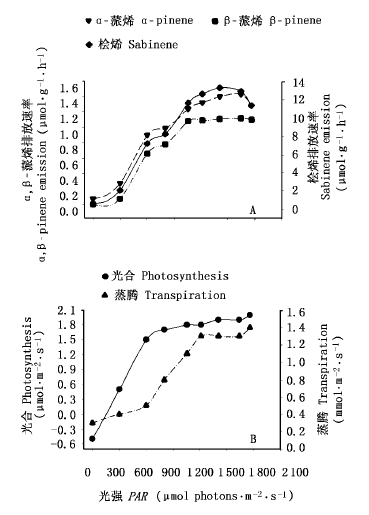
Fig.1 Effect of increasing photosynthesis active radiation (PAR) on α-pinene, sabinene and β-pinene emissions of rubber tree (Hevea brasiliensis)
| [1] |
Affek HP, Yakir D (2002). Protection by isoprene against singlet oxygen in leaves. Plant Physiology, 129,269-277.
DOI URL |
| [2] | Asada K (1994). Production and action of active oxygen species in photosynthetic tissues. In: Foyer CH, Mullineaux PM eds. Causes of Photooxidative Stress and Amelioration of Defense Systems in Plants. CRC, London,77-104. |
| [3] | Bai JH (白建辉), Baker B (2004). Model simulation of isoprene emission flux in a tropical forest plantation of rubber trees. Acta Scientiae Circumstantiae (环境科学学报), 24,197-203. (in Chinese with English abstract) |
| [4] | Bai JH (白建辉), Wang GC (王庚辰), Ren LX (任丽新), Baker B, Zimmerman P, Liang BS (梁宝生) (2003). The emission flux of volatile organic compounds in the Inner Mongolia grassland. Environmental Science (环境科学), 24,17-22. (in Chinese with English abstract) |
| [5] | Bai JH (白建辉), Wang MX (王明星), Graham JR, Prinn G (2001). A study of the nonmethane hydrocarbons at subtropical forest Part Ⅱ. Diurnal variation. Climatic and Environmental Research (气候与环境研究), 6,456-466. (in Chinese with English abstract) |
| [6] | Bai JH (白建辉), Wang MX (王明星), Graham J, Prinn RG, Huang ZL (黄忠良) (1998). Primary study on the concentrations of nonmethane hydrocarbon emitted from the forest. Scientia Atmospherica Sinica (大气科学), 22,247-251. (in Chinese with English abstract) |
| [7] | Bai YH (白郁华), Li JL (李金龙), Zhao MP (赵美萍), Xia Y (夏羽), Tang XY (唐孝炎) (1995). Relative factor of hydrocarbons emission from popular tree. Environmental Chemistry (环境化学), 14,118-123. (in Chinese with English abstract) |
| [8] |
Benjamin MT (1996). Low-emitting urban forests: a taxonomic methodology for assessing isoprene and monoterpene emission rates. Atmospheric Environment, 30,1437-1452.
DOI URL |
| [9] | Brasseur G, Chatfield R (1991). The fate of biogenic trace gases in the atmosphere. In: Sharkey T, Holland E, Mooney H eds. Trace Gas Emissions by Plants. Academic Press, San Diego,1-27. |
| [10] |
Carter WPL, Atkinson R (1996). Development and evaluation of a detailed mechanism for the atmospheric reactions of isoprene and NOx. International Journal of Chemical Kinetics, 28,497-530.
DOI URL |
| [11] |
Delwiche CF, Sharkey TD (1993). Rapid appearance of 13C in biogenic isoprene when 13CO2 is fed to intact leaves. Plant, Cell and Environment, 16,587-591.
DOI URL |
| [12] |
De Moraes CM, Mescher MC, Tumlinson JH (2001). Caterpillar-induced nocturnal plant volatiles repel conspecific females. Nature, 410,577-580.
PMID |
| [13] | Fehsenfeld F, Calvert J, Fall R, Goldan P, Guenther AB, Lamb B, Trainer M, Westberg H, Zimmerman P, Hewitt CN (1992). Emissions of volatile organic compounds from vegetation and the implications for atmospheric chemistry. Global Biogeochemical Cycles, 6,389-430. |
| [14] | Fuentes JD, Hayden BP, Garstang M, Lerdau M, Fitzjarrald D, Baldocchi DD, Monson R, Lamb B, Geron C (2000). VOCs and biosphere-atmosphere feedbacks. Atmospheric Environment, 31,189-191. |
| [15] |
Gershenzon J, McConkey ME, Croteau RB (2000). Regulation of monoterpene accumulation in leaves of peppermint. Plant Physiology, 122,205-213.
DOI URL |
| [16] |
Gray DW, Lerdau MT, Goldstein AH (2003). Influrences of temperature history, water stress, and needle age on methylbutenol emissions. Ecology, 84,765-776.
DOI URL |
| [17] |
Guenther AB, Hewitt CN, Erickson D, Fall R, Geron C, Graedel T, Harley P, Klinger L, Lerdau M, McKay WA, Pierce T, Scholes B, Steinbrecher R, Tallamraju R, Taylor J, Zimmerman P (1995). A global model of natural volatile organic compound emissions. Journal of Geophysical Research, 100,8873-8892.
DOI URL |
| [18] |
Guenther AB, Monson RK, Fall R (1991). Isoprene and monoterpene emission rate variability: observations with eucalyptus and emission rate algorithm development. Journal of Geophysical Research, 96,10799-10808.
DOI URL |
| [19] |
Harley P, Fridd-Stroud V, Greenberg J, Guenther A, Vasconcellos P (1998). Emission of 2-methyl-3-buten-2-ol by pines: a potentially large natural source of reactive carbon to the atmosphere. Journal of Geophysical Research, 103,25479-25486.
DOI URL |
| [20] | Hewitt CN, Kok GL, Fall R (1990). Hydroperoxides in plants exposed to ozone mediate air pollution damage to alkene emitters. Nature, 344,56-58. |
| [21] |
Jacob DJ, Wofsy SC (1988). Photochemistry of biogenic emissions over the Amazon forest. Journal of Geophysical Research, 93,1477-1486.
DOI URL |
| [22] |
Kavouras LG, Mihalopoulos N, Stephanou EG (1998). Formation of atmospheric particles from organic acids produced by forests. Nature, 395,683-686.
DOI URL |
| [23] |
Kesselmeier J, Staudt M (1999). Biogenic volatile organic compounds (VOC) : an overview on emission, physiology and ecology. Journal of Atmospheric Chemistry, 33,23-88.
DOI URL |
| [24] |
Klinger LF, Greenberg JP, Guenther AB, Tyndall G, Zimmerman P, M'Bangui M, Moutsamboté JM, Kenfack D (1998). Patterns in volatile organic compound emissions along a savanna-rainforest gradient in central Africa. Journal of Geophysical Research, 103,1443-1454.
DOI URL |
| [25] | Klinger LF, Li QJ, Guenther AB, Greenberg JP, Baker B, Bai JH (2002). Assessment of volatile organic compound emissions from ecosystems of China. Journal of Geophysical Research, 107,4603-4624. |
| [26] |
Langenheim J (1994). Higher plant terpenoids: a phytocentric overview of their ecological roles. Journal of Chemical Ecology, 20,1223-1280.
DOI URL |
| [27] |
Larom D, Garstang M, Lindeque M, Raspet R, Zunckel M, Hong Y, Brassel K, O'Beirne S, Sokolic F (1997). The influence of surface atmospheric conditions on the range and area reached by animal vocalizations. Journal of Experimental Biology, 200,421-431.
PMID |
| [28] | Li JL (李金龙), Bai YH (白郁华), Hu JX (胡建信), Shao M (邵敏), Zhang BX (张宝祥), Xia Y (夏羽), Tang XY (唐孝炎) (1994). Diurnal variation in the concentration of terpenes and its emission rate measurements from oil pine. China Environmental Science (中国环境科学), 14,165-169. (in Chinese with English abstract) |
| [29] | Li QJ (李庆军), Klinger LF (2001). The correlation between the volatile organic compound emissions and the vegetation succession of ecosystems in different climatic zones of China. Acta Botanica Sinica (植物学报), 43,1065-1071. (in Chinese with English abstract) |
| [30] |
Lichtenthaler HK, Schwender J, Disch A, Rohmer M (1997). Biosynthesis of isoprenoids in higher plant chloroplasts proceeds via a mevalonate-independent pathway. FEBS Letters, 400,271-274.
DOI URL |
| [31] | Loreto F, Ciccioli P, Brancaleoni E, Valentini R, Lillis MD, Csiky O, Seufert G (1998). A hypothesis on the evolution of isoprenoid emission by oaks based on the correlation between emission type and Quercus taxonomy. Oecologia, 11,302-305. |
| [32] |
Loreto F, Ciccioli P, Cecinato A, Brancaleoni E, Frattoni M, Tricoli D (1996). Influence of environmental factors and air composition on the emission of alpha-pinene from Quercus ilex leaves. Plant Physiology, 110,267-275.
PMID |
| [33] |
Loreto F, Mannozzi M, Maris C, Nascetti P, Ferranti F, Pasqualini S (2001). Ozone quenching properties of isoprene and its antioxidant role in leaves. Plant Physiology, 126,993-1000.
DOI URL |
| [34] |
Loreto F, Sharkey TD (1990). A gas-exchange study of photosynthesis and isoprene emission in Quercus rubru L. Planta, 182,523-531.
DOI PMID |
| [35] |
Loreto F, Velikova V (2001). Isoprene produced by leaves protects the photosynthetic apparatus against ozone damage, quenches ozone products, and reduces lipid peroxidation of cellular membranes. Plant Physiology, 127,1781-1787.
DOI URL |
| [36] |
Martin DM, Gershenzon J, Bohlmann J (2003). Induction of volatile terpene biosynthesis and diurnal emission by Methyl Jasmonate in foliage of Norway spruce. Plant Physiology, 132,1586-1599.
DOI URL |
| [37] |
Martin PH, Guenther AB (1995). Insights into the dynamics of forest succession and non-methane hydrocarbon trace gas emissions. Journal of Biogeography, 22,493-499.
DOI URL |
| [38] |
Monson R, Harley P, Litvak M, Wildermuth M, Guenther A, Zimmerman P, Fall R (1994). Environmental and developmental controls over the seasonal pattern of isoprene emission from aspen leaves. Oecologia, 99,260-270.
DOI PMID |
| [39] |
Niinemets M, Reichstein M, Seufert G, Tenhunen JD (2002). Stomatal constraints may affect emission of oxygenated monoterpenoids from the foliage of Pinus pinea. Plant Physiology, 130,1371-1385.
DOI URL |
| [40] | Owen SM, Harley P, Guenther AB, Hewitt CN (2002). Light dependency of VOC emissions from selected Mediterranean plant species. Atmospheric Environment, 36,3147-3159. |
| [41] |
Paré PW, Tumlinson JH (1997). De novo biosynthesis of volatiles induced by insect herbivory in cotton plants. Plant Physiology, 114,1161-1167.
DOI URL |
| [42] |
Peñuelas J, Llusià J (2001). The complexity of factors driving volatile organic compound emissions by plants. Biologia Plantarum, 44,481-487.
DOI URL |
| [43] |
Peñuelas J, Llusià J (2003). BVOCs: plant defense against climate warming? Trends in Plant Science, 8,105-109.
DOI URL |
| [44] |
Rohmer M (1993). The biosynthesis of triterpenoids of the hopane series in the Eubacteria: a mine of new enzyme reactions. Pure and Applied Chemistry, 65,1293-1298.
DOI URL |
| [45] |
Rohmer M, Knani M, Simonin P, Sahm H (1993). Isoprenoid biosynthesis in bacteria: a novel pathway for the early steps leading to isopentenyl diphosphate. The Biochemical Journal, 295,517-524.
DOI URL |
| [46] |
Rosenstiel TN, Fisher AJ, Fall R, Monson RK (2002). Differential accumulation of dimethylallyl diphosphate in leaves and needles of isoprene- and methylbutenol-emitting and nonemitting species. Plant Physiology, 129,1276-1284.
DOI URL |
| [47] | Sharkey TD, Singsaas EL (1995). Why plants emit isoprene? Nature, 374,769. |
| [48] |
Sharkey TD, Chen X, Yeh S (2001). Isoprene increases thermotolerance of fosmidomycin-fed leaves. Plant Physiology, 125,2001-2006.
DOI URL |
| [49] | Sharkey TD, Yeh S (2001). Isoprene emission from plants. Annual Review of Plant Physiology & Plant Molecular Biology, 52,407-436. |
| [50] |
Shallcross DE, Monks PS (2000). A role for isoprene in biosphere-climate-chemistry feedbacks? Atmospheric Environment, 34,1659-1660.
DOI URL |
| [51] |
Shen B, Jensen RG, Bohnert HJ (1997). Mannitol protects against oxidation by hydroxyl radicals. Plant Physiology, 115,527-532.
PMID |
| [52] |
Singsaas EL, Lerdau M, Winter K, Sharkey TD (1997). Isoprene increases thermotolerance of isoprene-emitting species. Plant Physiology, 115,1413-1420.
PMID |
| [53] |
Staudt M, Seufert G (1995). Light-dependent emissions of monoterpenes by holm oak (Quercus ilex L.). Naturwissenschaften, 82,89-92.
DOI URL |
| [54] |
Terry GM, Stokes NJ, Hewitt CN, Mansfield TA (1995). Exposure to isoprene promotes flowering in plants. Journal of Experimental Botany, 46,1629-1631.
DOI URL |
| [55] | Tingey TD, Turner DP, Weber JA (1991). Factors controlling the emissions of monoterpenes and other volatile organic compounds. Trace Gas Emissions by Plants. Academic Press, San Diego,93-119. |
| [56] |
Trainer M, Williams E, Parrish D, Buhr M, Allwine E, Westberg H, Fehsenfeld F, Liu S (1987). Models and observations of the impact of natural hydrocarbons on rural ozone. Nature, 329,705-707.
DOI URL |
| [57] |
Tuazon EC, Atkinson R (1990). A product study of the gas-phase reaction of isoprene with the OH radical in the presence of NOx. International Journal of Chemical Kinetics, 22,1221-1236.
DOI URL |
| [58] |
Wildermuth MC, Fall R (1998). Biochemical characterization of stromal and thylakoid-bound isoforms of isoprene synthase in willow leaves. Plant Physiology, 116,1111-1123.
PMID |
| [59] | Zhang L (张莉), Bai YY (白艳莹), Wang XK (王效科), Ouyang ZY (欧阳志云), Mu YJ (牟玉静), Miao QL (缪启龙) (2002). Isoprene emission of bamboo and its implication to ozone level in region. Acta Ecologica Sinica (生态学报), 22,1339-1344. (in Chinese with English abstract) |
| [60] | Zhao MP (赵美萍), Shao M (邵敏), Bai YH (白郁华), Li JL (李金龙), Tang XY (唐孝炎) (1996). Study on NMHC emission characteristics of several typical trees in China. Environmental Chemistry (环境化学), 15,69-75. (in Chinese with English abstract) |
| [1] | Cao Yi-fei, Su Tao, Cao Min, Wang Hai-yan, Yang Jie. Drivers of Cenozoic Angiosperm Leaf Vein Density Evolution: Climate Adaptation and Herbivory Pressure [J]. , 2027, 51(动植物互作): 0-. |
| [2] | XI Nian-Xun. The impact of multiple global change factors on traits of mycorrhizal plants [J]. , 2026, 50(预发表): 0-. |
| [3] | TAN Qiu-Yan, ZHANG Qing, GAO Cheng, CHU Hai-Yan, YANG Teng. Ectomycorrhizal fungi: key drivers of carbon and nitrogen cycling in alpine ecosystems [J]. Chin J Plant Ecol, 2026, 50(3): 584-599. |
| [4] | FANG Di, MA Ning, LI Sheng-Gong, ZHENG Jia-Jia, CHU Yun-Xin, YANG Jin-Chang, YANG Zan-Ming, ZHANG Long-Ning, MENG Sheng-Wang, GAO De-Cai, DAI Xiao-Qin, FU Xiao-Li, WANG Hui-Min, KOU Liang. Regulatory role of mycorrhizal types in internal nutrient cycling of forest ecosystems [J]. Chin J Plant Ecol, 2026, 50(3): 552-565. |
| [5] | WANG Fa-Yuan, ZHANG Xin, CHEN Bao-Dong. Interactions between soil microplastics and arbuscular mycorrhizal fungi [J]. Chin J Plant Ecol, 2026, 50(3): 612-624. |
| [6] | HOU Xiao-Fan, MA Chen-Han, SUN Yu-Qian, GAO Yu-Han, LI Pin. Differential ecological stoichiometry of leaf and fine root litter decomposition under ozone stress [J]. Chin J Plant Ecol, 2026, 50(2): 268-278. |
| [7] | ZHENG Zi-Yi, CHEN Jiang-Hui, LIU Hui-Ying. Climate warming increases root exudation rates of dominant species in alpine meadow on the Qingzang Plateau [J]. Chin J Plant Ecol, 2025, 49(9): 1363-1373. |
| [8] | CHANG Peng-Fei, LI Ping, Nairsag , WANG Jing, WANG Zhen-Hua, YANG Sen, JIA Zhou, YANG Lu, LIU Ling-Li, DENG Mei-Feng. Contributions of soil organic carbon and inorganic carbon stocks to total soil carbon stock and their driving factors across different types in Nei Mongol temperate grasslands [J]. Chin J Plant Ecol, 2025, 49(9): 1374-1387. |
| [9] | ZHANG Lin, YUAN Wei-Ying, SONG Chuang-Ye, WU Dong-Xiu. Dynamic dataset of environmental elements, species richness and biomass of long-term observation plots of typical ecosystems in China from 1998 to 2010 [J]. Chin J Plant Ecol, 2025, 49(8): 1182-1190. |
| [10] | FAN Ya-Ran, XIA Shao-Pan, YU Bing-Bing, ZHU Zi-Qi, YANG Wei, FAN Yu-Chuan, LIU Xiao-Yu, ZHANG Xu-Hui, ZHENG Ju-Feng. Effects of elevated atmospheric CO2 concentration and warming on stability of soil organic carbon pool accumulation, molecular composition and structure stability [J]. Chin J Plant Ecol, 2025, 49(7): 1053-1069. |
| [11] | LIU Bi-Ying, CHEN Zi-Hao, YUAN Si-Hao, ZHOU Ting. Common issues and technical references for diagram drawing in the compilation of vegetation monographs [J]. Chin J Plant Ecol, 2025, 49(6): 911-921. |
| [12] | QIAO Pei-Yang, GU Xiao-Xuan, LIU Chang-Xin, CAO Ze-Yu, ZHANG Ting-Ting, LIN Chen, CHEN Qin-Chang, PENG Xiu-Fan, CHEN Fei-Fei, LI Hua-Liang, CHEN Wei, CHEN Lu-Zhen. Damage to the mangrove forests in Dongzhaigang of Hainan caused by super typhoon “Yagi” [J]. Chin J Plant Ecol, 2025, 49(4): 540-551. |
| [13] | ZHOU Si-Qi, AI Ling, NI Xiang-Yin, WU Fu-Zhong, WU Qiu-Xia, ZHU Jing-Jing, ZHANG Xin-Ying. Global patterns and controls of variation in cellulose decomposition rates of plant litters [J]. Chin J Plant Ecol, 2025, 49(3): 393-403. |
| [14] | WANG Kun-Ying, QIU Gui-Fu, LIU Zi-He, MENG Jun, LIU Yu-Xuan, JIA Guo-Dong. Climate change regulate tree growth and intrinsic water use efficiency of Populus simonii at different levels of degradation [J]. Chin J Plant Ecol, 2025, 49(2): 343-355. |
| [15] | HUANG Mei-Hong, NIU Meng-Qiu, YANG Peng-Fei, LIN Jie, LIAO Zhou-Yu, CHEN Jian-Guo, XIANG Jian-Ying. Effects of temperature and burial depth on seedling emergence and growth of the alpine cushion plant Arenaria oreophila [J]. Chin J Plant Ecol, 2025, 49(12): 2092-2104. |
| Viewed | ||||||
|
Full text |
|
|||||
|
Abstract |
|
|||||
Copyright © 2026 Chinese Journal of Plant Ecology
Tel: 010-62836134, 62836138, E-mail: apes@ibcas.ac.cn, cjpe@ibcas.ac.cn

