
Chin J Plant Ecol ›› 2014, Vol. 38 ›› Issue (5): 405-416.DOI: 10.3724/SP.J.1258.2014.00037 cstr: 32100.14.SP.J.1258.2014.00037
• Research Articles • Next Articles
LÜ Ting-Ting1,WANG Ping1,*( ),YAN Hong1,ZHANG Wen1,LIAO Gui-Xiang1,JIANG Hai-Bo1,ZOU Chang-Lin2,SHENG Lian-Xi1,*()
Received:2013-10-28
Accepted:2014-02-07
Online:2014-10-28
Published:2014-05-13
Contact:
WANG Ping,SHENG Lian-Xi
LÜ Ting-Ting,WANG Ping,YAN Hong,ZHANG Wen,LIAO Gui-Xiang,JIANG Hai-Bo,ZOU Chang-Lin,SHENG Lian-Xi. Relationship between functional diversity and productivity in meadow and marsh plant communities[J]. Chin J Plant Ecol, 2014, 38(5): 405-416.
Add to citation manager EndNote|Ris|BibTeX
URL: https://www.plant-ecology.com/EN/10.3724/SP.J.1258.2014.00037
| 生境 Habitat | 群落 Community | 经纬度 Longitude and latitude | 海拔 Altitude (m) | 群落高度 Community height (cm) | 群落盖度 Community cover (%) |
|---|---|---|---|---|---|
| 草甸 Meadow | 芦苇群落 Phragmites australis community | 45.87° N, 123.77° E | 134.80 | 32.98 ± 9.42 | 50.96 ± 3.79 |
| 虎尾草群落 Chloris virgatas community | 46.17° N, 123.55° E | 146.40 | 15.45 ± 2.99 | 23.89 ± 3.91 | |
| 碱蓬群落 Suaeda glauca community | 46.67° N, 123.52° E | 141.10 | 7.60 ± 1.34 | 33.84 ± 5.06 | |
| 沼泽 Marsh | 扁秆藨草群落 Scirpus planiculmis community | 45.88° N, 123.70° E | 138.90 | 98.85 ± 17.53 | 70.94 ± 4.25 |
| 扁秆藨草-芦苇群落 Scirpus planiculmis-Phragmites australis community | 46.83° N, 123.67° E | 135.30 | 84.54 ± 20.76 | 45.50 ± 3.76 | |
| 芦苇-荆三棱群落 Phragmites australis-Scirpus fluviatilis community | 46.10° N, 123.67° E | 140.30 | 90.34 ± 9.95 | 35.26 ± 4.88 |
Table 1 Distribution and characteristics of the experimental sites (mean ± SE)
| 生境 Habitat | 群落 Community | 经纬度 Longitude and latitude | 海拔 Altitude (m) | 群落高度 Community height (cm) | 群落盖度 Community cover (%) |
|---|---|---|---|---|---|
| 草甸 Meadow | 芦苇群落 Phragmites australis community | 45.87° N, 123.77° E | 134.80 | 32.98 ± 9.42 | 50.96 ± 3.79 |
| 虎尾草群落 Chloris virgatas community | 46.17° N, 123.55° E | 146.40 | 15.45 ± 2.99 | 23.89 ± 3.91 | |
| 碱蓬群落 Suaeda glauca community | 46.67° N, 123.52° E | 141.10 | 7.60 ± 1.34 | 33.84 ± 5.06 | |
| 沼泽 Marsh | 扁秆藨草群落 Scirpus planiculmis community | 45.88° N, 123.70° E | 138.90 | 98.85 ± 17.53 | 70.94 ± 4.25 |
| 扁秆藨草-芦苇群落 Scirpus planiculmis-Phragmites australis community | 46.83° N, 123.67° E | 135.30 | 84.54 ± 20.76 | 45.50 ± 3.76 | |
| 芦苇-荆三棱群落 Phragmites australis-Scirpus fluviatilis community | 46.10° N, 123.67° E | 140.30 | 90.34 ± 9.95 | 35.26 ± 4.88 |
| 土壤理化性质 Soil physical and chemical property | t检验 t-test | F检验 F-test | |
|---|---|---|---|
| 草甸 Meadow | 沼泽 Marsh | ||
| 有机质 Organic matter (g·kg-1) | -7.00*** | 13.86 ± 1.03 | 40.47 ± 3.26*** |
| 全氮 Total nitrogen (g·kg-1) | -7.07*** | 0.78 ± 0.05*** | 1.96 ± 0.19*** |
| 全磷 Total phosphorus (g·kg-1) | -0.70 | 0.30 ± 0.02 | 0.28 ± 0.02*** |
| 电导率 Electrical conductivity (μS·cm-1) | 1.79 | 794.63 ± 112.89** | 550.58 ± 44.09*** |
| pH | 6.88*** | 9.97 ± 0.10*** | 9.17 ± 0.19*** |
| 水位 Water lever | - | - | 29.17 ± 3.04*** |
Table 2 T-test between the meadow and marsh sites, and F-test among communities on soil physical and chemical properties
| 土壤理化性质 Soil physical and chemical property | t检验 t-test | F检验 F-test | |
|---|---|---|---|
| 草甸 Meadow | 沼泽 Marsh | ||
| 有机质 Organic matter (g·kg-1) | -7.00*** | 13.86 ± 1.03 | 40.47 ± 3.26*** |
| 全氮 Total nitrogen (g·kg-1) | -7.07*** | 0.78 ± 0.05*** | 1.96 ± 0.19*** |
| 全磷 Total phosphorus (g·kg-1) | -0.70 | 0.30 ± 0.02 | 0.28 ± 0.02*** |
| 电导率 Electrical conductivity (μS·cm-1) | 1.79 | 794.63 ± 112.89** | 550.58 ± 44.09*** |
| pH | 6.88*** | 9.97 ± 0.10*** | 9.17 ± 0.19*** |
| 水位 Water lever | - | - | 29.17 ± 3.04*** |
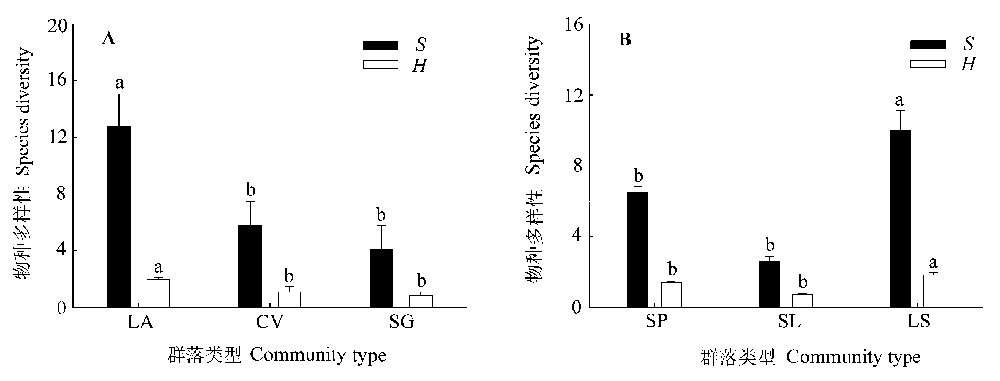
Fig. 1 Species richness (S) and Shannon-Weaver index (H) in different plant communities in meadow (A) and marsh (B). CV, Chloris virgate community; LA, Phragmites australis community; LS, Phragmites australis-Scirpus fluviatilis community; SG, Suaeda glauca community; SL, Scirpus compactus-Phragmites australis community; SP, Scirpus planiculmis community. Different lower-case letters indicate significant differences among communities (p < 0.05).
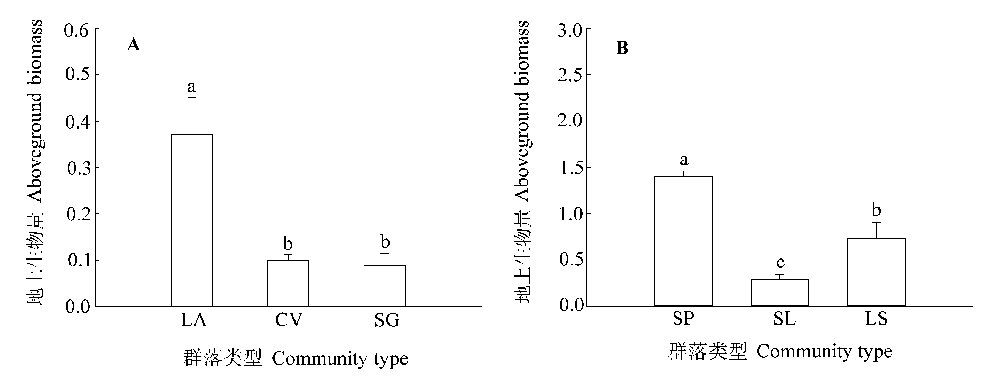
Fig. 2 Aboveground biomass of different plant communities in meadow (A) and marsh (B). CV, Chloris virgate community; LA, Phragmites australis community; LS, Phragmites australis-Scirpus fluviatilis community; SG, Suaeda glauca community; SL, Scirpus compactus-Phragmites australis community; SP, Scirpus planiculmis community. Different lower-case letters indicate significant differences among communities (p < 0.05).
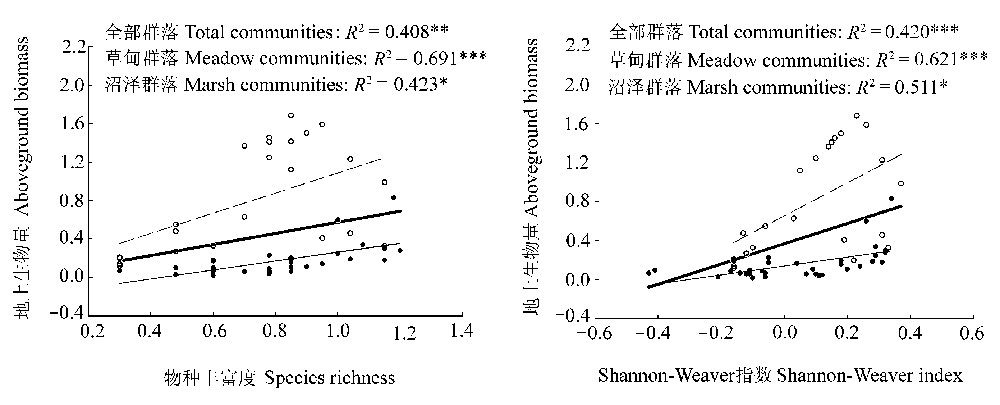
Fig. 3 Relationships between aboveground biomass (lg transformed) and species diversity (lg transformed) of communities. The bold solid line represents all communities, the thin solid line represents meadow communities, and the dash line represents marsh communities. *, ** and *** indicate p = 0.05, 0.01 and 0.001, respectively.
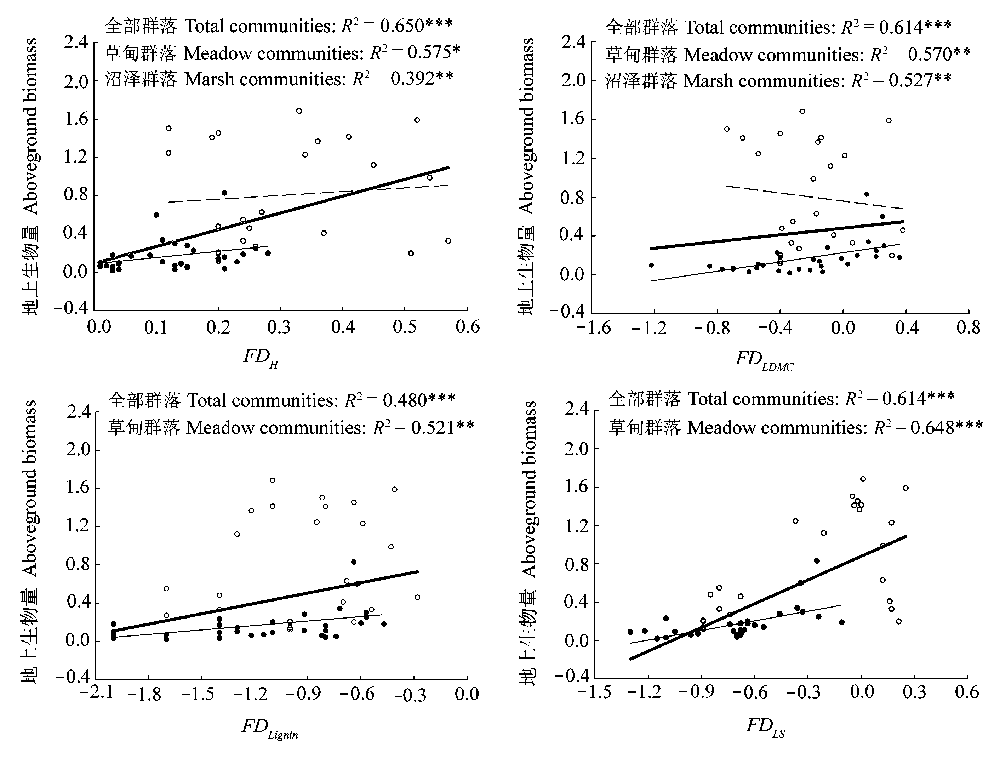
Fig. 4 Relationships between aboveground biomass (lg transformed) and Rao’s quadratic entropy of different traits of communities. The bold solid line represents all communities, the thin solid line represents meadow communities, and the dash line represents marsh communities. FDH, FDLDMC (lg transformed), FDLignin (lg transformed), FDLS (lg transformed), indicate Rao’s quadratic entropy of plant height, leaf dry matter content, leaf lignin content and leaf size, respectively. *, ** and *** indicate p = 0.05, 0.01 and 0.001, respectively.
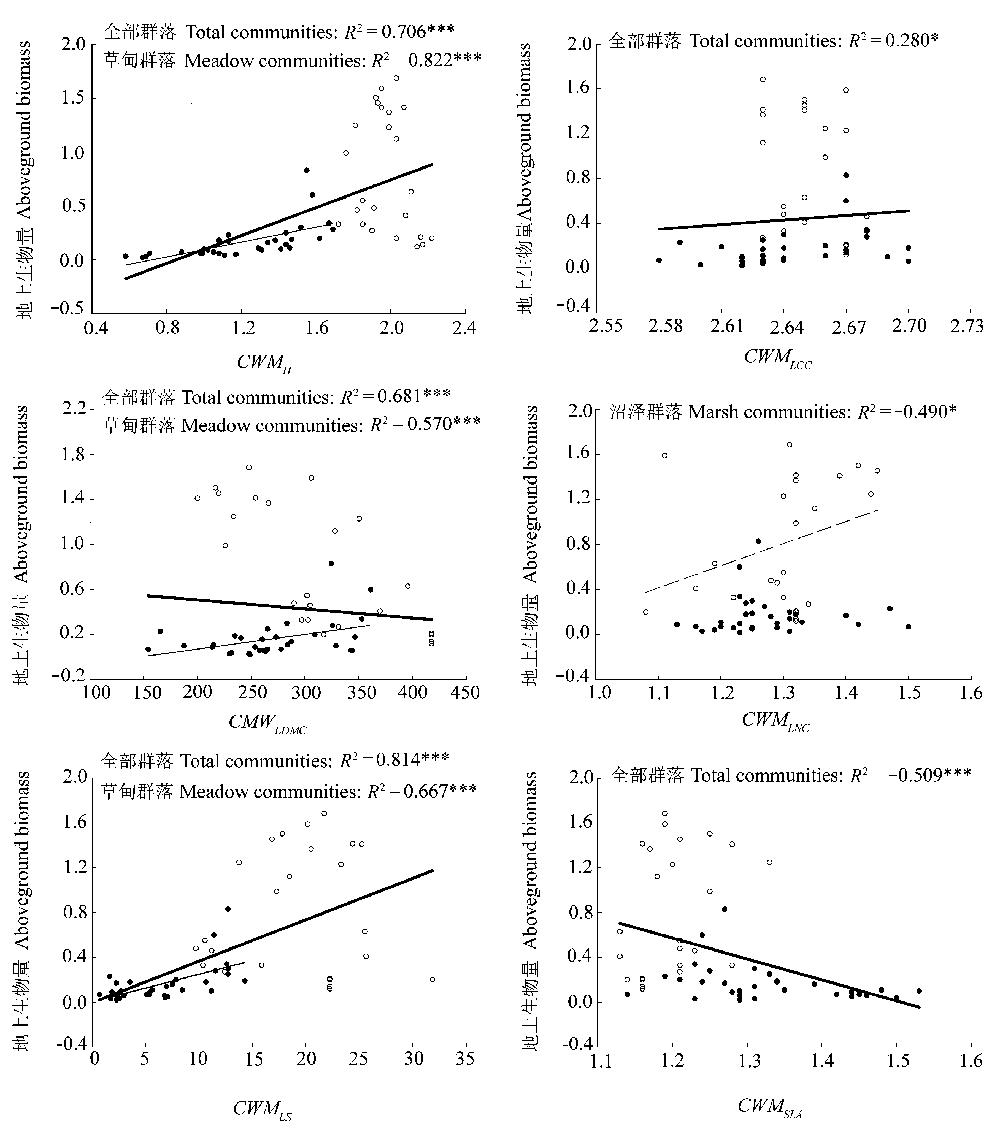
Fig. 5 Relationships between aboveground biomass (lg transformed) and community weighted mean of different traits of communities. The bold solid line represents all communities, the thin solid line represents meadow communities, and the dash line represents marsh communities. CWMH (lg transformed), CWMLCC, CWMLDMC, CWMLNC (lg transformed), CWMLS, CWMSLA (lg transformed) indicate community weighted mean of plant height, leaf carbon content, leaf dry matter content, leaf nitrogen content, leaf size and specific leaf area, respectively. *, ** and *** indicate p = 0.05, 0.01 and 0.001, respectively.
| 回归方程Regression equation | R2 | p | |
|---|---|---|---|
| 草甸 Meadow | lgW = 2.735 + 0.967 (0.785) lgCWMH -1.378 (0.348) lgCWMSLA | 0.747 | <0.001 |
| 沼泽 Marsh | lgW = 4.724 + 0.655 (0.546) lgFDLDMC -0.226 (0.345) pH | 0.442 | <0.001 |
| 全部 Total | lgW = 1.877 + 0.569 (0.582) lgFDLS + 0.291 (0.242) lgFDLDMC + 0.891 (0.961) lgCWMH -0.04 (0.768) CWMLS -0.212 (0.223) FDSLA | 0.702 | <0.002 |
Table 4 Stepwise regression equations of community aboveground biomass and diversity
| 回归方程Regression equation | R2 | p | |
|---|---|---|---|
| 草甸 Meadow | lgW = 2.735 + 0.967 (0.785) lgCWMH -1.378 (0.348) lgCWMSLA | 0.747 | <0.001 |
| 沼泽 Marsh | lgW = 4.724 + 0.655 (0.546) lgFDLDMC -0.226 (0.345) pH | 0.442 | <0.001 |
| 全部 Total | lgW = 1.877 + 0.569 (0.582) lgFDLS + 0.291 (0.242) lgFDLDMC + 0.891 (0.961) lgCWMH -0.04 (0.768) CWMLS -0.212 (0.223) FDSLA | 0.702 | <0.002 |
| 指标 Item | 草甸 Meadow | 沼泽 Marsh | |||||
|---|---|---|---|---|---|---|---|
| 自由度 df | F检验 F-test | 显著性 Sig. | 自由度 df | F检验 F-test | 显著性 Sig. | ||
| CWMH | 29 | 23.633 | < 0.001 | 21 | 0.927 | 0.411 | |
| CWMLCC | 29 | 8.148 | 0.002 | 21 | 4.903 | 0.018 | |
| CWMLDMC | 29 | 7.304 | 0.003 | 21 | 10.494 | 0.001 | |
| CWMLignin | 29 | 3.841 | 0.033 | 21 | 18.966 | < 0.001 | |
| CWMLNC | 29 | 5.162 | 0.012 | 21 | 14.541 | < 0.001 | |
| CWMLS | 29 | 71.731 | < 0.001 | 21 | 1.528 | 0.240 | |
| CWMSLA | 29 | 8.082 | 0.002 | 21 | 1.161 | 0.332 | |
| FDH | 29 | 3.179 | 0.056 | 21 | 7.791 | 0.003 | |
| FDLCC | 29 | 10.642 | < 0.001 | 21 | 2.717 | 0.089 | |
| FDLDMC | 29 | 14.909 | < 0.001 | 21 | 14.043 | < 0.001 | |
| FDLignin | 29 | 11.241 | < 0.001 | 21 | 19.152 | < 0.001 | |
| FDLNC | 29 | 9.414 | 0.001 | 21 | 2.301 | 0.125 | |
| FDLS | 29 | 29.094 | < 0.001 | 21 | 50.351 | < 0.001 | |
| FDSLA | 29 | 8.701 | 0.001 | 21 | 10.245 | 0.001 | |
Table 3 Summary of ANOVA on functional diversity among meadow and marsh plant communities
| 指标 Item | 草甸 Meadow | 沼泽 Marsh | |||||
|---|---|---|---|---|---|---|---|
| 自由度 df | F检验 F-test | 显著性 Sig. | 自由度 df | F检验 F-test | 显著性 Sig. | ||
| CWMH | 29 | 23.633 | < 0.001 | 21 | 0.927 | 0.411 | |
| CWMLCC | 29 | 8.148 | 0.002 | 21 | 4.903 | 0.018 | |
| CWMLDMC | 29 | 7.304 | 0.003 | 21 | 10.494 | 0.001 | |
| CWMLignin | 29 | 3.841 | 0.033 | 21 | 18.966 | < 0.001 | |
| CWMLNC | 29 | 5.162 | 0.012 | 21 | 14.541 | < 0.001 | |
| CWMLS | 29 | 71.731 | < 0.001 | 21 | 1.528 | 0.240 | |
| CWMSLA | 29 | 8.082 | 0.002 | 21 | 1.161 | 0.332 | |
| FDH | 29 | 3.179 | 0.056 | 21 | 7.791 | 0.003 | |
| FDLCC | 29 | 10.642 | < 0.001 | 21 | 2.717 | 0.089 | |
| FDLDMC | 29 | 14.909 | < 0.001 | 21 | 14.043 | < 0.001 | |
| FDLignin | 29 | 11.241 | < 0.001 | 21 | 19.152 | < 0.001 | |
| FDLNC | 29 | 9.414 | 0.001 | 21 | 2.301 | 0.125 | |
| FDLS | 29 | 29.094 | < 0.001 | 21 | 50.351 | < 0.001 | |
| FDSLA | 29 | 8.701 | 0.001 | 21 | 10.245 | 0.001 | |
| [1] |
Aarssen LW (1997). High productivity in grassland ecosystems: effected by species diversity or productive species? Oikos, 80, 183-184.
DOI URL |
| [2] | Bao SD (2005). Soil Agrochemical Analysis. Chinese Agriculture Press, Beijing. 30-34. (in Chinese) |
| [ 鲍士旦 (2005). 土壤农化分析. 中国农业出版社, 北京. 30-34.] | |
| [3] |
Cadotte MW, Cavender-Bares J, Tilman D, Oakley TH (2009). Using phylogenetic, functional and trait diversity to understand patterns of plant community productivity. PLoS ONE, 4, e5695.
DOI URL PMID |
| [4] | Callaway JC, Sullivan G, Zedler JB (2003). Species-rich plantings increase biomass and nitrogen accumulation in a wetland restoration experiment. Ecology Application, 13, 1626-1639. |
| [5] | Chanteloup P, Bonis A (2013). Functional diversity in root and above-ground traits in a fertile grassland shows a detrimental effect on productivity. Basic and Applied Ecology, 14, 208-216. |
| [6] | Cornelissen JHC, Kavorel S, Garnier E, Díaz S, Buchmann N, Gurvich DE, Reich PB, ter Steege H, Morgan HD, van der Heijden MGA, Pausas JG, Poorter H (2003). A handbook of protocols for standardized and easy measurements of plant functional traits worldwide. Annals of Botany, 51, 335-380. |
| [7] | de Bello F, Lepš J, Sebastià MT (2006). Variations in species and functional plant diversity along climatic and grazing gradients. Ecography, 29, 801-810. |
| [8] | Díaz S, Cabido M (2001). Vive la difference: plant functional diversity matters to ecosystem processes. Trends in Ecology & Evolution, 16, 646-655. |
| [9] | Dukat B (2005). Rao’s quadratic entropy as a measure of functional diversity based on multiple traits. Journal of Vegetation Science, 16, 533-540. |
| [10] | Dukes JS (2001). Productivity and complementarity in grassland microcosms of varying diversity. Oikos, 94, 468-480. |
| [11] | Garnier E, Cortez J, Billès G, Navas M, Roumet C, Debussche M, Laurent G, Blanchard A, Aubry D, Bellmann A, Neill C, Toussaint JP (2004). Plant functional markers capture ecosystem properties during secondary succession. Ecology, 85, 2630-2637. |
| [12] | Grime JP (1997). Biodiversity and ecosystem function: the debate deepens. Science, 277, 1260-1261. |
| [13] | Grime JP (1998). Benefits of plant diversity to ecosystems: immediate, filter and founder effects. Journal of Ecology, 86, 902-910. |
| [14] | Hector A, Beale AJ, Minns A, Otway SJ, Lawton JH (2000). Consequences of the reduction of plant diversity for litter decomposition: effects through litter quality and microenvironment. Oikos, 90, 357-371. |
| [15] | Hector A, Schmid B, Beierkuhnlein C, Caldeira MC, Diemer M, Dimitrakopoulos PG, Finn JA, Freitas H, Giller PS, Good J, Harris R, Högberg P, Huss-Danell K, Joshi J, Jumpponen A, Körner C, Leadley PW, Loreau M, Minns A, Mulder CPH, Donovan GO, Otway SJ, Pereira JS, Prinz A, Read DJ, Scherer-Lorenzen M, Schulze ED, Siamantziouras ASD, Spehn EM, Terry AC, Troumbis AY, Woodward FI, Yachi S, Lawton JH (1999). Plant diversity and productivity experiments in European grasslands. Science, 286, 1123-1127. |
| [16] | Hooper DU (1998). The role of complementarity and competition in ecosystem responses to variation in plant diversity. Ecology, 79, 704-719. |
| [17] | Hooper DU, Solan M, Symstad AJ, Díaz S, Gessner MO, Buchmann N, Degrande V, Grime JP, Hulot FD, Mermillod- Blondin F, Roy J, Spehn EM, van Peer L (2002). Species Diversity, Functional Diversity, and Ecosystem Functioning. Oxford University Press, Oxford. |
| [18] | Hooper DU, Vitousek PM (1997). The effects of plant composition and diversity on ecosystem processes. Science, 277, 1302-1305. |
| [19] | Hooper DU, Vitousek PM (1998). Effects of plant composition and diversity on nutrient cycling. Ecology Monograph, 68, 121-149. |
| [20] |
Huston MA (1997). Hidden treatments in ecological experiments: re-evaluating the ecosystem function of biodiversity. Oecologia, 110, 449-460.
DOI URL PMID |
| [21] | Iiyama K, Wallis AFA (1990). Determination of lignin in herbaceous plants by an improved acetyl bromide procedure. Journal of the Science of Food and Agriculture, 51, 145-161. |
| [22] | Jiang XL, Zhang WG, Wang G (2007). Effects of different components of diversity on productivity in artificial plant communities. Ecological Research, 22, 629-634. |
| [23] | Jones RM, Hargreaves JNG (1979). Improvements to the dry-weight-rank method for measuring botanical composition. Grass and Forage Science, 34, 181-189. |
| [24] | Lepš J, de Bello F, Lavorel S, Berman S (2006). Quantifying and interpreting functional diversity of natural communities: practical considerations matter. Preslia, 78, 481-501. |
| [25] | Li XG, Zhu ZH, Zhou XS, Yuan FR, Fan RJ, Xu ML (2011). Effects of clipping, fertilizing and watering on the relationship between species diversity, functional diversity and primary productivity in alpine meadow of China. Chinese Journal of Plant Ecology, 35, 1136-1147. (in Chinese with English abstract) |
| [ 李晓刚, 朱志红, 周晓松, 袁芙蓉, 樊瑞俭, 许曼丽 (2011). 刈割、施肥和浇水对高寒草甸物种多样性、功能多样性与初级生产力关系的影响. 植物生态学报, 35, 1136-1147.] | |
| [26] |
Loreau M, Naeem S, Inchausti P, Bengtsson J, Grime JP, Hector A, Hooper DU, Huston MA, Raffaelli D, Schmid B, Tilman D, Wardle DA (2001). Biodiversity and ecosystem functioning: current knowledge and future challenges. Science, 294, 804-808.
DOI URL PMID |
| [27] | Mannetje L, Haydock KP (1963). The dry-weight-rank method for the botanical analysis of pasture. Journal of the British Grassland Society, 18, 268-275. |
| [28] | Meng TT, Ni J, Wang GH (2007). Plant functional traits, environment and ecosystem functioning. Journal of Plant Ecology (Chinese Version), 31, 150-165. (in Chinese with English abstract) |
| [ 孟婷婷, 倪健, 王国宏 (2007). 植物功能性状与环境和生态系统功能. 植物生态学报, 31, 150-165.] | |
| [29] | Mittelbach GG, Steiner CF, Scheiner SM, Gross KL, Reynoldes HL, Waide RB, Willig MR, Dodson SI, Gough L (2001). What is the observed relationship between species richness and productivity? Ecology, 82, 2381-2396. |
| [30] | Mokany K, Ash J, Rxburgh S (2008). Functional identity is more important than diversity in influencing ecosystem processes in a temperate native grassland. Journal of Ecology, 96, 884-893. |
| [31] | Petchey OL, Gaston KJ (2002). Functional diversity (FD), species richness, and community composition. Ecology Letters, 5, 402-411. |
| [32] | Petchey OL, Hector A, Gaston KJ (2004). How do different measures of functional diversity perform? Ecology, 85, 847-857. |
| [33] |
Roscher C, Schumacher J, Gubsch M, Lipowsky A, Weigelt A, Buchmann N, Schmid B, Schulze ED (2012). Using plant functional traits to explain diversity-productivity relationships. PLoS ONE, 7, e36760.
URL PMID |
| [34] | Roscher C, Temperton VM, Scherer-Lorenzen M, Schmitz M, Schumacher J, Schmid B, Buchmann N, Weisser WW, Ernst-Detlef S (2005). Overyielding in experimental grassland communities irrespective of species pool or spatial scale. Ecology Letters, 8, 419-429. |
| [35] | Schellberg J, Pontes L da S (2012). Plant functional traits and nutrient gradients on grassland. Grass and Forage Science, 67, 305-319. |
| [36] | Schulze ED, Mooney HA (1994). Biodiversity and Ecosystem Function. Springer, New York. |
| [37] | Shannon CE, Weaver W (1971). The Mathematical Theory of Communication. University of Illinois Press, Urbana. |
| [38] | Tilman D (1997). Distinguishing between the effects of species diversity and species composition. Oikos, 80, 185. |
| [39] | Tilman D (2001). Functional diversity. Encyclopedia of Biodiversity, 3, 109-120. |
| [40] |
Wacker L, Baudois O, Eichenberger-Glinz S, Schmid B (2009). Diversity effects in early- and mid-successional species pools along a nitrogen gradient. Ecology, 90, 637-648.
DOI URL PMID |
| [41] | Walker B, Kinzig A, Langridge J (1999). Plant attribute diversity, resilience, and ecosystem function: the nature and significance of dominant and minor species. Ecosystems, 2, 95-113. |
| [42] |
Xiao Y, Xie GD, An K, Lu CX (2012). A research framework of ecosystem services based on functional traits. Chinese Journal of Plant Ecology, 36, 353-362. (in Chinese with English abstract)
DOI URL |
|
[ 肖玉, 谢高地, 安凯, 鲁春霞 (2012). 基于功能性状的生态系统服务研究框架. 植物生态学报, 36, 353-362.]
DOI URL |
|
| [43] | Zang YM, Zhu ZH, Li YN, Wang WJ, Xi B (2009). Effects of species diversity and functional diversity on primary productivity of alpine meadow. Chinese Journal of Ecology, 28, 999-1005. (in Chinese with English abstract) |
| [ 臧岳铭, 朱志红, 李英年, 王文娟, 席博 (2009). 高寒矮嵩草草甸物种多样性与功能多样性对初级生产力的影响. 生态学杂志, 28, 999-1005.] |
| [1] | MA Jian-Hui, TONG Xin, ZHANG Si-Rong, MAO Zi-Kun, QIN Jun, MA Ke-Ping. Research advances and perspectives on physiological and ecological functions of mycorrhizal fungi [J]. Chin J Plant Ecol, 2026, 50(3): 498-514. |
| [2] | WANG Zi-Xuan, XING Ai-Jun, CHEN Zi-Xin, SHEN Hai-Hua, FANG Jing-Yun. Effects of long-term nitrogen addition on understory plant functional traits in a boreal forest [J]. Chin J Plant Ecol, 2026, 50(2): 244-255. |
| [3] | GUO Zhi-Hong, YANG Ni, ZHANG Tao, LI Hai-Bo, TIAN Tai-An, HUANG Xiao-Bo, LI Cong, MA Si-Ju, SU Jian-Rong, LI Shuai-Feng. Change of functional diversity and community assembly of mycorrhizal plant along an altitudinal gradient in primary forests of Fanjing Mountain, Guizhou, China [J]. Chin J Plant Ecol, 2025, 49(9): 1410-1423. |
| [4] | JIA Zi-Xuan, FANG Tao, ZHANG Shu-Xin, LIU Yi-Fan, ZHAO Wei, WANG Rong, CHANG Hai-Chao, ZHU Yao-Jun, LUO Fang-Li, GUO Yun-Qian, YU Fei-Hai. Responses of aboveground-belowground traits of Phragmites australis in different marsh wetlands to changes in soil moisture [J]. Chin J Plant Ecol, 2025, 49(9): 1448-1460. |
| [5] | MA Fu-Long, WANG Yu-Qing, HAO Yu, DUAN Ji-Chao, LIU Fei-Fei, XI Lin-Qiao, HAN Lu. Effects of altitude gradient on plant and soil microbial community structure and diversity in the middle part of the northern slope of the Kunlun Mountains, China [J]. Chin J Plant Ecol, 2025, 49(5): 732-747. |
| [6] | WU Yan-Ning, HAO Min-Hui, HE Huai-Jiang, ZHANG Chun-Yu, ZHAO Xiu-Hai. Relationships between functional diversity and aboveground carbon sink functions and their changes with forest succession in Changbai Mountains, China [J]. Chin J Plant Ecol, 2025, 49(2): 232-243. |
| [7] | LU Lei-Qin, SUN Long, SONG Yu-Xuan, YANG Guang, CAI Hui-Ying. Post-fire time impacts on nonstructural carbohydrates in leaves-branches-roots of Vaccinium vitis-idaea in Da Hinggan Mountains [J]. Chin J Plant Ecol, 2025, 49(12): 2105-2118. |
| [8] | QIU Dan-Ni, PENG Qing-Qing, ZHANG Hui-Ling, WEN Hui-Hui, WU Fu-Zhong. Seasonal effects of typical canopy tree species on ant community dynamics in mid-subtropical evergreen broadleaf forests [J]. Chin J Plant Ecol, 2025, 49(11): 1805-1816. |
| [9] | GUO Huan-Min, SHEN Xiao-Xue, LI Rui-Li. Species co-occurrence and distribution probability in Futian Mangrove Nature Reserve of Shenzhen Bay [J]. Chin J Plant Ecol, 2025, 49(11): 1833-1843. |
| [10] | GAO Yu-Xuan, SU Yan-Jun, FENG Yu-Cai, ZHANG Jun, WANG Xiao-Quan, LIU Ling-Li. Research and conservation status of the rare and endangered relict plant Cathaya argyrophylla [J]. Chin J Plant Ecol, 2025, 49(10): 1572-1582. |
| [11] | LI Li-Ping, YU Kun, CHEN Fang-Miao, CHEN Qiang, JING Yu-Hang, NIU Zhen-Guo, HU Chen-Lu, QIN Hai-Ning, HUANG Hui-Ping, TIAN Yi-Chen. Red List Index of Chinese higher plants based on IUCN global assessment data [J]. Chin J Plant Ecol, 2025, 49(10): 1612-1625. |
| [12] | HE Yi, ZHOU Jing, CHEN Chen, FANG Ting-Zhou, SU Jian, GAO Hao-Jie, CAO Jia-Hao, YANG Fei-Yu, FAN Qi-Bo, ZHU Le-Yao, CHEN Yi-Ming, YANG Fei, WANG Yi-Teng, FENG Lei, LIU Fei, LIANG Shuang, JIANG Ming-Kai, CHEN Jun, ZHAO Yun-Peng, CHEN Wei-Le, ZHAO Ying, HUANG Jian-Guo. Protection and restoration of endangered tree species on coastal islands of Zhejiang, China [J]. Chin J Plant Ecol, 2025, 49(10): 1583-1599. |
| [13] | ZHANG Zhong-Yang, SONG Xi-Qiang, REN Ming-Xun, ZHANG Zhe. Ecological functions of vascular epiphytes in habitat construction [J]. Chin J Plant Ecol, 2023, 47(7): 895-911. |
| [14] | YANG Jia-Rong, DAI Dong, CHEN Jun-Fang, WU Xian, LIU Xiao-Lin, LIU Yu. Insight into recent studies on the diversity of arbuscular mycorrhizal fungi in shaping plant community assembly and maintaining rare species [J]. Chin J Plant Ecol, 2023, 47(6): 745-755. |
| [15] | LI Yao-Qi, WANG Zhi-Heng. Functional biogeography of plants: research progresses and challenges [J]. Chin J Plant Ecol, 2023, 47(2): 145-169. |
| Viewed | ||||||
|
Full text |
|
|||||
|
Abstract |
|
|||||
Copyright © 2026 Chinese Journal of Plant Ecology
Tel: 010-62836134, 62836138, E-mail: apes@ibcas.ac.cn, cjpe@ibcas.ac.cn

