
Chin J Plant Ecol ›› 2017, Vol. 41 ›› Issue (3): 359-368.DOI: 10.17521/cjpe.2015.0257 cstr: 32100.14.cjpe.2015.0257
Special Issue: 植物功能性状
• Research Articles • Previous Articles Next Articles
Xue YANG, Jun-Fang SHEN, Nian-Xi ZHAO*( ), Yu-Bao GAO
Online:2017-03-10
Published:2017-04-12
Contact:
Nian-Xi ZHAO
About author:KANG Jing-yao(1991-), E-mail: Xue YANG, Jun-Fang SHEN, Nian-Xi ZHAO, Yu-Bao GAO. Phenotypic plasticity and genetic differentiation of quantitative traits in genotypes of Leymus chinensis[J]. Chin J Plant Ecol, 2017, 41(3): 359-368.
Add to citation manager EndNote|Ris|BibTeX
URL: https://www.plant-ecology.com/EN/10.17521/cjpe.2015.0257
| 性状 Traits | 基因型 Genotype (G) | 刈割 Defoliation (De) | 干旱 Drought (Dr) | De × Dr | 基因型×刈割 G × De | 基因型×干旱 G × Dr | 基因型× 刈割×干旱 G × De × Dr | |||||||
|---|---|---|---|---|---|---|---|---|---|---|---|---|---|---|
| F | p | F | p | F | p | F | p | F | p | F | p | F | p | |
| 光系统II光化学效率 Photochemical efficiency of photosystem II | 19.47 | <0.001 | 2.649 | 0.105 | 17.19 | <0.001 | 0.476 | 0.491 | 1.064 | 0.391 | 0.912 | 0.516 | 1.824 | 0.066 |
| 最大净光合速率 Maximum net photosynthetic rate | 41.08 | <0.001 | 315.7 | <0.001 | 7.305 | 0.007 | 0.023 | 0.879 | 9.143 | <0.001 | 1.385 | 0.197 | 1.353 | 0.212 |
| 蒸腾速率 Transpiration rate | 4.878 | <0.001 | 4.979 | 0.027 | 2.226 | 0.137 | 1.764 | 0.186 | 3.817 | <0.001 | 2.805 | 0.004 | 0.881 | 0.543 |
| 比叶面积 Specific leaf area | 3.781 | <0.001 | 34.3 | <0.001 | 2.916 | 0.089 | 11.62 | 0.001 | 1.231 | 0.278 | 2.207 | 0.023 | 1.843 | 0.063 |
| 相对生长速率 Relative growth rate | 2.829 | 0.006 | 1 765 | <0.001 | 212.8 | <0.001 | 115.1 | <0.001 | 6.55 | <0.001 | 3.071 | 0.003 | 4.847 | <0.001 |
| 分蘖增长数 The number of tillers increased | 1.842 | 0.073 | 4.488 | 0.037 | 30.15 | <0.001 | 24.72 | <0.001 | 1.061 | 0.401 | 1.5 | 0.162 | 0.848 | 0.574 |
| 地上生物量 Aboveground biomass | 1.454 | 0.167 | 0.007 | 0.933 | 69.06 | <0.001 | 28.66 | 0.001 | 1.116 | 0.353 | 1.848 | 0.062 | 0.635 | 0.767 |
| 地下生物量 Belowground biomass | 2.249 | 0.021 | 1.221 | 0.27 | 21.93 | <0.001 | 11.07 | 0.001 | 0.527 | 0.854 | 1.644 | 0.105 | 0.664 | 0.741 |
| 叶总酚浓度 Total phenolic concentration of leaf | 1.624 | 0.111 | 30.62 | <0.001 | 0.002 | 0.962 | 48.21 | <0.001 | 1.978 | 0.044 | 2.321 | 0.017 | 0.957 | 0.477 |
| 根非结构性碳水化合物总量 Total non-structural carbohydrates content of root | 1.480 | 0.157 | 11.09 | 0.001 | 47.13 | <0.001 | 16.21 | <0.001 | 1.938 | 0.049 | 2.462 | 0.011 | 1.76 | 0.078 |
| 根冠比 Root/shoot ratio | 0.976 | 0.461 | 0.099 | 0.753 | 6.005 | 0.015 | 0.479 | 0.49 | 1.099 | 0.365 | 0.855 | 0.567 | 1.093 | 0.369 |
Table 1 Multivariate analysis of variance for genotype and phenotypic variations and interactions of genotype and treatments in Leymus chinensis
| 性状 Traits | 基因型 Genotype (G) | 刈割 Defoliation (De) | 干旱 Drought (Dr) | De × Dr | 基因型×刈割 G × De | 基因型×干旱 G × Dr | 基因型× 刈割×干旱 G × De × Dr | |||||||
|---|---|---|---|---|---|---|---|---|---|---|---|---|---|---|
| F | p | F | p | F | p | F | p | F | p | F | p | F | p | |
| 光系统II光化学效率 Photochemical efficiency of photosystem II | 19.47 | <0.001 | 2.649 | 0.105 | 17.19 | <0.001 | 0.476 | 0.491 | 1.064 | 0.391 | 0.912 | 0.516 | 1.824 | 0.066 |
| 最大净光合速率 Maximum net photosynthetic rate | 41.08 | <0.001 | 315.7 | <0.001 | 7.305 | 0.007 | 0.023 | 0.879 | 9.143 | <0.001 | 1.385 | 0.197 | 1.353 | 0.212 |
| 蒸腾速率 Transpiration rate | 4.878 | <0.001 | 4.979 | 0.027 | 2.226 | 0.137 | 1.764 | 0.186 | 3.817 | <0.001 | 2.805 | 0.004 | 0.881 | 0.543 |
| 比叶面积 Specific leaf area | 3.781 | <0.001 | 34.3 | <0.001 | 2.916 | 0.089 | 11.62 | 0.001 | 1.231 | 0.278 | 2.207 | 0.023 | 1.843 | 0.063 |
| 相对生长速率 Relative growth rate | 2.829 | 0.006 | 1 765 | <0.001 | 212.8 | <0.001 | 115.1 | <0.001 | 6.55 | <0.001 | 3.071 | 0.003 | 4.847 | <0.001 |
| 分蘖增长数 The number of tillers increased | 1.842 | 0.073 | 4.488 | 0.037 | 30.15 | <0.001 | 24.72 | <0.001 | 1.061 | 0.401 | 1.5 | 0.162 | 0.848 | 0.574 |
| 地上生物量 Aboveground biomass | 1.454 | 0.167 | 0.007 | 0.933 | 69.06 | <0.001 | 28.66 | 0.001 | 1.116 | 0.353 | 1.848 | 0.062 | 0.635 | 0.767 |
| 地下生物量 Belowground biomass | 2.249 | 0.021 | 1.221 | 0.27 | 21.93 | <0.001 | 11.07 | 0.001 | 0.527 | 0.854 | 1.644 | 0.105 | 0.664 | 0.741 |
| 叶总酚浓度 Total phenolic concentration of leaf | 1.624 | 0.111 | 30.62 | <0.001 | 0.002 | 0.962 | 48.21 | <0.001 | 1.978 | 0.044 | 2.321 | 0.017 | 0.957 | 0.477 |
| 根非结构性碳水化合物总量 Total non-structural carbohydrates content of root | 1.480 | 0.157 | 11.09 | 0.001 | 47.13 | <0.001 | 16.21 | <0.001 | 1.938 | 0.049 | 2.462 | 0.011 | 1.76 | 0.078 |
| 根冠比 Root/shoot ratio | 0.976 | 0.461 | 0.099 | 0.753 | 6.005 | 0.015 | 0.479 | 0.49 | 1.099 | 0.365 | 0.855 | 0.567 | 1.093 | 0.369 |
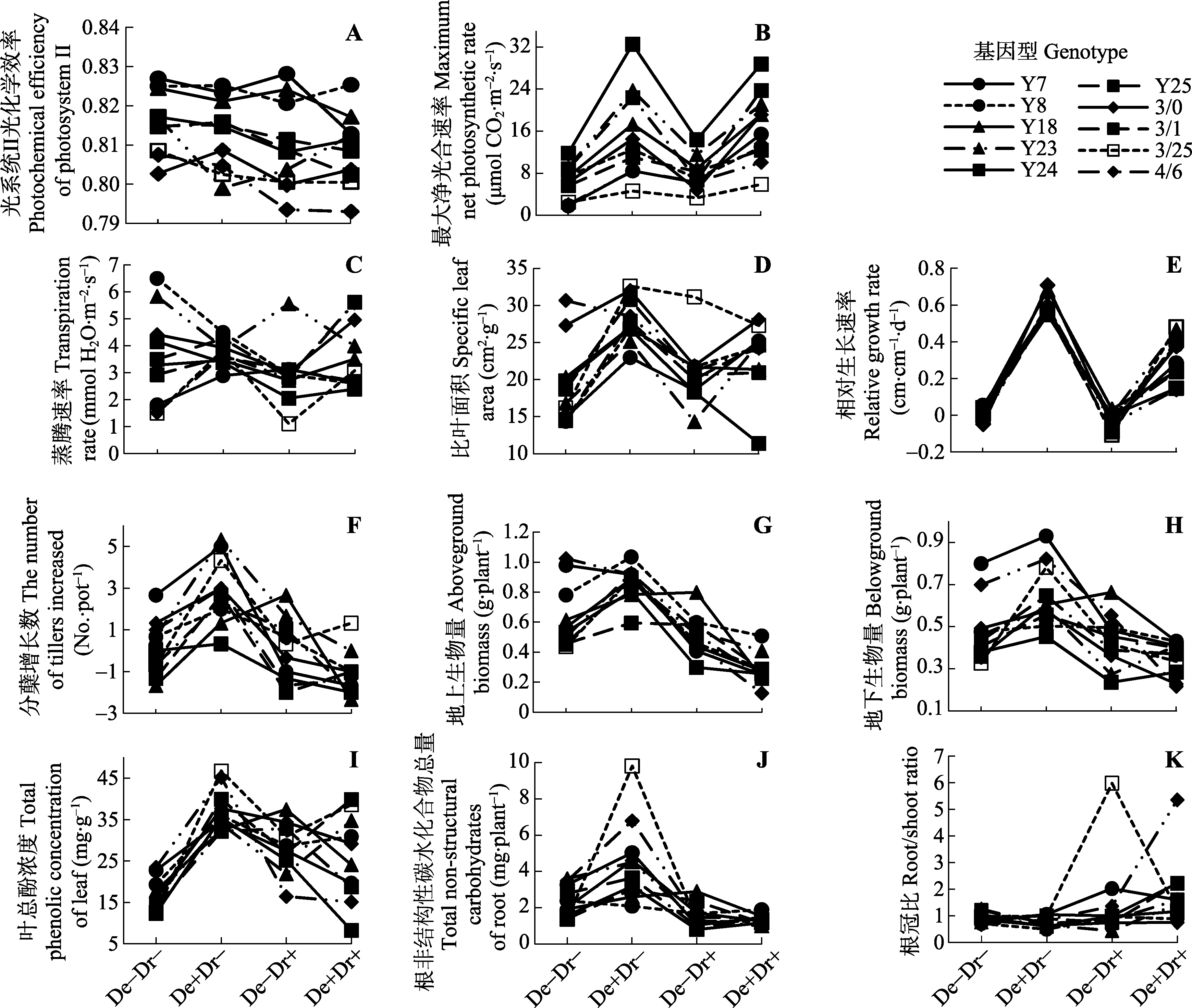
Fig. 1 Reaction norms of traits of 10 Leymus chinensis genotypes under four treatments. De-Dr-, control; De+Dr-, non-arid defoliation; De-Dr+, non-defoliation but drought; De+Dr+, defoliation and drought.
| 性状 Trait | 对照 Control | 刈割 Defoliation | 干旱 Drought | 刈割干旱 Defoliation and drought | ||||
|---|---|---|---|---|---|---|---|---|
| H2 | p | H2 | p | H2 | p | H2 | p | |
| 光系统II光化学效率 Photochemical efficiency of photosystem II | 0.000 | <0.001 | 0.000 | <0.001 | 1.000 | <0.001 | 1.000 | <0.001 |
| 最大净光合速率 Maximum net photosynthetic rate | 0.847 | <0.001 | 0.679 | <0.001 | 0.585 | <0.001 | 0.660 | <0.001 |
| 蒸腾速率 Transpiration rate | 0.538 | <0.001 | - | 0.948 | 0.380 | <0.001 | 0.168 | 0.029 |
| 比叶面积 Specific leaf area | 0.221 | 0.022 | - | 0.127 | 0.171 | 0.022 | - | 0.061 |
| 相对生长速率 Relative growth rate | 0.400 | 0.002 | 0.727 | <0.001 | 0.625 | 0.001 | 0.515 | 0.006 |
| 分蘖增长数 The number of tillers increased | - | 0.314 | - | 0.286 | - | 0.410 | - | 0.056 |
| 地上生物量 Aboveground biomass | 0.269 | 0.007 | - | 0.787 | - | 0.752 | - | 0.075 |
| 地下生物量 Belowground biomass | - | 0.151 | - | 0.145 | - | 0.523 | - | 0.553 |
| 叶总酚浓度 Total phenolic concentration of leaf | - | 0.170 | - | 0.201 | - | 0.616 | 0.145 | 0.004 |
| 根非结构性碳水化合物总量 Total non-structural carbohydrates content of root | - | 0.201 | - | 0.062 | - | 0.550 | - | 0.951 |
| 根冠比 Root/shoot ratio | - | 0.936 | - | 0.061 | - | 0.068 | 0.202 | 0.017 |
Table 2 ANOVA analysis and the broad-sense heritability (H2) estimates for 10 traits of phenotypic variations under four treatments in Leymus chinensis
| 性状 Trait | 对照 Control | 刈割 Defoliation | 干旱 Drought | 刈割干旱 Defoliation and drought | ||||
|---|---|---|---|---|---|---|---|---|
| H2 | p | H2 | p | H2 | p | H2 | p | |
| 光系统II光化学效率 Photochemical efficiency of photosystem II | 0.000 | <0.001 | 0.000 | <0.001 | 1.000 | <0.001 | 1.000 | <0.001 |
| 最大净光合速率 Maximum net photosynthetic rate | 0.847 | <0.001 | 0.679 | <0.001 | 0.585 | <0.001 | 0.660 | <0.001 |
| 蒸腾速率 Transpiration rate | 0.538 | <0.001 | - | 0.948 | 0.380 | <0.001 | 0.168 | 0.029 |
| 比叶面积 Specific leaf area | 0.221 | 0.022 | - | 0.127 | 0.171 | 0.022 | - | 0.061 |
| 相对生长速率 Relative growth rate | 0.400 | 0.002 | 0.727 | <0.001 | 0.625 | 0.001 | 0.515 | 0.006 |
| 分蘖增长数 The number of tillers increased | - | 0.314 | - | 0.286 | - | 0.410 | - | 0.056 |
| 地上生物量 Aboveground biomass | 0.269 | 0.007 | - | 0.787 | - | 0.752 | - | 0.075 |
| 地下生物量 Belowground biomass | - | 0.151 | - | 0.145 | - | 0.523 | - | 0.553 |
| 叶总酚浓度 Total phenolic concentration of leaf | - | 0.170 | - | 0.201 | - | 0.616 | 0.145 | 0.004 |
| 根非结构性碳水化合物总量 Total non-structural carbohydrates content of root | - | 0.201 | - | 0.062 | - | 0.550 | - | 0.951 |
| 根冠比 Root/shoot ratio | - | 0.936 | - | 0.061 | - | 0.068 | 0.202 | 0.017 |
| 性状 Traits | 对照 Control | 刈割 Defoliation | 干旱 Drought | 刈割干旱 Defoliation and drought | ||||
|---|---|---|---|---|---|---|---|---|
| 函数1 Function 1 | 函数2 Function 2 | 函数1 Function 1 | 函数2 Function 2 | 函数1 Function 1 | 函数2 Function 2 | 函数1 Function 1 | 函数2 Function 2 | |
| 光系统II光化学效率 Photochemical efficiency of photosystem II | 0.891 | 0.966 | -0.510 | -0.191 | 1.585 | 0.717 | -0.193 | 0.312 |
| 最大净光合速率 Maximum net photosynthetic rate | 1.285 | -0.462 | -0.905 | 0.865 | 1.231 | -1.609 | 0.783 | -0.672 |
| 蒸腾速率 Transpiration rate | -0.561 | 0.125 | 0.491 | -0.213 | 0.576 | -0.827 | 1.319 | 0.098 |
| 比叶面积 Specific leaf area | -0.692 | -0.533 | 0.542 | 0.219 | 1.341 | -0.835 | -0.042 | 1.452 |
| 相对生长速率 Relative growth rate | -0.588 | 0.815 | 0.962 | 0.953 | 1.235 | 0.236 | 1.101 | 0.267 |
| 分蘖增长数 The number of tillers increased | -0.416 | 0.347 | -0.424 | -1.030 | -1.365 | 0.603 | -0.079 | 0.521 |
| 地上生物量 Aboveground biomass | 1.114 | 0.571 | 1.919 | 2.834 | -0.579 | 3.541 | 1.323 | 2.44 |
| 地下生物量 Belowground biomass | -1.81 | 0.104 | -1.614 | -2.049 | 1.594 | -3.385 | 0.055 | -2.852 |
| 叶总酚浓度 Total phenolic concentration of leaf | 0.126 | 0.905 | -0.714 | -0.021 | -0.115 | 0.486 | -1.226 | -1.07 |
| 根非结构性碳水化合物总量 Total non-structural carbohydrates content of root | 0.598 | -1.076 | -0.010 | -0.446 | -1.058 | 0.564 | -0.129 | -0.498 |
| 根冠比 Root/shoot ratio | 1.174 | 0.781 | 1.201 | 1.319 | -0.141 | 1.039 | 0.838 | 2.452 |
| 解释的方差 Explained variance (%) | 49.8 | 31.9 | 44.5 | 30.2 | 59.2 | 20.4 | 37.3 | 22.0 |
Table 3 Function coefficients of canonical discriminant traits of Leymus chinensis for four treatments
| 性状 Traits | 对照 Control | 刈割 Defoliation | 干旱 Drought | 刈割干旱 Defoliation and drought | ||||
|---|---|---|---|---|---|---|---|---|
| 函数1 Function 1 | 函数2 Function 2 | 函数1 Function 1 | 函数2 Function 2 | 函数1 Function 1 | 函数2 Function 2 | 函数1 Function 1 | 函数2 Function 2 | |
| 光系统II光化学效率 Photochemical efficiency of photosystem II | 0.891 | 0.966 | -0.510 | -0.191 | 1.585 | 0.717 | -0.193 | 0.312 |
| 最大净光合速率 Maximum net photosynthetic rate | 1.285 | -0.462 | -0.905 | 0.865 | 1.231 | -1.609 | 0.783 | -0.672 |
| 蒸腾速率 Transpiration rate | -0.561 | 0.125 | 0.491 | -0.213 | 0.576 | -0.827 | 1.319 | 0.098 |
| 比叶面积 Specific leaf area | -0.692 | -0.533 | 0.542 | 0.219 | 1.341 | -0.835 | -0.042 | 1.452 |
| 相对生长速率 Relative growth rate | -0.588 | 0.815 | 0.962 | 0.953 | 1.235 | 0.236 | 1.101 | 0.267 |
| 分蘖增长数 The number of tillers increased | -0.416 | 0.347 | -0.424 | -1.030 | -1.365 | 0.603 | -0.079 | 0.521 |
| 地上生物量 Aboveground biomass | 1.114 | 0.571 | 1.919 | 2.834 | -0.579 | 3.541 | 1.323 | 2.44 |
| 地下生物量 Belowground biomass | -1.81 | 0.104 | -1.614 | -2.049 | 1.594 | -3.385 | 0.055 | -2.852 |
| 叶总酚浓度 Total phenolic concentration of leaf | 0.126 | 0.905 | -0.714 | -0.021 | -0.115 | 0.486 | -1.226 | -1.07 |
| 根非结构性碳水化合物总量 Total non-structural carbohydrates content of root | 0.598 | -1.076 | -0.010 | -0.446 | -1.058 | 0.564 | -0.129 | -0.498 |
| 根冠比 Root/shoot ratio | 1.174 | 0.781 | 1.201 | 1.319 | -0.141 | 1.039 | 0.838 | 2.452 |
| 解释的方差 Explained variance (%) | 49.8 | 31.9 | 44.5 | 30.2 | 59.2 | 20.4 | 37.3 | 22.0 |
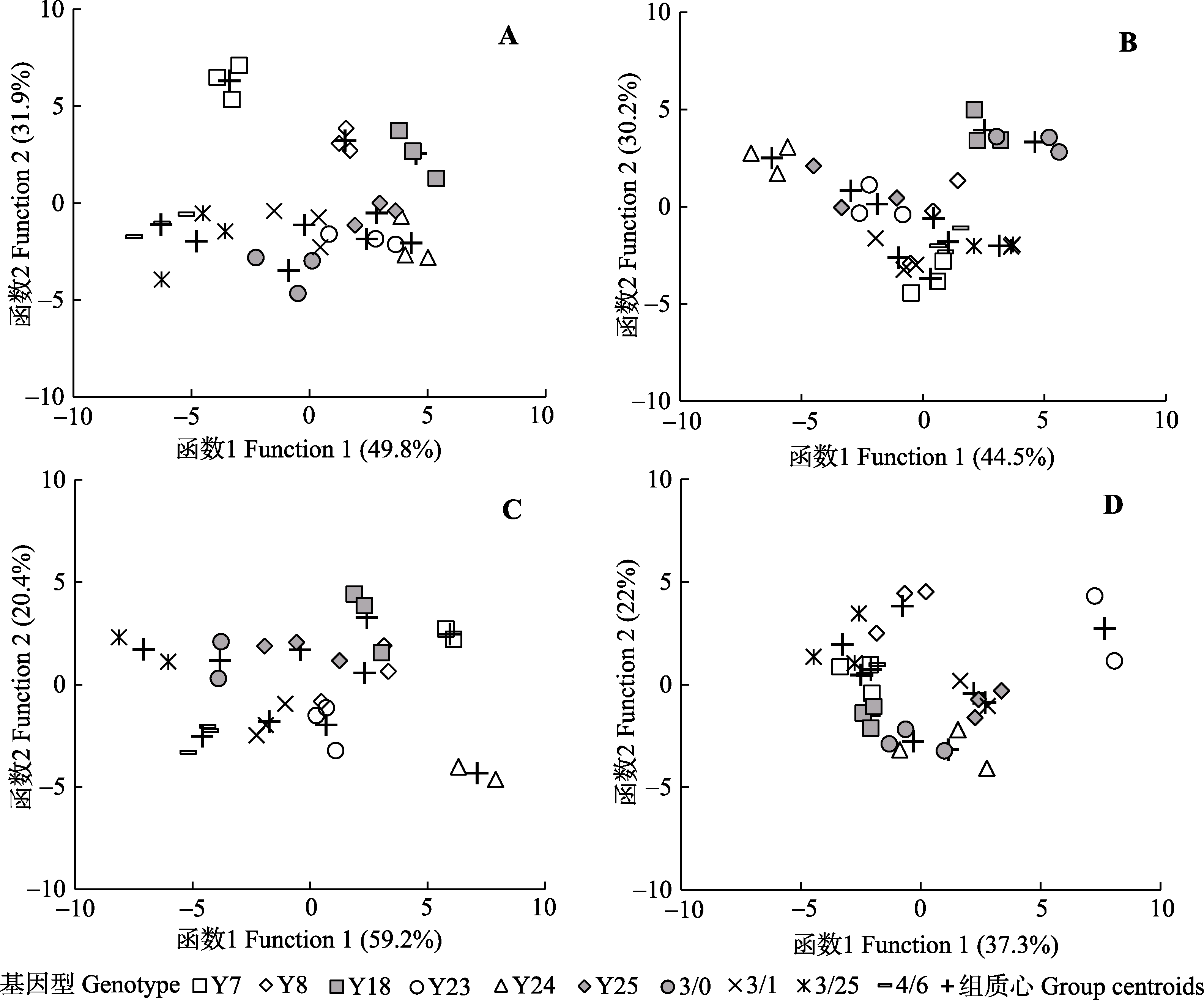
Fig. 2 Scatterplot of canonical discriminant of 10 genotypes in Leymus chinensis for four treatments. A, Control. B, Non-arid defoliation. C, Non-defoliation but drought. D, Defoliation and drought.
| [1] | Ackerly DD, Dudley SA, Sultan SE, Schmitt J, Coleman JS, Linder CR, Sandquist DR, Geber MA, Evans AS, Dawson TE (2000). The evolution of plant ecophysiological traits: Recent advances and future directions new research addresses natural selection, genetic constraints, and the adaptive evolution of plant ecophysiological traits. Bioscience, 50, 979-995. |
| [2] | Aslam M, KhanIA, Saleem M, Ali Z (2006). Assessment of water stress tolerance in different maize accessions at germination and early growth stage. Pakistan Journal of Botany, 38, 1571-1579. |
| [3] | Bolnick DI, Amarasekare P, Araújo MS, Bürger R, Levine JM, Novak M, Rudolf VH, Schreiber SJ, Urban MC, Vasseur DA (2011). Why intraspecific trait variation matters in community ecology. Trends in Ecology & Evolution, 26, 183-192. |
| [4] | Chang CC, Smith MD (2014). Direct and indirect relationships between genetic diversity of a dominant grass, community diversity and above-ground productivity in tallgrass prairie. Journal of Vegetation Science, 25, 470-480. |
| [5] | Cook-Patton SC, McArt SH, Parachnowitsch AL, Thaler JS, Agrawal AA (2011). A direct comparison of the consequences of plant genotypic and species diversity on communities and ecosystem function. Ecology, 92, 915-923. |
| [6] | Crutsinger GM, Sanders NJ, Classen AT (2009). Comparing intra-and inter-specific effects on litter decomposition in an old-field ecosystem. Basic and Applied Ecology, 10, 535-543. |
| [7] | Da Silveira AJ, Feitosa Teles F, Stull JW (1978). A rapid technique for total nonstructural carbohydrate determination of plant tissue. Journal of Agricultural and Food Chemistry, 26, 770-772. |
| [8] | Draghi JA, Whitlock MC (2012). Phenotypic plasticity facilitates mutational variance, genetic variance, and evolvability along the major axis of environmental variation. Evolution, 66, 2891-2902. |
| [9] | Eid MH (2009). Estimation of heritability and genetic advance of yield traits in wheat (Triticum aestivum L.) under drought condition. International Journal of Genetics and Molecular Biology, 1, 115-120. |
| [10] | Fernandez-Orozco R, Li L, Harflett C, Shewry PR, Ward JL (2010). Effects of environment and genotype on phenolic acids in wheat in the health grain diversity screen. Journal of Agricultural and Food Chemistry, 58, 9341-9352. |
| [11] | Gao Y, Wang D, Ba L, Bai Y, Liu B (2008). Interactions between herbivory and resource availability on grazing tolerance of Leymus chinensis. Environmental and Experimental Botany, 63, 113-122. |
| [12] | Gu WC (2004). Statistical Genetic. Science Press, Beijing. (in Chinese)[顾万春 (2004). 统计遗传学. 科学出版社, 北京.] |
| [13] | Gutbrodt B, Dorn S, Mody K (2012). Drought stress affects constitutive but not induced herbivore resistance in apple plants. Arthropod-Plant Interactions, 6, 171-179. |
| [14] | Haugen R, Steffes L, Wolf J, Brown P, Matzner S, Siemens DH (2008). Evolution of drought tolerance and defense: Dependence of tradeoffs on mechanism, environment and defense switching. Oikos, 117, 231-244. |
| [15] | Hedrick PW (2005). A standardized genetic differentiation measure. Evolution, 59, 1633-1638. |
| [16] | Hu BZ, Liu D, Hu GF, Jiang SJ, Zhang AY (2001). Morphological variation and genetic diversity in Aneurolepidium chinensis. Acta Phytoecologica Sinica, 25, 83-89. (in Chinese with English abstract)[胡宝忠, 刘娣, 胡国富, 姜述君, 张阿英 (2001). 羊草遗传多样性的研究. 植物生态学报, 25, 83-89.] |
| [17] | Hughes AR, Stachowicz JJ, Williams SL (2009). Morphological and physiological variation among seagrass (Zostera marina) genotypes. Oecologia, 159, 725-733. |
| [18] | Johnson MT, Agrawal AA (2005). Plant genotype and environment interact to shape a diverse arthropod community on evening primrose (Oenothera biennis). Ecology, 86, 874-885. |
| [19] | Joshi J, Stoll P, Rusterholz HP, Schmid B, Dolt C, Baur B (2006). Small-scale experimental habitat fragmentation reduces colonization rates in species-rich grasslands. Oecologia, 148, 144-152. |
| [20] | Kanaga MK, Ryel RJ, Mock KE, Pfrender ME (2008). Quantitative-genetic variation in morphological and physiological traits within a quaking aspen (Populus tremuloides) population. Canadian Journal of Forest Research, 38, 1690-1694. |
| [21] | Kotowska AM, Cahill JJ, Keddie BA (2010). Plant genetic diversity yields increased plant productivity and herbivore performance. Journal of Ecology, 98, 237-245. |
| [22] | Lande R (2009). Adaptation to an extraordinary environment by evolution of phenotypic plasticity and genetic assimilation. Journal of Evolutionary Biology, 22, 1435-1446. |
| [23] | Le Corre V, Kremer A (2012). The genetic differentiation at quantitative trait loci under local adaptation. Molecular Ecology, 21, 1548-1566. |
| [24] | Li H, Yang YF, Lu XS (2004). Quantitative analysis of reproductive tiller characteristics of Leymus chinensis populations on the Songnen Plain of China. Acta Prataculturae Sinica, 13(4), 50-56. (in Chinese with English abstract)[李红, 杨允菲, 卢欣石 (2004). 松嫩平原羊草种群生殖分蘖株的数量特征及其定量分析. 草业学报, 13(4), 50-56.] |
| [25] | Li HY, Li JD, Xu ZG, Zhou JY, Zhang JF (2011). Vegetative reproduction characteristics of Leymus chinensis populations in Tumuji National Nature Reserve, Inner Mongolia. Acta Prataculturae Sinica, 20(5), 19-25. (in Chinese with English abstract)[李海燕, 李建东, 徐振国, 周景英, 张建峰 (2011). 内蒙古图牧吉自然保护区羊草种群营养繁殖特性的比较. 草业学报 20(5), 19-25.] |
| [26] | Liefting M, Hoffmann AA, Ellers J (2009). Plasticity versus environmental canalization: Population differences in thermal responses along a latitudinal gradient in Drosophila serrata. Evolution, 63, 1954-1963. |
| [27] | Liu HF, Gao YB, Ruan WB, Chen L, Li CL, Zhao NX, Wang D (2004a). Genetic differentiation within and between Leymus chinensis populations from different zones of mid-eastern Inner Mongolia steppe. Acta Ecologica Sinica, 24, 2157-2164. (in Chinese with English abstract)[刘惠芬, 高玉葆, 阮维斌, 陈磊, 李长林, 赵念席, 王丹 (2004a). 内蒙古中东部不同草原地带羊草种群遗传分化. 生态学报, 24, 2157-2164.] |
| [28] | Liu HF, Gao YB, Wang D, Ren AZ, Ruan WB, Chen L, Zhao NX (2004b). Genetic differentiation in eight populations of Leymus chinensis in Inner Mongolia steppe. Acta Ecologica Sinica, 24, 423-431. (in Chinese with English abstract)[刘惠芬, 高玉葆, 王丹, 任安芝, 阮维斌, 陈磊, 赵念席 (2004b). 内蒙古典型草原羊草种群遗传分化的RAPD分析. 生态学报, 24, 423-431.] |
| [29] | Malinowski DP, Alloush GA, Belesky DP (1998). Evidence for chemical changes on the root surface of tall fescue in response to infection with the fungal endophyte Neotyphodium coenophialum. Plant and Soil, 205, 1-12. |
| [30] | Mallitt KL, Bonser SP, Hunt J (2010). The plasticity of phenotypic integration in response to light and water availability in the pepper grass, Lepidium bonariense. Evolutionary Ecology, 24, 1321-1337. |
| [31] | Manaa A, Ahmed HB, Valot B, Bouchet JP, Aschi-Smiti S, Causse M, Faurobert M (2011). Salt and genotype impact on plant physiology and root proteome variations in tomato. Journal of Experimental Botany, 17, 1-17. |
| [32] | Miner BG, Sultan SE, Morgan SG, Padilla DK, Relyea RA (2005). Ecological consequences of phenotypic plasticity. Trends in Ecology & Evolution, 20, 685-692. |
| [33] | Nicotra AB, Atkin OK, Bonser SP, Davidson AM, Finnegan E, Mathesius U, Poot P, Purugganan MD, Richards C, Valladares F (2010). Plant phenotypic plasticity in a changing climate. Trends in Plant Science, 15, 684-692. |
| [34] | Pigliucci M, Schlichting C, Whitton J (1995). Reaction norms of Arabidopsis. II. Response to stress and unordered environmental variation. Functional Ecology, 9, 537-547. |
| [35] | Richards JH (1993). Physiology of Plants Recovering from Defoliation. SIR Publishing, Wellington, New Zealand. 85-94. |
| [36] | Seliskar DM, Gallagher JL, Burdick DM, Mutz LA (2002). The regulation of ecosystem functions by ecotypic variation in the dominant plant: A Spartina alterniflora salt-marsh case study. Journal of Ecology, 90, 1-11. |
| [37] | Shen JF, Ren HQ, Xin XJ, Xu B, Gao YB, Zhao NX (2015). Leymus chinensis genotypic diversity increases the response of population to disturbance. Acta Ecologica Sinica, 35, 7682-7689. (in Chinese with English abstract)[申俊芳, 任慧琴, 辛晓静, 徐冰, 高玉葆, 赵念席 (2015). 羊草基因型多样性能增强种群对干扰的响应. 生态学报, 35, 7682-7689.] |
| [38] | Stevens MT, Waller DM, Lindroth RL (2007). Resistance and tolerance in Populus tremuloides: Genetic variation, costs, and environmental dependency. Evolutionary Ecology, 21, 829-847. |
| [39] | Strasburg JL, Sherman NA, Wright KM, Moyle LC, Willis JH, Rieseberg LH (2012). What can patterns of differentiation across plant genomes tell us about adaptation and speciation? Philosophical Transactions of the Royal Society of London B: Biological Sciences, 367, 364-373. |
| [40] | Sultan SE (1995). Phenotypic plasticity and plant adaptation. Acta Botanica Neerlandica, 44, 363-383. |
| [41] | Sultan SE (2000). Phenotypic plasticity for plant development, function and life history. Trends in Plant Science, 5, 537-542. |
| [42] | Toker C (2004). Estimates of broad-sense heritability for seed yield and yield criteria in faba bean (Vicia faba L.). Hereditas, 140, 222-225. |
| [43] | Wang D (2004). The Variance and Differentiation of Leymus chinensis in Mid-Eastern Inner Mongolia Grassland. Master degree dissertation, Nankai University, Tianjin. 35-45. (in Chinese with English abstract)[王丹 (2004). 内蒙古中东部草原羊草种内变异与分化研究. 硕士学位论文, 南开大学, 天津. 35-45.] |
| [44] | Wang R, Gao Q (2001). Photosynthesis, transpiration, and water use efficiency in two divergent Leymus chinensis populations from Northeast China. Photosynthetica, 39, 123-126. |
| [45] | Yang Y, Fang J, Ji C, Han W (2009). Above- and belowground biomass allocation in Tibetan grasslands. Journal of Vegetation Science, 20, 177-184. |
| [1] | Cao Yi-fei, Su Tao, Cao Min, Wang Hai-yan, Yang Jie. Drivers of Cenozoic Angiosperm Leaf Vein Density Evolution: Climate Adaptation and Herbivory Pressure [J]. , 2027, 51(动植物互作): 0-. |
| [2] | XIAO Zhi-Shu. Advances in pollination and seed dispersal of tropical liana Mucuna (Fabaceae): current status and outlook [J]. , 2027, 51(动植物互作): 0-. |
| [3] | FENG Zhe, XU Ge-Xi, LIU Shun, CHEN Jian, LI Fei-Fan, GONG Shan-Shan, JIA Lei, SUN Zhen, YU Mei-Ni, SHI Zuo-Min, ZHOU Qing-Hong, JIANG Dong-Mei. Habitat factors and phylogeny jointly drive leaf stoichiometry in dry-hot valley region of Jinsha River, Yunnan, China [J]. Chin J Plant Ecol, 2026, 50(2): 352-361. |
| [4] | SONG Yao-Bin, DONG Ming, YU Fei-Hai, YE Xue-Hua, LIU Jian. Clonal plant ecology: responses and effects [J]. Chin J Plant Ecol, 2025, 49(7): 999-1037. |
| [5] | CHEN Kai, YANG Yan, XU Ling, JIANG Zhong-Hua. Variations in seed morphology and germination of Primula denticulata along an elevational gradient in the mountains of southwestern Yunnan, China [J]. Chin J Plant Ecol, 2025, 49(7): 1119-1127. |
| [6] | ZHANG Xiao-Di, WANG Xiao-Xia, ZHANG Yu-Wen, HOU Jing-Yu, SHI Xiao-Peng, HE Lu-Lu, LIU Ya-Dong, XUE Liu, HE Bao-Hua, DUAN Jie. Hydraulic architecture, leaf functional traits and environmental adaptation strategies of three understory shrubs in Beijing mountainous areas [J]. Chin J Plant Ecol, 2025, 49(7): 1128-1143. |
| [7] | LU Zhen, XIE Guang-Jie, Qaisar KHAN, QIN Ying, HUANG Yu-Yan, GUO Dao-Jun, YANG Ting-Ting, YANG Li-Tao, XING Yong-Xiu, LI Yang-Rui, WANG Zhen. Burkholderia strains enhance the tolerance of sugarcane to aluminum stress by improving the physiological adaptability and regulating the expression of aluminum responsive genes [J]. Chin J Plant Ecol, 2025, 49(3): 475-487. |
| [8] | WANG Ya-Xuan, WANG Qian, LIN Qian-Ti, ZHANG Yi-Jia, ZHENG Min, GU Yan-Sheng. Leaf anatomical structure traits of six herbaceous plants response to different water habitats in Dajiuhu wetland, Mt. Shennongjia [J]. Chin J Plant Ecol, 2025, 49(12): 2149-2165. |
| [9] | LU Zi-Jia, WANG Tian-Rui, ZHENG Si-Si, MENG Hong-Hu, CAO Jian-Guo, Gregor KOZLOWSKI, SONG Yi-Gang. Environmental adaptive genetic variation and genetic vulnerability of relict plant Pterocarya hupehensis [J]. Chin J Plant Ecol, 2025, 49(10): 1626-1642. |
| [10] | XU Hong, SU Hua, LI Yong-Geng, SU Ben-Ying, YANG Jing-Cheng, LI Yu-Qiang, WANG Zheng-Wen. Exploration of livestock-poultry-grassland systems: the influence of different land use types on the grassland dominated by Leymus chinensis in northern China [J]. Chin J Plant Ecol, 2025, 49(1): 211-220. |
| [11] | BAI Hao-Ran, HOU Meng, LIU Yan-Jie. Mechanisms of the invasion of Cenchrus spinifex and drought effects on productivity of Leymus chinensis community [J]. Chin J Plant Ecol, 2024, 48(5): 577-589. |
| [12] | YAO Zhen-Yu, XIN Yue, MU Wen-Kui, ZHANG Quan-Min, YANG Liu, ZHAO Li-Qing. Community characteristics of Leymus chinensis steppe in Nei Mongol, China [J]. Chin J Plant Ecol, 2024, 48(10): 1385-1392. |
| [13] | LIU Cong-Cong, HE Nian-Peng, LI Ying, ZHANG Jia-Hui, YAN Pu, WANG Ruo-Meng, WANG Rui-Li. Current and future trends of plant functional traits in macro-ecology [J]. Chin J Plant Ecol, 2024, 48(1): 21-40. |
| [14] | MA Chang-Qin, HUANG Hai-Long, PENG Zheng-Lin, WU Chun-Ze, WEI Qing-Yu, JIA Hong-Tao, WEI Xing. Response of compound leaf types and photosynthetic function of male and female Fraxinus mandschurica to different habitats [J]. Chin J Plant Ecol, 2023, 47(9): 1287-1297. |
| [15] | YU Jun-Rui, WAN Chun-Yan, ZHU Shi-Dan. Hydraulic vulnerability segmentation in woody plant species from tropical and subtropical karst forests [J]. Chin J Plant Ecol, 2023, 47(11): 1576-1584. |
| Viewed | ||||||
|
Full text |
|
|||||
|
Abstract |
|
|||||
Copyright © 2026 Chinese Journal of Plant Ecology
Tel: 010-62836134, 62836138, E-mail: apes@ibcas.ac.cn, cjpe@ibcas.ac.cn

