
Chin J Plant Ecol ›› 2025, Vol. 49 ›› Issue (10): 1721-1732.DOI: 10.17521/cjpe.2024.0300 cstr: 32100.14.cjpe.2024.0300
• Research Articles • Previous Articles Next Articles
ZHANG Jian-Hua1, ZHOU Xiao-Yang2, DUAN Shan-Shan1, BAI Jia-Ni1, XU Long-Chao2,*( )
)
Received:2024-09-06
Accepted:2025-03-04
Online:2025-10-20
Published:2025-05-07
Contact:
XU Long-Chao
Supported by:ZHANG Jian-Hua, ZHOU Xiao-Yang, DUAN Shan-Shan, BAI Jia-Ni, XU Long-Chao. Carbon density and distribution characteristics of two typical shrublands in Dongling Mountain, Beijing[J]. Chin J Plant Ecol, 2025, 49(10): 1721-1732.
Add to citation manager EndNote|Ris|BibTeX
URL: https://www.plant-ecology.com/EN/10.17521/cjpe.2024.0300
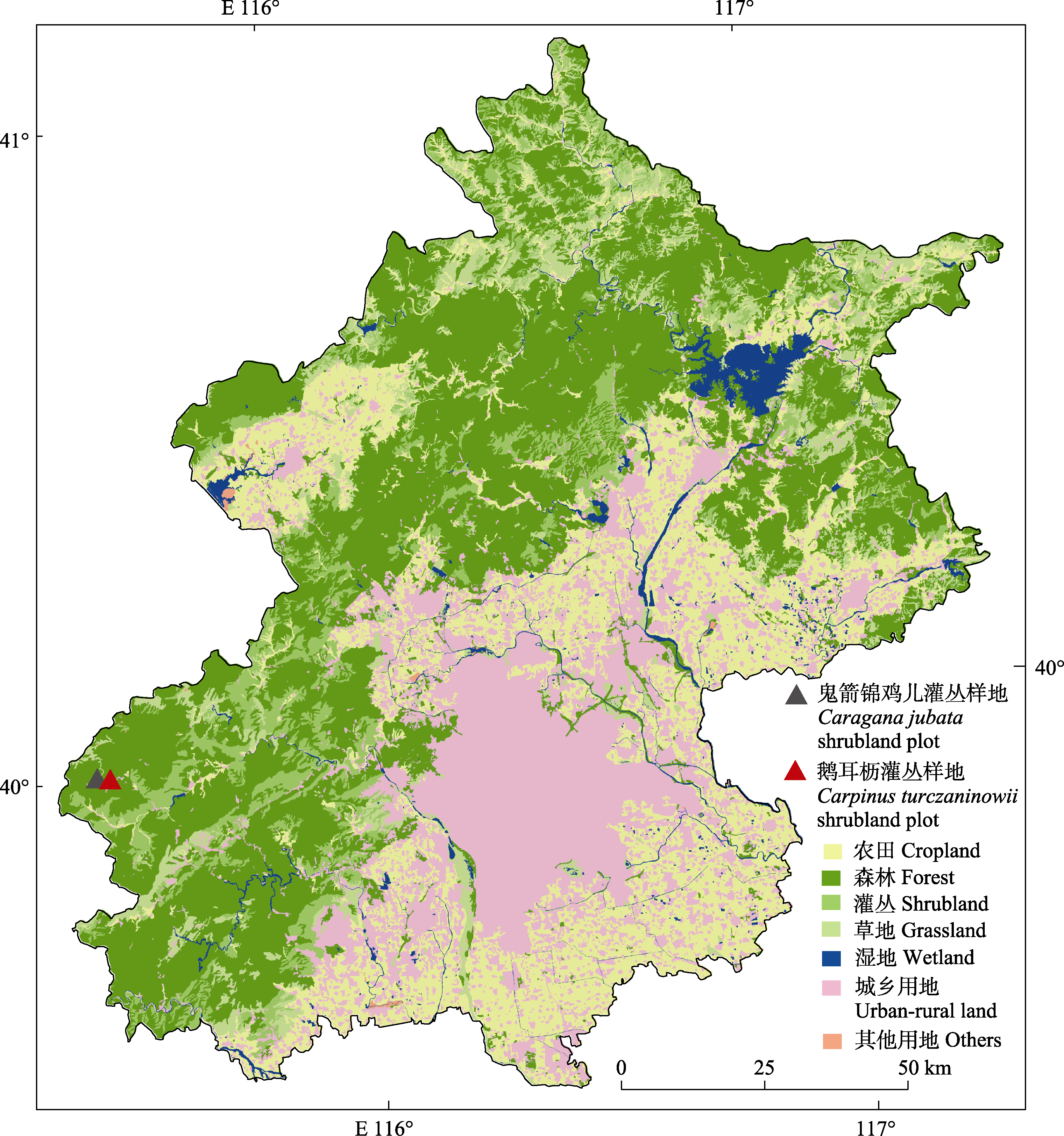
Fig. 1 Vegetation distribution map of Beijing and sampling location.
| 项目 Item | 鬼箭锦鸡儿灌丛 Caragana jubata shrubland | 鹅耳枥灌丛 Carpinus turczaninowii shrubland |
|---|---|---|
| 地形特征 Topography character | ||
| 海拔 Altitude (m) | 2 300 | 1 170 |
| 坡向 Aspect | 北坡 North | 北坡 North |
| 坡度 Slope (°) | 9 | 30 |
| 表层土壤养分含量 Topsoil nutrient content | ||
| 总碳含量 Total carbon content (mg·g-1) | 73.86 ± 2.15 | 27.79 ± 2.20 |
| 总氮含量 Total nitrogen content (mg·g-1) | 6.89 ± 0.10 | 2.32 ± 0.30 |
| 总磷含量 Total phosphorous content (mg·g-1) | 0.97 ± 0.04 | 0.42 ± 0.05 |
| 无机氮含量 Inorganic nitrogen content (mg·kg-1) | 18.90 ± 0.22 | 13.15 ± 2.08 |
| 速效磷含量 Available phosphorous content (mg·kg-1) | 1.22 ± 0.09 | 4.62 ± 0.19 |
| 群落特征 Community character | ||
| 灌木高度 Shrub height (cm) | 44.05 ± 7.03 | 382.76 ± 5.74 |
| 平均基径 Average base diameter (cm) | - | 36.28 ± 0.98 |
| 灌木密度 Shrub density (stems·hm-2) | 1.7 × 10⁴ | 1.8 × 10⁴ |
| 灌木层优势种 Dominant species in shrub layer | 鬼箭锦鸡儿 Caragana jubata | 鹅耳枥 Carpinus turczaninowii |
| 草本层优势种 Dominant species of herbaceous layer | 丝柄薹草 Carex filipes var. sparsinux 返顾马先蒿 Pedicularis resupinata 橐吾 Ligularia sibirica | 细叶薹草 Carex duriuscula subsp. stenophylloides |
Table 1 Topography, topsoil nutrients and vegetation characteristics of the experimental sites of Caragana jubata and Carpinus turczaninowii shrublands (mean ± SE, n = 3)
| 项目 Item | 鬼箭锦鸡儿灌丛 Caragana jubata shrubland | 鹅耳枥灌丛 Carpinus turczaninowii shrubland |
|---|---|---|
| 地形特征 Topography character | ||
| 海拔 Altitude (m) | 2 300 | 1 170 |
| 坡向 Aspect | 北坡 North | 北坡 North |
| 坡度 Slope (°) | 9 | 30 |
| 表层土壤养分含量 Topsoil nutrient content | ||
| 总碳含量 Total carbon content (mg·g-1) | 73.86 ± 2.15 | 27.79 ± 2.20 |
| 总氮含量 Total nitrogen content (mg·g-1) | 6.89 ± 0.10 | 2.32 ± 0.30 |
| 总磷含量 Total phosphorous content (mg·g-1) | 0.97 ± 0.04 | 0.42 ± 0.05 |
| 无机氮含量 Inorganic nitrogen content (mg·kg-1) | 18.90 ± 0.22 | 13.15 ± 2.08 |
| 速效磷含量 Available phosphorous content (mg·kg-1) | 1.22 ± 0.09 | 4.62 ± 0.19 |
| 群落特征 Community character | ||
| 灌木高度 Shrub height (cm) | 44.05 ± 7.03 | 382.76 ± 5.74 |
| 平均基径 Average base diameter (cm) | - | 36.28 ± 0.98 |
| 灌木密度 Shrub density (stems·hm-2) | 1.7 × 10⁴ | 1.8 × 10⁴ |
| 灌木层优势种 Dominant species in shrub layer | 鬼箭锦鸡儿 Caragana jubata | 鹅耳枥 Carpinus turczaninowii |
| 草本层优势种 Dominant species of herbaceous layer | 丝柄薹草 Carex filipes var. sparsinux 返顾马先蒿 Pedicularis resupinata 橐吾 Ligularia sibirica | 细叶薹草 Carex duriuscula subsp. stenophylloides |
| 物种 Species | 器官 Organ | 方程 Equation | 变量 Variable | a | b | R2 | F | p |
|---|---|---|---|---|---|---|---|---|
| 鬼箭锦鸡儿 Caragana jubata | 根 Root | y = axb | Ac | 0.000 2 | 1.493 7 | 0.89 | 100.51 | <0.000 1 |
| 茎 Stem | y = ax + b | Ac | 0.030 0 | 1.808 2 | 0.95 | 254.07 | <0.000 1 | |
| 叶 Leaf | y = ax + b | Ac | 0.005 8 | 2.116 8 | 0.95 | 260.62 | <0.000 1 | |
| 整体 Total | y = axb | Ac | 0.016 | 1.141 6 | 0.95 | 257.80 | <0.000 1 | |
| 鹅耳枥 Carpinus turczaninowii | 根 Root | y = axb | (BD)2H | 0.070 | 1.02 | 0.99 | 970.63 | <0.000 1 |
| 茎 Stem | y = axb | (BD)2H | 0.050 | 1.14 | 0.99 | 965.96 | <0.000 1 | |
| 叶 Leaf | y = axb | (BD)2H | 0.009 | 1.09 | 0.98 | 724.70 | <0.000 1 | |
| 整体 Total | y = axb | (BD)2H | 0.110 | 1.11 | 0.99 | 1 369.18 | <0.000 1 | |
| 山葡萄 Vitis amurensis | 根 Root | y = axb | (BD)2H | 0.29 | 0.87 | 0.76 | 33.94 | 0.000 1 |
| 茎 Stem | y = axb | (BD)2H | 0.52 | 0.92 | 0.52 | 13.11 | 0.004 | |
| 叶 Leaf | y = axb | (BD)2H | 1.31 | 0.71 | 0.27 | 3.98 | 0.07 | |
| 整体 Total | y = axb | (BD)2H | 1.99 | 0.82 | 0.47 | 9.63 | 0.01 | |
| 照山白 Rhododendron micranthum | 根 Root | y = axb | (BD)2H | 0.40 | 0.90 | 0.60 | 40.80 | <0.000 1 |
| 茎 Stem | y = axb | (BD)2H | 0.07 | 1.24 | 0.89 | 217.52 | <0.000 1 | |
| 叶 Leaf | y = axb | (BD)2H | 0.09 | 0.81 | 0.54 | 31.63 | <0.000 1 | |
| 整体 Total | y = axb | (BD)2H | 0.37 | 1.07 | 0.82 | 126.64 | <0.000 1 | |
| 小花溲疏 Deutzia parviflora | 根 Root | y = axb | (BD)2H | 0.19 | 0.98 | 0.74 | 62.55 | <0.000 1 |
| 茎 Stem | y = axb | (BD)2H | 0.30 | 1.04 | 0.93 | 303.82 | <0.000 1 | |
| 叶 Leaf | y = axb | (BD)2H | 0.54 | 0.71 | 0.62 | 35.54 | <0.000 1 | |
| 整体 Total | y = axb | (BD)2H | 0.79 | 0.97 | 0.94 | 322.34 | <0.000 1 | |
| 暴马丁香 Syringa reticulata | 根 Root | y = axb | (BD)2H | 0.10 | 1.08 | 0.81 | 117.10 | <0.000 1 |
| 茎 Stem | y = axb | (BD)2H | 0.33 | 1.02 | 0.92 | 311.34 | <0.000 1 | |
| 叶 Leaf | y = axb | (BD)2H | 0.43 | 0.75 | 0.80 | 114.20 | <0.000 1 | |
| 整体 Total | y = axb | (BD)2H | 0.71 | 0.98 | 0.92 | 324.16 | <0.000 1 | |
| 六道木 Abelia biflora | 根 Root | y = axb | (BD)2H | 0.26 | 0.93 | 0.97 | 345.81 | <0.000 1 |
| 茎 Stem | y = axb | (BD)2H | 0.32 | 0.98 | 0.97 | 364.20 | <0.000 1 | |
| 叶 Leaf | y = axb | (BD)2H | 0.56 | 0.59 | 0.82 | 44.26 | <0.000 1 | |
| 整体 Total | y = axb | (BD)2H | 0.74 | 0.94 | 0.98 | 428.95 | <0.000 1 | |
| 大叶白蜡 Fraxinus rhynchophylla | 根 Root | y = axb | (BD)2H | 10.956 0 | 0.538 | 0.89 | 50.43 | 0.005 7 |
| 茎 Stem | y = axb | (BD)2H | 0.236 7 | 0.995 | 0.99 | 2 227.54 | <0.000 1 | |
| 叶 Leaf | y = axb | (BD)2H | 0.000 7 | 1.353 | 0.98 | 388.54 | 0.000 3 | |
| 整体 Total | y = axb | (BD)2H | 2.490 4 | 0.805 | 0.98 | 414.18 | 0.000 3 |
Table 2 Biomass allometric models for eight common shrub species in Dongling Mountain
| 物种 Species | 器官 Organ | 方程 Equation | 变量 Variable | a | b | R2 | F | p |
|---|---|---|---|---|---|---|---|---|
| 鬼箭锦鸡儿 Caragana jubata | 根 Root | y = axb | Ac | 0.000 2 | 1.493 7 | 0.89 | 100.51 | <0.000 1 |
| 茎 Stem | y = ax + b | Ac | 0.030 0 | 1.808 2 | 0.95 | 254.07 | <0.000 1 | |
| 叶 Leaf | y = ax + b | Ac | 0.005 8 | 2.116 8 | 0.95 | 260.62 | <0.000 1 | |
| 整体 Total | y = axb | Ac | 0.016 | 1.141 6 | 0.95 | 257.80 | <0.000 1 | |
| 鹅耳枥 Carpinus turczaninowii | 根 Root | y = axb | (BD)2H | 0.070 | 1.02 | 0.99 | 970.63 | <0.000 1 |
| 茎 Stem | y = axb | (BD)2H | 0.050 | 1.14 | 0.99 | 965.96 | <0.000 1 | |
| 叶 Leaf | y = axb | (BD)2H | 0.009 | 1.09 | 0.98 | 724.70 | <0.000 1 | |
| 整体 Total | y = axb | (BD)2H | 0.110 | 1.11 | 0.99 | 1 369.18 | <0.000 1 | |
| 山葡萄 Vitis amurensis | 根 Root | y = axb | (BD)2H | 0.29 | 0.87 | 0.76 | 33.94 | 0.000 1 |
| 茎 Stem | y = axb | (BD)2H | 0.52 | 0.92 | 0.52 | 13.11 | 0.004 | |
| 叶 Leaf | y = axb | (BD)2H | 1.31 | 0.71 | 0.27 | 3.98 | 0.07 | |
| 整体 Total | y = axb | (BD)2H | 1.99 | 0.82 | 0.47 | 9.63 | 0.01 | |
| 照山白 Rhododendron micranthum | 根 Root | y = axb | (BD)2H | 0.40 | 0.90 | 0.60 | 40.80 | <0.000 1 |
| 茎 Stem | y = axb | (BD)2H | 0.07 | 1.24 | 0.89 | 217.52 | <0.000 1 | |
| 叶 Leaf | y = axb | (BD)2H | 0.09 | 0.81 | 0.54 | 31.63 | <0.000 1 | |
| 整体 Total | y = axb | (BD)2H | 0.37 | 1.07 | 0.82 | 126.64 | <0.000 1 | |
| 小花溲疏 Deutzia parviflora | 根 Root | y = axb | (BD)2H | 0.19 | 0.98 | 0.74 | 62.55 | <0.000 1 |
| 茎 Stem | y = axb | (BD)2H | 0.30 | 1.04 | 0.93 | 303.82 | <0.000 1 | |
| 叶 Leaf | y = axb | (BD)2H | 0.54 | 0.71 | 0.62 | 35.54 | <0.000 1 | |
| 整体 Total | y = axb | (BD)2H | 0.79 | 0.97 | 0.94 | 322.34 | <0.000 1 | |
| 暴马丁香 Syringa reticulata | 根 Root | y = axb | (BD)2H | 0.10 | 1.08 | 0.81 | 117.10 | <0.000 1 |
| 茎 Stem | y = axb | (BD)2H | 0.33 | 1.02 | 0.92 | 311.34 | <0.000 1 | |
| 叶 Leaf | y = axb | (BD)2H | 0.43 | 0.75 | 0.80 | 114.20 | <0.000 1 | |
| 整体 Total | y = axb | (BD)2H | 0.71 | 0.98 | 0.92 | 324.16 | <0.000 1 | |
| 六道木 Abelia biflora | 根 Root | y = axb | (BD)2H | 0.26 | 0.93 | 0.97 | 345.81 | <0.000 1 |
| 茎 Stem | y = axb | (BD)2H | 0.32 | 0.98 | 0.97 | 364.20 | <0.000 1 | |
| 叶 Leaf | y = axb | (BD)2H | 0.56 | 0.59 | 0.82 | 44.26 | <0.000 1 | |
| 整体 Total | y = axb | (BD)2H | 0.74 | 0.94 | 0.98 | 428.95 | <0.000 1 | |
| 大叶白蜡 Fraxinus rhynchophylla | 根 Root | y = axb | (BD)2H | 10.956 0 | 0.538 | 0.89 | 50.43 | 0.005 7 |
| 茎 Stem | y = axb | (BD)2H | 0.236 7 | 0.995 | 0.99 | 2 227.54 | <0.000 1 | |
| 叶 Leaf | y = axb | (BD)2H | 0.000 7 | 1.353 | 0.98 | 388.54 | 0.000 3 | |
| 整体 Total | y = axb | (BD)2H | 2.490 4 | 0.805 | 0.98 | 414.18 | 0.000 3 |
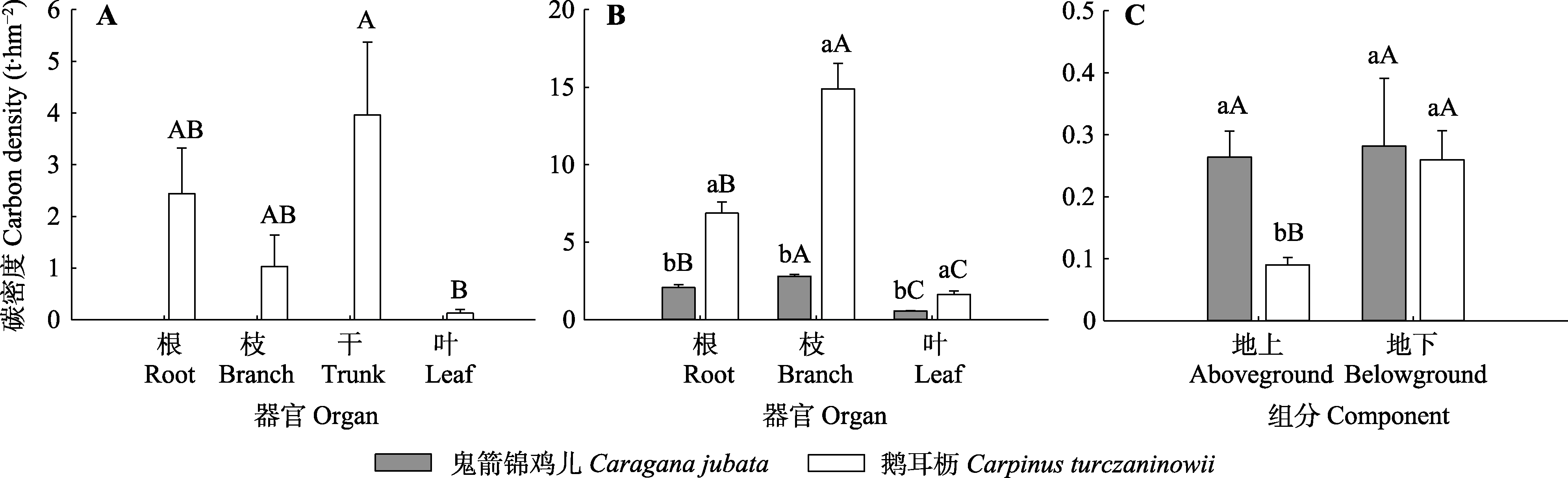
Fig. 2 Carbon density of various organs in the tree layer (A), shrub layer (B), and herb layer (C) of Caragana jubata and Carpinus turczaninowii shrublands (mean ± SE). Different lowercase letters on the bar chart indicate significant differences in the same component among different communities (p < 0.05), while different uppercase letters indicate significant differences among different components within the same community (p < 0.05).
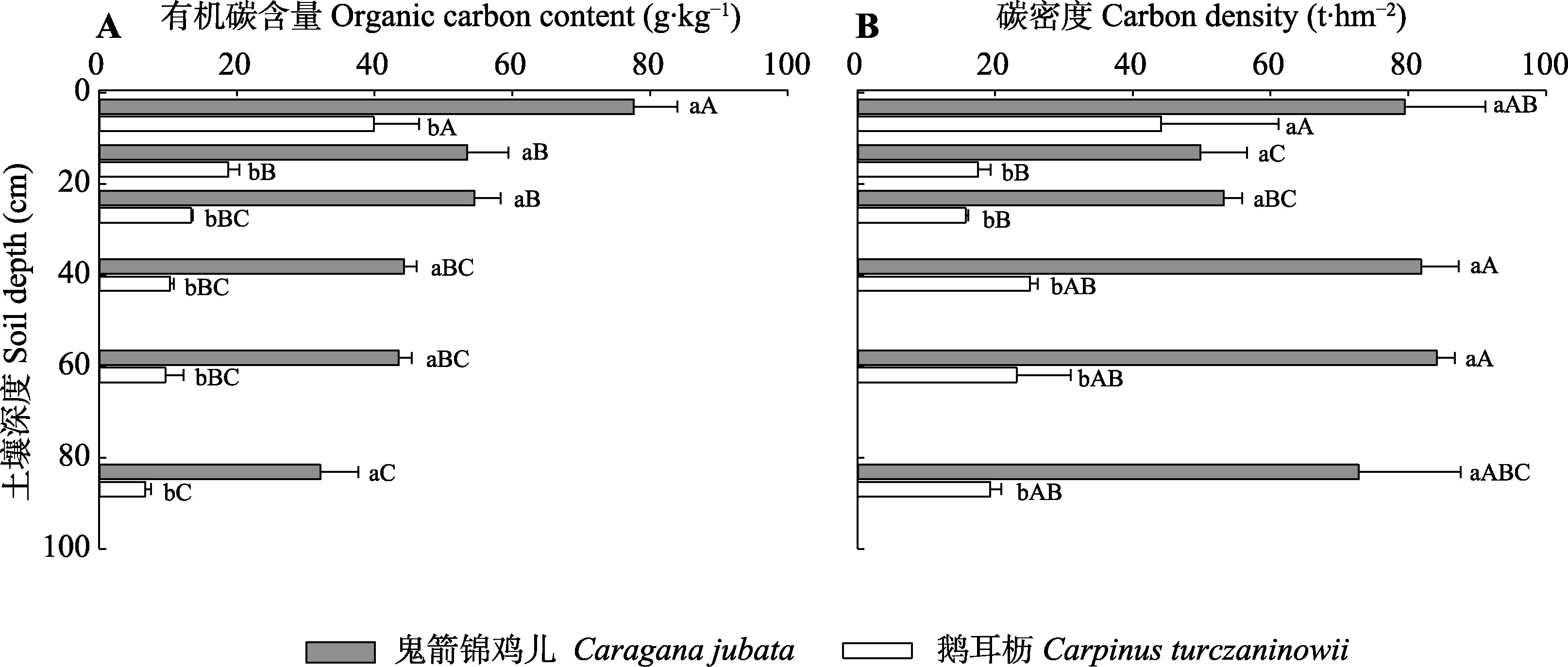
Fig. 3 Vertical distribution characteristics of soil organic carbon content (A) and carbon density (B) of Caragana jubata and Carpinus turczaninowii shrublands (mean ± SE). Different lowercase letters on the bar chart indicate significant differences in the same depth among different communities (p < 0.05), while different uppercase indicate significant differences among different depth within the same community (p < 0.05).
| 组分 Component | 鬼箭锦鸡儿灌丛 Caragana jubata shrubland | 鹅耳枥灌丛 Carpinus turczaninowii shrubland | ||
|---|---|---|---|---|
| 碳密度 Carbon density (t·hm-2) | 比例 Proportion (%) | 碳密度 Carbon density (t·hm-2) | 比例 Proportion (%) | |
| 乔木层 Overstory layer | - | - | 7.57 ± 3.25 | 4.23 |
| 灌木层 Shrub layer | 5.44 ± 0.33b | 1.27 | 24.12 ± 2.58a | 13.54 |
| 草本层 Herb layer | 0.55 ± 0.10a | 0.13 | 0.35 ± 0.06b | 0.20 |
| 凋落物层 Litterfall layer | 0.31 ± 0.03b | 0.07 | 1.27 ± 0.34a | 0.71 |
| 土壤层 Soil layer | 421.29 ± 21.50a | 98.53 | 144.89 ± 7.54b | 81.31 |
| 总计 Total | 427.59a | 100.00 | 178.19b | 100.00 |
Table 3 Carbon density and distribution proportion of Caragana jubata and Carpinus turczaninowii shrublands (mean ± SE)
| 组分 Component | 鬼箭锦鸡儿灌丛 Caragana jubata shrubland | 鹅耳枥灌丛 Carpinus turczaninowii shrubland | ||
|---|---|---|---|---|
| 碳密度 Carbon density (t·hm-2) | 比例 Proportion (%) | 碳密度 Carbon density (t·hm-2) | 比例 Proportion (%) | |
| 乔木层 Overstory layer | - | - | 7.57 ± 3.25 | 4.23 |
| 灌木层 Shrub layer | 5.44 ± 0.33b | 1.27 | 24.12 ± 2.58a | 13.54 |
| 草本层 Herb layer | 0.55 ± 0.10a | 0.13 | 0.35 ± 0.06b | 0.20 |
| 凋落物层 Litterfall layer | 0.31 ± 0.03b | 0.07 | 1.27 ± 0.34a | 0.71 |
| 土壤层 Soil layer | 421.29 ± 21.50a | 98.53 | 144.89 ± 7.54b | 81.31 |
| 总计 Total | 427.59a | 100.00 | 178.19b | 100.00 |
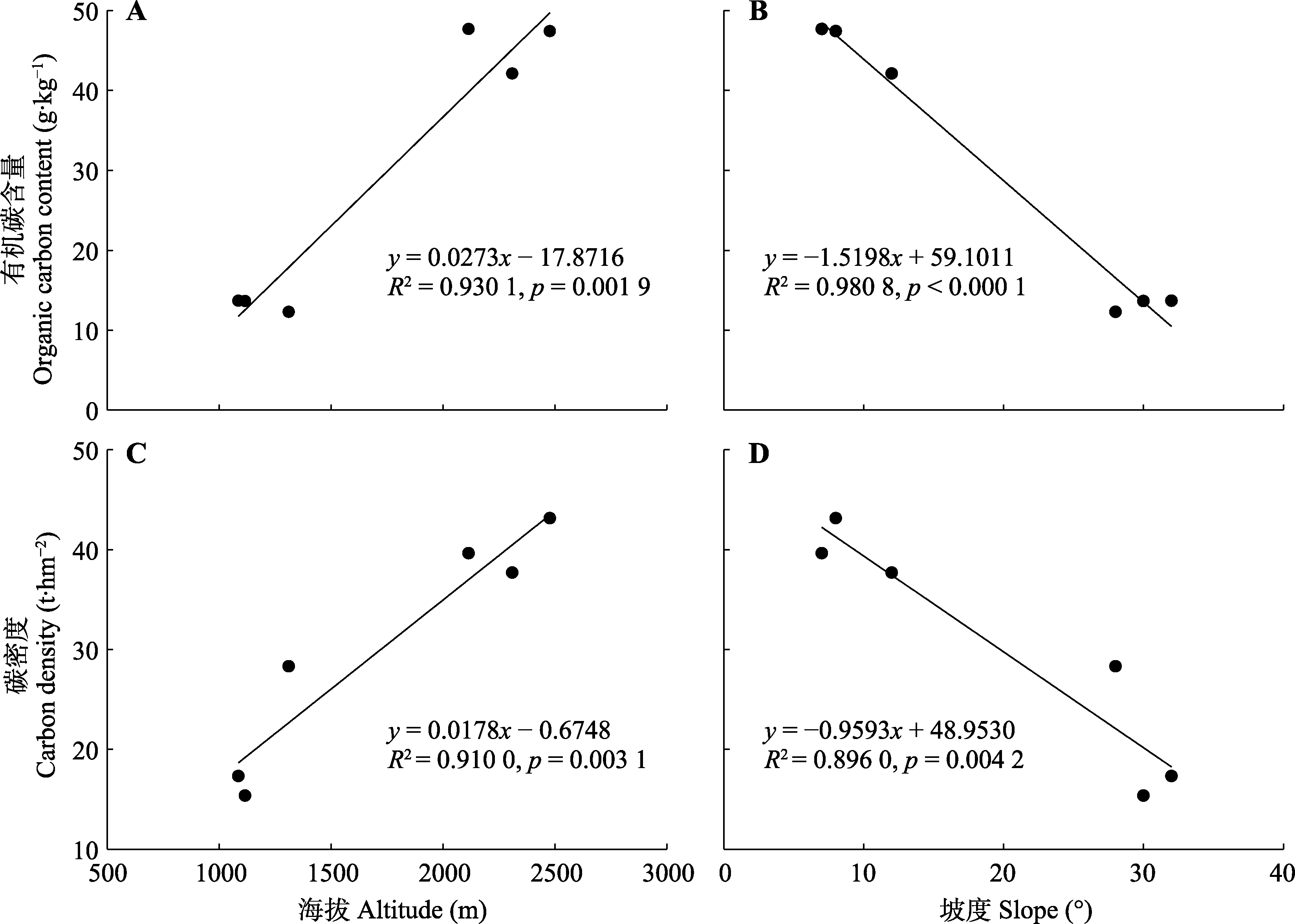
Fig. 4 Correlation between altitude, slope and soil organic carbon content, soil carbon density of Caragana jubata and Carpinus turczaninowii shrublands.
| [1] | Bray JR, Gorham E (1964). Litter production in forests of the world. Advances in Ecological Research, 2, 101-157. |
| [2] | Chen ZL, Qiang LL, Xiang AM, Tian CC, Pang JZ, Dang KL (2022). Effects of topographical factors on the spatial distribution of soil organic carbon of Juniperus przewalskii forest in Qinghai Province. Journal of Northwest Forest University, 37(6), 68-74. |
| [陈志林, 强浪浪, 向安民, 田翠翠, 庞军柱, 党坤良 (2022). 地形因子对青海祁连圆柏林土壤有机碳空间分布的影响. 西北林学院学报, 37(6), 68-74.] | |
| [3] |
Dang XH, Gao Y, Meng ZJ, Gao JL, Ding YL, Wang ZY (2018). Carbon density in dominant desert shrub species ecosystem in west Ordos Region. Journal of Desert Research, 38, 352-362.
DOI |
|
[党晓宏, 高永, 蒙仲举, 高君亮, 丁延龙, 王祯仪 (2018). 西鄂尔多斯荒漠灌丛生态系统碳密度. 中国沙漠, 38, 352-362.]
DOI |
|
| [4] | Fang JY, Guo ZD, Piao SL, Chen AP (2007). Biomass and net production of forest vegetation in China. Science in China (Series D: Earth Sciences), 37, 804-812. |
| [方精云, 郭兆迪, 朴世龙, 陈安平 (2007). 1981-2000年中国陆地植被碳汇的估算. 中国科学(D辑: 地球科学), 37, 804-812.] | |
| [5] | Fang JY, Liu GH, Zhu B, Wang XK, Liu SH (2006). Carbon cycle of three temperate forest ecosystems in Dongling Mountain, Beijing. Science in China (Series D: Earth Sciences), 36, 533-543. |
| [方精云, 刘国华, 朱彪, 王效科, 刘绍辉 (2006). 北京东灵山三种温带森林生态系统的碳循环. 中国科学(D辑: 地球科学), 36, 533-543.] | |
| [6] |
Gao Q, Yang XC, Yin CY, Liu Q (2014). Estimation of biomass allocation and carbon density in alpine dwarf shrubs in Garzê Zangzu Autonomous Prefecture of Sichuan Province, China. Chinese Journal of Plant Ecology, 38, 355-365.
DOI URL |
|
[高巧, 阳小成, 尹春英, 刘庆 (2014). 四川省甘孜藏族自治州高寒矮灌丛生物量分配及其碳密度的估算. 植物生态学报, 38, 355-365.]
DOI |
|
| [7] |
Guo YP, Gheyret G, Liu TY, Zhang YW, Kang MY, Anwar M, Liu HY, Ma WH, Wang RQ, Yu SL, Yue M, Zhang F, Tang ZY (2021). Distribution patterns and climate limitations of typical shrublands in northern China. Scientia Sinica Vitae, 51, 346-361.
DOI URL |
| [郭焱培,艾尤尔·亥热提, 刘同彦, 张艺伟, 康慕谊, 安尼瓦尔·买买提, 刘鸿雁, 马文红, 王仁卿, 于顺利, 岳明, 张峰, 唐志尧 (2021). 中国北方典型灌丛的分布特征及气候限制. 中国科学: 生命科学, 51, 346-361.] | |
| [8] |
Guo YP, Yang X, Anwar M, Liu HY, Ma WH, Yu SL, Tang ZY (2017). Storage of carbon, nitrogen and phosphorus in temperate shrubland ecosystems across Northern China. Chinese Journal of Plant Ecology, 41, 14-21.
DOI |
|
[郭焱培, 杨弦,安尼瓦尔·买买提, 刘鸿雁, 马文红, 于顺利, 唐志尧 (2017). 中国北方温带灌丛生态系统碳、氮、磷储量. 植物生态学报, 41, 14-21.]
DOI |
|
| [9] | Jiang H, Huang JH, Chen LZ, Yang CY, Yang XQ (1994). DCA ordination quantitative classification and environmental interpretation of plant communities in Donging Mountain. Acta Botanica Sinica, 36, 539-551. |
| [江洪, 黄建辉, 陈灵芝, 杨朝阳, 杨小秋 (1994). 东灵山植物群落的排序、数量分类与环境解释. 植物学报, 36, 539-551.] | |
| [10] | Li J (2008). Study on the Storage Pattern of Soil Organic Carbon and Its Influencing Factors Under Main Forest Communities in China. Master degree dissertation, Sichuan Agricultural University, Yaan, Sichuan. |
| [李江 (2008). 中国主要森林群落林下土壤有机碳储量格局及其影响因子研究. 硕士学位论文, 四川农业大学, 四川雅安.] | |
| [11] | Li L, Yao YF, Qin FC, Zhang ML, Gao YH (2016). Distribution characteristics of soil organic carbon density of different forests in Huanghuadianzi watershed. Journal of Northwest A&F University (Natural Science Edition), 44(2), 77-82. |
| [李龙, 姚云峰, 秦富仓, 张美丽, 高玉寒 (2016). 黄花甸子流域人工林土壤有机碳密度分布特征. 西北农林科技大学学报(自然科学版), 44(2), 77-82.] | |
| [12] | Li YN, Yu XF, Xu ZQ, Liu LL, Yao WX, Wang L (2014). Carbon density characteristics of two typical shrub communities in the northern mountain region of Hebei. Scientia Silvae Sinicae, 50(6), 28-33. |
| [李亚男, 虞晓凡, 许中旗, 刘乐乐, 姚卫星, 王丽 (2014). 冀北山地2种典型灌丛的碳密度特征. 林业科学, 50(6), 28-33.] | |
| [13] | Li YY, Xu TT, Ai Z, Wei LL, Ma F (2023). Diversity and predictive functional of Caragana jubata bacterial community in rhizosphere and non-rhizosphere soil at different altitudes. Environmental Science, 44, 2304-2314. |
| [李媛媛, 徐婷婷, 艾喆, 魏庐潞, 马飞 (2023). 不同海拔鬼箭锦鸡儿根际和非根际土壤细菌群落多样性及PICRUSt功能预测. 环境科学, 44, 2304-2314.] | |
| [14] | Lian M, Tie J (2020). Phylogenetic structure characteristics of Carpinus turczaninowii community in Taxus chinensis Nature Reserve in Lingchuan, Shanxi Province. Acta Ecologica Sinica, 40, 2267-2276. |
| [廉敏, 铁军 (2020). 山西陵川南方红豆杉自然保护区鹅耳枥植物群落谱系结构特征. 生态学报, 40, 2267-2276.] | |
| [15] | Liang QP, Yu XX, Pang Z, Wang C, Lü XZ (2010). Study on soil organic carbon density of different forest types. Ecology and Environmental Sciences, 19, 889-893. |
|
[梁启鹏, 余新晓, 庞卓, 王琛, 吕锡芝 (2010). 不同林分土壤有机碳密度研究. 生态环境学报, 19, 889-893.]
DOI |
|
| [16] | Lieth H, Whittaker RH (1975). Primary Productivity of the Biosphere. Springer-Verlag, New York. |
| [17] | Liu H, Dong L, Ajier A, Li PJ, Jia RQ, Wang WY (2015). Value of carbon sequestration of Tamarix in the midstream of the Tarim River. Acta Agriculturae Universitatis Jiangxiensis, 37, 484-489. |
| [刘华, 董玲,艾吉尔·阿不拉, 李丕军, 贾瑞琪, 王文月 (2015). 塔里木河中游柽柳灌丛碳储量及其价值评估. 江西农业大学学报, 37, 484-489.] | |
| [18] | Liu HY, Cui HT, Zhang JH, Xiang GL (1998). Influence of tourism development on subalpine meadow in Dongling Mountain. Chinese Journal of Ecology, 17(3), 63-66. |
| [刘鸿雁, 崔海亭, 张金海, 向国良 (1998). 旅游开发对东灵山亚高山草甸的影响. 生态学杂志, 17(3), 63-66.] | |
| [19] | Liu T, Dang XH, Liu GB, Liu BJ, Shao CK (2013). Comparison of carbon densities of three shrub plantation ecosystems in Hilly Loess Plateau. Journal of Northwest A & F University (Natural Science Edition), 41(9), 68-72. |
| [刘涛, 党小虎, 刘国彬, 刘宝军, 邵传可 (2013). 黄土丘陵区3种退耕灌木林生态系统碳密度的对比研究. 西北农林科技大学学报(自然科学版), 41(9), 68-72.] | |
| [20] | Liu XZ, Wang GA, Li JZ, Wang Q (2009). Nitrogen isotopic composition of modern plants in Dongling Mountain area of Beijing and its response to altitude gradient. Science in China (Series D: Earth Sciences), 39, 1347-1359. |
| [刘贤赵, 王国安, 李嘉竹, 王庆 (2009). 北京东灵山地区现代植物氮同位素组成及其对海拔梯度的响应. 中国科学(D辑: 地球科学), 39, 1347-1359.] | |
| [21] | Liu Y, Zha TG, Fu RJ (2012). Soil organic carbon storage and vertical distribution of different forest types in Baihua Mountain area. Acta Agriculturae Boreali-occidentalis Sinica, 21(3), 182-187. |
| [刘艳, 查同刚, 付汝军 (2012). 百花山典型林分土壤有机碳储量及垂直分布特征. 西北农业学报, 21(3), 182-187.] | |
| [22] | Liu YY, Sheng QQ, He WY, Ye SY, Li JW, Zhou SC (2021). Advances in physiology and ecology of Carpinus L. Chinese Wild Plant Resources, 40(4), 65-69. |
| [刘宇阳, 圣倩倩, 何文妍, 叶舜尧, 李佳蔚, 周思聪 (2021). 鹅耳枥属植物生理生态学研究进展. 中国野生植物资源, 40(4), 65-69.] | |
| [23] | Ma J, Jin M, Jing WM, Wang SL, Zhao WJ, Wang RX, Ren XF, Zhao JZ, Hu HL (2020). Study on soil organic carbon density of typical vegetation in middle Qilian Mountains. Journal of Central South University of Forestry & Technology, 40(8), 99-105. |
| [马剑, 金铭, 敬文茂, 王顺利, 赵维俊, 王荣新, 任小凤, 赵晶忠, 呼海林 (2020). 祁连山中段典型植被土壤有机碳密度研究. 中南林业科技大学学报, 40(8), 99-105.] | |
| [24] | Ma KP, Chen LZ, Yu SL, Huang JH, Gao XM, Liu CR (1994). Studies on plant community diversity in Dongling Mountain, Beijing I. Classification and a brief description// Advances in Biodiversity Research: Proceeding of the First National Symposium on the Conservation and Sustainable Use of Biodiversity. China Science and Technology Press, Beijing. 318-334. |
| [马克平, 陈灵芝, 于顺利, 黄建辉, 高贤明, 刘灿然 (1994). 北京东灵山地区植物群落多样性的研究I. 植物群落的基本类型// 生物多样性研究进展: 首届全国生物多样性保护与持续利用研讨会论文集. 中国科学技术出版社, 北京. 318-334.] | |
| [25] | Ministry of Environmental Protection of the People’s Republic of China, Chinese Academy of Science (2015). National Ecological Function Zoning (Revised Version). [2015-01-13]. https://www.mee.gov.cn/gkml/hbb/bgg/201511/t20151126_317777.htm. |
| [中华人民共和国环境保护部, 中国科学院 (2015). 全国生态功能区划(修编版). [2015-01-13]. https://www.mee.gov.cn/gkml/hbb/bgg/201511/t20151126_317777.htm.] | |
| [26] | Montané F, Rovira P, Casals P (2007). Shrub encroachment into mesic mountain grasslands in the Iberian Peninsula: effects of plant quality and temperature on soil C and N stocks. Global Biogeochemical Cycles, 21, 2006GB002853. DOI: 10.1029/2006GB002853. |
| [27] | Piao SL, Fang JY, Huang Y (2010). The carbon balance of terrestrial ecosystems in China. China Basic Science, 12(2), 20-22. |
| [朴世龙, 方精云, 黄耀 (2010). 中国陆地生态系统碳收支. 中国基础科学, 12(2), 20-22.] | |
| [28] | Qi G, Du XJ, Gao XM, Liu YG, Jiao ZH, Chen LP, Ye JW (2019). The carbon pool and its distribution pattern of typical forest vegetation in Baotianman. Jiangsu Agricultural Sciences, 47(13), 158-163. |
| [齐光, 杜晓军, 高贤明, 刘永刚, 焦志华, 程立平, 叶继旺 (2019). 宝天曼典型森林植被碳库及其分配格局. 江苏农业科学, 47(13), 158-163.] | |
| [29] |
Schlze ED, Freibauer A (2005). Environmental science: carbon unlocked from soils. Nature, 437, 205-206.
DOI |
| [30] | Shu JJ, Chen QB, Chang YS, Zhao JX, Huang B (2015). Soil organic carbon density of Pinus armandii plantation and related affecting factors. Journal of Arid Land Resources and Environment, 29(8), 110-114. |
| [舒蛟靖, 陈奇伯, 常玉山, 赵吉霞, 黄北 (2015). 华山松人工林土壤碳密度及其影响因子. 干旱区资源与环境, 29(8), 110-114.] | |
| [31] | Shu Y, Zhou M, Zhao PW, Ge P, Zhang B, Wang ZX, Zhao W (2017). Distribution of plantation soil carbon density in Larix gmelinii forest. Journal of Northwest A&F University (Natural Science Edition), 45(6), 44-52. |
| [舒洋, 周梅, 赵鹏武, 葛鹏, 张波, 王梓璇, 赵威 (2017). 兴安落叶松人工林土壤碳密度分布特征研究. 西北农林科技大学学报(自然科学版), 45(6), 44-52.] | |
| [32] | Song P, Li CR, Yu J (2008). Determination of the total flavonoid content in the Tibetan patent Caragana jubata (Pall.) Poir by spectrophotometry. Lishizhen Medicine and Materia Medica Research, 19, 2076-2077. |
| [宋萍, 李存仁, 于军 (2008). 分光光度法测定藏药鬼箭锦鸡儿中总黄酮的含量. 时珍国医国药, 19, 2076-2077.] | |
| [33] | Song P, Li XJ, Jia YY (2011). Chemical constituents of Caragana jubata (Pall.) Poir. Chinese Traditional Patent Medicine, 33, 1934-1936. |
| [宋萍, 李小娟, 贾岩岩 (2011). 鬼箭锦鸡儿化学成分的研究. 中成药, 33, 1934-1936.] | |
| [34] |
Sturm M, Racine C, Tape K (2001). Increasing shrub abundance in the Arctic. Nature, 411, 546-547.
DOI |
| [35] | Sun HL, Li WH, Yang YH, Yang YH (2012). Soil organic carbon changing with altitudes on the Ili Mountainous region. Scientia Geographica Sinica, 32, 603-608. |
|
[孙慧兰, 李卫红, 杨余辉, 杨玉海 (2012). 伊犁山地不同海拔土壤有机碳的分布. 地理科学, 32, 603-608.]
DOI |
|
| [36] |
Vourlitis GL, Zorba G, Pasquini SC, Mustard R (2007). Carbon and nitrogen storage in soil and litter of southern Californian semi-arid shrublands. Journal of Arid Environments, 70, 164-173.
DOI PMID |
| [37] | Wang N, Wang BT, Wang RJ, Cao XY, Wang WJ, Chi L (2013). Study on soil carbon density under some main forest types in the central part of Shanxi Province. Chinese Journal of Soil Science, 44, 858-862. |
| [王宁, 王百田, 王瑞君, 曹晓阳, 王文静, 迟璐 (2013). 山西中部主要森林植被类型土壤碳密度研究. 土壤通报, 44, 858-862.] | |
| [38] | Wang X, Yang DG, Xiong HG, Liu YY, Anwar M (2017). Carbon storage characteristics of four different Tamarix L. shrubs in the arid land of Xinjiang. Acta Ecologica Sinica, 37, 4384-4391. |
| [王鑫, 杨德刚, 熊黑钢, 柳妍妍, 安尼瓦尔·买买提 (2017). 新疆干旱区4种柽柳灌丛碳贮量特征. 生态学报, 37, 4384-4391.] | |
| [39] | Xie ZQ, Tang ZY (2017). Studies on carbon storage of shrubland ecosystems in China. Chinese Journal of Plant Ecology, 41, 1-4. |
|
[谢宗强, 唐志尧 (2017). 中国灌丛生态系统碳储量的研究. 植物生态学报, 41, 1-4.]
DOI |
|
| [40] | Xie ZQ, Tang ZY, Liu Q, Xu WT (2019). Study on Carbon Budget of Shrub Ecosystems in China. Science Press, Beijing. |
| [谢宗强, 唐志尧, 刘庆, 徐文婷 (2019). 中国灌丛生态系统碳收支研究. 科学出版社, 北京.] | |
| [41] | Yang LC, Li CB, Ning Y, Nie XQ, Xu WH, Zhou GY (2017). Carbon density and its spatial distribution in the Potentilla fruticosa dominated alpine shrub in Qinghai, China. Chinese Journal of Plant Ecology, 41, 62-70. |
|
[杨路存, 李长斌, 宁祎, 聂秀青, 徐文华, 周国英 (2017). 青海高寒金露梅灌丛碳密度及其分配格局. 植物生态学报, 41, 62-70.]
DOI |
|
| [42] | Yu WT, Ma Q, Zhao X, Zhou H, Li JD (2007). Changes of soil active organic carbon pool under different land use types. Chinese Journal of Ecology, 26, 2013-2016. |
| [宇万太, 马强, 赵鑫, 周桦, 李建东 (2007). 不同土地利用类型下土壤活性有机碳库的变化. 生态学杂志, 26, 2013-2016.] | |
| [43] | Zhang JH (2014). Effects of Nitrogen Addition on Carbon Cycling in Shrublands in Dongling Mountain. PhD dissertation, University of Chinese Academy of Sciences, Beijing. |
| [张建华 (2014).氮添加对北京东灵山灌丛碳循环的影响. 博士学位论文, 中国科学院大学, 北京.] | |
| [44] | Zhang JH, Tang ZY, Shen HH, Fang JY (2017). Responses of growth and litterfall production to nitrogen addition treatments from common shrublands in Mt. Dongling, Beijing, China. Chinese Journal of Plant Ecology, 41, 71-80. |
|
[张建华, 唐志尧, 沈海花, 方精云 (2017). 北京东灵山地区常见灌丛生长及凋落物生产对氮添加的响应. 植物生态学报, 41, 71-80.]
DOI |
|
| [45] | Zhang L, Zhou GS, Ji YH, Bai YF (2016). Spatiotemporal dynamic simulation of grassland carbon storage in China. Science in China: Earth Sciences, 46, 1946-1958. |
| [张利, 周广胜, 汲玉河, 白永飞 (2016). 中国草地碳储量时空动态模拟研究. 中国科学: 地球科学, 46, 1392-1405.] | |
| [46] | Zhang Q, Cheng B, Yang ZP, Gao CH, Zhang YG, Zhang LZ (2006). Nutritional characteristics of Caragana jubata shrub and distribution patters of soil nutrients in Luya Mountain. Chinese Journal of Applied Ecology, 17, 2287-2291. |
| [张强, 程滨, 杨治平, 郜春花, 张一弓, 张丽珍 (2006). 芦芽山鬼箭锦鸡儿灌丛营养特征及土壤养分分布规律. 应用生态学报, 17, 2287-2291.] | |
| [47] | Zhang Q, Li JX, Xu WT, Xiong GM, Xie ZQ (2017). Estimation of biomass allocation and carbon density of Rhododendron simsii shrubland in the subtropical mountainous areas of China. Chinese Journal of Plant Ecology, 41, 43-52. |
|
[张蔷, 李家湘, 徐文婷, 熊高明, 谢宗强 (2017). 中国亚热带山地杜鹃灌丛生物量分配及其碳密度估算. 植物生态学报, 41, 43-52.]
DOI |
|
| [48] | Zhang XH, Zhang YD, Gu FX, Liu SR (2011). Dynamics of shrubs normalized difference vegetation index and its correlations with climatic factors in Southwest China. Chinese Journal of Ecology, 30, 2577-2583. |
| [张笑鹤, 张远东, 顾峰雪, 刘世荣 (2011). 西南地区灌丛归一化植被指数动态及其与气候因子的相关性. 生态学杂志, 30, 2577-2583.] | |
| [49] | Zhou YR, Yu ZL, Zhao SD (2000). Carbon storage and budget of major Chinese forest types. Acta Phytoecologica Sinica, 24, 518-522. |
| [周玉荣, 于振良, 赵士洞 (2000). 我国主要森林生态系统碳贮量和碳平衡. 植物生态学报, 24, 518-522.] | |
| [50] | Zhu JJ, Dai EF, Zheng D, Wang XL (2016). Carbon density and allocation of forest ecosystems of Moshao forest farm at Huitong National Research Station of Forest Ecosystem. Journal of Natural Resources, 31, 1871-1880. |
|
[朱建佳, 戴尔阜, 郑度, 王晓莉 (2016). 会同森林生态实验站磨哨林场森林碳密度及分配特征. 自然资源学报, 31, 1871-1880.]
DOI |
| [1] | LIU Zhi-Xiang, LI Fenglan, HUANG Xiaolei. The complexity of insect gall ecosystem and advances in gall induction mechanisms [J]. , 2027, 51(动植物互作): 0-. |
| [2] | TAN Qiu-Yan, ZHANG Qing, GAO Cheng, CHU Hai-Yan, YANG Teng. Ectomycorrhizal fungi: key drivers of carbon and nitrogen cycling in alpine ecosystems [J]. Chin J Plant Ecol, 2026, 50(3): 584-599. |
| [3] | MA Jian-Hui, TONG Xin, ZHANG Si-Rong, MAO Zi-Kun, QIN Jun, MA Ke-Ping. Research advances and perspectives on physiological and ecological functions of mycorrhizal fungi [J]. Chin J Plant Ecol, 2026, 50(3): 498-514. |
| [4] | FANG Di, MA Ning, LI Sheng-Gong, ZHENG Jia-Jia, CHU Yun-Xin, YANG Jin-Chang, YANG Zan-Ming, ZHANG Long-Ning, MENG Sheng-Wang, GAO De-Cai, DAI Xiao-Qin, FU Xiao-Li, WANG Hui-Min, KOU Liang. Regulatory role of mycorrhizal types in internal nutrient cycling of forest ecosystems [J]. Chin J Plant Ecol, 2026, 50(3): 552-565. |
| [5] | RAN Jia-Xin, HE Shu-Ting, LUO Su-Ping, WANG Yun, MAO Chao. Global patterns and drivers of soil gross nitrogen transformations of forest ecosystems [J]. Chin J Plant Ecol, 2026, 50(1): 45-54. |
| [6] | ZHANG Lin, CHEN Hua-Yang, HUANG Zhen-Ying. Dataset of plant species composition and community characteristics of long-term observation plots in the Ordos sandy grassland from 2004 to 2010 [J]. Chin J Plant Ecol, 2025, 49(8): 1263-1270. |
| [7] | BAI Fan, WANG Yang. Dataset of plant species composition and community characteristics from a long-term observation plot of warm-temperate deciduous broadleaf forests in Dongling Mountain, Beijing from 2007 to 2015 [J]. Chin J Plant Ecol, 2025, 49(8): 1229-1235. |
| [8] | WANG Li-Long, FENG Jing, SU Na, LIU Xin-Ping, PAN Cheng-Chen, LI Yu-Qiang. Dataset of maize harvest traits and yields from long-term observation plots in typical farmland ecosystems of the Horqin Sandy Land from 2005 to 2015 [J]. Chin J Plant Ecol, 2025, 49(8): 1293-1300. |
| [9] | ZHOU Zhi-Qiong, DING Jian-Lin, LI Xiao-Ming, HE Qi-Hua. Dataset on plant species composition and community characteristics in a long-term observation plot of montane coniferous plantations in southwest China from 2005 to 2010 [J]. Chin J Plant Ecol, 2025, 49(8): 1255-1262. |
| [10] | WANG Peng, LI Xiang-Yi, GAO Yan-Ju, SHABITI Repkat, ZENG Fan-Jiang. Dataset of cotton harvest traits and yield in the oasis farmland ecosystems on the southern margin of Taklimakan Desert from 2005 to 2010 [J]. Chin J Plant Ecol, 2025, 49(8): 1329-1338. |
| [11] | ZHU Xi, HE Zhi-Bin, DU Ming-Wu, ZHAO Li-Wen, WU Dan-Dan. Dataset of crop harvest traits and yields from long-term observation plots of oasis farmland ecosystems in the middle part of Hexi Corridor from 2004 to 2010 [J]. Chin J Plant Ecol, 2025, 49(8): 1312-1320. |
| [12] | FAN Ya-Ran, XIA Shao-Pan, YU Bing-Bing, ZHU Zi-Qi, YANG Wei, FAN Yu-Chuan, LIU Xiao-Yu, ZHANG Xu-Hui, ZHENG Ju-Feng. Effects of elevated atmospheric CO2 concentration and warming on stability of soil organic carbon pool accumulation, molecular composition and structure stability [J]. Chin J Plant Ecol, 2025, 49(7): 1053-1069. |
| [13] | WANG Yao, WANG Yao-Bin, CHEN Zi-Yan, YI Ru-Han, BAI Yong-Fei, ZHAO Yu-Jin, JIN Jing-Wei. Effect of consecutive drought on the resilience and resistance of the grasslands on the Mongolian Plateau [J]. Chin J Plant Ecol, 2025, 49(7): 1070-1081. |
| [14] | XIONG Gao-Ming, SHEN Guo-Zhen, XU Wen-Ting, XIE Zong-Qiang, LI Yue-Lin, XU Yao-Zhan, CHEN Fang-Qing, LI Jia-Xiang. Major vegetation types and community characteristics of tropical evergreen broadleaf shrubland in low mountain and hilly areas of China [J]. Chin J Plant Ecol, 2025, 49(6): 865-874. |
| [15] | CAO Yi, ZHANG Song-Lin, WANG Xu-Feng, YANG An-Chang, REN Min-Hui, YANG Hao, HAN Chao. Plant community datasets of the northern and southern mountains of Lanzhou, China [J]. Chin J Plant Ecol, 2025, 49(6): 975-989. |
| Viewed | ||||||
|
Full text |
|
|||||
|
Abstract |
|
|||||
Copyright © 2026 Chinese Journal of Plant Ecology
Tel: 010-62836134, 62836138, E-mail: apes@ibcas.ac.cn, cjpe@ibcas.ac.cn

