
Chin J Plant Ecol ›› 2026, Vol. 50 ›› Issue (2): 293-305.DOI: 10.17521/cjpe.2024.0361 cstr: 32100.14.cjpe.2024.0361
• Research Articles • Previous Articles Next Articles
LI Xin-Mao1,2, JIN Guang-Ze1, LIU Zhi-Li1,*( )(
)( )
)
Received:2024-10-18
Accepted:2025-04-08
Online:2026-02-28
Published:2026-04-01
Contact:
LIU Zhi-Li
Supported by:LI Xin-Mao, JIN Guang-Ze, LIU Zhi-Li. Seasonal dynamics and organ differences in growth and defense strategies of “twig system” of Corylus mandshurica[J]. Chin J Plant Ecol, 2026, 50(2): 293-305.
Add to citation manager EndNote|Ris|BibTeX
URL: https://www.plant-ecology.com/EN/10.17521/cjpe.2024.0361
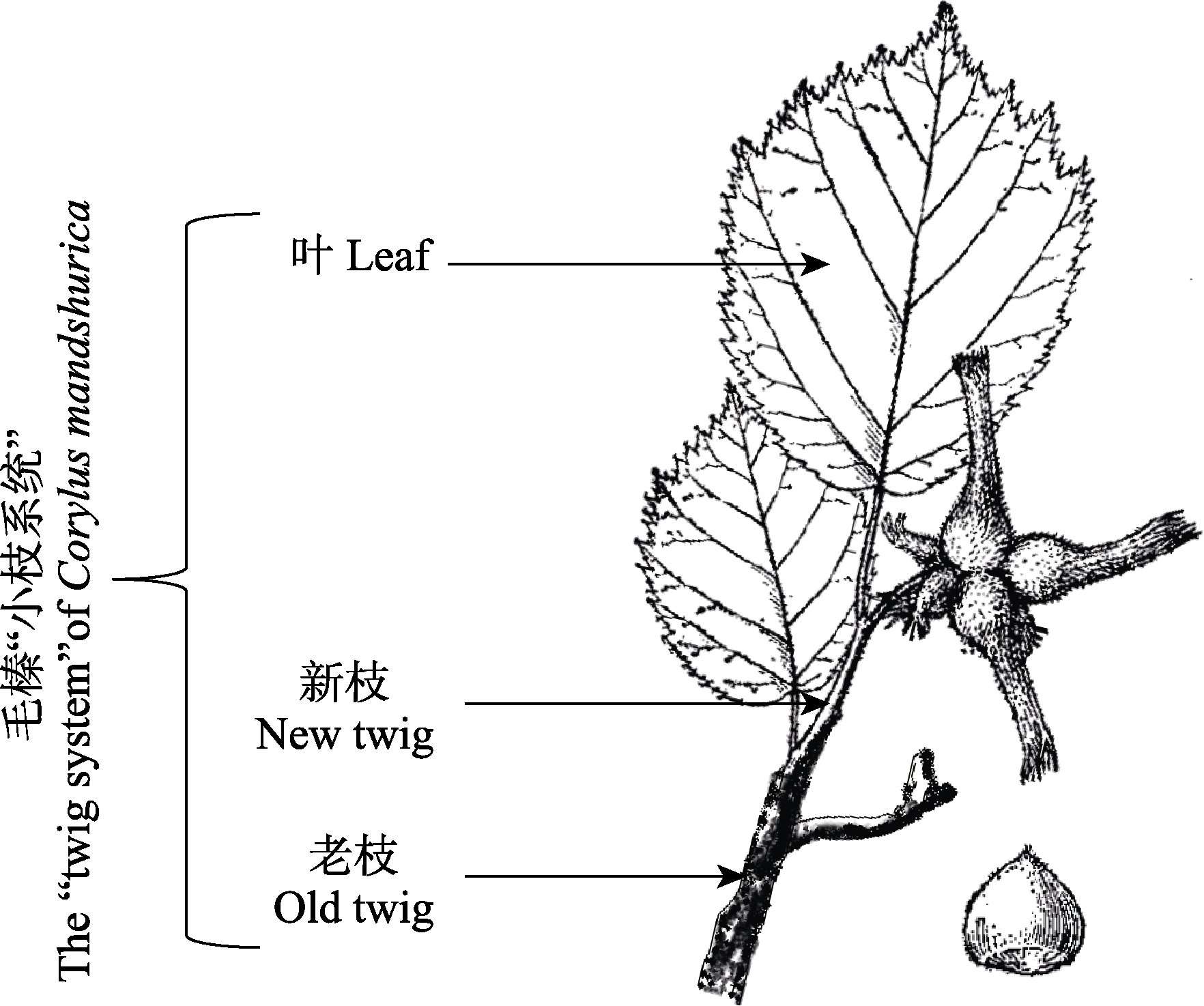
Fig. 1 Schematic diagram of the “twig system” of Corylus mandshurica. The materials in the figure are sourced from Flora of China (https://www.iplant.cn).
| 性状类别 Trait category | 简称 Abbreviation | 性状 Trait | 单位 Unit |
|---|---|---|---|
| 化学性状 Chemical trait | CT | 碳含量 Carbon (C) content | mg·g-1 |
| 氮含量 Nitrogen (N) content | mg·g-1 | ||
| 磷含量 Phosphorus (P) content | mg·g-1 | ||
| 非结构性碳 Non-structural carbon | NSC | 可溶性糖含量 Soluble sugar (SS) content | % DM |
| 淀粉含量 Starch (ST) content | % DM | ||
| 总非结构性碳水化合物含量 Total nonstructural carbohydrates (TNC) content | % DM | ||
| 防御性状 Defensive trait | DT | 总酚含量 Total phenol (TP) content | mg·g-1 |
| 单宁含量 Tannin (TA) content | mg·g-1 | ||
| 类黄酮含量 Flavonoid (FLA) content | mg·g-1 |
Table 1 Nine traits of Corylus mandshurica and their classification information
| 性状类别 Trait category | 简称 Abbreviation | 性状 Trait | 单位 Unit |
|---|---|---|---|
| 化学性状 Chemical trait | CT | 碳含量 Carbon (C) content | mg·g-1 |
| 氮含量 Nitrogen (N) content | mg·g-1 | ||
| 磷含量 Phosphorus (P) content | mg·g-1 | ||
| 非结构性碳 Non-structural carbon | NSC | 可溶性糖含量 Soluble sugar (SS) content | % DM |
| 淀粉含量 Starch (ST) content | % DM | ||
| 总非结构性碳水化合物含量 Total nonstructural carbohydrates (TNC) content | % DM | ||
| 防御性状 Defensive trait | DT | 总酚含量 Total phenol (TP) content | mg·g-1 |
| 单宁含量 Tannin (TA) content | mg·g-1 | ||
| 类黄酮含量 Flavonoid (FLA) content | mg·g-1 |
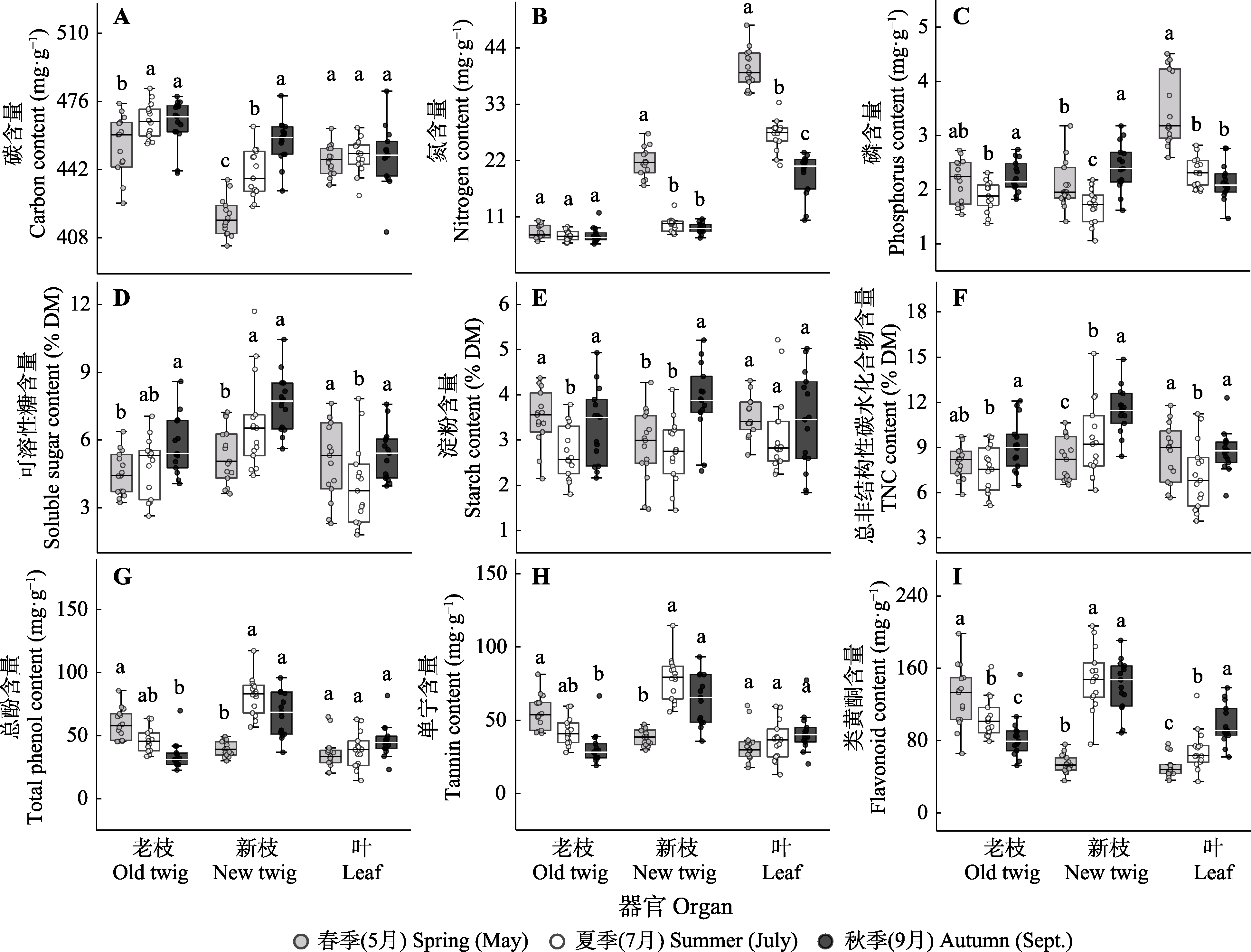
Fig. 2 Contents of chemical, non-structural carbon and defense traits in old twigs, new twigs and leaves of Corylus mandshurica in different seasons. Different lowercase letters indicate significant differences (p < 0.05) among different months within the same organ. TNC, total non-structural carbohydrates.
| 因素 Factor | 性状 Trait | df | 均方 Mean square | F | p | 偏Eta平方 Partial Eta squared |
|---|---|---|---|---|---|---|
| 季节 Season | C | 2 | 0.004 | 24.774 | <0.001 | 0.282 |
| N | 2 | 0.753 | 170.300 | <0.001 | 0.730 | |
| P | 2 | 0.129 | 23.601 | <0.001 | 0.273 | |
| SS | 2 | 0.160 | 10.580 | <0.001 | 0.144 | |
| ST | 2 | 0.090 | 7.732 | <0.01 | 0.109 | |
| TNC | 2 | 0.107 | 13.512 | <0.001 | 0.177 | |
| TP | 2 | 0.058 | 3.678 | <0.05 | 0.055 | |
| TA | 2 | 0.062 | 3.691 | <0.05 | 0.055 | |
| FLA | 2 | 0.406 | 37.153 | <0.001 | 0.371 | |
| 器官 Organ | C | 2 | 0.005 | 33.414 | <0.001 | 0.347 |
| N | 2 | 3.616 | 817.676 | <0.001 | 0.928 | |
| P | 2 | 0.150 | 27.443 | <0.001 | 0.303 | |
| SS | 2 | 0.264 | 17.426 | <0.001 | 0.217 | |
| ST | 2 | 0.012 | 1.005 | ns | 0.016 | |
| TNC | 2 | 0.080 | 10.145 | <0.001 | 0.139 | |
| TP | 2 | 0.485 | 31.031 | <0.001 | 0.330 | |
| TA | 2 | 0.611 | 36.476 | <0.001 | 0.367 | |
| FLA | 2 | 0.446 | 40.838 | <0.001 | 0.393 | |
| 季节×器官 Season × organ | C | 4 | 0.001 | 8.196 | <0.001 | 0.206 |
| N | 4 | 0.172 | 39.002 | <0.001 | 0.553 | |
| P | 4 | 0.088 | 16.094 | <0.001 | 0.338 | |
| SS | 4 | 0.045 | 2.983 | <0.05 | 0.087 | |
| ST | 4 | 0.040 | 3.383 | <0.05 | 0.097 | |
| TNC | 4 | 0.026 | 3.297 | <0.05 | 0.095 | |
| TP | 4 | 0.318 | 20.318 | <0.001 | 0.392 | |
| TA | 4 | 0.323 | 19.304 | <0.001 | 0.380 | |
| FLA | 4 | 0.456 | 41.781 | <0.001 | 0.570 |
Table 2 Impacts of seasons, organs and their interactions on the functional traits of Corylus mandshurica
| 因素 Factor | 性状 Trait | df | 均方 Mean square | F | p | 偏Eta平方 Partial Eta squared |
|---|---|---|---|---|---|---|
| 季节 Season | C | 2 | 0.004 | 24.774 | <0.001 | 0.282 |
| N | 2 | 0.753 | 170.300 | <0.001 | 0.730 | |
| P | 2 | 0.129 | 23.601 | <0.001 | 0.273 | |
| SS | 2 | 0.160 | 10.580 | <0.001 | 0.144 | |
| ST | 2 | 0.090 | 7.732 | <0.01 | 0.109 | |
| TNC | 2 | 0.107 | 13.512 | <0.001 | 0.177 | |
| TP | 2 | 0.058 | 3.678 | <0.05 | 0.055 | |
| TA | 2 | 0.062 | 3.691 | <0.05 | 0.055 | |
| FLA | 2 | 0.406 | 37.153 | <0.001 | 0.371 | |
| 器官 Organ | C | 2 | 0.005 | 33.414 | <0.001 | 0.347 |
| N | 2 | 3.616 | 817.676 | <0.001 | 0.928 | |
| P | 2 | 0.150 | 27.443 | <0.001 | 0.303 | |
| SS | 2 | 0.264 | 17.426 | <0.001 | 0.217 | |
| ST | 2 | 0.012 | 1.005 | ns | 0.016 | |
| TNC | 2 | 0.080 | 10.145 | <0.001 | 0.139 | |
| TP | 2 | 0.485 | 31.031 | <0.001 | 0.330 | |
| TA | 2 | 0.611 | 36.476 | <0.001 | 0.367 | |
| FLA | 2 | 0.446 | 40.838 | <0.001 | 0.393 | |
| 季节×器官 Season × organ | C | 4 | 0.001 | 8.196 | <0.001 | 0.206 |
| N | 4 | 0.172 | 39.002 | <0.001 | 0.553 | |
| P | 4 | 0.088 | 16.094 | <0.001 | 0.338 | |
| SS | 4 | 0.045 | 2.983 | <0.05 | 0.087 | |
| ST | 4 | 0.040 | 3.383 | <0.05 | 0.097 | |
| TNC | 4 | 0.026 | 3.297 | <0.05 | 0.095 | |
| TP | 4 | 0.318 | 20.318 | <0.001 | 0.392 | |
| TA | 4 | 0.323 | 19.304 | <0.001 | 0.380 | |
| FLA | 4 | 0.456 | 41.781 | <0.001 | 0.570 |
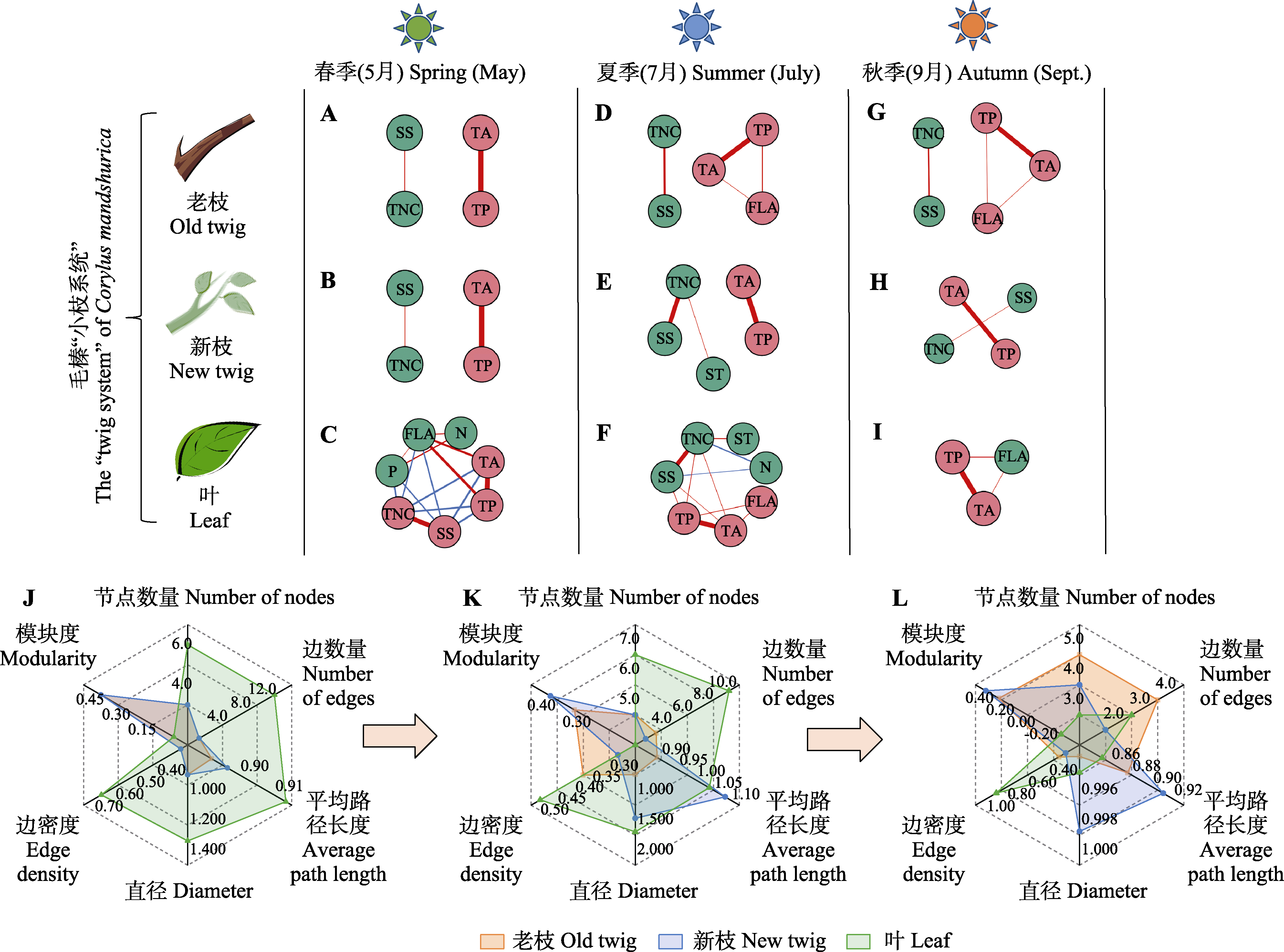
Fig. 3 Functional trait correlation networks and their overall characteristic parameters of old twigs, new twigs and leaves of Corylus mandshurica in different seasons. A, B, and C represent the trait networks of old twigs, new twigs, and leaves in spring (May) respectively. D, E, and F represent the trait networks of old twigs, new twigs, and leaves in summer (July) respectively. G, H, and I represent the trait networks of old twigs, new twigs, and leaves in autumn (September) respectively. Red and blue connecting lines represent positive and negative correlations respectively. The thicker the line, the stronger the correlation. Node circles of different colors represent different modules to which the traits belong, namely green and pink circles. The trait abbreviation information is shown in Table 1. J, K, and L represent the overall characteristics of the trait-correlation networks of the “twig system” (old twig, new twig, and leaf) in spring (May), summer (July), and autumn (September), respectively.
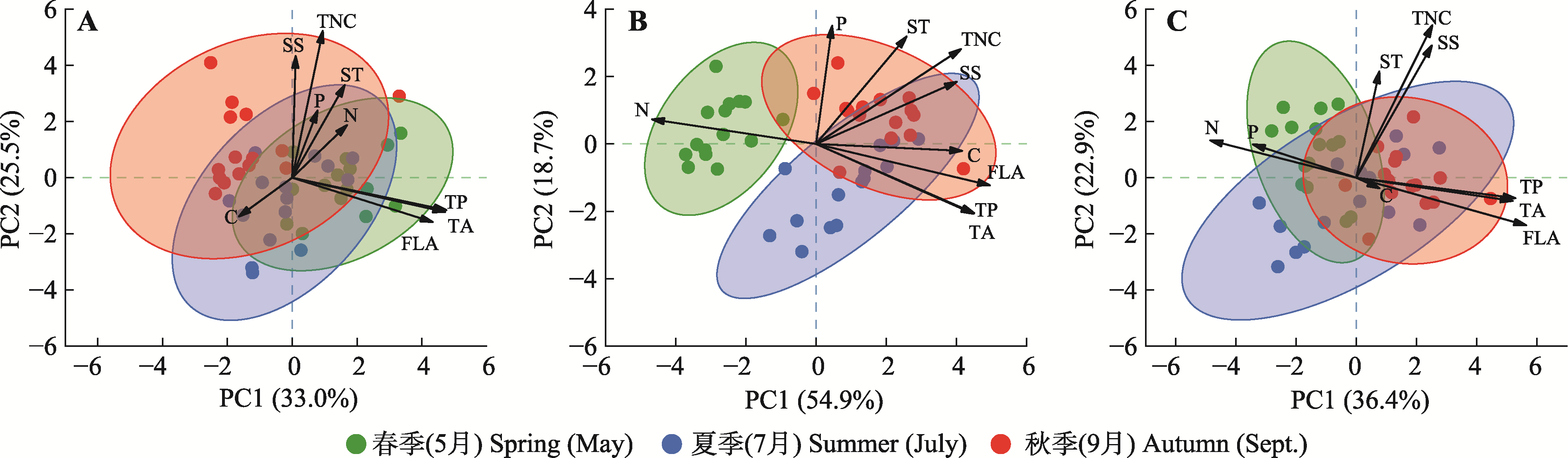
Fig. 4 Principal component analysis of the traits of old twigs (A), new twigs (B) and leaves (C) of Corylus mandshurica in different seasons. Information on trait abbreviations is shown in Table 1.
| [1] |
Barbehenn RV, Constabel CP (2011). Tannins in plant- herbivore interactions. Phytochemistry, 72, 1551-1565.
DOI PMID |
| [2] |
Blumstein M, Gersony J, Martínez-Vilalta J, Sala A (2023). Global variation in nonstructural carbohydrate stores in response to climate. Global Change Biology, 29, 1854-1869.
DOI URL |
| [3] |
Buysse J, Merckx R (1993). An improved colorimetric method to quantify sugar content of plant tissue. Journal of Experimental Botany, 44, 1627-1629.
DOI URL |
| [4] |
Chacón-Fuentes M, Parra L, Lizama M, Seguel I, Urzúa A, Quiroz A (2017). Plant flavonoid content modified by domestication. Environmental Entomology, 46, 1080-1089.
DOI PMID |
| [5] |
Chen FS, Niklas KJ, Liu Y, Fang XM, Wan SZ, Wang HM (2015). Nitrogen and phosphorus additions alter nutrient dynamics but not resorption efficiencies of Chinese fir leaves and twigs differing in age. Tree Physiology, 35, 1106-1117.
DOI URL |
| [6] |
Cheng SQ, Jiang F, Jin GZ (2022). Leaf economics spectrum of broadleaved plant seedlings and its relationship with defense traits in a temperate forest. Chinese Journal of Plant Ecology, 46, 678-686.
DOI URL |
|
[程思祺, 姜峰, 金光泽 (2022). 温带森林阔叶植物幼苗叶经济谱及其与防御性状的关系. 植物生态学报, 46, 678-686.]
DOI |
|
| [7] | Ciocan AG, Tecuceanu V, Enache-Preoteasa C, Mitoi EM, Helepciuc FE, Dimov TV, Simon-Gruita A, Cogălniceanu GC (2023). Phenological and environmental factors’ impact on secondary metabolites in medicinal plant Cotinus coggygria Scop. Plants, 12, 1762. DOI: 10.3390/plants12091762. |
| [8] |
Corner EJH (1949). The durian theory or the origin of the modern tree. Annals of Botany, 13, 367-414.
DOI URL |
| [9] | Fan JP (2006). Research on the Extraction and Separation of Active Ingredients in Persimmon Leaves. PhD dissertation, Zhejiang University, Hangzhou. |
| [范杰平 (2006). 柿叶中有效成分的提取与分离研究. 博士学位论文, 浙江大学, 杭州.] | |
| [10] |
Furze ME, Huggett BA, Aubrecht DM, Stolz CD, Carbone MS, Richardson AD (2019). Whole-tree nonstructural carbohydrate storage and seasonal dynamics in five temperate species. New Phytologist, 221, 1466-1477.
DOI PMID |
| [11] |
Hartmann H, Trumbore S (2016). Understanding the roles of nonstructural carbohydrates in forest trees—From what we can measure to what we want to know. New Phytologist, 211, 386-403.
DOI PMID |
| [12] |
He NP, Li Y, Liu CC, Xu L, Li MX, Zhang JH, He JS, Tang ZY, Han XG, Ye Q, Xiao CW, Yu Q, Liu SR, Sun W, Niu SL, et al. (2020). Plant trait networks: improved resolution of the dimensionality of adaptation. Trends in Ecology & Evolution, 35, 908-918.
DOI URL |
| [13] |
Henn JJ, Buzzard V, Enquist BJ, Halbritter AH, Klanderud K, Maitner BS, Michaletz ST, Pötsch C, Seltzer L, Telford RJ, Yang Y, Zhang L, Vandvik V (2018). Intraspecific trait variation and phenotypic plasticity mediate alpine plant species response to climate change. Frontiers in Plant Science, 9, 1548. DOI: 10.3389/fpls.2018.01548.
PMID |
| [14] | Hou YL (2023). Research on the Nutritional Value, Solubility and Stability of Corylus mandshurica Kernel Protein. Master degree dissertation, Northeast Forestry University, Harbin. |
| [候艳丽 (2023). 毛榛榛仁蛋白营养价值及溶解性和稳定性的研究. 硕士学位论文, 东北林业大学, 哈尔滨.] | |
| [15] |
Huang PX, Dong Z, Guo PR, Zhang X, Qiu YP, Li BS, Wang YC, Guo HW (2020). Salicylic acid suppresses apical hook formation via NPR1-Mediated repression of EIN3 and EIL1 in Arabidopsis. Plant Cell, 32, 612-629.
DOI URL |
| [16] | Jiang HJ, Su JH, Ren ZR, Wang DX, Hills A, Kinoshita T, Blatt MR, Wang Y, Wang YZ (2024). Dual function of overexpressing plasma membrane H+-ATPase in balancing carbon-water use. Science Advances, 10, eadp8017. DOI: 10.1126/sciadv.adp8017. |
| [17] |
Johnson KS (2005). Plant phenolics behave as radical scavengers in the context of insect (Manduca sexta) hemolymph and midgut fluid. Journal of Agricultural and Food Chemistry, 53, 10120-10126.
PMID |
| [18] | Jónsdóttir IS, Halbritter AH, Christiansen CT, Althuizen IHJ, Haugum SV, Henn JJ, Björnsdóttir K, Maitner BS, Malhi Y, Michaletz ST, Roos RE, Klanderud K, Lee H, Enquist BJ, Vandvik V (2023). Intraspecific trait variability is a key feature underlying high Arctic plant community resistance to climate warming. Ecological Monographs, 93, e1555. DOI: 10.1002/ecm.1555. |
| [19] |
Kleyer M, Trinogga J, Cebrián-Piqueras MA, Trenkamp A, Fløjgaard C, Ejrnæs R, Bouma TJ, Minden V, Maier M, Mantilla-Contreras J, Albach DC, Blasius B (2019). Trait correlation network analysis identifies biomass allocation traits and stem specific length as hub traits in herbaceous perennial plants. Journal of Ecology, 107, 829-842.
DOI URL |
| [20] | Kong DL, Wang JJ, Wu HF, Valverde-Barrantes OJ, Wang RL, Zeng H, Kardol P, Zhang HY, Feng YL (2019). Nonlinearity of root trait relationships and the root economics spectrum. Nature Communications, 10, 2203. DOI: 10.1038/s41467-019-10245-6. |
| [21] |
Li JL, Chen XP, Niklas KJ, Sun J, Wang ZY, Zhong QL, Hu DD, Cheng DL (2022a). A whole-plant economics spectrum including bark functional traits for 59 subtropical woody plant species. Journal of Ecology, 110, 248-261.
DOI URL |
| [22] |
Li L, Wang XK, Manning WJ (2019). Effects of elevated CO2 on leaf senescence, leaf nitrogen resorption, and late-season photosynthesis in Tilia americana L. Frontiers in Plant Science, 10, 1217. DOI: 10.3389/fpls.2019.01217.
PMID |
| [23] | Li XM, Jin GZ, Liu ZL (2024). The seasonal dynamics of cross-sectional tissue characteristics of Corylus mandshurica twig, petiole, and leaf vein are inconsistent. Global Ecology and Conservation, 53, e02998. DOI: 10.1016/j.gecco.2024.e02998. |
| [24] | Li XN, Wang JT, Gu L, Qi X, Liu JW, Lin Z, Li Y (2021). Study on the material basis of medicinal properties and activities in hazelnuts. Journal of Changchun University of Chinese Medicine, 37, 1441-1445. |
| [李曦凝, 王俊桐, 谷乐, 齐鑫, 刘金薇, 林喆, 李勇 (2021). 榛子药效物质基础及活性研究. 长春中医药大学学报, 37, 1441-1445.] | |
| [25] |
Li Y, Liu CC, Sack L, Xu L, Li MX, Zhang JH, He NP (2022b). Leaf trait network architecture shifts with species-richness and climate across forests at continental scale. Ecology Letters, 25, 1442-1457.
DOI URL |
| [26] | Liang ZC, Liu TT, Chen XY, Xu WJ, Dong TF, Liu QS, Xu X (2023). Twigs of dove tree in high-latitude region tend to increase biomass accumulation in vegetative organs but decrease it in reproductive organs. Frontiers in Plant Science, 13, 1088955. DOI: 10.3389/fpls.2022.1088955. |
| [27] |
Liu HY, Shangguan HL, Zhou M, Airebule P, Zhao PW, He WQ, Xiang CL, Wu XC (2019). Differentiated responses of nonstructural carbohydrate allocation to climatic dryness and drought events in the Inner Asian arid timberline. Agricultural and Forest Meteorology, 271, 355-361.
DOI URL |
| [28] |
Liu R, Yang XJ, Gao RR, Huang ZY, Cornelissen JHC (2023). Coordination of economics spectra in leaf, stem and root within the genus Artemisia along a large environmental gradient in China. Global Ecology and Biogeography, 32, 324-338.
DOI URL |
| [29] |
Makkar HPS, Blümmel M, Borowy NK, Becker K (1993). Gravimetric determination of tannins and their correlations with chemical and protein precipitation methods. Journal of the Science of Food and Agriculture, 61, 161-165.
DOI URL |
| [30] |
Niinemets Ü, Ostonen I (2020). Plant organ senescence above- and belowground in trees: How to best salvage resources for new growth. Tree Physiology, 40, 981-986.
DOI PMID |
| [31] |
Olson ME, Aguirre-Hernández R, Rosell JA (2009). Universal foliage-stem scaling across environments and species in dicot trees: plasticity, biomechanics and Corner’s Rules. Ecology Letters, 12, 210-219.
DOI PMID |
| [32] |
Pan SN, Wang X, Yan ZB, Wu J, Guo LL, Peng ZY, Wu YT, Li J, Wang B, Su YJ, Liu LL (2024). Leaf stomatal configuration and photosynthetic traits jointly affect leaf water use efficiency in forests along climate gradients. New Phytologist, 244, 1250-1262.
DOI PMID |
| [33] | Paponov M, Antonyan M, Slimestad R, Paponov IA (2021). Decoupling of plant growth and accumulation of biologically active compounds in leaves, roots, and root exudates of Hypericum perforatum L. by the combination of jasmonate and far-red lighting. Biomolecules, 11, 1283. DOI: 10.3390/biom11091283. |
| [34] |
Peng X, Jin GZ (2022). Effects of plant characteristics and environmental factors on the dark diversity in a broadleaved Korean pine forest. Chinese Journal of Plant Ecology, 46, 656-666.
DOI |
|
[彭鑫, 金光泽 (2022). 植物特性和环境因子对阔叶红松林暗多样性的影响. 植物生态学报, 46, 656-666.]
DOI |
|
| [35] |
Primack RB, Laube J, Gallinat AS, Menzel A (2015). From observations to experiments in phenology research: investigating climate change impacts on trees and shrubs using dormant twigs. Annals of Botany, 116, 889-897.
DOI PMID |
| [36] | Rao QY, Su HJ, Ruan LW, Deng XW, Wang LT, Rao X, Liu JR, Xia WL, Xu PK, Shen H, Chen J, Xie P (2021). Stoichiometric and physiological mechanisms that link hub traits of submerged macrophytes with ecosystem structure and functioning. Water Research, 202, 117392. DOI: 10.1016/j.watres.2021.117392. |
| [37] | Signori-Müller C, Oliveira RS, de Vasconcellos Barros F, Tavares JV, Gilpin M, Diniz FC, Zevallos MJM, Yupayccana CAS, Acosta M, Bacca J, Chino RSC, Cuellar GMA, Cumapa ERM, Martinez F, Mullisaca FMP, et al. (2021). Non-structural carbohydrates mediate seasonal water stress across Amazon forests. Nature Communications, 12, 2310. DOI: 10.1038/s41467-021-22378-8. |
| [38] |
Tian D, Yan ZB, Fang JY (2021). Review on characteristics and main hypotheses of plant ecological stoichiometry. Chinese Journal of Plant Ecology, 45, 682-713.
DOI |
|
[田地, 严正兵, 方精云 (2021). 植物生态化学计量特征及其主要假说. 植物生态学报, 45, 682-713.]
DOI |
|
| [39] |
Tian DS, Reich PB, Chen HYH, Xiang YZ, Luo YQ, Shen Y, Meng C, Han WX, Niu SL (2019). Global changes alter plant multi-element stoichiometric coupling. New Phytologist, 221, 807-817.
DOI PMID |
| [40] |
Umaña MN, Salgado-Negret B, Norden N, Salinas V, Garzón F, Medina SP, Rodríguez-M GM, López-Camacho R, Castaño-Naranjo A, Cuadros H, Franke-Ante R, Avella A, Idárraga-Piedrahita Á, Jurado R, Nieto J, et al. (2023). Upscaling the effect of traits in response to drought: the relative importance of safety-efficiency and acquisitive- conservation functional axes. Ecology Letters, 26, 2098-2109.
DOI URL |
| [41] | Wang H, Prentice IC, Wright IJ, Warton DI, Qiao SC, Xu XT, Zhou J, Kikuzawa K, Stenseth NC (2023). Leaf economics fundamentals explained by optimality principles. Science Advances, 9, eadd5667. DOI: 10.1126/sciadv.add5667. |
| [42] | Wang L, Li JP, Wang Y, Xue H, Dai YX, Han YZ (2022). Interactive effect between tree ageing and trunk-boring pest reduces hydraulics and carbon metabolism in Hippophae rhamnoides. AoB Plants, 14, plac051. DOI: 10.1093/aobpla/plac051. |
| [43] | Wei B, Zhang DY, Wang GQ, Liu Y, Li QL, Zheng ZH, Yang GB, Peng YF, Niu KC, Yang YH (2023). Experimental warming altered plant functional traits and their coordination in a permafrost ecosystem. New Phytologist, 240, 1802-1816. |
| [44] | Wei SB, Li X, Lu ZF, Zhang H, Ye XY, Zhou YJ, Li J, Yan YY, Pei HC, Duan FY, Wang DY, Chen S, Wang P, Zhang C, Shang LG, et al. (2022). A transcriptional regulator that boosts grain yields and shortens the growth duration of rice. Science, 377, eabi8455. DOI: 10.1126/science.abi8455. |
| [45] |
Weigelt A, Mommer L, Andraczek K, Iversen CM, Bergmann J, Bruelheide H, Fan Y, Freschet GT, Guerrero-Ramírez NR, Kattge J, Kuyper TW, Laughlin DC, Meier IC, van der Plas F, Poorter H, et al. (2021). An integrated framework of plant form and function: the belowground perspective. New Phytologist, 232, 42-59.
DOI URL |
| [46] |
Westerband AC, Funk JL, Barton KE (2021). Intraspecific trait variation in plants: a renewed focus on its role in ecological processes. Annals of Botany, 127, 397-410.
DOI PMID |
| [47] |
Westoby M, Wright IJ (2003). The leaf size-twig size spectrum and its relationship to other important spectra of variation among species. Oecologia, 135, 621-628.
PMID |
| [48] |
Wojciechowska N, Sobieszczuk-Nowicka E, Bagniewska- Zadworna A (2018). Plant organ senescence-regulation by manifold pathways. Plant Biology, 20, 167-181.
DOI PMID |
| [49] |
Wright IJ, Reich PB, Westoby M, Ackerly DD, Baruch Z, Bongers F, Cavender-Bares J, Chapin T, Cornelissen JHC, Diemer M, Flexas J, Garnier E, Groom PK, Gulias J, Hikosaka K, et al. (2004). The worldwide leaf economics spectrum. Nature, 428, 821-827.
DOI |
| [50] |
Wu ZF, Fu YH, Crowther TW, Wang SX, Gong YF, Zhang J, Zhao YP, Janssens I, Penuelas J, Zohner CM (2023). Poleward shifts in the maximum of spring phenological responsiveness of Ginkgo biloba to temperature in China. New Phytologist, 240, 1421-1432.
DOI URL |
| [51] |
Xu LN, Jin GZ (2012). Species composition and community structure of a typical mixed broadleaved-Korean pine (Pinus koraiensis) forest plot in Liangshui Nature Reserve, Northeast China. Biodiversity Science, 20, 470-481.
DOI |
|
[徐丽娜, 金光泽 (2012). 小兴安岭凉水典型阔叶红松林动态监测样地: 物种组成与群落结构. 生物多样性, 20, 470-481.]
DOI |
|
| [52] |
Ye YH, Kitayama K, Onoda Y (2022). A cost-benefit analysis of leaf carbon economy with consideration of seasonal changes in leaf traits for sympatric deciduous and evergreen congeners: implications for their coexistence. New Phytologist, 234, 1047-1058.
DOI PMID |
| [53] |
Zhang JH, He NP, Liu CC, Xu L, Chen Z, Li Y, Wang RM, Yu GR, Sun W, Xiao CW, Chen HYH, Reich PB (2020). Variation and evolution of C:N ratio among different organs enable plants to adapt to N-limited environments. Global Change Biology, 26, 2534-2543.
DOI URL |
| [54] |
Zheng J, Jiang Y, Qian H, Mao YJ, Zhang C, Tang XX, Jin Y, Yi Y (2022). Size-dependent and environment-mediated shifts in leaf traits of a deciduous tree species in a subtropical forest. Ecology and Evolution, 12, e8516. DOI: 10.1002/ece3.8516.
PMID |
| [1] | guangjin wu, 郭 垚鑫, Ren Chengjie, Wang Jun, YUE Ming, Zhao Fazhu. Distribution of soil organic carbon content and its influencing factors in different vegetation type on the northern foot of the Qinling Mountains [J]. Chin J Plant Ecol, 2026, 50(预发表): 1-. |
| [2] | Zhao Zhi-Yi, HUANG Wei-Quan, HU Jing-Yan, WANG Yi-yue, Yu Mengjie, Yuhuan Wu. Advances of plant litter decomposition and its microbial mechanisms in peatland [J]. , 2026, 50(预发表): 0-. |
| [3] | . Plant Responses to Cadmium Contamination: Mechanisms of Uptake, Transport, and Physiological-Molecular Mitigation [J]. Chin J Plant Ecol, 2026, 50(预发表): 1-. |
| [4] | ZHANG An-Ning, XIAO Ya-Ning, ZHAO Xia, ZHANG Miao, CUI Han Wen, Chen Shu-Yan, AN Li-Zhe. Interactions between shrub encroachment and nitrogen addition on nematode community and functional traits on Qinghai–Tibetan Plateau [J]. Chin J Plant Ecol, 2026, 50(预发表): 0-. |
| [5] | CHEN Xin-Rui, SONG Wei-Feng, Yi WANG, Hao WANG, Shi-Yao SUN, Cai-Jiang WANG, Shi-Peng CAI, Hong REN, Yu-Tao HE, Min PAN, Guang-Xiu CAO, Yi YAN, Zhi-Yong XIE, WANG Hang. Nitrogen and phosphorus resorption characteristics and adaptive strategies of typical emergent plants in the lakeshore zone of Dianchi Lake, China [J]. , 2026, 50(预发表): 0-. |
| [6] | LI Wen-Zhu, LUAN Jun-Wei, DI Ya-Ping, WANG Yi, NIE Xiu-Qing, LIU Shi-Rong. Effects of manipulative drought on mycorrhiza-mediated soil enzyme activities and soil organic carbon fractions in a warm temperate Quercus aliena var. acuteserrata forest [J]. Chin J Plant Ecol, 2026, 50(3): 660-673. |
| [7] | LIU Run-Hong, YANG Liu-Rong, LIANG Hui-Ting, SHEN Wei-Jun. Research progress and prospect on phosphorus acquisition and utilization strategies of arbuscular mycorrhizal and ectomycorrhizal plants [J]. Chin J Plant Ecol, 2026, 50(3): 566-583. |
| [8] | HE Zheng-Jia, ZENG Xin-Ran, WANG Lin-Ying, XUE Xin-Yu, SU Qin-Ze, LI Yu, ZHANG Yin-Jie, WU Hui-Huang, CHEN Cheng-Cong, WU Liang-Quan, WEI An-Ni, QIU Yun-Peng, GUO Li-Jin. Response of arbuscular mycorrhizal fungal communities and soil organic carbon to magnesium fertilization in tea plantations [J]. Chin J Plant Ecol, 2026, 50(3): 700-709. |
| [9] | ZHANG Jing-Wen, LI Jing, WANG Ru-Miao, WANG He-Nian, CUI Li-Juan. Ecological stoichiometry characteristics and homeostasis analysis of plant roots and soil in coastal wetlands at different latitudes [J]. Chin J Plant Ecol, 2026, 50(2): 461-473. |
| [10] | HAO Ya-Xin, JIN Guang-Ze, LIU Zhi-Li. Effects of different stages of growing season and twig ages on twig traits in evergreen conifers [J]. Chin J Plant Ecol, 2026, 50(2): 279-292. |
| [11] | FENG Zhe, XU Ge-Xi, LIU Shun, CHEN Jian, LI Fei-Fan, GONG Shan-Shan, JIA Lei, SUN Zhen, YU Mei-Ni, SHI Zuo-Min, ZHOU Qing-Hong, JIANG Dong-Mei. Habitat factors and phylogeny jointly drive leaf stoichiometry in dry-hot valley region of Jinsha River, Yunnan, China [J]. Chin J Plant Ecol, 2026, 50(2): 352-361. |
| [12] | TAN Cong, SHI Liang, ZHAO Chang-Ti, GAN Pei-Qin, CHEN Bing-Rui, TAN Shen, BU Yan-Hua, TIAN Di. Analysis of ecological optimization strategies for Beijing plain forests based on multidimensional characteristics of leaf functional traits [J]. Chin J Plant Ecol, 2026, 50(2): 388-399. |
| [13] | HOU Xiao-Fan, MA Chen-Han, SUN Yu-Qian, GAO Yu-Han, LI Pin. Differential ecological stoichiometry of leaf and fine root litter decomposition under ozone stress [J]. Chin J Plant Ecol, 2026, 50(2): 268-278. |
| [14] | PI Hui-Zhi, ZHANG Qiu-Fang, SUN Hao, ZENG Quan-Xin, PENG Yuan-Zhen, YUAN Xiao-Chun, XU Jian-Guo, CHEN Yue-Min. Microbial carbon-nitrogen imbalance affects the response of microbial nitrogen use efficiency to nitrogen enrichment in Castanopsis faberi forest soils [J]. Chin J Plant Ecol, 2026, 50(1): 34-44. |
| [15] | LI Yue-Qi, MA Zhong-Hua, LIU Wei-Fan, SU Ming, WAN Meng-Hu, LI Qing-Yun, ZHANG Dan, LIU Ji-Li, WU Na. Effects of vertical deep rotary tillage with organic fertilizer on leaf senescence characteristics and yield of maize in saline soil [J]. Chin J Plant Ecol, 2026, 50(1): 222-236. |
| Viewed | ||||||
|
Full text |
|
|||||
|
Abstract |
|
|||||
Copyright © 2026 Chinese Journal of Plant Ecology
Tel: 010-62836134, 62836138, E-mail: apes@ibcas.ac.cn, cjpe@ibcas.ac.cn

