
Chin J Plant Ecol ›› 2026, Vol. 50 ›› Issue (3): 760-773.DOI: 10.17521/cjpe.2025.0272 cstr: 32100.14.cjpe.2025.0272
• Research Articles • Previous Articles Next Articles
WEI Li1, WANG Peng-Sen1, LIU Shan1, FAN Rui1, HUANG Nan1, ZHANG Jian-Guo1, Qimeilamu 2, GOU Yang1, LIU Mo-Han1, HUANG Ting1, ZHOU Ji-Qiong1,*( )(
)( )
)
Received:2025-07-21
Accepted:2026-02-25
Online:2026-03-20
Published:2026-05-20
Contact:
ZHOU Ji-Qiong
Supported by:WEI Li, WANG Peng-Sen, LIU Shan, FAN Rui, HUANG Nan, ZHANG Jian-Guo, Qimeilamu , GOU Yang, LIU Mo-Han, HUANG Ting, ZHOU Ji-Qiong. Arbuscular mycorrhizal fungi influence nutrient uptake along vertical niches in legume-grass mixtures[J]. Chin J Plant Ecol, 2026, 50(3): 760-773.
Add to citation manager EndNote|Ris|BibTeX
URL: https://www.plant-ecology.com/EN/10.17521/cjpe.2025.0272
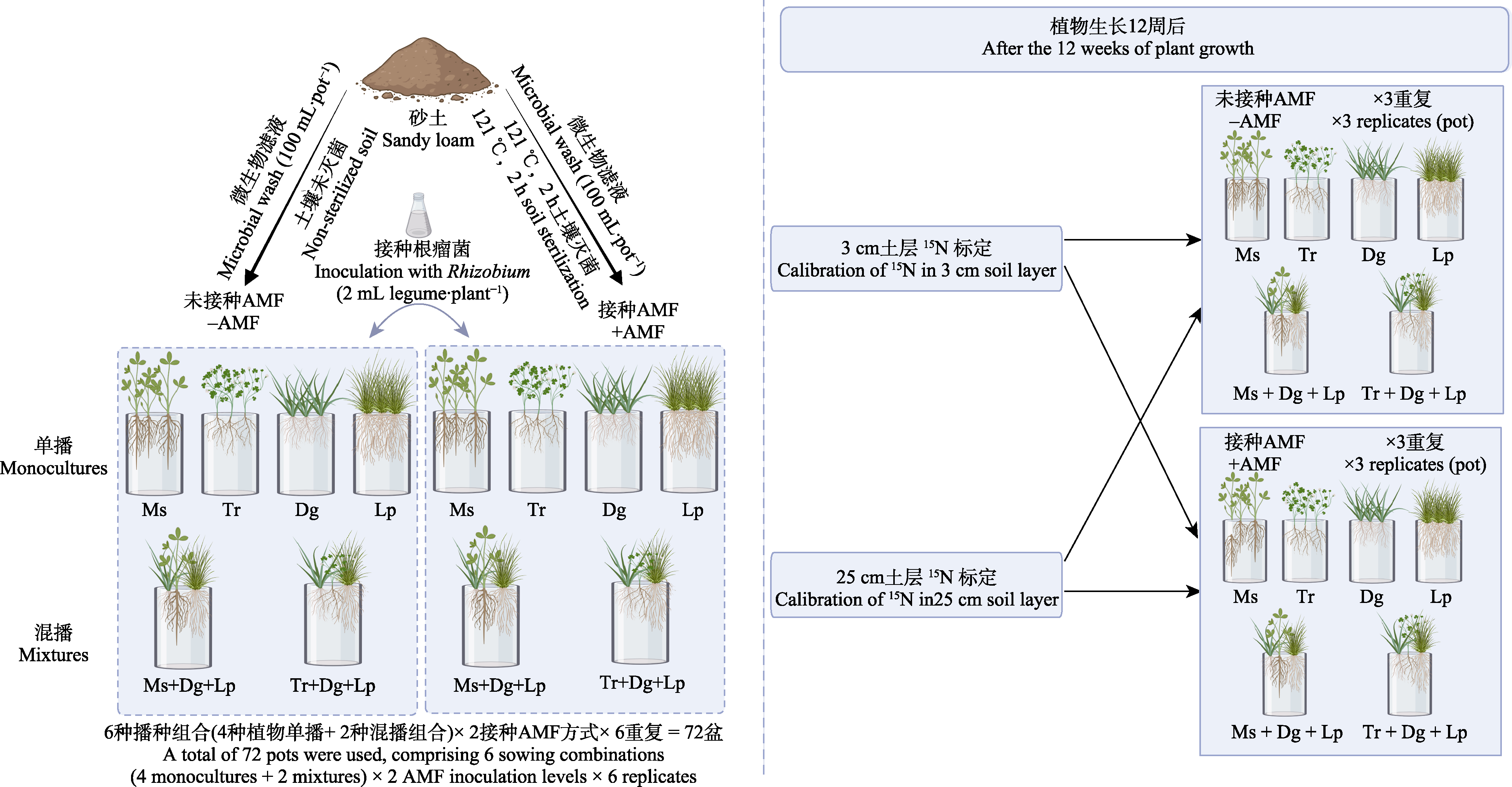
Fig. 1 15N isotope labeling at various soil depths. AMF, arbuscular mycorrhizal fungi; -AMF, without AMF; +AMF, inoculation with AMF; Dg, Dactylis glomerata monoculture; Lp, Lolium perenne monoculture; Ms, Medicago sativa monoculture; Tr, Trifolium repens monoculture; Ms + Dg + Lp, Medicago sativa + Dactylis glomerata + Lolium perenne mix; Tr + Dg + Lp, Trifolium repens + Dactylis glomerata + Lolium perenne mix.
| 变量 Response variable | CS | AMF | CS × AMF | |
|---|---|---|---|---|
| df | 1/2 | 1 | 1/2 | |
| 植物群落生物量 Plant community biomass | ||||
| 苜蓿 Medicago sativa | F | 0.443 | 4.247 | 0.435 |
| p | 0.513 | 0.053 | 0.517 | |
| 白三叶 Trifolium repens | F | 67.118 | 9.526 | 1.301 |
| p | <0.001 | 0.006 | 0.267 | |
| 鸭茅 Dactylis glomerata | F | 4.940 | 3.113 | 0.212 |
| p | 0.014 | 0.088 | 0.810 | |
| 黑麦草 Lolium perenne | F | 20.072 | 1.601 | 0.624 |
| p | <0.001 | 0.215 | 0.542 |
Table 1 Two-way ANOVA results of the effects of cropping system (CS), arbuscular mycorrhizal fungi inoculation (AMF), and their interaction on plant community biomass of four plant species
| 变量 Response variable | CS | AMF | CS × AMF | |
|---|---|---|---|---|
| df | 1/2 | 1 | 1/2 | |
| 植物群落生物量 Plant community biomass | ||||
| 苜蓿 Medicago sativa | F | 0.443 | 4.247 | 0.435 |
| p | 0.513 | 0.053 | 0.517 | |
| 白三叶 Trifolium repens | F | 67.118 | 9.526 | 1.301 |
| p | <0.001 | 0.006 | 0.267 | |
| 鸭茅 Dactylis glomerata | F | 4.940 | 3.113 | 0.212 |
| p | 0.014 | 0.088 | 0.810 | |
| 黑麦草 Lolium perenne | F | 20.072 | 1.601 | 0.624 |
| p | <0.001 | 0.215 | 0.542 |
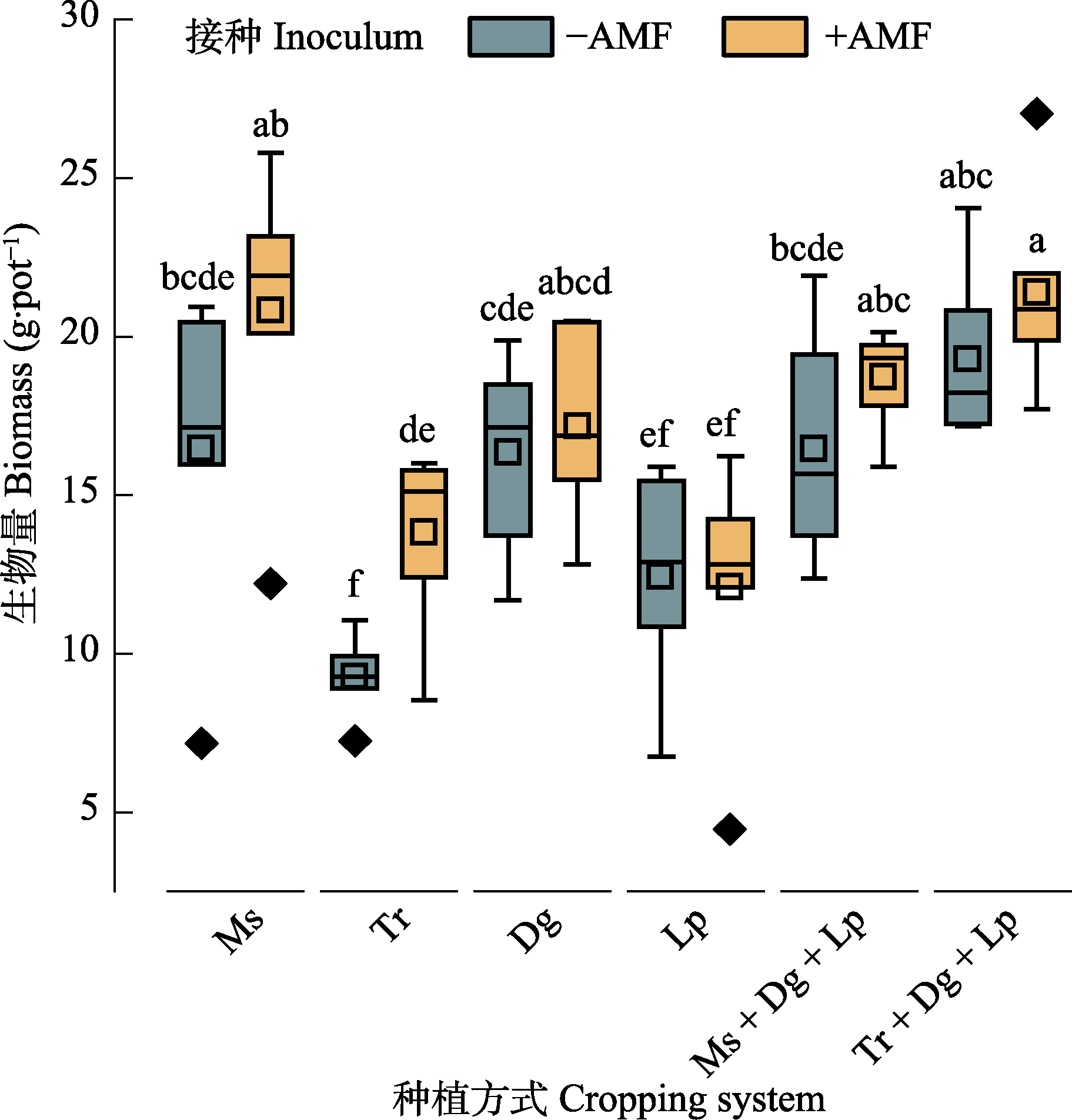
Fig. 2 Effects of culture system and inoculation with arbuscular mycorrhizal fungi (AMF) on plant community biomass (total aboveground and belowground biomass). -AMF, without AMF; +AMF, inoculation with AMF; Dg, Dactylis glomerata monoculture; Lp, Lolium perenne monoculture; Ms, Medicago sativa monoculture; Tr, Trifolium repens monoculture; Ms + Dg + Lp, Medicago sativa + Dactylis glomerata + Lolium perenne mix; Tr + Dg + Lp, Trifolium repens + Dactylis glomerata + Lolium perenne mix. Different lowercase letters denote significant differences between treatments (p < 0.05).
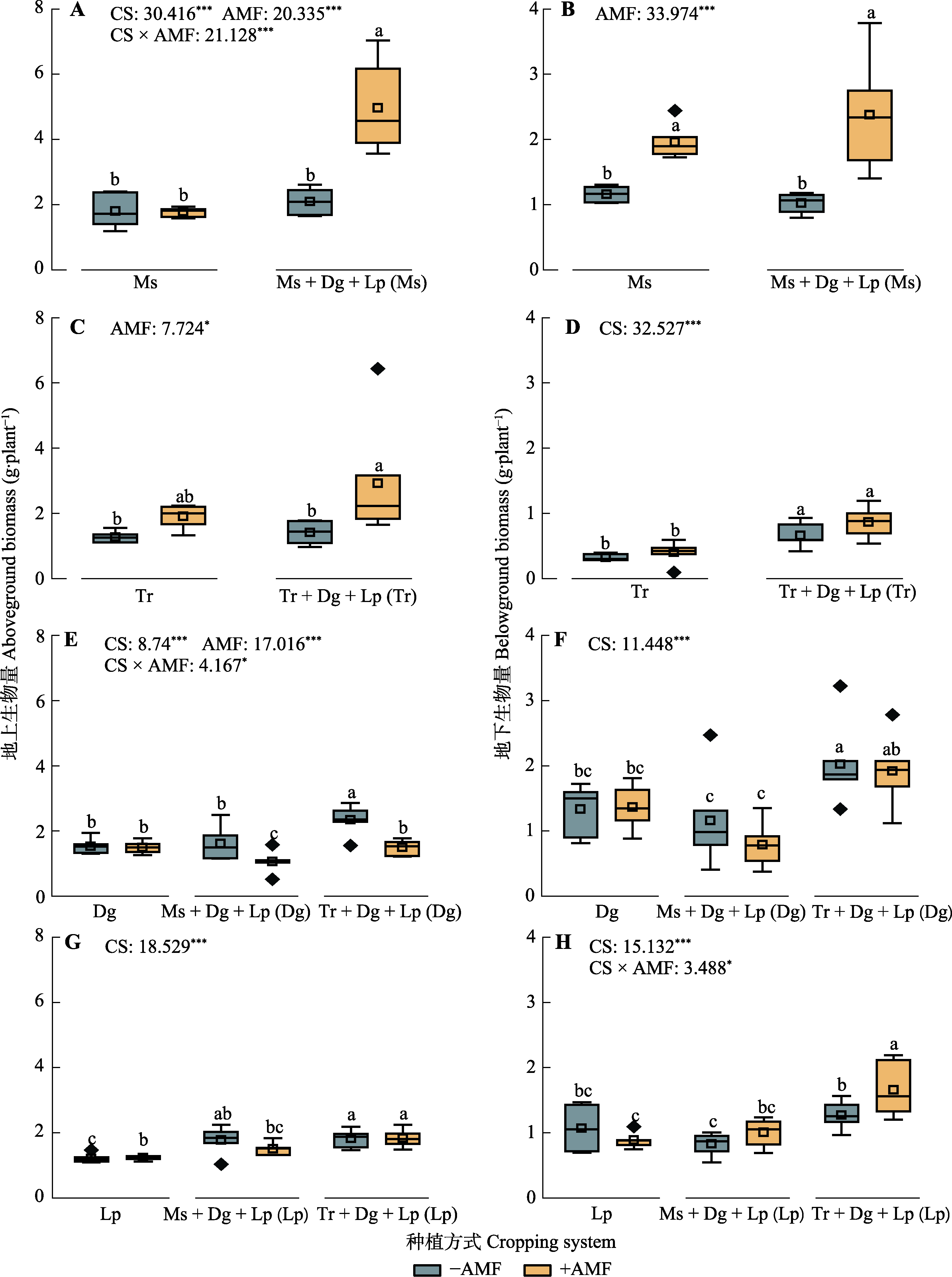
Fig. 3 Effects of culture system and inoculation with arbuscular mycorrhizal fungi (AMF) on plant above biomass, below ground biomass. -AMF, without AMF; +AMF, inoculation with AMF; Dg, Dactylis glomerata monoculture; Lp, Lolium perenne monoculture; Ms, Medicago sativa monoculture; Tr, Trifolium repens monoculture; Ms + Dg + Lp, Medicago sativa + Dactylis glomerata + Lolium perenne mix; Tr + Dg + Lp, Trifolium repens + Dactylis glomerata + Lolium perenne mix. The letters in parentheses indicate the aboveground biomass or belowground biomass of that specific plant species with the nixed system. CS indicates the cropping system, AMF indicates AMF inoculation, and CS × AMF indicates their interaction effect. Two-way ANOVA results are shown above each panel: *, p < 0.05; ***, p < 0.001. Different lowercase letters indicate significant differences between treatments (p < 0.05).
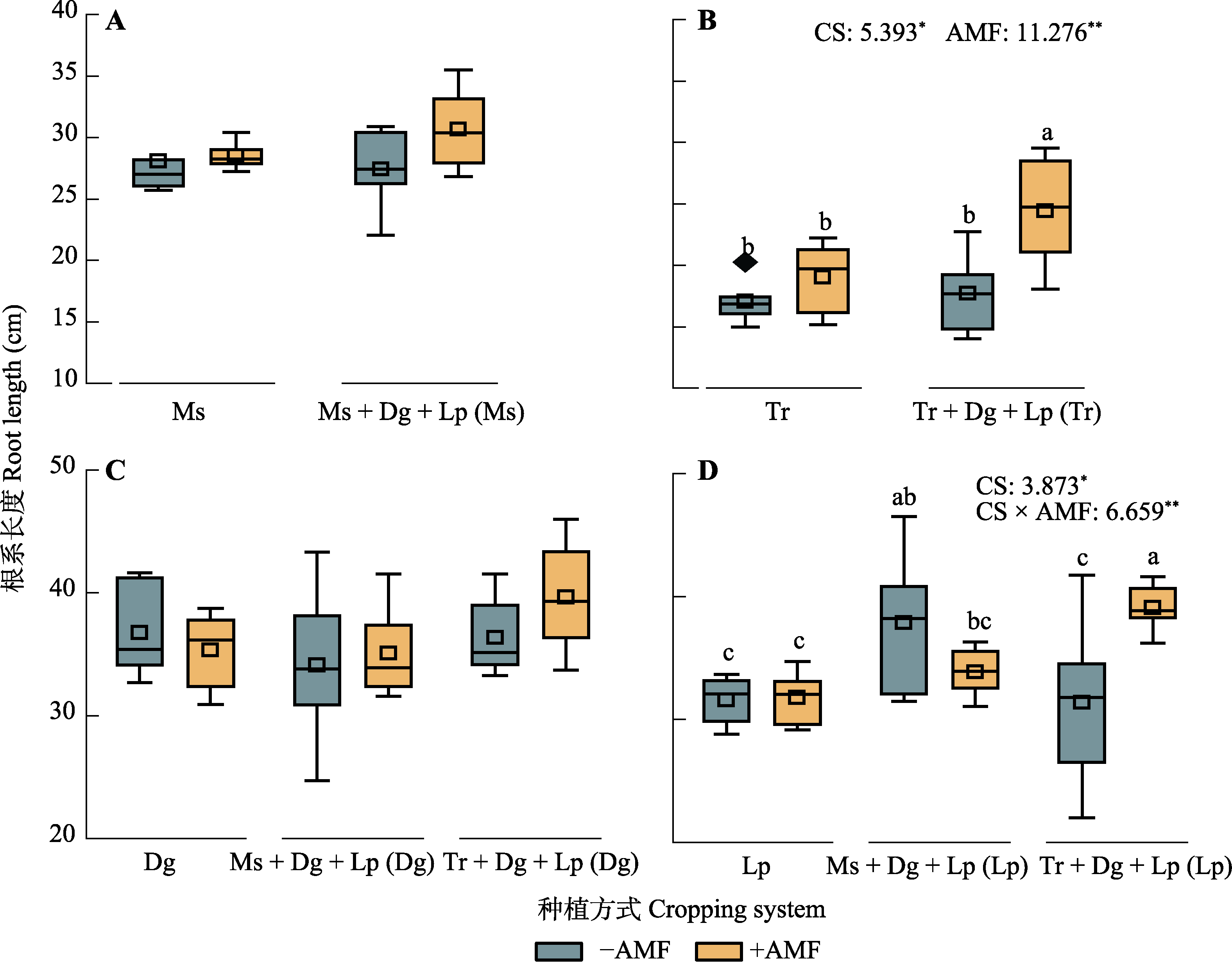
Fig. 4 Effects of culture system and inoculation with arbuscular mycorrhizal fungi (AMF) on plant root length. -AMF, without AMF; +AMF, inoculation with AMF; Dg, Dactylis glomerata monoculture; Lp, Lolium perenne monoculture; Ms, Medicago sativa monoculture; Tr, Trifolium repens monoculture; Ms + Dg + Lp, Medicago sativa + Dactylis glomerata + Lolium perenne mix; Tr + Dg + Lp, Trifolium repens + Dactylis glomerata + Lolium perenne mix. The letters in parentheses indicate the root length of that specific plant species within the mixed system. CS indicates the cropping system, AMF indicates AMF inoculation, and CS × AMF indicates their interaction effect. Two-way ANOVA results are shown above each panel: *, p < 0.05; **, p < 0.01; ***, p < 0.001. Different lowercase letters indicate significant differences between treatments (p < 0.05).
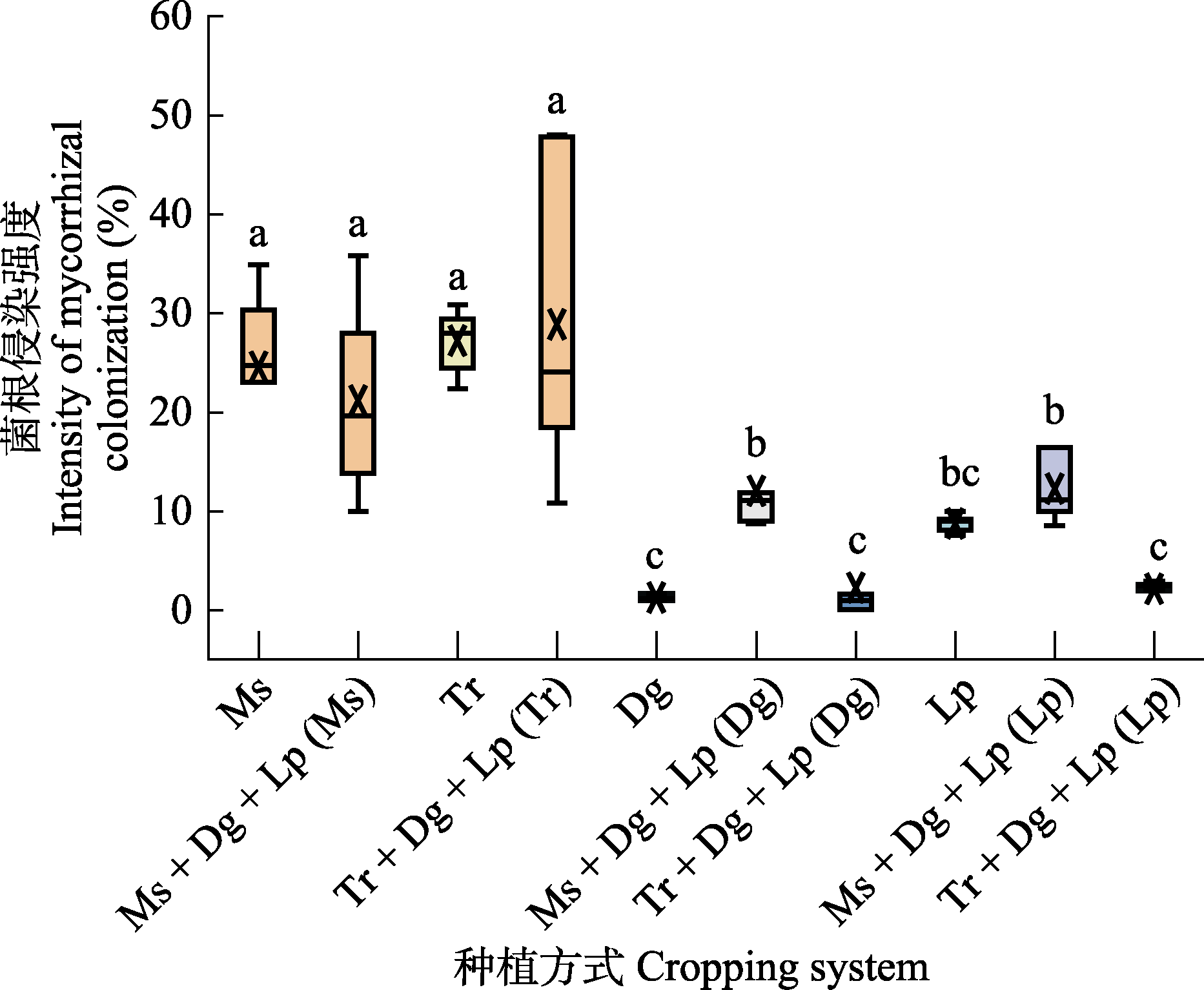
Fig. 5 Effects of culture systems on the intensity of mycorrhizal colonization. Dg, Dactylis glomerata monoculture; Lp, Lolium perenne monoculture; Ms, Medicago sativa monoculture; Ms + Dg + Lp, Medicago sativa + Dactylis glomerata + Lolium perenne mix; Tr, Trifolium repens monoculture; Tr + Dg + Lp, Trifolium repens + Dactylis glomerata + Lolium perenne mix. The letters in parentheses indicate the mycorrhizal colonization intensity of that specific plant species within the mixed system. Different lowercase letters indicate significant differences between treatments (p < 0.05).
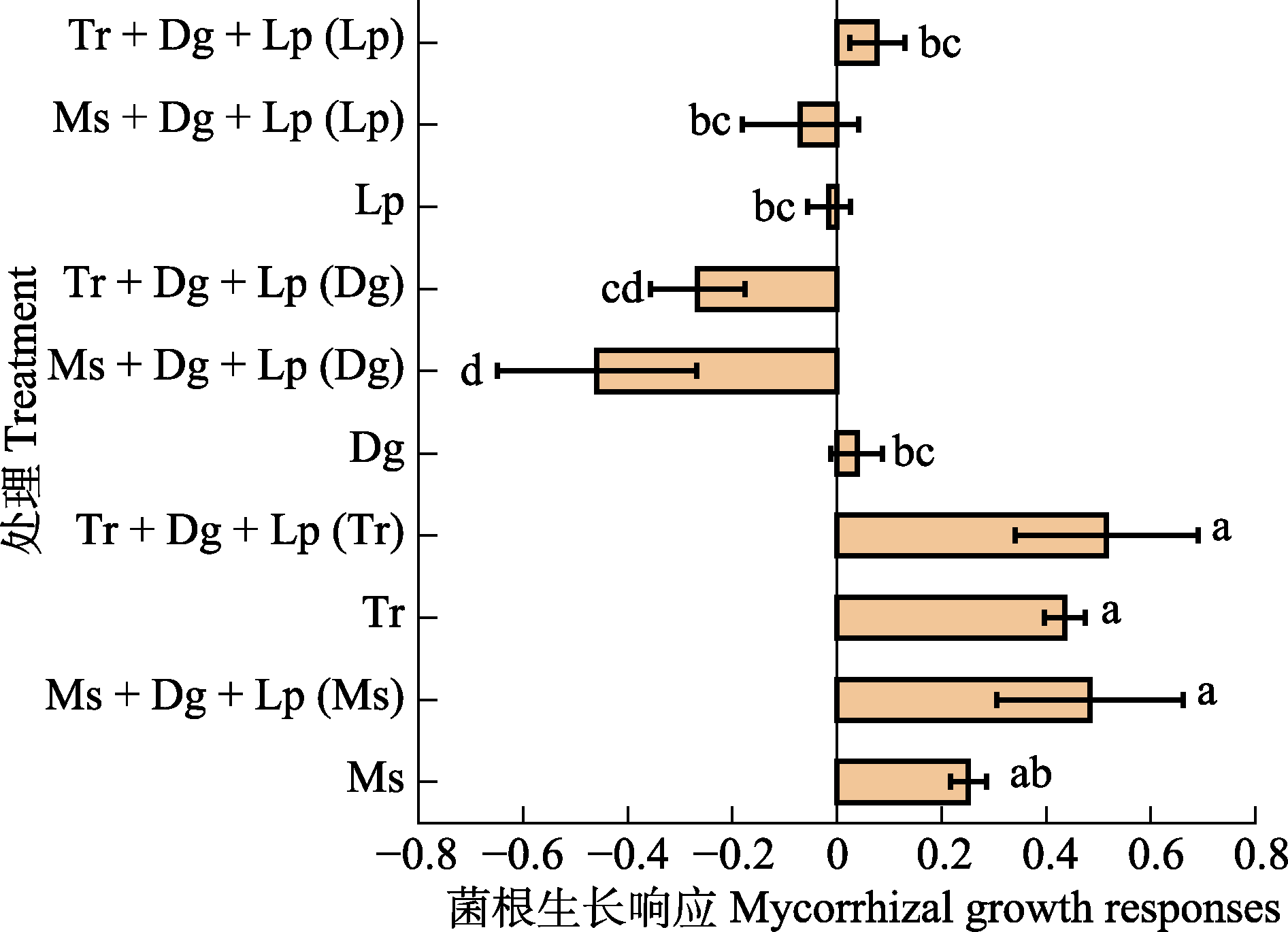
Fig. 6 Effect of culture system on the mycorrhizal growth response of plant aboveground biomass. Dg, Dactylis glomerata monoculture; Lp, Lolium perenne monoculture; Ms, Medicago sativa monoculture; Ms + Dg + Lp, Medicago sativa + Dactylis glomerata + Lolium perenne mix; Tr, Trifolium repens monoculture; Tr + Dg + Lp, Trifolium repens + Dactylis glomerata + Lolium perenne mix. The letters in parentheses indicate the mycorrhizal growth response of that specific plant species within the mixed system. Different lowercase letters indicate significant differences between treatments (p < 0.05).
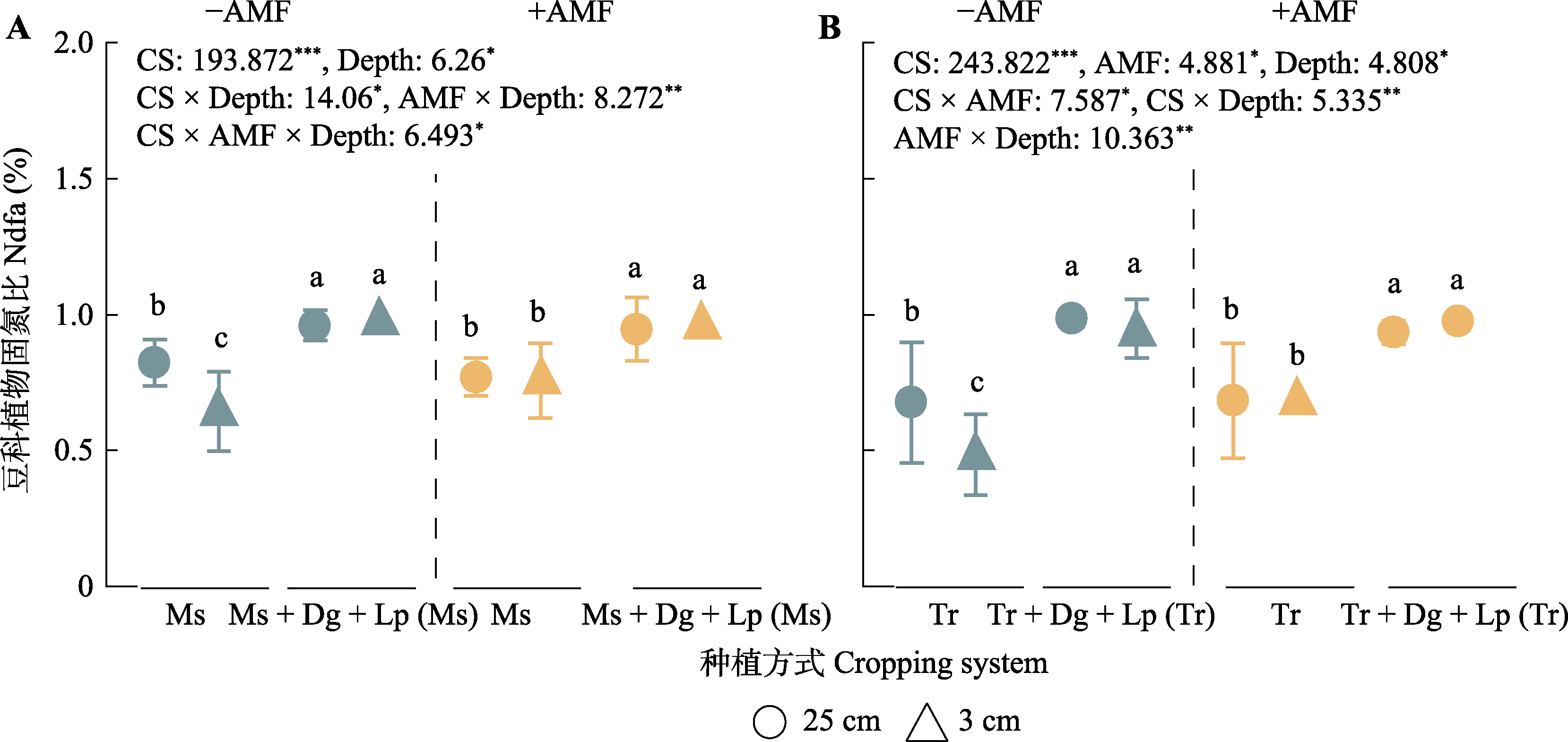
Fig. 7 Effects of culture system and inoculation with arbuscular mycorrhizal fungi (AMF) on nitrogen fixation ratio of legumes (Ndfa). -AMF, without AMF; +AMF, inoculation with AMF; Dg, Dactylis glomerata monoculture; Lp, Lolium perenne monoculture; Ms, Medicago sativa monoculture; Ms + Dg + Lp, Medicago sativa + Dactylis glomerata + Lolium perenne mix; Tr, Trifolium repens monoculture; Tr + Dg + Lp, Trifolium repens + Dactylis glomerata + Lolium perenne mix. The letters in parentheses indicate the nitrogen fixation rate of that specific plant species within the mixed system. CS indicates cropping system, AMF indicates AMF inoculation treatment, and Depth indicates 15N tracer depth; CS × AMF indicates their interaction. 25 cm, 15N tracer labeling at 25 cm depth; 3 cm, 15N tracer labeling at 3 cm depth. Three-way ANOVA results are shown above each panel: *, p < 0.05; **, p < 0.01; ***, p < 0.001. Different lowercase letters indicate significant differences between treatments (p < 0.05).
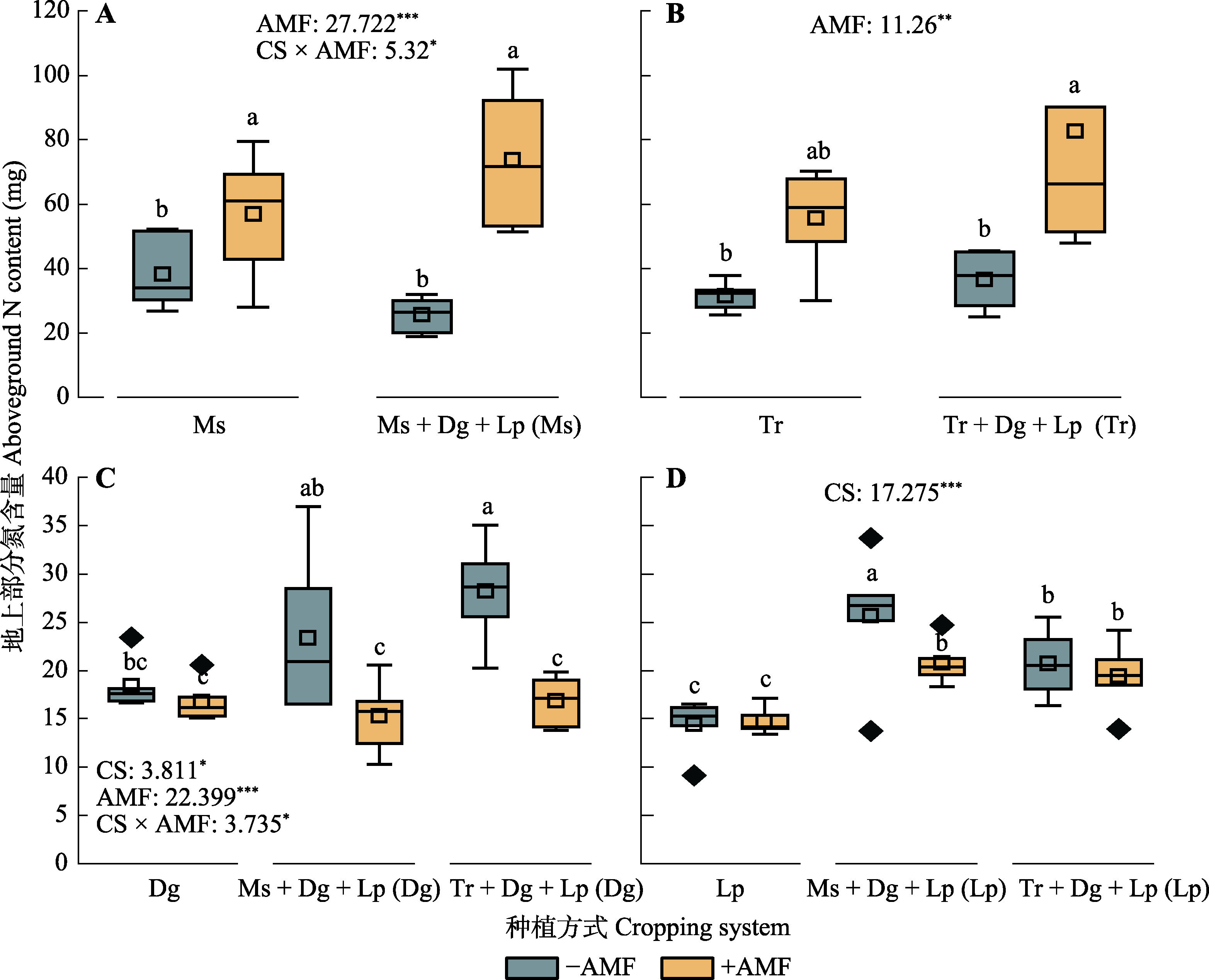
Fig. 8 Effects of culture system and inoculation with arbuscular mycorrhizal fungi (AMF) on aboveground plant nitrogen content. -AMF, without AMF; +AMF, inoculation with AMF; Dg, Dactylis glomerata monoculture; Lp, Lolium perenne monoculture; Ms, Medicago sativa monoculture; Ms + Dg + Lp, Medicago sativa + Dactylis glomerata + Lolium perenne mix; Tr, Trifolium repens monoculture; Tr + Dg + Lp, Trifolium repens + Dactylis glomerata + Lolium perenne mix. The letters in parentheses indicate the plant nitrogen content of that specific plant species within the mixed system. CS indicates cultivation mode and AMF indicates inoculation mode of AMF, CS × AMF is the interaction effect of the two. Two-way ANOVA results are shown above each panel: *, p < 0.05; **, p < 0.01; ***, p < 0.001. Different lowercase letters indicate significant differences between treatments (p < 0.05).
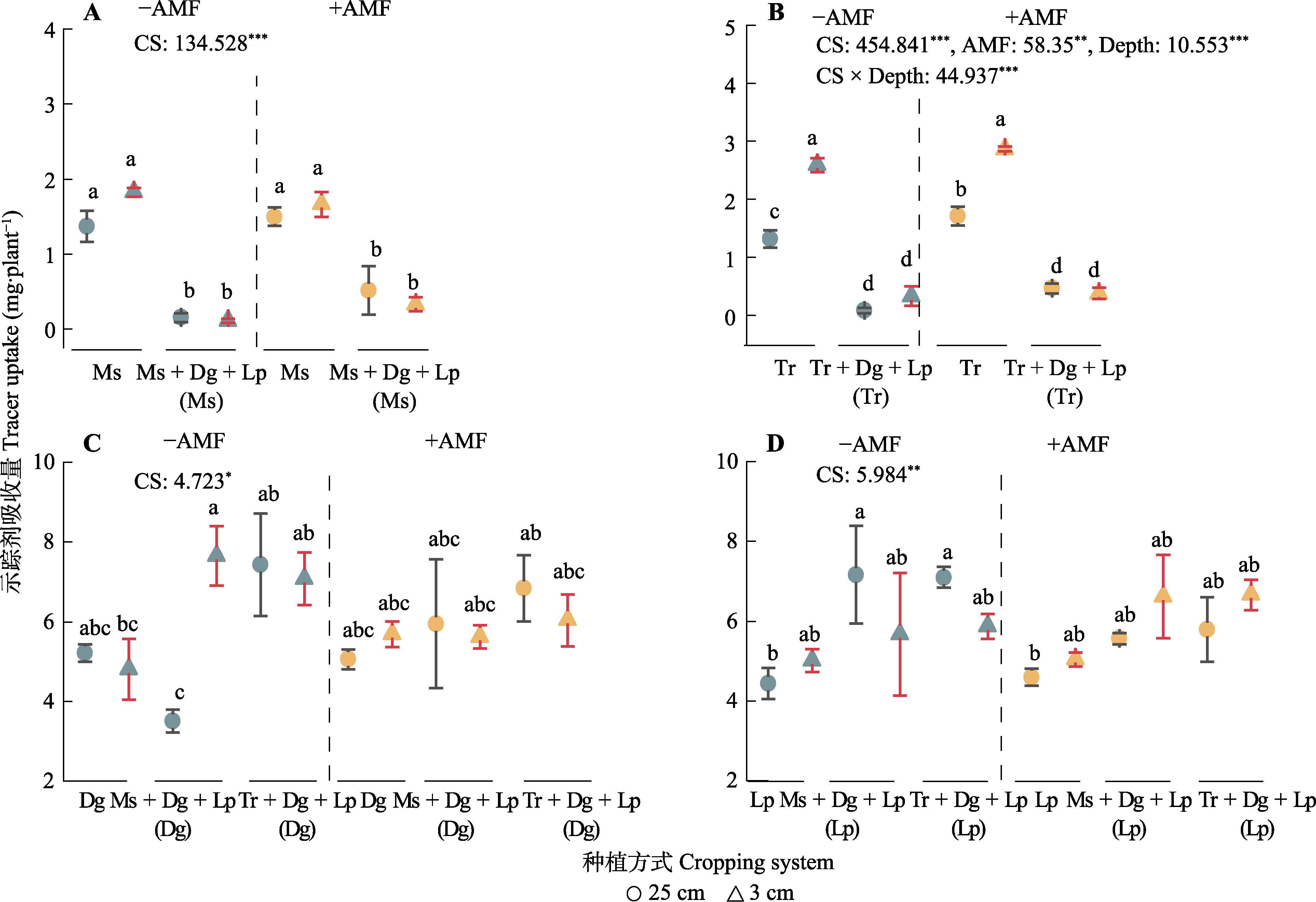
Fig. 9 Effects of culture system and inoculation with arbuscular mycorrhizal fungi (AMF) on plant uptake of tracer. -AMF, without AMF; +AMF, inoculation with AMF; Dg, Dactylis glomerata monoculture; Lp, Lolium perenne monoculture; Ms, Medicago sativa monoculture; Ms + Dg + Lp, Medicago sativa + Dactylis glomerata + Lolium perenne mix; Tr, Trifolium repens monoculture; Tr + Dg + Lp, Trifolium repens + Dactylis glomerata + Lolium perenne mix. The letters in parentheses indicate the plant tracer uptake of that specific plant species within the mixed system. CS indicates cultivation mode and AMF indicates inoculation mode of AMF, CS × AMF is the interaction effect of the two. Depth: depth of 15N tracer labeling; 25 cm, 15N tracer labeling at 25 cm depth; 3 cm, 15N tracer labeling at 3 cm depth: *, p < 0.05; **, p < 0.01; ***, p < 0.001. Different lowercase letters indicate significant differences between treatments (p < 0.05).
| [1] |
Bakker L, Barry K, Mommer L, Ruijven J (2021). Focusing on individual plants to understand community scale biodiversity effects: the case of root distribution in grasslands. Oikos, 130, 1954-1966.
DOI URL |
| [2] | Duan JG, Fang K, Chu JM, Wang YX, Zhang Q (2025). Effect of degradation stage on the relationship between species diversity and soil nutrients in typical steppe. Acta Agrestia Sinica, 33, 2890-2899. |
|
[段俊光, 房凯, 褚建民, 王迎新, 张琦 (2025). 退化程度对典型草原物种多样性和土壤养分关系的影响. 草地学报, 33, 2890-2899.]
DOI |
|
| [3] |
Gao WT, Zhang CY, Dong TF, Xu X (2019). Effects of arbuscular mycorrhizal fungi on the root growth of male and female Populus cathayana individuals grown under different sexual combination patterns. Chinese Journal of Plant Ecology, 43, 37-45.
DOI URL |
|
[高文童, 张春艳, 董廷发, 胥晓 (2019). 丛枝菌根真菌对不同性别组合模式下青杨雌雄植株根系生长的影响. 植物生态学报, 43, 37-45.]
DOI |
|
| [4] | Guo C, Zhao YL, Li XJ, Zhou JQ, Liu L, Sun FD, Bai YF, Ma CY (2022). Effect of sowing ratio on interspecific relationships between species and grassland productivity in legume-grass mixtures. Pratacultural Science, 39(11), 2307-2316. |
| [郭川, 赵艳兰, 李香君, 周冀琼, 刘琳, 孙飞达, 白彦福, 马骢毓 (2022). 不同豆禾混播比例对植物种间关系及草地生产力的影响. 草业科学, 39, 2307-2316.] | |
| [5] | Guo CY, Wang W, Peng D, Pu XJ, Fu YJ, Wang LR, Xu CT (2023). Effect of sowing method and row spacing on soil physicochemical properties of oat/forage pea grassland in alpine regions. Pratacultural Science, 40, 654-664. |
| [郭常英, 王伟, 彭丹, 蒲小剑, 傅云洁, 王龙然, 徐成体 (2023). 播种方式和行距对高寒地区燕麦/饲用豌豆草地土壤理化特性的影响. 草业科学, 40, 654-664.] | |
| [6] |
Hadir S, Döring TF, Justes E, Demie DT, Paul M, Legner N, Kemper R, Gaiser T, Weedon O, Ewert F, Seidel SJ (2025). Root growth and belowground interactions in spring wheat/faba bean intercrops. Plant and Soil, 506, 57-76.
DOI |
| [7] |
Hoekstra NJ, Finn JA, Buchmann N, Gockele A, Landert L, Prill N, Scherer-Lorenzen M, Lüscher A (2014). Methodological tests of the use of trace elements as tracers to assess root activity. Plant and Soil, 380, 265-283.
DOI URL |
| [8] |
Hoekstra NJ, Suter M, Finn JA, Husse S, Lüscher A (2015). Do belowground vertical niche differences between deep- and shallow-rooted species enhance resource uptake and drought resistance in grassland mixtures? Plant and Soil, 394, 21-34.
DOI URL |
| [9] | Huang D, Zhang YJ, Han JG, Wang K (2006). Study on community photosynthetic and other ecological physiology characteristics of white clover, perennial ryegrass and orchardgrass. Journal of China Agricultural University, 11(2), 44-48. |
| [黄顶, 张英俊, 韩建国, 王堃 (2006). 白三叶、多年生黑麦草和鸭茅光合生理生态特性研究. 中国农业大学学报, 11(2), 44-48.] | |
| [10] |
Husse S, Lüscher A, Buchmann N, Hoekstra NJ, Huguenin-Elie O (2017). Effects of mixing forage species contrasting in vertical and temporal nutrient capture on nutrient yields and fertilizer recovery in productive grasslands. Plant and Soil, 420, 505-521.
DOI |
| [11] |
Johnson NC (2010). Resource stoichiometry elucidates the structure and function of arbuscular mycorrhizas across scales. New Phytologist, 185, 631-647.
DOI PMID |
| [12] |
Johnson NC, Wilson GWT, Bowker MA, Wilson JA, Miller RM (2010). Resource limitation is a driver of local adaptation in mycorrhizal symbioses. Proceedings of the National Academy of Sciences, 107, 2093-2098.
DOI URL |
| [13] |
Joslin JD, Wolfe MH, Hanson PJ (2000). Effects of altered water regimes on forest root systems. New Phytologist, 147, 117-129.
DOI URL |
| [14] |
Kiers ET, Duhamel M, Beesetty Y, Mensah JA, Franken O, Verbruggen E, Fellbaum CR, Kowalchuk GA, Hart MM, Bago A, Palmer TM, West SA, Vandenkoornhuyse P, Jansa J, Bücking H (2011). Reciprocal rewards stabilize cooperation in the mycorrhizal symbiosis. Science, 333, 880-882.
DOI PMID |
| [15] |
Li HB, Liu BT, McCormack ML, Ma ZQ, Guo DL (2017). Diverse belowground resource strategies underlie plant species coexistence and spatial distribution in three grasslands along a precipitation gradient. New Phytologist, 216, 1140-1150.
DOI PMID |
| [16] | Li XJ, Gong JC, Li XX, Ma CY, Liu L, Sun FD, Zhou JQ (2023). Effects of legume-grass mixtures on soil arbuscular mycorrhizal fungi community and plant nitrogen uptake. Chinese Journal of Grassland, 45(7), 71-80. |
| [李香君, 弓晋超, 李旭旭, 马骢毓, 刘琳, 孙飞达, 周冀琼 (2023). 豆禾混播对丛枝菌根真菌群落及氮素吸收的影响. 中国草地学报, 45(7), 71-80.] | |
| [17] | Liu LL, Jing X, Ren HY, Huang JS, He JS, Fang JY (2023). Grassland biodiversity, stability, and implications for grassland conservation and restoration. Bulletin of National Natural Science Foundation of China, 37, 560-570. |
| [刘玲莉, 井新, 任海燕, 黄俊胜, 贺金生, 方精云 (2023). 草地生物多样性与稳定性及对草地保护与修复的启示. 中国科学基金, 37, 560-570.] | |
| [18] |
Liu LL, Sayer EJ, Deng MF, Li P, Liu WX, Wang X, Yang S, Huang JS, Luo J, Su YJ, Grünzweig JM, Jiang L, Hu SJ, Piao SL (2023). The grassland carbon cycle: mechanisms, responses to global changes, and potential contribution to carbon neutrality. Fundamental Research, 3, 209-218.
DOI PMID |
| [19] |
Liu M, Xu XL, Wanek W, Sun J, Bardgett RD, Tian YQ, Cui XY, Jiang L, Ma ZQ, Kuzyakov Y, Ouyang H, Wang YF (2025). Nitrogen availability in soil controls uptake of different nitrogen forms by plants. New Phytologist, 245: 1450-1467.
DOI PMID |
| [20] | Liu YL, Qian HY, Zhang X, Zheng CY, Deng AX, Jiang Y, Zhang WJ (2021). Impacts of arbuscular mycorrhizal fungi (AMF) on growth, N bio-fixation, and phosphorus uptake of legume crop. Chinese Journal of Applied Ecology, 32, 1761-1767. |
|
[刘云龙, 钱浩宇, 张鑫, 郑成岩, 邓艾兴, 江瑜, 张卫建 (2021). 丛枝菌根真菌对豆科作物生长和生物固氮及磷素吸收的影响. 应用生态学报, 32, 1761-1767.]
DOI |
|
| [21] |
Ma JF, Xin M, Xu CC, Zhu WY, Mao CZ, Chen X, Cheng L (2021). Effects of arbuscular mycorrhizal fungi and nitrogen addition on nitrogen uptake of rice genotypes with different root morphologies. Chinese Journal of Plant Ecology, 45, 728-737.
DOI URL |
|
[马炬峰, 辛敏, 徐陈超, 祝琬莹, 毛传澡, 陈欣, 程磊 (2021). 丛枝菌根真菌与氮添加对不同根形态基因型水稻氮吸收的影响. 植物生态学报, 45, 728-737.]
DOI |
|
| [22] |
Newsham KK, Fitter AH, Watkinson AR (1995). Multi-functionality and biodiversity in arbuscular mycorrhizas. Trends in Ecology & Evolution, 10, 407-411.
DOI URL |
| [23] |
Pan Y, Zhou JQ, Guo C, Yang Z, Liu L, Yan YH, Sun FD (2021). Arbuscular mycorrhizal fungi and rhizobia regulate plant interspecific interaction of three legumes and grasses species. Acta Agrestia Sinica, 29, 644-654.
DOI |
|
[潘越, 周冀琼, 郭川, 杨喆, 刘琳, 闫艳红, 孙飞达 (2021). 丛枝菌根真菌与根瘤菌对3种豆禾混播植物种间互作的影响. 草地学报, 29, 644-654.]
DOI |
|
| [24] |
Phillips JM, Hayman DS (1970). Improved procedures for clearing roots and staining parasitic and vesicular-arbuscular mycorrhizal fungi for rapid assessment of infection. Transactions of the British Mycological Society, 55, 158-161.
DOI URL |
| [25] |
Romero F, Argüello A, de Bruin S, van der Heijden MGA (2023). The plant-mycorrhizal fungi collaboration gradient depends on plant functional group. Functional Ecology, 37, 2386-2398.
DOI URL |
| [26] |
Rubio G, Walk T, Ge ZY, Yan XL, Liao H, Lynch JP (2001). Root gravitropism and below-ground competition among neighboring plants: a modelling approach. Annals of Botany, 88, 929-940.
DOI URL |
| [27] | Shang Y (2023). Grass-livestock balance research in China: from initial exploration to expansion and in-depth development. The Chinese Livestock and Poultry Breeding, 19(4), 67-74. |
| [尚燚 (2023). 从探索到拓展再到深化: 国内草畜平衡研究现状及其展望. 中国畜禽种业, 19(4), 67-74.] | |
| [28] | Shi MM, Wang Z, Zhou BR, Yang XG, Sun WJ (2022). Characteristics of grassland degradation and its relationship with climate factors on Qinghai-Tibetan Plateau. Chinese Journal of Applied Ecology, 33, 3271-3278. |
|
[石明明, 王喆, 周秉荣, 杨鑫光, 孙玮婕 (2022). 青藏高原草地退化特征及其与气候因子的关系. 应用生态学报, 33, 3271-3278.]
DOI |
|
| [29] |
Shi NN, Gao C, Zheng Y, Guo LD (2016). Arbuscular mycorrhizal fungus identity and diversity influence subtropical tree competition. Fungal Ecology, 20, 115-123.
DOI URL |
| [30] |
Singh A, Schöb C, Iannetta PPM (2023). Nitrogen fixation by common beans in crop mixtures is influenced by growth rate of associated species. BMC Plant Biology, 23, 253. DOI: 10.1186/s12870-023-04204-z.
PMID |
| [31] | Smith SE, Gianinazzi-Pearson V (1988). Physiological interactions between symbionts in vesicular-arbuscular mycorrhizal plants. Annual Review of Plant Biology, 39, 221-244. |
| [32] | Starke AP, O’Connor TG, Everson CS (2021). Topo-edaphic environment and forestry plantation disturbance affect the distribution of grassland forage and non-forage resources, Maputaland, South Africa. African Journal of Range & Forage Science, 38, 220-230. |
| [33] | Sun BR, Peng Y, Yang HY, Li ZJ, Gao YZ, Wang C, Yan YL, Liu YM (2014). Alfalfa (Medicago sativa L.)/maize (Zea mays L.) intercropping provides a feasible way to improve yield and economic incomes in farming and pastoral areas of Northeast China. PLoS ONE, 9, e110556. DOI: 10.1371/journal.pone.0110556. |
| [34] | Tuo WH, Liu ZH, Zhang RL, Zhang Q, Zhou HK (2024). Research progress on the causes and restoration of degraded grassland of black soil land in Qinghai Province. Qinghai Prataculture, 33(4), 43-49. |
| [妥万花, 刘泽华, 张润琳, 张强, 周华坤 (2024). 青海省黑土滩退化草地的成因及恢复治理研究进展. 青海草业, 33(4), 43-49.] | |
| [35] |
Walder F, Niemann H, Natarajan M, Lehmann MF, Boller T, Wiemken A (2012). Mycorrhizal networks: common goods of plants shared under unequal terms of trade. Plant Physiology, 159, 789-797.
DOI PMID |
| [36] | Wan JX, Bi YX, Yang GW (2024). Effect of arbuscular mycorrhizal fungi inoculation on alfalfa growth in Hulunbuir degraded grassland. Acta Agrestia Sinica, 32, 3017-3025. |
|
[万吉鑫, 秘一先, 杨高文 (2024). 呼伦贝尔退化草地接种丛枝菌根真菌对黄花苜蓿生长的影响. 草地学报, 32, 3017-3025.]
DOI |
|
| [37] |
Wang B, Qiu YL (2006). Phylogenetic distribution and evolution of mycorrhizas in land plants. Mycorrhiza, 16, 299-363.
PMID |
| [38] | Wang XL, Feng H, Wang YY, Wang MX, Xie XG, Chang HZ, Wang LK, Xie XG, Chang HZ, Wang LK, Qu JC, Sun K, He W, Wang CY, Dai CC, et al. (2021). Mycorrhizal symbiosis modulates the rhizosphere microbiota to promote rhizobia-legume symbiosis. Molecular Plant, 14, 503-516. |
| [39] |
Wen ZH, Li HB, Shen Q, Tang XM, Xiong CY, Li HG, Pang JY, Ryan MH, Lambers H, Shen JB (2019). Tradeoffs among root morphology, exudation and mycorrhizal symbioses for phosphorus-acquisition strategies of 16 crop species. New Phytologist, 223, 882-895.
DOI PMID |
| [40] |
Wipf D, Krajinski F, van Tuinen D, Recorbet G, Courty PE (2019). Trading on the arbuscular mycorrhiza market: from arbuscular to common mycorrhizal networks. New Phytologist, 223, 1127-1142.
DOI URL |
| [41] | Xiang L (2024). Response of Wheat/Alfalfa Intercropping Productivity and Water Consumption to Alfalfa Cutting Time in Loess Plateau. Master degree dissertation, Lanzhou University, Lanzhou. |
| [向琳 (2024). 黄土旱塬区小麦/紫花苜蓿间作生产力和耗水对苜蓿刈割时间的响应研究. 硕士学位论文, 兰州大学, 兰州.] | |
| [42] | Xiao YB, Li L, Zhang FS (2004). Effect of root contact on interspecific competition and N transfer between wheat and fababean using direct and indirect 15N techniques. Plant and Soil, 262, 45-54. |
| [43] | Xie KY, Zhao Y, Li XL, He F, Wan LQ, Wang D, Han DM (2013). Relationships between grasses and legumes in mixed grassland: a review. Acta Prataculturae Sinica, 22, 284-296. |
|
[谢开云, 赵云, 李向林, 何峰, 万里强, 王丹, 韩冬梅 (2013). 豆-禾混播草地种间关系研究进展. 草业学报, 22, 284-296.]
DOI |
|
| [44] |
Xie W, Hao ZP, Zhang X, Chen BD (2022). Research progress and prospect of signal transfer among plants mediated by arbuscular mycorrhizal networks. Chinese Journal of Plant Ecology, 46, 493-515.
DOI |
|
[谢伟, 郝志鹏, 张莘, 陈保冬 (2022). 丛枝菌根网络介导的植物间信号交流研究进展及展望. 植物生态学报, 46, 493-515.]
DOI |
|
| [45] | Xu X (2016). Research advances in root recognition in plants. Journal of China West Normal University (Natural Sciences), 37, 365-369. |
| [胥晓 (2016). 植物根系识别的研究. 西华师范大学学报(自然科学版), 37, 365-369.] | |
| [46] | Yan HL, Gu SS, Li SZ, Shen WL, Zhou XL, Yu H, Ma K, Zhao YG, Wang YC, Zheng H, Deng Y, Lu GX (2022). Grass-legume mixtures enhance forage production via the bacterial community. Agriculture, Ecosystems & Environment, 338, 108087. DOI: 10.1016/j.agee.2022.108087. |
| [47] | Yang XH, Menggen QMG, Hua GL, Wang ZT, Wang EC (2024). Effects of sowing ratios of legumes-grasses mixture on the restoration effect of degraded grassland in Horqin area. Grassland and Prataculture, 36(4), 33-38. |
| [杨晓华, 孟根其木格, 华桂兰, 王竹天, 王恩慈 (2024). 豆禾混播比例对科尔沁地区退化草地修复效果的影响. 草原与草业, 36(4), 33-38.] | |
| [48] | Zak DR, Grigal DF, Gleeson S, Tilman D (1990). Carbon and nitrogen cycling during old-field succession: constraints on plant and microbial biomass. Biogeochemistry, 11, 111-129. |
| [49] |
Zheng W, Zhu JZ, Ku EB, Zhang QQ, Jianaerguli, Li H (2010). Dynamics of interspecific competition of legume-grass mixture under different mixed sowing patterns. Acta Agrestia Sinica, 18, 568-575.
DOI |
|
[郑伟, 朱进忠, 库尔班, 张强强, 加娜尔古丽, 李海 (2010). 不同混播方式下豆禾混播草地种间竞争动态研究. 草地学报, 18, 568-575.]
DOI |
|
| [50] | Zhou JQ, Gong JC, Liu S, Cobb AB, Yang GW, Li XJ, Sun FD, Peng Y, Yan YH, Liu L, Zhang XQ (2024). AM fungi reduce grass-legume competition by increasing nutrient access. Plant and Soil, 494, 127-147. |
| [51] | Zhu YQ, Zheng W, Wang X, Guan ZX (2018). Effects plant spacing pattern on root morphological and architectural characteristics of legume-grass mixtures. Acta Prataculturae Sinica, 27(1), 73-85. |
|
[朱亚琼, 郑伟, 王祥, 关正翾 (2018). 混播方式对豆禾混播草地植物根系构型特征的影响. 草业学报, 27(1), 73-85.]
DOI |
|
| [52] | Zou DC (2024). Responses of Robinia pseudoacacia Co-inoculated with Rhizobia and AMF to Cadmium Under Nitrogen Excess Condition. Master degree dissertation, Southwest University, Chongqing. |
| [邹东辰 (2024). 氮过量条件下根瘤菌与AMF共接种刺槐对镉胁迫的响应. 硕士学位论文, 西南大学, 重庆.] |
| [1] | CHEN Miao, CHEN Jian, LIU Shun, XU Ge-Xi, FENG Qiu-Hong, SHI Zuo-Min. Contribution and influencing factors of ectomycorrhizal fungi to nitrogen acquisition for Abies fargesii var. faxoniana and Betula utilis on the eastern Qingzang Plateau [J]. Chin J Plant Ecol, 2026, 50(3): 731-741. |
| [2] | MIAO Chun, LIU Liang, ZHU Guan-Nan, BAI Yu-Xuan, SHE Wei-Wei, QIN Shu-Gao, GUO Yan-Pei, ZHANG Yu-Qing. Effects of Artemisia ordosica on the nitrogen uptake rate and proportion of associated herbaceous plants in the Mau Us Sandy Land [J]. Chin J Plant Ecol, 2025, 49(3): 446-459. |
| [3] | LIU Qian-Yuan, YU Zhen-Dong, ZHANG Wei-Wei. Uptake rate and preference of inorganic and organic nitrogen in roots of tree and shrub plants in Bashang, Hebei, China [J]. Chin J Plant Ecol, 2024, 48(10): 1361-1373. |
| [4] | MA Ju-Feng, XIN Min, XU Chen-Chao, ZHU Wan-Ying, MAO Chuan-Zao, CHEN Xin, CHENG Lei. Effects of arbuscular mycorrhizal fungi and nitrogen addition on nitrogen uptake of rice genotypes with different root morphologies [J]. Chin J Plant Ecol, 2021, 45(7): 728-737. |
| [5] | WANG Yin-Liu, GENG Qian-Qian, HUANG Jian-Hui, WANG Chang-Hui, LI Lei, HASI Muqier, NIU Guo-Xiang. Effects of nitrogen addition and planting density on the growth and biological nitrogen fixation of Lespedeza davurica [J]. Chin J Plant Ecol, 2021, 45(1): 13-22. |
| [6] | LIU Jian-Fu, YANG Dao-Mao, OUYANG Ming-An, WANG Li-Na, ZHANG Yong, ZENG Ming. INFLUENCE OF METHANOL ELUATES FRACTIONATED FROM MACADAMIA INTEGRIFOLIA ROOTS ON SPORE GERMINATION AND HYPHAL GROWTH OF AM FUNGI [J]. Chin J Plant Ecol, 2005, 29(6): 1038-1042. |
| [7] | JIANG Li-Geng, DAI Ting-Bo, WEI Shan-Qing, GAN Xiu-Qin, XU Jian-Yun, CAO Wei-Xing. Genotypic Differences and Valuation in Nitrogen Uptake and Utilization Efficiency in Rice [J]. Chin J Plan Ecolo, 2003, 27(4): 466-471. |
| Viewed | ||||||
|
Full text |
|
|||||
|
Abstract |
|
|||||
Copyright © 2026 Chinese Journal of Plant Ecology
Tel: 010-62836134, 62836138, E-mail: apes@ibcas.ac.cn, cjpe@ibcas.ac.cn

