
Chin J Plant Ecol ›› 2025, Vol. 49 ›› Issue (11): 1858-1868.DOI: 10.17521/cjpe.2024.0214 cstr: 32100.14.cjpe.2024.0214
• Research Articles • Previous Articles Next Articles
ZHANG Wang, TAN Si-Yi, TU Wen-Qin, LOU An-Ru*( )
)
Received:2024-07-02
Accepted:2025-01-09
Online:2025-11-20
Published:2025-11-20
Contact:
LOU An-Ru
Supported by:ZHANG Wang, TAN Si-Yi, TU Wen-Qin, LOU An-Ru. Genetic diversity and genetic structure of Haloxylon ammodendron in the Turpan and Hami area, Xinjiang, China[J]. Chin J Plant Ecol, 2025, 49(11): 1858-1868.
Add to citation manager EndNote|Ris|BibTeX
URL: https://www.plant-ecology.com/EN/10.17521/cjpe.2024.0214
| 序号 ID | 地点 Locality | 编号 Code | 经度 Longitude (E) | 纬度 Latitude (N) | 样本量 Sample size | 单倍型 Haplotypes | 核苷酸多样性 Nucleotide diversity (π) | Tajima D | 单倍型多样性 Haplotype diversity (Hd) | ||
|---|---|---|---|---|---|---|---|---|---|---|---|
| 新疆昌吉回族自治州 Changji Hui Autonomous Prefecture, Xinjiang | |||||||||||
| 1 | 奇台 Qitai | QT | 89.63° | 44.19° | 12 | H3(3), H4(1), H5(2), H6(1), H14(1), H15(1), H34(1), H35(1), 36(1) | 0.004 | -0.604 | 0.929 | ||
| 2 | 木垒 Mori | ML | 90.78° | 44.03° | 12 | H11(10), H29(1), H30(1) | 0.003 | -0.050 | 0.318 | ||
| 新疆吐鲁番和哈密地区 Turpan and Hami area, Xinjiang | |||||||||||
| 3 | 星星峡 Xingxingxia | XXX | 95.17° | 41.72° | 12 | H20(10) | 0.003 | 0.440 | 0.000 | ||
| 4 | 镜儿泉 Jing’erquan | JEQ | 95.34° | 42.35° | 12 | H7(1), H8(9), H28(1) | 0.004 | 0.194 | 0.345 | ||
| 5 | 沁城 Qincheng | QCN | 94.61° | 42.60° | 12 | H6(3), H12(2), H13(2), H14(1), H31(1), H32(1), H33(1) | 0.003 | -0.748 | 0.909 | ||
| 6 | 西山乡 Xishan Township | XSN | 93.35° | 43.06° | 12 | H5(1), H18(8), H19(1), H20(1) | 0.003 | 0.419 | 0.491 | ||
| 7 | 亚勒曼 Yaleman | YLM | 95.70° | 43.05° | 12 | H8(7), H40(5) | 0.003 | -0.010 | 0.530 | ||
| 8 | 三塘湖 Santanghu | STH | 93.21° | 44.11° | 12 | H6(7), H15(1), H16(1), H37(1), H38(1), 39(1) | 0.003 | -0.771 | 0.682 | ||
| 9 | 老爷庙 Laoyemiao | LYM | 93.93° | 44.66° | 12 | H9(7), H10(5) | 0.003 | -0.164 | 0.530 | ||
| 10 | 汉水泉 Hanshuiquan | HSQ | 92.05° | 44.52° | 12 | H6(4), H24(4), H25(1), H26(1), H27(1) | 0.002 | -0.843 | 0.782 | ||
| 11 | 吐鲁番 Turpan | TLF | 88.86° | 43.28° | 12 | H17(11), H18(1) | 0.004 | 0.493 | 0.167 | ||
| 甘肃 Gansu | |||||||||||
| 12 | 敦煌 Dunhuang | DH | 94.70° | 40.11° | 12 | H3(3), H4(4), H5(4) | 0.004 | -0.292 | 0.727 | ||
| 13 | 阿克塞 Aksay | AKS | 94.36° | 39.72° | 12 | H1(8), H2(2), H22(1), H23(1) | 0.003 | -0.630 | 0.561 | ||
Table 1 Sampling information and genetic diversity of the 13 Haloxylon ammodendron populations
| 序号 ID | 地点 Locality | 编号 Code | 经度 Longitude (E) | 纬度 Latitude (N) | 样本量 Sample size | 单倍型 Haplotypes | 核苷酸多样性 Nucleotide diversity (π) | Tajima D | 单倍型多样性 Haplotype diversity (Hd) | ||
|---|---|---|---|---|---|---|---|---|---|---|---|
| 新疆昌吉回族自治州 Changji Hui Autonomous Prefecture, Xinjiang | |||||||||||
| 1 | 奇台 Qitai | QT | 89.63° | 44.19° | 12 | H3(3), H4(1), H5(2), H6(1), H14(1), H15(1), H34(1), H35(1), 36(1) | 0.004 | -0.604 | 0.929 | ||
| 2 | 木垒 Mori | ML | 90.78° | 44.03° | 12 | H11(10), H29(1), H30(1) | 0.003 | -0.050 | 0.318 | ||
| 新疆吐鲁番和哈密地区 Turpan and Hami area, Xinjiang | |||||||||||
| 3 | 星星峡 Xingxingxia | XXX | 95.17° | 41.72° | 12 | H20(10) | 0.003 | 0.440 | 0.000 | ||
| 4 | 镜儿泉 Jing’erquan | JEQ | 95.34° | 42.35° | 12 | H7(1), H8(9), H28(1) | 0.004 | 0.194 | 0.345 | ||
| 5 | 沁城 Qincheng | QCN | 94.61° | 42.60° | 12 | H6(3), H12(2), H13(2), H14(1), H31(1), H32(1), H33(1) | 0.003 | -0.748 | 0.909 | ||
| 6 | 西山乡 Xishan Township | XSN | 93.35° | 43.06° | 12 | H5(1), H18(8), H19(1), H20(1) | 0.003 | 0.419 | 0.491 | ||
| 7 | 亚勒曼 Yaleman | YLM | 95.70° | 43.05° | 12 | H8(7), H40(5) | 0.003 | -0.010 | 0.530 | ||
| 8 | 三塘湖 Santanghu | STH | 93.21° | 44.11° | 12 | H6(7), H15(1), H16(1), H37(1), H38(1), 39(1) | 0.003 | -0.771 | 0.682 | ||
| 9 | 老爷庙 Laoyemiao | LYM | 93.93° | 44.66° | 12 | H9(7), H10(5) | 0.003 | -0.164 | 0.530 | ||
| 10 | 汉水泉 Hanshuiquan | HSQ | 92.05° | 44.52° | 12 | H6(4), H24(4), H25(1), H26(1), H27(1) | 0.002 | -0.843 | 0.782 | ||
| 11 | 吐鲁番 Turpan | TLF | 88.86° | 43.28° | 12 | H17(11), H18(1) | 0.004 | 0.493 | 0.167 | ||
| 甘肃 Gansu | |||||||||||
| 12 | 敦煌 Dunhuang | DH | 94.70° | 40.11° | 12 | H3(3), H4(4), H5(4) | 0.004 | -0.292 | 0.727 | ||
| 13 | 阿克塞 Aksay | AKS | 94.36° | 39.72° | 12 | H1(8), H2(2), H22(1), H23(1) | 0.003 | -0.630 | 0.561 | ||
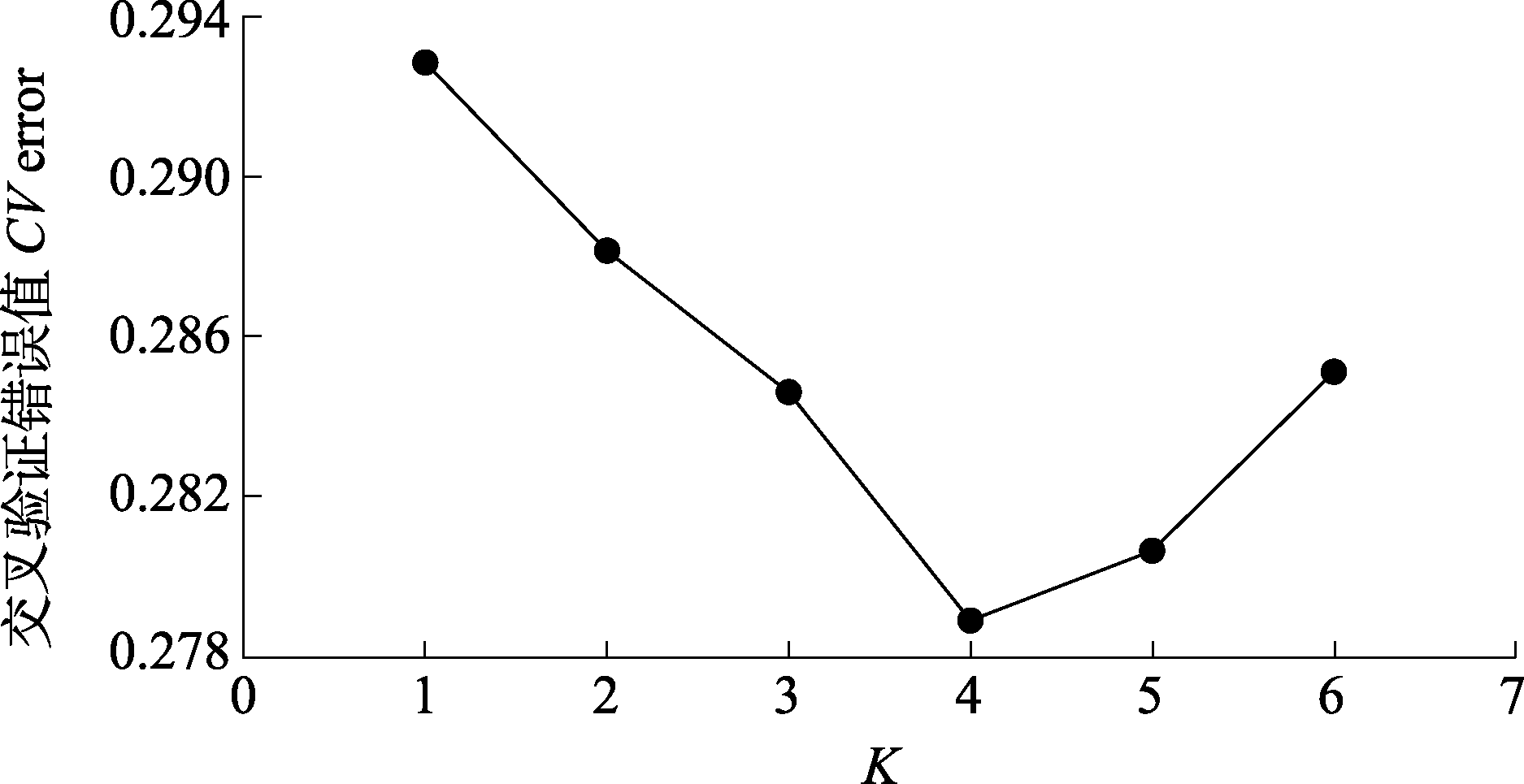
Fig. 1 Estimation of cross-validation errors (CV error) for K values ranging from 1 to 6 of the13 Haloxylon ammodendron populations.
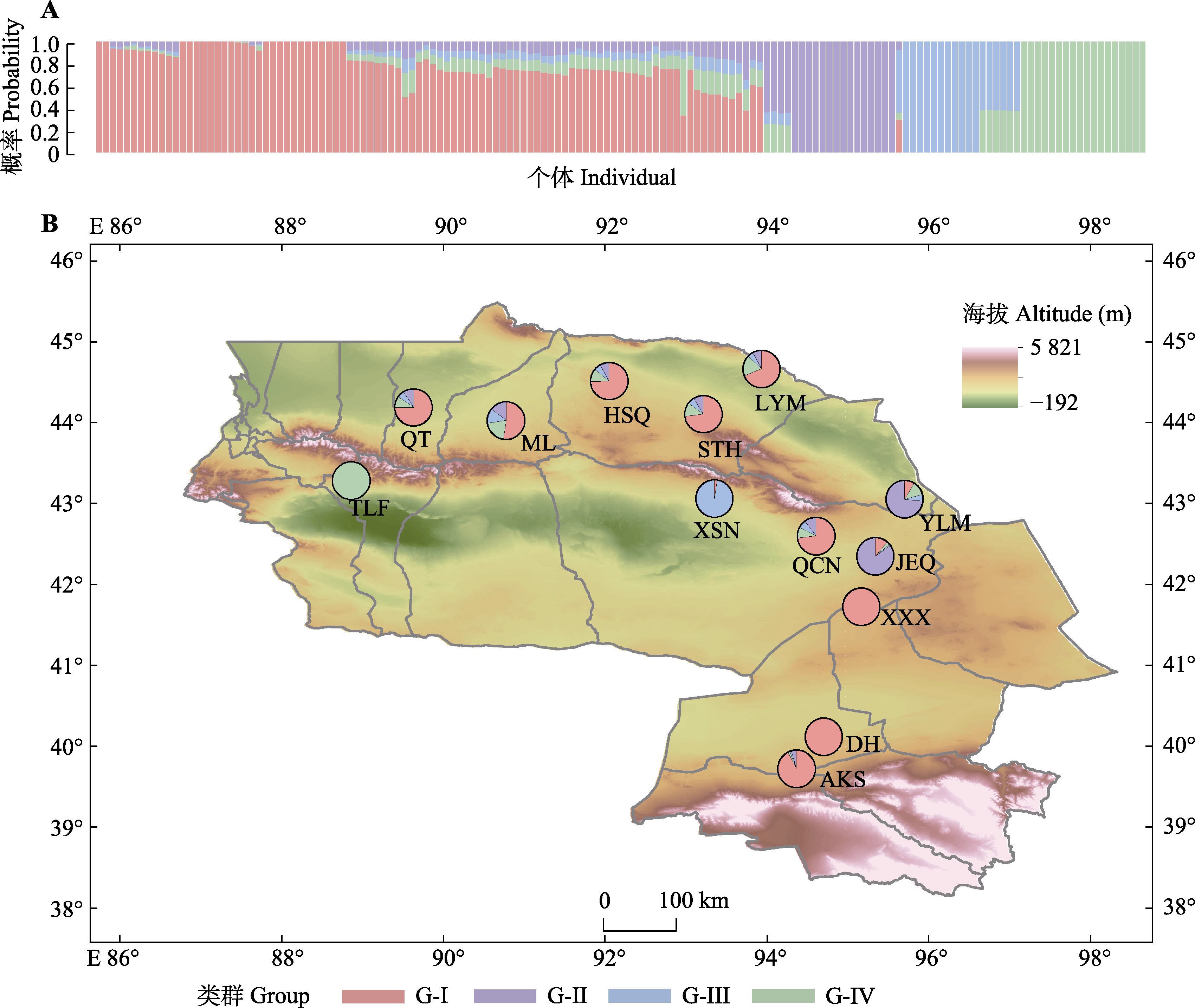
Fig. 2 Results of population genetic structure and geographical distribution of Haloxylon ammodendron obtained based on single nucleotide polymerphism (SNP) markers. A, ADMIXTURE results for 151 samples from 13 populations at K = 4. B, Geographical distribution of the genetic structure of 13 H. ammodendron populations with ADMIXTURE at K = 4. The abbreviations indicate population codes, as shown in Table 1.
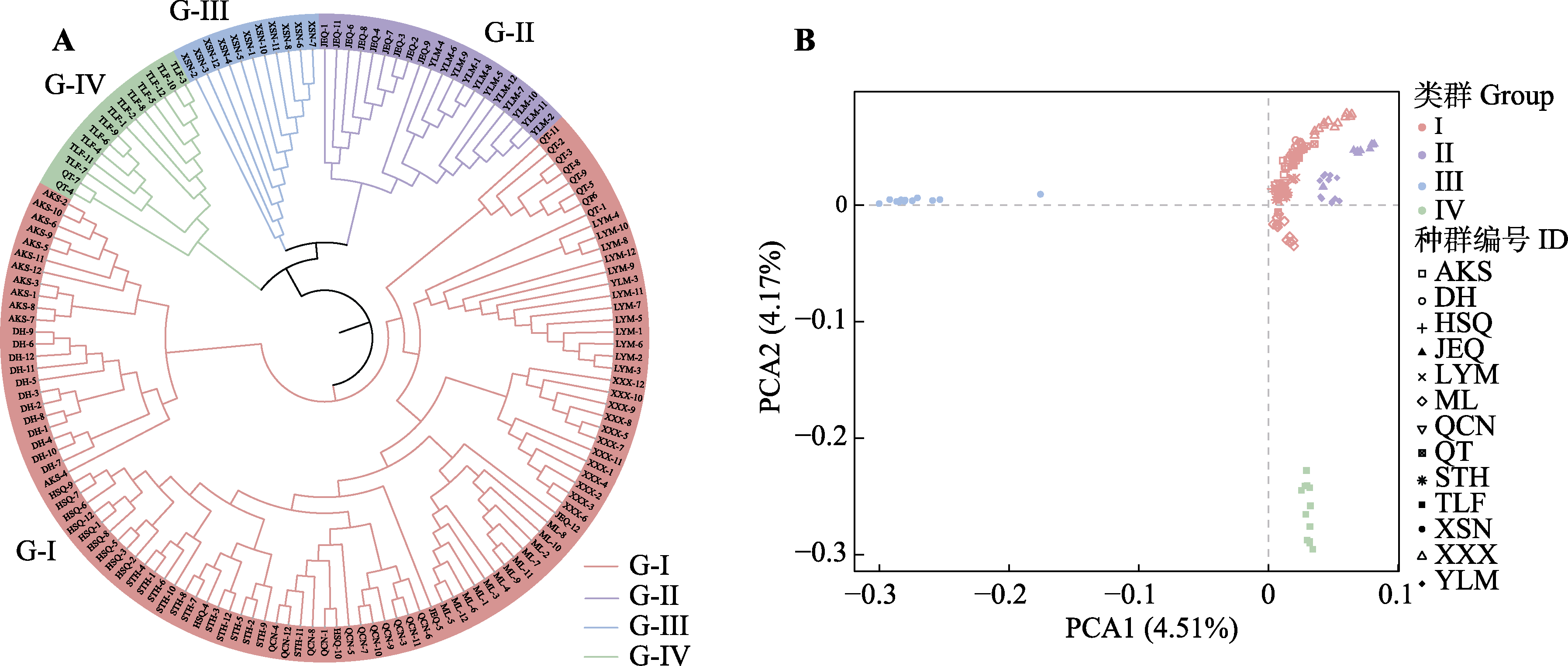
Fig. 3 Neighbor-Joining tree (A) and principal components analysis (PCA) (B) of 13 Haloxylon ammodendron populations obtained based on single nucleotide polymorphism markers. G-I-G-IV represents the four groups divided according to the ADMIXTURE result. The abbreviations indicate population codes, as shown in Table 1.
| 类群 Inferred group | G-I | G-II | G-III | G-IV |
|---|---|---|---|---|
| G-I | - | 0.048 | 0.110 | 0.038 |
| G-II | - | 0.136 | 0.059 | |
| G-III | - | 0.118 | ||
| G-IV | - |
Table 2 Pairwise genetic differentiation (Fst) of the four groups in this study
| 类群 Inferred group | G-I | G-II | G-III | G-IV |
|---|---|---|---|---|
| G-I | - | 0.048 | 0.110 | 0.038 |
| G-II | - | 0.136 | 0.059 | |
| G-III | - | 0.118 | ||
| G-IV | - |
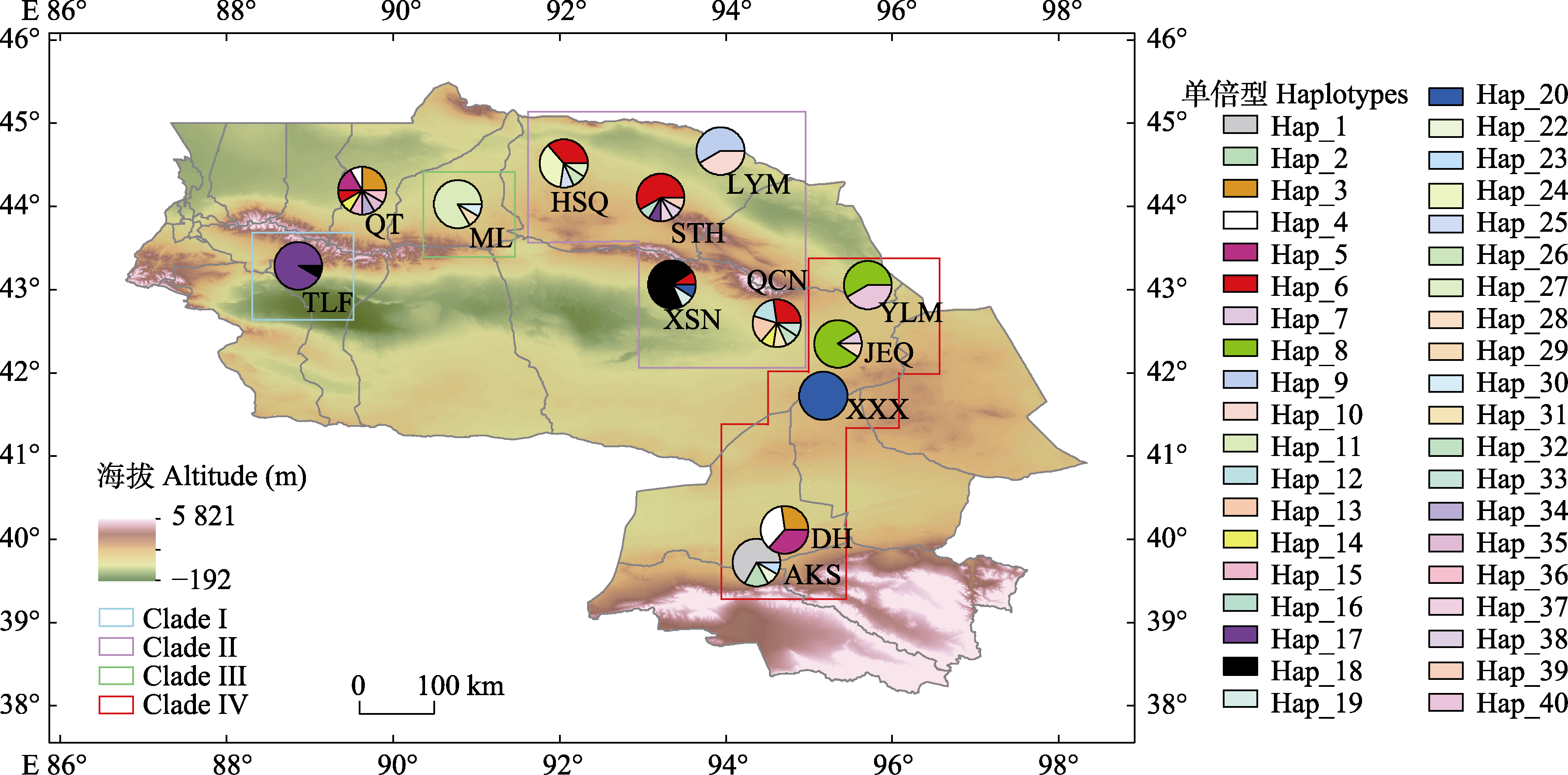
Fig. 4 Geographical distribution of 39 haplotypes of 13 Haloxylon ammodendron populations. The abbreviations indicate population codes, as shown in Table 1. In the fan chart, the color represents different haplotypes, and the size of the fan represents the proportion of haplotypes in the population. Clade I-IV represent four clades divided according to chloroplast genomes.
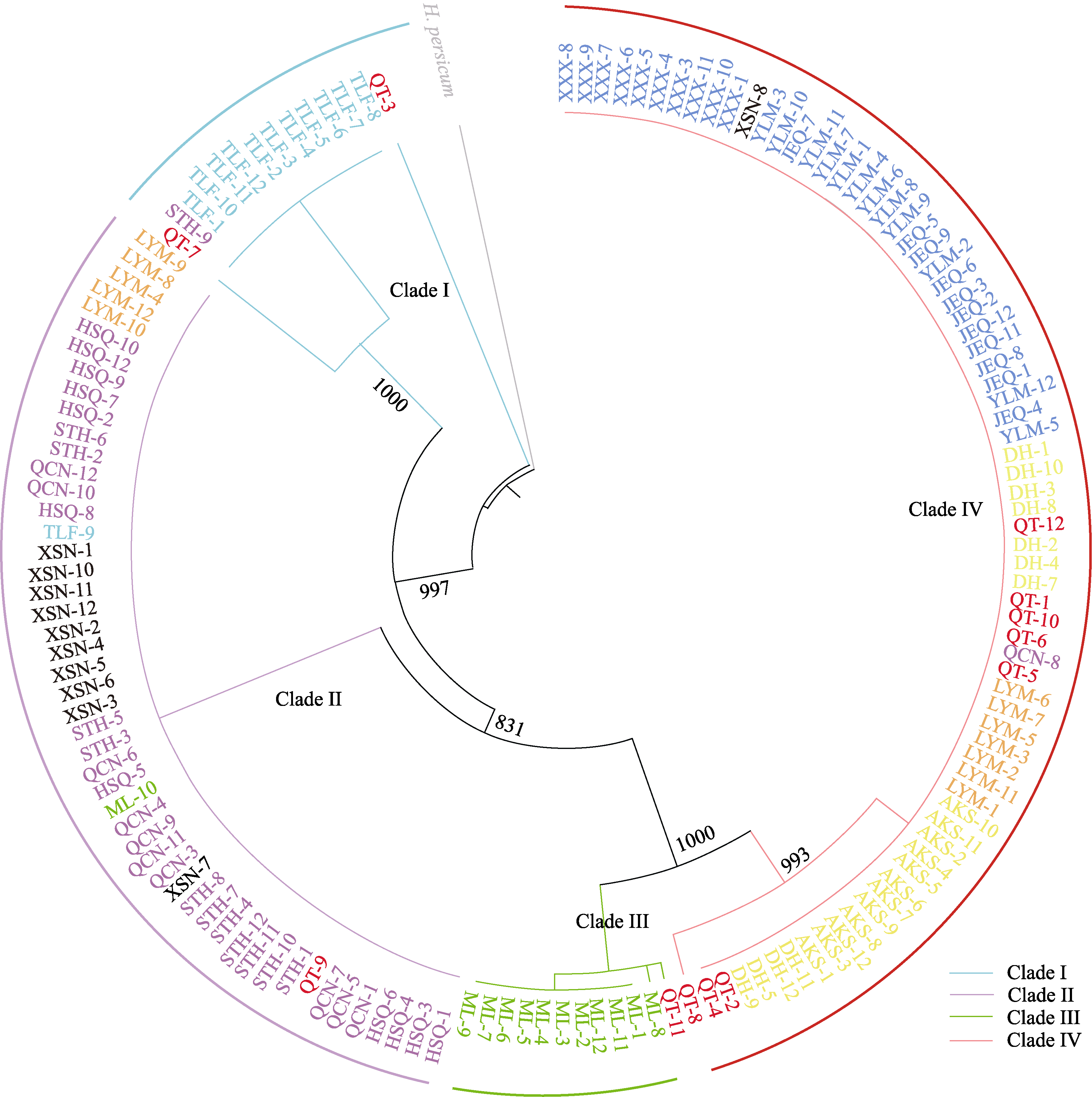
Fig. 5 A maximum likelihood phylogenetic tree of the 149 Haloxylon ammodendron based on chloroplast genomes. The end of each branch represents 149 individuals in 13 H. ammodendron populations, QT is red, TLF is light blue, HSQ, STH, QCN is purple, LYM is orange, XSN is brown, ML is green, JEQ, YLM, XXX is dark blue, AKS, DH is yellow. The information of populations is shown in Table 1. The outmost colored strips (Clade I-IV) indicate four clades divided according to chloroplast genomes.
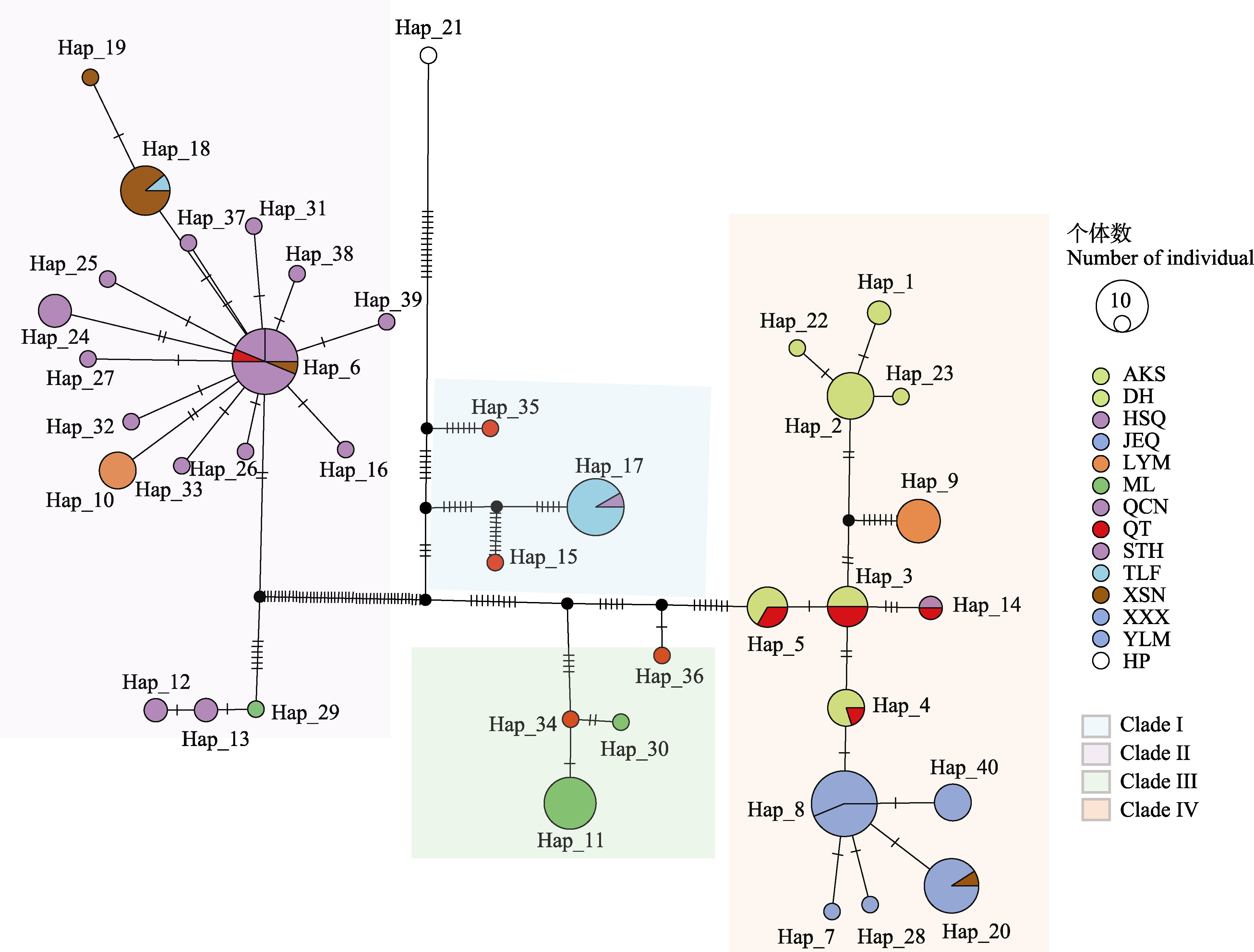
Fig. 6 Haplotype (Hap) network for the 39 haplotypes of Haloxylon ammodendron based on chloroplast genomes. The circles represent haplotypes, the size of the circle represents the number of individuals with the haplotype, and different colors represent different populations. The abbreviations indicate population codes, as shown in Table 1. The black circle represents the unsampled or extinct haplotypes, and the white circle represents the haplotype of Haloxylon persicum. The fan size indicates the proportion of individuals from different populations with a certain haplotype. Clade I-IV represent four clades divided according to chloroplast genomes.
| [1] |
Alexander DH, Novembre J, Lange K (2009). Fast model-based estimation of ancestry in unrelated individuals. Genome Research, 19, 1655-1664.
DOI PMID |
| [2] | Bai WN, Zhang DY (2014). Current status and future directions in plant phylogeography. Chinese Bulletin of Life Sciences, 26, 125-137. |
| [白伟宁, 张大勇 (2014). 植物亲缘地理学的研究现状与发展趋势. 生命科学, 26, 125-137.] | |
| [3] |
Chang CC, Chow CC, Tellier LC, Vattikuti S, Purcell SM, Lee JJ (2015). Second-generation PLINK: rising to the challenge of larger and richer datasets. GigaScience, 4, 7. DOI: 10.48550/arXiv.1410.4803.
PMID |
| [4] |
Chen H, Xie W, He H, Yu H, Chen W, Li J, Yu R, Yao Y, Zhang W, He Y, Tang X, Zhou F, Deng XW, Zhang Q (2014). A high-density SNP genotyping array for rice biology and molecular breeding. Molecular Plant, 7, 541-553.
DOI PMID |
| [5] | Chen Y, Ma S, Zhang D, Wei B, Huang G, Zhang Y, Ge B (2022). Diversification and historical demography of Haloxylon ammodendron in relation to Pleistocene climatic oscillations in northwestern China. PeerJ, 10, e14476. DOI: 10.7717/peerj.14476. |
| [6] |
Chen YT, Ma SM, Zhang D, Zhang L, Wang CC (2024). Diversity pattern and formation mechanism of sympatric Haloxylon ammodendron and Haloxylon persicum in Xinjiang, China. Chinese Journal of Plant Ecology, 48, 56-67.
DOI URL |
|
[陈雨婷, 马松梅, 张丹, 张林, 王春成 (2024). 新疆同域分布梭梭和白梭梭多样性格局及其形成机制. 植物生态学报, 48, 56-67.]
DOI |
|
| [7] | Cheng WM, Bao AM, Chai HX, Zhao SM, Fang Y (2018). Geomorphological Patterns and Effects in Xinjiang. Science Press, Beijing. |
| [程维明, 包安明, 柴慧霞, 赵尚民, 方月 (2018). 新疆地貌格局及其效应. 科学出版社, 北京.] | |
| [8] |
Danecek P, Auton A, Abecasis G, Albers CA, Banks E, DePristo MA, Handsaker RE, Lunter G, Marth GT, Sherry ST, McVean G, Durbin R (2011). The variant call format and VCFtools. Bioinformatics, 27, 2156-2158.
DOI PMID |
| [9] | Danecek P, Bonfield JK, Liddle J, Marshall J, Ohan V, Pollard MO, Whitwham A, Keane T, McCarthy SA, Davies RM, Li H (2021). Twelve years of SAMtools and BCFtools. GigaScience, 10, giab008. DOI: 10.1093/gigascience/giab008. |
| [10] | Dierckxsens N, Mardulyn P, Smits G (2017). NOVOPlasty: de novo assembly of organelle genomes from whole genome data. Nucleic Acids Research, 45, e18. DOI: 10.1093/nar/gkw955. |
| [11] | Dong ZB, Su ZZ, Qian GQ, Luo WY, Zhang ZS, Wu JF (2011). Geomorphology of the Kumtagh Desert. Science Press, Beijing. |
| [董治宝, 苏志珠, 钱广强, 罗万银, 张正偲, 吴晋峰 (2011). 库姆塔格沙漠风沙地貌. 科学出版社, 北京.] | |
| [12] |
Duan L, Fu L, Chen HF (2023). Phylogenomic cytonuclear discordance and evolutionary histories of plants and animals. Science China: Life Sciences, 66, 2946-2948.
DOI |
| [13] | Gavin DG, Fitzpatrick MC, Gugger PF, Heath KD, Rodríguez-Sánchez F, Dobrowski SZ, Hampe A, Hu FS, Ashcroft MB, Bartlein PJ, Blois JL, Carstens BC, Davis EB, de Lafontaine G, Edwards ME, et al. (2014). Climate refugia: joint inference from fossil records, species distribution models and phylogeography. New Phytologist, 204, 37-54. |
| [14] | Guo F, Wang Q (2013). A summary of the desert formation and evolution in West China I. Journal of Foshan University (Natural Science Edition), 31(1), 56-61. |
| [郭峰, 王亲 (2013). 中国西部干旱区沙漠形成演化综述I. 佛山科学技术学院学报(自然科学版), 31(1), 56-61.] | |
| [15] | Guo QS, Wang CL, Guo ZH, Tan DY, Shi ZM (2005). Geographic distribution of existing Haloxylon desert vegetation and its patch character in China. Scientia Silvae Sinicae, 41(5), 2-7. |
| [郭泉水, 王春玲, 郭志华, 谭德远, 史作民 (2005). 我国现存梭梭荒漠植被地理分布及其斑块特征. 林业科学, 41(5), 2-7.] | |
| [16] | Hou XY (2001). Vegetation Atlas of China. Science Press, Beijing. |
| [侯学煜 (2001). 中国植被图集. 科学出版社, 北京.] | |
| [17] |
Hu Y, Wang X, Zhang XX, Zhou W, Chen XY, Hu XS (2019). Advancing phylogeography with chloroplast DNA markers. Biodiversity Science, 27, 219-234.
DOI |
|
[胡颖, 王茜, 张新新, 周玮, 陈晓阳, 胡新生 (2019). 叶绿体DNA标记在谱系地理学中的应用研究进展. 生物多样性, 27, 219-234.]
DOI |
|
| [18] | Jia SW, Zhang ML (2021). Introgression of phylogeography lineages of Convolvulus gortschakovii (Convolvulaceae) in the northwest China. Plant Systematics and Evolution, 307, 19. DOI: 10.1007/s00606-020-01734-z. |
| [19] | Krutovsky KV, Neale DB (2005). Nucleotide diversity and linkage disequilibrium in cold-hardiness- and wood- quality-related candidate genes in Douglas fir. Genetics, 171, 2029-2041. |
| [20] |
Li H, Durbin R (2009). Fast and accurate short read alignment with Burrows-Wheeler transform. Bioinformatics, 25, 1754-1760.
DOI PMID |
| [21] |
Li H, Handsaker B, Wysoker A, Fennell T, Ruan J, Homer N, Marth G, Abecasis G, Durbin R (2009). The sequence alignment/map format and SAMtools. Bioinformatics, 25, 2078-2079.
DOI PMID |
| [22] | Li Q (2020). Solar forcing of desert vegetation and drought frequency during the last 2700 years in the interior Qaidam Basin, northeastern Tibetan Plateau. Scientia Sinica (Terrae), 50, 995-1008. |
| [李泉 (2020). 过去2700年太阳活动对青藏高原东北部柴达木盆地荒漠植被与气候干旱频率的驱动. 中国科学: 地球科学, 50, 995-1008.] | |
| [23] | Li SJ, Wang ZH, Su PX, Wang H, Wang FX, Cui LJ (2022). Research progress on the trade-off strategy and functional diversity of desert plants. Acta Ecologica Sinica, 42, 7308-7320. |
| [李善家, 王子濠, 苏培玺, 王辉, 王福祥, 崔莉娟 (2022). 荒漠植物性状权衡策略及功能多样性研究进展. 生态学报, 42, 7308-7320.] | |
| [24] |
Liu YK, Zhu ZW, Chen L, Zou J, Tong HW, Zhu G, He WJ, Zhang YQ, Gao CB (2020). Revealing the genetic diversity of wheat varieties (lines) in China based on SNP markers. Acta Agronomica Sinica, 46, 307-314.
DOI URL |
|
[刘易科, 朱展望, 陈泠, 邹娟, 佟汉文, 朱光, 何伟杰, 张宇庆, 高春保 (2020). 基于SNP标记揭示我国小麦品种(系)的遗传多样性. 作物学报, 46, 307-314.]
DOI |
|
| [25] |
Ma SM, Zhang ML (2012). Phylogeography and conservation genetics of the relic Gymnocarpos przewalskii (Caryophyllaceae) restricted to northwestern China. Conservation Genetics, 13, 1531-1541.
DOI URL |
| [26] | Sang YP, Long ZQ, Dan XM, Feng JJ, Shi TT, Jia CF, Zhang XX, Lai Q, Yang GL, Zhang HY, Xu XT, Liu HH, Jiang YZ, Ingvarsson PK, Liu JQ, et al. (2022). Genomic insights into local adaptation and future climate-induced vulnerability of a keystone forest tree in East Asia. Nature Communications, 13, 6541. DOI: 10.1038/s41467-022-34206-8. |
| [27] |
Simonsen KL, Churchill GA, Aquadro CF (1995). Properties of statistical tests of neutrality for DNA polymorphism data. Genetics, 141, 413-429.
DOI PMID |
| [28] | Sturm AB, Eckert RJ, Méndez JG, González-Díaz P, Voss JD (2020). Population genetic structure of the great star coral, Montastraea cavernosa, across the Cuban archipelago with comparisons between microsatellite and SNP markers. Scientific Reports, 10, 15432. DOI: 10.1038/s41598-020-72112-5. |
| [29] | Sun FF, Nie YB, Ma SM, Wei B, Ji WQ (2019). Species differentiation of Haloxylon ammodendron and Haloxylon persicum based on its and cpDNA sequences. Scientia Silvae Sinicae, 55(3), 43-53. |
| [孙芳芳, 聂迎彬, 马松梅, 魏博, 吉万全 (2019). 基于ITS和cpDNA序列的梭梭和白梭梭物种分化. 林业科学, 55(3), 43-53.] | |
| [30] |
Suo ZL, Jia ZQ, Lu Q, Pan BR, Jin XB, Xu G, Peng XQ, Sun HB, Tao YH (2012). Distinguishing Haloxylon persicum and H. ammodendron (Haloxylon Bunge, Amaranthaceae) using DNA marker. AASRI Procedia, 1, 305-310.
DOI URL |
| [31] | Wang M, Zhang L, Tong S, Jiang D, Fu Z (2022). Chromosome-level genome assembly of a xerophytic plant, Haloxylon ammodendron. DNA Research, 29, dsac006. DOI: 10.1093/dnares/dsac006. |
| [32] | Wei B (2020). Genetic Characteristics and Conservation Strategies of Haloxylon ammodendron Populations in Desert. Master degree dissertation, Shihezi University, Shihezi, Xinjiang. |
| [魏博 (2020). 荒漠植物梭梭居群的遗传特征及保护策略研究. 硕士学位论文, 石河子大学, 新疆石河子.] | |
| [33] | Wu ZY (1980). Vegetation of China. Science Press, Beijing. |
| [吴征镒 (1980). 中国植被. 科学出版社, 北京.] | |
| [34] | Yin HX, Wang LR, Shi Y, Qian CJ, Zhou HK, Wang WY, Ma XF, Tran LP, Zhang BY (2020). The east Asian winter monsoon acts as a major selective factor in the intraspecific differentiation of drought-tolerant Nitraria tangutorum in northwest China. Plants, 9, 1100. DOI: 10.3390/plants9091100. |
| [35] | Zhang D, Ma SM, Wei B, Wang CC, Zhang L, Yan H (2022). Historical distribution pattern and driving mechanism of Haloxylon in China. Biodiversity Science, 30, 42-51. |
| [张丹, 马松梅, 魏博, 王春成, 张林, 闫涵 (2022). 中国梭梭属植物历史分布格局及其驱动机制. 生物多样性, 30, 42-51.] | |
| [36] | Zhang P, Dong YZ, Wei Y, Hu CZ (2006). ISSR analysis of genetic diversity of Haloxylon ammodendron (C. A. Mey.) bunge in Xinjiang. Acta Botanica Boreali-Occidentalia Sinica, 26, 1337-1341. |
| [张萍, 董玉芝, 魏岩, 胡成志 (2006). 利用ISSR标记对新疆梭梭遗传多样性的研究. 西北植物学报, 26, 1337-1341.] | |
| [37] | Zhu SY, Wu HB, Li Q, Zhang CX, Yu YY, Sun AZ, Guo ZT (2016). Aridification in northwestern China since the late Cenozoic evidenced by the vegetation change. Quaternary Sciences, 36, 820-831. |
| [祝淑雅, 吴海斌, 李琴, 张春霞, 于严严, 孙爱芝, 郭正堂 (2016). 晚新生代以来中国西北植被演化及反映的干旱化过程. 第四纪研究, 36, 820-831.] |
| [1] | HAN Yu-Qing, XIONG Wei, WU Bo, LU Qi, YANG Wen-Bin, LIU Ya-Li, ZHANG Jing-Bo, XIN Zhi-Ming, MA Ying-Bin, LIAN Hong-Lin, WANG Si-Han. Responses of stem sap flow of Haloxylon ammodendron to rainfall pulses in Ulan Buh Desert [J]. Chin J Plant Ecol, 2024, 48(9): 1172-1179. |
| [2] | CHEN Yu-Ting, MA Song-Mei, ZHANG Dan, ZHANG Lin, WANG Chun-Cheng. Diversity pattern and formation mechanism of sympatric Haloxylon ammodendron and Haloxylon persicum in Xinjiang, China [J]. Chin J Plant Ecol, 2024, 48(1): 56-67. |
| [3] | CHEN Tu-Qiang, XU Gui-Qing, LIU Shen-Si, LI Yan. Hydraulic traits adjustments and nonstructural carbohydrate dynamics of Haloxylon ammodendron under drought stress [J]. Chin J Plant Ecol, 2023, 47(10): 1407-1421. |
| [4] | ZHANG Li-Rui, PENG Yan-Ling, REN Guang-Peng, ZHOU Yong-Feng, LI Zhong-Hu, LIU Jian-Quan. Population genetic diversity and species divergence of Pinus massoniana and P. hwangshanensis at two nucleotide loci [J]. Chin J Plant Ecol, 2011, 35(5): 531-538. |
| [5] | YAN Qiao-Di, SU Pei-Xi, CHEN Hong-Bin, ZHANG Ling-Mei. COMPARATIVE STUDIES ON CRYSTAL IDIOBLASTS OF FIVE DESERT C4 PLANTS [J]. Chin J Plant Ecol, 2008, 32(4): 873-882. |
| Viewed | ||||||
|
Full text |
|
|||||
|
Abstract |
|
|||||
Copyright © 2026 Chinese Journal of Plant Ecology
Tel: 010-62836134, 62836138, E-mail: apes@ibcas.ac.cn, cjpe@ibcas.ac.cn

